Introduction
Stem borers are the most damaging pests in sugarcane worldwide (Goebel and Sallam, Reference Goebel and Sallam2011). In the American continent, the sugarcane borer (SCB) Diatraea saccharalis (F.) is the main pest in sugarcane producing areas of USA, Brazil, Ecuador, Perú, and Argentina (Mendoza, Reference Mendoza2004; Dinardo Miranda, Reference Dinardo Miranda, Dinardo-Miranda, Vasconcelos and de A. Landell2008; Salvatore et al., Reference Salvatore, Lopez, Willink, Romero, Digonzelli and Scandaliaris2009; Beuzelin et al., Reference Beuzelin, Akbar, Mészaros, Reay-Jones and Reagan2010; Vigil, Reference Vigil2012; Gomez and Vargas, Reference Gomez and Vargas2014). Tucumán is the leading sugarcane producing state in Argentina, with 275,290 ha with an average yearly production of 1,5 million metric tons of sugar (Fandos et al., Reference Fandos, Scandaliaris, Scandaliaris, Carreras Baldrés, Soria, Giardina, de Ullivarri and Romero2019). The region belongs to a subtropical climatic zone, where the occurrence of frost is common. Typical harvest season extends from May to November according to the rainfall occurrence.
D. saccharalis eggs are laid on both sides of the leaves in clusters of 10 to 50. When egg batches are fresh, the color is pale yellow, turning to dark brown as they get older. There are five instars larvae, the first ones being spent outside feeding on leaf sheath. At the third stage, the larva penetrates into the stem and galleries are formed inside causing internal damage (Hayward, Reference Hayward1943). The pupal stage is formed inside these galleries (Navarro et al., Reference Navarro, Saini and Leiva2009). In Tucumán province, five annual generations can be observed and each of them presents different development times. The winter generation lasts more than 200 days and most larvae are found inside the stumps of the cane (Osores et al., Reference Osores, Willink and Costilla1981).
The natural enemies of D. saccharalis in Tucumán are several species of Trichogramma genera (eggs parasitoids) (Hymenoptera: Trichogrammatidae), Paratheresia claripalpis (Diptera: Tachinidae), Jayneleskia jaynesi (Diptera: Tachinidae), Agathis sp. (Hymenoptera: Braconidae) and Iphiaulax tucumanus (Hymenoptera: Braconidae) (larval parasitoids) (Box, Reference Box1927; Hayward, Reference Hayward1943; Willink et al., Reference Willink, Osores and Costilla1991; Pérez et al., Reference Pérez, Brunet, Isas and Varela2010; Isas et al., Reference Isas, Albarracin, del P. Pérez and Salvatore2016).
The importance of cultural practices for D. saccharalis management was highlighted by several authors (Dinardo Miranda, Reference Dinardo Miranda, Dinardo-Miranda, Vasconcelos and de A. Landell2008; Beuzelin et al., Reference Beuzelin, Mészáros, Akbar and Reagan2011; Pannuti et al., Reference Pannuti, Baldin, Gava, Silva, Souza and Kölln2015). The knowledge of underlying ecological processes of these practices, which may limit or favor population growth of pests, is useful to Improve or change current practices or design alternative ones (Bajwa and Kogan, Reference Bajwa, Kogan, Koul, Dhaliwal and Cuperus2004). Moreover, cultural practices are the foundation upon which the other integrated pest management (IPM) tactics will be implemented. Several agronomic factors have shown effects on sugarcane borer populations including planting date (Beuzelin et al., Reference Beuzelin, Mészáros, Akbar and Reagan2011), Vinasse application (Dinardo Miranda, Reference Dinardo Miranda, Dinardo-Miranda, Vasconcelos and de A. Landell2008), irrigation and fertilization (Pannuti et al., Reference Pannuti, Baldin, Gava, Silva, Souza and Kölln2015).
In the last decades, one of the most important changes in sugarcane crop management was the adoption of chopper harvesters. This technology eliminates leaves, tops, and leaf sheets avoiding the burning practice. Crop residues left in the soil, also known as ‘trash blanket’, create a favorable micro-environment for the arthropod fauna (Sandhu et al., Reference Sandhu, Nuessly, Webb, Cherry and Gilbert2010). In Tucumán more than 94% of sugarcane area is harvested without pre-harvest burning (Ostengo et al., Reference Ostengo, Espinosa, Díaz, Chavanne, Aybar Guchea, Costilla and Cuenya2019). However, despite the benefits of trash blanketing, it is sometimes eliminated by post-harvest burning (Benedetti and Valeiro, Reference Benedetti and Valeiro2011) which is mainly accidental. Moreover, the frosts added to the dry environment define a markedly favorable scenario for the expansion of the phenomenon during winter and spring (Fandos et al., Reference Fandos, Soria, Carreras Baldrés, Scandaliaris and Scandaliaris2010). The potential impact of this change on fauna associated with the crop is a common concern in different regions around the world (White et al., Reference White, Viator and White2011; Dinardo Miranda and Fracasso, Reference Dinardo Miranda and Fracasso2013). The question is whether burning has a greater impact on the pest than on its natural enemies. Results and recommendations on trash management are disparate. Many authors have recommended to burn crop residues to destroy all larvae passing the winter mainly because this material is considered as the most important hibernation site and therefore a source of spring infestation. This recommendation relies on the assumption that high temperatures reached during burning of residues cause larval mortality (Hinds and Osterberger, Reference Hinds and Osterberger1935; Bynum et al., Reference Bynum, Halley and Charpentier1938; Hayward, Reference Hayward1943; Questel and Breger, Reference Questel and Bregger1959).
Ant assemblies associated with sugarcane crop could also be affected by the fire. In several studies, an increase of some species such as Paratrechina fulva Mayr and Solenopsis saevissima Smith was observed in green harvesting (Gomez Laverde and Lastra Borja, Reference Gomez Laverde and Lastra Borja1998; Macedo and Araujo, Reference Macedo and Araujo2000). In reference to the recolonization after burning, a slight decrease in the total ant abundance immediately after burning was observed but in the following weeks, a process of recovery of the abundance and richness of species began (Araújo et al., Reference Araújo, Castro Della Lucia, da Veiga and Cardoso do Nascimento2004a). On the other hand, Souza et al. (Reference Souza, Stingel, de Almeida, Munhae, Mayhé Nunes, Bueno and Morini2010) monitoring a batch through several production cycles under green harvest detected an increase in species diversity and abundance of Pheidole sp., Brachymyrmex sp. and Solenopsis sp. from the second year without burning. Finally, in the USA and Pakistan in comparative trials between plots with and without burning there was a lower abundance of ants in the latter (White et al., Reference White, Viator and White2011; Sajjad et al., Reference Sajjad, Ahmad, Makhdoom and Imran2012).
Taking into account the importance of the pest and the discrepancy between authors, the objectives of this study was to assess the effect of crop residue management on borer damage of D. saccharalis, its egg parasitoids and the ants (Formicidae) associated with sugarcane, under Tucumán (Argentina) conditions.
Materials and methods
Study area and experimental design
The study was carried out during 2011–2012, 2012–2013 and 2013–2014 crop cycles, in three commercial fields located in different regions of Tucumán state, Argentina: (1) Piedmont region, represented by Fronterita (26.81°S, 65.05°W) with well-drained soils and positive hydric balance; (2) Depressed Plain region with slow-draining soils and negative hydric balance represented by Simoca (27.26°S, 65.32°W), and (3) ‘Chaco Pampeana’ Plain region represented by Luisiana (27.03°S, 65.47°W), with moderately well-drained soils and negative hydric balance (Zuccardi and Fadda, Reference Zuccardi and Fadda1985). Fields were planted with ratoon crops of sugarcane variety LCP 85-384, the most widely grown variety in Tucumán sugarcane area (Ostengo et al., Reference Ostengo, Espinosa, García, Delgado and Cuenya2012). Standard Tucumán sugarcane practices for each region (Romero et al., Reference Romero, Scandaliaris, Digonzelli, Leggio Neme, Giardina, Tonatto, Giardina, Fernández de Ullivarri, Casen, Alonso, Tonatto, Romero, Digonzelli and Scandaliaris2009) were followed during all crop seasons. Fronterita and Luisiana plots were harvested in September, while Simoca was harvested in July. Fields were green harvested using a chopper-harvester with shredder type topper (the most used type). This mechanism reduces cane tops to small pieces (Ridge et al., Reference Ridge, Hurney and Chandlor1979), allowing the homogenous distribution of crop residues in the soil. Paired plots design was used. Two types of management of the crop residue were compared: conservation of trash at the surface (CT) and trash burning (TB). In ‘trash conservation’ treatment the crop residue was left over the soil surface during the whole sugarcane growing season, while the second treatment consisted of complete burning approximately 2 weeks after harvest. Three plots of 100 m × 100 m were established for each treatment at each location.
Diatraea Saccharalis injury
During tillering and early grand growth phases (from December until February) damage of the sugarcane borer (SCB) D. saccharalis was estimated as percentage of stalks bored. At each plot stalks bored were counted in six sampling units of 2 m long randomly selected. Counting was made by carefully pulling all leaf sheaths away from every stalk in the 2 m long transect. Stalks were sampled in the row and left without cutting. The damage was recorded independently if it caused or not the death of the stalk. In Argentina sugarcane areas, adults of sugarcane weevil Acrotomopus atropunctellus Boheman (Coleoptera: Curculionidae), also cause holes in the stalks which may be confused with D. saccharalis damage (P. Pérez et al., Reference del P. Pérez, Guadalupe Del Río and Lanteri2012). However, weevil punctures are smaller and present irregular edges, while SCB causes bigger and sharper holes.
In early and mid-harvest, the percentage of internodes bored by D. saccharalis was evaluated by cutting six samples of ten stalks (sixty stalks per plot). The total number of internodes and the number of internodes bored by SCB larvae were recorded for each stalk. Mixed model procedure was performed with R using the interface in Infostat® software package (Di Rienzo et al., Reference Di Rienzo, Casanoves, Balzarini, Gonzalez, Tablada and Robledo2013) to analyze the percentage of stalks infested, internodes bored. A repeated measures analysis was performed to analyze the percentage of stalks bored and internodes bored due to potential existence of a covariance structure associated with the assessment of damage in the same plots over the time, according to Balzarini et al. (Reference Balzarini, Gonzalez, Tablada, Casanoves, Di Rienzo and Robledo2008). Treatment (crop residue management), time (date sample) and treatment × time interaction were fixed effects in the analysis of variance (ANOVA) model. Year and plot were random effects.
Egg parasitism of Diatraea saccharalis
The effect of residue management on egg parasitism was evaluated in Fronterita and Luisiana. During 2013–2014 the evaluation was performed at three periods (February, March and April). The leaves and leaf sheaths with egg clusters were cut and taken in plastic cups. In Obispo Colombres Agricultural Station laboratory eggs were incubated in Petri dishes with wet absorbent paper. Parasitism was estimated by counting the total number of eggs and number of black eggs (which indicates the occurrence of egg parasitoids) (Consoli et al., Reference Consoli, Botelho and Parra2001). Thirty egg clusters were collected at each plot.
An ANOVA was performed to evaluate the effect of treatment and location, therefore, the means were compared by LSD Fisher test (P < 0.05). InfoStat® Professional software was used (Di Rienzo et al., Reference Di Rienzo, Casanoves, Balzarini, Gonzalez, Tablada and Robledo2013).
Ant assemblies
The impact of crop residue management on Hymenoptera Formicidae was studied in Fronterita, Simoca and Luisiana during 2012–2013 grown season. Ants were studied due to a broad consensus on the suitability of their use (Hymenoptera: Formicidae) as an indicator group to assess changes in the environment (Andersen et al., Reference Andersen, Hoffmann, Müller and Griffiths2002; Underwood and Fischer, Reference Underwood and Fisher2006). In addition, changes in the structure of post-disturbance ant communities reflect changes in other invertebrate groups (Andersen, Reference Andersen, Hale and Lamb1997; King et al., Reference King, Andersen and Cutter1998). Lastly, it is well known that ants are dominant predators of moth borers in sugarcane (Goebel et al., Reference Goebel, Tabone, Do Thi Khanh, Roux, Marquier and Frandon2010).
Insects were sampled using four pitfall traps at each plot in three periods, two during the early growth period (December and February) and one during maturation (June). Each trap consisted of an 850-ml plastic cup buried in the ground and half-filled with a solution containing water, detergent and a preservative. This sampling method was chosen due to quickness, low cost and objectivity (Cheli and Corley, Reference Cheli and Corley2010). Specimens obtained were kept in 70% ethanol until their identification using Specific keys (Bolton et al., Reference Bolton, Palacios, Fernández and Fernández2003; Palacio and Fernández, Reference Palacio, Fernández and Fernández2003; Fernández and Feitosa, Reference Fernández and Feitosa2012). Therefore, the relative abundance and frequency of each genus was calculated. Frequency = (number of trap with × genus/number of trap) × 100 (Kuno, Reference Kuno1986).
The genera were grouped following the guild structure proposed by Cuezzo and Campero (Reference Cuezzo and Campero2010). A database with a picture of identified specimens was created by TAXIS 3.5 software. Voucher specimens of each ant genus were deposited in the entomological collection Zoology section of Estación Experimental Agroindustrial Obispo Colombres, Las Talitas, Tucumán, Argentina.
The analyses were realized by summing three monitoring periods. The expected richness was calculated by two estimators ACE (abundance-based coverage estimator) and ICE (incidence-based coverage estimator) (Chazdon et al., Reference Chazdon, Colwell, Denslow, Guariguata, Dallmeier and Comiskey1998). Therefore, the non-parametric richness estimators were used: Chao 2 (based on ‘unique specimen’ that appears in only one sample and ‘duplicated specimens’ that appears in two samples) and Jackknife (based on unique specimens and the number of samples) (Moreno, Reference Moreno2001). Accumulated lines were constructed with a total of ants, unique and duplicated specimens by each crop residue management. The estimators and the lines were calculated by the software Estimates 8.2 (Colwell and Coddington, Reference Colwell and Coddington1994). To detect dominancy pattern and the hierarchy of the genus, range-abundance diagrams were constructed (Perovic et al., Reference Perovic, Trucco, Tálamo, Quiroga, Ramallo, Lacci, Baungardner and Mohr2008; Matthews and Whittaker, Reference Matthews and Whittaker2014).
As an additional measure of Alpha diversity, the Shannon and Simpson indices were calculated (Magurran, Reference Magurran1988). Beta diversity was estimated by Jaccard index (Magurran, Reference Magurran1988), the results were expressed as a measure of dissimilitude between assemblies (Moreno et al., Reference Moreno, Sánchez Rojas, Verdú, Numa, Marcos García, Martínez Falcón, Galante and Halffter2007). To detect the effect of management on assemblies a similitude analysis was realized (ANOSIM) based on Bray-Curtis matrix in the PRIMER v.5 software (Clarke and Gorley, Reference Clarke and Gorley2001).
Lastly, the indicator value (IndVal) (Dufrene and Legendre, Reference Dufrene and Legendre1997) was estimated through the measurement of specificity and fidelity. The first term is defined as the relative abundance of a species in one ecological state compared to its abundance in another, while the second is the frequency of occurrence of a species throughout all sites of a given ecological state.
Results
Diatraea Saccharalis injury
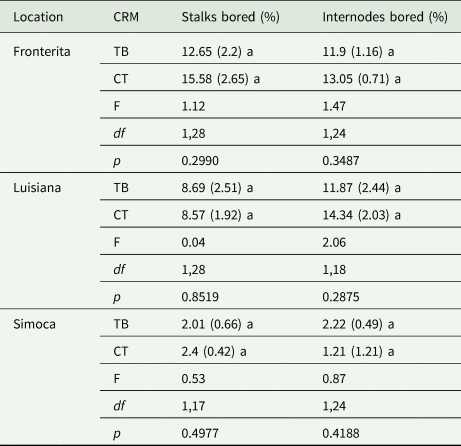
The highest percentages of internodes bored were 32, 14 and 4% in Fronterita, Luisiana and Simoca, respectively. The statistical analysis showed no significant differences for stalks bored and internodes bored between TB and CT (table 1).
Statistical analysis of the effects of crop residue management (CRM) on Diatraea saccharalis damages in sugarcane. 2011–2012 to 2013–2014 harvest seasons

TB, trash burning, CT conservation of trash. Means within a column inside each location which share a letter are not significantly different (LSD fisher P < 0.05).
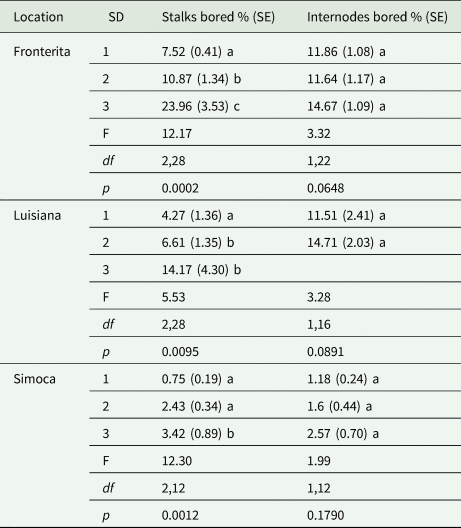
At all locations, the interaction ‘crop residue management’ by ‘sampling date’ was not significant (P < 0.05) for stalks bored and internodes bored. The effect of sampling time was significant for stalks bored in Fronterita, Simoca and Luisiana. This effect was not significant for the percentage of internodes bored (final infestation) at any location (table 2).
Statistical analysis of the effects of sampling date (SD) on Diatraea saccharalis damages in sugarcane. 2011–2012 to 2013–2014 harvest seasons

SE, Standard errors.
Means within a column which share a letter are not significantly different (LSD fisher P < 0.05).
Egg parasitism of Diatraea saccharalis
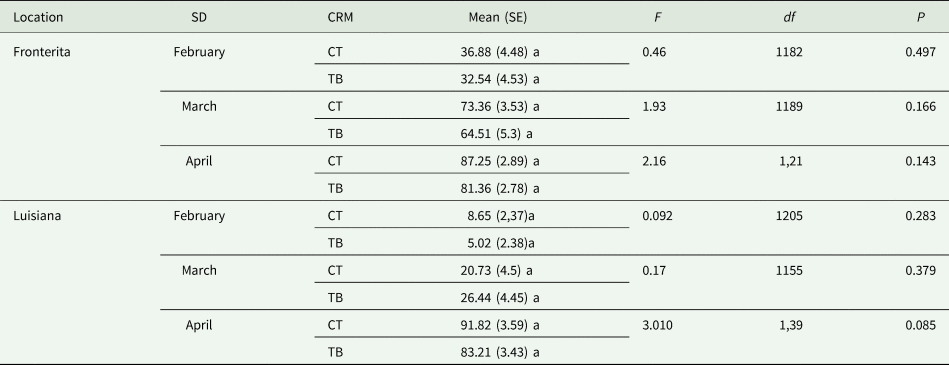
At Luisiana and Simoca locations the effect of the burning on D. saccharalis egg parasitism was not significant in any of the sampling dates and locations (table 3).
Statistical analysis of the effects of crop residue management (CRM) on Diatraea saccharalis egg parasitoidism at three sample dates (SD) in sugarcane

Means within a column which share a letter are not significantly different (LSD fisher P < 0.05).
2013–2014 harvest seasons.
In April, both locations showed high values of parasitism, however in Luisiana at the first sampling date, parasitism was much lower than that observed in Fronterita.
Ant assemblies
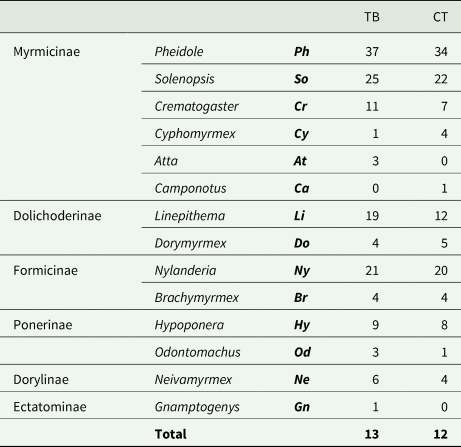
Richness was similar in both crop management with 13 genera collected in TB and 12 genera in CT (table 4).
Frequency of ant genus in conservation of trash (CT) and trash burning (TB) in sugarcane crop

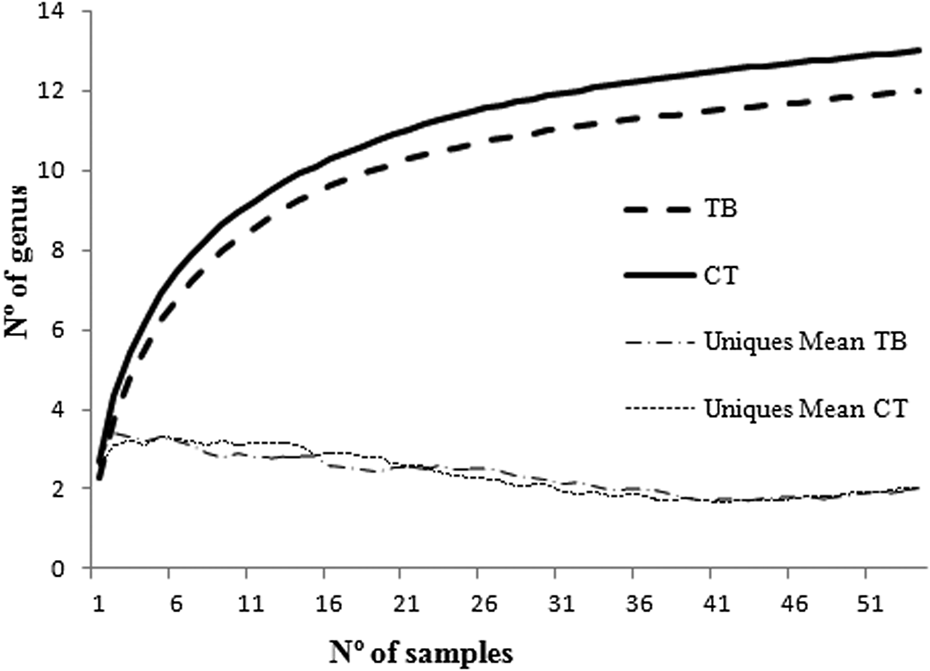
Richness estimators indicated a coverage percentage higher than 85%. Jackknife was the most demanding due to the presence of the ant genus with one specimen even doing the maximum monitoring efforts (table 5). However, both accumulation curves tended to achieve the asymptote indicating a good monitoring efficiency in each crop residue management (fig. 1).
Accumulation curves of the ant genus in conservation of trash (CT) management and trash burning (TB) management in sugarcane crop.

Analysis of completeness of ant genus in conservation of trash (CT) and trash burning (TB)

CRM, crop residue management.
Number of observed genus and number of expected genus by ACE (abundance-based coverage estimator) and ICE (Incidence-based coverage estimator), Chao1 y Chao 2 estimators and completeness (%) in crop residue management.
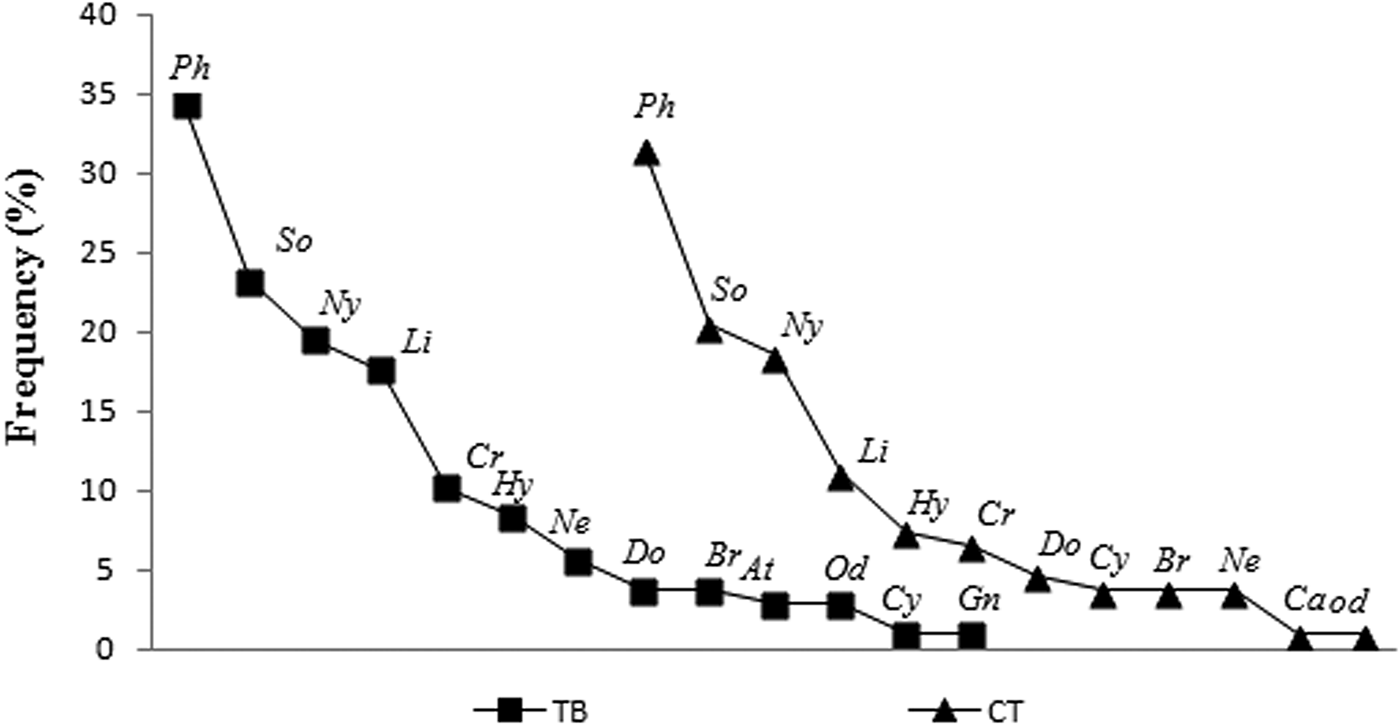
Range-abundance diagrams indicated a similar abundance pattern. In both crop residue management, the genus Pheidole is most abundance following by Solenopsis, Nylanderia and Linepithema (fig. 2). This similitude is also observed using Shannon (CT = 1.65; TB = 1.68) and Simpson indices (CT = 3.72; TB = 3.73).
Range-abundance diagrams of the ant genus in two sugarcane crop residue management. The abbreviation can be seen in table 1.

In fig. 2, we observed that the genus Linepithema presents a higher difference between crop residue management suggesting a frequency difference between management. Because of that, non-parametric analysis was used to evaluate the effect of management on this genus, however, there was no statistical differences (Kruskal–Wallis, Fronterita: H = 0.43, P = 0.6000; Luisiana: H = 1.26, P = 0.3030; Simoca H = 1.26, P = 0.3030).
Inverse Jaccard achieve the 0.21% and the similitude analysis was not significant (ANOSIM, R = 0.007; P = 0.3810).
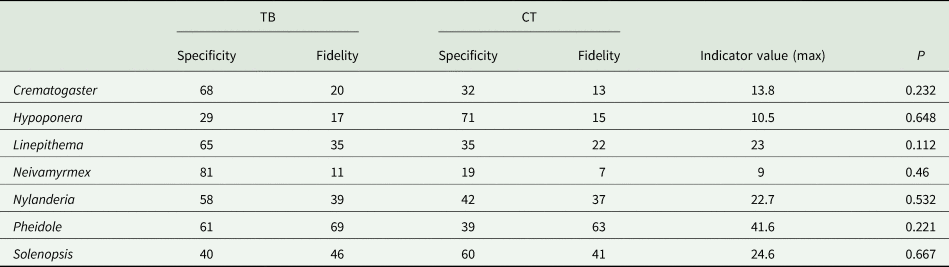
Taking into account the IndVal analysis, no ant genera were the management indicator. Highest values were observed with the genus Pheidole, Nylanderia, Linepithema, in TB and Solenopsis in CT (table 6). They had a high frequency in both environments, so their Indication Value was not significant.
Specificity and fidelity of the most abundant ant genus in trash burning (TB) and conservation of trash (CT) management

Significantly values were calculated through the Montecarlo test (1000 randomizations).
Discussion
Diatraea Saccharalis injury
Kirst and Hensley (Reference Kirst and Hensley1974) observed that most overwintering larvae are located in the stubs remaining in the soil after harvest and the main source of reinfestation. In this site, Sandhu et al., (Reference Sandhu, Gilbert, Kingston, Subiros, Morgan, Rice, Baucum, Shine and Davis2013) observed that temperatures would not reach high temperatures during pre-harvest, while Fogliata et al., (Reference Fogliata, Leiderman and Matiussi1967) observed that temperatures above 36°C were not registered at 5-cm depth during the burning of crop residues. Moreover, high survival of larvae to temperatures of burning was corroborated in the laboratory for D. saccharalis (Degaspari et al., Reference Degaspari, Botelho, de Almeida, Macedo and de Araujo1983) and field studies for Diatraea considerata Heinrich (Lepidoptera: Crambidae), for those individuals located in underground stalks (Vejar Cota et al., Reference Vejar Cota, Rodriguez del Bosque and Caro2009).
In other sugar cane growing areas of the world, green harvesting is considered as the main reason of the decrease (Rochat et al., Reference Rochat, Goebel, Tabone, Begue, Fernandez, Tibère and Vercambre2001) and increase of sugarcane borer damage (Dinardo Miranda and Fracasso, Reference Dinardo Miranda and Fracasso2013). These observations were based on comparisons to big scale. In Tucumán province is difficult to attribute to one single factor the occurrence of the sugarcane borer due to they are many other regulating factors that could explain the variations in pest populations.
Alam (Reference Alam1980) observed a higher percentage of ‘deadhearts’ produced by D. saccharalis in burnt plots. Regarding the effect of burning in other borers, infestation by Chilo sacchariphagus decreased when burning was banned in Reunion Islands and this was due to an increase in abundance of natural enemies of the borer (Rochat et al., Reference Rochat, Goebel, Tabone, Begue, Fernandez, Tibère and Vercambre2001). Rana et al. (Reference Rana, Haq, Malik and Akhtar2007) also reported a decrease in damage of borers Chilo infuscatellus Snellen (Lepidotera: Pyrallidae), Scirpophaga nivella F., Acigona steniellus Hampson (Lepidoptera: Crambidae) and Emmalocera depressella Swin. (Lepidoptera: Pyralidae) which combined trash mulching with the release of egg parasite Trichogramma chilonis (Hymenoptera: Trichogrammatidae).
Some authors such as Goebel and Sallam (Reference Goebel and Sallam2011) reported that burning (post-harvest or pre-harvest) causes immediate destruction of natural enemies while keeping crop residue promote its higher abundance and diversification (Macedo and Araujo, Reference Macedo and Araujo2000; Macedo and Macedo, Reference Macedo and Macedo2005; White et al., Reference White, Viator and White2011). However other authors observed no effects on parasitoids (Bynum et al., Reference Bynum, Halley and Charpentier1938; Makhdum et al., Reference Makhdum, Cock and Shehzad2001) or a higher impact on the pest than on natural enemies (Degaspari et al., Reference Degaspari, Botelho, de Almeida, Macedo and de Araujo1983).
Egg parasitism of Diatraea saccharalis
Ours results agree with Bynum (Reference Bynum, Halley and Charpentier1938) and Makdhum et al. (Reference Magurran2001) who observed similar levels of egg parasitism for D. saccharalis and C. infuscatellus, respectively. However, some authors detected higher parasitism effectiveness in plots where the trash blanket was retained (Rana et al., Reference Rana, Haq, Malik and Akhtar2007). In that case, the coverage may increase survival by providing protection to adult parasitoids since they are highly sensitive to environmental conditions (Fournier and Boivin, Reference Fournier and Boivin2000).
The lack of effects observed at the present study may be due to timing elapsed between burnings and parasitoid life cycle. In Tucumán province the parasitism of D. saccharalis eggs is due to Trichogramma spp. (Hymenoptera: Trichogrammatidae) (Isas et al., Reference Isas, Albarracin, del P. Pérez and Salvatore2016) and its presence period in sugarcane crop does not overlap with burnings.
Other studies about the effect of fire on egg parasitoids refer to the burning carried out before the harvest (of standing cane). Macedo and Araujo (Reference Macedo and Araujo2000) reported a higher performance of the egg parasitoids in the management of green harvest and conservation of the stubble at the surface compared with burned lots before harvesting but these differences were not statistically significant.
Smyth (Reference Smyth1938) mentioned that this type of burning eliminated all egg parasitoids present in sugarcane. However, in Tucumán province at the time when this phenomenon occurs no parasitized egg batches were found in the field as observed during the egg collections for the realization of the present study. Trichogramma spp, spend the winter as immature diapausing stages (induced by the low temperatures) in eggs of other lepidóptera outside the sugarcane fields (Jaynes and Bynum, Reference Jaynes and Bynum1941; Zaslavski and Umarova, Reference Zaslavski and Umarova1990; Boivin, Reference Boivin, Wajnberg and Hassan1994).
Ant assemblies
The colonies of Formicidae have the ability to survive and/or restore their colonies in areas subjected to burning. An example of this is the underground nesting habit where most of the colony is protected from the fire (Araújo et al., Reference Araújo, Castro Della Lucia and Picanço2004b). Fogliata et al., (Reference Fogliata, Leiderman and Matiussi1967) observed that during the burning of sugarcane residues in Tucumán province the soil surface temperature fluctuated between 200 and 400°C and at the first 5 cm of soil did not exceed 36°. Then, during the burning only the individuals outside the nest could be killed by the fire.
The species that have nests locate at the surface of the soil are able to colonize and organize themselves allowing a rapid restoration in the combustion area (Ahlgren, Reference Ahlgren and Kozlowski1974). Even within the same species great flexibility is observed to change their nesting site in the litter to the ground in case of seasonality or to change the source of food in case of temporary absence of their main resource (Kaspari, Reference Kaspari2003).
Our results suggest that crop residue management have no effect on ant assemblies of sugarcane crop at the genus level. This statement agrees with Araújo (Reference Araújo, Castro Della Lucia, da Veiga and Cardoso do Nascimento2004a), who observed that although there is initially a slight decrease in the frequency of capture of ants, patterns of richness and abundance are quickly restored. Macedo and Araujo (Reference Macedo and Araujo2000) did not detect effect on most found species, only Solenopsis saevissima Smith was affected by the management, probably due to its nests that are constructed on the soil.
However, there are studies reporting a major abundance of ants where crop residues was maintained (White et al., Reference White, Viator and White2011; Sajjad et al., Reference Sajjad, Ahmad, Makhdoom and Imran2012). On other hand, Souza et al. (Reference Souza, Stingel, de Almeida, Munhae, Mayhé Nunes, Bueno and Morini2010) observed that during the first year of the sugarcane crop (without trash blanket) the richness was minor than in the ratoon (with trash blanket).
None of the genus registered in this study was identified as an ecological indicator of the areas subjected to burning. The low values of indication observed suggested that there is no affinity of any particular environment, meaning that ants associated with the cultivation of sugarcane have the capacity to develop in burned fields as well as in the coverage on the surface of the ground is maintained. However, with the environmental concern of burning practices, it can be better to maintain or even reinforce green harvesting knowing that the trash can also be used in the manufacture of bioproducts such as bioplastics or biodegradable papers. There is a growing demand of such products.
Most of the genera recorded are in line with those observed by Souza et al. (Reference Souza, Stingel, de Almeida, Munhae, Mayhé Nunes, Bueno and Morini2010) in a survey of sugarcane fields with trash blanket and by Araújo (Reference Araújo, Castro Della Lucia, da Veiga and Cardoso do Nascimento2004a), Brazil. The genera Dorymyrmex, Linepithema, Brachymyrmex, Camponotus, Nylanderia, Crematogaster, Pheidole and Solenopsis are cited as predators of different stages of the life cycle of D. saccharalis (Oliveira et al., Reference Oliveira, Almeida, Souza, Munhae, Bueno and Morini2012). This variety of potential predators suggests that ants could be playing an important role in the natural control of this pest in the province of Tucumán. However, most of them are not strictly predators but omnivores.
Acknowledgements
This study was supported by Estacion Experimental Agro-industrial Obispo Colombres (EEAOC) and Instituto de Tecnología Agroindustrial del Noroeste Argentino (ITANOA) of Consejo Nacional de Investigaciones Científicas y Técnicas (CONICET).
The farmers who allowed us to collect data in their farms are also greatly acknowledged.