The blueberry fruit fly, Rhagoletis mendax Curran (Diptera: Tephritidae), also known as the blueberry maggot, is an important pest of commercial lowbush blueberry (Vaccinium angustifolium Aiton (Ericaceae)) and highbush blueberry (Vaccinium corymbosum Linnaeus (Ericaceae)) production in many parts of eastern North America (Rodriguez-Saona et al. Reference Rodriguez-Saona, Vincent, Polk and Drummond2015). As with other Rhagoletis Loew species, female R. mendax generally oviposit one egg per berry. This occurs because females deposit a host-marking pheromone (HMP) immediately after oviposition, which deters repeated ovipositions in already infested fruit (Prokopy et al. Reference Prokopy, Reissig and Moericke1976). The posterior half of the midgut is a principal site of production of a major component of the HMP of female Rhagoletis pomonella Walsh (Diptera: Tephritidae) flies, which is released with other gut contents and faeces during dragging of the ovipositor on the fruit surface after egg-laying (Prokopy et al. Reference Prokopy, Averill, Bardinelli, Bowdan, Cooley and Crnjar1982). Host marking pheromone is present in faeces of other Tephritidae (Hurter et al. Reference Hurter, Boller, Städler, Blattmann, Buser and Bosshard1987; Arredondo and Díaz-Fleischer Reference Arredondo and Díaz-Fleischer2006), and this may also be the case with R. mendax, but has yet to be confirmed. Here we report on methods of collecting HMP from R. mendax fly faeces, and from artificial oviposition devices.
Rhagoletis mendax pupae were collected from low-bush blueberry fields in Nova Scotia, Canada. Maggots emerged from berries held on screens over wooden boxes containing moist sand, and pupae were collected and reared through to adults as previously described (Renkema et al. Reference Renkema, Cutler, Lynch, MacKenzie and Walde2011). Male and female flies were caged together so that mated female flies (mating commenced after 8–10 days) were used in bioassays.
To collect fly faeces, ~1000 pupae were placed in Plexiglas cages containing water, sugar, amino acids, and vitamins (Renkema et al. Reference Renkema, Cutler, Lynch, MacKenzie and Walde2011), with clean glass panes adhered to the inner surfaces (Hurter et al. Reference Hurter, Boller, Städler, Blattmann, Buser and Bosshard1987). Emerged male and female flies deposited faeces on the glass panes for up to four weeks. Faeces were scraped off glass panes with a clean razor blade, and 50 mg was purified using methods of Aluja-Schuneman et al. (Reference Aluja-Schuneman, Diaz-Fleisher, Edmunds and Hagmann2003). The residue (31.2 mg) was dissolved in 25 mL of methanol at 50 °C, cooled at room temperature for two hours, filtered through filter paper on a Büchner flask, and rinsed with 99% methanol. The solution was evaporated on a rotary evaporator until dry, giving 30 mg of pale yellow residue that was used in experiments.
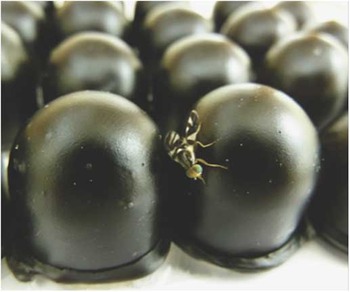
Host-marking pheromone was also collected from artificial oviposition domes made from cheese wax (BW-107J01 Black, Blended Waxes; Oshkosh Wisconsin, United States of America) (Prokopy Reference Prokopy1966; Katsoyannos Reference Katsoyannos1975). Sixteen domes were spaced 0.5 cm apart and firmly attached to a Plexiglas plate (8×10 cm) by ringing the base of the dome with molten wax (Fig. 1). For pheromone collection, gravid female flies (reared and collected as described above) were exposed to the 16 domes onto which they could oviposit. Domes were replaced every two days and used only once. After removing dry eggs from the surface (flies were unable to fully penetrate the wax), infested domes were held with forceps and rinsed with 99% methanol using a Pasteur pipette. The collected crude putative pheromonal solution was concentrated on a rotary evaporator at 40 °C and 20 mbar until almost dry. A total of 20 mg of dry material was collected from 120 domes and dissolved in 20 mL of methanol. We estimate that there were 10–15 ovipositions per dome, suggesting the total collected pheromone was equivalent to that of 1200–1800 ovipositions. In all, 20 μL of the crude pheromonal solution was used per treatment, which we estimate approximated the amount of HMP deposited during a single ovipositor-dragging event.
Black wax domes used as Rhagoletis mendax artificial oviposition devices.

Female flies used in two-choice bioassays were 8–10 days old and assumed to have been mated, having been collected from cages with food and male flies. Twenty-four hours before tests, female flies were held in separate cages and provided 16 clean wax domes for oviposition. Only females observed attempting to oviposit in a dome were selected to ensure we used females with a propensity to oviposit and to allow some degree of egg load depletion before testing (Roitberg and Prokopy Reference Roitberg and Prokopy1983).
In all bioassays, crude pheromonal solution or faeces–methanol extracts were uniformly applied with a micro-applicator syringe (PAX 100-3; Burkard® Scientific, Uxbridge, United Kingdom) as 1-μL droplets, with a total of 20 droplets (20 μL) per dome. Methanol was used as a control. Domes were left dry for 10–15 minutes before conducting the bioassay. Two-choice tests were done in 0.5 L transparent plastic cups that contained one treated and one control wax dome. One female was introduced into each test cage and observed until she attempted oviposition (inserting her ovipositor), up to a maximum of two hours. A total of 55 female flies were tested with faeces extract, and 45 female flies with crude phermonal solution. If no oviposition was attempted, the behaviour was recorded as no response. The null hypothesis that fly choice of oviposition site is not affected by treatment of domes was tested by χ2 analyses using the FREQ procedure in SAS (SAS Institute 2008).
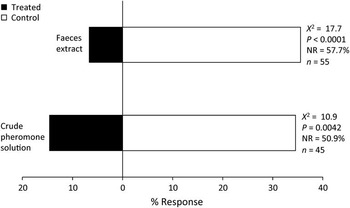
At least half of flies used in both bioassays did not respond, but among responding flies there was a significant preference for wax domes treated with control solution when offered this versus domes treated with the faeces extract (χ2=17.7, P<0.0001) or crude pheromonal solution (χ2=10.9, P=0.0042). Domes treated with faeces extract experienced only 7% oviposition relative to 15% oviposition observed on domes treated with crude phermonal solution, but overall, fewer flies were responsive in bioassays with the former (Fig. 2).
Rhagoletis mendax percentage oviposition preference on wax domes treated with crude pheromone solution or faeces extract. NR, no response.

Our results corroborate previous findings indicating the existence of an oviposition deterring HMP in R. mendax (Prokopy et al. Reference Prokopy, Reissig and Moericke1976). We also show, for the first time, that a putative HMP is present in faeces of female R. mendax flies, and that R. mendax HMP can be isolated from their faeces or artificial wax oviposition devices through extractions using polar solvents. Black cheese wax domes were effective artificial oviposition devices but needed frequent replacement to maximise oviposition and HMP deposition. Previous studies on Rhagoletis indifferens Curran suggested that even after remelting wax of previously used domes the pheromone was still present and could deter females from ovipositing (Mumtaz and Aliniazee Reference Mumtaz and Aliniazee1983). Collection of faeces also proved an effective means of collecting the HMP, but was also labour intensive.
As previously reported with other Rhagoletis species (Prokopy et al. Reference Prokopy, Reissig and Moericke1976), we observed that R. mendax females circled around the oviposition devices immediately after oviposition, dragging their fully extended ovipositors on the fruit surface behind them. Naïve females only seemed to detect the HMP after tactile contact. During the choice test, half of the tested population did not respond to any oviposition stimulus, although this level of non-response can occur in semiochemical bioassays with insects (e.g., Sullivan et al. Reference Sullivan, Pettersson, Seltmann and Berisford2000; Bray and Hamilton Reference Bray and Hamilton2007). Our unnatural bioassay conditions, consisting of small, enclosed plastic cages and artificial oviposition devices, probably contributed to the lack of response of those flies.
One of our main motivations for this work was to explore opportunities to develop a pest management tool for R. mendax based on its HMP. For example, if a synthetic HMP pheromone for R. mendax could be developed, theoretically it should be possible to treat part of a blueberry field or prescribed number of bushes to deter oviposition and attract parasitoids (Stelinski et al. Reference Stelinski, Rodriguez-Saona and Meyer2009) in those areas, with deployment of R. mendax traps and/or insecticide treatments confined to untreated areas. This approach has been explored with Rhagoletis cerasi Linnaeus, for which the HMP can be removed from infested cherry fruit by rinsing with water (Katsoyannos Reference Katsoyannos1975), and reapplied to fruit trees to deter oviposition by R. cerasi in an orchard setting (Katsoyannos and Boller Reference Katsoyannos and Boller1976, Reference Katsoyannos and Boller1980). The R. cerasi HMP was also successfully identified (Hurter et al. Reference Hurter, Boller, Städler, Blattmann, Buser and Bosshard1987) and synthesised (Ernst and Wagner Reference Ernst and Wagner1989). The methods described herein for collecting the HMP of R. mendax should provide a starting point for its eventual identification and synthesis.
Acknowledgements
This research was supported by an Atlantic Canada Opportunities Agency, Atlantic Innovation Fund to N. Kirk Hillier (number 197853). The authors thank Jason Sproule for technical assistance.