Introduction
In the U.K., the number of people aged 65 years and over is expected to rise from 9.6 million in 2005 to 15.3 million in 2031 (Office of National Statistics/Government Actuary's Department, 2006). Problems with dental or oral health are common in older people with 33–57% of community-living older people being edentulous (Steele and Ayatollahi, Reference Steele and Ayatollahi1996; Stewart and Hirani, Reference Stewart and Hirani2007). About 50% of dentate older people have root caries (Steele et al., Reference Steele, Sheiham, Marcenes, Fay and Walls2001) and between 67% and 85% show moderate periodontal disease in the form of plaque, calculus, periodontal pocketing and loss of attachment (Adult Dental Health Survey, 1998; Morris et al., Reference Morris, Steele and White2001). However, older people are not regular users of dental services in the U.S.A. (Dolan et al., Reference Dolan, Atchison and Huynh2005) and old age per se is not a major determinant of the use of dental services in Europe (Holm-Pedersen et al., Reference Holm-Pedersen2005). Dentition status (number of remaining teeth), perceived need, dental anxiety, gender, educational and socio-economic status, living alone, cognitive impairment, general health and functional status, prescribed medications and cost are some of the key determinants of the use of dental services (McGrath and Bedi, Reference McGrath and Bedi1998; McGrath et al. Reference McGrath, Bedi and Dhawan1999; Nuttall et al. Reference Nuttall2001; Dolan et al. Reference Dolan, Atchison and Huynh2005; Holm-Pedersen et al. Reference Holm-Pedersen2005).
In younger people, mental illness has been associated with poor dental health and has led to the development of specialist outpatient and domiciliary dental services; for example, in the U.K. (Pearson et al., Reference Pearson, Gibson, Davis, Gelbier and Robinson2007), U.S.A. (Dicks, Reference Dicks1995) and Australia (Chalmers et al., Reference Chalmers, Kingsford Smith and Carter1998). However, the effect of mental illness on dental health and use of dental services among community-living older people has not been investigated systematically.
We conducted a case control study to examine the dental health and need for dental treatment in community-living older people with diagnosed mental illness and compared them with community-living older people without known mental illness. The aims of the study were (a) to measure and compare the prevalence of dental problems and need for treatment between the two groups; and (b) to investigate their relationship with the key psychosocial variables. We hypothesized that (i) dental problems and need for treatment would be more frequent in older people with mental illness compared to older people without mental illness; and (ii) dental problems and need for treatment would be independently associated with cognitive impairment, depressive symptoms and overall mental and social health in both groups, and especially in those with mental illness.
Methods
Sample
A convenience sample of patients aged 65 years or over were recruited from two health services in south Manchester, U.K.: (i) outpatients and day hospital attendees with diagnosed mental illness (ICD-10; World Health Organization, 1992) from old age psychiatry services (the psychiatry group); and (ii) outpatients and day hospital attendees from general/geriatric medicine services (the medical group). Residents in care homes were excluded. Patients from the medical group were excluded if they had a formal diagnosis of mental illness from psychiatry services. The study was approved by the South Manchester Local Research Ethics Committee and was completed over 18 months. A registered mental health nurse (SB) explained study details and obtained written informed consent from all participants and, if appropriate, from their carers. Information about medical and mental health problems, including current medications, was gathered from patients, their carers and a review of medical and psychiatry case notes.
Assessment of mental and physical health
The health assessment was carried out by a trained mental health nurse (SB) at face-to-face interviews and consisted of (a) cognition: Mini-mental State Examination (MMSE; Folstein et al., Reference Folstein, Folstein and McHugh1975), range 0–30, lower scores indicate increasing severity of cognitive impairment; (b) depression: Geriatric Depression Scale – 15 items (GDS-15; Yesavage et al., Reference Yesavage1983), range 0–15, higher scores indicate increasing depressive symptoms; (c) overall mental and social health: Health of the Nation Outcome Scale for older people (HoNOS 65+; Burns et al., Reference Burns1999), measuring the severity of problems on a scale of 0 (no problem) to 4 (severe problem) is assessed on 12 mental and social health domains leading to the total score, ranging from 0 to 48; (d) daily function: Barthel Index (Mahoney and Barthel, Reference Mahoney and Barthel1965), 10 items that measure a person's ability in daily living activities (for example, feeding, bathing and dressing) and mobility, ranging from 0 to 100, the higher scores indicate more independence and less need for any assistance with daily activities; and (e) overall physical illness: a modified version of the scale used to quantify physical illness in psychiatry research (Burvill-modified scale; Burvill et al., Reference Burvill, Mowry and Hall1990), overall disability (well, minor, moderate or severe) resulting from acute and chronic physical illness in eight body systems.
Assessment of dental health
A registered dentist (ED) visited each patient at home to carry out an independent dental assessment. Baseline medical and dental histories were obtained from the patient and carers to assess the patient's suitability for an oral examination. A dental questionnaire recorded: (a) use of dental services in terms of last visit to dentist and regularity of visits; and (b) dental habits in terms of frequency and manner of cleaning teeth/ dentures. An intra oral examination was carried out using a disposable mirror and ambient light. The following parameters were recorded: (a) dentition – a full charting of all teeth present, including restorations, the presence of caries, fractures of teeth or restoration, or other anomalies; (b) dentures – retention, stability, condition, and age of dentures; (c) oral hygiene – visible plaque, calculus, food debris or fixative on the patient's teeth or dentures; and (d) a basic periodontal examination (BPE) using the Community Periodontal Index of Treatment Needs probe (CPITN, 1987). Based on the above assessment, the dentist made a clinical judgment as to whether there was any need for dental treatment. This is a “normative” need rather than a “perceived” need for treatment by the patient.
Statistical analyses
The frequency of patients identified as needing dental treatment by the research dentist was taken as a summary measure of dental problems and was the primary outcome. A sample size of 103 patients in each group was required to detect a difference of 20% or more in those with dental problems between older people with and without mental illness (50% v 30%) with 80% power at a significance level of 0.05 (two-tailed).
The differences in the occurrence of dental problems between the medical and psychiatry groups were analyzed using chi-square tests, tests for linear trend and Mann-Whitney U-tests as appropriate. Psychosocial variables with continuous data were compared using independent samples t-tests. Step-wise logistic regression analyses were used to investigate the relationship between key psychosocial variables and the primary outcome (need for dental treatment). Independent variables were entered in following blocks: (i) age, gender, social factors (living alone); (ii) measures of physical health and functioning (Barthel Index, Burvill-modified scale and number of comorbid physical illnesses); (iii) psychosocial variables (MMSE, GDS, HoNOS 65+); and (iv) teeth status (no teeth or edentulous vs. some teeth or dentate).
Results
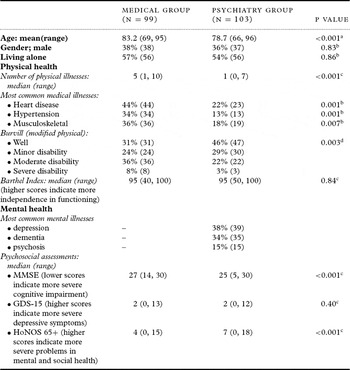
A total 208 older people agreed to participate in the study. Six subjects dropped out before study assessments could be completed (two died and four withdrew consent), leaving a final sample of 202, of which 103 were in the psychiatry group and 99 in the medical group. The comparison of demographic and clinical characteristics between these two groups is shown in Table 1. Briefly, those in the psychiatry group were younger, physically healthier, but cognitively, socially and functionally more impaired compared to those in the medical group.
Clinical characteristics of the participants

at-test; bχ2 test; cMann-Whitney U-test; dtest for linear trend
MMSE = Mini-mental State Examination; GDS = Geriatric Depression Scale; HoNOS 65+ = Health of the Nation Outcome Scale for older people
Edentulism
Of the participants in our sample, 107 (53%) were edentulous with no natural remaining teeth. They were older [mean (range) 82.4 (66, 95) vs. 79.1 (66, 96) years; p < 0.001] compared to dentate people (n = 93). Edentulous older people were less likely to be currently registered with a dentist (30% vs. 63%; p < 0.001) or had visited a dentist in the previous year (18% vs. 54%; p < 0.001) compared to dentate people. Fifty-five percent (57/107) of dentate people were in need of dental treatment compared to 86% (79/93) of edentulous people (p < 0.001). The mean (range) MMSE scores were similar in edentulous and dentate people [24.2 (5, 30) vs. 24.8 (6, 30); p = 0.35]. Post-hoc analyses restricted to dentate people (n = 93) found a positive correlation between number of teeth and scores on the MMSE (Spearman's ρ = 0.27; p = 0.009). In this subgroup, those requiring dental treatment (n = 78) scored significantly lower on the MMSE compared to those not needing dental treatment (24.4 vs. 27.2; p < 0.001).
Comparison between the medical and psychiatry groups
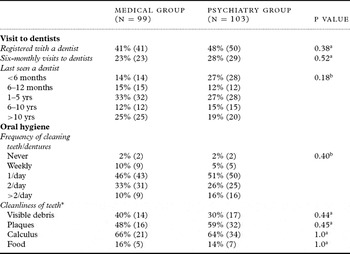
About a third (n = 69, 34%) of our total sample had visited their dentist in the previous year and about a quarter (n = 52, 26%) visited their dentist every six months. Dental cleaning habits, oral hygiene and access to dentists were similar in the medical and psychiatry groups (Table 2).
Dental habits and visits to dentists

*For those with any remaining teeth.
aχ2 test; btest for linear trend.
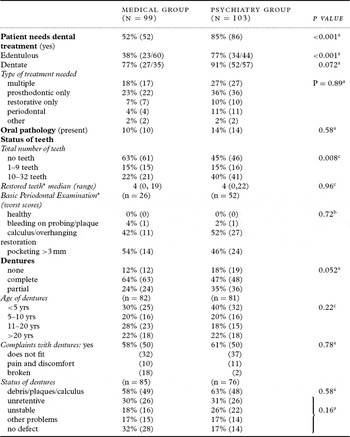
On oral examination, over two-thirds of our total sample (138/202, 68%) were judged to need some form of dental treatment, most commonly prosthodontic treatment followed by restorative and periodontal treatments. A comparison of findings on oral examination and need for dental treatment between the medical and psychiatry groups is presented in Table 3. A significantly higher proportions in the psychiatry group were judged to need dental treatment compared to the medical group (85% vs. 52%, p < 0.001). Among edentulous people, 38% (23/60) in the medical group and 77% (34/44) in the psychiatry group were thought to need some dental treatment (p < 0.001). Among dentate people, 77% (27/35) in the medical group and 91% (52/57) in the psychiatry group were thought to require dental treatment (p = 0.072). partial or complete dentures were used by 82% (n = 84) of the psychiatry group and 88% (n = 87) of the medical group (p = 0.052). Those in the psychiatry group were more likely to be dentate and have lower frequencies of complete dentures (at trend level) compared to the medical group.
Findings on oral examination

*For those with any remaining teeth.
aχ2 test; btest for linear trend; cMann-Whitney U-test.
Factors predicting “need for dental treatment”
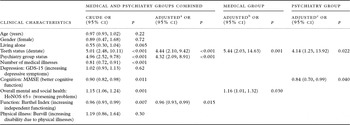
Logistic regression analyses (Table 4) showed that being dentate [adjusted odds ratio, OR (95% confidence interval): 4.44 (2.10, 9.42)]; psychiatry group status [OR 4.32 (2.09, 8.91)] and increasing severity of overall physical disability [OR: 0.96 (0.93, 0.99)] were independent predictors of the need for dental treatment in these community living older people. The psychiatry group was significantly more likely to need dental treatment compared to the medical group; even after taking account of the effect of age, gender, teeth status, HoNOS-Total, MMSE, GDS and medical comorbidity. The psychiatry group was significantly more likely to need dental treatment if they were dentate and had cognitive impairment. This association was independent of the type of mental illness. The medical group was significantly more likely to need dental treatment if they were dentate and had greater difficulties with overall mental and social health.
Logistic regression analyses predicting “need for dental treatment”

aSignificant independent predictors from age, gender, living alone, subject group (with and without mental illness), number of medical diagnoses, GDS, MMSE, Barthel, Burvill, HoNOS-Total and teeth status (edentulous vs. dentate).
bAs above; restricted to the medical group.
cAs above; restricted to the psychiatry group.
OR = odds ratio; CI = confidence interval; GDS = Geriatric Depression Scale; MMSE = Mini-mental State Examination; HoNOS 65+ = Health of the Nation Outcome Scale for older people.
Discussion
On oral examination, over two-thirds of community dwelling older people were judged to need dental treatment, most commonly prosthodontic treatment. Being dentate, having a diagnosis of mental illness and having a more severe physical disability were independent predictors of the need for dental treatment.
The presence of natural and functional teeth is important in maintaining a satisfactory nutritional status (Sahyoun et al., Reference Sahyoun, Lin and Krau2003) and acceptable body mass index (Sheiham et al., Reference Sheiham2002). Dental problems are associated with increased risk of coronary heart disease (Loesche et al., 1998), cardiac arrhythmias (Holm-Pedersen et al., Reference Holm-Pedersen2005), aspiration pneumonia (Terpenning et al., Reference Terpenning2001) and reduced quality of life (McGrath and Bedi, Reference McGrath and Bedi1998). This is the first study to compare objectively the dental health problems of community-living older people with mental illness to those without mental illness. A presence of mental illness (depression, dementia or psychosis) was associated with an increased need for dental treatment, even after accounting for the presence of any natural remaining teeth. This increased need was not due to any specific dental problems but rather to an amalgamation of small increases in various problems. In older people with mental illness the need increased further with increasing cognitive impairment. Older people in care homes, especially those with dementia, have been shown to have considerable unmet need with respect to dental problems (Merelie and Heyman, Reference Merelie and Heyman1992). However, the literature examining the associations of mental illness with dental problems in community-living older people is limited, with cognitive impairment being the only risk factor studied (Fenwick et al., Reference Fenwick, Batchelor and Samarawickrama1998; Stewart and Hirani, Reference Stewart and Hirani2007; Wu et al., Reference Wu, Plassman, Liang and Wei2007). The independent association of HoNOS 65+ with increased dental health needs in older people without known mental illness raises the possibility of undiagnosed mental illness in this population, suggesting that the association with mental illness observed in our study may be an underestimate.
Our sample was drawn from secondary care medical and psychiatry services. About a third had visited their dentist in the previous year and about a quarter visited their dentist every six months compared to respective figures of 47% and 43% noted in a previous U.K. study (McGrath et al., Reference McGrath, Bedi and Dhawan1999). Just over half of our sample were edentulous which is higher than the reported frequency of 40% in the population Health Survey for England 2000 (Stewart and Hirani, Reference Stewart and Hirani2007). A higher frequency of edentulism may partly explain lower frequencies of visits to dentists as possession of full dentures has been associated with a six-fold decrease in non-emergency visits to dentists (McGrath et al., Reference McGrath, Bedi and Dhawan1999). In our sample, edentulism was associated with not being registered with a dentist and not seeing a dentist in the previous year. The association of edentulism with a higher age in the older population was confirmed but its association with female sex or cognitive impairment was not (Stewart and Hirani, Reference Stewart and Hirani2007). However, among dentate patients, we found cognitive impairment to be associated with a reduced number of teeth and an increased need for dental treatment. In dentate older people, higher cognitive functioning has been suggested as an enabling factor in dental service utilization (Wu et al., Reference Wu, Plassman, Liang and Wei2007) while our study suggests that cognitive impairment may also be a need factor in this subgroup.
This was a cross-sectional study with convenience sampling from secondary care and some caution is required in generalizing the results to other settings. We do not have any information on people who did not agree to being referred or did not consent to the study. Also, we cannot say whether the observed increased need for dental treatment in the psychiatry group was due to mental illness itself or the effect of previous and or current treatment with psychotropic medications. We assessed normative need as defined by the qualified dentist. However, it is also important to assess a perceived need. This can be done by asking subjects about their oral health, either absolute or relative to other people, using multiple choice options in the following domains: mouth appearance, chewing ability, tooth decay, dentures, and the need for treatment (Drake et al., Reference Drake, Beck and Strauss1990; Robinson et al., Reference Robinson, Nadanovsky and Sheiham1998; Vered and Sgan-Cohen, Reference Vered and Sgan-Cohen2003). The perceived need may reflect the normative need at population level but not at an individual level (Robinson et al., Reference Robinson, Nadanovsky and Sheiham1998). The perceived need may be affected by a number of factors including sociodemographic factors, awareness about dental problems, and the experience and expectations of dental services. The perceived need is likely to be lower among older people, especially those with cognitive impairment and mental illness. The inconvenience of leaving a dental practice and preconceptions about older people, particularly those with mental illness, may be some of the other hurdles in improving access to dental services (Fabiano et al., Reference Fabiano, Waldrop, Nochajski, Davis and Goldberg2005; Antoun et al., Reference Antoun, Adsett, Goldsmith and Thomson2008). The domiciliary dental services have been shown to benefit community-living older patients requiring complete dentures (Pearson et al., Reference Pearson, Gibson, Davis, Gelbier and Robinson2007) and specialist community dental services have been developed to meet the dental health needs of younger people with mental illness (Dicks, Reference Dicks1995; Chalmers et al., Reference Chalmers, Kingsford Smith and Carter1998). Hence, it should be possible to develop integrated mental health and dental care services with emphasis on prevention for older people. In the U.K., this could be done through the care planning approach in secondary care or the annual reviews in primary care. In addition, the national implementation of a single assessment process could provide an opportunity to integrate dental healthcare with the provision of other complex health and social care needs (Lane and Gallagher, Reference Lane and Gallagher2006).
Conclusion
Dental problems requiring treatment are common in community-living older people attending outpatient clinics or day hospitals of secondary care general medical or old age psychiatry services; especially those with some natural remaining teeth and those with mental illness. There is a need to develop integrated dental and mental health care with emphasis on prevention of dental problems among older people.
Conflict of interest
None.
Description of authors' roles
N. Purandare, J. F. McCord and A. Burns designed the study. E. Woods and S. Butler collected the data. N. Purandare and M. Vernon supervised the recruitment. J. Morris and N. Purandare analyzed the data. N. Purandare wrote the manuscript with all authors contributing and approving the final version. N. Purandare is the guarantor for the study.
Acknowledgments
We would like to thank staff working in general/geriatric medicine and old age psychiatry outpatient and community clinics and day hospitals in South Manchester for their help with study recruitment. We thank all participants and their carers without whom this study would not have been possible.