The Palawan tribe of the Philippines is celebrating after a local government panel refused to give the go-ahead to mining giant MacroAsia to mine on their traditional territory. […] [The panel] heard evidence from a Palawan indigenous leader and other experts about the Palawan communities’ opposition to mining on their land, and how MacroAsia's explorations have been predominantly in highly protected areas of virgin forest.
- Survival International, press release, Aug. 2010Back then, it was the Muslims who organised us. Today, it's the government and NGOs. […] What they usually do is take photos of us wearing [traditional garb] or dancing so they can use us to get funds from other countries. But there are laws saying we have rights to our land, livelihood, and culture, so that is what we must learn.
- government-recognised Palawan ‘chieftain’Pfft. What's a ‘chieftain’? Isn't that English?
- Wife of government-recognised Palawan ‘chieftain’The ancestral domain is supposed to be for all of us Palawan, so that we won't lose our land to outsiders. But I have seen that it's not really for all of us, but only those who know how to do business and read laws. We true Palawan are squeezed up here in the mountains.
- Palawan elderIndigeneity is an ambivalent concept, and so it seems appropriate to begin this essay with an ambivalent series of statements. In the first, a transnational activist organisation asserts Indigenous Peoples’ rights to their ‘traditional territory’, but then invokes a trope — ‘virgin forest’ — that obscures Indigenous livelihood practices. In the second, a government-recognised ‘tribal chieftain’ laments the fetishisation of Indigenous traditions, but then embraces the promise of Indigenous rights as enshrined in law. In the third, the same chieftain's wife concisely draws out the foreignness of her husband's title and, by implication, of the institutions that bestow it. And finally, in the fourth, a respected elder laments the unevenness he sees in who benefits from those institutions, which, he implies, serve to amplify social inequality within the Indigenous population.Footnote 1
All of these statements refer to conditions on Palawan Island in the southwestern Philippines, and all of them evoke the ambivalent and often contradictory ways in which indigeneity as a legally recognised political identity intersects with the lives of Indigenous Peoples. Indigeneity is of course much more than a legal matter; it is a claim about history and often also about ontology. But the legal recognition of indigeneity by a growing number of states means that we cannot ignore the role of law in shaping what it means to be Indigenous in a given context. This essay, then, asks how the Philippines’ attempt to legislate indigeneity and Indigenous rights has fared in practice.
The Philippines is something of an anomaly when it comes to this issue. In 1997, it became the first country in Asia to legally recognise Indigenous rights in a manner that upheld international standards. Since then, Filipino activists have played a leading role in transnational Indigenous movements within Asia and beyond.Footnote 2 Even so, the Philippines is by no means unique. As I will explain below, circumstances there are consistent with what Mark Goodale calls ‘“dark matter:” the ineluctable, constant, and veiled presence of trans-national (primarily extractive) capital working not against, but with, policies of indigenous rights’.Footnote 3 In the Philippines, as in many parts of the world, the codification of Indigenous rights often serves to augment the very assimilative, dispossessory processes that it purports to prevent.
But there is more to the story, and it concerns me that dispossession and assimilation may increasingly appear to be foregone conclusions. Instead, I invite readers to consider these paradoxical realities with an eye to how people practically navigate and contest them. Many scholars and activists have called attention to the agency that Indigenous Peoples bring to their encounters with colonial actors and processes. Yet there remains, I would argue, a palpable sense of Eurocentric determinism in far too many popular, journalistic, and academic accounts of these matters — no more so than in accounts of Indigenous–state relations in Asia. While I completely agree with well-placed critiques of institutionalised indigeneity,Footnote 4 I also believe that it is vital to hold (academic) space for acts of Indigenous endurance that take place within — and despite — the institutions that work to contain them.Footnote 5
Here I aim to honour the enduring presence of my Palawan interlocutors by illustrating some of the creative and often unexpected ways in which they confront the dilemmas facing them. Specifically, I will present three ways in which Indigenous Palawan men and women have engaged with dominant policy assumptions to intervene in dispossessory processes. These include instances in which Palawan persons have: codified a ‘tradition’ of inheritance to influence legislative outcomes; performed the policy narrative of ‘ecological balance’ to shape the outcome of conservation interventions; and filed a civil case tacitly challenging official expectations that they govern themselves as homogenous collectivities. These vignettes will, I hope, help to disrupt deterministic narratives regarding the ambivalent effects of Indigenous rights — and the futures of Indigenous Peoples — in Southeast Asia and beyond.
Indigenous rights in law
In the Philippines, questions of indigeneity are inseparable from questions of law. This is a context in which, since the fall of the Marcos regime in 1986, post-authoritarian reformers have sought to foster a liberal, multicultural political culture, and in which Indigenous rights have been a central part of that agenda.Footnote 6 In this section, I will situate Philippine legal constructions of indigeneity in their societal context before addressing some of the (largely disappointing) practical results of these laws to date.
Legal recognition of Indigenous rights as such began with the 1987 Constitution. The use of the word ‘indigenous’ in post-1986 reforms was a conscious repudiation of earlier categories (pagans, non-Christian tribes, national minorities) and the ethnocentric, assimilationist policies they underpinned.Footnote 7 Although commonplace stereotypes about Indigenous Peoples have retained older prejudices, it is no longer politically correct to describe them as ‘uncivilised’ or ‘wild’.Footnote 8 More concretely, the turn to indigeneity has been driven by connections forged between minoritised groups’ resistance to Marcos-era development aggression and an emerging transnational Indigenous-rights movement.
Among these connections, the struggle against the Chico Dam was arguably the most consequential. In the 1970s and ‘80s, various Igorot groups in northern Luzon partnered with both Communist militants and international human-rights activists to protest the World Bank-funded dam project. Dorothea Hilhorst writes that mainstream leaders of the movement ended up embracing notions of Indigenous self-determination and autonomy as a result of their collaboration with the United Nations and other proponents of the transnational Indigenous movement.Footnote 9 Their success in garnering support among Filipino intellectuals and activists played a pivotal role in the constitutional embrace of Indigenous rights.
Although Indigenous rights had a foothold in the 1987 Constitution, the language used was ambiguous. On the one hand, the Constitution reinscribes the Regalian Doctrine, declaring all non-agricultural land as ‘public domain’ under the ownership of the state.Footnote 10 On the other hand, the Constitution provides for the creation of two autonomous regions (in the Cordillera and Mindanao) and enjoins the state to protect Indigenous rights and well-being elsewhere. Article XII Section 5 stipulates:
The State, subject to the provisions of this Constitution and national development policies and programs, shall protect the rights of Indigenous cultural communities to their ancestral lands to ensure their economic, social, and cultural well-being. The Congress may provide for the applicability of customary laws governing property rights or relations in determining the ownership and extent of ancestral domain.
Given these potentially contradictory constitutional directives, bureaucrats and legislators were left to define indigeneity and the rights it entails. What has ensued has been convoluted, to say the least. Initially, the Aquino administration created three subcabinet agencies charged with implementing the Indigenous-rights provisions of the constitution.Footnote 11 While waiting for Congress to pass enabling legislation, these agencies began laying the groundwork for the recognition of ancestral land claims. In Palawan, this involved the appointment of ‘tribal chieftains’ and the establishment of ‘tribal councils’ in each barangay Footnote 12 with Indigenous residents. Beyond this, however, little progress was made. James Eder and Thomas McKenna observe that ‘the local offices of these … agencies were lightly staffed and received little regular funding, … [leaving] members of ethnic minority groups in need of material, legal, or other forms of assistance … to turn to a variety of better-staffed and better-funded NGOs’.Footnote 13
Meanwhile, the aforementioned enabling legislation was stalled in Congress. This left implementation in the hands of the Department of Environment and Natural Resources (DENR), which had jurisdiction over all public lands eligible for recognition as ancestral lands. Although some within the DENR opposed recognising customary claims to public lands, the Indigenous Community Affairs Division managed to push a series of policies through the approval process.Footnote 14 Their efforts culminated with the issuance, in 1993, of a Department Administrative Order (DAO2) that spelled out guidelines for issuing Certificates of Ancestral Domain Claim (CADCs). Some Indigenous-rights groups opposed the DAO2 guidelines for a number of reasons.Footnote 15 First, because CADCs were issued only on the basis of a departmental order, they could be overridden by other laws, such as the Mining Act of 1995, under which a CADC would ‘provide no impediment to the granting of mining exploration leases’.Footnote 16 Second, CADCs only provided for ancestral domain claims and not titles, thus perpetuating state ownership of Indigenous land. And, third, the DAO2 guidelines included numerous clauses that could compel Indigenous groups to cooperate with conservation and other government interventions. I will revisit these and other important features of the guidelines below.Footnote 17 For now, it suffices to say that, whatever their limitations, the DAO2 guidelines enabled the DENR to issue more than one hundred CADCs, covering some 2.546 million hectares in different parts of the country.Footnote 18
One salient and arguably more salutary feature of the DAO2 guidelines was the use of the term ‘ancestral domain’ in addition to ‘ancestral land’.Footnote 19 The Constitution used both terms, but proponents of Indigenous-rights reforms had favoured ancestral domain as a more socioculturally inclusive and legally robust concept of territory. Filipino jurist Marvic Leonen, who has long been an influential advocate for Indigenous rights, traces the use of ‘ancestral domain’ to a 1985 conference of the Anthropological Association of the Philippines. ‘Advocates,’ he recalled, ‘wanted a common slogan.’Footnote 20 Unlike ‘ancestral land’ or its Tagalog equivalent (lupang ninuno), ‘ancestral domain’ aims to encompass the wide range of Indigenous conceptions of territory. Gus Gatmaytan, a Filipino anthropologist and attorney who has figured centrally in Indigenous-rights advocacy, adds that the term ‘domain’ signifies not just land, but all the dimensions of an Indigenous territory, including marine, lacustrine, subterranean, and spiritual spaces and resources.Footnote 21
Never intended to be a permanent arrangement, the DAO2 framework for ancestral domain recognition lasted only five years. In 1997, Congress finally passed the Indigenous Peoples’ Rights Act (IPRA), which provided a comprehensive legal framework for the protection of Indigenous rights, including an upgraded tenure mechanism called the Certificate of Ancestral Domain Title (CADT). A new government agency — the National Commission on Indigenous People (NCIP) — was also created to oversee IPRA's implementation. As with the DAO2 guidelines, the authors of IPRA faced the politically fraught task of defining indigeneity. Despite having a larger European settler population than most other parts of Southeast Asia, the Philippines never became a true settler colony, making the question of who is Indigenous an even more complex one than it already is in countries in the Americas, Australia, or New Zealand. After all, are not all Philippine ethnic groups indigenous to the archipelago? In practice, of course, indigeneity does not refer simply to place of origin, but to historical processes of colonisation and marginalisation.Footnote 22
Faced with this complexity, the authors of IPRA arrived at the following definition:
Indigenous Cultural Communities/Indigenous Peoples […] refer to a group of people or homogenous societies identified by self-ascription and ascription by others, who have continuously lived as organized community on communally bounded and defined territory, and who have, under claims of ownership since time immemorial, occupied, possessed and utilized such territories, sharing common bonds of language, customs, traditions and other distinctive cultural traits, or who have, through resistance to political, social and cultural inroads of colonization, non-Indigenous religions and cultures, became historically differentiated from the majority of Filipinos. ICCs/IPs shall likewise include peoples who are regarded as Indigenous on account of their descent from the populations which inhabited the country, at the time of conquest or colonization, or at the time of inroads of non-Indigenous religions and cultures, or the establishment of present state boundaries, who retain some or all of their own social, economic, cultural and political institutions, but who may have been displaced from their traditional domains or who may have resettled outside their ancestral domains.Footnote 23
Under IPRA, minoritised groups who meet these criteria are entitled to special economic, social, political, and cultural rights;Footnote 24 and, to help protect these rights, the law requires that ‘free and prior informed consent’ (FPIC) be obtained under government supervision by any person or entity hoping to engage Indigenous communities in business contracts, research activities, or development projects of any kind.Footnote 25
Indigenous rights in practice
The passage of IPRA made the Philippines the first country in Asia to adopt international standards for Indigenous rights and was hailed around the world as one of the most progressive legal reforms of its kind. Immediately, though, several aspects of the law raised concerns. To say nothing of the pitfalls of expecting Indigenous people to be culturally distinctive and ‘homogenous’, IPRA stipulates a handful of ‘responsibilities’ that could, under certain circumstances, undermine the very rights the law is meant to protect.Footnote 26 These responsibilities centre on the expectation that Indigenous groups will ‘maintain an ecological balance’ in their ancestral domains ‘by protecting the flora and fauna, watershed areas, and other reserves’. More specifically, in ancestral domains that the government deems ‘necessary for critical watersheds, mangroves, wildlife sanctuaries, wilderness, protected areas, forest cover, or reforestation’, Indigenous people ‘shall be given the responsibility to maintain, develop, protect and conserve such areas with the full and effective assistance of government agencies’. To square these expectations with the right to self-determination and development, one must assume, as the authors of IPRA evidently did, that Indigenous Peoples' self-determination will by default lead to ecological balance and environmental conservation. This ‘eco-indigenism’, as I have argued elsewhere, sets up expectations that Indigenous Peoples sometimes find very difficult to live up to — as, for example, when Indigenous groups who support or propose particular conservation or development projects find their authenticity challenged.Footnote 27
Notwithstanding these weaknesses, Indigenous groups in Palawan and elsewhere have filed hundreds of applications for recognition of their ancestral domains. The application process is a laborious, expensive, and technically complex one that requires the submission of hundreds of pages of documentation. Not only must applicants prove they meet the criteria for recognition — through the production of maps, ethnographic narratives, kinship diagrams, and oral histories — they must also prepare an Ancestral Domain Management Plan that inventories local resources and establishes guidelines for their stewardship. In virtually all cases, this requires the technical assistance of non-governmental organisations (NGOs) and government experts as well as the financial support of foreign or domestic funders.
Even for groups who do manage to obtain a CADC or CADT, recognition is of course no panacea. Neither the CADC nor the CADT can abrogate valid, pre-existing claims held by non-Indigenous Peoples within an ancestral domain. Nor can these documents simply undo the long-standing structural inequalities that drive dispossession and lead Indigenous groups to sell their lands or enter into exploitative contracts. For example, one of the main benefits of ancestral domain recognition is priority access to permits for non-timber forest products (NTFPs). Advocates have envisioned Indigenous control of local NTFP markets as a crucial step toward long-term tenurial security and sustainable development. However, because few Indigenous persons can afford permitting and other start-up costs, financiers have used capital advances and resulting cycles of debt to convert ancestral domains into de facto private concessions.Footnote 28 In fact, it was precisely this situation that led to the filing of the civil case that I will describe below (in ‘Vignette 3’). Melanie Hughes McDermott has eloquently noted that, in the rush to establish territorial boundaries, the recognition of ancestral domain may overlook the ‘pathways’ of patronage, debt, and exploitation that have the greatest consequences for Indigenous rights.
Moreover, due to its chronic underfunding and embroilment in resource politics, the NCIP has struggled to implement the IPRA in an efficient and timely manner. It took nearly fifteen years to begin implementing the provision that requires Indigenous representation in all legislative bodies. As of early 2013, 159 CADTs had been ‘approved’, covering some 4.4 million hectares and 921,918 people defined as being Indigenous.Footnote 29 But of these, only 40 CADTs had actually been awarded, whilst an untold number of applications languish in the pre-approval phase. In Palawan, at least seven CADTs have been approved since the passage of IPRA, but only one awarded. Meanwhile, the legal status of CADCs remains uncertain, with NCIP guidelines calling for their conversion into CADTs; however, most CADC holders lack the resources to apply for conversion. Worse still, the NCIP has been widely criticised by Indigenous-rights activists for helping mining companies secure FPIC and mishandling mining royalties that it manages on behalf of Indigenous groups.
In short, then, what looked so promising on paper has proven disappointing in practice. Very few applications for ancestral domain title have successfully made their way through the long, expensive, and technically complex bureaucratic process.Footnote 30 Extractive industries have corrupted the enforcement of FPIC.Footnote 31 The mandate for legislative representation has been severely delayed. Indigenous groups are increasingly involved in bureaucracy, in litigation, and above all in waiting — waiting for the provincial officer to come for a survey, waiting for an opening in the municipal court's docket, waiting for an international donor to fund the validation of an ancestral domain application, waiting for a mining company to pay royalties, and so on. Meanwhile, in many parts of the country, dispossession of Indigenous lands continues largely unabated.
Why has the IPRA law's implementation faltered? Part of the problem is that its full legal implications remain unclear. Not long after the law was passed, its constitutionality was challenged. The Philippines Supreme Court reached a split decision regarding which of two competing constitutional doctrines determined the scope of the law. One side favoured the Regalian Doctrine, which is said to give ownership of all untitled land to the state regardless of any customary claims;Footnote 32 the other side favoured the Cariño Doctrine, which derives from a 1909 United States Supreme Court ruling and is interpreted as giving customary claims precedence over those of the state.Footnote 33 This jurisprudential ambiguity means that even successful assertions of Indigenous rights stand on a legally unstable foundation and that bureaucrats and lawyers can readily legitimise any number of contradictory positions with respect to what Indigenous rights entail in practice.Footnote 34
Equally problematic is how IPRA enacts what Tania Li has called the ‘management of dispossession’.Footnote 35 In several Asian countries, Li argues, the recognition of indigeneity has involved imposing collective land tenure mechanisms on peoples who have had heterogeneous and dynamic ways of dealing with access to land and resources. This has appealed to elites as a way to counter the radicalisation of marginalised upland populations, but it risks creating the illusion that Indigenous groups are protected from the alienation of their land even as other forms of dispossession continue unabated. This, I concur, is certainly the case in the Philippines, where the singular notion of ‘ancestral domain’ is applied to a highly diverse landscape of customary tenurial practices and where ancestral domain titles often do little to prevent dispossession in the long term.Footnote 36
Underpinning the recognition of collective tenure or ‘ancestral domain’ is a broader process of bureaucratisation and territorialisation — what Frank Hirtz has described as a form of ‘bureaucratic Orientalism’.Footnote 37 To be recognised as such, Indigenous groups must gather extensive documentation that they are internally ‘homogenous’, distinguished by their adherence to distinctive ‘tribal’ customs, historically ‘resistant’ to assimilation by foreign powers, and inclined to maintain the ‘ecological balance’ of their ancestral domains.Footnote 38
With these strings attached, indigeneity can constitute a disempowering ‘burden of authenticity’Footnote 39 and risks shunting aside the most marginalised actors in favour of those who are most adept at navigating bureaucracy.Footnote 40 Oona Paredes, for example, has examined state efforts to identify Higuanon leaders in northern Mindanao and found that those with the greatest legitimacy among their fellows are often those who are least comfortable dealing with bureaucracy (and vice versa).Footnote 41 Similarly, Bernadette Resurreccion has shown how, among the Kalanguya of Luzon, the pursuit of ancestral domain recognition appealed to men but alienated women, who felt they had better things to do than perform the government's vision of Indigenous resource managers.Footnote 42 Indeed, the technically complex work of validating an Indigenous group's status is often divorced from the everyday practices through which spatial boundaries and social differences are produced and contested.
The net result of these processes is not, then, Indigenous empowerment so much as the extension of capitalist-state power over re-territorialised spaces, the co-optation of claims-making processes by elite interests, and the intensified regulation of rural populations through bureaucratic procedures. This observation tracks with critical studies of indigeneity elsewhere in Asia, as well as in Australia, Africa, and the Americas,Footnote 43 and it reinforces the notion that, even though the Philippines is something of a regional anomaly, it is by no means an exception to global patterns. Here, too, we find confirmation of what the more radical Indigenous-rights groups, such as the Cordillera Peoples Alliance, have said all along: that IPRA would bureaucratise Indigenous movements and thereby defuse any real challenge they might pose to ongoing processes of colonisation.Footnote 44
Clearly, then, the legislation of indigeneity in the Philippines embodies what Elizabeth Povinelli terms the ‘cunning of recognition’ — by which she describes how liberal regimes selectively recognise difference in order to render it epistemologically, symbolically, and economically benign (and, indeed, valuable).Footnote 45 Nevertheless, as I suggested above, focusing disproportionately on these subjugating effects risks reinforcing the oft-presumed inevitability of Indigenous assimilation and dispossession.Footnote 46 My aim in what follows is to illustrate how Indigenous engagements with the institutions of recognition do more than simply reproduce the colonial logics and designs of the capitalist state. Together with acts of resistance and refusal, these acts of negotiation and accommodation are forms of endurance. As such, they too work to disrupt physical and discursive moves to assimilate Indigenous societies and dispossess their lands. This interpretation is inspired, in part, by Michael Cepek's critique of ‘environmentality’.Footnote 47 Rather than self-disciplined, eco-rational subjects, what Cepek found among the Cofán was the persistence of a critical awareness of power and resource politics — and this despite years of NGO interventions aiming to shape their subjectivities otherwise. Such is also the case, I submit, in the Philippines, where the cunning of recognition must contend with the cunning of the recognised.
Palawan, an island and a people
Over the past decade, I have spent more than two years doing ethnographic research with different communities on Palawan Island (see Figure 1). Palawan is an UNESCO Biosphere Reserve, where claims to indigeneity are very much at the centre of debates over development and conservation — and especially over extractive industries like mining and palm oil. The island is home to three distinct Indigenous groups: the Batak, Tagbanua, and Palawan. Since my first visit in 2006, I have worked primarily with Palawan communities in the southwestern corner of the island (2008 to the present) and on smaller islands off its southern tip (2006–7).Footnote 48 As an ethnolinguistic demonym, Palawan — occasionally spelled Palaqwan, Pala'wan, or Pälawan — derives from the name of the island on which Palawan peoples have lived since time immemorial.
Map of Palawan Island (courtesy of Danielle Theriault).

Today some 50,000 Palawan-speaking persons live in the southern half of the island, where they find themselves outnumbered by settlers from other parts of the Philippines. Like highland groups throughout the region, Palawan peoples have long practised swidden agriculture, hunting, fishing, and the collection of forest products, and they have long traded their products for non-local goods, especially salt, kiln-fired ceramics, metals, and money.Footnote 49 Muslim traders have been an influential presence in southern Palawan for at least two centuries,Footnote 50 engendering distinct communities of Penimusan or so-called ‘Islam’ Palawan along the coast. In more recent decades, both Catholicism and a variety of Evangelical denominations have made major inroads as Christian migrants have settled in large numbers. Many Palawan now live in lowland towns, send their children to school, and rely principally on intensive agriculture and/or wage labour for their livelihoods. Dispossession has marginalised many others into the uplands, while the growing dependence on money has deepened socioeconomic disparities across the board.
And yet, as I suggested above, Palawan men and women are anything but passive participants in these processes. In what follows, I offer three vignettes from my research, each illustrating a distinct way in which Palawan persons have intervened in regulatory processes to assert their own worldviews, interests, and aspirations. By highlighting the endurance of Palawan lifeworlds, these vignettes complicate the notion that their engagements with ‘modern’ institutions serve simply to further their assimilation as governmentalised subjects.
Vignette 1: Legislative manoeuvres
In July 2014, I caught up with my friend Bon in the air-conditioned comfort of the municipal building where he had recently acquired an office. I commented that he had gained weight, and he replied that not only had I gained weight but I was going grey to boot. Touché. I have known Bon since 2006, when he was employed as a community organiser with a local NGO that I volunteered with. Bon is one of relatively few Palawan with enough formal education and English language fluency to succeed as a professional in the provincial capital. Today he is one of the province's most prominent Indigenous-rights and anti-mining activists, as well as an elected official. Beyond Bon's own individual strengths, which are many, developments in the legal apparatus of Indigenous recognition are key to understanding his rising influence.
In 2010, after years of dragging its feet, the Department of the Interior and Local Government (DILG), a national-government agency, finally ordered local governments to implement the provision of the IPRA law that mandates Indigenous representation on all legislative bodies. Because Indigenous customs vary widely across the archipelago, the national government left it to local officials to work out how these new legislative seats would be allocated.
Indigenous Palawan forms of authority have historically revolved around kin relations, age, and expertise in shamanic mediation or customary law.Footnote 51 The Palawan did not have ‘leaders’ as such, making it extremely problematic to determine who should represent all Palawan within any government-recognised jurisdiction.Footnote 52 For years, therefore, government agencies, mining companies, and NGOs have vied with one another to identify ‘legitimate’ Palawan leaders, and these contestations have closely followed the factional contours of resource politics. But in order for Palawan individuals to be allocated legislative seats per the government's order, there needed to be a standardised code for recognising eligible candidates, particularly those with some kind of customary authority.
This prompted Bon and his colleagues at several allied NGOs to take action. They did not want mining companies to determine any standardised code that might emerge. Bon and other anti-mining activists have long challenged the legitimacy of Palawan leaders aligned with mining companies, and so this was their chance to give their own claim to legitimacy the force of law. They proceeded to develop a set of ‘local guidelines’ for the verification of Indigenous leaders in the municipality at the centre of the mining debate. These Guidelines specify criteria, including inheritance of customary title and long-term residence in a particular place, that impose dominant legal expectations on Palawan practices but that also make it more difficult for the verification process to be corrupted by outside interests.
After having their guidelines validated by various levels of government, Bon and colleagues set out using it to legally identify Palawan elders whom they considered to have legitimate claims to serve as representatives and who were also their allies in the fight against mining. In the end, they succeeded in recognising enough allied elders that they ultimately elected Bon to serve as their first representative on the municipal legislature. Many of these allies, moreover, have gone on to serve at the village level.
The point of this story is not that Bon is some kind of hero. The ‘Local Guidelines’Footnote 53 he and his colleagues developed risk hardening the criteria of recognition, particularly when it comes to gender and lineage, so that far too many Palawan are excluded from eligibility. Their approach was clearly shaped by resource politics and the agenda of their NGO allies. Nevertheless, this is also an example of how marginalised but recognised Indigenous actors have used potentially disempowering legal expectations as a counter to the power of extractive industry. Bon and his fellow Palawan representatives must think and act very differently as legislators than they do as customary dispute mediators, and in that respect recognition has exercised its cunning. Here, to borrow Paul Nadasdy's phrasing, ‘“empowerment” must also be viewed as a form of subjection’.Footnote 54 On the other hand, though, this is perhaps the most direct way to influence policies that have profound consequences for Palawan and their still largely forest-dependent way of life.
Bon harbours no illusions about keeping his fellow Palawan in some romantic state of ecologically noble primitivism. But he does not believe that mining will bring them the future they desire. ‘We want respect,’ Bon told me, ‘and the right to decide for ourselves.’ When Bon and I met at his office, he had an assistant at his beck and call and a list of what he called ‘pro-environment, pro-Indigenous’ resolutions he was co-sponsoring. What he's doing cannot be reduced to ‘environmentality’, even as his experiences do in many ways testify to the transformative powers of legislating indigeneity.
Vignette 2: Performing conservation
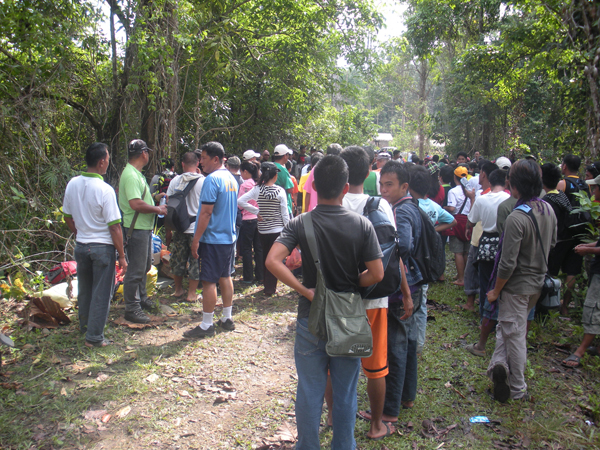
The last day of June in 2011 was an eventful one in Tenga't Gebaq. Tenga't Gebaq was the Palawan hamlet where I conducted extensive fieldwork, and it was located within a new protected area known as the Mt. Mantalingahan Protected Landscape (MMPL). That June day was the second anniversary of the MMPL's declaration into law. To mark the anniversary, the national DENR, along with a host of other government agencies, were touring southern Palawan and conducting mass tree-planting activities in each of five ‘key watersheds’ (see Figure 2). Tenga't Gebaq was at the centre of one of those five watersheds and, being somewhat accessible by road, was selected to host one of the mass tree plantings. The organisers brought the local mayor with them, and he had brought more than a hundred college students.
Government employees and students gathered for a tree-planting activity (photograph by Noah Theriault).
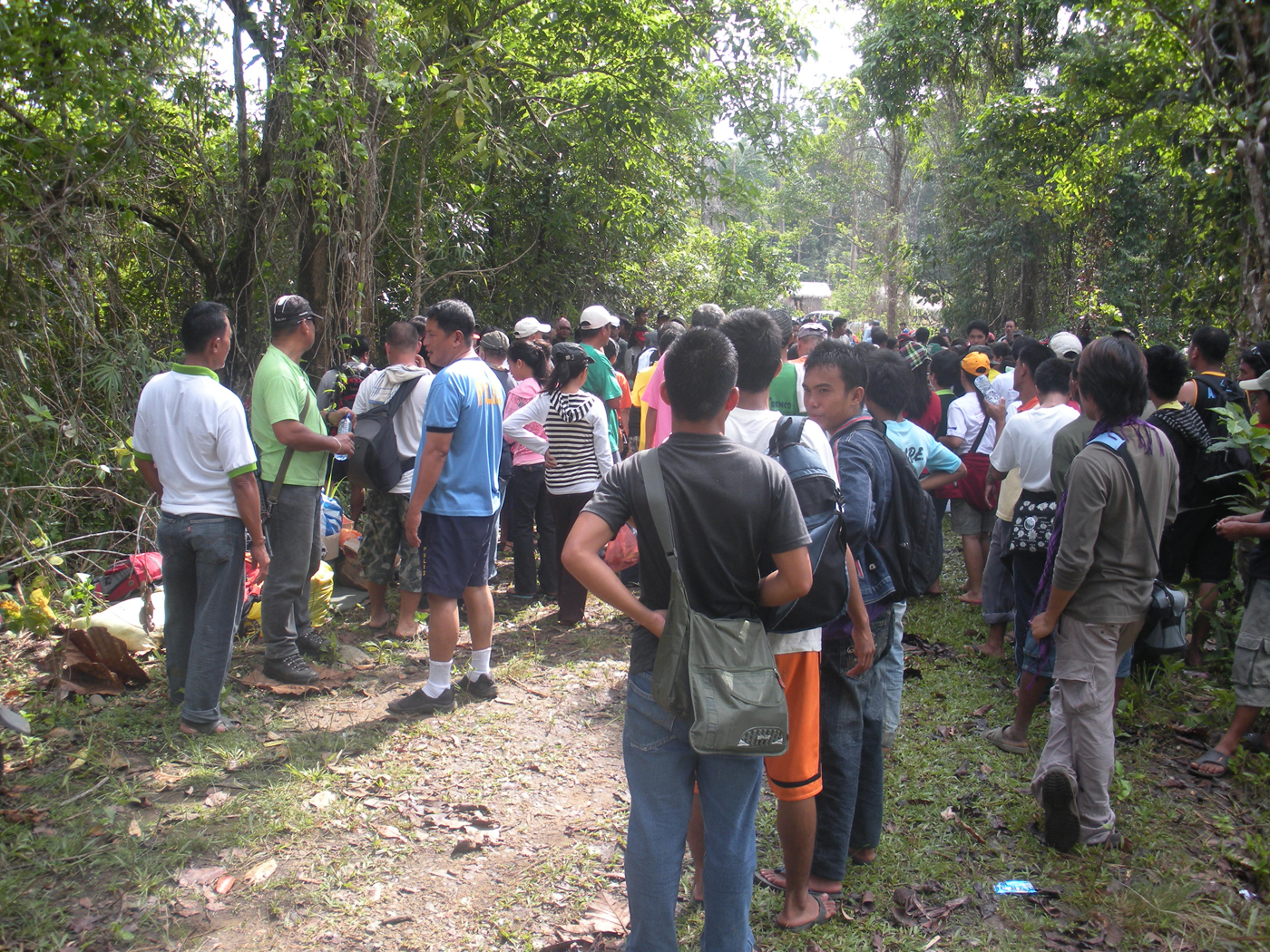
My host, Jimi, was the government-recognised Palawan ‘chieftain’ for the area, so he would be expected to participate in the activity. But he had business in town that day, so he left early on his motorbike, hoping to make it to the main road before crossing paths with the tree-planting caravan. He had no such luck. Just downstream of his house, the crowd of clipboard-wielding bureaucrats, photo-snapping students, and rifle-toting bodyguards had already jammed the old logging road. I arrived on the scene just after Jimi and could see the surprise lingering in his jittery movements as he worked his way through the crowd and greeted his esteemed guests. With no polite way of leaving, he was obliged to stay and participate. That obligation did not apply, however, to other Palawan, for whom an unexpected gathering of outsiders was an event to be avoided. Before word had spread upstream, I saw a few men and women come down the road; as soon as they glimpsed the crowd, they stopped, mumbled a curse, and immediately turned back. So, besides Jimi and me, not a single resident of Tenga't Gebaq participated in the activity. In the days leading up to it, a few local men had been hired to clear a trail up the mountainside and dig holes for seedlings, but none of them showed up for the actual planting. Despite this, several of the pre-activity speeches praised ‘the community’ for helping the government take care of the environment and thanked Jimi for his cooperation. Jimi too was called on to give a speech, and in it he thanked the government for its help in protecting the environment. This ‘official transcript’, as James Scott might call it, was a pitch-perfect enactment of the protected area's management policy, which in turn reflected legal expectations that Indigenous groups cooperate with conservation.Footnote 55
This was not the first or the last time Jimi would have to make such a speech. Palawan and other Indigenous groups are regularly called on to publicly perform their ecological credentials. These performances paper over profound differences between Palawan and the state, particularly when it comes to questions of regulating swidden, resource extraction, and land use. But they also help to disguise differences within the Palawan population itself. Prior to the tree-planting ceremony, Jimi was asked to select a site for it, preferably one that was ‘sacred’ (i.e., off-limits to swidden) since that fit with official narratives for how these sites were selected. But his primary motive for selecting that particular mountainside was not, in fact, its sacred or taboo status. It was, rather, because claims to it were contested. Jimi's in-laws had sold an adjacent plot of land to another Palawan couple, but had, they thought, retained part of that mountainside. The couple who bought the land believed that they had rights to at least part of the mountainside and were hoping to clear and plant it. This created the possibility of a dispute that Jimi would have to mediate. By guiding the government to plant hardwoods on the contested land, Jimi was at least temporarily deferring that difficult situation (which would pit his parents-in-law against the father of his brother's wife). Nobody, he figured, would fight to clear a piece of land where the state had just planted tree saplings.Footnote 56 And, if he had to let the government plant trees on Palawan land, it might as well be land that was causing local tension.
His calculation was correct. As of August 2018, the dispute remained in abeyance. Even though the government had not done anything further to maintain the saplings, the couple hoping to clear the land had not pursued the matter further.
Here, again, there are two interpretations to balance. One is about how eco-indigenism masks and even inspires ongoing processes of colonisation, which are very much experienced and understood as such by the Indigenous population in question. And the other is about how members of that population engage creatively with their legal rights and obligations in ways that defend local priorities of land use.
Vignette 3: The freedom to do business
For the third and final vignette, let's remain with Jimi, who used litigation to challenge what he considered a disempowering legal provision that enabled commercial interests to monopolise permits for NTFPs.Footnote 57
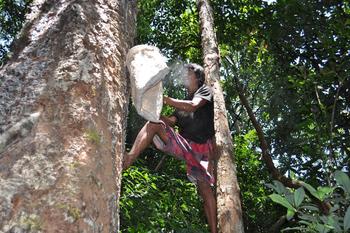
‘But do people own money or does money own people? In the past, it seemed like people owned money, but today it seems like money owns people.’ Aban offered this observation to his brother, Jimi, as they squatted in the shade of a mango tree. They were discussing a lawsuit that Jimi had filed against a fellow Palawan leader who was using government-issued permits to monopolise the local trade in copal (a valuable tree resin known as almaciga in Tagalog and begtik in Palawan) (see Figure 3). In this and other conversations, Jimi framed his legal struggle as one for the economic freedom to which he was legally entitled as an Indigenous person — in Jimi's words, ‘the freedom to do business’. But Aban was sceptical. Even with legal protections for Indigenous peoples, who (or what) did ‘business’ really empower? His doubts echoed those of many others I encountered during my fieldwork. For the Palawan, the recognition of indigeneity has come in tandem with intensified commodification, monetisation, and regulation — and what all of this means for their ‘freedom’ remains very much in question.
A Palawan man gathering copal resin (photograph by Noah Theriault).

I will return to this question in a moment, but first I will review the nuts and bolts of Jimi's lawsuit. Although seemingly very local in nature, the dispute at the centre of the lawsuit would come to embroil actors on three different levels. At the local level were rival Indigenous leaders who were aligned with different government agencies and who made claims to represent partially overlapping, ambiguously demarcated constituencies. The defendant was Jimi's rival, an elderly Palawan man named Bordo. Bordo was the president of the local ‘Indigenous association’ that was supposed to manage resources collected within the Ancestral Domain. When the association was founded, it was recognised by DENR, and the capital for its copal-buying operations was advanced by a regional trader who had already been operating in the area. In exchange for that advance, Bordo signed a contract granting that trader exclusive rights to copal collected in the Ancestral Domain. That initial advance was never repaid, growing both in principal and interest over the years and enabling the trader to establish a monopoly. Bordo and his followers, despite nominally controlling the permits, thus found themselves beholden to a single copal trader.
On the other side of the dispute at the local level was Jimi. Bordo's only real rival when it came to external recognition, Jimi was recognised as a ‘chieftain’ by the National Commission on Indigenous People (NCIP). When the Ancestral Domain was established, Jimi and most of his kin declined to endorse it or participate in its management. They were suspicious, they now say, of Bordo's motives since he was not originally from the area or a ‘blood’ member of the lineages he was now claiming to represent.
At the regional level were two competing copal traders. One of them was a Manila-based trader who has dominated southern Palawan since the 1990s. As noted above, she used contracts, sealed with debt, to turn Indigenous associations like Bordo's into local fronts for her regional trading operation. Her quasi-monopoly over the southern Palawan copal trade went largely unchallenged until 2009, when one of her most trusted employees decided she wanted to start her own trading operation.Footnote 58 This renegade approached Jimi and asked him to become one of her local agents, thus setting in motion the dispute in question.
With Bordo's association controlling the copal permits, Jimi needed their permission in order to act as an independent middleman. When he was refused access to the areas under permit, Jimi found a lawyer through his financier and together they sought redress through the NCIP, which has ‘quasi-judicial authority’ to intervene in disputes among Indigenous people. After a series of failed mediations, the NCIP advised both sides to stop selling copal pending resolution of the dispute. When Bordo's association failed to comply, the NCIP ceased playing the role of a neutral mediator. It confiscated a large shipment of copal and issued a memo that both questioned the legality of Bordo's association and challenged the DENR's basis for issuing permits to it. This decisive action escalated the dispute to the national level. At stake nationally is the long-vexing question of which agency — the DENR or the NCIP — has ultimate authority to regulate Indigenous people's environmental activities.
Beyond bureaucratic rivalries, the national implications of Jimi's case also concern the substantive question of how to deal with intractable disputes within Indigenous populations. The law favours ‘customary’ dispute resolution through Indigenous institutions but only gives vague guidelines for the NCIP's intervention in cases where customary resolution fails. If the Palawan are recognised as a homogenous, self-regulating collectivity, what is the state to do when a member of that collectivity presents himself as an individual and seeks legal adjudication of his rights as such? As their case dragged on, Jimi and Bordo watched their stocks of copal pile up, leaving them to ponder the uncertain boundary between special cultural rights for minority groups and the sort of institutional exclusion one might find in a bifurcated colonial state.Footnote 59
‘Wala na tayong pag-asa. Mali ang witnis ko.’ We have no hope. My witness was wrong. Jimi dictated this text message, in Tagalog rather than Palawan, to a companion during a hearing of his case in the provincial capital. It was then sent to his family in the village, where it caused much speculation and alarm. Jimi was two days from coming home, and between his resistance to sending text messages and the village's maddeningly weak cell-phone signal, there was no way to find out what exactly his text meant.
At the hearing in question, we later learned, one of Jimi's cousins humiliated him by botching his testimony. His cousin failed to realise that, in order to testify successfully as an Indigenous person before the NCIP, one must vastly oversimplify one's life so that it meets official criteria for authentic indigeneity.Footnote 60 What is your main source of income, the attorney asked. Well, he said, I often perform wage labour, I sometimes make charcoal, I sometimes collect rattan or copal. That was the wrong answer. Indigenous peoples worthy of controlling NTFP permits should not rely on wage labour or charcoal-making. So Jimi's text message was melodramatic for good reason: if he and his witnesses were less adept than their opponents at performing recognisable Indigenous subjectivities, they could lose their case. Such an outcome would leave Jimi buried in debts he could never repay.
Jimi repeatedly expressed surprise that his case has grown to such proportions. He was, he argued, just defending his legally guaranteed ‘freedom’. When Jimi articulated his position as a matter of ‘freedom’, he called forth a classic argument in debates over the role of the state in economic affairs. United States residents, in particular, should find the equation of liberty with market participation a familiar ideological proposition. When I first heard this rhetoric, I wondered whether Jimi was drawing on language used by his NCIP-assigned attorney. After all, he was using the term ‘kalayaan’, a Tagalog word that does not occur with great frequency in colloquial Palawan speech. From the NCIP's standpoint, Jimi was standing up for the collective right of Indigenous peoples to oversee their own resources. I was surprised, then, when I heard Jimi correct a non-Palawan man who praised him for standing up for Indigenous rights. Even as he warranted his position by citing the Indigenous Peoples’ Rights Act, Jimi made it clear that he did not file his case for the sake of Indigenous rights, but for the sake of his own freedom to conduct business.
Coupled with his cousin's testimony, Jimi's self-fashioning as an individual entrepreneur would seem to disappoint bureaucratic expectations for homogenous Indigenous collectivities. Yet Jimi ultimately prevailed when Bordo's side gave in and agreed to give Jimi access to the permits. An NCIP attorney explained to me that the judge was prepared to side with Jimi because, he reasoned, an Ancestral Domain is meant to benefit the entire Indigenous group living within it, not a single individual or subgroup. Somehow, then, Jimi deployed the apparatus of indigeneity in his favour even as he rejected (or simply failed to conform to) the practices and categories that apparatus calls into being.
So does Jimi's lawsuit constitute a challenge to the ‘bureaucratic Orientalism’ of recognition?Footnote 61 Has he manipulated the state into undermining the categories upon which its authority depends? Answering these questions in the affirmative would, I think, vastly oversimplify things. On one hand, the freedom Jimi seeks is one achieved through the marketing of a particular commodity and the regulatory apparatus that sharpens its ‘leading edge’ — to borrow Anna Tsing's phrase.Footnote 62 For Foucault, such a notion of freedom,
no longer [calls forth] the exemptions and privileges attached to a person, but the possibility of movement, change of place, and processes of circulation of both people and things. [I]t is in terms of this option of circulation, that we should understand the word freedom, and understand it as one of the facets, aspects, or dimensions of the deployment of apparatuses of [government].Footnote 63
Indeed, the power of liberal government is not necessarily that it produces uniform subjectivities. Rather, its power inheres in the way it draws forth desires — desires which, whether in keeping with the law or not, reproduce the logic of commodity capitalism through their very expression. That these desires often contradict the expectations of Indigenous recognition does not subvert the overarching regulatory system of which recognition is a part. But it does, nevertheless, open up space for people like Jimi to assert a claim to personal autonomy that answers both to his moral vision and to the demands of making a living in a changing world. It is an act of endurance, even if it also redounds to the power of capitalism and the state.
A brief conclusion
Mohawk scholar Audra Simpson has pointed to the dangers of uncritically imposing concepts and categories derived from imperial formations onto the very social formations that face colonisation.Footnote 64 This imposition, she argues, tends to coincide with the assumption that colonisation is already a fait accompli, that Indigenous societies are fully contained within the political, epistemological, and ontological bounds of empire. Simpson shows how Mohawk refusals of recognition — their long history of rejecting the categories imposed upon them by settler–colonial society, including those intended to grant them exceptional rights — enacts the endurance of Indigenous forms of belonging and of Indigenous sovereignty rather than their invention in the present as an epiphenomenon of colonial rule.
In closing, I would like to suggest that Simpson's insight holds even in cases where refusal remains hidden or implicit. That is, even in places where people actively pursue problematic forms of state recognition, processes of colonisation and governmentality remain far from complete. As our encounters with Bon and Jimi suggest, engaging selectively with the obligations and ambiguities of recognition can open up space for contesting the demands of extractive industry, bureaucracy, and even local rivals. These engagements are transformative, but why assume that they are transformative only for Bon, Jimi, and other Palawan? It is true that the ‘juridification of indigenous politics’ is more a move to extend the reach of capitalist-state power than a move to defend Indigenous self-determination.Footnote 65 But acts of Indigenous endurance can and do exceed the juridical bounds imposed on them. As Indigenous scholars in particular have made clear, even claims articulated within those bounds often enact and defend social formations very different from the ones that Eurocentric/colonial frameworks call forth.Footnote 66 In the Philippines and other contexts where indigeneity has been codified into capitalist-state law, the ‘cunning of recognition’ is absolutely at work.Footnote 67 But we should not let it overwhelm our sensitivity to the micro-level practices that contest and perhaps even subvert it.