Pacemaker implantation in children is associated with high rates of complications both in the acute phase and during follow-up, especially in patients with epicardial leads.Reference Silvetti, Drago, Grutter, De Santis, Di Ciommo and Ravà 1 , Reference Silvetti, Drago, Di Carlo, Placidi, Brancaccio and Carotti 2
Telecardiology, one of the main branches of telemedicine, seems to be useful in the field of cardiac pacing. Through dedicated and secure websites, standard electrocardiographic strips and transmissions can be reviewed in real time, obtaining important information about the implanted device function. These new remote monitoring techniques have been demonstrated to be an effective alternative to traditional outpatient follow-up for all types of implanted devices – that is, pacemakers,Reference Crossley, Chen and Choucair 3 , Reference Mabo, Victor and Bazin 4 cardiac resynchronisation therapy devices, implantable cardioverter defibrillators,Reference Varma, Epstein, Irimpen, Schweikert and Love 5 – Reference Landolina, Perego and Lunati 10 and implantable loop recorders.Reference Furukawa, Maggi and Bertolone 11 Accurate management of children implanted with cardiac devices requires frequent scheduled and unscheduled follow-up visits, with the latter being related to known or suspected complications.
The aim of our study was to evaluate the impact of remote monitoring on the clinical workflow and patient management in a paediatric and young adult population implanted with either a pacemaker, cardiac resynchronisation therapy device, implantable cardioverter defibrillator or an implantable loop recorder undergoing in-office and remote follow-up, with the hypothesis that remote monitoring would improve patient management.
Methods
This is an observational registry collecting data on consecutive patients followed remotely using the Medtronic CareLink Network™ system (Medtronic Inc., Minneapolis, Minnesota, United States of America). This system is compatible with all current models of Medtronic pacemakers, cardiac resynchronisation therapy devices, implantable cardioverter defibrillators, or implantable loop recorders available in almost all European countries.Reference Raatikainen, Uusimaa, van Ginneken, Janssen and Linnaluoto 12 , Reference Burri and Senouf 13 Patients implanted with a Medtronic device in the Arrhythmia Unit of the Bambino Gesù Children’s Hospital in RomeReference Silvetti, Drago, Grutter, De Santis, Di Ciommo and Ravà 1 , Reference Silvetti, Drago, Di Carlo, Placidi, Brancaccio and Carotti 2 were provided with a CareLink monitor that performed interrogation and transmission of device data at home. Inclusion criteria were a Medtronic device implanted and patient’s willingness to undergo remote follow-up.
The procedures for scheduled in-office follow-up visits have already been described.Reference Silvetti, Drago, Grutter, De Santis, Di Ciommo and Ravà 1 , Reference Silvetti, Drago, Di Carlo, Placidi, Brancaccio and Carotti 2 The enrolment period was from February 2011 to June 2012.
Ethical standards
Data collection was performed according to the guidelines of the Declaration of Helsinki. Informed consent was obtained from all enrolled patients, or from parents if the patients were <18 years of age.
Organisational model
All patients were trained by nurses and cardiac physiology technicians at the time of enrolment. Training groups included 10–20 participants – patients and/or parents. A nurse trained in counselling interacted with patients and their families through a dedicated phone line and e-mail address. In the initial phase of enrolment, at the beginning of our experience with CareLink system, patients or parents completed a written questionnaire to evaluate the psychological impact and level of acceptance and satisfaction of this new technology. After this early phase, the questionnaire was no longer utilised because of organisational reasons.
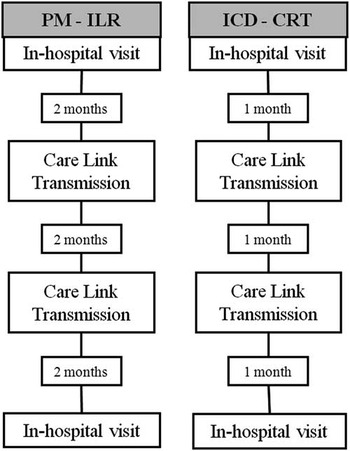
Dates for transmissions were scheduled every 2 months for pacemakers and implantable loop recorders, and every month for implantable cardioverter defibrillators and cardiac resynchronisation therapy devices (Fig 1). Patients were asked to send additional transmissions if complications or symptoms developed. Wireless devices – last generation implantable cardioverter defibrillators – automatically sent transmissions for critical events, set as alerts. Events transmitted included the following: high atrial or ventricular rate that is generally set to 180 bpm in pacemakers, capture management for pacing thresholds, variations of lead impedance that is generally set >3000 and <200 Ω, elective replacement indicator, atrial tachycardia/fibrillation, supraventricular tachycardia, ventricular tachycardia/fibrillation, ventricular sensing episodes in cardiac resynchronisation therapy devices, ventricular pacing <90% in cardiac resynchronisation therapy devices, fluid accumulation – OptiVol fluid index present in last generation non-wireless pacemakers and in wireless implantable cardioverter defibrillators, which measures transthoracic impedance variations as an indicator of heart failure onset.
Flow-chart of follow-up in patients with PM/ILR and ICD/CRT. CRT=cardiac resynchronisation therapy device; ICD=implantable cardioverter defibrillator; ILR=implantable loop recorder; PM=pacemaker.

The review of all transmissions was carried out by two cardiac physiology technicians within 2 working days. If no critical events were reported, transmissions were archived, whereas transmissions with relevant events were forwarded for physician review. In case of missed transmissions, patients were recalled within a week of the scheduled date. The time (minutes) spent by technicians in reviewing the first 500 transmissions was recorded from the opening of patient transmission, including downloading, to final decision – transmission archiving or physician review.
Statistical analysis
Proportions or, where appropriate, means or medians together with standard deviation and range were computed. Data received by remote control were analysed to evaluate the number of scheduled and unscheduled transmissions, the missed ones, and the events found. Transmissions were also analysed in patients with or without other congenital or structural heart defects (CHD) – for example, cardiomyopathies – with two-sample t-test, Pearson χ2-test, or Fisher’s exact test. An analysis of variance model was used to assess results of transmissions according to different age groups: children (<12 years) versus adolescents (13–18 years) and versus adults (>18 years). A p-value <0.05 was considered statistically significant. All statistical analyses were conducted using StataSE 12.0 (StataCorp., College Station, Texas, United States of America).
Results
Out of a total of 520 patients with cardiac implantable electronic devices, 221 patients implanted with a Medtronic device were enrolled in the study – 200 pacemakers, 19 implantable cardioverter defibrillators (18 wireless), and two implantable loop recorders.
Patients were enrolled either at the time of first device implantation (n=44), or at generator replacement (n=39), or during in-hospital visits for scheduled follow-up (n=138).
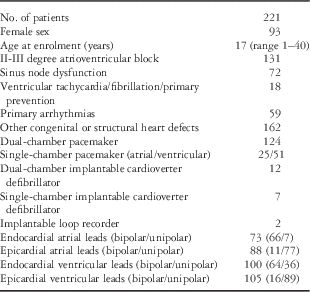
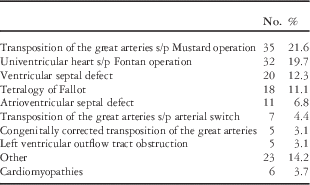
The baseline characteristics of the enrolled population are reported in Table 1. Age at implant was 7 years (1 day–30 years) [median (range)], age at enrolment in the CareLink Network was 17 years (1–40 years). There were 71 patients younger than 12 years of age; 58 patients between 13 and 18 years of age; and 92 patients older than 18 years of age. Cardiac implantable electronic devices and leads used are described in Table 1. CHDs were documented in 162 patients (73%) (Table 2). Among all, 11 patients received a device for cardiac resynchronisation therapy-pacemaker, implanted with epicardial leads in seven, and one had a device for cardiac resynchronisation therapy-defibrillator implanted with epicardial leads; 22 patients were pacemaker-dependent.
Patient characteristics.

Patients with other congenital or structural heart defects (n=162).

s/p=status post
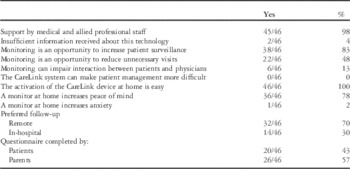
The questionnaire was given to the first 50 patients and was completed by 46 patients (43% patients and 57% parents). Results of patients’ level of acceptance and satisfaction with the CareLink system are summarised in Table 3. In general, patients and parents showed positive attitude towards this new technology: most subjects preferred remote (70%) than in-hospital (30%) follow-up. Information given about the system and staff support were found satisfactory. Remote monitoring was expected to increase patient surveillance and reduce unnecessary controls without impairing interpersonal relationship or patient management. The remote control system was considered user friendly by parents. The presence of a home monitor increased peace of mind in 78% of the participants, whereas it increased anxiety in only 2%.
Results of the questionnaire on patients’ expectations and level of acceptance and satisfaction with the CareLink system.

During the enrolment period, only one family (0.4%) declined remote follow-up because of the difficulty in completing data transmissions (non-wireless pacemaker).
Transmissions
From February 2011 to August 2012, during a median follow-up of 12 months (range 4–18), the technicians reviewed 1361 transmissions. On average, there were 17 transmissions per week.
The mean time spent by technicians in reviewing transmissions was 6±2 minutes – that is, on average nearly 100 minutes a week.
A total of 1264 scheduled transmissions were recorded (92.9% of reviewed transmissions). There were 128 missed transmissions (10.1% of scheduled transmissions), and 122 unscheduled (patient-initiated) transmissions (8.9% of reviewed transmissions). All patients performed a test transmission at enrolment, which was not counted in the total number of transmissions reviewed.
Of the 128 missed transmissions, 103 (80.4%) were due to patient noncompliance – that is, they forgot to transmit – and 25 (19.6%) were related to problems with wired connection. These patients were recalled, forgotten transmissions were performed – once received were considered performed – and connection problems were solved by providing patients with the M-Link system that allows wireless data transmission using Global System for Mobile Communications connection. In one case, it was necessary to replace the CareLink monitor. The 25 transmissions missed because of connection problems were considered as “truly” missed (1.6% of scheduled transmissions): if a home monitoring station was replaced, transmissions were considered as newly scheduled.
By adding the 122 unscheduled transmissions to the 1264 scheduled ones, and detracting the 25 “truly” missed transmissions, a total of 1361 transmissions were received.
The 122 unscheduled, patient-initiated, transmissions included 22 alerts from wireless devices (18%), 40 (33%) patient-related errors such as repeated transmissions or manual transmissions from a wireless device that had already sent an alert, 32 (26%) transmissions for symptom occurrence such as presyncope, syncope, or tachycardia or implantable cardioverter defibrillator alert tones, and 28 (23%) checks of device functioning after suspected electromagnetic interference or a child’s trauma.
In patient-initiated transmissions due to symptom onset or suspected electromagnetic interference, data stored in the devices did not show correlation between symptoms/interferences and arrhythmias or signs of device failure. This avoided urgent extra follow-up or emergency room admissions, and patients came back to the hospital only for a scheduled follow-up.
Events
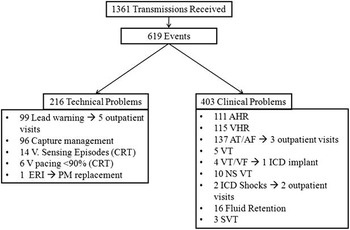
Out of the 1361 transmissions reviewed, 619 (45%) were associated with events, differentiated between technical and clinical problems (system versus patient) (Fig 2).
Events detected through CareLink transmissions. AHR=atrial high rate; AT/AF=atrial tachycardia/fibrillation; CRT=cardiac resynchronisation therapy device; EPS=electrophysiologic study; ERI=elective replacement indicator; ICD=implantable cardioverter defibrillator; NS=non-sustained; PM=pacemaker; SVT=supraventricular tachycardia; V=ventricular; VF=ventricular fibrillation; VHR=ventricular high rate; VT=ventricular tachycardia. See text for further details.

Most technical problems were related to lead impedance warnings and capture management. Only elective replacement indicator warning and five impedance warnings, including three red alerts in implantable cardioverter defibrillator patients (see below) and two epicardial lead fractures, one atrial and one ventricular, were considered clinically relevant.
Clinical problems included high rates, supraventricular tachycardia/ventricular tachyarrhythmias, implantable cardioverter defibrillator shocks, and fluid accumulation. Despite the occurrence of ventricular tachyarrhythmias, only three out of 364 (0.8%) arrhythmia episodes – atrial or ventricular high rate, atrial tachycardia/fibrillation, or supraventricular tachycardia – were considered clinically relevant (see below).
Other technical and clinical events were interpreted as artefacts, not relevant impedance or threshold variations, inappropriate detections by the devices, non-sustained tachycardias not requiring further therapeutic interventions, non-pathological arrhythmias – that is, sinus tachycardia) – or simply as data already known in previous follow-up.
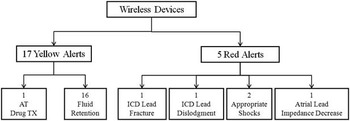
Of the 619 events, 17 (2.7%) were yellow alerts sent by wireless devices, and five (0.8%) were red alerts (Fig 3).
Alerts by wireless devices (implantable cardioverter defibrillators). AT=atrial tachycardia; ICD=implantable cardioverter defibrillator; TX=therapy.

Of the 17 yellow alerts, 16 resulted from the OptiVol fluid index exceeding the threshold, whereas one alert was due to an episode of prolonged atrial tachycardia. After OptiVol alerts, all patients were contacted by phone, but no clinically significant correlation was found between fluid index and patient symptoms. The OptiVol fluid index was reset in a patient who performed data transmission three times following an OptiVol alert.
Among red alerts, three were due to lead impedance warnings in implantable cardioverter defibrillator patients – one lead dislodgement, one lead fracture, and one atrial lead impedance <200 Ω. The other two red alerts reported ventricular fibrillation episodes appropriately treated by a shock.
During follow-up, one patient with a pacemaker, which did not have alert tones, had a fracture of the epicardial ventricular pacing lead that went undetected by the remote control system because the fracture occurred 2 days after transmission. The patient was asymptomatic with an adequate junctional escape rhythm, and the fracture was detected 60 days later during the outpatient follow-up visit.
No special conditions were observed in pacemaker-dependent patients. No clinically relevant arrhythmias were detected in the two patients with implantable loop recorders, who did not experience symptoms.
Transmissions reviewed by physicians
A total of 39 (6.3%) transmissions with events or alerts required physician review. These included all the alerts of wireless devices, and the technical and clinical problems judged as clinically relevant. After physician evaluation, 29 patients (13% of patients, 4.7% of events) were contacted by phone, and of these 12 (5%) were recalled for an extra outpatient follow-up visit Among them, three were recalled for atrial tachycardia, four for lead impedance warnings, one for repeated OptiVol alerts, one for a ventricular tachycardia episode and syncope, two after a correct implantable cardioverter defibrillator shock, and one for elective replacement indicator warning. Patients with atrial tachycardia underwent electrical or pharmacological cardioversion, and those with lead warnings underwent reimplantation.
The patient with a pacemaker who experienced syncope and ventricular tachycardia was upgraded to an implantable cardioverter defibrillator. Pacemaker replacement was electively scheduled for elective replacement indicator warning.
For these patients, the recognition of events with CareLink system occurred 76 days (16–150 days) earlier than the next scheduled in-office follow-up.
Analysis of subgroups
Patients with or without CHD were compared, and no significant differences were observed in the total number of transmissions (11.2±7.7 versus 10.6±6.0, p=0.58), scheduled transmissions (11.3±6.4 versus 10.5±5.4, p=0.39), missed transmissions (1.1±1.9 versus 0.8±1.8, p=0.26), unscheduled transmissions (1.0±1.9 versus 1.0±1.2, p=0.83), events (6.4±6.9 versus 6.9±6.7, p=0.68), yellow alerts (p=0.49), or red alerts (p=1.00).
In addition, the analysis of variance model for subgroups of patients divided by age (adolescents versus children and adults versus children) did not show any significant difference in the total number of transmissions (p=0.60 and 0.84, respectively), scheduled transmissions (p=0.81 and 0.74, respectively), missed transmissions (p=0.58 and 0.17, respectively), unscheduled transmissions (p=0.73 and 0.10, respectively), and events (p=0.47 and 0.46, respectively).
Discussion
Remote monitoring is a safe and effective alternative to conventional outpatient follow-up for adults implanted with a pacemaker or an implantable cardioverter defibrillator. It enables early detection and management of clinical events, shortens time to clinical decision in response to events, reduces unnecessary visits, optimises resources, and has a favourable impact on patient survival.Reference Crossley, Chen and Choucair 3 – Reference Crossley, Boyle, Vitense, Chang and Mead 6 , Reference Landolina, Perego and Lunati 10 , Reference Saxon, Hayes and Gilliam 14 , Reference Ricci, Morichelli and D’Onofrio 15 Above all, in patients with implantable cardioverter defibrillator, early recognition of lead malfunction is crucial to prevent inappropriate shock delivery.Reference Spencker, Coban, Koch, Schirdewan and Muller 16 , Reference Varma, Michalski, Epstein and Schweikert 17
According to a recent survey of the European Heart Rhythm Association,Reference Halimi and Cantù 18 devices compatible with a remote monitoring system are implanted in 20% of paediatric centres.
Excluding case reports, there are few studies about remote follow-up and monitoringReference Dubner, Auricchio and Steinberg 19 of implantable devices in the paediatric field. Malloy et alReference Malloy, Gingerich, Olson and Atkins 20 retrospectively reviewed the results of remote monitoring (CareLink and Boston ScientificTM Latitude systems) in 198 patients, with median age of 18 years. Of 615 transmissions submitted, 16% had adverse events and 11% required clinical intervention. There have been two studies published about the use of Home Monitoring (BiotronikTM) system. In 45 children, Zartner et alReference Zartner, Toussaint-Goetz, Photiadis, Wiebe and Schneider 21 showed that 17% of transmissions were related to acute variations in lead parameters or tachycardia episodes, which required medical intervention. Half of these transmissions occurred during the first month following device implantation or after the last outpatient visit. De Asmundis et alReference De Asmundis, Ricciardi, Namdar, Chierchia, Sarkozy and Brudaga 22 described 11 children with Brugada syndrome who received an implantable cardioverter defibrillator. Most patients experienced lead and device dysfunction or inappropriate therapies, and the alerts received led to treatment of these problems 76 days earlier than the scheduled follow-up.
To the best of our knowledge, this study enrolled the largest paediatric and congenital heart disease patients’ cohort with cardiac implantable electronic devices remotely monitored by the CareLink system. The study population is approximately half of all patients implanted in our centre. This study neither aimed at comparing outpatient visits with remote follow-up or monitoring nor at reducing the number of the former. As an initial extensive experience with the CareLink system in the paediatric field, it aimed at evaluating this new monitoring method to improve device surveillance and patient management.
The level of satisfaction of young patients with remote monitoring and follow-up was as high as that reported in adults.Reference Raatikainen, Uusimaa, van Ginneken, Janssen and Linnaluoto 12 , Reference Dubner, Auricchio and Steinberg 19 Patients and parents expressed a positive attitude towards this new technology, and the home monitor increased psychological well-being in most patients. In addition, the majority of patients preferred remote follow-up and monitoring to in-hospital follow-up.
Most of the study population (58%) was in the paediatric age range, and most of the patients (73%) had CHD. In patients with or without CHD, as well as in children, adolescents, or adults, no significant differences were recorded in the total number of transmissions, either scheduled, unscheduled, missed, or associated with events. Only a small proportion (6.3%) of events were reviewed by physicians, and only 13% of patients were contacted by phone. Most of the high rate events (Fig 2) showed sinus tachycardia, inappropriate detection of farfield signals, or artefacts – for example, myopotentials – due to unipolar lead frequently used in epicardial implants.Reference Silvetti, Drago, Grutter, De Santis, Di Ciommo and Ravà 1 , Reference Silvetti, Drago, Di Carlo, Placidi, Brancaccio and Carotti 2 All OptiVol alerts were judged as false-positive. Indeed, the sensitivity and positive predictive value of OptiVol was shown to be low in a paediatric population with a low rate of systemic ventricular failure or with epicardial systems.Reference LaPage, von Alvensleben, Dick, Serwer and Bradley 23 In the majority of cases, the knowledge of both patients and devices enabled technicians and physicians to recognise not clinically relevant problems or already known situations that did not require further investigations than those provided during scheduled outpatient visits. In addition, the CareLink system led to an earlier recognition of several clinically relevant events – that is, lead fracture, atrial or ventricular arrhythmias – allowing physicians to make quicker decisions.Reference Crossley, Chen and Choucair 3 – Reference Varma, Epstein, Irimpen, Schweikert and Love 5 , Reference Furukawa, Maggi and Bertolone 11 , Reference Spencker, Coban, Koch, Schirdewan and Muller 16 , Reference Varma, Michalski, Epstein and Schweikert 17
In pacemaker-dependent patients, no unexpected events were recorded. It is likely that a longer follow-up would reveal a higher number of clinically relevant technical problems, given that a paediatric population is at high risk for device malfunction.Reference Silvetti, Drago, Grutter, De Santis, Di Ciommo and Ravà 1 , Reference Silvetti, Drago, Di Carlo, Placidi, Brancaccio and Carotti 2 Transmissions were scheduled every 2 months for pacemakers and implantable loop recorders, and every month for implantable cardioverter defibrillators, pacemaker-dependent patients, and cardiac resynchronisation therapy devices. At present, there are no guidelines that suggest the exact timing of scheduled transmissions for remote follow-up of non-wireless devices, especially in children. In this study, scheduling of transmissions every 3 months would have delayed the recognition of two of five events (40%); however, the few clinically relevant events of non-wireless devices requiring extra in-office follow-up visits (five of 12 cases) do not allow further analysis and reliable conclusions, although this and other works may aid in coming up with guidelines.
Nearly 10% of transmissions were missed due to patient non-compliance or phone line connection problems. This rate of missed transmissions is comparable with the 8% of non-compliant children described by Malloy et al,Reference Malloy, Gingerich, Olson and Atkins 20 but it is higher than that reported in other remote monitoring registries, as in the TRUST trial where transmission failure occurred in 0.97% of patients.Reference Ricci and Morichelli 24 By contrast, in the PREFER study,Reference Crossley, Chen and Choucair 3 30% of transmissions were not sent or received, and in the CONNECT trial automatic alerts were triggered but not successfully transmitted in 45% of events; moreover, many events did not trigger an automatic alert because the alert was switched off or not reset after being triggered.Reference Crossley, Boyle, Vitense, Chang and Mead 6 Movsowitz and Mittal showed that 25% of patients implanted with a wireless device never sent transmissions, and only 5.2% completed the scheduled quarterly transmissions.Reference Movsowitz and Mittal 25 Other authors reported 49% of missed transmissions due to patient non-compliance.Reference Cronin, Ching, Varma, Martin, Wilkoff and Lindsay 26 CareLink system is a platform that utilises inductive systems without automatic alerts in pacemakers, requiring patient interaction to transmit data.Reference Cronin and Varma 27 Therefore, in young patients with CareLink system, there is room for greater family compliance. The education of families plays a significant role in increasing their compliance.
In our study, unscheduled transmissions accounted for <10% of total transmissions, and were generally useful to reassure patients and to avoid urgent additional in-hospital follow-up visits or emergency admissions.
The time spent by technicians in reviewing transmissions was shorter than that reported (30 minutes) in a paediatric study,Reference Malloy, Gingerich, Olson and Atkins 20 and it was comparable with data reported in an adult series: 9.3±15.9 minutes in Raatikainen et al,Reference Raatikainen, Uusimaa, van Ginneken, Janssen and Linnaluoto 12 11.5±7.7 minutes in Cronin et al,Reference Cronin, Ching, Varma, Martin, Wilkoff and Lindsay 26 96±39 seconds per patient, and on average 59 minutes/week in Ricci et al.Reference Ricci, Morichelli and Santini 28 Although this time should be added to physicians’ and technicians’ workload, the earlier detection of arrhythmias and device complications along with the reduction in unscheduled follow-up visits due to patient-initiated transmissions that do not show events will probably result in less resource utilisation.
There was only one case of lead fracture occurring between a transmission and a scheduled in-hospital visit. This event was not recorded by the remote monitoring system, but was detected during outpatient follow-up. This is a limitation of a system that, for non-wireless devices, transmits data only at scheduled intervals, with a stepwise appearance of the probability curve of events related to the time of transmissions.Reference Crossley, Chen and Choucair 3
Limitations
This was a single-centre experience based on the observation of daily clinical practice. The main limitation was that there is no comparison group; therefore, no definitive conclusions can be reached about the comparative performance of remote monitoring and conventional follow-up in our population. Despite the large cohort of children, the follow-up period was short/medium. The low number of wireless devices in this cohort of patients is a limitation of this study. The result could be different and more relevant with a larger proportion of wireless devices.
Conclusions
Based on these results, remote follow-up and monitoring via Medtronic CareLink system is useful in enhancing cardiac implantable electronic device surveillance in young patients. No differences were observed in the number of transmissions performed by patients with or without CHD or by children, adolescents, or adults. Many transmissions occurred without events, and most of the reported events were considered not clinically relevant; however, in a small percentage of events or alarms, remote control allowed physicians to diagnose and manage arrhythmias or pacing system complications earlier than expected. Without remote monitoring system, these events would have been documented later during routine in-hospital visits or after symptom occurrence. In addition, unscheduled transmissions prevented unnecessary hospital admissions in case of doubtful or suspicious symptoms. The time spent for transmission review was relatively short. Patients’ level of satisfaction was high, and <1% of our population declined remote follow-up.
Acknowledgements
The authors thank Antonio Longoni, CCP, and Silvana Lunerti, MSN, for technical assistance in the clinical and remote management of pacemaker patients, Dr Lucilla Ravà for statistical analysis, and Dr Elisa Del Vecchio for her valuable collaboration in editorial revision.
Financial Support
This research received no specific grant from any funding agency, commercial, or not-for-profit sectors.
Conflicts of Interest
None.