We report here on the observation of an abundant macroalga living at great depth (166 m) in the high Arctic. The macroalga appears in benthic images recorded on 19 September 2011 at 79°52′N 11°53′E, in outer Raudfjorden, Spitsbergen, Svalbard (Figure 1). Photos were originally recorded for the purpose of benthic habitat mapping, and the presence of the macroalga was noted during later analysis.
Map showing location of Svalbard (inset, NASA) and the site in outer Raudfjorden where the macroalga was observed (red star) as well as the location of a reference station on the shelf (blue circle). Depth contours shown every 100 m.

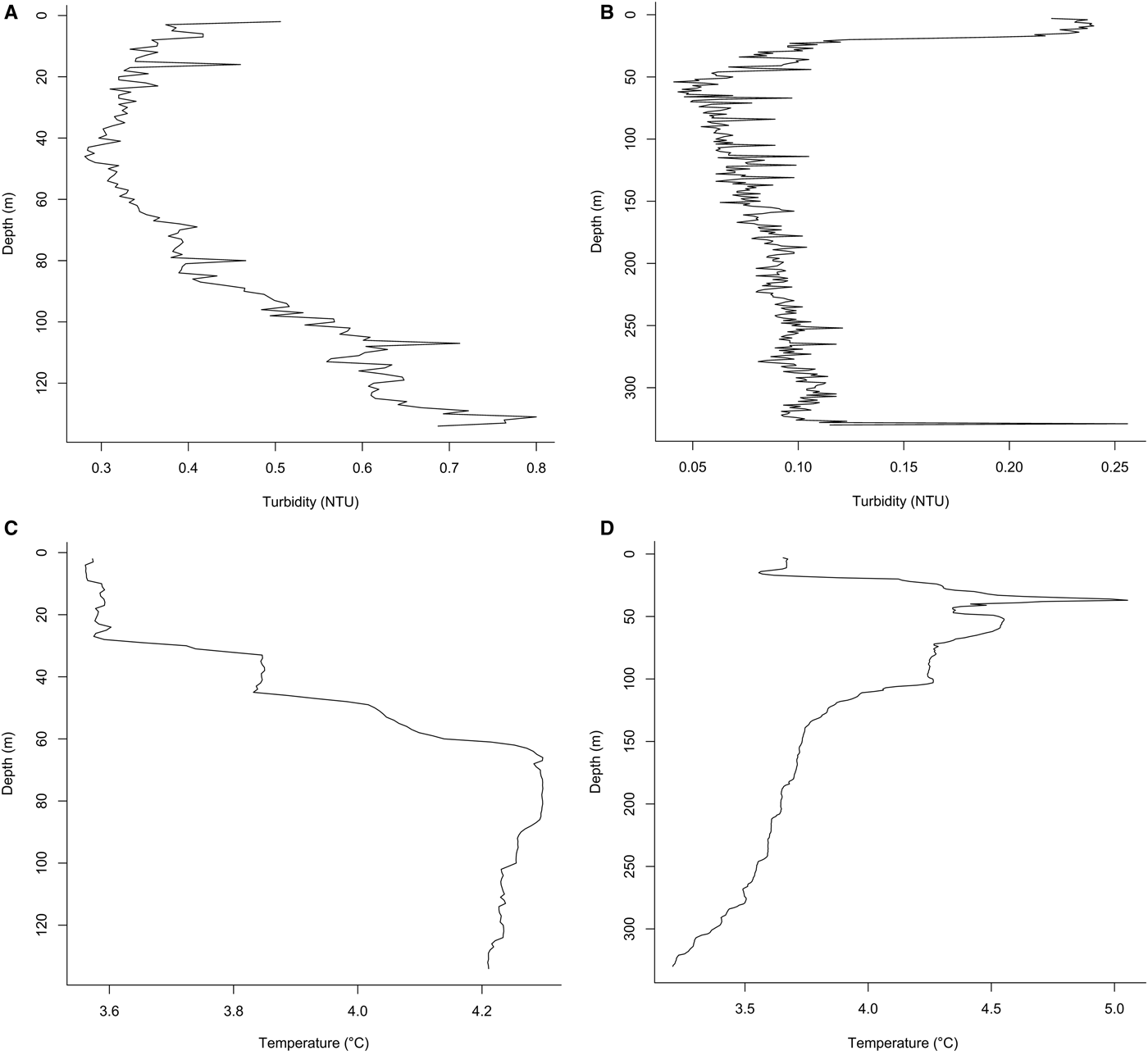
Photographs were recorded using a vertical-facing camera system deployed from R/V Helmer Hanssen. The camera system (Ocean Imaging Systems DSC 12000 camera and strobe system with Nikon D90 digital Single Lens Reflex camera) and 1.2 × 1.2 m2 steel frame were lowered from a ship-mounted winch, and each photo was triggered when a weight suspended 2.5 m below the camera lens contacted the seafloor. Lasers mounted 26 cm apart were used for size reference. Further camera details can be found in Sweetman & Chapman (Reference Sweetman and Chapman2011). The size of algae and stones, as well as the percent cover of the macroalgae, were measured using ImageJ (1.47v). Water column turbidity and temperature were measured on 19 September 2011 using a Seapoint Turbidity Meter attached to a Seabird SBE 9/11+ CTD, and data were aggregated into 1 m depth bins.
Images recorded in outer Raudfjorden at a depth of 166 m show what appears to be an abundant macroalga on stones at the seafloor (Figure 2). Unfortunately, in the absence of voucher specimens, it is impossible to say with absolute certainty that the observed organisms are not in fact something else, such as a hydrozoan, but in every respect, the organisms certainly appear algal in nature. Based on colour alone, it appears it may be a brown (Phaeophyceae) or red alga (Rhodophyta), though without further information, taxonomic identification is impossible. The alga appears to consist of a thin, flexible thallus with an alternate branching pattern. Thin, stringy filaments cover the thalli. Superficially, the alga is morphologically similar to Desmarestia aculeata, which has been collected down to 20 m in Kongsfjorden (Hop et al., Reference Hop, Wiencke, Vögele and Kovaltchouk2012). Individuals are on average 30.7 ± 1.6 cm in length (mean ± SE), and the largest individual observed was 88.8 cm. Individuals could be found alone but often formed thick, bush-like stands on a stone.
Two selected images showing the presence of an abundant, live macroalga at 166 m in Raudfjorden, Spitsbergen. Black scale bar = 26 cm for both images.
The alga is seen attached to both the tops and sides of stones on the seafloor. In 30 recorded images, an average of 66% of stones feature the macroalga. Of these inhabited stones, the macroalga occurs at an average of 74 ± 3.4% cover (mean ± SE). The only other hard-bottom fauna present at this station include an unknown morphotype, possibly a bryozoan, and a pink sea star. The soft-sediment fauna is also depauperate, as the most common item observed on the sediment are the white shells of dead clams.
The macroalga observed in the images is visibly attached to the rocks (Figure 2), so it is clearly not detrital matter, which has been deposited from a shallower depth. In many images, the alga is found streaming in the bottom current, which could only be accomplished if it were alive and attached to the rock substrata. The deep brown colour also suggests the presence of photosynthetic pigments, again indicating that the alga is alive. The origin of the stones to which the alga is attached is unknown, but some stones are covered in a layer of sedimented material, implying that the stones had been present for a long time, and others are even partially buried in the sediment. The stones at the fjord station are also quite large (177.8 ± 53.8 cm, mean ± SE), and the seafloor slopes at a mere 3–4° adjacent to the fjord station. It is, therefore, unlikely that these stones were recently deposited at this station from a shallower depth and merely carried the attached alga with them.
Raudfjorden, where the macroalga was observed, is characterized by heavy glacial sedimentation, which increases toward the fjord head (Elverhøi et al., Reference Elverhøi, Lønne and Seland1983; Holte & Gulliksen, Reference Holte and Gulliksen1998). Turbidity of the water was much higher at the fjord photo station than at a reference station on the adjacent continental shelf (Figure 3A, B). In fact, turbidity values in the bottom 10 m of the water column were approximately seven times higher at the fjord station than on the shelf. It must be borne in mind that these measurements show only one point in time at the end of the Arctic summer and only extend down to 134 m at the fjord station (not to the seafloor at 166 m). Nevertheless, the present macroalga is likely exposed to very turbid, low-light conditions. Irradiance at depth has to the authors’ knowledge not been measured in Raudfjorden; however, light attenuation coefficients are available from nearby Kongsfjorden. Svendsen et al. (Reference Svendsen, Beszczynska-Möller, Hagen, Lefauconnier, Tverberg, Gerland, Ørbæk, Bischof, Papucci, Zajaczkowski, Azzolini, Bruland, Wiencke, Winther and Dallmann2002) report a K d value of 0.13 m−1 at the mouth of Kongsfjorden. Using this number, it can be extrapolated that only 4.2 × 10⁻⁸% of surface irradiance would reach the seafloor at 166 m.
Environmental conditions at the fjord station where macroalga was observed and at a reference station on the shelf. (A) turbidity at the fjord station; (B) turbidity on the shelf; (C) temperature at the fjord station; (D) temperature on the shelf. Note different scales of x- and y-axes.
Several studies report macroalgae occurring at great depths (30–60 m) at temperate and tropical latitudes (Hannisak & Blair, Reference Hannisak and Blair1988; Vadas & Steneck, Reference Vadas and Steneck1988; Spalding et al., Reference Spalding, Foster and Heine2003). Littler et al. (Reference Littler, Littler, Blair and Norris1986) observed foliose algae as deep as 189 m and crustose coralline algae as deep as 268 m off the coast of the Bahamas, and it has been predicted that extensive deepwater algal refugia exist at depths of 30–200 m throughout the tropics (Graham et al., Reference Graham, Kinlan, Druehl, Garske and Banks2007), though the clarity of the water is likely to be much greater here compared to our turbid study site. Littler et al. (Reference Littler, Littler, Blair and Norris1986), for example, reported 1 × 10⁻³% of surface irradiance at 189 m, where the deepest foliose alga was found. This is a full five orders of magnitude greater than our extrapolated irradiance value; however, this value was merely extrapolated from another fjord, and the true K d value for outer Raudfjorden may in fact be lower.
Water temperature can affect the distribution of polar algae (Gómez et al., Reference Gómez, Wulff, Roleda, Huovinen, Karsten, Quartino, Dunton and Wiencke2009), though in this case, water temperature at the fjord station was not largely different from that on the shelf. Bottom water differed by only about 1°C between the fjord and the reference station (Figure 3C, D).
Macroalgae in polar regions are often adapted to low-light conditions, which they experience especially during the winter (Gómez et al., Reference Gómez, Wulff, Roleda, Huovinen, Karsten, Quartino, Dunton and Wiencke2009; Wulff et al., Reference Wulff, Iken, Quartino, Al-Handal, Wiencke and Clayton2009). Several studies have shown that increased UV and photosynthetically-active radiation inhibited photosynthetic production in polar macroalgae and that the effect was more pronounced for macroalgae collected at greater depths (Bischof et al., Reference Bischof, Hanelt and Wiencke1998; Aguilera et al., Reference Aguilera, Karsten, Lippert, Vögele, Philipp, Hanelt and Wiencke1999; Karsten et al., Reference Karsten, Bischof and Wiencke2001). Much research on polar macroalgal communities in fact centres on the inhibition of photosynthesis and other negative effects of UV radiation, which in many cases determine the upper distribution limits of macroalgal species (Gómez et al., Reference Gómez, Weykam, Klöser and Wiencke1997; Bischof et al., Reference Bischof, Gómez, Molis, Hanelt, Karsten, Lüder, Roleda, Zacher and Wiencke2006). However, to our knowledge, no previous studies have reported specimens of macroalgae collected below ~40 m in the Arctic.
The combination of polar night conditions and ice cover can cause polar macroalgae to exist in darkness for up to ten months out of the year, even at shallow depths (Zacher et al., Reference Zacher, Rautenberger, Hanelt, Wulff and Wiencke2009). The present macroalga may be adapted to extremely low-light conditions, since there are multiple factors limiting light exposure at its location. It occurs at great depth, in turbid water and at a high enough latitude to experience the polar night. In the future, it is desirable to collect specimens in order to taxonomically identify the alga and to understand how it is able to survive in such low-light conditions. The present report is not the deepest record of macroalgal presence in the world (see Littler et al., Reference Littler, Littler, Blair and Norris1986), but it may very well be the deepest macroalgal record to date for the high Arctic.
ACKNOWLEDGEMENTS
This material is based upon work supported by the National Science Foundation Graduate Research Fellowship Program under Grant No. DGE-0829517. Additional funding was provided by the University Centre in Svalbard. I. Kjersti Sjøtun (University of Bergen) provided taxonomic council. The suggestions of two anonymous reviewers significantly improved an earlier version of this manuscript.