

1. Introduction
Many people learn and use a third language. This is particularly true in multilingual settings, where several languages are part of everyday life. Asia and Africa are the most multilingual continents but third language acquisition (TLA) is common in many other parts of the world as well. TLA is more common among the immigrant population and speakers of minority languages but second, third and additional languages can also be learned in monolingual contexts.
Third language acquisition is a relatively new area of research that has expanded rapidly in recent years, highlighting the differences between acquiring a second and third language. The term ‘TLA’ usually denotes ‘the acquisition of a language that is different from the first and the second and is acquired after them’ (Cenoz forthcoming a); it is also used to denote the study of third language acquisition. Although there are different terminological proposals (see, for example, Hammarberg Reference Hammarberg2010), in this article I use ‘third language’ to mean a language acquired chronologically after the first and the second or after the two first languages in the case of early bilinguals.
Differences between second language acquisition (SLA) and TLA have been neglected in SLA research and in studies on bilingualism. For this reason, TLA can be considered as a reaction. The intense activity in TLA is reflected in the number of monographs, special issues and edited volumes published recently on different aspects of TLA (see, for example, Safont Reference Safont2005; De Angelis Reference De Angelis2007; Cenoz Reference Cenoz2009; Aronin & Hufeisen Reference Aronin and Hufeisen2009; Leung Reference Leung2009; Lindqvist & Bartel Reference Lindqvist and Bartel2010). In 2004, a specialized journal, the International Journal of Multilingualism made its appearance. Other activities are the bi-annual conference on TLA, the International Conference on Third Language Acquisition and Multilingualism and the International Association of Multilingualism.
TLA is a broad area and research focuses on different processes and factors affecting its development. Research in TLA can also adopt a variety of methodologies. The term TLA is sometimes used as synonymous for ‘multilingualism’, but in a strict sense it means the acquisition of a third language, and multilingualism is a much broader term that does not necessarily refer to acquisition. TLA can be regarded as a specific aspect of the study of multilingualism (see Cenoz forthcoming b). The areas of TLA that have received most attention are cross-linguistic influence on TLA and the influence of bilingualism or prior linguistic knowledge on the acquisition of a third language.
With regard to the first of these areas, learners are influenced by both their L1 and L2 when learning an L3 and research on cross-linguistic influence in TLA has tried to identify the patterns of this influence at the phonological, lexical and syntactic levels as well as the factors that can predict this influence (De Angelis Reference De Angelis2007; Ringbom Reference Ringbom2007; Hammarberg Reference Hammarberg2009; Lindqvist & Bartel Reference Lindqvist and Bartel2010; Wrembel, Gut & Mehlhorn Reference Wrembel, Gut and Mehlhorn2010).
In this paper I will focus on the second area, that is, the influence of bilingualism or prior linguistic knowledge on the acquisition of a third language. The question that needs to be answered and discussed here is this:
Do bilinguals have advantages over monolinguals when learning an additional language?
In section 2, I will compare SLA and TLA and in section 3, I will provide a brief review of research on TLA. Then, in section 4, I will argue that the research approach used so far in TLA research poses some problems, and I will discuss an alternative approach, focus on multilingualism. The last section of this paper briefly mentions the teaching implications of this approach.
2. Second language acquisition and the acquisition of additional languages
TLA shares many of the characteristics of SLA, but there are also important differences because third language learners already have at least two languages in their linguistic repertoire. Third language learners can use this broader linguistic repertoire when learning a third language. For example, they can relate new structures, new vocabulary or new ways of expressing communicative functions to the two languages they already know, not just to one of them, as in the case of monolinguals. Learners who have gone through the process of learning a second language are also more experienced language learners and it is likely that they have developed certain skills and strategies for achieving the language-learning task. When facing the task of learning a third language, these skills and strategies can be reactivated and adapted to the new challenge. We could compare this experience to walking (L1), then learning to drive a car (L2) and then facing the challenge of driving a bus (L3). The experience of driving a car, despite involving different skills and strategies, can nevertheless be extremely useful when driving another type of vehicle: the starting point is not the same as for an absolute beginner. Even though the difference seems clear, it has not been acknowledged in SLA studies that refer to any target language as ‘L2’, paying little attention to the learners’ language learning background or experience.
When multilingual speakers, who have gone through the process of acquiring an L3 (L4 or L5), reflect on how they acquire languages, they do explain that other languages are useful and that they are used as a basis. Take the case of Humphrey Tonkin (Reference Tonkin, Todeva and Cenoz2009: 201), a multilingual speaker, brought up in a monolingual English home, with experience in Esperanto, Latin, English, French, German, Italian and Dutch: ‘The art of language learning may lie not in the acquisition of an individual language but in mastery of the learning process itself’.
Elka Todeva (Reference Todeva, Todeva and Cenoz2009: 68), a multilingual speaker with Bulgarian as a first language and with experience in languages such as English, French, Italian, Norwegian, German, Spanish, Latin, Greek, Japanese and Russian, also acknowledges the role played by other languages, particularly those that are closer to the target language:
. . .my rich language learning experience assists me tremendously in breaking the code of new languages, particularly if they belong to a language family from which I already know one or more languages.
The usefulness of prior linguistic knowledge, acknowledged by these multilinguals who acquired first their mother tongue and, later, other languages, is shared by early bilinguals, who acquired two languages as a child. For example, Hayan Hu (Reference Hu, Todeva and Cenoz2009: 219), an early bilingual, explains the advantages of having acquired two languages as first languages:
My background as a speaker of two first languages, the dialects Huihui and Yunnan, helped me develop an inventory of sounds and an almost innate awareness of different sentence structures, which I believe has facilitated my learning of English, Japanese, Mandarin, Cantonese and Spanish as an adult.
Another noticeable difference between SLA and TLA is related to diversity of learning contexts. ‘SLA’ usually means a second language that is learned chronologically after the first language. However, that second language can be learned in a variety of significantly different ways. For example, a second language can be studied as a foreign language for a few hours a week at school, or it may be the language of instruction or the main language of the community. There can be differences related to many other factors such as age, instructional methods or motivation. In the case of TLA, this diversity exists not only for the target language but is also related to the way the second language was acquired. Moreover, it is important to take into account that TLA is very common among early bilinguals who have acquired their two first languages simultaneously. There can be also important differences in the use of the languages. Some L3 learners are active bilinguals who use their other two languages in everyday life, while others live in a monolingual context and use their second language, in this case a foreign language, only occasionally.
However, as we would expect, TLA shows not only differences from but also strong similarities with SLA. They are both processes of acquiring a non-native language, but TLA brings together SLA and bilingualism because it is related to the outcomes of bilingualism along with other cognitive and social outcomes such as metalinguistic awareness or creativity (see, for example, Baker Reference Baker2011).
3. Do bilinguals and multilinguals have advantages over monolinguals in L3 acquisition?
Beliefs about the advantages of prior linguistic knowledge reported by multilinguals are usually shared by the general public. According to folk wisdom, the more languages a person knows, the easier it becomes to acquire an additional language. Does research on TLA confirm these beliefs? In this section I summarize the main trends observed in research on this issue.
Studies in the 1960s and 1970s reported that bilinguals had some advantages over monolinguals in phonetic discrimination skills and auditory discrimination tests. They also found that more balanced bilinguals (those with similar competence in their two languages) made fewer errors than less balanced bilinguals (see Cenoz Reference Cenoz2003 for a review). Laboratory studies with artificial linguistic systems in the 1980s and early 1990s also reported that multilingual learners demonstrated greater flexibility than monolinguals in the use of learning strategies (Nation & McLaughlin Reference Nation and McLaughlin1986; McLaughlin & Nayak Reference McLaughlin, Nayak, Dechert and Raupach1989; Nayak et al. Reference Nayak, Hansen, Krueger and McLaughlin1990).
At about the same time, studies on TLA were conducted in bilingual education programs in Canada. Bild & Swain (Reference Bild and Swain1989) and Swain et al. (Reference Swain, Lapkin, Rowen and Hart1990) compared the level of French proficiency attained by learners who had English as an L1 and French as an L2 and immigrant children who could speak English and another language and were learning L3 French. The results indicate that bilingual children obtained higher scores in the French tests than monolingual children. Another study involving bilingual immigrant learners of an L3 was carried out in Brussels by Jaspaert & Lemmens (Reference Jaspaert, Lemmens, Byram and Leman1990). Participants in this project were Italian immigrant children who were in a bilingual program in their L1 (Italian) and French and were learning Dutch as a third language. When the level of proficiency in Dutch of these Italian-French bilinguals was compared to that of French-speaking monolinguals, no significant differences were observed. These results were considered very positive, given that immigrant students often face more difficulties and obtain lower scores at school than local children.
Some years later, four studies were conducted in bilingual schools in three bilingual communities in Spain – the Basque Country, Catalonia and Valencia – where a minority language (Basque or Catalan) is an official language alongside Spanish and is extensively used in education (Cenoz & Valencia Reference Cenoz and Valencia1994; Lasagabaster Reference Lasagabaster, Cenoz and Jessner2000; Sanz Reference Sanz2000; Safont Reference Safont2005). In these studies, bilingual learners outperformed monolingual learners in the third language, English. The first three studies looked at general oral and written proficiency in English, and the study by Safont (Reference Safont2005) focused on the acquisition of pragmatic competence in English. Another study on the effect of bilingualism on TLA, conducted with minority language speakers in Switzerland, was carried out by Brohy (Reference Brohy2001). She analysed the acquisition of French as a third language by Romansch-German bilinguals, who were in a bilingual programme, and German-speaking monolinguals. She reported that bilinguals obtained significantly higher scores than monolinguals in the acquisition of French as a third language. Taken together, these research studies carried out within the context of bilingual education indicate that bilinguals have advantages over monolinguals in TLA.
TLA also takes place outside the context of bilingual education, as is frequently the case with immigration. Several studies have been carried out with immigrant bilingual learners in the Netherlands. For example, Sanders & Meijers (Reference Sanders and Meijers1995) reported no differences in the acquisition of English as a third language between immigrant Turkish-Dutch or Arabic-Dutch bilingual learners and monolingual Dutch learners. Schoonen et al. (Reference Schoonen, van Gelderen, De Glopper, Hulstijn, Snellings, Simis, Stevenson, Ransdell and Barbier2002) focused on proficiency in written English by immigrants who were bilingual in their L1 and Dutch (L2) and Dutch L1 learners of English. No significant differences were found between the two groups in this study.
In another study with the same participants Van Gelderen et al. (Reference Van Gelderen, Schoonen, De Glopper, Hulstijn, Snellings, Simis and Stevenson2003) reported different results because bilingual speakers obtained significantly lower scores in the reading comprehension measures. Some studies conducted in Sweden have also compared immigrant bilinguals and monolinguals learning English. Balke-Aurell & Lindblad (Reference Balke-Aurell and Linblad1982) reported no differences between these groups in tests of general proficiency in English. Mägiste (Reference Mägiste1984) compared English proficiency by monolingual Swedish speakers, passive bilinguals and active bilinguals, and reported that passive bilinguals obtained the best scores. Another study conducted with immigrants was carried out in the United States. Thomas (Reference Thomas1988) focused on the acquisition of French by monolingual English-speakers and bilingual English-Spanish speakers and found that bilingual learners obtained significantly higher scores in French than monolinguals. Bilingual learners acquiring a third language obtained good results in a study conducted by Clyne, Hunt & Isaakidis (Reference C.2004) in Australia. In this study, L3 learners outperformed L2 learners when learning Greek or Spanish as a third language.
In sum, these studies comparing immigrant learners of an L3 and non-immigrant learners of an L2 tend to confirm the advantages of bilingualism when learning an L3, but the results are not as conclusive as in the case of the bilingual programmes. However, it is important to remember that immigrant learners may also be at a disadvantage because of their socioeconomic status or other social and cultural factors.
Some studies on TLA have focused on very specific aspects of language proficiency, such as the acquisition of particular phonemes (Enomoto Reference Enomoto1994), writing systems (Okita & Jun Hai Reference Okita, Jun Hai, Cenoz, Hufeisen and Jessner2001), specific syntactic structures (Zobl Reference Zobl, Gass and Selinker1993; Klein Reference Klein1995) or prepositions (Gibson, Hufeisen & Libben Reference Gibson, Hufeisen, Libben, Cenoz, Hufeisen and Jessner2001), vocabulary (Keshavarz & Astaneh Reference Keshavarz and Astaneh2004), reading comprehension (Modirkhamene Reference Modirkhamene2006), vocabulary and verbal morphology (Griessler Reference Griessler2001). Most of these studies associate prior linguistic knowledge with advantages in TLA, but there are some studies that report no differences between monolinguals and bilinguals.
The advantages of bilinguals over monolinguals in TLA have been explained in different ways, but most researchers associate them with three factors, firstly, metalinguistic awareness, secondly, learning strategies and thirdly, the broader linguistic repertoire that is available in TLA as compared to SLA. We explore these factors in a little more detail in the next three paragraphs.
First, TLA leaners can develop a higher level of metalinguistic awareness on the basis of their previous experience of the task of learning a language and their knowledge of two linguistic systems. The idea is that bilingual learners can think about language in a more abstract way and regard it as an object (Moore Reference Moore2006; Ransdell, Barbier & Niit Reference Ransdell, Barbier and Niit2006; Jessner Reference Jessner2008). Bilinguals have also been shown to have advantages over monolinguals in some other non-linguistic areas of cognition (Bialystok Reference Bialystok2010), and research findings even show that they may benefit from a delay in the decrease in cognitive functioning resulting from ageing (Craik, Bialystok & Freedman Reference Craik, Bialystok and Freedman2010).
A second explanation for the advantages of bilinguals in TLA is related to their experience as language learners. As a result of this experience, bilinguals have developed a wider range of learning strategies that help them to learn the third language. Bowden, Sanz & Stafford (Reference Bowden, Sanz, Stafford and Sanz2005: 122) described these strategies as follows: ‘They look for more sources of input, make an early effort to use the new language, and show self-direction and a positive attitude toward the task’. This wider and more frequent use of learning strategies, outlined above in the research studies using artificial linguistic systems in the 1980s and early 1990s, has also been identified in other studies. Kemp (Reference Kemp2007) reported that language learners who knew more languages used a larger number of grammar-learning strategies and used them more frequently than learners with less language learning experience. Psaltou-Joycey & Kantaridou (Reference Psaltou-Joycey and Kantaridou2009) found that trilingual students reported the use of more strategies than bilingual students.
Thirdly, the fact that bilinguals have a broader linguistic repertoire at their disposal has also been associated with advantages in TLA. The positive influence of the linguistic repertoire has been associated with language distance, which would mean that closely related languages would be more useful for bilinguals learning a third language (Cenoz, Hufeisen & Jessner Reference Cenoz, Hufeisen and Jessner2001, Reference Cenoz2003; De Angelis Reference De Angelis2007; Ringbom Reference Ringbom2007; Jarvis & Pavlenko Reference Jarvis and Pavlenko2008).
As Cenoz & Todeva (Reference Todeva, Todeva and Cenoz2009: 278) point out, ‘multilinguals get many “free rides” when learning additional languages as their prior linguistic knowledge helps on all levels of language – grammar, pragmatics, lexicon, pronunciation, and orthography’.
The positive effects of bilingualism on TLA are also related to contextual variables. Socioeconomic and socioeducational status have an important influence and can explain to a certain extent the mixed results reported in studies with bilingual immigrant learners. The development of the first language and the acquisition of literacy skills in that language have also been found to be associated with advantages in TLA in the case of immigrants (Thomas Reference Thomas1988; Bild & Swain Reference Bild and Swain1989) and minority language speakers (see Sanz Reference Sanz, Perez-Vidal, Bel and Garau2007; Cenoz Reference Cenoz2009 for a review). However, more studies are needed to confirm the effect of literacy, because instruction in a second language without literacy in the first does not always hinder the acquisition of a third language (Wagner, Spratt & Ezzaki Reference Wagner, Spratt and Ezzaki1989).
Another factor that has been related to the advantages of bilinguals in TLA is the degree of proficiency in the languages involved. How proficient does a learner have to be in the previously acquired language(s) to have advantages in TLA? It was expected that balanced bilinguals with a high level of proficiency in the two languages would have advantages over unbalanced bilinguals: this hypothesis has been confirmed in some cases but not in others. Sagasta (Reference Sagasta2003) reported that more balanced bilinguals had developed more advanced writing skills in English as a third language than less balanced bilinguals. However, Gallardo (Reference Gallardo2007) did not find any differences between more or less balanced bilinguals in the acquisition of phonetic competence in English as a third language, although this may be related to the similar phonetic characteristics of the other two languages. Sanz (Reference Sanz, Perez-Vidal, Bel and Garau2007) reported a different effect of balanced bilingualism for different tests in TLA, balanced bilinguals obtaining higher scores in measures of grammatical proficiency but not in lexical proficiency. A related issue is the analysis of the differences between early and late bilinguals in TLA. Stafford, Sanz & Bowden (Reference Shohamy2010) reported strong similarities between early and late bilinguals in TLA in adulthood when acquiring Latin in a controlled experiment.
Another question related to proficiency is to analyse at what stage of TLA bilinguals can benefit more from their prior linguistic knowledge. Dewaele (Reference Dewaele2010) observed that knowledge of other languages facilitates TLA at intermediate levels of proficiency in the L3. Peyer, Kayser & Berthele (Reference Peyer, Kayser and Berthele2010) found a positive effect of English-reading competence in a German-reading test for less advanced readers of German. These studies are both cross-sectional, and the results need to be supported by longitudinal studies that show in more detail the influence of bilingualism at different stages of TLA.
Different results from studies on the effect of bilingualism on TLA are also related to how language proficiency is tested. Research studies that focus on overall L3 achievement and use a number of tests to measure different dimensions of proficiency report more advantages for bilinguals than studies that focus on a very specific aspect of language proficiency. These findings are not surprising, since bilinguals do not necessarily have advantages across-the-board in every aspect of TLA, so studies that select a narrow linguistic focus may not find any differences. Another important point that has to be taken into account is that the effect of bilingualism on TLA may not be as strong as that of other variables such as intelligence, socioeconomic status, motivation and exposure, and may even be hidden by those variables.
In sum, bilingualism has in most cases a positive effect on TLA, but language acquisition is a complex phenomenon that is also influenced by many other factors. Research conducted so far has been successful in identifying some trends. However, it is difficult to generalise the results because of the enormous diversity that can be found in research methodology, characteristics of the learners, learning situations, measurement of proficiency and control of other variables. There is also a need for better controlled studies and, in particular, for longitudinal studies.
4. Focus on multilingualism
So far I have summarised research in one of the most relevant areas of TLA by looking at the effect of prior linguistic knowledge and the possible advantages of bilinguals over multilinguals when learning an additional language. In this section I am going to reflect critically on the approach taken in this research and discuss an alternative.
I consider that studies on TLA in general, and on the positive effect of bilingualism on TLA in particular, are an important contribution to the study of language acquisition. They certainly fill a gap by considering the presence and contribution of languages other than the L1 on the process of acquiring additional languages. We know more about language acquisition now that we also consider prior linguistic knowledge. However, I argue that most of these studies paradoxically adopt a ‘monolingual’ rather than a ‘multilingual’ focus. TLA is often labelled as ‘multilingual’ because it involves situations with three languages. However, the research approach used in the TLA studies summarised here is not very different from that of traditional SLA approaches and can be regarded as ‘monolingual’ for the following reasons:
1. It uses the native speaker as a reference when measuring overall proficiency in the L3 or specific linguistic aspects of proficiency in the L3. The native speaker has traditionally been the reference in studies on SLA and bilingualism and TLA brings together these disciplines, so it is not surprising that this is the case. However, TLA studies sometimes discuss the contributions made by Cook (Reference Cook2003, Reference Cook, Cummins and Davison2007) in the field of SLA and Grosjean (Reference Grosjean and Harris1992, Reference Grosjean2008) in the field of bilingualism, who consider that a ‘second language user’ and a ‘bilingual’ are different and cannot be judged against the yardstick of monolingual speakers of their languages. The idea is that bilinguals and multilinguals achieve a different type of knowledge that is not comparable to that of monolinguals (Herdina & Jessner Reference Herdina and Jessner2002). In spite of this awareness, TLA research has so far not tried to measure this special type of knowledge, but instead uses traditional language tests.
2. TLA research focuses on what Li Wei (forthcoming) calls ‘one language only’ or ‘one language at a time’. When analysing the effect of bilingualism on TLA, most studies look at proficiency or some aspects of proficiency in the L3 only (‘one language only’) after dividing learners into two groups, monolinguals and bilinguals. Some studies examine overall proficiency or some aspects of proficiency in the three languages, but in these cases the focus is usually also on ‘one language at a time’. This was already the case in SLA studies and even in some studies on bilingualism, despite the fact that theoretical contributions in the study of TLA and multilingualism highlight ‘the dynamic interaction between complex systems’ (Jessner Reference Jessner2008: 26).
Apart from these two problems related to a monolingual approach, there are other issues that deserve attention.
In general, the study of TLA has received more influence from SLA than from studies on bilingualism. The focus has been mainly on the psycholinguistic aspects of language processing, and little attention has been paid to the role of social and educational factors. Some studies on the influence of prior linguistic knowledge on TLA have been carried out in laboratories and even with artificial languages; others have just asked students to fill in questionnaires and carry out language tests. Studies on the influence of bilingualism on TLA focus on cognition rather than social context and do not seem to echo the ‘social turn’ in SLA (Block Reference Block2003). Social aspects of language acquisition are seldom mentioned unless they are ad hoc explanations offered when analysing results. For example, there is very little information about what it means for a bilingual person to include an additional language in his/her repertoire for daily language use.
Another issue that deserves attention is that, although TLA research brings SLA and bilingualism together, which is in principle very positive for both areas (Ortega Reference Ortega2010), there are some distinctions that may be methodologically important when analysing the effect of prior linguistic knowledge on TLA. Some learners are bilinguals who actively use their two languages in everyday life and are learning a third language. They may be early bilinguals exposed to two languages from birth, but may also have acquired a second language at school. For example, this applies to immigrant children who speak one language at home and learn another at school, or speakers of a majority language in bilingual educational programs. We can call these L3 learners ‘active bilinguals’. In contrast, there are many other learners who have acquired a foreign language (either at school and/or in contact with the community of speakers) and are in the process of acquiring a third language, which is an additional foreign language. We can call these L3 learners ‘foreign language users’. Studies on bilingualism have highlighted more than SLA studies the use of the two languages in the case of bilingual learners, rather than focusing on the acquisition of a second or foreign language.
Both types of learners are L3 learners but this is an important distinction when looking at the effect of prior linguistic knowledge on TLA. The two types of learner are not exclusive categories but should rather be seen as positions on a continuum on which there are many possibilities; in addition, situations can change over time. The following vignettes illustrate the differences between the two situations I refer to.
Vignette1: An active bilingual
Miren acquired Basque, a regional minority language, as a first language at home but was soon exposed to Spanish, the majority language. She attends a Basque-medium school that aims at bilingualism and has Basque as the main language of instruction. Now that she is 15, she is fully competent in Spanish as well. She studies Spanish at school but she has learned the language talking to her Spanish-dominant friends, and in her leisure activities (television, cinema, internet, sports, etc.). She is equally confident using Basque and Spanish but she thinks her Basque is stronger. She usually mixes Basque and Spanish a lot when talking to her friends, but her teachers do not allow her to switch languages in front of them or in writing. She started to learn English at the age of four and has had a lot of exposure to the language when visiting English-speaking countries during holidays and family visits abroad. She can manage in English very well although her English is weaker than her Spanish or Basque. Sometimes she mixes Basque, Spanish and English when she chats on the internet.
Vignette 2: A foreign language user
Mario acquired Italian, his first language, at home. Italian is also the language of instruction at school. He started learning English as a subject at school at the age of ten, and two years later he also started learning French at school. He had the opportunity to improve his English last summer when he spent one month in England. Now he can manage quite well in English but he does not use any English or French outside school. He always uses Italian with his friends in his leisure time. His French is still quite limited. When he chats on the internet he only uses Italian.
Miren and Mario have been exposed to their three languages consecutively: first their L1, then the L2 and finally the L3. In both cases English, which is either the L2 or L3, is not used in their daily communication. However, the main difference between them is that Miren lives in a bilingual context where she uses her resources in Basque and Spanish while engaging in multilingual language practices. These practices include the use of code-switching and code-mixing as a way of expressing her communicative intent better.
Scholars working on bilingualism look at TLA as related to the outcomes of bilingualism along with the effect of bilingualism on cognitive development or communicative skills. Those working on SLA (or foreign language acquisition) look at prior linguistic knowledge as one of the factors influencing SLA, along with cognitive, affective or contextual factors (see Hufeisen & Marx Reference Hufeisen, Marx, Thije and Zeevaert2007). The fact that ‘TLA’ refers to both situations is not in itself problematic, but it may be a mistake not to be aware of the important differences between both types (active bilinguals vs. foreign language users) or to ignore the implications of dealing with one situation rather than the other.
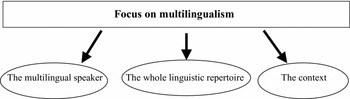
In the rest of this section I discuss an alternative perspective, focus on multilingualism, as a more appropriate way to analyse the effect of bilingualism on TLA and other areas of TLA (see also Cenoz & Gorter forthcoming). Figure 1 shows its main elements.
Focus on multilingualism

Focus on multilingualism is a holistic approach to the study of multilingualism and the acquisition of third and additional languages. This approach can be characterised by its focus on the following three elements.
1. Focus on the multilingual speaker
The first idea is that a multilingual speaker cannot be compared to several monolingual speakers of different languages because multilingual competence is a different type of competence (Grosjean Reference Grosjean and Harris1992, Reference Grosjean2008; Cook Reference Cook2003, Reference Cook, Cummins and Davison2007). Kecskes (Reference Kecskes2010: 100) explains that these differences are not only quantitative but also qualitative because ‘monolingual and bilingual children do not differ in what they do with language, but in how they do it’. According to Kecskes there are conceptual differences between monolinguals and bilinguals, because bilinguals use strategies such as code-switching and translanguaging (García Reference García2008; Creese & Blackledge Reference Creese and Blackledge2010). As Li Wei & Wu (Reference Li2009: 193) point out, code-switching is ‘the most distinctive behaviour of the bilingual speaker’. Focus on multilingualism is an approach that looks at the characteristics of multilingual speakers and poses two questions:
i. Is it appropriate to make comparisons between monolinguals and bilinguals?
ii. Can all third language learners be considered bilinguals?
Studies on the effect of bilingualism on TLA have compared monolingual and bilingual speakers, but this means that two different types of competence are being compared. If it is not fair to expect a bilingual speaker to behave in the same way as a monolingual in each of his/her languages, it can be also questioned whether it is appropriate to compare monolinguals and bilinguals in TLA. This does not mean that studies on the effect of bilingualism on TLA are no longer interesting, but it is important to be aware of the fact that monolingual and bilingual speakers are different types of speakers. The second question relates to the difference between the two types of third language learners identified above. ‘Active bilinguals’ alternate and mix languages in their multilingual practices. As Canagarajah (Reference Canagarajah2007: 925) explains, when referring to multilingual contexts where English is used alongside other languages, this competence is distinct because ‘it derives from their multilingual life’. Psycholinguistic studies have usually compared ‘active bilinguals’ and monolinguals, relating bilingualism to cognitive advantages and enhanced metalinguistic awareness (see, for example, Bialystok Reference Bialystok2007). Do these cognitive advantages also exist in the case of third language learners who are foreign language users? If the cognitive differences between monolinguals and bilinguals are related to being ‘active bilinguals’, learners who have just acquired a foreign language but do not use it regularly in multilingual contexts may not count as bilinguals. Focus on multilingualism looks at multilingual speakers and proposes looking at the different types of L3 learners, attending to how bilingual speakers integrate a third language into their linguistic repertoire and the fluidity between their three languages. By focusing on the multilingual person as a speaker we can obtain a deeper knowledge of the different types of L3 learners and the effects of their prior linguistic knowledge.
2. Focus on the whole linguistic repertoire
Instead of focusing on ‘one language only’ or ‘one language at a time’, focus on multilingualism looks at all the languages in the multilingual speakers’ repertoire. It considers the complexity of multilingualism and how the different subsystems are connected across the languages in their development, and in the way they support each other. The idea of ‘connected growers’ discussed by De Bot, Lowie & Verspoor (Reference De Bot, Lowie and Verspoor2007) when explaining dynamic systems theory in SLA can be useful when applied to the effect of bilingualism on TLA. In fact, by looking at the interaction among languages in the multilingual learner's whole linguistic repertoire, ‘connected growers’ that facilitate TLA might be identified. When Miren and Mario learn how to organise a written text and use cohesive devices in their first languages (Basque or Italian), they can apply the skills they have learned to their second and third languages. The interaction between different languages can be seen when the scores in three languages are correlated (see, for example, Muñoz Reference Muñoz, Cenoz and Jessner2000, Cenoz & Gorter forthcoming) and also when the multidirectionality of cross-linguistic interaction is analysed (Jessner Reference Jessner2006; Cenoz & Gorter forthcoming). By looking at the whole linguistic repertoire we see not just one part of the picture – as in studies focusing only on the third language – but the whole picture of the interaction among the languages.
3. Focus on context
Context is a crucial element in focus on multilingualism, because multilinguals build up their competence in social interaction. If we look at the vignettes, we can see that language practices are multilingual in the case of Miren and monolingual in the case of Mario. Miren's languages are fluid and she navigates between her L1 and L2 and occasionally even adds elements from her L3. This experience in communication is different from that of Mario, who does not switch between languages. Multilingual speakers use languages as a resource for communicating successfully and developing their own identities through multilingual practices. As Li Wei (Reference Li, King and Hornberger2008: 144) explains, linguistic knowledge is more than a matter of mental representation: bilingualism and multilingualism can be examined as ‘a matter of ideology, communicative practice and social process’. Focus on multilingualism proposes highlighting the importance of context when analysing the effect of bilingualism on TLA, to show how the L3 is incorporated into the multilingual speaker's language practices.
5. Conclusion
Focus on multilingualism is an alternative approach to the study of multilingualism in general and to the study of the influence of bilingualism on TLA in particular. It is a holistic approach based on a range of theoretical proposals (for example Grosjean Reference Grosjean and Harris1992, Reference Grosjean2008; Cook Reference Cook2003, Reference Cook, Cummins and Davison2007) that looks at the whole linguistic repertoire and the interaction between languages (Herdina & Jessner Reference Herdina and Jessner2002; Li Wei forthcoming). At the same time focus on multilingualism looks at the acquisition and use of languages in relation to the social context.
In this article I have applied the approach focus on multilingualism to the study of bilingualism on TLA, a specific area of research on multilingualism. Unlike previous research on TLA, focus on multilingualism takes multilingual speakers and their repertories as the starting point, with the aim of analysing how bilingual third language learners use their prior linguistic knowledge in their multilingual practices when acquiring a third language. Research that distinguishes between ‘active bilinguals’ and ‘foreign language users’ will be crucial. At the same time, there are important challenges regarding language testing in the light of an approach like focus on multilingualism (see, for example, Shohamy forthcoming).
The process of acquiring a third language often takes place in school contexts. As we saw in the vignettes, TLA can be part of a bi/multilingual educational programme or a regular programme in which two foreign languages are taught. In either case, the Focus on multilingualism approach has some important teaching implications.
First, schools that have multilingualism as one of their educational goals cannot view TLA learners as imitation monolinguals, but as possessing unique forms of competence, or competencies, in their own right. This idea had already been proposed by Grosjean (Reference Grosjean and Harris1992) and Cook (Reference Cook2003) for the two language situation, but it is even more relevant when three or more are involved. Third language learners cannot be monolingual speakers of three languages, but in practice their proficiency is often measured against the yardstick of native speakers of the target language both in research and at school. Focus on multilingualism proposes looking at proficiency in the L3 as related to proficiency in the L1 and the L2, including interaction phenomena such as code-switching and code-mixing.
Second, school curricula and teaching practices could benefit from relating the different languages so that TLA learners have the opportunity to develop metalinguistic awareness based on their knowledge and use of two or more languages (Elorza & Muñoa Reference Elorza and Muñoa2008; Cenoz & Goikoetxea Reference Cenoz, Goikoetxea, Erhart, Hélot and Le Nevez2010). In this way, what is learned in one language can be reinforced in the other languages. By looking at the relationship between the different languages and encouraging learners to use the resources at their disposal, focus on multilingualism takes the learner and his/her languages, not the third language, as the centre in both teaching and research.
In sum, focus on multilingualism is focused on the learner, and can provide new insights when studying the influence of bilingualism on TLA because it looks at the way multilingual speakers acquire and use languages rather than at ‘one language only’ or ‘one language at a time’ from a monolingual perspective.
Acknowledgments
This research was carried out with the assistance of research grant EDU2009–11601 from the Spanish Ministry of Science and Technology and Basque Government funding for the research group ‘Donostia Research on Education and Multilingualism (DREAM)’.
Jasone Cenoz is Professor of Research Methods in Education at the University of the Basque Country. Her research focuses on bilingualism and multilingualism in education. She is the editor of The International Journal of Multilingualism (Taylor and Francis), and is on the executive boards of AILA (International Association of Applied Linguistics) and IAM (International Association of Multilingualism). She has published extensively on bilingualism and multilingualism. Her most recent books are Towards multilingual education (2009, Multilingual Matters) and, with Elka Todeva, The multiple realities of multilingualism (2009, Mouton de Gruyter).