Healthcare-associated infections (HAIs) remain a significant source of morbidity and mortality among critically ill patients. According to national surveillance data from 2013, 51% of central line–associated bloodstream infections and 75% of catheter-associated urinary tract infections occurred in intensive care unit (ICU) patients. 1 , Reference Yokoe, Anderson and Berenholtz 2 The disproportionate burden of HAIs in ICU populations has been attributed to many factors, including their high severity of illness, frequent use of invasive devices, and prolonged hospitalization, but one potentially important and underappreciated risk factor particular to ICU populations is the choice and management of sedative agents.
Intravenous sedative agents are typically used to enhance patient comfort and patient-ventilator synchrony. Paradoxically, however, the use of sedation can also have deleterious effects, such as prolonging dependency on mechanical ventilation, increasing risk for delirium, and impairing patient mobility. A growing body of literature now supports a link between sedative agent choice, sedative management strategy, immunodysregulation, and infection in the critically ill population.
The critical care community has embraced the importance of sedation choice and judicious sedation management, particularly for minimizing delirium and facilitating early extubation. Optimizing sedative choice and sedation management may also be an important strategy to prevent HAIs. The potential link between sedation and infection risk is likely to become increasingly relevant to hospital epidemiologists and infection preventionists in coming years. Acquiring basic fluency in this arena can help infection control staff to engage with critical care colleagues in discussions related to this topic.
Given the growing relevance of sedation practices to hospital epidemiologists and infection preventionists, we undertook a systematic review of the literature on the relationship between sedative choice, sedative management strategy, and risk of HAIs. We begin with a précis of relevant pharmacology, the science behind immunomodulatory effects of sedatives, and then evaluate the limited clinical trial data available thus far on sedation practices and HAIs.
METHODS
We conducted a systematic review of the literature on sedatives and their associations with infection, immune dysfunction, or ventilator-associated events (VAEs). We searched the MEDLINE database (1946 to October 21, 2015) for English-language articles. Sedation-related terms included “sedation,” “sedatives,” “benzodiazepines,” “midazolam,” “lorazepam,” “propofol,” or “dexmedetomidine.” Infection-related terms included “healthcare-associated infection,” “hospital-acquired infection,” “immunity,” “ventilator-associated event,” “central line–associated bloodstream infection,” “bloodstream infection,” “catheter-associated urinary tract infection,” “Clostridium difficile,” “surgical site infection,” “VAP,” or “ventilator-associated pneumonia.” All sedation-related and infection-related search term combinations were evaluated. Titles and abstracts were used to evaluate each study. All studies that reported on sedative choice or management strategy in relation to any infectious or immunologic process were eligible for inclusion. References of accepted studies were reviewed for pertinent articles. Studies of opioids and ketamine were not considered. There were no restrictions on study type.
RESULTS
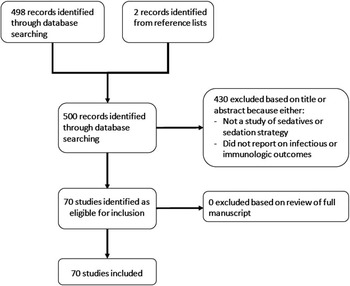
The search strategy yielded 500 articles. After exclusion of duplicate and nonpertinent studies, 70 articles were included (Figure 1). Studies were classified as pharmacology reviews (13), basic science studies (26), clinical guidelines (1), systematic reviews or meta-analyses (2), or clinical studies (28).
Study selection flow diagram.

Pharmacology of Relevant Sedatives
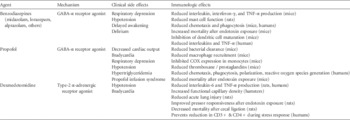
Three classes of sedative agents (distinct from analgesic agents such as opioids) are most commonly used for sedation in critically ill ventilated patients: benzodiazepines, propofol, and dexmedetomidine (Table 1). Benzodiazepines, including midazolam, lorazepam, and many others, bind to the gamma-aminobutyric acid (GABA)-α receptor in the central nervous system to induce anxiolysis, anti-epileptic effect, and sedation.Reference Hansen 3 These drugs vary in their potency and timing of onset. Midazolam, commonly used for ventilated patients, has a dose-dependent onset typically 3–5 minutes after bolus infusion, is 95% protein-bound, creates active metabolites that are renally excreted, and has an elimination half-life of 1–4 hours.Reference Hansen 3 Common adverse effects of benzodiazepines include respiratory depression, hypotension, and delayed awakening.Reference McCollam, O'Neil, Norcross, Byrne and Reeves 4 There may be increased risk of delirium with benzodiazepines, particularly continuous intravenous infusionsReference Zaal, Devlin and Hazelbag 5 and lorazepam.Reference Pandharipande, Shintani and Peterson 6
Pharmacologic and Immunologic Properties of Sedative Agents

NOTE. COX, cyclooxygenase; GABA, gamma-aminobutyric acid; TNF, tumor necrosis factor.
Propofol—an agent in its own class—provides rapid onset and rapid resolution of sedation, although effects may linger following prolonged infusions.Reference Hansen 3 Like benzodiazepines, propofol interacts with the GABA-α receptor and has similar anxiolytic, anti-epileptic, and sedative effects. Propofol follows a 3-compartment distribution model with an initial distribution half-life of 2–4 minutes.Reference Larijani, Gratz, Afshar and Jacobi 7 Unlike benzodiazepines, propofol undergoes rapid hepatic and renal metabolism.Reference Trapani, Altomare, Liso, Sanna and Biggio 8 Common adverse effects of propofol include respiratory depression, hypotension, and decreased cardiac output, making it less desirable in patients with reduced cardiac function.Reference Jacobi, Fraser and Coursin 9 Rarer side effects of propofol include hypertriglyceridemia and propofol infusion syndrome, which affects less than 1% of exposed patients.Reference Crozier 10 The latter is characterized by acidosis, liver injury, renal failure, rhabdomyolysis, heart failure, and hypertriglyceridemia. It is associated with prolonged propofol exposure, typically more than 48 hours, and more often at doses greater than 4 mg/kg/hour.Reference Hansen 3 , Reference Jacobi, Fraser and Coursin 9 , Reference Mirrakhimov, Voore, Halytskyy, Khan and Ali 11
Dexmedetomidine is the newest sedative agent and has recently become available in generic form. 12 It activates central type-2 α-adrenergic receptors to induce sedation with maintained arousal, which may therefore result in less respiratory depression and delirium compared with benzodiazepines, particularly in patients with severe sepsis and septic shock.Reference Xia, Chen, Yao, Xie, Wen and Liu 13 , Reference Riker, Shehabi and Bokesch 14 Patients treated with dexmedetomidine are sedated when undisturbed, but awaken with gentle stimulation. Use of dexmedetomidine has been associated with less need for concomitant analgesics and other sedatives.Reference Hall, Uhrich, Barney, Arain and Ebert 15 , Reference Le Guen, Liu and Tounou 16 Dexmedetomidine has an 8-fold stronger affinity for the type-2 α-adrenergic receptor than clonidine, has a distribution half-life of 6 minutes with peak effect at 10–20 minutes, is 95% renally excreted, and has an elimination half-life of 2–3 hours.Reference Hansen 3 , Reference Bhana, Goa and McClellan 17 Side effects of dexmedetomidine can include hypertension, hypotension, and bradycardia.Reference Bhana, Goa and McClellan 17
Sedation and Immune Function: Basic Science Studies
Benzodiazepines have immunomodulatory properties.Reference Smith, Hibino, Falcione, Eichinger, Patel and Empey 18 , Reference Nseir, Makris, Mathieu, Durocher and Marquette 19 In vitro studies show decreases in interleukins (IL) 6 and 8, decreases in interferon-γ, and inhibition of human monocytes and T-cell function after benzodiazepine exposure.Reference Miyawaki, Sogawa, Maeda, Kohjitani and Shimada 20 – Reference Wei, Li and Meng 22 Rat and other animal studies suggest that benzodiazepines decrease mast cell and tumor necrosis factor-alpha (TNF-α) production.Reference Bidri, Royer, Averlant, Bismuth, Guillosson and Arock 23 , Reference Matsumoto, Ogata, Koga and Shigematsu 24 A 1995 study found that bacteremic mice treated with diazepam for 2–3 months had higher mortality and reduced neutrophil chemotaxis and phagocytosis compared with mice not treated with benzodiazepines.Reference Galdiero, Bentivoglio and Nuzzo 25 In a separate study, exposing murine dendritic cells to midazolam for 24 hours and then stimulating them with lipopolysaccharide (LPS) inhibited their maturation and capacity to stimulate helper T-cells.Reference Ohta, Ohashi, Takayama, Mashimo and Fujino 26 Similar findings have been reported in human studies using midazolam: one study of patients taking midazolam for migraine reported decreased neutrophil chemotaxis and phagocytosisReference Nishina, Akamatsu and Mikawa 27 ; another study of patients who received midazolam during surgery documented decreases in serum IL-1B, IL-6, IL-8, and TNF-α levels.Reference Helmy and Al-Attiyah 28 It is thought that these effects occur through stimulation of a peripheral benzodiazepine receptor.Reference Ohta, Ohashi, Takayama, Mashimo and Fujino 26
Propofol may also have immunomodulatory properties. In a mouse model of bloodstream infection due to Listeria monocytogenes and Staphylococcus aureus, mice were first challenged with either placebo lipid carrier or therapeutic-dose propofol, and then infused with bacteria. Mice exposed to propofol developed a 10,000-fold increase in bacterial burden of vital organs, altered chemokine expression, decreased macrophage recruitment, and increased rate of S. aureus kidney abscesses.Reference Visvabharathy, Xayarath, Weinberg, Shilling and Freitag 29 This effect persisted in mice inoculated with L. monocytogenes for up to 96 hours after propofol exposure. Propofol inhibited cyclooxygenase activity in human monocytic THP-1 cells, reduced expression of prostaglandin and thromboxane, and increased levels of interferon-γ in murine macrophages.Reference Inada, Kubo, Kambara and Shingu 30 , Reference Inada, Kubo and Shingu 31 Other studies have associated propofol with dose-dependent impairment of human neutrophil chemotaxis, phagocytosis, production of reactive oxygen species,Reference Mikawa, Akamatsu and Nishina 32 and reduced LPS-associated interleukin-8 production.Reference Helmy and Al-Attiyah 28 Compared with midazolam, propofol inhibited human neutrophil polarization by 40%–50% at all drug concentrations.Reference O'Donnell, McSharry, Wilkinson and Asbury 33 Conversely, 2 mouse studies reported lower mortality rates among mice treated with propofol compared with controls after both groups were challenged with endotoxin; the authors hypothesized that propofol may reduce production of peroxynitrite, a cytotoxic nitric oxide metabolite, or cause general attenuation of the cytokine response.Reference Taniguchi, Kanakura and Yamamoto 34 , Reference Gao, Zeng, Zhou and Yuan 35
Potentially beneficial immunomodulatory effects of dexmedetomidine have been reported. Animal studies suggest that dexmedetomidine can have an inhibitory effect on the inflammatory response. Endotoxin-challenged rats had reduced levels of TNF-α and IL-6 after treatment with dexmedetomidine.Reference Taniguchi, Kidani, Kanakura, Takemoto and Yamamoto 36 , Reference Qiao, Sanders, Ma, Wu and Maze 37 In a hamster study of microcirculation, animals exposed to LPS and dexmedetomidine had less leukocyte adhesion, and greater functional capillary density and erythrocyte velocity, than animals treated with placebo.Reference Miranda, Balarini and Bouskela 38 In rats, supratherapeutic doses of dexmedetomidine reduced acute lung injury due to high-volume ventilation by suppressing cytokines IL-β, TNF-α, IL-6, and prostaglandin E2 in lung tissue.Reference Yang, Tsai and Huang 39 Another study compared rats’ responses to the vasopressor norepinephrine when coexposed to saline, clonidine, or dexmedetomidine, both before and after LPS exposure. Although vasopressor responsiveness decreased gradually in the saline-treated rats after LPS exposure, treatment with clonidine and dexmedetomidine after LPS exposure led to marked increases in the blood pressure response to norepinephrine, suggesting that central α-2 agonism may counteract vasoplegia in septic shock or amplify the effects of other adrenergic agonists.Reference Geloen, Chapelier and Cividjian 40 Finally, a randomized study of cecal ligation and puncture in mice showed that 7-day mortality was significantly lower in animals treated with intraperitoneal dexmedetomidine compared with control animals treated with intraperitoneal saline (90% mortality in control patients, 30% mortality when dexmedetomidine given before cecal ligation and puncture, 50% mortality when dexmedetomidine given after cecal ligation and puncture, P < .05).Reference Xu, Bao, Si and Wang 41 Levels of TNF-α and IL-6 levels were also lower in animals randomized to dexmedetomidine. Few human studies have evaluated molecular changes after dexmedetomidine exposure. In a study of pediatric neurosurgical patients, the use of perioperative dexmedetomidine blunted the stress-induced reductions in CD4+, CD3+, and natural killer cells compared with postoperative control subjects.Reference Wu, Lv, Luo, Jin and Hang 42 A clinical study of dexmedetomidine and propofol in human patients with sepsis revealed that dexmedetomidine reduced serum levels of TNF-α and IL-6 compared with propofol.Reference Tasdogan, Memis, Sut and Yuksel 43 The clinical significance of these observations is unclear.
Association of Sedation and HAI
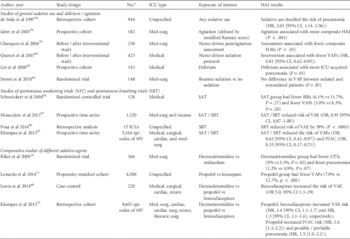
A small number of clinical trials have reported on clinical consequences of sedative use, regardless of agent, that may be relevant to HAI risk (Table 2). Sedatives prolong duration of mechanical ventilationReference Robinson, Mueller, Henson, Branson, Barsoum and Tsuei 44 and ICU length of stay,Reference Shelly, Sultan, Bodenham and Park 45 which in turn may increase infection risk. Delirium, although complex in etiology with modifiable and nonmodifiable risk factors, may be related to sedative use in certain populationsReference Agarwal, O'Neill and Cotton 46 , Reference Pandharipande, Sanders and Girard 47 and has been associated with longer duration of mechanical ventilationReference Bryczkowski, Lopreiato, Yonclas, Sacca and Mosenthal 48 – Reference Lin, Huang and Liu 50 and mortality.Reference Lin, Huang and Liu 50 – Reference Shehabi, Riker and Bokesch 53
Clinical Studies of Sedatives That Report Infectious Outcomes

NOTE. BSI, bloodstream infection; HAI, healthcare-associated infection; HR, hazard ratio; ICU, intensive care unit; IVAC, infection-related ventilator-associated complication; med-surg, medical-surgical; MV, mechanical ventilation; OR, odds ratio; UTI, urinary tract infection; VAE, ventilator-associated event; VAP, ventilator-associated pneumonia.
a No. = number of subjects, unless specified as number of ICUs or number of episodes of mechanical ventilation.
Several clinical studies have suggested an association between delirium and HAIs. In an observational study of medical-surgical ICU patients, sedatives were a significant risk factor for agitation, which in turn was associated with more HAIs (34% vs 7%, P < .001).Reference Jaber, Chanques and Altairac 54 HAIs in this study included a composite of ventilator-associated pneumonia (VAP), central venous catheter bacterial colonization, catheter-associated urinary tract infection, and bloodstream infection. In another trial, ICU patients assigned to a nurse-driven pain and agitation assessment protocol (pharmacologic interventions left up to the clinician) had a decrease in agitation scores (12% in the experimental group vs 29% in the control group, P=.002), a decreased average duration of hypnotic sedative infusions (48 vs 84 hours, P=.03), and fewer HAIs (composite of VAP, central venous catheter colonization, catheter-associated urinary tract infection, and bloodstream infection) (8% vs 17%, P < .05) compared with standard care.Reference Chanques, Jaber and Barbotte 55 An analysis of risk factors for delirium reported that ICU-acquired pneumonia was more common in delirious patients compared with nondelirious patients (65% vs 38%, P=.01).Reference Lin, Huang and Liu 50 The direct risk of infection due to sedation, however, has been minimally studied outside of the context of delirium/agitation. One retrospective analysis of risk factors for HAI found that use of sedation was associated with a 2-fold increased risk of pneumonia (hazard ratio, 2.01; 95% CI, 1.14–3.56).Reference de Irala Estevez, Fernandez-Crehuet Navajas, Diaz Molina, Martinez de la Concha, Salcedo Leal and Masa Calles 56
VAEs represent a special category of complications that are unique to ventilated patients.Reference Klompas 57 The VAE definition captures a broad array of serious complications of ventilation using objective criteria. The clinical entities responsible for VAEs include atelectasis, acute respiratory distress syndrome, pulmonary edema, aspiration, and VAP.Reference Klompas 58 VAEs are strongly associated with increased mortality and prolonged duration of ventilation.Reference Klompas, Magill and Robicsek 59 Although research on the risk factors for VAE is in early stages, data suggest that sedation can increase VAE risk, and that the choice of sedative and use of daily awakening and breathing trials might mitigate this risk.Reference Klompas 58 A case-control study found that use of benzodiazepines before intubation increased the risk of infection-related ventilator-associated complications (odds ratio, 5.0 [95% CI, 1.3–29]), a subset of VAE.Reference Lewis, Li, Murphy and Klompas 60
Depth of Sedation
Sedation depth has been evaluated as a risk factor for adverse outcomes. In an international longitudinal study, deep sedation (defined as Richmond Agitation-Sedation score of −3 to −5) within the first 48 hours of mechanical ventilation decreased the chances of extubation (hazard ratio, 0.90 [95% CI, 0.87–0.94]), and increased the risk of in-hospital mortality (1.11 [1.02–1.20]) and 180-day mortality (1.08 [1.01–1.16]), after adjusting for admitting diagnosis and severity of illness.Reference Shehabi, Bellomo and Reade 61 A similar multicenter study set in Malaysia found that early deep sedation (Richmond Agitation-Sedation score <−3) was associated with decreased chance of extubation (hazard ratio, 0.93 [95% CI, 0.89–0.97]), in-hospital mortality (1.11 [1.05–1.18]), and 180-day mortality (1.09 [1.04–1.15]), regardless of the choice of sedative agent.Reference Shehabi, Chan and Kadiman 62 Lightening sedation has been associated with lower infection risk, suggesting that adverse outcomes associated with deep sedation may include HAIs; a before-and-after quasi-experimental study reported less ventilator-associated pneumonia with light sedation (hazard ratio, 0.81 [95% CI, 0.62–0.95]).Reference Quenot, Ladoire and Devoucoux 63
The complete withholding of sedation during mechanical ventilation is an emerging practice and has been studied in relationship to the duration of mechanical ventilation and VAP rates. In a randomized nonmasked study, patients who received no sedation during mechanical ventilation had more ventilator-free days in the ICU than subjects who did receive sedation (mean difference, 4.2 days [95% CI, 0.3–8.1 days]; P=.019) but there was no difference in VAP rates (11% vs 12%, P=.85).Reference Strøm, Martinussen and Toft 64
Sedation Management: Spontaneous Awakening and Spontaneous Breathing Trials
Spontaneous awakening trials (SAT) and spontaneous breathing trials (SBT) are techniques in which sedative infusions (SAT) and ventilator support (SBT) are interrupted to assess whether a patient can get by with less sedation and/or whether the patient is ready for extubation. These techniques can reduce the duration of mechanical ventilation and VAE rates. Data from one prospective time series found a protective effect of SAT against VAEs (odds ratio, 0.93 [95% CI, 0.87–1.00]).Reference Muscedere, Sinuff and Heyland 65 In a nonrandomized study of SBT compliance among 15 community hospitals, 80% or greater compliance with daily SBT reduced VAEs by 39% (P < .0001).Reference Posa, Bogan and DiGiovine 66 In the CDC Prevention Epicenters’ Wake Up and Breathe Collaborative, which included 12 ICUs in 7 hospitals, improvements in the use of SATs and SBTs were associated with a drop in VAEs from 9.1 to 5.2 events per 100 episodes of mechanical ventilation (odds ratio, 0.63 [95% CI, 0.42–0.97]) and a decrease in infection-related ventilator-associated complications (0.35 [0.17–0.71]).Reference Klompas, Anderson and Trick 67 There was also a nonsignificant trend toward fewer VAPs (odds ratio, 0.51 [95% CI, 0.19–1.3]). In an analysis of randomized controlled trial data on protocolized daily SAT versus clinician-directed sedation management, there were numerically fewer bloodstream infections (4/66 [6.1%] vs 7/60 [11.7%], P=.27) and ventilator-associated pneumonias (2/66 [3.0%] vs 5/60 [8.3%], P=.20) in patients randomized to daily SATs but these signals were not statistically significant.Reference Schweickert, Gehlbach, Pohlman, Hall and Kress 68
Comparative Studies of Sedative Agents
Clinical guidelines recommend using non-benzodiazepines (propofol or dexmedetomidine) whenever possible given trial data suggesting that benzodiazepines, particularly continuous infusions, prolong duration of mechanical ventilation and ICU stay.Reference Fraser, Devlin and Worby 69 , Reference Barr, Fraser and Puntillo 70 Some studies have also found differences in infection rates between sedative classes. A randomized trial of dexmedetomidine vs midazolam in mechanically ventilated patients found fewer urinary tract infections (0% vs 3.3%, P=.02) and pneumonias (1.2% vs 4.9%, P=.07) in the dexmedetomidine group, but no difference in ICU length of stay.Reference Riker, Shehabi and Bokesch 14 In a propensity-matched cohort study, propofol was associated with less VAP versus lorazepam (7.9% vs 12.7%, P < .001).Reference Lonardo, Mone and Nirula 71 In an observational analysis of VAE and sedatives, benzodiazepines and propofol were both associated with development of VAE; however, dexmedetomidine was not.Reference Klompas, Li, Szumita, Kleinman and Murphy 72
DISCUSSION
Deep sedation, prolonged sedation, and use of benzodiazepines may be risk factors for infection whereas light sedation, protocolized attempts to decrease sedation and assess readiness for extubation (paired daily SATs and SBTs), and use of dexmedetomidine and to a lesser extent propofol may reduce the risk of infection and VAE.Reference Riker, Shehabi and Bokesch 14 , Reference Klompas, Li, Szumita, Kleinman and Murphy 72 Definitive studies are lacking, and it remains unclear whether duration of mechanical ventilation and length of ICU stay lie on this causal pathway.
The preponderance of HAIs in the ICU population can likely be attributed at least in part to high severity of illness and consequent vulnerability to infection. However, modern critical care involves numerous diagnostic and therapeutic tools not encountered in the care of non–critically ill patients, and it is conceivable that some of these tools could share responsibility for the HAI burden. It is accepted that pharmacologic interventions such as total parenteral nutrition and broad-spectrum antibiotics can increase the risk of certain infections, specifically bloodstream infections and C. difficile infection, respectively. On the basis of the available evidence, certain sedative classes may also potentiate infection risk. Although benzodiazepines, propofol, and dexmedetomidine each have complex immunoregulatory effects, dexmedetomidine more consistently demonstrates favorable effects on potentially damaging inflammatory mediators and has optimized outcomes in bench studies, including prolonged survival and improved vasopressor responsiveness in models of sepsis.Reference Miranda, Balarini and Bouskela 38 , Reference Geloen, Chapelier and Cividjian 40 , Reference Xu, Bao, Si and Wang 41 Clinical studies to date are not conclusive, but most suggest that dexmedetomidine may confer a lower risk of infection compared with other sedatives, especially benzodiazepines. If these suggestive but tentative signals are confirmed, preferential use of light sedation, dexmedetomidine, and SAT/SBTs could help prevent HAIs in the critically ill patients.
This review should be interpreted in light of the limitations of the literature on sedation and HAI risks. Many included studies were performed in the past and may not reflect current guidelines, technology, and sedative choices. The variable immunologic effects of sedatives may be difficult to interpret because modifications of the inflammatory cascade may have positive or negative effects on clinical outcomes of infections. There are relatively few clinical studies on the impact of sedative choice and sedation practices on HAI risk, and many of the available studies were observational and/or underpowered. We do not provide a formal assessment of study quality owing to the wide breadth of study types reviewed. Our review did not include studies of opioids because we chose to focus on pure sedatives as opposed to analgesics.
In conclusion, pharmacologic, immunologic, and clinical data suggest the distinct possibility that sedative choice and sedative management can impact infection risk in critically ill patients. Optimizing sedative agent choice and lightening sedation through protocols and/or SATs and SBTs may decrease infection risk. More interventional studies are needed to confirm these relationships, to determine the effect size of these interventions, and to study other types of HAIs using robust multicenter designs. If sedative choice and sedation practices do in fact reduce HAI risk, this would represent a new tool in the fight against HAIs, particularly in the ICU and after surgery. Further research and education on the interaction between sedation and infection risk will assist infection preventionists and hospital epidemiologists to collaborate with critical care colleagues on new strategies to prevent HAIs.
ACKNOWLEDGMENTS
Financial support. None reported.
Potential conflicts of interest. All authors report no conflicts of interest relevant to this article.