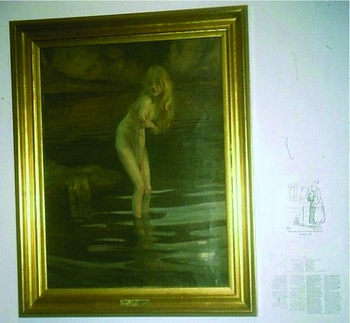
In his studio in Beirut in 1929, the young artist Moustapha Farroukh (1901–57) envisioned a composition to change his society.Footnote 1 He hoped his oil painting would incite broad support among his fellow Lebanese for a revolution in conventional gender relations and women's participation in the urban social order.Footnote 2 He titled the picture The Two Prisoners and based it on a European convention for representing the East: the Nude odalisque (Figure 1). The resulting painting exemplifies the complex role Arab intellectuals of the early 20th century played in the formation of modern art and universal modernity. Leading artists in Mandate-era Beirut felt compelled to paint Nudes and display them as part of a culturing process they called tathqīf (disciplining or enculturing). To a large extent, tathqīf consisted of recategorizing norms for interaction and self-scrutiny. Joseph Massad has revealed that one crucial component of tathqīf was the repudiation of behaviors and desires associated with the Arab Past, such as male homosexuality. An equally important component was the cultivation of “modern,” “masculine” heterosexual eroticism and a dutiful feminine compliance associated with ḥadātha (novelty) and muʿāṣira (contemporaneity).Footnote 3 This was accomplished through the use of a genre that was deliberately new and alien in both its material media and its impact on makers and viewers.
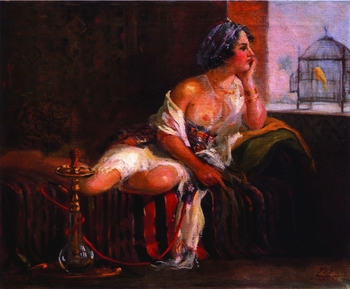
The Two Prisoners by Moustafa Farroukh; 1929, oil on canvas, 38 × 47 cm. From Tabiʿa wa Turath (Nature and Patrimony), M. Farrouk Series, Portfolio 7, Beirut, Lebanon, 1995. Reproduced with permission of Hani Farroukh. Copyright 1995 Hani Farroukh. [A color version of this figure can be viewed online at journals.cambridge.org/mes]

This article establishes that in the decades between 1920 and 1940, fine-art Nudes were not hidden from Beirut's populace and not rejected as shameful. As indexes of modernity, they were an important element of nationalist painters’ membership in “al-ʿaṣr al-ḥadīth” (the modern era), and they demonstrate the importance of the painters’ physical and aesthetic experiences in forming the emergent meaning of modernity. Moreover, Nudes were the very form of the strategic claims artists made on their consociates.Footnote 4 Crafted out of a foreign genre and local bodies to impact the aesthetic sensibilities of their viewers, Nudes made claims on all who saw them and compelled viewers to reflect on their social roles. The visual archive from Mandate Beirut provides a means to heed the call issued by Frederick Cooper and Ann Laura Stoler to study civilizing missions without using binary oppositions that preempt the analysis.Footnote 5
THE ABSENCE OF NUDES
The plethora of talk about Nudes in Lebanon today demonstrates the abiding power of the links Mandate-era artists established between modernity and painted nudity. During my fieldwork in Beirut on contemporary Lebanese art (1997–2005), the discussion of Nudes, whether at others’ prompting or my own, frequently occasioned a curious form of time travel: the commentator on Nudes was suddenly able and required to speak with certainty about a past deplete of Nudes and a present characterized by potential improvement if only this paramount index of modernity could be abided. Take one catalogue-writer's commentary on the exhibition in 2003 of another Nude by Farroukh: “In an era when exhibition walls did not show pictures of naked women, this painting provoked at the very least confusion and bewilderment among the audience, if not stupefaction [emphasis added].”Footnote 6 Similarly, when Women at an Exhibition (originally known as A l'exposition) (Figure 2), by Farroukh's age-mate Omar Onsi (1901–69), appeared at a London exhibition in 1989, the copywriter observed:
The first time a nude was included in an exhibition in Lebanon, it caused quite a stir. Whereas young Lebanese painters who had studied in Paris were familiar with painting nude models, they found it difficult to show their paintings to the conservative Lebanese public upon their return home [emphasis added].Footnote 7
Regarding the same painting by Onsi, an exhibition essayist intoned in 1997, “We are now, for the first time before the paintings Onsi painted of nude women, paintings that he did not want to show or even sign his name to . . .” [emphasis added].Footnote 8 Curator Sylvia Agémian observed that Onsi's passion for Nudes “remained confidential, or semi-confidential, rarely exposed and, according to received testimony, revealed only to amateurs of the genre” [emphasis added].Footnote 9 Noting that far fewer oil than pastel or crayon Nudes were among the artist's known body of work, she suggested that the paper-supported media were more easily hidden away.Footnote 10 Further, Agémian asserted that owners of such paintings “still” do not expose them, “not even in the bedrooms.”Footnote 11
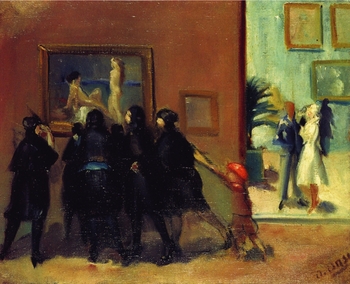
Women at an Exhibition (originally A l'exposition) by Omar Onsi; 1932, oil on canvas, 37 × 45 cm. From the collection of Samir Abillama. Reproduced with permission of Samir Abillama. [A color version of this figure can be viewed online at journals.cambridge.org/mes]

By contrast, several elderly Muslim Beiruti women described their mother (born c. 1905) as “modèrne compared to her milieu,” for she had seen a Nude painting at a friend's and “not found it shameful.”Footnote 12 Such comments reinforce the necessity of Nudes to index the march of a teleological modernity. Yet they do so by treating the painting of Nudes as a reflection of a given individual or social condition. Their presence supposedly reflects a pioneer's modern outlook, their absence the obstacle Beirutis posed to the advance of fine art and time. The very compulsion to speak of time and modernity in the presence of Nudes, however, hints at the agential nature of these pictures. Reducing them to reflections ignores the way they connect audiences to (ascribed) causes (here, modernity) through the indexicality of the techniques evinced. Treating the pictures as firsthand documents from ongoing dialogues clarifies their agential nature. To do this, I focus on the careers of two artist-intellectuals, Moustapha Farroukh and Omar Onsi, who were highly lauded in their time and are particularly well remembered in Lebanon today.
A PLENTITUDE OF NUDES
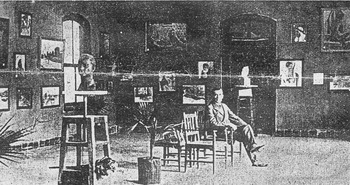
Khalil Gibran (1883–1931) is perhaps the best-known painter of the Nude associated with Lebanon. Although his pictures were not exhibited in Lebanon during his lifetime, they were well circulated through distribution of his book The Prophet. Footnote 13 Better known locally were Habib Srour (1860–1938) and Khalil Saleeby (1870–1928), both of whom are credited with a large corpus of Nude paintings and significant influence on their successors.Footnote 14 Newspapers add further evidence that the painting of Nudes was neither new in Mandate-era Beirut nor confined to a few maverick picture makers and their intimate audiences. They are peppered with discussions of the Nudes painted by, among others, Onsi, Farroukh, Caesar Gemayel, Saliba Douwaihy, and Jean Kober. Al-Maʿrad declared that nearly 5,000 men and women visited a group show held at Ecole des Arts et Métiers in 1930.Footnote 15 It provided a photograph of the exhibition (Figure 3), including five Nudes. The paper's long review praises them in passing.
Group Exhibition, Ecole des Arts et Métiers, January 1931. Photograph from Al-Maʿrad, No. 935, 22 January 1931, 8.

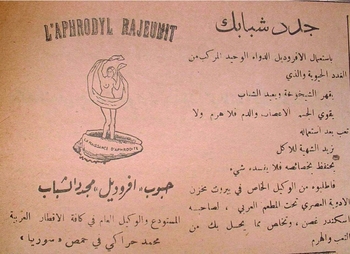
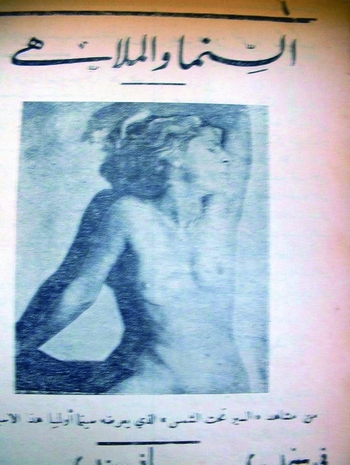
Naked ladies were not only the subjects of fine-art imagery. In the early 1930s the cultural review Al-Makshuf included fairly pornographic photographs and erotic stories as well as advertisements for a depilatory cream whose efficiency was demonstrated by a supine, armpit-baring female Nude.Footnote 16 Prominent journals such as Al-Nahar, La Revue du Liban, and Al-Maʿrad were furnished with similar illustrations and advertisements during the 1930s. One, promoting Aphrodite Medicine for Men, showed a voluptuous Venus rising, like Botticelli's Spring, naked from an oyster shell (Figure 4). Another, for a film, was even more explicit (Figure 5).Footnote 17
An advertisement for Aphrodyl Pills. From Al-Nahar, No. 85, 25 November 1933, 6. [A color version of this figure can be viewed online at journals.cambridge.org/mes]

A scene from the film Al-Sir Taht al-Shams (Walking Under the Sun). From Al-Nahar, No. 203, 19 April 1934, 6. [A color version of this figure can be viewed online at journals.cambridge.org/mes]

It is clear that the 1990s were not the first time Nudes were publicly exposed in Lebanon nor were the 1920s an era of artists fearing to sign their names to such pictures, let alone galleries banning them. Indeed, at Onsi's exhibition in 1932, eight of the ninety-one pictures were of nude women, with sale prices ranging from 250 to 1,500 francs.Footnote 18The Two Prisoners sold in Beirut in 1929 for the staggering sum of eighteen Ottoman gold pounds.Footnote 19 How is it, then, that Nudes are consistently dislocated from early Lebanon to “proper homes” in other locales?
The point of revisiting these forgotten Nudes is not to right a wrongly ascribed absence but to question its very production. The issue is not to what degree naked women and artistic Nudes actually existed in the young Lebanese capital but rather why nudity, as a form of novelty and contemporaneity, became an index and instrument of modernizing. This essay explores the reasons for the agentiality and indexicality of Nudes and, in so doing, illuminates the convergent process by which some Arab artists cultivated universal modernity as a tangible concept and urgent injunction.Footnote 20 Displayed at numerous local exhibitions and discussed in the newspapers, the Nude impacted developing ideas of gender, urbanity, and modernity. In this project artists worked from their particular backgrounds and ambitions toward hazy concepts that were motivating their peers around the globe but were not fully formed in any single locale.
The commendation The Two Prisoners and other Nudes received in the local papers contributed major boosts to their makers’ careers. This favorable reaction counters not only the common assumption that paintings of nude women posed a threat to Lebanese and Arab viewers but also the notion that those viewers posed an obstacle to the development of fine arts in the Arab world.Footnote 21 Not only did Beirut audiences from the 1920s to 1940s appreciate Nudes but they also did so in ways that contradict the notion that Nudes were part and parcel of a Eurocentric modernity.Footnote 22 The specific type of audience interaction and forms of artistic imagery at this time illuminate the role these Lebanese played in producing a modernity that is best understood as neither externally imposed nor alternatively derived but, rather, convergently constructed. Here I explain how Nudes enabled viewers to understand “local” conditions in relation to “foreign” ones and how the “foreign” became universally valid in the process.
MUSLIM SCOUTS AND A MODERN NUDE
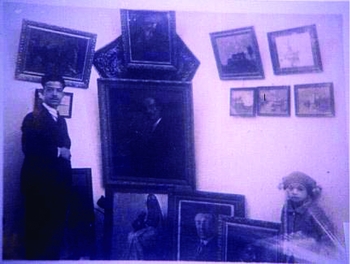
Nudes have been included in art exhibitions in Lebanon since their very beginning.Footnote 23 On 1 January 1927, the Muslim Scouts gathered in the home of the wealthy merchant and Scout patron Ahmad Ayas to celebrate the return of troop member Moustapha Farroukh from Italy carrying degrees from the School of Ornament and the Royal Academy of Fine Arts. A recitation from the Holy Quʾran opened the event and sacralized the space. On display were a few thickly varnished oil portraits, a handful of city scenes and landscapes from Paris recording the artist's trip to the “cradle of art,” and one composition that had earned the artist critical mention at the Roman Biennale. Amidst this array of skill and recognition (Figure 6) is a picture of a dark-skinned, nearly naked woman with a water jug. She smiles brazenly at her viewers. Her gaudy necklaces and white shawl accentuate the expanse of her brown flesh.
Moustapha Farroukh at the Muslim Scouts Exhibition, Ahmad Ayas Villa, 1 January 1927. From the collection of Hani Farroukh. Reproduced with permission of Hani Farroukh. [A color version of this figure can be viewed online at journals.cambridge.org/mes]

Like the other pictures on display, this Nude is rendered in beaux-arts, academic style. In beaux-arts academic art classrooms, novices became familiar with “the experience of feeling ‘magnificent emotion’ in front of the totally naked body and transforming that into a conception for drawing, which could intellectually correct physical flaws and trivia; natural desire thus overcome, a naked body became an ideal Nude and a man, an artist.”Footnote 24 Eminent art historian Sir Kenneth Clark, Farroukh's contemporary, wrote an entire tome discussing the treatment of nudity in art as a civilizational index. He distinguishes between nude bodies and the depiction of Nudes in the academic genre, which he sets off by capitalizing.Footnote 25 He interprets the painting of Nudes as “individual” and “modern” for setting the artist free of guild conventions; “learned” for being the result of anatomical training accessible only to a portion of society; “masculine” for involving heterosexual male desires; “refined” for sublimating those desires; “European” for connecting ancient Greek statuary to Renaissance painters and then to modern-day continental heirs; and ultimately “Western,” because making Nudes “simply did not occur to the Chinese or Japanese mind.”Footnote 26 In other words, perfectly executed female Nudes in the academic tradition were more than just “certificates of professional competence”; they were also, supremely, the medium and sign of a refined, intellectual, modern, masculine individual of continental-Western outlook who enjoyed access to elite, exclusively male, art institutions.Footnote 27
Farroukh, his peers, and their predecessors all left Beirut at some point in their careers to receive training abroad. This has usually been discussed as a weakness in local art making.Footnote 28 But to disparage their stylistic preferences is to trivialize the exercise of choice in their effort to attain al-fann al-jamīl (fine art). Moreover, it overlooks the role migrant artists from around the world had in reinforcing the centrality both of the metropolitan centers and of the beaux-arts ideals that were under attack by various anti-establishment movements.Footnote 29 Among the many styles practiced in Rome and Paris from 1900 to 1930, what spoke to Lebanese painters was the one taught in the private academies by professors with classical training. Planned compositions, careful execution, and details demonstrating finesse and virtuosity characterized this style. Painters employed it to make a conscious articulation of their intellectual pedigree and to assert their talent as members of an elite with a refined ability to abstract enduring metaphysical truths beneath the wily surfaces of quotidian life.
Presiding over the event, Scoutmaster Muhi al-Din al-Nsuli told the audience what their response to Farroukh's beaux-arts skills was to be: “we were enchanted and amazed, we the sons of Nature and Existence [fa saḥarnā wa rawʿanā nahnu abnāʾ al-ṭabī ʿa wa kiyān al-wujūd].”Footnote 30 Demanding no special attention, the Nude was received as part of the broader implementation of something now known as al-fann al-jamīl rather than simply al-taṣwīr (picturing).Footnote 31 It was this skill, the Scouts learned, that made Farroukh's Italian mentor ask him to join his atelier. Yet the painter returned to Lebanon to perform “a duty in his nation.”Footnote 32 As a consequence, the ensemble of pictures indexed Farroukh as belonging to Italy and Lebanon at once: the first through his talent and use of genre and the second through his political commitment. Thus, the artist becomes visible to his peers as potentially elsewhere but not, at the same time that “here” becomes visible to them as not Italy or, rather, not a place where art of this type is familiar.
During the event, eminent thinker and historian ʿUmar Fakhuri delivered a lecture called “Picturing in Islam,” in which he is said to have declared that “the encouragement of al-fann is a sign of the awareness of the young generation of this country, something that bodes well for an artistic renaissance that will testify to their expected progress.”Footnote 33 These words convey a positive attitude toward cultural transformation as well as concern about a current cultural lacuna. At present, people did not encourage art enough. Scout leader al-Nsuli put the matter more forcefully:
Shall we cling to old, antiquated, intolerant traditions or shall we walk with life, live, and give life to the art that we honor on the evening of the first day of the New Year? We, the sons of the era of the new [ʿaṣr al-jadīd], encourage art and are accepting of it.Footnote 34
The exhibition organizers repeatedly urged that the presence of this “new” art be welcomed by the all-male audience as an essential part of their new life. They were now joined not only as believers in Islam and dutiful citizens of a nation but also as members of modernity. The spotlighted newness or ḥadātha of the event was thus deliberately aligned with a commitment to membership in the new era, literally muʿāṣira.
NUDES AS AGENTS AND INDEXES
“Enchanting” (sāḥir) is the adjective most commonly used by commentators in the Lebanese press and exhibition registries to describe Nude paintings. If artist-intellectuals were engaging the aesthetic responses of a nascent public, it was the specific skills and style of their novel pictures that people experienced as captivating them. To reduce the art works to the artists would allow us to grasp neither the sensual materiality of Nudes like The Two Prisoners nor the urgency with which Farroukh and his peers disseminated them. Not only were the artists’ agents in their social circles but the art objects were too.
According to Alfred Gell, who has gone the furthest in analyzing the agency of art, the “technology” that produces and is embodied by art objects is “the power that technical processes have of casting a spell over us so that we see the real world in an enchanted form.”Footnote 35 An art object moves between people within a social nexus and “abducts” their attention. Viewers must infer the cause of the traits they recognize in the art object. When viewers attribute the object's visible features to a specific source, the object itself becomes for them an index of the imputed source. For example, one may see a photographically realistic portrait and attribute its convincing appearance to the artist's brilliance or to the sitter's intriguing form. The act of attribution is caused by the portrait's entry into the viewer's world, and in this sense the portrait abducts its viewer. This means that art objects act on people and may induce changes in their lives if they perceive challenges made by the indexed source. An agential analysis of Nudes, thus, looks not for what they reflect but for what they index, or for the ways they enlist various people, even across cultural boundaries, in performances of social change.
The experience engendered by Nudes of captivating skills and surmounted instinctual responses indicates that the aesthetic element in social change cannot be separated, experientially or analytically, from the lives of the people enacting change. As Jonathan Crary has put it, “Far from being exterior to this process [of modernization], the observer as human subject is completely immanent to it.”Footnote 36 In other words, the aesthetic experiences people had of the new techniques they encountered were fundamental to how they could live ḥadātha and muʿāṣira. Art is not an epiphenomenon of culture but an agent of its emergence.
In terms of local debates about modernity, al-fann al-jamīl instantiated an attitude the renowned educator and reformer Butrus al-Bustani had outlined: neither rejection of nor submission to Western-introduced concepts, acquiescence to no cultural givens.Footnote 37 Ideally, this modernity would result from the principles of observation, self-reflection, and honest evaluation of one's conditions. Muslim Scout leaders reckoned that a “cultural awakening,” like that propounded by al-Bustani, confronted them in Farroukh's paintings, which indexed the ability to convert objective inspection into “precise” and “exact” representations and, also, the courage to overcome “intolerant traditions.”Footnote 38
The convergence of nudity and Muslim Scouting deserves further consideration. Watenpaugh and Dueck have separately documented the concern of Levantine Scout organizations for refashioning a masculinity shattered by colonialism into one worthy of modernity.Footnote 39 The movement borrowed ideas developed for the British invasion of South Africa (1899–1902) to cultivate local youth who were observant, disciplined, self-sufficient, alert, and curious: in short, rational. This training had a double nature: it regimented youths’ ways of relating to their surroundings while it standardized their actions according to an international practice.
At Farroukh's first exhibition of a Nude in 1927, being a man and being modern meant performing traits newly associated with masculinity: open-mindedness and cosmopolitanism, rationality, self-control, initiative, and self-reliance as well as recognition of authority and hierarchy. Ensconced among other imported genres such as landscapes and city scenes, the Nude exemplified and promoted the embrace of new practices these men deemed to be globally endorsed approaches to contemporary life. Its appearance was fitted to the Gregorian calendar, as opposed to the hijri. Its realistic style indexed not only the artist's entrepreneurial initiative in overcoming social obstacles and getting training but also his interest in close observation and rational interaction with the physical world. Moreover, his rugged independence and mobility indexed in this type of painting supported the idea that men of the modern era should be comfortable in new surroundings, ones they literally “scout out.” Finally, the display of this picture indexed Farroukh's nationalism, that he had come to do such good “in” Lebanon when he could have succeeded elsewhere. Yet none of this precluded the Nude from being part of local patronage, hosting conventions, and Muslim piety. By letting themselves be abducted by Farroukh's academic representational techniques, al-Nsuli, his Scouts, and Farroukh himself challenged themselves to participate in ḥadātha and muʿāṣira. The goal of doing so was to demonstrate the right of such men to national liberation and self-determination.
The Nude can be understood as an integral but unexceptional component of the Scouts’ project. As Farroukh reintegrated into Beirut society he came to seek a more active intervention in the aesthetic, ethical, and political practices of his community of conationals, and his engagement of the Nude changed dramatically.
BORROWED BODIES AND LOCAL PLEASURES
To construct his next Nude, The Two Prisoners, Farroukh borrowed not only a European convention for representing the East, the odalisque, but also a European body. The image's actual production ironically required the insertion of an ajnabiyya (foreign) woman. The story Farroukh narrates of Two Prisoners’ coming into being is a striking instantiation of the intertwining of aesthetics, gender, and space from which the meaning of modernity emerged:
I think it pleasant to recall a story that happened to me once with a foreign friend in Beirut when it had occurred to me to make a picture of the subject “Two Prisoners”: an Eastern woman in her living-room rich in feathers, rugs, and opulence, smoking her water-pipe while leaning toward her window and whispering to a bird before her in its beautiful cage. It is as if she says to it, “You are like me, a prisoner in my beautiful house.” So, I set about making the picture, but I found it difficult to imagine the correct positioning of the thigh, as I wasn't able to procure a modèle. I had a foreign muthaqqaf [intellectual] friend who used to visit me, and that is how he found me confused before my canvas that he liked. I explained my problem. He said nothing, but the next morning I was surprised by the entry of his young wife into my studio. After greeting me she started taking off her clothes, saying, “My husband told me yesterday that you are painting a picture and that you have been kept from completing it due to not understanding a portion of the body. So here I've come to put myself at your service to make your picture.” No sooner had she said this then she was completely naked. Well, I started shaking, but I got up and closed the door, afraid that someone might come in and find us in this state, in which case no power on Earth or in the Heavens would rid him of the idea that we were not innocent. I undertook my work until I was finished. As a matter of fact, it pleased her. Then she put her clothes back on and left after I had thanked her for her favor.Footnote 40
The resulting painting would command scholarly attention for the paradoxes of its production alone. A native son's image of “our folk life,” Two Prisoners is a concatenation of nonnative components, from the imported paints and canvas, to the academic beaux-arts representational style, to the very model, whose dress and pose are inauthentic. The art tradition Farroukh invoked is replete with artifices for overcoming the distance between traveling colonial painters and their colonized subjects.Footnote 41 In relation to this school, Two Prisoners promises authenticity—local views from a local's perspective—only to subvert the notion of locality both by using foreign elements and by trying to change local conditions.
Two components of modernity take the foreground in Two Prisoners: ḥadātha and muʿāṣira.Footnote 42 The artist sought to make an image that was “modern” in the sense of provoking change in conceptions of muwaṭaniyya (loosely, citizenship) and gender relations. To do so, he deployed a new form of critique, painting in oil “muwāḍī ʿ ijtimāʿiyya” (social subjects) from “ḥayātinā al-qawmiyya” (our national life), in order to create specifically graphic challenges to the current state of gender roles.Footnote 43 In this way, Nudes were an agent of ḥadātha or novelty.
The topic and style could not be simply new, however; they also had to connect with distant models. In other words, their newness had to involve an element of dislocation, by which I mean using nonlocal standards to evaluate the local. Borrowed practices, gestures, forms, and other cultural elements maintain their outward connections upon entering new localities.Footnote 44 Cultures are not merged. Grounded actors use the alienness of dislocated elements to create an opening in one cultural setting and allow for another to interact with it, so that the first comes to contain an aporia, the weightlessness of which sets off the other as an important parallel world. In the case at hand, The Two Prisoners had to please both the self-proclaimed ibn al-balad maker and the nonlocal model. It did so in a way that pointed to its connection to a “foreign” artistic prototype and a discerning female sitter—both said to be satisfied by the result. “Pleasing” to local and foreign alike, the canvas could bridge (perceived) sociocultural distance with aesthetic convergence.Footnote 45 In this way, the Nude genre was an agent of muʿāṣira.
Farroukh's aesthetic bridge points to the final criteria of the successful modern visual critique: for it to incite appropriate audience response, it had to involve the rational control of physical reactions as a “new” aesthetic. Farroukh's “shaking” before the naked feminine body as well as his overcoming social objections to female undress were key elements in this process. These responses came from the very fiber of the painter's being, from his own rootedness in a “local” way of life. His “authentic” responses provided a bridge to a universal modernity. The visual medium may have had a singular effect. Whereas Massad finds that in writings of the period, Arab intellectuals engaged the notion of humanity by linking “their sexual desires to the civilized worth,” and thereby recorded and recoded apparently preextant “societal energies,” Nudes, I argue, cultivated those very energies and charged them with universal meaning.Footnote 46
AESTHETICS AND MODERNITY
By and large, the literature on Arab modernity has not engaged people's aesthetic experiences.Footnote 47 An even smaller portion of literature on modernity in the Middle East has paid attention to the careers of “self-described modern artists,” and fewer still have used their art works as data.Footnote 48 One approach has been to study how art provides a realm in which Arabs construct “authenticity” in opposition to threatening “Western modernities.”Footnote 49 Jonathan Shannon proposes that “emotionality,” or sincere responses to aesthetic stimuli (however cultivated and politicized), forms the basis of an Arab art connoisseur's connection to a deep-rooted, non-Western identity. The evidence from a set of forgotten Nudes made in Beirut between 1920 and 1940 provides another way of thinking about the alleged contrast between authenticity and modernity: not separated by emotionality but joined by it. For intellectuals like Farroukh, Nudes created aesthetic interaction with like-minded “foreigners.” This was the starting point for enacting a “universal” truth about the proper organization of society. With a borrowed “foreign” body, Farroukh engaged his “traditional” society—“traditional” because, according to him, it did not provide women with public roles and, likewise, painters with naked females. He cultivated new, sincere, physical, and aesthetic responses in a process that testifies to the intertwining of cross-cultural convergence, fine art, masculinity, and notions of local lack in the production of modern Lebanon and universal modernity.
Farroukh painted during the 1930s, a period in which Beirut expanded in population twenty fold; a new urban plan and building codes were instituted; uncommon housing styles, furnishing, and clothing became widely displayed; and campaigns to rationalize education, house care, hygiene, and personal relationships were undertaken.Footnote 50 It is a period that marks the “consolidation of a public sphere” out of earlier experiments in press and education institutionalization.Footnote 51 Malek Sharif suggests that the most common terms for social change, iṣlāḥ (rectification) and tanẓīm (regularization), were largely replaced by ḥadātha and muʿāṣira during this time.Footnote 52 Studies of the period have largely focused on the material and managerial transformations. Yet it is the conceptual shifts that may best indicate how “modernity” came to have meaning, for as significant as the substance of the physical changes Beirut saw was the shift in their designation. Paired, ḥadātha and muʿāṣira suggest a conception of change as not merely improving and imposing social order but also rupturing its temporal flow and overflowing its spatial boundaries. This is the essence of convergent modernity.
Because modernity in the region today is claimed for diametrically opposing groups, political scientist Alev Çinar argues that the subject of these claims is best studied not as an entity in itself, delimiting specific practices and objects, but as an “attitude towards society, its present and future, that constructs the present as deficient and in need of remedial intervention that will transform it toward . . . an ideal future.”Footnote 53 Çinar proposes that this “attitudinal modernity” came into existence slowly, whether in Europe or its colonies, and without clear definition. Nowhere was its meaning, much less the method of its realization, clear and uncontroversial.
The Nudes in Beirut from the 1920s through the 1940s exemplify one process of defining modernity, a process in which sensorial experiences and attitudes were essential. Farroukh experienced his modernity at the conjunction of his trembling body and his steady paintbrush. Essential too, however, is the sense of lack pervading the modern subject's sensual experience. Farroukh's pleasure in painting Nudes is marred by the knowledge that he almost missed the opportunity to be modern due to the lack of local women who would be modèles. A final element of this process of definition is the attribution of plentitude to another culture. Farroukh attributes the disrobing of his model not to his instigation but to her own national-cultural instincts. He thereby dislocates modernity even as he enacts it and experiences it.
Certainly women willing to drop their clothes for the sake of art were few and far between in France, but it is that special willing woman who comes to stand for French society in Farroukh's verbal and visual composition. Her borrowed body stands in place of critical scrutiny of French society, returning the gaze to the artist's “own” society, whose absence of Nudes is now unjustifiable. The “necessary” character of Nudes in Beirut intimates that French society was imbued by Arab intellectuals with modernity through such interactions. For the artist, contrasting his society with French society in terms of having or lacking necessary Nude modèles works as a strategic appeal.Footnote 54 With it he invites his consociates, female and male, to converge on a new way of living that if not locally present could be.
If one seeks to comprehend modernity as a concept, attitude, and lived experience, the search for modernity's origin is misleading. Our categories of place, time, or character cannot serve as tools for measuring or mapping modernity when they are products of its coming into being.Footnote 55 Ultimately, the models of Eurocentric modernity and of “alternative modernities” both fail to recognize the urgency with which actors like Farroukh insisted that beaux-arts painting of Nudes was neither “their own [Lebanese] fashion” nor exclusively that of someone else.Footnote 56 Whether there truly was a singular source for modernity, as the “Eurocentric” model would have it, or multiple sources, as an “alternative modernities” model would hold, it is the strategies these actors chose for defining and enrolling others in their projects of modernizing that remain to be explained. To appreciate a painting like Two Prisoners we need to understand what I call the urgency of convergence, the effort toward an allegedly universal pole that universalized it indeed.
Artist-intellectuals sought to embody a modernity that is best understood as convergent. Some, like Farroukh, taught their bodies to shake and then be still in the presence of a borrowed female body; most proclaimed the self-evident universality of art they traveled to learn. When, with the rise of public exhibitions and the spread of art criticism in local journals, the artist was increasingly thought of as a muthaqqaf, paintings created from academic training were embedded with imported skills that were the tools of tathqīf, or the process of developing new viewers.Footnote 57 Use of the term muthaqqaf pointed to the observational and manual discipline that artists gained and imported with beaux-arts conventions, as well as to their role in disseminating that discipline. In the making of Two Prisoners, a foreign muthaqqaf (the model's husband) disseminates aesthetic skills by sharing the asset of beauty over which he has privilege. The painting itself further disseminates that asset.
TWO PRISONERS: THE FEMININE NUDE AND THE MASCULINE INTELLECTUAL
The exposed feminine body of the water carrier, shown at Farroukh's first exhibition with the Muslim Scouts in 1927, was carefully reworked for his second exhibition two years later, when The Two Prisoners appeared at the American University of Beirut. In contrast to the dark-skinned Nude of 1927, here the Nude is fair skinned and has a pleasant and glimmering plumpness. White gauze winds its way serpentinely around her torso, falling from her shoulders to reveal her right breast while concealing her left breast and two thighs (see Figure 1). Her knees protrude at an angle from the canvas just sufficient to coyly intimate the depths from which they emerge. Her affluence is apparent from the décor, rich in traditional forms of luxury: leather and velvet cushions, tassels, damascene silk drapes, an imported canary, and slow-burning opiates. Certainly there are no signs that these are the products of her own labor. She has not a tense muscle in her body. Indeed, the water pipe signals the opposite of work, the dulling of the senses and energies. Amidst all these products of manual work, her body is simply splayed, like a ripe fruit set on a finely wrought tray. But if she has not manufactured the surrounding ornamentalia, she is connected to it in a much more organic way. The playing of light across the Nude's body inscribes it on the canvas as an analogue to the highly polished water pipe. She is no artisanal laborer but a thing of beauty in herself.
This is a woman who can sit, just sit, with no one and nothing to answer to. The bird is the only sign of mental engagement by this female whose senses are clearly dulled through smoke. She has turned out of her way to regard it. With her curved neck carrying the viewer's vision from her thigh, to her breast, to her face, to the dab of bright yellow, the canary is the end-point of her corporal trajectory. The visual bond illuminates a narrative one: In academic painting conventions, the caged canary symbolizes female imprisonment. If the symbolism escaped local viewers, the title of the work would have articulated it. Yet the cage of the odalisque is not material. Were it formed by walls, it could be exited though the open window. Instead, her cage is aesthetic: her addiction to the pipe and her submersion in the sheeny, soft surfaces of the accoutrements of her wealth. Her imprisonment results from her physical fusion with her luxurious material surroundings.
It is interesting that Farroukh's writes of his 1929 show that, contrary to the 1927 show, he excluded “western views” and “naked feminine bodies,” which, he maintained, were likely to reverse his aim of forwarding a “nationalist orientation” among his viewers.Footnote 58 The single Nude that Farroukh crafted for the event is thus best seen as a “national view,” one charged with the formation of modern, urbane, nationalist subjectivities. In fact, although Farroukh cautioned that he did not expect “people here” to drop their clothes, he endorsed this instance of feminine nakedness as a metaphor of self-sacrifice and physical strain for the sake of a greater good.Footnote 59 His narrative of the picture's making indicates that he conceived of painting as a medium for transferring the process of tathqīf from one muthaqqaf to others, with the feminine as a medium of transference.
The passage recounting Farroukh's “pleasant” encounter that produced The Two Prisoners follows a long tirade against women “in our era” who remain in a “state of ignorance [and] materialism, and exploit and compromise men with their bodies.”Footnote 60 Farroukh contrasts these local women with the “woman in the West,” who goes to exhibitions, appreciates art, and uses her aesthetic inclinations not to lull in hazy opulence but to produce national resources: intelligent, alert children; public harmony; and inspirational paintings. While urbane, unproductive Beiruti women could be seen practicing the wrong sort of muʿāṣira—smoking and going to cinemas—Farroukh employed another type of contemporaneity—the transportable genre—to justify ḥadātha in conceptions of womanhood and nationalist duties. A woman's duty was to inspire her sons to reach their full potential by instilling in them appreciation of moral, physical, and material propriety. Only a woman who was muthaqqafa could do so. Sons of uncultured mothers were just as imprisoned as Farroukh's smoking odalisque. Reiterating the discourse of “patriotic motherhood,” the painter affirmed that women had a special social role because their natural aestheticism, through tathqīf (here both discipline and disciplining), could transform society from a materialistic hell to a civic paradise.Footnote 61
While the dilemma of femininity in the context of urbanity had long been discussed in the local press, Farroukh brought a new way of approaching it. His very “terminology”—oil pigments on canvas, artistic formulae, and so forth—insisted on a convergence between local quandaries and otherwise located histories. The female figure of The Two Prisoners is coded as a marʾa sharqiyya (Eastern woman) by her physiognomy, costume, and props.Footnote 62 Yet, she is just as clearly not a marʾa sharqiyya because she takes a borrowed pose and narrative justification. Further, she appears in a compositional structure comparable to that of 19th-century studio postcards produced from “the Orient,” which had made the passively available “Eastern woman” an icon of the colonized Arab world's feminine rank in colonial hierarchies.Footnote 63 As an image that makes publicly visible sights that not even a native son could paint “from life,” The Two Prisoners is a picture of both what is “here” in Beirut, in terms of social conventions for gender relations, and what is “not here” but could be imported from elsewhere, in terms of changed conceptions. Thus, the canvas is the perfect instance of the muʿāṣira of far-flung peoples. Further, Farroukh's trust in women's “natural aestheticism” to enact social change poses authenticity as a means to modernity rather than its opposite.
The question raised by this composition is whether the woman's subjectivity, her ability to realize herself in her surroundings, is strong enough to free her. The answer is not given as part of the visual cueing. Following Gell's notion of “captivating” artworks, we can locate the agency of The Two Prisoners, for Beiruti viewers of the 1930s, in its connection to academic, beaux-arts skills of representation. It provides “correct,” palpable anatomy, an astonishing array of textures, carefully finished strokes, and brilliant colors. Full breasts, flushed cheeks, rouged lips, peaked nipples, half-unwrapped wrappings: these provocative elements are highlighted by Farroukh's naturalistic presentation, in line with beaux-arts, academic ideals. Her physical allure is so tangible as to be obscene, or as Crary explains, to upset the expected scenic arrangement between viewer and object.Footnote 64
Farroukh's intensely sensual presentation makes viewers intimates of the “typical” Eastern woman, privy to her whisperings of self-doubt. In doing so, it puts the viewer on the spot. Farroukh has provided no visual clues that could narrate the outcome of the woman's presence. Any moral ending is left to viewers who find themselves precariously close to an image of their own, potential society and compelled to account for the relationship between the woman's physicality, her role in urban society, and aesthetic codes. Indeed, the drama Farroukh tells of his turning the naked foreign woman into a painted eastern Nude is reenacted each time the canvas is displayed publicly: will the viewer respond to this provocation in an aesthetically modern way? A beauty-loving yet disciplined and dutiful woman could be a prime instrument of ḥadātha for her ability to initiate in the household new social relationships, or not. A man cognizant of the civic value of women could likewise improve society by enabling her education and public participation, or not. Literally, the viewers would decide the picture's unclear outcome by identifying with the woman (or vicariously through a female relative) and acting out the completion of her narrative in their own lives.
Displayed at the American University of Beirut, The Two Prisoners was intended to operate as a mirror held up to what Farroukh and others called al-ṭabaqa al-muthaqqafa (the cultured class) of Beirut, those who have the resources to participate in tathqīf but may not already do so. The canvas questioned their modernity but also demonstrated its enactment. First, it established that “an artist from Beirut” could give pleasure (aesthetic, mind you) to foreigners with cultivated aesthetic sensibilities. Second, it allowed viewers to participate in the modern engagement of heterosexually charged masculinity through its revelation of the artist's own sublimation: this Nude could arouse a sensation of self-control for disciplined male viewers. Third, it structured likely responses to the Nude's challenge by inserting them into a public arena with specific protocols: public access, heightened viewing, rational queuing, and signing and expressing aesthetic opinions in registries. All aligned the audience response with a greater social transformation than attempted at the Scouts show. “Imprisoned,” the Nude female body was no longer simply a connection but a provocation, throwing the burden of modernity squarely on viewers’ shoulders.
Farroukh's 1927 Nude indexed imported novelty as well as contemporaneity through acquisition and nationalist use of observational, manual, and rational skill. His 1929 Nude abducted viewers to modernity with its vivid depiction of the male artist's overcoming of his less than innocent impulses and the female model's rising to her aesthetic duty. The result was called by many fann sāḥir.Footnote 65 The agency of the Nude lies in how it magically enrolls viewers, male and female, in a social drama of the picture and forces them to produce the conclusion to the dramatic dilemma of gender relations in Mandate Beirut.
WOMEN AS VIEWERS, NUDES, AND VIEWERS OF NUDES
In 1932, Omar Onsi, Farroukh's peer in age and background, painted a composition dealing with audience interactions (Figure 2). Like Farroukh's Nudes, it deals with feminine aesthetic sensibilities, masculine sexuality, and the promise of tathqīf, though in a more optimistic way. Onsi called it simply A l'exposition (At the Exhibition). At the time it was described as showing “several young veiled women flocking to gaze at an artistic picture that represents naked women” [emphasis added].Footnote 66 In the foreground are six women and one small boy seen from behind, grouped around a framed image of two Nudes in poses straight out of a novice's art class. The female viewers wear short, black taffeta frocks, silk stockings, high heels, and the yachmak (an Ottoman-style head covering common among Beirut's upper-class Sunni families). In the background an amorous couple engage in earnest conversation, disregarding the pictures on display. The man sports a suit and a fez; the woman dons the latest Parisian fashion, including a turban á l'orientale.
If this is a picture of Onsi's society, as is usually assumed, it is also a picture that wedges art into society. Given that the women of the foreground have the most engaged relationship with the artwork on display and that they represent women from the artist's social milieu, if not family friends, it seems likely that Onsi used their image to explore and induce transformations in urban public behavior. The catalogue order suggests that it hung at the very beginning of the display.Footnote 67 Upon seeing it there, visitors could become exceptionally aware of themselves as embodying categories of viewing. This heightened sense of self, of being seen rather than being the one seeing, of having to observe social codes as well as pictures, may have tinged the show with an unprecedented aura. Indeed, reviewers recognized their abduction by art when they spoke enthusiastically of the “glow” crafted in pedigreed “Raphaelian” manner by the artist's “enchanting brush [rīshatihi al-sāḥira].”Footnote 68
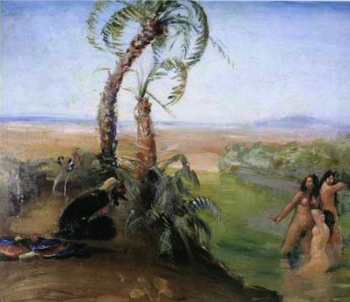
Immediately adjacent to A l'exposition was a picture that tightly secures Onsi's use of an artistic ḥadātha to gender relations. Les Baigneuses de Darat Jouljoul presents the moment from pre-Islamic poetry when Imruʿ al-Qais comes upon damsels bathing in a river and steals their clothes (Figure 7).Footnote 69 A reviewer in Al-Maʿrad newspaper explains, “[Qais] stands waiting their exit to the shore to enjoy the view of their nakedness.”Footnote 70 Whereas the gilt frame provides the curious viewers in A l'exposition with dignified, dislocating access to the object of their vision, the palm fronds framing Qais's gaze are circumstantial and flimsy, emphasizing his undisciplined bulkiness behind them. It is clear that Qais is not in a proper position for viewing nudity. His lascivious stare, uninvited and ghastly, indicates an unsanctified, inartistic way of viewing. It is a viewing act liable to turn the ancient Arab male's physical reaction to this aesthetic impulse into something far from “innocent.” Moreover, his engagement with their physical beauty lacks the sense of muʿāṣira conveyed by the pastiche dress of the viewers in A l'exposition. The respect Onsi demonstrates for women who attend carefully to Nudes contrasts drastically with the critique he makes of a male viewer peeking privately and appreciating women only as naked bodies. The two aesthetics bode differently for modernity.
Les Baigneuses de Darat Jouljoul by Omar Onsi; 1932, oil on canvas, 64.5 × 80 cm. From the collection of Raed Bassatne. Reproduced with permission of Raed Bassatne. [A color version of this figure can be viewed online at journals.cambridge.org/mes]

The pairing of two pictures about viewing art at his first solo Beirut exhibition suggests that Onsi was interested in art appreciation and the possible restructuring of social and gender relations. He framed these relations in terms of modern versus antiquated social mores through visual codes and dislocated genres and posited the artist as an intellectual inciting changes. A l'exposition impacts quite literally the act of viewing. In it, the nudity is in the jauntily depicted canvas, while the viewer of the real canvas is called by its composition to identify with the feminine vectors of visual attention. Thus, they model the external viewer's own vision. Here, by replicating the act of looking in an area newly dedicated to that very act, Onsi demarcates a new social space, the recently built Ecole des Arts et Lettres, as a place where people must discipline their ways of looking and responding to aesthetic, physically engaging cues.
NECESSARY DISLOCATIONS: HOW MASCULINITY MIGHT BE MODERN
Undressed females were an essential component of Beirut's fine art from the 1920s through the 1940s. The painters did not simply paint naked women, however: they made Nudes.Footnote 71 In this genre universally accessible nakedness meets with exclusively civilized fine art. The meeting was by no means an easy one for the artists of Mandate Beirut. In his memoirs, Farroukh narrates the first time he found a naked woman standing in the middle of his drawing class in Rome: “My mouth went dry, my legs started trembling, and my hands too. I was overwhelmed by stupor and shivering. I truly tried my hardest to resist the unpleasant, unwanted reaction.”Footnote 72 He was so horrified, both at the woman's presumed humiliation and at his own “uncontrollable” physical response, that he had to exit the room. After forcing himself to make a few sketches, he went home, took a cold shower, and read from the Qurʾan.Footnote 73 It was both his desire to enter the lineage of academic art makers and his consultation of the Qurʾan that enabled Farroukh to overcome the obstacle posed by his bodily reaction. The “far-reaching impact” of the event, says Farroukh, was that it marked his transformation from “a young man from Basta Tahta [Beirut]” to a diploma-carrying artist.Footnote 74
With his professional career, the “shock” Farroukh felt before the naked model was triumphantly transformed into a sense of removal from sociospatial limitations to membership in a professional class. Farroukh's narrative and the Nudes that embodied it for Beiruti viewers complicate the idea that “psychological dislocation” necessarily signifies the corruption of authenticity.Footnote 75 Shannon argues that the history of Arab mobility and ambition is concealed with the shock metaphor.Footnote 76 Farroukh not only teases his fellow Beirutis for being “immobile” but also depicts dislocation as a possible means to produce modernity through one's own experience.
The racist and sexist policies of most European art academies in the early 20th century deliberately precluded the possibility of non-Europeans, and of female Europeans, taking the role of heirs and progenitors within the academy.Footnote 77 But they could not preclude those people from universalizing that tradition and appointing themselves its begetters and beneficiaries. By choosing masters of the European Nude, such as Paul Chabas or Renoir, for their professional forefathers, Farroukh and Onsi affiliated themselves to the tradition of the Nude and, in an unarguably radical move, became its source.Footnote 78 It was precisely aesthetically affiliated people who, in an instance of mutual construction, materialized the claim that Paris and Rome were the centers of the art world, despite the battles raging inside them over the form modern art should take.
Paintings of Nudes in Mandate-era Beirut enacted modernity in multiple ways. They enabled the artist's self-insertion into continentally based art genealogies so as to deprovincialize the production of fine art and claim it for local projects. By dislocating Roman representational conventions, and by applying them to local women in The Two Prisoners, Farroukh enacted the pedagogical system of fine art and allowed his viewers to reenact it. Onsi mapped out the physical and aesthetic modernity gendered urbane Beirutis should enact. Both of their canvasses provided occasions for experiencing the Nude as a geographically unconfined entity. They warped local interactions with womanhood and urban space. The Nude's palpable universality could emerge through the enrollment of viewers’ bodies in a process of tathqīf. Ultimately, Nudes from Mandate Beirut suggest that the famous “shock” of modernity, or “psychological dislocation,” for colonial Arabs was sometimes cultivated, strategic, and productive rather than imposed, inescapable, and destructive.
The sublimation of heterosexual masculine desires into a graphic “avalanche of hips, thighs, breasts, and shoulder-plates” demonstrated the “discipline of the fire of the artist before the nude model.”Footnote 79 Thus, the epitome of the “successful modern picture,” intellectual and reformer Rushdi Maʿluf explained, was the painting of zalitāt (uncovered feminine things), in their undeniably “desire-provoking positions,” because they had “an impact in refining characters that velvet and silken clothes cannot for the way they camouflage.”Footnote 80 As aesthetic works they both indexed the muthaqqaf artist and enabled the process of tathqīf. Journalist after journalist contrasted artists’ works with that of politicians to argue that aesthetic sensibility could be the basis of responsible urban behavior.
VIEWERS OF NUDES: PEASANTS OR MODERNS?
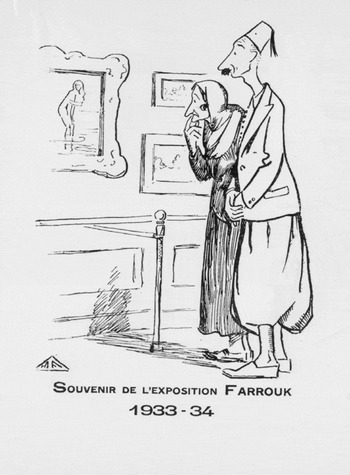
From its very title, the inked caricature Farroukh called Souvenir de l'exposition Farrouk (1933–1934) would appear to summarize the character of viewers to the artist's December 1933 exhibition at the Ecole des Arts et Métiers (Figure 8). It depicts a peasant couple viewing a painting by Farroukh. Their questioning gestures and passive stance mark their bafflement. These are not people whose aesthetic encounter invigorates or motivates them. The artist draws a stark division between the geometrical rationality of the art exhibition and the slovenly, stooping character of its audience. Further, he has the visitors darken the art rather than receive its enlightenment.
Souvenir de l'exposition Farrouk (1933–34) by Moustafa Farroukh; ink on paper, 14 × 10 cm. Reproduced with permission of Hani Farroukh.

The actual visitors to Farroukh's 1933 exhibition signed a registry. The signatures therein place the audience firmly in the urban class: the artist's relatives and peers, journalists and writers, education officials and bureaucrats, and members of the diplomatic corps all attended. Half of the visitors were indigenous to Beirut, and women made up a full third.Footnote 81 This contrast between “souvenir” and signatures makes it impossible to treat the ink drawing as a simple portrait. Rather, it is an image of the potentiality of peasanthood still present in many of the viewers who encounter Nudes. Throughout his career Farroukh created ennobling pictures of peasants. It is therefore likely that his critique of the couple's cultural difference was not an instance of attributing their backwardness to an inherent cultural cause, or “culturalizing” as Massad puts it, but rather a strategy of cultivating a new possible subjectivity.Footnote 82 The picture challenging their backwardness is, of course, of a Nude but not just any nude. It is a copy of Crépuscule, a famous work by Farroukh's French mentor Paul Chabas and thus a performance of the painter's affiliation with the lineage of academic artistry.
By aligning confusion over how to understand and respond to a Nude with signs of pastoral lifestyle, Farroukh equates the appreciation of this fine-art genre with urban, technologically modern lifestyles. If it were published in a local newspaper, as most of Farroukh's ink caricatures were, it may have incited potential exhibition goers to align their art-engaging practices with the broader set of “new” practices that took their force not only from their novelty but also, more importantly, and as opposed to mere iṣlāḥ and tanẓīm, from their dislocation. The distance Farroukh draws between apparently universal practices of art viewing and aged, country ways reminds that people who share a city space might yet live in different temporal zones, as distinct as rural and urban sensibilities. Souvenir proposes that viewers adopting the wrong viewing practices will lose their urban membership and privileges. Fine art may invite viewers into a convergent modernity, but achieving it will require effort and self-monitoring. Jean Bulus, who wrote the catalogue essay for Farroukh's 1933 exhibition, phrased it thus: “To contemplate a work of art is to contemplate oneself, to watch oneself.”Footnote 83
FROM THE GENRE OF NUDE TO THE GENRE OF LACK
Many editors of Beirut's newspapers in the 1920s and 1930s did have problems with Nudes—not for their lack of clothing but, counterintuitively, for the lack of art making they seemed to index. For example, Kamal al-Nafi reported in Al-Ahwal that in response to learning that a “national painter” was holding an exhibition at the American University of Beirut, he exclaimed, “Don't be crazy! Do you think you're in Venice or in one of the elevated cities of the West?!”Footnote 84 For al-Nafi the fact of an exhibition could occasion public awareness of local lack and dislocated plenitude. He took “the Eastern woman” of The Two Prisoners as an opportunity to comment on the connection between gender relations and aesthetic sensibility:
She glances at her companion in prison, a small bird placed in a cage that sings sad songs that bring pain to the heart, the songs of the eternal prisoner. For they are both, verily, prisoners whose counsel still, to this very day, fights to defend their cause before public opinion [emphasis added].Footnote 85
How is it that elsewhere women may represent themselves, but to this very day the Eastern woman relies on others to voice her needs? Al-Nafi spoke to an audience intensely involved in the debate over women's suffrage, among other elements of Lebanon's political and economic character. With the trope of teleological change, al-Nafi warns that people can have muʿāṣira without ḥadātha. Merely living “this very day” does not guarantee living the life of an “elevated city.” He then calls on his readers to conform to the demands of muʿāṣira, to demonstrate their parity in linear time and their ability to embrace new gender relations, by engaging in sexualized, aesthetic art loving. They should attend shows, support art, and not leave aesthetic uplift to “the foreigners in charge.”Footnote 86 The stakes for “giving Art its due” are high, according to al-Nafi: “In so doing, they would show that they are a living people truly striving for freedom.”Footnote 87 Nine years of French Mandate colonialism may have met their antidote.
With al-Nafi and Maʿluf, the “anxiety of the nude” becomes clearer. The necessity of Nudes to social projects formative of national, gender, and class identities made them also necessarily provocative of a certain threat: the threat of invisibility. An index of a modernity that is potentially that of every human, Nudes provoke the anxiety that their enchanting agency may not be heeded by “peasant” viewers and undisciplined men. Compatriots could ignore or, worse, condemn them. Inscribed in the newness of Nude compositions is a strategy of dislocation that involves both reference to other places undergoing similar experiences, muʿāṣira, and the ability to claim these experiences for local projects of change under the name of ḥadātha.Footnote 88 In other words, the Arab “anxiety of the nude” is not so much in relation to the actual number of Nudes present but, rather, to the necessity of their marking a “missing” modernity.
THE LESSONS OF FORGOTTEN NUDES
In the past twenty years, Souvenir has gotten extensive replay. Most recently, at Farroukh's 2003 retrospective, it appeared next to his copy of Crépuscule, accompanied by a lengthy wall comment berating Lebanese audiences for not appreciating Nudes (Figure 9).Footnote 89 Further, the comment compares the cartoon to Onsi's similarly inspired “satire,” A l'exposition. Notably, the latter painting has been assigned a new name in recent decades: Young Women at an Exhibition. Footnote 90 Meanwhile, the picture has grown younger and younger with each showing. In a 1989 catalogue it is dated to “c. 1935,” in 1997 to “c. 1945,” and in 2003 to “the beginning of the 1950s.”Footnote 91 Curatorial reckoning has pushed its production up to coincide more exactly with national independence (1943), modern governance, and urban expansion. These reckonings are not wrong, sociologically speaking: they are facts produced by the captivating legacy of Nudes.
Author's photograph of Farroukh's copy of Crepescule by Paul Chabas. From the Musée Sursock Retrospective for Moustapha Farroukh, 8 January 2003, Beirut, Lebanon. On the right there is a small image of Farroukh's Souvenir de l'exposition, 1933–34 (see Figure 8) and a curatorial commentary. [A color version of this figure can be viewed online at journals.cambridge.org/mes]

When we see pictures as reflections of preextant social facts we cannot understand their connection to Lebanese society. How could a picture of women looking at their naked sisters be “about” Lebanese society? How could it be about viewing generally, when only gendered viewing is depicted? But the works discussed in this paper did not illustrate social conditions and conceptions: they instigated them. Ironically, Nudes that were created to be agents of modernity haunt every exhibition of art in Lebanon today, as participants evaluate the degree of ḥadātha and muʿāṣira in their aesthetic sensibilities. Meanwhile, the alleged “lack” of art appreciation, female models, and so on has come to be at once the main trope for defining the local art scene and the dominant strategy for promoting art in the Arab world.
The political project of nudity in Mandate Lebanon encourages art historians to grasp the historical, cultural, and political value of fine art by expanding their scope from attempts to trace its alleged origins. Outside the metropole, art must be scrutinized for both the genres and the formal elements by which its makers experienced affiliations and created universal modernities. Such expansion would also heighten the relevance of art history to the study of intercultural, and especially colonial, junctures.Footnote 92 The necessity of these imported pictures to index a universal modernity demonstrates a method for studying the strategy of dislocation and the relevance of the contemporary discourse of lack in culture and politics.
The forgotten Nudes of Beirut also highlight the importance of studying the aesthetic forms and experiences that have produced the contemporary Arab world. They push theories of cultural reproduction beyond class analysis to intercultural junctures and there provide a way to study cultural contests where the boundaries of identity, belief, and ambition are not clearly circumscribed. The centrality of aesthetic experience they illuminate shows that modernity is not always a rude imposition or an inauthentic appropriation. It may be a convergence of a conceptual, sensorial nature. The production of Nudes complicates our understanding of the historical processes that impacted and altered, by local reckoning, Arab societies. That, in turn, must direct our attention to the agencies that have produced “modernity” as a universal force.