

1. INTRODUCTION
Climate change poses an unprecedented challenge for humankind. To address climate-related threats, climate legislation and government regulatory policies have proliferated over the past two decades.Footnote 1 Moreover, as a response to existing global regulatory gaps in climate change mitigation and adaptation, a cascade of climate change litigation (CCL)Footnote 2 has developed and become a transnational judicial phenomenon.Footnote 3 To date, the Sabin Center's Climate Change Litigation Database (CCL database) has already recorded 1,248 cases worldwide, which include 973 in the United States (US).Footnote 4 Accordingly, literature on CCL has proliferated during the past decade. The earliest studies concerned major US Supreme Court decisions, including among others the well-known cases of Massachusetts v. Environmental Protection Agency (EPA) in 2007,Footnote 5 American Electric Power v. Connecticut in 2011,Footnote 6 and Utility Air Regulatory Group v. EPA in 2014.Footnote 7 As Osofsky and Peel noted,Footnote 8 following this first wave of scholarship on individual cases, the second wave created typologies of CCL. As a step forward, the third wave examined the role of litigation in climate change regulation, creating a discourse of litigation as a ‘regulatory pathway’, to which this study is closely related.
Prominent among contributors to this third wave of legal scholarship on the regulatory role of litigation are scholars from the US and Australia, the two countries with the most extensive CCL practices. Markell and Ruhl, having conducted an empirical analysis of 201 US cases concerning climate change, found that courts could either intervene directly, as in Massachusetts v. EPA, or perform a ‘prods and pleas’ function.Footnote 9 Peel and Osofsky refined this framing by exploring the diversity of direct and indirect regulatory impacts of CCL under a ‘pluralist/polycentric approach’.Footnote 10 They concluded that CCL plays a positive role in the multi-dimensional climate change regulatory system by fostering action to reduce greenhouse gas (GHG) emissions and minimizing associated climate change impacts, whether directly through classic statutory interpretation, the ‘prods and pleas’ function of judicial decisions or, more recently, through a strategy based on human rights.Footnote 11 While the majority of cases focus on government regulatory behaviour, there are also cases that target corporate emitters for climate-related damage or for injunctive relief based on tort law (using, for example, the public nuisance doctrine), although no climate nuisance action has been successful to date.Footnote 12 Benjamin and Kysar have explored the ‘prods and pleas’ function of CCL in the context of climate nuisance litigation and suggested that ‘although climate change plaintiffs still face long odds on the actual merits of their claims, judges would sell short their institutional role if they dismissed such claims as categorically beyond the proper domain of the courts and the common law’.Footnote 13
Analyses of regulatory pathways so far have been primarily interested in courts as alternative suppliers of climate change regulation, stepping up where government regulation falters. There has been less interest in courts as collaborators in the regulatory process, engaging with and interpreting government climate change policies and, in this guise, contributing to the maturing of climate change regulation. Current CCL studies also largely refrain from considering how the experience of common law countries (especially the US and Australia) compares with that of other countries with different legal traditions. What pattern might CCL follow in civil law countries, especially in regimes where the separation of powers is not guaranteed and courts are ‘little more than a loyal subordinate of the party-state that carefully carried out assigned tasks’?Footnote 14 A study of CCL experience in China will help to complete the global picture of CCL practices. It may also help to highlight the extent to which CCL is a transnational judicial phenomenon and the importance of recent judicial innovation in the Global South, thus challenging the understanding of the standard account of CCL as shaped mainly by cases in the Global North.Footnote 15
This article aims to fill the gaps and to enrich the knowledge of the ‘regulatory pathway’ paradigm by contextualizing it within the Chinese legal regime. Our study demonstrates that, instead of the court-driven regulatory policy-making process typical of the US and Australia, China apparently adopts a government-led response to climate change, leaving courts with a secondary supporting role. In doing so, we focus on the following questions:
• Does CCL exist in China?
• How does CCL in the Chinese context differ, if at all, from global understandings of CCL?
• What is the most likely channel for future CCL in China?
To answer these questions, the following sections will first explore existing Chinese case law, and then examine the possible future pathways for CCL in the legal context of China. To this end, the article is structured as follows. Section 2 provides an empirical analysis of 177 cases selected according to the description of CCL adopted by the Chinese judiciary. The analysis shows that Chinese CCL consists mainly of civil actions related to contract disputes between energy enterprises and low-carbon industries. The outcome of these judicial decisions reflects the influence of Chinese government low-carbon policies on the judiciary. Section 3 examines the differences between Chinese and mainstream conceptualizations of CCL. Traditionally, CCL involves mainly statutory or rights-based administrative public interest litigation (PIL), which usually holds the government accountable for its failure to perform climate-related duties. By contrast, CCL in China takes the form of contract-based civil actions in response to the government low-carbon policies.
The article then shows (in Section 4) that the institutional arrangements of the overwhelmingly powerful administrative authorities and relatively weak judicial competence have jointly defined the Chinese ‘government-led regulatory pathway’ of CCL. Instead of the familiar CCL profile of a case in which a government or government agency is held liable for its acts of nonfeasance or misfeasance in relation to its climate duty, CCL in China is more likely to be predominantly tort-based and instigated on the basis of government climate policies that target carbon emitters. In the final section, the article examines the emerging phenomenon of tort-based PIL on air pollution in China. In these cases, some important legal hurdles faced by both air pollution claimants and climate change petitioners have been successfully overcome, showing a growing receptivity on the part of the Chinese judiciary to the framing of tort-based and large-scale environmental PIL. These cases may offer a channel to vindicate, directly or indirectly, climate-related public interests vis-à-vis emitters of GHGs.
2. CCL IN CHINESE COURTS: AN EMPIRICAL ANALYSIS
As a result of China's rapid economic growth and reliance on coal, it overtook the US to become the world's largest GHG emitter in 2006. In 2016, China committed to cut its GHG emissions, and in recent years it has made tremendous progress in reducing its emissions. The impetus for change comes chiefly from the insistence of central government and the top-down enforcement of climate change-related legislation and policies.Footnote 16 The role of Chinese civil society and the Chinese judiciary are seemingly insignificant. In the global CCL databases such as that run by the Sabin Center, not a single case from China has ever been recorded.
Is there any climate change-related litigation in China? In 2016, the Chinese Supreme People's Court (SPC) issued an Opinion on the enhancement of judicial functions in promoting the construction of ecological civilization and green development (the 2016 Opinion)Footnote 17 and a report on the environment and resources related to Chinese judicial practices (the Report).Footnote 18 Under the heading of ‘Civil Litigation concerning the Environment and Natural Rresources’, both documents included certain ‘litigation as a response to climate change’, including disputes concerning ‘carbon emissions’, ‘energy conservation’, ‘green finance’, and ‘biodiversity conservation’. It constitutes the only formal confirmation of CCL in Chinese official judicial documents. This categorization is obviously somewhat different from the mainstream understanding of CCL. To gain further insight into this distinctive category of litigation and its relation with non-Chinese CCL, this article adopts an empirical approach to probe into the status of CCL in the legal context of China.
Although the current Chinese legal system does not formally recognize precedent, earlier cases are often cited for persuasive authority. Some courts also follow precedent to decide issues when statutes are vague.Footnote 19 In particular, certain decisions of the SPC that can be read as generating legal norms could have binding effect on lower courts.Footnote 20 This shows the efforts of the Chinese judiciary to guarantee consistency in judicial decisions.Footnote 21 With regard to CCL, as there is no specific legal framework in China that could possibly offer a clear definition of its scope, judicial decisions therefore represent an important, if not the only source to which this study could refer. By collecting and examining relevant cases, the article intends to provide a comprehensive empirical analysis of the version of CCL in China.
2.1. Methodology
Markell and Ruhl correctly noted that ‘[w]ithout a complete picture of what has and has not been within the sweep of climate change litigation, it is difficult to offer a robust evaluation of the past, present, and future of climate change jurisprudence’.Footnote 22 So, to reveal how Chinese courts currently understand CCL and to explore the present and future of possible CCL in China, this article will first analyze 177 cases from 2011 to 2018 involving ‘carbon emissions’, ‘energy conservation’, ‘green finance’, and ‘biodiversity conservation’. The cases are identified by keywords selected according to the description of each category of cases in the 2016 Opinion.Footnote 23
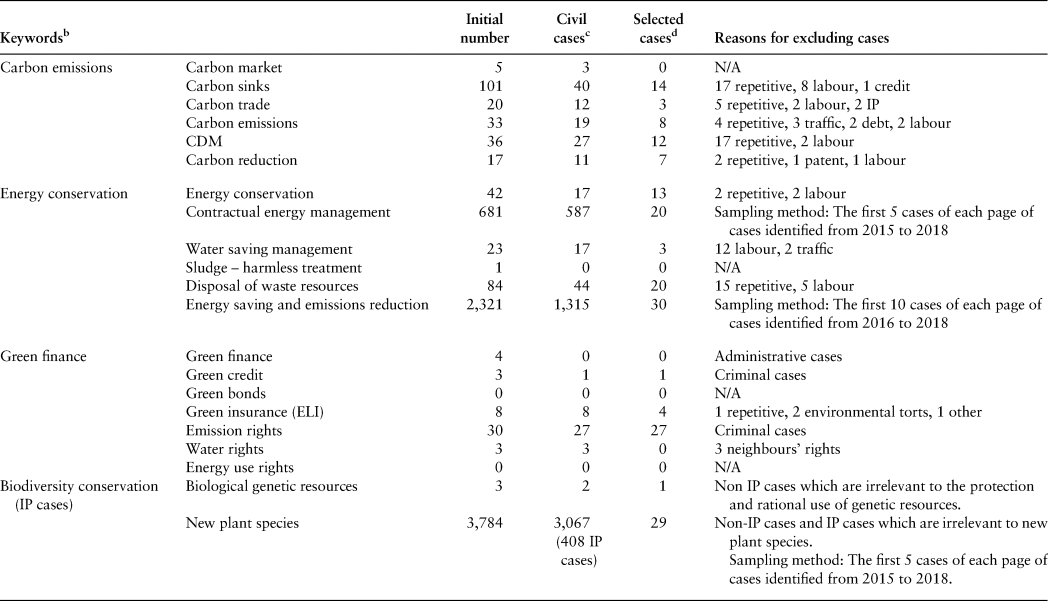
Based on keyword searches in a court rulings database known as 中国裁判文书网 [China Judgments Online]Footnote 24 and in some unofficial databases (e.g. http://www.itslaw.org) to complement the results, the initial dataset included 7,200 cases. Having eliminated non-civil cases,Footnote 25 5,190 cases were left. In order to limit the number of cases to a manageable size and guarantee the inclusion of the most relevant cases, the research team adopted a case-by-case manual selection approach.
Firstly, as the results found under ‘new plant species’, ‘contractual energy management’, and ‘energy conservation’ are voluminous, the research team randomly picked 20 to 30 cases from each type.Footnote 26 Secondly, duplicated resultsFootnote 27 – and obviously irrelevant cases involving, inter alia, matrimonial, succession and labour disputes – were eliminated. Moreover, cases that make only passing reference to the keyword-related issues without directly and meaningfully addressing the laws, policies and actions that compel, support, or facilitate climate mitigation or adaptation were not taken into account (Table 1). Consequently, a final dataset of 177 cases was produced. The team then coded the dataset of cases according to three variables: (i) the type of plaintiff and defendant; (ii) the cause of action; and (iii) the outcome of the case.
Case Collection and Selection Process for the Chinese ‘CCL’ Dataseta

Notes
a As the search is based on the Chinese Judgments Online database, which is known for its inadequate transparency, some important cases have not been recorded. Secondly, the most important limitation of this approach lies in the lack of official definition of all relevant categories of case, as the database classifies judicial cases according to the categorization of ‘causes of cases’ recognized by the SPC. Yet, the definition of Chinese CCL in the Opinion led the research team only to a rather broad and vague categorization of cases. Consequently, the selected keywords may not accurately correspond with the choice of wording (or the phraseology) of the judicial texts. Thus, some decisions may not be identified in the case collection process. Lastly, also as a result of the ambiguous categorization of cases, there were many repetitive and irrelevant results in the initial set of cases and, notwithstanding the team's efforts to include all relevant cases in the dataset, some cases could still have been excluded. The number of results found by ‘new plant species’ is huge, as it corresponds exactly with one ‘cause of action’ recognized by the Supreme Court under the category of IP cases.
b Keywords are selected according to the description of each category of cases in the Opinion.
c In the 2016 Opinion (n. 17 above), ‘litigation as a response to climate change’ falls within the category of ‘Civil Litigation of the Environment and Natural Resources’.
d In order to limit the number of cases to a manageable size and guarantee the greatest relevance of the cases, the team turned to a case-by-case manual selection approach.
2.2. Overall Findings
This analysis reveals some important insights into critical features and trends of Chinese CCL.
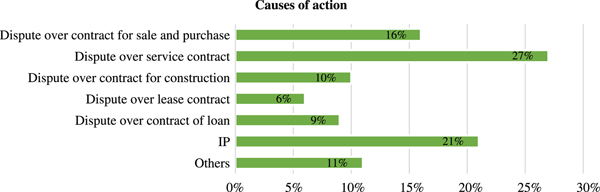
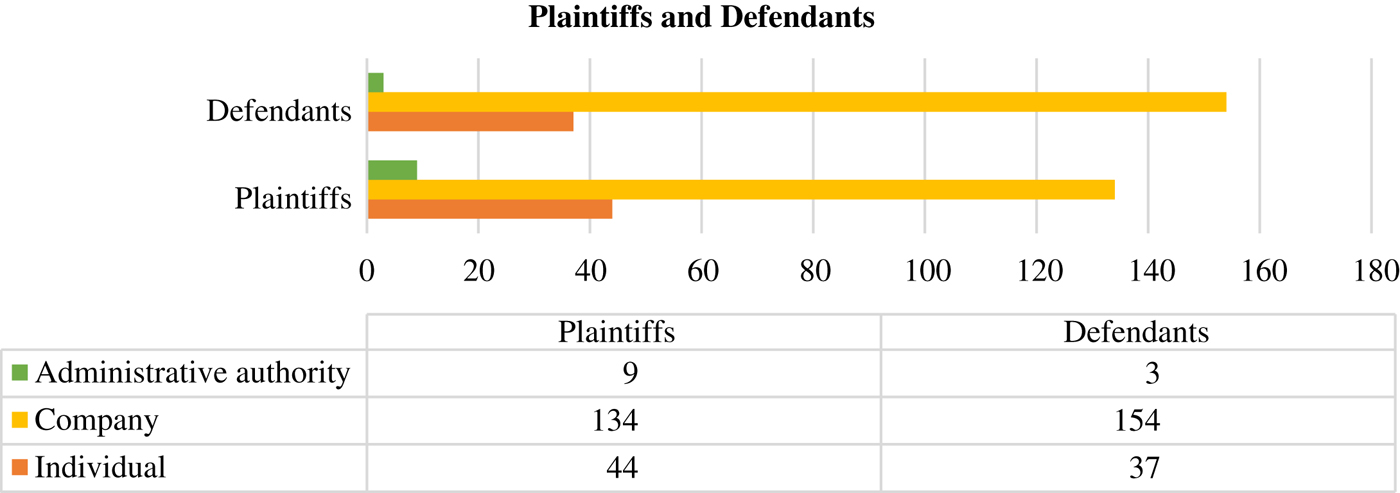
Trend 1: Contractual disputes with enterprises related to energy conservation and biotechnology as plaintiffs and defendants dominate (see Figure 1,Footnote 28 Figure 2)
While all Chinese CCL cases are civil actions, there is nonetheless variation in the specific types of action. Contractual disputes obviously predominate (69%), while tort disputes occur mainly within the category of biodiversity-related intellectual property (IP) cases (less than 21%). Among contractual disputes, the most frequent disputes concern service contracts (27%), which generally involve ‘energy management service contracts’. These refer to cooperative energy-saving projects which often assume the form of contracts between energy-saving service companies and industrial energy consumers. In such cases, usually the energy-saving service provider will first invest in the installation of the energy-saving system to guarantee its performance on energy conservation. It will then share the benefit derived from the energy-saving project. If the owner of the project, for various reasons, refuses to share the benefit or stops running this energy-saving equipment, a dispute may arise. Coming in second are cases related to IP disputes (21%) concerning the protection and transfer of environmental and biodiversity-related technologies.
Summary of Causes of Action

Categorization of Plaintiffs and Defendants

As for the players involved, in Chinese climate change-related cases the parties are diverse, yet the majority are companies operating in the fields of energy conservation, carbon emissions reduction, and biotechnology. For instance, service contracts disputes, which occur most frequently, mainly involve energy service companies (providers of technological services in respect of energy management) and companies with energy-saving demands. By contrast, IP disputes involve predominately agricultural biotechnology companies. Individuals, the government and government agencies also participate, apart from companies, especially in disputes arising from administrative contracts between individuals and the government concerning forest conservation and the rational use of land.
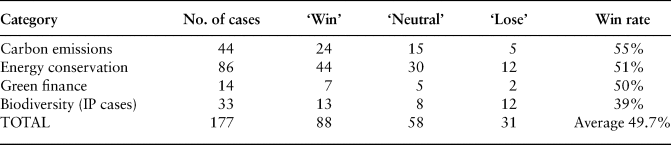
Trend 2: Obvious judicial tendency in favour of low-carbon economy policy (Table 2)
Table 2 shows judicial trends in Chinese CCL. The success rate among the 177 cases is impressive, and averages 49.7% (compared with a failure rate of 17.5%).Footnote 29 The success rate of cases identified under ‘carbon emissions’ and ‘energy conservation’ is even higher, as they mainly involve disputes over energy management service contracts.
Summary of Outcomes of Cases

Energy conservation is one of China's ‘basic state policies’, and has been integrated in the Energy Conservation Law (ECL). Article 66 ECL explicitly stipulates that ‘the state supports the promotion of power demand side management, contract energy management, energy conservation voluntary agreements, and other energy-saving methods’. In 2010, The Chinese government issued a policy document to promote the energy-saving service industry through the implementation of ‘contract energy management’.Footnote 30 Therefore, this relatively high success rate possibly reveals the efforts of the Chinese judiciary in helping to implement the relevant laws and policies that address low-carbon economy issues. In a typical case, the plaintiff (an energy service company) claimed that the defendant did not perform its contractual obligation to share the profits generated from the energy management project, yet the defendant (a coke-powered plant) argued that, as the circumstances had changed (a huge cost increase), the contract should be modified accordingly, and the fulfilment of its obligation under the current contract would be unfair to the defendant. The court decided in favour of the plaintiff energy service company and ordered the defendant to share the profits.Footnote 31
In some circumstances, the court explicitly refers to the government's environmental policies in its reasoning.Footnote 32 In one contract dispute, for example, the plaintiff claimed that the defendant, a property developer, was liable for breach of contract as it had installed an external solar water heating system and charged an additional fee for the installation, which had not been foreseen in the original sales contract. In the judicial decision of the second instance, the local court dismissed the plaintiff's claim, holding that:
Although the two sides in the contract contain no agreement on the installation of a solar water heating system, given that the government promotes the use of solar energy as a green power, and that the installation … is also clearly required by the Qinghai provincial people's government in the Qinghai Green Building Action Implementation Plan, the [installation effectuated by the] defendant is in line with the energy-saving and low-carbon policy requirements [of the government], which should thus be supported and encouraged.Footnote 33
Another case involved a taxi management contract signed between the owner of the car and a taxi management company. The latter wanted to terminate the contract unilaterally on the grounds that it was a ‘yellow labelled car’, and therefore a heavy-polluting vehicle, which was subject to the state's mandatory write-off policy. In its decision, the court decided in favour of the taxi company:
Atmospheric environmental protection is related to the fundamental interests of the people, the sustainable and healthy development of the economy, the comprehensive well-being of society, the realization of the great rejuvenation of the Chinese nation's dream … In order to improve air quality, the State Council formulated the Air Pollution Prevention Action Plan … To implement the Air Pollution Prevention Action Plan, [on] 10 October 2015 the Ministry of Environmental Protection [and five other ministries] jointly issued the ‘Notice on the Elimination of Yellow Labelled Cars’ … In accordance with Article 6 of the Civil Law of the People's Republic of China, ‘Civil activities must respect the law, [and] where the law is silent, the state policies’. The court decides to dismiss the plaintiff's claim since it was clearly inconsistent with the state's current policy.Footnote 34
It should be clarified that, in most cases, the state environmental policies referred to enjoy only ‘persuasive authority’ to support judges’ reasoning in their decisions, as policies typically lack the clarity and legitimacy of legal norms. It is only after government policies have been translated into regulations or other legislative forms that they could become the formal basis of any judicial decision.
3. CHINESE CCL AND THE STANDARD ACCOUNT OF CCL: DIFFERENT REGULATORY PATHWAYS
In order to reveal how the understanding of CCL among Chinese courts differs from that associated with the standard account of CCL, this article performs a comparative study between general transnational practices and the Chinese version of CCL, using the results of the empirical analysis.
3.1. How Does Chinese CLL Differ from the Standard Account of CCL?
Before undertaking a comparison, it is important to address the question of what constitutes the standard account of CCL. Peel and Osofsky have proposed a broad definition of CCL, which includes ‘litigation with climate change as the central issue’ (core cases), ‘litigation with climate change as a peripheral issue’, ‘litigation with climate change as one motivation but not raised as an issue’, and ‘litigation with no specific climate change framing but implications for mitigation or adaptation’ (such as fracking cases).Footnote 35 Although this definition of CCL could include a broad range of cases, most academic focus has been on the ‘cases with deliberate framing of the arguments or judgment in climate change terms’. Hence, that is the image that dominates in mainstream conceptualizations of CCL. Chinese CCL cases, however, do not correspond to this stereotype on a range of factors. In order to demonstrate how most typical practices of CCL may differ from the Chinese version of CCL, we chose to focus on the core cases with ‘deliberate framing of the arguments or judgment in climate change terms’.
Statutory/rights-based litigation against governments v. contract-based actions against industry
The most well-known case of CCL in the US, Massachusetts v. EPA, focused on statutory interpretation – whether the US EPA had abused its discretion by refusing to regulate GHG emissions under the Clean Air Act. Unlike this statutory-based approach, rights-based CCL represents a relatively new phenomenon. In 2015, a Pakistani court in the case of Leghari v. Federation of Pakistan Footnote 36 made history by accepting the argument that failures on the part of the government to address climate change violated the petitioners’ rights. In the recent appeal in Urgenda, the state was also held accountable on human rights grounds.Footnote 37 These cases, either involving statutory interpretation or human rights protection, are examples of the predominant judicial strategy of pursuing climate change goals by suing government bodies.Footnote 38 Tort-based CCL (or actions based on public nuisance)Footnote 39 – where plaintiffs hold emitters responsible for causing climate change – has grown rapidly over the last two years,Footnote 40 but has never been successful to date.Footnote 41 This is largely because diffuse and disparate anthropogenic GHG emissions represent the ‘paradigmatic anti-tort’.Footnote 42
In contrast, the majority of Chinese CCL cases target companies that are mostly carbon emitters. Yet, instead of addressing climate change-related concerns per se, these cases are contract-based civil disputes, and the plaintiffs are companies rather than individuals or non-governmental organizations (NGOs). The contracts are usually signed between green economy companies, such as in the energy-saving industry. The role of the court in Chinese CCL cases is to help to regulate the low-carbon market and define the behavioural pattern of the relevant players. These are private interest litigation cases; the public interest with regard to climate change does not feature even at the periphery of legal arguments in their adjudication.
Law-oriented v. policy-oriented litigation
In CCL across the globe, especially in common law countries, judges have played a dominant role. Their adjudication has given concrete meaning to climate-related values and ordered the administration to take specific measures to address climate change issues.Footnote 43 Yet, as an empirical analysis by Markell and Ruhl found, judgments in the US are a ‘mixed bag with no clear favored position’, with courts ‘applying existing laws consistent with their settled interpretations, rather than embedding a new jurisprudence of climate change within the existing statutory frameworks’.Footnote 44
In contrast, Chinese judges decide largely in accordance with government policy. As demonstrated in the empirical study of 177 Chinese CCL cases, Chinese judges invoke not only relevant legislation but also climate change-related policies in arriving at their decisions. If, in the US, ‘the courts have treated climate change as business as usual’,Footnote 45 Chinese court rulings reflect certain influences of Chinese low-carbon policies on the judiciary, who seek to help to accomplish the climate change goals set out in the policies. However, in most cases Chinese courts have stopped short of developing specific case law in response to the particular concern of fostering a low-carbon economy. Considering the sizeable number of ‘neutral’ cases (see Table 2), we may conclude that Chinese judges, while being steered by government policies, still try to retain judicial impartiality and adjudicate according to law.
To conclude, CCL (so called) in China mainly involves actions related to contract disputes brought by or involving energy or biotechnology enterprises. Whether these cases will play a positive role in addressing climate change is not obvious. The enterprises involved in litigation are motivated by protecting contractual rights or fulfilling contractual obligations rather than achieving specific climate change goals. Therefore, in these cases, concern for climate change does not feature even at the periphery of the argument. Instead of the plaintiff, it is the court that seeks to help to implement public policies on the low-carbon economy. However, since the judgments could help in promoting better performance of the low-carbon economy and therefore have a positive implication for climate mitigation or adaptation (even if it represents merely an indirect and incidental effect), Chinese ‘CCL’, without addressing climate change-related concerns per se, could still fall within the broadest definition of CCL.Footnote 46
3.2. The Chinese ‘Government-led Regulatory Pathway’ of CCL
Despite the great efforts of the Chinese government to tackle climate change, some gaps still exist in Chinese climate change regulation, especially with regard to the adaptation aspects of climate changeFootnote 47 and the absence of legally binding GHG emissions reduction targets.Footnote 48 In this context ‘litigation can provide a limited opportunity for judges, lawyers, academics, and NGOs to explore new roles’ and, in so doing, offer proactive strategies to tackle climate change, while gently expanding ‘the universe of political possibilities’.Footnote 49 The question therefore arises whether this form of CCL, which is more strategic and less contract-based in nature, is likely to emerge in China. If so, what would be the most likely channel for future CCL in China? To answer these questions, it is first necessary to conduct an analysis of the Chinese regulatory context.
There are two major differences between China's regulatory context and that of most democratic common law countries: namely, limited judicial activism, and relatively stronger government performance in tackling climate change. Firstly, the Chinese government is absolutely central in addressing climate change. Whereas the US, in particular, is lagging behind, and even reversing climate change action in support of the fossil fuel sector,Footnote 50 the Chinese government is relatively active in response to climate change and has implemented some effective measures. At the international level, China is a party to the United Nations Framework Convention on Climate Change (UNFCCC)Footnote 51 as well as its Kyoto ProtocolFootnote 52 and the Paris Agreement.Footnote 53 As a non–Annex I country, which has no legally binding obligation to reduce carbon emissions under the Kyoto Protocol, China's GHG emissions reductions are voluntary. Yet, China has promised to peak its carbon dioxide (CO2) emissions in around 2030, including a pledge to cut its carbon intensity by 3.5% per year through to 2030.Footnote 54 With a firm resolution for change and effective implementation of solid measures, China's fossil fuel CO2 emissions dropped by 0.6% in 2015 and 0.35% in 2016.Footnote 55 The Chinese economy grew by nearly 7% in 2017, but emissions increased by just 1.7% (or 150 MT) thanks to continued renewable deployment and faster coal-to-gas switching.Footnote 56 Some studies even predict that, among other factors, by decreasing its reliance on coal, increasing investment in clean energy, and shifting its economy away from heavy industry and towards services, ‘China will exceed both its energy intensity and clean energy goals by 2020 and peak its carbon emissions by 2025, five years ahead of its international commitment’.Footnote 57 Therefore, if CCL is a way to respond to the inaction of the government or its failure to take significant action to address climate change concerns in most jurisdictions, holding the government accountable for its failure to perform climate-related duties may not be the major motivation for CCL in the context of China.
Secondly, Chinese courts are ‘rule-interpreting bureaucrats’ rather than ‘value-driven lawmakers’.Footnote 58 One critical legal precondition for the emergence of CCL is the independence of courts and judges. In countries where governments have expressly prioritized development (such as Pakistan), and where governments are actively addressing climate change (such as the Netherlands, Sweden, and Switzerland), judicial independence guarantees that courts are not subject to improper influence from the government or from private or partisan interests; courts, therefore, can push the government on concrete action to tackle climate change. However, notions of judicial independence are less strongly embedded in Chinese legal culture than in, for example, the US. In the US, where judicial independence is safeguarded by the separation of powers, it is legitimate for courts to conduct judicial review of executive orders and legislative actions of the government. In China, following the statute-oriented civil law tradition, judges refrain from constructive interpretation, lest they be seen as legislating. Judicial activity is sometimes understood as a way to help to achieve state policy goals.Footnote 59
This relatively subordinate role of Chinese courts to the government in tackling climate change could be a double-edged sword for the emergence of CCL in the country. On the one hand, existing power arrangements indicate that the judiciary is the weakest branch compared with the congress and the government.Footnote 60 It is stipulated explicitly in China's Constitution that the People's Congress enjoys the ‘highest power’ in the country. If the courts were able to review the legality of government policies, they would be conferred a stronger position in relation to the Peoples’ Congress, which would threaten the values underlying the principle of congressional control over the judiciary. In this context, it would be unrealistic to count on the courts to rule against regulatory authorities when the law has not imposed duties on the government to reduce GHG emissions. On the other hand, in common law countries where ‘checks and balances’ are guaranteed by constitutional law, courts may refrain from adjudicating tort-based CCL because of the political question doctrine,Footnote 61 as well as the doctrines of pre-emption and displacement.Footnote 62 Similar dilemmas will not concern Chinese judges. Our empirical study shows that Chinese environmental policy, though obviously political in nature, in contrast would steer the court's behaviour, often in unspectacular yet conscious ways.
To conclude, instead of the court-driven regulatory policy-making process that is to be found especially in the Netherlands, India and Pakistan,Footnote 63 China follows a government-led pathway in response to climate change, leaving courts with a secondary supporting role. Given the subservient relationship between the judiciary and the executive, it is highly unlikely that CCL involving public authority defendants would ever take off in China if government duties to reduce GHG emissions are not prescribed by law. However, this still leaves the question of whether tort-based litigation, targeting private defendants, could flourish in China. To answer this question, the next section looks at developments in PIL on air pollution to gauge the likelihood that trends in this area could migrate towards the field of CCL.
4. A POTENTIAL PATHWAY FOR CHINESE CCL: PUBLIC INTEREST LITIGATION RELATED TO AIR POLLUTION IN CHINA
Chinese courts, despite their limited competence, have the potential to push for greater change in tort-based CCL if Chinese government policy encourages them to do so. A key model for prospective tort-based CCL to follow could be the recent policy-oriented PIL on air pollution in China.
4.1. PIL Cases related to Air Pollution in China
China's air pollution has been a problem for decades, with the issue drawing significant attention at both local and international levels. The Chinese government is finally determined to fight air pollution for the sake of a cleaner sky. As part of the official policy drive to ‘make China's sky blue again’, there has been a strong push to reduce pollutant emissions by, among others, ending national dependence on coal through the creation of solar and wind farms and, potentially, by a future ban on non-electric cars.Footnote 64 In 2013, China's State Council released its first Action Plan for Air Pollution Prevention and Control (Action Plan), setting the road map for air pollution control for the next five years. The Chinese government has promised to lower the concentration of particulate matter PM2.5 in China and to ‘substantially’ improve air quality in the country by 2035. In 2015, the newly amended Air Pollution Prevention and Control Law came into full effect. It requires cities to regularly submit and release definitive plans to ensure they are on track to meet national air quality targets and accordingly it imposes heavier fines on emitters who fail to meet air emission standards. Under the steering effect of these governmental actions, PIL has emerged to strengthen the nationwide anti-air pollution trend. Since 2015, tort-based PIL on air pollution, initiated by NGOs and public prosecutors, has helped to secure compensation for damage caused by air pollution. This phenomenon illustrates the potential for the Chinese judiciary to play a positive role in helping to implement government air policies and relevant legislation.
While, to date, there is no record of tort-based CCL in China, PIL cases concerning air pollution have emerged as a new judicial phenomenon.Footnote 65 The first case, decided in 2016, was brought by the environmental NGO All-China Environment Federation (ACEF) against Jinghua Group Zhenhua Co. Ltd (JH).Footnote 66 ACEF contended that JH should pay compensation for damage to public environmental interests caused by its excessive emissions of air pollutants. Recognizing the adverse effect on the environment and public health caused by JH's unlawful emissions, the court found for the plaintiff and ordered JH to pay compensation. After this first successful example, 15 more cases were filed in 2016 alone.
In these cases, the defendants are mainly petrochemical companies with air pollutant emissions exceeding the legal threshold (9 cases) and motor vehicle production and sales enterprises (4 cases),Footnote 67 and the plaintiffs are mostly NGOs.Footnote 68 As to the cause of action, one case concerns vehicle emissions,Footnote 69 whereas the remaining 15 cases relate to air pollution caused by excessive industrial emissions, for which the respective emitters had already been found in breach of regulation by the local environmental protection authorities. As it is difficult to obtain evidence, and since the appraisal of harm caused by air pollution is both costly and time consuming,Footnote 70 trials usually last for years. The first case in Hebei Province was filed in 2016, and the final judicial decision was given two years later in 2018.Footnote 71
In 2018, a major new trend emerged with Chinese public prosecutors stepping forward as the leading plaintiff in PIL air pollution cases. According to the newly amended Chinese Civil Procedure Law,Footnote 72 public prosecutors are allowed to file tort-based lawsuits against polluters who compromise public interests related to environmental protection. The first tort-based PIL on air pollution brought by public prosecutors against a polluting entity was filed in Beijing on 8 May 2018.Footnote 73 The court gave its decision in favour of the plaintiff less than a month later, on 5 June 2018, World Earth Day. Proceedings initiated by public prosecutors are obviously less protracted. In the Beijing case, the public prosecutor brought an action against a steel construction company for damage caused by the untreated discharge of volatile organic compounds produced during the paint-spraying process. Once again, it involved excessive emissions of air pollutants which had already been subject to administrative enforcement action.
4.2. Important Legal Hurdles Overcome by Chinese Tort-Based PIL on Air Pollution
Tort-based climate actions have not been successful to date. Across the globe, CCL raises several common challenges, such as justiciability (standing and the political question doctrine), and establishing causation, harm or injury. In the US, based on the displacement doctrine,Footnote 74 the Supreme Court excluded federal common law as a pathway for CCL in American Electric Power Co. v. Connecticut (AEP).Footnote 75 The Supreme Court held that ‘the Clean Air Act and the EPA actions it authorizes displace any federal common law right to seek abatement of carbon-dioxide emissions from fossil-fuel fired power plants’.Footnote 76 In other jurisdictions, proving causation represents a major challenge in any litigation which seeks to hold particular emitters liable for adverse impacts of climate change.
If no special rules have yet been created by the courts in response to climate change issues in the context of contract-based CCL,Footnote 77 the following paragraphs will show that such rules have been creatively adopted in the field of air pollution PIL in order to facilitate an effective judicial response. The implementation of similar judicial strategies with respect to climate change would help to remove some of the key obstacles to CCL. More specifically, now that public prosecutors are entitled to initiate PIL in parallel with NGOs, and now that local governments can bring claims for compensation for ecological damage, the standing threshold could easily be overcome in the Chinese legal context. The hurdles in establishing causation could be lowered by the adoption of a ‘burden-shifting’ principle and reliance on administrative enforcement records, as has happened in air pollution cases. Similarly, as Chinese courts have embraced the concept of ‘pure ecological damage’ as well as the ‘foreseeable harm’ standard, and accept supporting evidence from government agencies in evaluating air pollution damage, these practices could be transferred and applied in potential future CCL.
Standing and justiciability
Two initial questions that courts in various jurisdictions encounter in CCL relate to standing and justiciability.Footnote 78 In the US, ‘to demonstrate standing, a litigant must show that it has suffered a concrete and particularized injury that is either actual or imminent, that the injury is fairly traceable to the defendant, and that a favorable decision will likely redress that injury’.Footnote 79 In the field of CCL, the justification of injury, causation, and redressability is obviously a big challenge for petitioners who target ‘carbon majors’ directly.Footnote 80 Secondly, even if petitioners successfully cross the hurdle of standing, the political question doctrine and implied pre-emption and displacementFootnote 81 lie ahead, questioning the justiciability of the case.Footnote 82 While the US is atypically restrictive in this field, in other jurisdictions (such as Germany and India)Footnote 83 the standing of plaintiffs has not been raised as a major obstacle for tort-based CCL.
In the legal context of China, if the separation or balance of powers is not an issue for Chinese courts, the standing threshold still represents an important procedural barrier for claimants of environmental damage caused by pollution or climate change. However, thanks to the establishment of the PIL system, the standing question has been successfully resolved in China. PIL was not formally permitted until 2015 in the country.Footnote 84 Article 58 of the new Environmental Protection Law entitles Chinese NGOs to initiate legal proceedings against polluters on behalf of the public interest, even if they do not have a direct interest in the lawsuit. Based on the legal criteria set up for eligible NGOs, an estimated 700 Chinese NGOs may bring lawsuits against polluters on behalf of the public interest. Between January 2015 and June 2016, Chinese courts heard 116 cases, made up of 104 civil cases and 12 administrative cases of PIL.Footnote 85
The second group of potential plaintiffs against polluters are Chinese public prosecutors. According to the amendment to the Civil Procedure Law, in the absence of eligible environmental NGOs, prosecutors are allowed to file civil lawsuits against any activity that compromises public rights and interests in cases related to the protection of the environment and natural resources, as well as to food and drug safety.Footnote 86 Our empirical study based on keyword searches in Chinese Judgments Online shows that 80% of plaintiffs in tort-based PIL on air pollution are environmental NGOs, while prosecutors are more active in administrative actions. Environmental NGOs evidently are playing a central role in carrying out civil PIL on air pollution.
Other potential plaintiffs in PIL related to air pollution, as well as to climate change, in China are provincial governments and their environment-related agencies. A pilot project was initiated in 2015 to authorize 13 local governments to bring lawsuits against polluters.Footnote 87 In December 2017, the State Council officially initiated a nationwide reform whereby, as of 2018, polluters will be required either to remedy any environmental damage they have caused or pay compensation. This nationwide expansion of the pilot is the first step in a more long-term plan to adopt legislation on compensation for ecological damage.Footnote 88 In the Plan on the Reform of Ecological Damage Compensation (the Plan),Footnote 89 the State Council authorized provincial and municipal governments to act as plaintiffs in claims for compensation for ecological environmental damage in their respective administrative areas. ‘Ecological damage’ is defined in the Plan as ‘adverse changes in environmental factors such as atmosphere, surface water, groundwater, soil, forest and other biological factors, such as plant, animal and microorganism, and the degradation of ecosystem function caused by the environmental pollution or ecological destruction’. Within this broad definition, air pollution and climate change could be interpreted as an ‘adverse change in atmosphere’ caused by the ‘acts of polluting the environment or destroying the ecological system’.Footnote 90
In August 2018, Chinese judges decided the first PIL case initiated by a local government claiming compensation for ecological damage. It was brought by the Government of Jiangsu Province against a local company which had illegally dumped toxic industrial waste in the local river, causing severe water pollution.Footnote 91 The court supported the plaintiff's claim and confirmed that the defendant is required to compensate for the damage to the environment. If motivated, local governments therefore could also bring tort-based Chinese CCL and hold emitters responsible for climate-related damage.
Causation
The second major barrier to successful tort-based CCL is the need to establish a causal relationship between climate change and the particular GHG emissions. Because of the globally dispersed and cumulative nature of such emissions, it is impossible to attribute any particular climate-related harm to any particular source of emissions. In Lliuya v. RWE AG,Footnote 92 a Peruvian farmer brought an action in a German court against a German utility. Lliuya sought damages to offset the costs of protecting his town from melting glaciers, for which he alleged RWE was partly responsible. The German court dismissed Lliuya's claim on the ground of failing to provide evidence of causation.Footnote 93 The court found that no ‘linear causal chain’ linked the alleged damage and RWE's emissions. In Comer v. Murphy Oil USA Inc.,Footnote 94 the court rejected the case because the plaintiffs could not establish that their injuries were properly traceable to the companies’ GHG emissions. Recent advancements in ‘extreme weather attribution science’, which shift ‘understanding of what weather is expected and, relevantly for law, foreseeable’,Footnote 95 may help to reduce the obstacles to proving causation. Despite this, as general acceptance by the courts of this evidence is not obvious at present, the prospects for future plaintiffs to meet the causation hurdle remain challenging.
Air pollution cases face similar issues. Air pollutants discharged by certain emitters may affect the regional air quality along with the flowing air. It is thus difficult to prove the causal relationship between a particular emission and pollution damage. However, with the recent emergence of Chinese PIL on air pollution, Chinese courts easily recognize the existence of a causal relationship between emissions and their adverse effect on the environment and public health, especially if non-compliance with environmental regulations has been established.Footnote 96 These developments are primarily a consequence of the application of the ‘burden-shifting doctrine’ to the establishment of causation and the heavy reliance of the courts on evaluation reports. In the next paragraph, the approach of Chinese courts to questions of causation will be explored. The relation between regulatory non-compliance and the establishment of environmental harm will be analyzed in the following section on injury and harm.
The ‘burden-shifting’ doctrine was first provided for in the Chinese Tort Liability Law (TLL) in 2009, according to which the burden of proof shifts to the defendant, who has to prove the absence of a causal relationship in environmental tort disputes. On 1 June 2015, to clarify how relevant provisions of the TLL could apply in judicial practice, the SPC of China issued the ‘Interpretation on Several Questions concerning Applicable Law in the Adjudication of Environmental Tort Liability Dispute Cases’ (Environmental Tort Interpretation (ETI)). The ETI took one step further by specifying that the tort claimant should establish the ‘relatedness’ (关联性) rather than the ‘causality’ between the emissions and the pollution impact in issue, which clearly dilutes the burden of proof for environmental tort claimants.Footnote 97 It involves an initial ‘light touch’ burden of proof to establish relatedness. If the claimant succeeds, the defendant, in turn, must provide evidence to prove that there is no causal relationship between the polluting behaviour and the damage.Footnote 98 If the defendant fails to show the absence of a causal relationship between the pollutant discharge and the consequent harm, and unless circumstances of mitigation or exemption from liability apply, the defendant is held responsible. However, our analysis of relevant PIL cases shows that there is a large gap between judicial interpretation and legislation that endorses the shifting of the burden of proof and the implementation of this principle in judicial practice.Footnote 99 This is partly because of the lack of clarification of the criteria for ‘relatedness’ in the ETI and also on account of the heavy reliance of Chinese courts on third-party evaluation reports.
Although the ‘burden-shifting’ doctrine has been assured by law and judicial interpretation, Chinese judges, faced with scientific uncertainty with regard to pollution, would still require the plaintiff to bear initial liability to introduce evidence to the court to establish ‘relatedness’. However, as the ETI has not specified the criteria for ‘relatedness’, this initial burden of proof in practice could be much heavier than is stipulated by law. Among the evidence endorsed by the courts in air pollution PIL, evaluation reports are the most common.Footnote 100 Since a certified report often determines the judicial decision, the plaintiff who has failed to provide an evaluation report may bear the risk of losing the action.Footnote 101 This heavy reliance of Chinese courts on costly scientific reports undermines the ‘burden-shifting’ doctrine and raises questions in relation to the independence of third-party evaluation institutions. In 2016, the Chinese Ministry of Justice and the former Ministry of Environmental Protection jointly set up a certification system for ‘judicial appraisal institutions for environmental damage’.Footnote 102 This places third-party evaluation institutions under the aegis of the Chinese government, which may therefore add a governmental influence in the future.
Injury and harm
In some legal regimes, such as in the US, injury represents a threshold question for a petitioner's standing before the court.Footnote 103 Under the Chinese PIL system, the petitioner no longer has to prove a particular interest in pollution (or in climate change) to be regarded as a qualified plaintiff. However, the existence of harm still plays an important role in determining compensation, and the plaintiff bears the burden of proof. In this respect, three favourable judicial rules have been developed in the practice of Chinese courts.
Firstly, the court accepts that environmental damage should be compensated. Both air pollution and climate change could cause indirect damage, via the medium of environmental elements, to human health and personal property.Footnote 104 In Chinese PIL on air pollution, the claimant is not required to prove damage to human health or personal property, since the direct impact of pollution on the ambient air per se is accepted by courts as a justiciable injury for a remedy.Footnote 105
Secondly, ‘injury-in-fact’ is replaced by ‘foreseeable harm’. According to Articles 1 and 8 of the Judicial Interpretation on Environmental Civil Public Interest Litigation (Judicial Interpretation on PIEL),Footnote 106 issued on 6 January 2015 by the Chinese SPC, the plaintiff is under an obligation to provide preliminary evidence ‘proving that the act of the defendant has harmed the social public interest or bears a major risk of harming the social public interest’.Footnote 107 Including ‘major risk’ is particularly auspicious for tort-based PIL on air pollution and, potentially, climate change, in that it lowers the requirements for harm from injury-in-fact to foreseeable harm.Footnote 108 The burden of proof of harm caused by particular GHG emissions, which is usually considered the key barrier to environmental compensational claims, is significantly reduced as a consequence.
Thirdly, environmental administrative authorities can provide supporting evidence. Under the ‘government-led’ pathway, administrative authorities could intervene and provide important evidence in support for petitioners. According to the Judicial Interpretation on PIEL, this usually includes historical administrative penalty decisions issued by environmental protection authorities, and monitoring reports provided by environmental monitoring centres. At times, environmental protection authorities even issue special statements to prove the existence of polluting activities.
The intervention of Chinese environmental agencies in PIL cases on air pollution usually starts at an even earlier stage – namely, the identification of potential defendants. In this respect, it is obviously much easier to prove the existence of harmful activities if non-compliance with environmental regulations has been established. This explains why, in judicial practice, PIL plaintiffs typically target emitters who have failed to take the required corrective action after repeated administrative sanctions.Footnote 109 From this perspective, PIL could even be regarded as a ‘penalty upgrade’ imposed by the Chinese courts, which are under the influence of the government. It is worth noting that, according to Article 1 ETI,Footnote 110 plaintiffs can also pursue cases against emitters and show proof of injury through means other than by showing that the defendant is in breach of environmental regulations. However, without supporting evidence from environmental administrative authorities, it is extremely difficult for a plaintiff to establish the existence of a ‘harm’ or ‘major risk’ of harm to environmental public interests. As a result, no successful PIL case has been identified in the China Judgments Online database.
4.3. PIL on Air Pollution: A Substitute or Gateway for CCL
Considering the similarities between climate change and air pollution, as well as the legal obstacles overcome by air pollution PIL in China, this type of litigation could arguably become a substitute or a gateway for Chinese CCL.
Air pollution PIL as a substitute for CCL
Given the close relation between climate change and air pollution, current Chinese PIL on air pollution could almost serve the same ends as CCL, thus constituting a substitute for CCL. Although climate change and air pollution are different issues, they share common features.Footnote 111 Firstly, the potential defendants in air pollution PIL and CCL overlap. The extraction and burning of fossil fuels are the main sources of emissions of both CO2 and other major air pollutants. Other industries that discharge air pollutants usually also emit GHGs. Secondly, air pollution does not only cause damage to public health, but also raises public awareness on climate change. China has not defined CO2 as an air pollutant, yet some air pollutants such as black carbon and ground-level ozone (O3) are considered GHGs (short-lived climate pollutants).Footnote 112 Furthermore, many air pollutants which are not defined as GHGs also contribute to climate change by affecting the amount of incoming sunlight that is reflected or absorbed by the atmosphere.Footnote 113 Therefore, the fight against air pollution could also contribute to the protection of public climate interests. In this respect, PIL involving air pollution to some extent could be a substitute for CCL.Footnote 114
However, the synchronization effect of air pollution and GHG control is not absolute. Firstly, based on atmospheric environmental science and considering the cloud condensation effect of aerosols, reducing emissions of air pollutants does not necessarily slow down global climate warming, but may even accelerate it. Secondly, from the perspective of environmental policy, some air quality improvement measures could be climate-unfriendly. For example, flue gas desulphurization technology, which was widely adopted and promoted by the Chinese government, could discharge more CO2.Footnote 115 Therefore, if GHG and air pollutant emissions control strategies are not coordinated, the emissions reduction promoted by air pollution PIL would not necessarily result in a decrease in GHG emissions.
Air pollution PIL as a gateway to CCL
Alternatively, if GHGs are ultimately included in the list of air pollutants, Chinese PIL related to air pollution could become a gateway for potential CCL.
The number of Chinese PIL cases concerning air pollution has increased noticeably since 2016, and in most of these cases public prosecutor or NGO plaintiffs have prevailed. This implies that the preconditions for such CCL challenges are already in place. Based on the ‘burden-shifting doctrine’, the courts are tending to recognize the causal link between particular emissions and injuries, and decide in favour of the plaintiff.
However, according to our empirical study of judicial cases, the plaintiff is usually required to show that the defendant has acted in breach of regulation and provide evaluation reports prepared by a third-party institution certified by the government. Otherwise, there is virtually no chance of a plaintiff being successful in an air pollution case. This means that tort-based air pollution PIL functions as an additional administrative penalty rather than an alternative pathway to pollution regulation.Footnote 116 As current Chinese regulations for GHG emissions function generally on the basis of voluntary reduction mechanisms, this subordinate role played by PIL will severely impact upon the scope and potential for tort-based CCL. This does not mean that the prospects for tort-based CCL are necessarily doomed, but rather that the future scope for tort-based CCL will hinge completely on how strict climate change regulation becomes, and how proactive Chinese authorities are in its enforcement. If GHGs could be recognized as air pollutants, and if climate change regulation tightens, current PIL on air pollution could eventually become a genuine gateway to CCL in China.
It should be acknowledged that, given the huge costs involved, the competent authorities are unlikely to include GHGs on the list of air pollutants in the foreseeable future. However, changing institutional conditions are favourable for the emergence of coordinated control.
For a number of historic reasons, response strategies to air pollution and climate change are often addressed by different policy authorities. In China, CO2 emissions fell under the administration of the National Development and Reform Committee (NDRC),Footnote 117 the most powerful economy-oriented administrative agency in the Chinese government. Air pollution falls within the remit of the former Ministry of Environmental Protection. During the 13th National People's Congress in early 2018, China formed a new environmental agency, the Ministry of Ecology and Environment (MEE). As part of China's historical institutional reform, the establishment of MEE is hailed as a major step towards protecting the environment and it will help in preventing the systemic destruction of China's ecology. Although thus far untested, it is considered to have sweeping powers to curb pollution.Footnote 118 With all the powers of its predecessor (the Ministry of Environmental Protection) intact, the newly formed MEE also takes over major responsibilities for environmental protection, including climate change and emissions reduction policies. The Chinese environmental protection authority finally has full competence over both air pollution climate change issues.Footnote 119
On the other hand, if air pollution is a ‘low hanging fruit’ that has already been picked, climate change action will inevitably put higher demands on economic resources, especially when resources are strained by an economic crisis. Will China finally open the judicial channel for climate justice and allow Chinese civil society to push for greater improvements? Any developments in that direction still remain closely tied to the ‘government-led regulatory approach’.
5. CONCLUSION
The global trend towards CCL could provide a mechanism to urge governments and enterprises to consider the public interest in climate change, and accelerate policy change and industrial restructuring. While the dominant legal scholarship in the field of CCL seeks to assess its impact on the regulatory state and its role played in the formation of climate change policy and public awareness,Footnote 120 this article explores another dimension of CCL as a ‘regulatory pathway’ and investigates its scope in the specific context of China, an authoritarian country with civil law traditions.
An empirical analysis of 177 Chinese CCL cases reveals that, so far, China has not seen a single CCL case in the traditional sense. The so-called Chinese CCL cases are mainly civil actions related to contract disputes between energy enterprises or are relevant to such enterprises. China apparently adopts a government-led stance in response to climate change, with the courts having a secondary and supporting role. Although no specific case law on climate change has yet been issued, the high success rate of these cases nevertheless demonstrates the potential for Chinese environmental policy to condition judicial behaviour, often in unspectacular yet deliberate ways.
Considering the limited power of Chinese courts and the strength of the Chinese government, the prospects for successful CCL against the government are very remote.Footnote 121 Yet, tort-based CCL, targeting carbon emitters directly, may be a possibility in China. The current Chinese PIL on air pollution offers a perfect example of how tort-based strategies can be successful if government policies promote better air pollution control. Our study reveals that, under the guidance of such policies and with the support of administrative environmental agencies, Chinese courts have adopted or even created exceptional rules for the specific purpose of curbing air pollution. Compared with contract-based CCL, air pollution PIL could offer either a substitute for, or even a gateway to an expanded range of CCL in China, particularly in light of the recent consolidation of air pollution and climate change competencies within the newly established MEE.