Introduction
Compared to the general population, individuals who have self-harmed have an increased risk of premature death, especially from ‘unnatural’ or external causes of death (ICD-10 codes V01–Y98), namely intentional self-harm, events of undetermined intent, and accidents (Ostamo & Lönnqvist, Reference Ostamo and Lönnqvist2001; Owens et al. Reference Owens, Horrocks and House2002; Hawton et al. Reference Hawton, Zahl and Weatherall2003b, Reference Hawton, Harriss and Zahl2006; Cooper et al. Reference Cooper, Kapur, Webb, Lawlor, Guthrie, Mackway-Jones and Appleby2005; Karasouli et al. Reference Karasouli, Owens, Abbott, Hurst and Dennis2010). There is ongoing debate concerning the classification of unnatural deaths by coroners' courts and medical examiners (Linsley et al. Reference Linsley, Schapira and Kelly2001; Stanistreet et al. Reference Stanistreet, Taylor, Jeffrey and Gabbay2001; Crepeau-Hobson, Reference Crepeau-Hobson2010; Hill & Cook, Reference Hill and Cook2011) and the high level of proof required for a suicide verdict in the UK (O'Donnell & Farmer, Reference O'Donnell and Farmer1995). Many deaths of undetermined intent are probable suicides, thus the standard practice in suicide research and prevention policy in the UK is to combine intentional self-harm deaths with those of undetermined intent (hereafter called suicide) (Linsley et al. Reference Linsley, Schapira and Kelly2001; Department of Health, 2002). In addition, there is evidence that some deaths classified as accidental may be probable suicides. For instance, deaths where there is no direct evidence of suicidal intent ‘beyond reasonable doubt’, and where alcohol is involved, and poisonings with therapeutic drugs, such as analgesics and antidepressants, or with illicit and recreational drugs are all likely to be given accidental verdicts (O'Donnell & Farmer, Reference O'Donnell and Farmer1995; Stanistreet et al. Reference Stanistreet, Gabbay, Jeffrey and Taylor2004). A small proportion of single vehicle car accidents (Peck & Warner, Reference Peck and Warner1995) and falls (Surtees, Reference Surtees1982) may also be probable suicides. Further misclassification of probable suicides may occur because of the increasing use of narrative verdicts in England and Wales, and the convention that where there is uncertainty about what cause of death should be assigned then accidental death is recorded (Hill & Cook, Reference Hill and Cook2011).
Previous investigations of non-suicide deaths following self-poisoning found little overlap between risk factors for accidents and death by natural causes (Carter et al. Reference Carter, Reith, Whyte and McPherson2005). Others had study populations too small to identify factors for accidental death alone (Owens et al. Reference Owens, Wood, Greenwood, Hughes and Dennis2005; Karasouli et al. Reference Karasouli, Owens, Abbott, Hurst and Dennis2010). Most studies have investigated risk factors for all-cause and accidental death combined, rather than as distinct outcomes (Reith et al. Reference Reith, Whyte, Carter and McPherson2003; Christiansen & Jensen, Reference Christiansen and Jensen2007). It seems important to investigate risk factors for suicide and for different categories of accidental death separately to determine their commonalities and differences. This is the focus of the study. Accidental deaths can be subdivided into categories that are qualitatively different, such as injury versus poisoning. The latter can also be categorized according to type of substance taken. For instance, many poisoning deaths involving narcotic substances are likely to be related to illicit drug use or addiction, making this group substantially different from other accidental deaths (and suicide) (Vento et al. Reference Vento, Schifano, Corkery, Pompili, Innamorati, Girardi and Ghodse2011). Thus, the groups of accidental death chosen for this study were self-poisoning with narcotic substances, self-poisoning with non-narcotic substances, and non-poisoning accidents. Closely matching risk profiles between categories may indicate either misclassification of a majority of deaths or shared characteristics of the individuals involved.
The timing of death in relation to previous self-harm is also likely to be different for suicide and accidental death (Hawton et al. Reference Hawton, Harriss and Zahl2006). Repetition of self-harm is common (Owens et al. Reference Owens, Horrocks and House2002), and risk of suicide increases with repetition (Zahl & Hawton, Reference Zahl and Hawton2004). We have focused on individuals' self-harm more proximate to their death than is standard practice. Studies of risk factors for suicide have generally used the first episode of self-harm in the study period (‘index episode’) to identify individuals involved, who are then followed up for a further time period with respect to mortality (Hall et al. Reference Hall, O'Brien, Stark, Pelosi and Smith1998; Ostamo & Lönnqvist, Reference Ostamo and Lönnqvist2001; Hawton et al. Reference Hawton, Zahl and Weatherall2003b, Reference Hawton, Bergen, Casey, Simkin, Palmer, Cooper, Kapur, Horrocks, House, Lilley, Noble and Owens2007; Carter et al. Reference Carter, Reith, Whyte and McPherson2005; Antretter et al. Reference Antretter, Dunkel and Haring2009; Karasouli et al. Reference Karasouli, Owens, Abbott, Hurst and Dennis2010). Risk factors in these studies were determined from exposure variables at the index episode, that is an arbitrary point in time, not necessarily the first-ever episode for the individual. It is therefore useful to consider an alternative method in which all self-harm episodes by an individual are identified within the study period, and the last episode of self-harm and time to subsequent death or end of follow-up are used for estimation of magnitude of risk and investigation of risk factors. It is likely that, for instance, precipitating problems at the last episode of self-harm and current or previous psychiatric treatment are more relevant to subsequent death than problems or treatment status at the index episode. The method of self-harm at the last episode may also have more relevance than methods used in earlier episodes.
The aim of this study was therefore to identify risk factors for suicide, and for different categories of accidental death (narcotic poisoning, non-narcotic poisoning, and non-poisoning accidents), determined from an individual's last episode of self-harm. Timing of death and risk profiles were compared to identify discriminating and shared characteristics for suicide and different categories of accidental death. Accidental poisoning with non-narcotic substances was expected to be similar to suicide.
Method
Setting and sample
The study was undertaken in three centres currently involved in the Multicentre Study of Self-harm in England (Hawton et al. Reference Hawton, Bergen, Casey, Simkin, Palmer, Cooper, Kapur, Horrocks, House, Lilley, Noble and Owens2007; Bergen et al. Reference Bergen, Hawton, Waters, Cooper and Kapur2010). Data were collected on all individuals who presented with non-fatal self-harm to general hospital emergency departments (EDs) in Oxford (one), Manchester (three) and Derby (two) during the 8-year period from 1 January 2000 to 31 December 2007. Non-fatal self-harm was defined as intentional self-poisoning or self-injury, irrespective of motivation (Hawton et al. Reference Hawton, Harriss, Hall, Simkin, Bale and Bond2003a). Following self-harm, the majority of patients received a psychosocial assessment by specialist psychiatric clinicians (and some by ED staff). Demographic, clinical and hospital management data on each episode were collected by clinicians using standardized forms or were entered directly into a computerized system. Patients not receiving an assessment were identified through scrutiny of ED and medical records, from which more limited data were extracted by research clerks.
Ethical approval
The monitoring systems in Oxford and Derby have approval from local Health/Psychiatric Research Ethics Committees to collect data on self-harm for local and multicentre projects. Self-harm monitoring in Manchester is part of a clinical audit system, and has been ratified by the local Research Ethics Committee. All three monitoring systems are fully compliant with the Data Protection Act of 1998. All centres have approval under Section 251 of the National Health Service (NHS) Act 2006 (formerly Section 60, Health and Social Care Act 2001) to collect patient identifiable information without patient consent. The centres also had ethical approval to release patient details to the Medical Research Information Service (MRIS) of the NHS for the retrieval of mortality information on these individuals.
Mortality
Mortality information was supplied by the MRIS, which traced and flagged individuals using the Central Health Register Inquiry System for patients in the UK, and equivalent sources in Scotland. Data used for tracing individuals included name, sex, date of birth, NHS number and postcode of last address. ICD-10 codes for the underlying cause of death were grouped as follows: intentional self-harm, X60–X85; undetermined intent, Y10–Y34; accidental, V01–X59 (narcotic poisoning, X42; non-narcotic poisoning, X40, X41, X43–X49; non-poisoning accidents, V01–V99, W00–W99, X00–X39, X50–X59); and all other causes (all other codes). The text of coroners' verdicts (including 29 narrative verdicts) was cross-checked against ICD-10 codes for underlying cause of death. In one case an ICD-10 code was missing, and in another case the ICD-10 code (W761) did not match the stated verdict. We used information from the associated narrative description to recode cause of death for these two cases as intentional self-harm by hanging (X70). In this study suicide was defined as death where the underlying cause of death was intentional self-harm or undetermined intent (Linsley et al. Reference Linsley, Schapira and Kelly2001). Individuals were followed up from 1 January 2000 to 31 December 2010; thus the minimum follow-up period was 3 years and the maximum was 11 years.
Statistical analyses
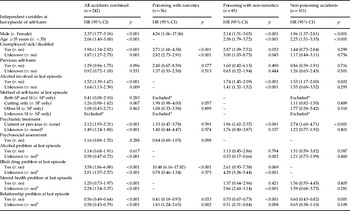
Potential risk factors were investigated for five outcomes: suicide, all accidental deaths combined, accidental narcotic poisoning, accidental non-narcotic poisoning, and non-poisoning accidents (Table 1). Hazard ratios (HRs) were estimated from Cox proportional hazard models. All individuals who were traced by the MRIS for any length of time were included. Observation time was censored when the individual died or embarked overseas. Censoring did not occur when an individual had a non-fatal repeat episode of self-harm.
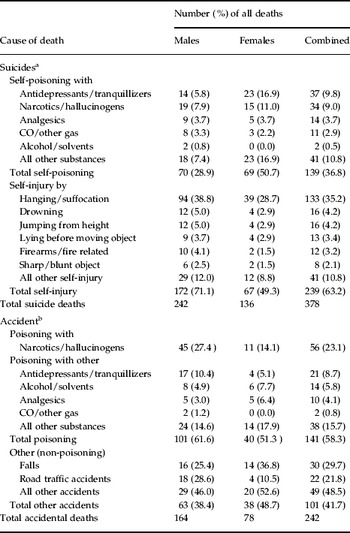
Underlying cause of death for suicide (intentional self-harm and undetermined intent) and accidents, for individuals (n=30 202) in the study sample, years 2000–2007 followed up to the end of 2010

CO, Carbon monoxide.
a ICD-10 codes X60–X85, Y10–Y34.
b ICD-10 codes V01–X59 (all accidents including poisoning with narcotics/hallucinogens, X42; and poisoning with non-narcotics X40, X41, X43–X49).
Age, gender, unemployment/sickness/disability status, self-reported previous self-harm, alcohol involvement at the time of self-harm or within 6 h of self-harm, method of self-harm, current or previous psychiatric treatment, psychosocial assessment, and precipitating problems were coded according to information known at the last episode of self-harm. Precipitating problem variables were coded in three categories (no, yes, unknown), the ‘unknown’ category being used where information was not available because the person was not assessed. This method of coding maximized inclusion of all cases in multivariate models.
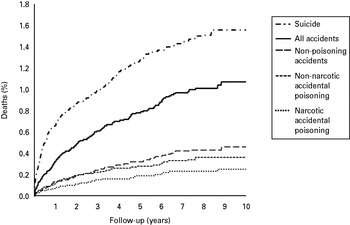
Univariate models were determined initially. Independent predictors were estimated from multivariate models using entry of variables significant in univariate models at p<0.2). Gender interactions with variables of interest were not significant. Clustering by centre was adjusted for using the ‘vce(cluster)’ option of the ‘stcox’ command in Stata (Stata Corporation, USA). Nelson–Aalen cumulative hazard estimates were used for Fig. 1. Proportional hazards assumptions were tested and upheld. Analyses were conducted using Stata version 10.0.
Cumulative hazard for time to suicide and accidental death following the last episode of non-fatal self-harm.

Results
The sample
During the 8-year study period from 1 January 2000 to 31 December 2007, 30 950 individuals presented with self-harm to the six hospitals in the three study centres. Some individuals (n=328) included in the original sample (Bergen et al. Reference Bergen, Hawton, Waters, Cooper and Kapur2010) were excluded from the current study because their single episode of self-harm resulted in death, or they were duplicate cases. Of the 30 950 remaining individuals, 748 (2.4%) could not be traced by the MRIS and were also excluded from the analyses.
Of the 30 202 individuals for whom follow-up information was available, 1833 (6.1%) died during the follow-up period (n=446, 6.2% of the Oxford cases; n=865, 5.9% in Manchester; and n=522, 6.2% in Derby), 88 (0.3%) left the UK, and the remainder were living at the end of the follow-up period. There were 17 709 females (58.6%), with a median age of 27 years [interquartile range (IQR) 17–37], and 12 474 males (41.3%), with a median age of 31 years (IQR 21.5–40.5); for 19 (0.1%) individuals the gender was not known. There were 50 332 episodes of non-fatal self-harm by these 30 202 individuals during the study period. The method of self-harm used at the last episode was 81.5% self-poisoning, 11.8% self-injury by cutting alone, 3.5% both self-poisoning and self-injury, 2.8% other self-injury, and 0.4% type of self-injury unknown. This varied by gender (χ2=475.36, df=4, p<0.001), with cutting alone being more common in males than females (15.5% v. 9.9%, χ2=148.51, p<0.001) and self-poisoning less common in males than females (76.7% v. 85.0%, χ2=331.38, p<0.001).
Mortality in the follow-up period
For the 1833 individuals who died in the follow-up period, cause of death was suicide in 20.6% [including intentional self-harm (13.4%) and undetermined intent (7.2%)], accidental in 13.2%, and other causes in 66.2%. Underlying causes of death for suicide and accidents are shown in Table 1.
Suicide
Approximately half (50.7%) the suicides by females involved self-poisoning, compared to 28.9% by males (χ2=17.81, p<0.001) (Table 1). Nearly three-quarters of suicides by males (71.1%) involved self-injury. The most commonly used method was hanging or suffocation, which was more frequent in males (n=94, 38.8%) than females (n=39, 28.7%; χ2=3.95, p=0.047).
Accidental death
Approximately half the accidental deaths by females involved poisoning (51.3%), compared to 61.6% by males (χ2=2.31, p=0.129) (Table 1). The most frequently used class of substance for accidental poisoning was narcotics/hallucinogens, which was used more often by males (n=45, 27.4%) than females (n=11, 14.1%; χ2=5.296, p=0.021).
Non-fatal self-harm in the study period
The number of episodes of self-harm for each individual during the study period varied from one to 213. The majority (76.6%) had one episode, 19.4% had two to four episodes, and the remaining 4.0% had five or more episodes. The number of episodes for individuals who eventually died by suicide (n=378) varied from one to 39, and by accidents (n=242) from one to 32. There was no difference in number of repeat episodes of self-harm in those who died by suicide and by accidents (1 episode, 65.9% v. 61.6%; 2–4 episodes, 26.2% v 26.9%; and ⩾5 episodes, 7.9% v 11.6%, χ2=2.53, df=2, p=0.282).
Cox regression models estimating risk factors for death
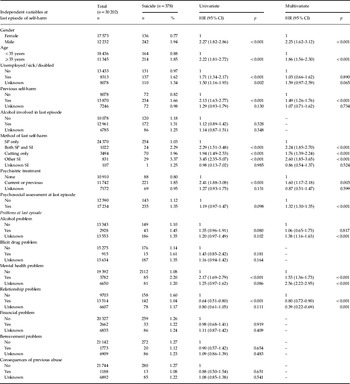
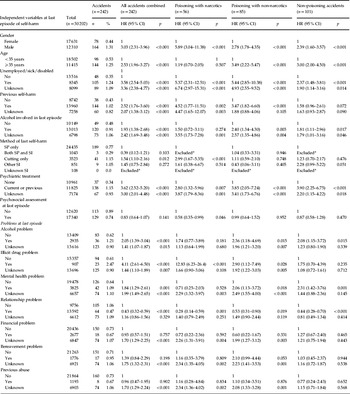
Associations between sociodemographic, individual and clinical factors identified throughout the individual's self-harm history, and death by suicide, were examined in univariate and multivariate models (Table 2). Univariate models for death by all accidents combined, and for accidental narcotic poisoning, accidental non-narcotic poisoning, and non-poisoning accidents, are shown in Table 3, and multivariate models in Table 4.
Cox proportional hazards models for time to death by suicide from the last episode of self-harm

SP, Self-poisoning; SI, self-injury; HR, hazard ratio; CI, confidence interval; –, variable not significant in univariate model at p<0.2, therefore not included in multivariate analysis.
Univariate Cox proportional hazards models for time to accidental death from the last episode of self-harm

HR, Hazard ratio; CI, confidence interval.
a Data excluded as not estimable (no deaths in this category).
Multivariate Cox proportional hazards models for time to accidental death from the last episode of self-harm

SP, Self-poisoning; SI, self-injury; HR, hazard ratio; CI, confidence interval.
–, not significant in univariate model at p<0.2, therefore not included in multivariate analysis.
a Data excluded as not estimable (no death in this category).
b Note that ‘unknown v. none’ or ‘unknown v. no’ may indicate a factor related to non-assessment such as self-discharge.
Summary of risk factors
Risk factors common to suicide and accidents
Independent predictors of increased risk of both suicide and accidents were male gender, older age and previous self-harm, current or previous psychiatric treatment [such as in-patient, out-patient, community mental health or day-patient treatment but excluding general practitioner (GP) care] (Tables 2 and 4). Exceptions for which there were no significant associations were older age and psychiatric treatment with death by accidental narcotic poisoning (Table 4). Individuals with relationship problems at their last episode of self-harm had a decreased risk of suicide and of accidental death.
Risk factors for suicide but not accidents
Independent predictors of increased risk of suicide but not accidents were previous self-harm, ‘both self-poisoning and self-injury’, ‘self-cutting’ and also ‘other type of self-injury’ (relative to self-poisoning) at the last method of self-harm, and mental health problems that may have precipitated the last episode of self-harm (Table 2). Individuals who received a psychosocial assessment at their last episode of self-harm were also at increased risk of suicide.
Risk factors for accidents but not suicide
Independent predictors of increased risk of accidents but not suicide were unemployment or sickness/disability status, illicit drug problems at the last episode of self-harm, predominantly for narcotic poisoning; and alcohol involvement during the self-harm history, predominantly for non-narcotic poisoning and other accidents (Table 4).
Time from last episode of self-harm to death
The proportions of deaths that occurred at various times after the last episode of self-harm were: (i) within 5 days (17/378) 4.5% [95% confidence interval (CI) 2.6–7.2] of suicides and (4/242) 1.7% (95% CI 0.4–4.2) of accidents; (ii) within 30 days (61/378) 16.1% (95% CI 12.3–20.7) of suicides and (22/242) 9.1% (95% CI 5.7–13.8) of accidents; and (iii) within 1 year (199/378) 52.6% (95% CI 45.6–60.5) of suicides and (95/242) 39.3% (95% CI 31.8–48.0) of accidents (39.3% narcotic poisoning, 38.8% non-narcotic poisoning, 39.6% non-poisoning accidents) (Fig. 1).
Discussion
In this study we investigated risk factors for suicide and accidental death separately, following the last hospital presentation for non-fatal self-harm in a large population (n=30 202) in three centres in England, 2000–2007. This novel approach has revealed important similarities and differences in proximal risk factors for suicide and accidents (all accidents combined, narcotic poisoning, non-narcotic poisoning, non-poisoning accidents) following self-harm.
Common risk factors for suicide and accidental death
Previous studies have shown that male gender and older age are strong risk factors for suicide and death from all causes following self-harm (Ostamo & Lönnqvist, Reference Ostamo and Lönnqvist2001; Reith et al. Reference Reith, Whyte, Carter and McPherson2003; Christiansen & Jensen, Reference Christiansen and Jensen2007). We also found greater risk in males, and in those aged 35 years or more for suicide and accidents with the exception of narcotic poisoning, the latter being a relatively homogeneous group of younger age, perhaps consistent with earlier findings regarding accidental death following self-poisoning (Carter et al. Reference Carter, Reith, Whyte and McPherson2005).
Approximately 40% of the individuals in the study were in current psychiatric treatment or reported previous treatment. Importantly, psychiatric treatment was independently associated with both suicide and accidental death with the exception of accidental narcotic poisoning. The latter group showed an association in univariate analyses that disappeared when other more strongly related factors such as drug problems were taken into account. This association has been noted previously for accidental death and substance-related disorders (Carter et al. Reference Carter, Reith, Whyte and McPherson2005), and also suicide (Cavanagh et al. Reference Cavanagh, Owens and Johnstone1999).
Risk factors for suicide but not accidental deaths
Repetition of self-harm is a well-known risk factor for death by suicide (Zahl & Hawton, Reference Zahl and Hawton2004) and all causes (Ostamo & Lönnqvist, Reference Ostamo and Lönnqvist2001). In our study, the frequency of non-fatal self-harm in those who died by suicide was remarkably similar to those who died by accidents, with approximately two-thirds of each group having one episode, one-quarter having two to four episodes, and the remainder more than five episodes in the study period. However, when follow-up time and other factors were taken into account using survival analysis, we found that individuals who reported previous self-harm had an increased risk of suicide only and not accidental death.
Another important independent predictor of suicide (but not accidental death) was the method used at the last hospital presentation for non-fatal self-harm, where self-injury and self-poisoning used concurrently, self-cutting and other self-injury had approximately twofold increased risks compared to self-poisoning alone. This is consistent with the predominance of relatively lethal and violent methods of self-injury used for suicide in this study. This association was expected, as the index method of self-harm also predicts suicide, often with use of the same method for the attempt as in the fatal act (Runeson et al. Reference Runeson, Tidemalm, Dahlin, Lichtenstein and Långström2010). Further investigation of this association, including method switching between repeat episodes, is warranted. Another reason for the correlation between violent forms of non-fatal self-injury and suicide, but not accidents, may be that self-harm involving methods with seemingly higher suicidal intent are more likely to be classified as suicide by coroners, due to the nature of the method (Linsley et al. Reference Linsley, Schapira and Kelly2001). By contrast, self-poisoning is more likely to be given an open or accidental coroner's verdict, especially in the absence of evidence of suicidal intent (Linsley et al. Reference Linsley, Schapira and Kelly2001). Furthermore, self-poisoning is a method where, depending on the substance used, there is time for the person to change their mind and to seek help. The relative lethality of self-poisoning is lower than most self-injury (Shenassa et al. Reference Shenassa, Catlin and Buka2003).
Mental health problems reported at the last episode of self-harm also increased risk of suicide (but not accidental death), even after accounting for psychiatric treatment. Both psychiatric disorders (Foster et al. Reference Foster, Gillespie and McClelland1997; Cavanagh et al. Reference Cavanagh, Owens and Johnstone1999; Qin et al. Reference Qin, Agerbo and Mortensen2003; Reith et al. Reference Reith, Whyte, Carter and McPherson2003; Christiansen & Jensen, Reference Christiansen and Jensen2009) and self-reported mental health problems (Bramness et al. Reference Bramness, Walby, Hjellvik, Selmer and Tverdal2010) are strongly associated with suicide. This may also explain the increased risk of suicide found in individuals who received a psychosocial assessment at their last episode of self-harm, possibly indicating the extent of their distress at that time, or the severity of their psychiatric disorder.
Risk factors for accidental deaths but not suicide
It is well known that socio-economic disadvantage and especially unemployment increase risk of suicide in self-harm populations (Gunnell et al. Reference Gunnell, Peters, Kammerling and Brooks1995; Beghi & Rosenbaum, Reference Beghi and Rosenbaum2010) and in general populations (Qin et al. Reference Qin, Agerbo and Mortensen2003; Kim et al. Reference Kim, Jung-Choi, Jun and Kawachi2010), having a stronger effect in males than females (Crombie, Reference Crombie1990). However, we found a significant association between suicide and unemployment and sickness/disability status at the last episode of self-harm only at the univariate level. After controlling for other factors, this association was no longer statistically significant. Non-poisoning deaths comprised a broad range of accidents, such as falls, drowning, fires and traffic-related accidents, and these also were not associated with socio-economic disadvantage when other factors were taken into account. By contrast, we found that unemployment and sickness/disability status independently predicted increased risk of accidental poisoning. The non-significant findings are difficult to explain. They may be due to a high correlation between socio-economic status and other factors under consideration in the statistical model, the latter contributing more strongly to the outcomes.
A problem with recreational or illicit drug use that precipitated the last episode of self-harm was strongly associated with accidental death, predominantly narcotic poisoning, with a 10-fold increased risk. Narcotics were the most frequently used class of substance in accidental poisoning deaths in both males and females in our study. Our finding is consistent with studies showing an association of substance use/abuse with accidental death following self-poisoning (Carter et al. Reference Carter, Reith, Whyte and McPherson2005; Bjornaas et al. Reference Bjornaas, Teige, Hovda, Ekeberg, Heyerdahl and Jacobsen2009), and with a UK study where accident victims were more likely than suicide victims to have had positive blood toxicological results for illicit drugs, alcohol and methadone at the time of death (Vento et al. Reference Vento, Schifano, Corkery, Pompili, Innamorati, Girardi and Ghodse2011). There was no association of illicit drug problems with suicide in our study, unlike the strong relationship of substance-use disorder with suicide found elsewhere (Suominen et al. Reference Suominen, Isometsä, Haukka and Lönnqvist2004; Stenbacka et al. Reference Stenbacka, Leifman and Romelsjö2010).
We found that alcohol involvement during the self-harm history increased risk of fatal accidental poisoning with non-narcotic substances, as well as other non-poisoning accidents. It is probable that alcohol was involved in the fatal act if it was prevalent in previous non-fatal attempts. Perhaps the disinhibiting effect of alcohol may have induced carelessness, making accidental poisoning or other accidents more likely. Or if suicidal intent was present, alcohol may have been used in overdoses to increase toxicity (Boenisch et al. Reference Boenisch, Bramesfeld, Mergl, Havers, Althaus, Lehfeld, Niklewski and Hegerl2010). In either case, criteria guiding coroners' verdicts in relation to intoxication may explain our findings for accidental death, as deaths are less likely to be classified by coroners as intentional self-harm if alcohol is involved (Linsley et al. Reference Linsley, Schapira and Kelly2001).
Relationship problems with a partner, family or friends that may have precipitated the last episode of self-harm were very common, being reported in more than half the sample. Our findings show a strong association of recent relationship problems with lowered risk of suicide and accidental death after taking other factors into account. This might seem contrary to findings in Ireland, where suicide rates were higher in divorced individuals compared to those married (Corcoran & Nagar, Reference Corcoran and Nagar2010). However, another study in England also found decreased risk of suicide in those with relationship problems, perhaps because these are transient types of problems, more likely to resolve than, for example, physical or mental health problems (Hawton & Fagg, Reference Hawton and Fagg1988). Our data include relationships with friends, family and partners, so having relationship problems may have broadly indicated positive social integration rather than isolation, the former being protective against suicide (Rojas & Stenberg, Reference Rojas and Stenberg2010).
Comparison of risks for accidents and suicide
Individuals who died by accidental poisoning with non-narcotic substances and by non-poisoning accidents shared some characteristics with those who died by suicide, such as male gender, older age and psychiatric treatment. Mental health problems precipitating the last episode of self-harm were also apparent for those who died by non-narcotic poisoning and other accidents (although these were not significantly related after controlling for other factors). Alcohol was often involved at the time or prior to self-harm, which frequently occurs with self-poisoning (Boenisch et al. Reference Boenisch, Bramesfeld, Mergl, Havers, Althaus, Lehfeld, Niklewski and Hegerl2010), although it may be involved in other accidents as well. Individuals who died by accidental narcotic poisoning had a major independent risk factor exclusive to their group, namely a 10-fold increased risk in those who reported illicit drug problems at their last episode. This is not surprising, given the nature of their deaths. They were of a younger age and were less likely than others who died accidentally to have had mental health problems related to their self-harm or to have had psychiatric treatment.
Considering the timing of death in relation to the last self-harm episode, nearly six times as many suicides as accidents occurred within 5 days, three times as many within 1 month, and twice as many within 1 year, similar to trends found elsewhere (Ostamo & Lönnqvist, Reference Ostamo and Lönnqvist2001). This may be related to suicidal intent, and that a death of questionable intent may be more likely to be classified as a suicide if a non-fatal attempt had taken place shortly beforehand (Stanistreet et al. Reference Stanistreet, Taylor, Jeffrey and Gabbay2001). There was no difference in timing between types of accidents.
To summarize, both shared and distinct risk factors were found for all groups. The risk profiles most similar to suicide were accidental non-narcotic poisoning, as expected, but also non-poisoning accidents, and where differences existed, these were partly related to factors that may have influenced coroners' decisions in favour of an accidental verdict rather than suicide (such as lack of violent method, involvement of alcohol, and longer time since previous self-harm). The dominant risk factor for narcotic poisoning was proximal drug problems.
Strengths and limitations
The follow-up time for individual patients varied considerably, from 2 to 10 years, although the use of survival statistics was able to account for this, and the relatively short period overall ensured reasonably stable social conditions under which the study data were collected (although the worldwide economic financial crisis began towards the end of the follow-up period). The study included a relatively large sample of over 30 000 individuals, with only 2.4% unable to be traced for mortality information. The number of deaths enabled sufficient power to analyse risk factors for categories of accidental death separately. As nearly 30% of patients did not receive a psychosocial assessment, some data were missing for the ‘precipitating problem’ variables. To overcome this we used a three-category variable (yes, no, unknown), which resulted in some significant associations for unknown versus no. Although these associations were included primarily for completeness, they may indicate some possible association between reasons for non-assessment (e.g. self-discharge) and risk of subsequent death.
There was a small inconsistency in sampling for our dataset. In Manchester during the period 1 January 2000 to 31 August 2002, information was collected only on assessed episodes; the proportion of non-assessed episodes being estimated at 30% (Bergen et al. Reference Bergen, Hawton, Waters, Cooper and Kapur2010). This would have had only a minor impact on the current study.
The risk factors found in this study were not dissimilar to those of studies using the index episode in a study period, possibly because the majority of this sample who died by unnatural causes had only one episode of self-harm in the study period. Analysis of our data using time from the index episode and independent variables related to the index episode resulted in similar sets of risk factors for suicide and accidents. Exceptions were that (a) methods of self-cutting and other self-injury at the index episode, and psychosocial assessment at the index episode, were no longer significantly associated with increased risk of suicide; and (b) self-cutting at the index episode was significantly associated with increased risk of accidental death, and psychosocial assessment at the index episode with decreased risk of accidental death.
Conclusions
In this study we found both distinct and shared risks for suicide and accidental death following self-harm. Risk factors differentiating suicide and accidental death, of relevance to clinical services, were associations of (i) self-cutting and relatively violent methods of last self-injury, and mental health problems, with suicide; (ii) illicit drug problems with accidental narcotic poisoning; and (iii) alcohol involvement in self-harm with accidental non-narcotic poisoning and non-poisoning accidents. Suicides were also more likely than accidents to have occurred closer in time to the last episode of self-harm.
The risk profiles for accidental non-narcotic poisoning and other accidents were most similar to suicide. Differences were largely in factors also related to the high standard of proof required by coroners to infer suicidal intent (e.g. lack of intoxication, violent method, proximal previous self-harm). This is in keeping with the suggestion that many accidental deaths, especially those involving poisoning, are likely to have been suicidal. The increasing trend in recent years towards use of narrative verdicts (where the ‘default’ verdict has to be recorded as accidental where there is uncertainty) (Hill & Cook, Reference Hill and Cook2011) may also have contributed to our findings.
The shared risk factors indicate common experiences of socio-economic disadvantage, life problems and psychopathology, perhaps resulting in mental illness or drug dependence, which lead to self-destructive behaviour in the form of suicide or accidental death (Stanistreet et al. Reference Stanistreet, Taylor, Jeffrey and Gabbay2001). Our findings support the proposition of the continuum of premature death and the commonality of risk factors in the psychosocially vulnerable population (Neeleman, Reference Neeleman2001). Regardless of how eventual death may be classified, each episode of self-harm is potentially the patient's last episode before death, and as such it may represent an opportunity to make a life-saving intervention. We endorse recent national guidance (National Collaborating Centre for Mental Health, 2004) that all self-harm patients, regardless of risk and need, who present to the general hospital should receive a psychosocial assessment.
Acknowledgements
We thank A. Powell from the MRIS of the NHS for assistance with mortality information. We also thank our research teams, clinical and administrative staff in Oxford, Manchester and Derby for assistance with self-harm data collection. K.H. is a National Institute for Health Research Senior Investigator. We acknowledge financial support from the Department of Health under the NHS R&D Programme (DH/DSH2008). The Department of Health had no role in study design, the collection, analysis and interpretation of data, the writing of the report, and the decision to submit the paper for publication. The views and opinions expressed herein do not necessarily reflect those of the Department of Health.
Declaration of Interest
None.