Introduction
Executive functions are essential in adaptive behavior in novel situations and have many subcomponents such as volition, planning, purposive action, effective performance, and upholding stimuli (Kane & Engle, Reference Kane and Engle2002; Lezak, Howieson, Bigler, & Tranel, Reference Lezak, Howieson, Bigler and Tranel2012). Executive functions are not a unitary concept (Jurado & Rosselli, Reference Jurado and Rosselli2007), and thus a wide range of measures are needed to tap into the construct. The most commonly examined subcomponents of executive functions include shifting, updating, and inhibition (Miyake et al., Reference Miyake, Friedman, Emerson, Witzki, Howerter and Wager2000).
Executive functions are thought to be supported by the frontal lobes, and the most common executive measures have often been purported as measures of frontal lobe function (Jurado & Rosselli, Reference Jurado and Rosselli2007; Stuss & Alexander, Reference Stuss and Alexander2000). Frontal lobes and their connections to the other brain areas are thought to contribute to memory (Davidson, Troyer, & Moscovitch, Reference Davidson, Troyer and Moscovitch2006). After damage to the frontal lobes, patients have problems in almost all aspects of list learning tasks of related words, but especially in free recall (Alexander, Stuss, & Gillingham, Reference Alexander, Stuss and Gillingham2009; Wheeler, Stuss, & Tulving, Reference Wheeler, Stuss and Tulving1995). In addition, they seem to have problems in using strategies or organizing memory material spontaneously (Davidson et al., Reference Davidson, Troyer and Moscovitch2006; Gershberg & Shimamura, Reference Gershberg and Shimamura1995). Executive dysfunction and frontal lobe damage have been used rather synonymously, although they differ (Stuss, Reference Stuss2011). For example, subcortical structures have also been implicated in executive control through the fronto-subcortical loops (Heyder, Suchan, & Daum, Reference Heyder, Suchan and Daum2004).
Direct connections between executive dysfunction and memory performance, without a link through the frontal lobes, have been studied in a few clinical populations. Executive dysfunction is related to impaired learning of related words (Brooks, Weaver, & Scialfa, Reference Brooks, Weaver and Scialfa2006; Tremont, Halpert, Javorsky, & Stern, Reference Tremont, Halpert, Javorsky and Stern2000; Tremont, Miele, Smith, & Westervelt, Reference Tremont, Miele, Smith and Westervelt2010). It is hypothesized that list learning may be more prone to deteriorate with executive impairment than story recall (Tremont et al., Reference Tremont, Halpert, Javorsky and Stern2000) due to the greater amount of structure inherently provided when information is presented in story compared to list format. The immediate recall of stories, however, has also been impaired in patients with executive dysfunction in one of the studies (Tremont et al., Reference Tremont, Miele, Smith and Westervelt2010).
In contrast to these findings, Busch et al. (Reference Busch, Booth, McBride, Vanderploeg, Curtiss and Duchnick2005) found no significant role for executive functions on any verbal memory tasks with various levels of structure after controlling the severity of neuronal injury. Analyzing only the learning of related words, Hill, Alosco, Bauer, and Tremont (Reference Hill, Alosco, Bauer and Tremont2012) found that executive functions account for only minimal variance of total learning, but for substantial variance of short and long delay recall. Moreover, limiting the executive demands for the patients in list learning, all of these studies used word lists with semantically related word clusters. Lists of unrelated words are hypothetically more executively demanding as they provide even less inherent structure than lists of related words, but performance on these types of lists has not been compared between executively intact and impaired patients.
Visual imagery and production seem to be skills that are less practiced and less automatic in everyday life compared to verbal production (Baddeley, Reference Baddeley1996), and the procedure of drawn recall in visual memory tasks seems more complex to patients. Baddeley (Reference Baddeley1996) has suggested that the visual sketch pad is more complex than the phonological loop, and that the sketch pad relies heavily on the central executive. Therefore, visual memory performance may be especially vulnerable to executive dysfunction. In clinical context, connections of executive functioning with visual memory performance have been studied even less than the connections with verbal memory performance. Executive measures have been predictive of some visual memory measures (Temple, Davis, Silverman, & Tremont, Reference Temple, Davis, Silverman and Tremont2006), and in contrast to the verbal memory performance, executive impairment was related to poorer performance on visual memory tests after controlling for injury severity (Busch et al., Reference Busch, Booth, McBride, Vanderploeg, Curtiss and Duchnick2005).
General intelligence clearly and robustly correlates with both executive functions and memory, in addition to the high intercorrelation between executive functions and memory (Duff, Schoenberg, Scott, & Adams, Reference Duff, Schoenberg, Scott and Adams2005). However, in most previous studies, minimal effort is made to eliminate the effects of general intellectual functioning (Brooks et al., Reference Brooks, Weaver and Scialfa2006; Hill et al., Reference Hill, Alosco, Bauer and Tremont2012; Temple et al., Reference Temple, Davis, Silverman and Tremont2006; Tremont et al., Reference Tremont, Halpert, Javorsky and Stern2000, Reference Tremont, Miele, Smith and Westervelt2010). Thus, it is unclear if associations between executive dysfunction and memory have been due to executive dysfunction per se or to a concomitant impairment of general intellectual ability. Furthermore, the controversies in the relationship between executive dysfunction and episodic memory performance may exist partly due to different patient groups used in the studies concerned, including mixed clinical samples (Hill et al., Reference Hill, Alosco, Bauer and Tremont2012; Temple et al., Reference Temple, Davis, Silverman and Tremont2006; Tremont et al., Reference Tremont, Halpert, Javorsky and Stern2000), and patients with mild cognitive impairment (MCI) (Brooks et al., Reference Brooks, Weaver and Scialfa2006; Tremont et al., Reference Tremont, Miele, Smith and Westervelt2010) or traumatic brain injury (TBI) (Busch et al., Reference Busch, Booth, McBride, Vanderploeg, Curtiss and Duchnick2005).
Our study aimed to examine the effects of executive dysfunction, after alleviation of the most acute symptoms at 6 months after stroke, on different aspects of memory performance at 6 months and at 2 years after stroke. We had a homogeneous study group with patients with a first-ever cerebral infarction, and we controlled for the effects of reasoning ability as an estimate of general intelligence.
Method
Participants
Subjects included in our study were part of a consecutive working-aged stroke inpatient cohort from two Finnish Central Hospitals and have been previously described in detail (Kauranen et al., Reference Kauranen, Laari, Turunen, Mustanoja, Baumann and Poutiainen2014; Turunen et al., Reference Turunen, Kauranen, Laari, Mustanoja, Tatlisumak and Poutiainen2013). Inclusion criteria were having a first-ever diagnosed supratentorial cerebral infarction, being between the ages of 18 and 65 years, and being a native Finnish speaker. Exclusion criteria were a history of diseases known to affect cognition and severely altered state of consciousness. Examinations were conducted at baseline, shortly after stroke (brief examination), at 3 and 6 months, at 1 year (subpopulation) and at 2 years. In this substudy, we used the 6-month and 2-year follow-up examination data. All the patients had a brain imaging done in the acute phase, with a brain computed tomography (CT) and/or magnetic resonance imaging (MRI).
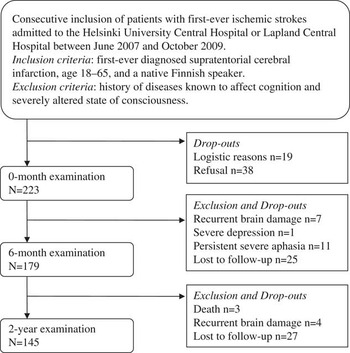
Additionally we excluded patients with recurrent brain damage (e.g., stroke, brain tumor) within 6 months or 2 years, severe depression hindering motivation for neuropsychological examination, and persistent severe aphasia matching ratings 1–2 of Boston Diagnostic Aphasia Examination (BDAE) (Goodglass & Kaplan, Reference Goodglass and Kaplan1983; Laine, Niemi, Koivuselkä-Sallinen, & Tuomainen, Reference Laine, Niemi, Koivuselkä-Sallinen and Tuomainen1997) at 6 months, as aphasia hampers psychometric evaluation of cognitive performance. This subsample comprised 179 patients at 6 months and 145 patients at 2 years, out of the initial 223 patients (Figure 1).
Flow chart of the examination procedure of the patients.

Fifty demographically comparable healthy subjects served as a reference group. All controls met the inclusion and exclusion criteria set for patients except for the stroke.
The Ethics Committee of the Department of Medicine, Helsinki University Central Hospital, approved the study protocol and the consent procedure. All patients received standard stroke care according to institutional guidelines. All subjects gave written informed consent for participation. All research procedures were completed in accordance with the Helsinki Declaration.
Neuropsychological Examination
A clinical neuropsychologist performed the neuropsychological examinations according to a written research protocol. To control the repeated measurements, controls were measured twice with a 3-month interval. We used the controls’ second examination in this study.
We used five measures of executive functions: Trail Making Test form B time minus form A time (TM B-A) (Poutiainen, Kalska, Laasonen, Närhi, & Räsänen, Reference Poutiainen, Kalska, Laasonen, Närhi and Räsänen2010; Reitan, Reference Reitan1958), modified Stroop Color and Word Test form B (naming colors of incongruent words) minus form A (naming colors) time (Stroop B-A) (Lezak et al., Reference Lezak, Howieson, Bigler and Tranel2012; Stroop, Reference Stroop1935), Digit Span backwards of the Wechsler Adult Intelligence Scale – Third Edition (WAIS-III) (Wechsler, Reference Wechsler1997, Reference Wechsler2005), Phonemic Fluency (Lezak et al., Reference Lezak, Howieson, Bigler and Tranel2012), and the number of perseverative errors in the Nelson version of the Wisconsin Card Sorting Test (WCST) (Nelson, Reference Nelson1976). We scored performance as defective when patients’ 6-month test score was below the 10th percentile level of the control group. When at least two of five executive measures were defective, we classified patients as executively impaired. This was to avoid classifying patients as executively impaired based on a chance mistake on a single measure, mimicking clinical decision making. We used the 6-month executive impairment classification at 2 years to better stabilize patient data, and to be able to better infer prediction for clinical purposes and rehabilitation resource allocation. We used the WCST only once, with both patients and controls, due to marked learning effects in it in reasonably well-functioning patients (Lezak et al., Reference Lezak, Howieson, Bigler and Tranel2012). All other executive measures were repeated at 2 years.
We measured list learning at 6 months and 2 years using a sum score of five learning trials of 10 unrelated words (Christensen, Reference Christensen1979) and 30-min delayed recall of the same list. We examined immediate and delayed recall of stories with the Logical Memory test I and II of the Wechsler Memory Scale – Revised (WMS-R) (Wechsler, Reference Wechsler1987, Reference Wechsler1996). At the 2-year examination, only one story was used, and for better comparability, we analyzed the two stories separately at 6 months. For visual memory, we used the odd-numbered tablets of the Revised Visual Retention Test at 6 months and 2 years (mod BRVRT) (Benton, Reference Benton1974); points were given for each correctly drawn geometric figure, and figures in the first and third cards were asked to be recalled later.
We evaluated patients’ reasoning ability with Similarities, Information, Digit Symbol, and Block Design subtests of the WAIS-III (Wechsler, Reference Wechsler1997, Reference Wechsler2005) at 6 months and again at 2 years, calculating patients’ Z-scores from the control data. The mean Z-score of these four subtests served as an estimate of general intelligence.
To assess whether language production or mood affected results, we used the modified visual naming task of the BDAE (Goodglass & Kaplan, Reference Goodglass and Kaplan1983; Laine et al., Reference Laine, Niemi, Koivuselkä-Sallinen and Tuomainen1997) to evaluate basic naming ability and a modified version of the Profile of Mood States (McNair & Lorr, Reference McNair and Lorr1964) to assess mood state.
Neurological and Radiological Examinations
An experienced stroke neurologist examined the patients in the acute stroke phase, at 6 months and at 2 years. National Institutes of Health Stroke Scale (NIHSS) (Brott et al., Reference Brott, Adams, Olinger, Marler, Barsan, Biller and Hertzberg1989; Goldstein, Bertels, & Davis, Reference Goldstein, Bertels and Davis1989), modified Rankin Scale (mRS) (van Swieten, Koudstaal, Visser, Schouten, & van Gijn, Reference Van Swieten, Koudstaal, Visser, Schouten and Van Gijn1988), and Barthel Index (Mahoney & Barthel, Reference Mahoney and Barthel1965) were used.
At baseline, infarct size (largest diameter in millimeters), side, location (cortical vs. subcortical), silent infarctions and co-occurring white matter lesions from CT or MRI axial images were visually evaluated by the stroke neurologist. Furthermore, as in a previous study (Nys, van Zandvoort, van der Worp, Kappelle, & de Haan, Reference Nys, Van Zandvoort, Van Der Worp, Kappelle and De Haan2006), with an atlas (Moeller & Reif, Reference Moeller and Reif2007), we recorded whether or not the lesioned area involved frontal cortex, parietal cortex, temporal cortex, occipital cortex, insular cortex, lenticular nucleus, caudate nucleus, thalamus, deep white matter, or white matter (corona radiata or centrum semiovale), and further calculated frontal location (pure frontal cortex vs. other gray matter location).
Statistical Analysis
We used IBM SPSS Statistics version 22 for statistical analyses. For measuring the associations between demographical, radiological, and neurological variables, we used Chi-square (χ2) and Mann-Whitney U tests. Brain imaging was not available for one patient, and 14 patients had missing data on the mood state questionnaire. We used correlations, Spearman’s rho (rs), to assess the relationships between the five executive measures. We analyzed cognitive variables with multivariate analysis of covariance (MANCOVA) and further with analysis of covariance (ANCOVA), where age and general intelligence score served as covariates. We used square root transformations to obtain variable normality when needed, but reported untransformed means. We set statistical significance at p<.05 and corrected for multiple comparisons with Benjamini-Hochberg correction (Benjamini & Hochberg, Reference Benjamini and Hochberg1995). For estimates of effect size, we used partial eta squared (η2), wherein approximately 0.02 represents a small effect and 0.13 a medium effect (Cohen, Reference Cohen1992).
Results
6-Month Examination
Demographics
The 6-month examination was performed after a mean of 6.1 months (SD=0.47; range, 3.7–8.3), and 179 patients were included. The patients were 18–66 years old (mean 54.2 years; SD=10.2), had mean of 12.2 years of education (SD=2.7; range, 9–20 years), and 107 (59.8%) were men. None of the patient demographics differed from those of the controls: age 23–66 years (mean, 54.6; SD=9.2; U=4409.0; p=.873), mean of 12.4 years of education (SD=2.9; range, 9–20 years; U=4432.0; p=.916), and 31 (62.0%) were men (χ2=0.081; df=1; p=.776).
Lowest correlations between patients’ executive measures were between WCST and WAIS-III digit span backwards (rs=−.178; p=.017) and between WCST and Stroop B-A (rs=.202; p=.007). All other correlations between the five executive measures were higher (absolute values rs=.292–.517 and all p<.001). In controls, all the correlations but those between WCST and Stroop B-A, WCST and phonemic fluency, and Stroop B-A and phonemic fluency were significant (p<.05). For correlation matrices, see Appendix 1.
Stroke patients had defective scores in each of the five executive measures as follows: 58 patients (32.6%) were impaired in modified Stroop B-A, 55 (30.7%) in TM B-A, 50 (27.9%) in WCST, and 32 (17.9%) in phonemic fluency and WAIS-III digit span backward each. Altogether, 66 patients (36.9%) had a defective score in at least two separate executive measures and were classified as executively impaired.
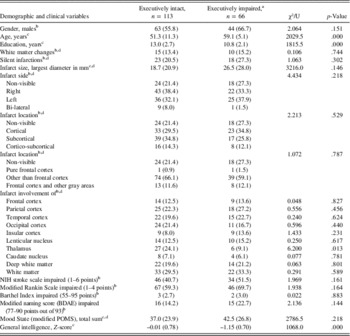
Executively impaired patients (n=66) were older (p<.001), less educated (p<.001), and had a lower general intelligence score at 6 months (p<.001), and their lesion was less likely to encompass the thalamus (p=.013) compared to the executively intact patients (n=113) (Table 1). We found no other demographic, neurological, imaging, or mood differences. When both age and general intelligence were controlled, education did not differ between executively impaired and executively intact groups (11.86±0.31; mean±SEM, vs. 12.40±0.23; ANCOVA, F 1,175=1.596; p=.208; partial η2=.009). Thus, age and general intelligence were controlled for in further analyses.
Demographics and clinical data between executively intact and impaired patients six months after stroke.

Note. General intelligence score was calculated from Similarities, Information, Digit Symbol and Block Design subtests of the Wechsler Adult intelligence Scale – Third Edition (WAIS-III) (Wechsler, Reference Wechsler1997). National Institutes of Health (NIH) Stroke Scale (Brott et al., Reference Brott, Adams, Olinger, Marler, Barsan, Biller and Hertzberg1989); modified Rankin Scale (mRS) (van Swieten et al., 1988); Barthel Index (Mahoney & Barthel, Reference Mahoney and Barthel1965); Boston Diagnostic Aphasia Examination (BDAE) (Goodglass & Kaplan, Reference Goodglass and Kaplan1983); and Profile of Mood States (POMS) (McNair & Lorr, Reference McNair and Lorr1964).
a Defined as at least two of five executive measures defective 6 months after stroke.
b Frequency (%), compared by chi-square (χ²) test, df=1, and df=3 in infarct side and locations.
c Mean (SD), compared by Mann-Whitney U test.
d In brain imaging total n=178; in Mood State total n=165.
Compared to the patients included in this substudy (n=179), the 44 patients that either were excluded (n=19) or dropped-out (n=25) from the study protocol between study admittance and 6-month follow-up were more likely to be men (59.8% vs. 77.3%, χ2=4.650; df=1; p=.031) and less educated [mean 12.2 years of education (SD=2.7) vs. 11.1 (SD=2.4); U=3017.0; p=.014], and they had more severe neurological deficits at stroke onset [e.g., NIHSS at admittance 12.2% intact, 73,7% mildly to moderately impaired (1–6 points), and 14.0% severely impaired (seven or more points) vs. 2.3%, 63.6%, and 34.1%; χ2=11.914; df=2; p=.003], and larger infarctions [mean 21.6 mm (SD=24.0) vs. 36.2 (SD=31.9); U=2841.5; p=.005].
Additionally, compared to the included patients, the excluded patients’ infarcts involved more brain areas [frontal cortex 23 (12.9%) vs. 14 (31.8%), χ²=9.070, df=1, p=.003; temporal cortex 37 (20.8%) vs. 20 (45.5%), χ2=11.250, df=1, p=.001; insular cortex 18 (10.1%) vs. 15 (34.1%), χ2=16.029, df=1, p<.001; and white matter 55 (30.9%) vs. 23 (52.3%), χ2=7.072, df=1, p=.008]. We found no differences between included and excluded patients in age, infarct side, cortical versus subcortical location of the infarct, involvement of parietal cortex, occipital cortex, lenticular nucleus, thalamus, caudate nucleus, or deep white matter, nor in the prevalence of vascular degeneration or silent infarctions. Only two patients had an infarct that involved only frontal cortex but no other gray brain area.
Episodic memory and executive functions
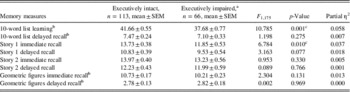
Executively impaired patients performed more poorly in all eight memory measures when compared to the executively intact patients. Interaction terms between executive impairment, age, and general intelligence score and memory variables were not significant in MANCOVA, and thus further results are reported from models without interaction terms. Based on a significant main effect for executive functioning in MANCOVA (F8,168 =2.704; p=.008; partial η2=0.114), we performed individual ANCOVAs for memory variables. When age and general intelligence were controlled for, executively impaired patients performed more poorly than executively intact patients in list learning (p=.001) and immediate recall of the first story of the WMS-R Logical Memory task (p=.010), see Table 2. We found no differences in immediate or delayed recall of the second story of the WMS-R Logical Memory task or in geometric figures.
Comparisons of memory measures between executively intact and impaired patients 6 months after stroke.

Note. 10-word list learning (Christensen, Reference Christensen1979); stories from Wechsler Memory Scale – Revised (WMS-R) (Wechsler, Reference Wechsler1987) and odd-numbered geometric figure tablets from Revised Visual Retention Test (BRVRT) (Benton, Reference Benton1974). Compared by ANCOVA, patients’ age, and general intelligence were controlled.
a Defined as at least two of five executive measures defective 6 months after stroke.
b Square root transformation was used in the analysis; untransformed means are reported.
c Significant after adjusting by Benjamini-Hochberg correction (Benjamini & Hochberg, Reference Benjamini and Hochberg1995).
2-Year Examination
Demographics
The 2-year assessment took place at a mean of 24.3 months after stroke (SD 0.6; range 22.8–26.5 months). Compared to the included patients (n=145), the patients who were excluded (n=7) or dropped-out (n=27) between 6-month and 2-year examinations were younger [mean 54.8 years (SD=9.9) vs. 51.4 (SD=11.0); U=1862.0; p=.026] and had a lower general intelligence score at the 6-month examination (mean intelligence Z-score −0.35 (SD=0.92) vs. −0.77 (SD=0.90); U=1829.0; p=.019). The groups did not differ in any other demographical, radiological, or neurological scores. Importantly, the frequency of executively impaired patients did not differ between included and excluded/dropped-out patients.
As at 6 months, executively impaired patients (n=53) were older [mean 61.6 years (SD=3.7) vs. 53.3 (SD=10.9); U=1199.0; p<.001], less educated [mean 10.8 years (SD=1.9) vs. 13.2 (SD=2.7); U=1159.5; p<.001], had a lower general intelligence score [mean −1.05 Z-score (SD=0.65) vs. 0.14 (SD=0.74); U=573.0; p<.001], and their lesion was less likely to encompass the thalamus [five thalamic infarctions (9.4%) vs. 23 (25.3%); χ2=5.366; df=1; p=.021] compared to the executively intact patients (n=92) at 2 years. We found no other demographic, neurological, imaging, or mood differences at 2 years. When both age and general intelligence were controlled for, education did not differ between the executively impaired and intact groups (11.98±0.36, mean±SEM, vs. 12.49±0.25; ANCOVA, F 1,141 =1.105; p=.295; partial η2=.008).
Additionally, we calculated the number of defective scores in executive measures at 2 years; 41 patients (28.3%) had at least two defective scores out of four possible measures. Furthermore, with this as the 2-year executive classification, 121 patients (83.4%) were consistently classified as executively intact (n=86) or executively impaired (n=35) both at 6 months and 2 years. Of the 18 patients (12.4%) who improved from executively impaired to intact, 11 had had the WCST impaired at 6 months. Six patients (4.1%) progressed from the executively intact to the impaired group.
Episodic memory and executive functions
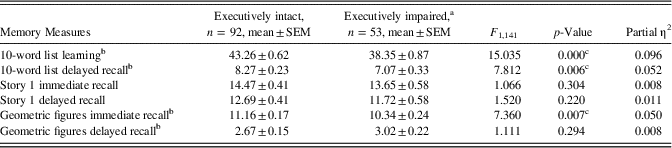
Interaction terms between memory variables and executive impairment and covariates were not significant in MANCOVA and further results are reported from models without interaction terms. A main effect of executive dysfunction was significant in MANCOVA at 2 years (F 6,136=3.695; p=.002; partial η2=0.140). Follow-up 2-year ANCOVAs controlling for age and general intelligence evaluated at the 2-year examination revealed that executively impaired patients at 6 months (n=53; 36.5%) performed worse in list learning (p<.001), delayed recall of the word list (p=.006), and in immediate recall of geometric figures (p=.007) compared to the executively intact patients (n=92) (Table 3). Other memory measures did not differ between the groups.
Comparisons of memory measures between executively intact and impaired patients two years after stroke

Note. 10-word list learning (Christensen, Reference Christensen1979); stories from Wechsler Memory Scale – Revised (WMS-R) (Wechsler, Reference Wechsler1987); odd-numbered geometric figure tablets from Revised Visual Retention Test (BRVRT) (Benton, Reference Benton1974). Compared by ANCOVA, patients’ age, and general intelligence were controlled.
a Defined as at least two of five executive measures defective 6 months after stroke.
b Square root transformation was used in the analysis; untransformed means are reported.
c Significant after adjusting by Benjamini-Hochberg correction (Benjamini & Hochberg, Reference Benjamini and Hochberg1995).
We also analyzed the 2-year memory data within patients who were classified executively intact or impaired based on the executive functioning at the 2-year examination. The results were similar to the analyses with the 6-month executive classification, except for in delayed recall of the list, wherein the result no longer reached significance after a statistical correction (Benjamini & Hochberg, Reference Benjamini and Hochberg1995).
Discussion
We analyzed the relationship between executive dysfunction and episodic memory performance after controlling for general intelligence in a more homogeneous patient sample than in previous reports. Executively impaired patients performed worse than executively intact patients in list learning of unrelated words and recall of a logical passage 6 months after stroke. The negative impact of 6-month executive impairment on list learning remained at 2 years. Additionally, executive impairment at 6 months was associated with impaired delayed recall of the list and immediate recall of geometric figures at 2 years.
The patients who were executively impaired at 6 months had also a lower general intelligence score, both at 6 months and 2 years, than the patients without marked executive impairment. This was in line with the overall neuropsychological impairment in TBI patients with executive dysfunction (Busch et al., Reference Busch, Booth, McBride, Vanderploeg, Curtiss and Duchnick2005). It also corresponded well to the earlier findings of high correlations found among the executive, memory, and general intelligence performances (Duff et al., Reference Duff, Schoenberg, Scott and Adams2005). These results raised question of the cause of memory impairment itself. Indeed, our patients with executive impairment were inferior to executively intact patients in all of the memory measures when general intelligence as measured by reasoning ability was disregarded. This overall memory inferiority was likely, at least partly, caused by the inferior reasoning ability and not a more specific executive impairment per se.
Busch et al. (Reference Busch, Booth, McBride, Vanderploeg, Curtiss and Duchnick2005) controlled the effects of general intelligence by creating cognitively matched subsamples of 100 patients at baseline and 54 at 1-year follow-up. Some previous studies excluded the patients impaired in all executive tests (Brooks et al., Reference Brooks, Weaver and Scialfa2006; Busch et al., Reference Busch, Booth, McBride, Vanderploeg, Curtiss and Duchnick2005; Tremont et al., Reference Tremont, Halpert, Javorsky and Stern2000) or used coarse screening methods such as the Modified Mini Mental State Examination to verify cognitive status equality among groups (Tremont et al., Reference Tremont, Miele, Smith and Westervelt2010). In our patients, the coarse clinical or neuroradiological defects did not differ between executively intact and impaired patients either at 6 months or 2 years. The cognitively more thorough general intelligence score, composed of four WAIS-III subtasks, did, however. Controlling for this general intelligence, executive impairment seemed to affect only list learning, immediate recall of the first logical passage, and immediate recall of geometric figures, which require efficient effort and spontaneous use of strategies, to be discussed next.
In our study, executively impaired patients’ list learning of unrelated words, which has not been studied before between executively intact and impaired patients, was consistently impaired both at 6 months and at 2 years. Dysexecutive patients’ most consistent memory problem has been impairment in list learning, but list learning of related words (Brooks et al., Reference Brooks, Weaver and Scialfa2006; Tremont et al., Reference Tremont, Halpert, Javorsky and Stern2000, Reference Tremont, Miele, Smith and Westervelt2010). In cognitively matching subsamples, however, executive functioning did not affect list learning of related words (Busch et al., Reference Busch, Booth, McBride, Vanderploeg, Curtiss and Duchnick2005). Learning unrelated words provides less inherent structure than learning related words. Our list learning task of unrelated words included only 10 words, yet it was systematically associated with executive impairment. This indicates that executive dysfunction can readily affect relatively easy tasks requiring inherent use of strategies.
The patients who were executively impaired at 6 months were inferior to executively intact patients in 30-min delayed recall of the word list, but only at the 2-year examination. Previous findings are mixed, as executive dysfunction has impaired performance in short or long delay recall of the list of related words (Brooks et al., Reference Brooks, Weaver and Scialfa2006; Tremont et al., Reference Tremont, Halpert, Javorsky and Stern2000) or has made no difference in delayed recall of the list (Busch et al., Reference Busch, Booth, McBride, Vanderploeg, Curtiss and Duchnick2005; Tremont et al., Reference Tremont, Miele, Smith and Westervelt2010). Hill et al. (Reference Hill, Alosco, Bauer and Tremont2012) found that executive functioning accounted for substantial variance (24–31%) in delayed recall of the word list in a mixed clinical sample and for much higher variance in their cerebrovascular subsample. It is possible that long-term effects of executive dysfunction are apparent only after diffuse cognitive impairment has sufficiently resolved after acute neuronal injuries.
In our study, executive impairment affected immediate recall of the first story but not the second story of the WMS-R Logical Memory tasks at 6 months. All other studies treated the two stories as one entity. We found only one previous study showing executive impairment to deteriorate immediate story recall (Tremont et al., Reference Tremont, Miele, Smith and Westervelt2010); three other studies found no difference in story recall between patients with or without executive impairment (Brooks et al., Reference Brooks, Weaver and Scialfa2006; Busch et al., Reference Busch, Booth, McBride, Vanderploeg, Curtiss and Duchnick2005; Tremont et al., Reference Tremont, Halpert, Javorsky and Stern2000). Tentatively, patients with executive impairment might benefit from familiarization of the story recall procedure to develop better strategies that already had been readily used by executively intact patients, and thus perform at the level of executively intact patients in the second story. Executive impairment was associated with inferior story recall only at 6 months. Unfortunately, we used only one story at 2 years in our study protocol. We could not determine if lack of difference at 2 years was due to patient improvements in story recall, familiarity with the task and already-learned strategies, or changes in our study procedure.
In line with previous results (Busch et al., Reference Busch, Booth, McBride, Vanderploeg, Curtiss and Duchnick2005), immediate recall of geometric figures differed between our executively impaired and intact patients only at the 2-year follow-up examination. The geometric figures presented in our study (BRVRT) (Benton, Reference Benton1974), have visuospatial and constructional components in addition to the visual recall component (Lezak et al., Reference Lezak, Howieson, Bigler and Tranel2012). As this test is sensitive to various alterations in cognitive abilities, all patients could have had residual diffuse impairment affecting their performance at 6 months. In stroke patients, recovery in visual perception/construction and visual memory has been common by 6 to 10 months (Nys et al., Reference Nys, Van Zandvoort, De Kort, Jansen, Van Der Worp, Kappelle and De Haan2005). Basic visual spatial and constructional impairments were among the most common impairments at baseline in this patient cohort and showed a significant trend of recovery before 6 months (Kauranen et al., Reference Kauranen, Laari, Turunen, Mustanoja, Baumann and Poutiainen2014).
It is possible that these functions could have improved further before 2 years. Altogether, differences in strategic skills between patients with and without executive dysfunction may have become detectable only after sufficient resolution of residual visual impairments. Executive functioning has been predictive of Visual Reproduction of the WMS-III (Temple et al., Reference Temple, Davis, Silverman and Tremont2006). The authors hypothesized that encoding information in consecutive bits required more organizational and executive skills, and that visual reproduction would be the visual equivalent to list learning. This supports the idea that visual memory tasks with consecutively presented material might be rather vulnerable to executive impairment.
Of our patients, 37% had executive impairment at 6 months despite rather good clinical and functional recovery. This fell on the conservative end of the range of 37–60% of executive impairment in previous studies (Brooks et al., Reference Brooks, Weaver and Scialfa2006; Busch et al., Reference Busch, Booth, McBride, Vanderploeg, Curtiss and Duchnick2005; Tremont et al., Reference Tremont, Halpert, Javorsky and Stern2000, Reference Tremont, Miele, Smith and Westervelt2010). The highest occurrences (54–60%) of executive dysfunction were observed in studies using clinical databases (mixed and MCI) and comparison to normative data (Tremont et al., Reference Tremont, Halpert, Javorsky and Stern2000, Reference Tremont, Miele, Smith and Westervelt2010). Only one previous study had a follow-up examination after 1 year, wherein 31% of TBI patients were executively impaired (Busch et al., Reference Busch, Booth, McBride, Vanderploeg, Curtiss and Duchnick2005). In line with that, 28% of our patients had at least two executive function measures defective at 2-year follow-up. Furthermore, residual executive impairment seemed rather stable after stroke as 83% of our patients were classified as either executively intact or impaired at both 6-month and 2-year examinations.
We found no differences in frontal versus other or in cortical versus other lesion locations between executively intact and impaired patients. This was expected as simple frontal/more posterior division is not sufficient to capture the nature of complex cognitive processing (Stuss & Alexander, Reference Stuss and Alexander2000), and as subcortical areas are linked to executive control through fronto-subcortical loops (Heyder et al., Reference Heyder, Suchan and Daum2004). Of more specific lesion locations, infarctions encompassing the thalamus were associated with intact executive functioning. This rather unexpected finding contradicted known effects of thalamic infarctions (Van der Werf, Witter, Uylings, & Jolles, Reference Van der Werf, Witter, Uylings and Jolles2000) and may have been a chance result. Our sample size, with only two pure frontal cortex lesions and 21 lesions affecting frontal cortex with other gray brain areas, was not sufficient to study more specific brain-behavior relations, for example, the link between more precise frontal infarctions and a subset of executive functions. Yet, our results provided a good reminder that executively impaired patients need not have frontal lesions.
As a strength, this study expands the literature on executive functions and memory performance with a homogenous, well-defined patient cohort with a large number of patients of uniform etiology. As far as we know, this is the first study on this issue with stroke patients, including 179 working-aged patients with their first-ever supratentorial infarction. As a limitation, the exclusion and drop-outs of the most severely affected patients before the 6-month examination was unavoidable in this clinical follow-up study, reducing the generalizability of the results in the most severely affected patients. Nevertheless, our results show that executive impairment is related to impaired memory performance.
We were able to conclude that associations between executive and memory impairments were not due to concomitant impairment of general intelligence. Also, we had a sufficiently long, 2-year follow-up period allowing us to expand the knowledge on the persistence of executive impairment’s impact on memory symptoms. Clinically, it is important to find the patients with possible residual cognitive impairment, as early as possible after the most prominent recovery period, to make more precise decisions in, for example, allocating rehabilitation resources. Thus, we used the 6-month categorization of executive impairment when comparing the memory results at 2 years. Yet further, we confirmed the stability of executive dysfunctions’ impact on memory by using the 2-year classification of executive dysfunction.
Executive impairments were common in working-aged stroke patients still 2 years after the infarction. Executively impaired patients seemed to have problems in memory tasks that require active use of strategies. In clinical practice, patients with executive impairment can have problems in using their memory efficiently. The nature of cognitive deficits is essential when choosing appropriate rehabilitation methods. Directing rehabilitation to executive functioning and focusing on metacognition and internal memory strategies in patients with memory and executive dysfunction might be beneficial also for patients’ active memory usage.
Acknowledgments
This work was supported by Kela – The Social Insurance Institution of Finland (grant number 37/26/2007); and Adult Education Allowance by the Education Fund, which is financed by the Unemployment Insurance Fund and the state (K.T., grant numbers 0075508-03, 0075508-04). Dr. Rachel Galioto and INS ILC Research Editing and Consulting Program are gratefully acknowledged for English language editing. The authors have no conflicts of interest to disclose.
Appendix 1
Correlations for the Executive Measures