Public health across the United States is in trouble. Government de-funding and de-authorizations are gutting many traditional public health functions. The spread of multiple preventable diseases is on the rise. Rates of some chronic conditions and injuries are increasing. Life expectancy among select American sub-populations is actually going down.Reference Montez1 Coextensively, modern assessments reveal threats to social determinants of health. Prevailing federal and state health and tax policies fall hard on lower and middle classes.Reference Pear2 Deregula-tory efforts in health care, housing, education, and climate change may negate decades of public health gains.
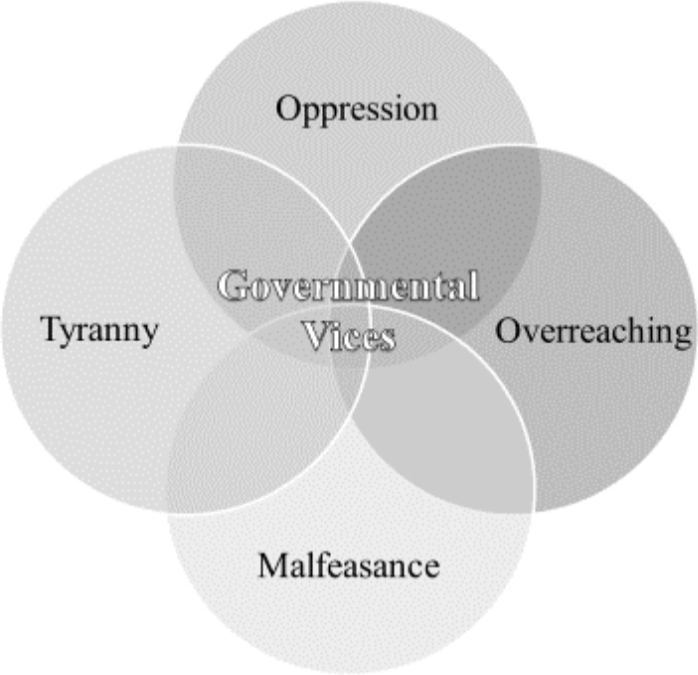
Countering this bleak forecast for America's health entails more than new law and policy approaches. It requires an innovative vision of the core role of law to further communal health. Part I of this commentaryReference Hodge3 premised the promotion of the public's health on the truism of “constitutional cohesion.” For many reasons constitutional structural principles (e.g., federalism, separation of powers) are often viewed distinctly from individual rights (e.g., due process, freedom of speech). The Bill of Rights to the federal Constitution was added only after structural foundations were laid out. For years, law schools have taught structural principles and rights in separate courses. Unsurprisingly, many lawyers, judges, and policymakers tend to see them discretely. In reality, structural- and rights-based constitutional norms are highly interdependent, working in tandem to limit governmental vices (e.g., oppression, overreaching, malfeasance, tyranny) (see Figure 1).Reference Brown4
Governmental Vices

Constitutional cohesion is a fine theory, but so what? In a 1969 lecture, Yale Law Professor Charles L. Black, Jr. forewarned: “One who reads at all in constitutional law will know, ruefully, that there is no new thing to be said, and that when you think you have said something new you later find that others have said much the same thing before.”Reference Black5 Even if Constitutional Framers, scholars, and others understand and support the theory,Reference Varol6 how can it lead to practical public health advancements?
One way, posited in Part I, is to consider whether structural principles or individual rights may be wielded effectively and interchangeably to improve health. For example, can individual rights like due process be argued successfully to defeat structural tactics like preemption that hamper local public health innovations? Conversely, can federalism be raised to limit negative impacts on constitutionally-protected rights to privacy or liberty?
One way, posited in Part I, is to consider whether structural principles or individual rights may be wielded effectively and interchangeably to improve health. For example, can individual rights like due process be argued successfully to defeat structural tactics like preemption that hamper local public health innovations? Conversely, can federalism be raised to limit negative impacts on constitutionally-protected rights to privacy or liberty?
The answer in either case is yes, but outcomes are unpredictable. Lacking approaches predicating positive effects, engaging constitutionally cohesive arguments may present mere “off-ramps” tied to singular victories or successes. At worst such arguments may underscore legal efforts that are initially (or later proven) antithetical to public health. In his 2009 text, for example, Robert Schapiro recounts the multiple ways the U.S. Supreme Court has “invalidated important state health and safety laws” under the guise of federalism.Reference Schapiro7
Still, against an onslaught of legal and political affronts to public health in the United States, cohesive legal maneuvers are worth the risk. Part II of this commentary (1) clarifies the conceptual groundwork of constitutional cohesion; (2) lays out a series of practical legal angles to generate cohesive arguments (absent greater formulaic certainties); and (3) relates how these arguments may promote the public's health.
Constitutional Cohesion Clarified
A simple premise underlies constitutional cohesion. Legal arguments raising structural impediments or rights infringements may present equally viable alternatives to challenge laws and policies that impair the public's health. Less understood is how to wield these ideas to promote collective health. The utility of constitutionally-cohesive arguments is tenuous. There are no reliable guides to implement this strategy. Few guarantees exist that such claims will prevail initially or not be used conversely to stifle laudable or innovative public health laws.
As noted in Part I, a formulaic approach (reminiscent of Judge Posner's legal pragmatism)Reference Posner8 may help identify and justify appropriate cohesive arguments. Generating this approach, however, involves a widespread assessment of multiple variables (e.g., legal theory, prevailing politics, relevant parties' objectives/positions, specific legal factors, and available resources). Mathematically-precise predictions may not be possible, but refined analyses can heighten the odds that proffered arguments advance communal health (instead of worsening it). Where does such analysis begin?
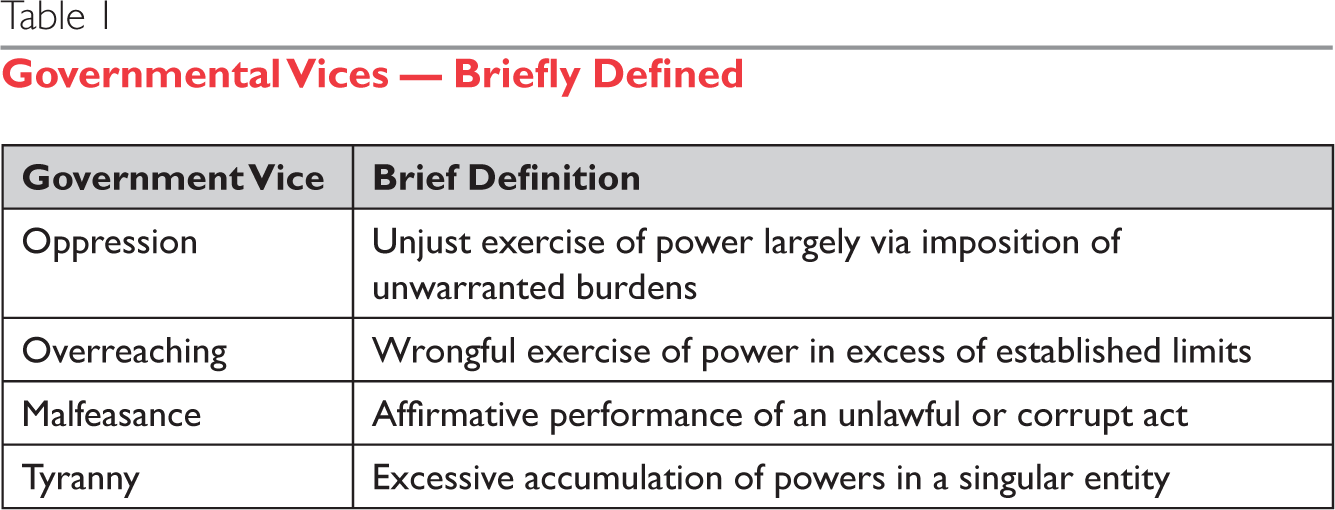
At the heart of constitutional cohesion is the joint role of structural and right-based principles in addressing governmental vices. Consequently, cohesive arguments may be particularly salient when framed in terms of limiting vices such as (1) oppression, (2) overreaching, (3) malfeasance, and (4) tyrannyReference Madison and Shapiro9 (as defined in Table 1). Government acts (or omissions) resonating these vices are universally disdained by U.S. law- and policy-makers on both sides of the aisle. The public has little tolerance for vice activities conducted by any level of government to the detriment of individuals or communities. As a result, when subjected to constitutional scrutiny, vice-driven powers or exercises are diminished or extinguished entirely.
Governmental Vices — Briefly Defined

Framing arguments in terms of governmental vices, however, is complicated. From the start people disagree on what constitutes a vice in the public health arena. As noted in Part I, preventable gun violence may emanate from policies supported by Second Amendment rights to bear arms. Some suggest that acts of gun violence collectively constitute oppression; others insist the Second Amendment exists to deter oppression (at least via government).10 Somewhere between these perspectives lies a healthy, legal balance that respects individual rights and enhances communal health. Striking this balance begins with a proper characterization of governmental actions from which may follow cohesive counter-arguments.
Constitutional Cohesion Applied
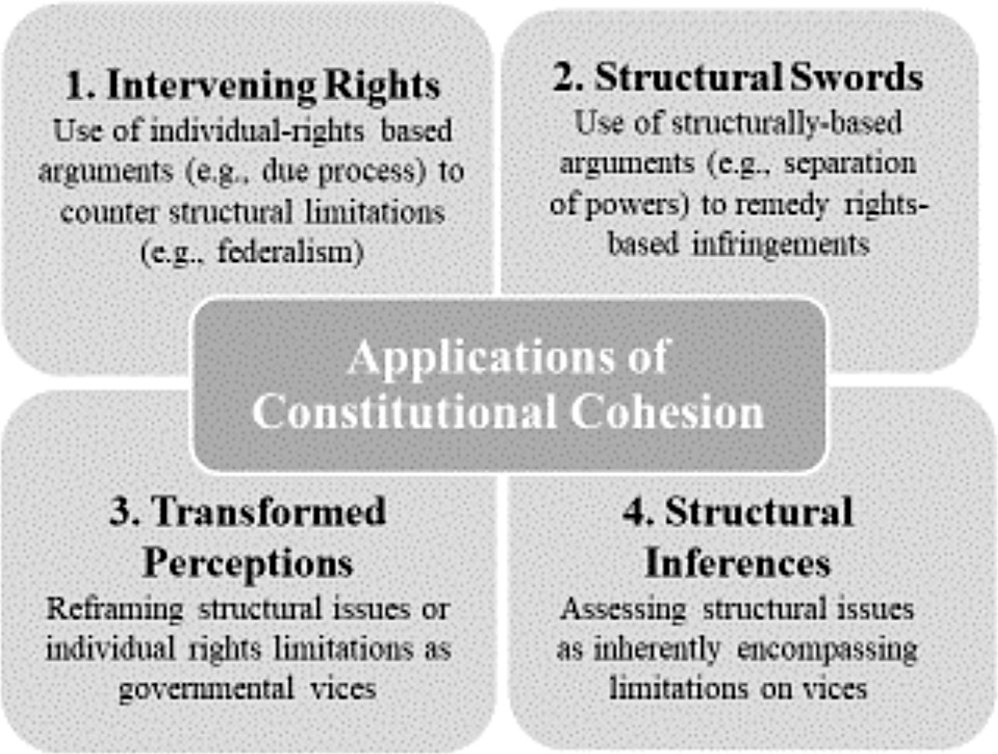
Four primary approaches may be considered in applying the theory of constitutional cohesion to actual or emerging legal threats to the public's health (see Figure 2). The first two, intervening rights and structural swords, provide the most immediate opportunities for positive interventions. The latter two, transformed perceptions and structural inferences, take constitutional cohesion to its theoretical edge.
Theories of Constitutional Cohesion

Intervening Rights.
Government at all levels is empowered to protect or inhibit the public's health. Exercises of these powers are constitutional to the degree they follow structural foundations like federalism, separation of powers, sovereign powers, and preemption. Adherence to structural principles, however, is not the only measure. When government uses structural principles to infringe unnecessarily on individual rights, cohesive arguments may follow.
In Jacobson v. Massachusetts (1905),11 the U.S. Supreme Court upheld a state-based exercise of police powers to require adult vaccinations against smallpox. In many ways the decision was consistent with decades of judicial acceptance of state and local public health efforts. However, the Court clarified that liberty principles inherent in due process do not succumb completely to public health police powers. Along the way, it revealed the interrelatedness of structural foundations and individual rights in crafting a balance between freedoms and public health exigencies.Reference Hodge12
In subsequent modern cases, application of constitutionally cohesive arguments grounded in individual or entity rights are designed to counter structural implementations of powers that stifle public health or safety. In 2017 the City of Tallahassee initially challenged state gun laws preempting local ordinances on the dual themes of legislative immunity and freedoms of speech.13 That same year in State ex rel. Brnovich v. City of Tucson,14 joint arguments grounded in local home rule authority and municipal due process were presented in response to the Arizona State legislature's preemptive scheme to withhold all state funds from localities whose public health (or other) laws conflict with state laws.Reference Bendor15 President Trump's 2017 Executive Order 1376816 threatening to federally-defund “sanctuary cities” led to rights-based and structural challenges.Reference Gonzales17 In County of Santa Clara v. Trump,18 the Order was deemed “unconstitutionally vague in violation of the Fifth Amendment's Due Process Clause.”
Structural Swords.
Intervening rights arguments may help counter vice-driven structural interventions. The flipside of this strategy is to use structural arguments as a sword to limit unwarranted infringements of individual rights contrary to the public's health. Among other claims, government impositions on individual rights may be circumvented via arguments that: (1) the wrong level of government has acted (i.e., federalism); (2) the wrong division of government has acted (e.g., separation of powers);19 (3) a lower government's action is negated (i.e., preemption);20 or (4) a government agency lacked authority to implement the measure at all (e.g., non-delegation doctrine, a component of separation of powers).
Use of structural swords has its greatest application when a damaging public health policy is abandoned as a result. In City of Chicago v. Sessions (2017),21 President Trump's aforementioned sanctuary city order was rejected as violative of separation of powers. However, in United States v. Lopez (1995),22 public defenders representing a Texas minor facing federal criminal charges for gun possession at school successfully crafted a federalism challenge to Congress' Commerce authority to implement the Gun Free School Zones Act. As a result, a portion of the Act designed to promote public health and safety nationally was repudiated.
Transformed Perception.
Despite risks inherent in cases like Lopez, the merits of applied arguments grounded in intervening rights and structural swords are indubitable. Intervening rights principles illuminate unconstitutional elements of government acts that may otherwise be adjudged lawful. Structural swords may derail governmental interventions that may not fully infringe specific rights, but clearly reflect unconstitutional vices.
Sometimes the presence of a vice is not so clear. As an applied component of constitutional cohesion, transformed perceptions denotes the potential to recast governmental actions as oppressive, over-reaching, malfeasant, or tyrannical. To the extent such actions constitute a vice, they are likely unconstitutional. The essence of this application is seen in Jacobson. Although Reverend Henning Jacobson argued against vaccination largely on a rights continuum, his complaint resonates themes of government over-reaching and oppression. True, he lost, but his re-characterization of state police powers led to affirmative limits that remain foundations of modern public health practices.
In a 2016 abortion rights case, Hodes & Nauser, MDs, P. A. v. Schmidt,23 Concurring Justice Gordon Atcheson of the Kansas Court of Appeals eloquently called for exacting judicial review related to Kansas' constitutional right to self-determination. “Doing otherwise,” he suggested, “vaults legislation ahead of an elemental constitutional barrier to governmental overreach, undercutting the very purpose of a bill of rights in shielding a select set of fundamental precepts from the vicissitudes of politics and the cravenness of politicians (emphasis added).”24
Structural Inferences.
Sometimes the presence of a vice is clear, but a concomitant rights-based violation is not. For example, a court may concur with the identification of a vice activity that impairs the public's health, but fail to see how it impinges one's rights under a prevailing balance test or other interpretation. Structural inferences suggest that even when a breach of specific individual rights is absent, an identified vice may still be constitutionally debated.
The rights of people to be free from governmental vices lie at the core of constitutional democracies. Constitutional structural foundations like federalism and separation of powers are designed to help rid society of governmental vices for the people's benefit. “[T]he Constitution divides authority between federal and state governments,” held the U.S. Supreme Court in 1992, “for the protection of individuals.”25 As Robert Schapiro later concluded “federalism protects citizens, not states.”26 In theory not every right has to be specified constitutionally to warrant protection. Applied remedies must exist to address the presence of any vice irrespective of explicit delineation of rights.
In plain terms, any governmental vice that negatively impacts the public's health may be disavowed to the extent assuring communal health remains a core function of government. Whether applied facets of constitutional cohesion strike at the heart or approach the edge of governmental acts or omissions, delineating and eliminating vices that encumber population health are consummate goals at every level of government. Quite possibly governments' ultimate vice is reflected in acts or omissions that fail to promote basic public health services for all.
Acknowledgments
The author is grateful for the research and design contributions of Jennifer Piatt, Senior Legal Researcher, and reviews by Sarah Wetter, J.D., and Madeline Morcelle, J.D., M.P.H., Research Scholars, at ASU's Center for Public Health Law and Policy.