Introduction
Cowpea (Vigna unguiculata) is a staple food for Brazilian northeastern people, as well as for people from several African countries (Timko, Reference Timko, Moore and Ming2008). One of the advantages regarding its cultivation in poor regions is the fast crop cycle – about 75 days from emergence to harvest (Rodrigues et al., Reference Rodrigues, Santos, Teodoro, Bastos, Ribeiro and Nogueira2018); low soil fertility requirements (Freire-Filho, Reference Freire-Filho2011); and low water demand (Timko, Reference Timko, Moore and Ming2008), being able to produce in environments subjected to low rainfall levels, feeding populations subjected to famine.
The physical aspect of grains depends highly on variety and cultivation region – there are regional preferences for consuming specific grain types and colours (Mishili et al., Reference Mishili, Fulton, Shehu, Kushwaha, Marfo, Jamal, Kergna and Lowenberg-Deboer2009). In Brazil, the most common grain types are ‘white’ (white or light brown grains with black or brown hilum), and ‘always-green’ (light brown grains with green hilum) (Rodrigues et al., Reference Rodrigues, Santos, Teodoro, Bastos, Ribeiro and Nogueira2018). Cowpea grains are rich in proteins, carbohydrates and several nutrients (Jayathilake et al., Reference Jayathilake, Visvanathan, Deen, Bangamuwage, Jayawardana, Nammi and Liyanage2018).
Grain yield average of smallholder farms in Brazil is around 320 kg ha−1 (Freire-Filho, Reference Freire-Filho2011). This represents also the approximate productivity obtained in several African countries as Senegal, Nigeria and Tanzania and others, but is below the average grain yield obtained in other African countries as Myanmar, Kenya and Cameroon, whose productivity levels are about 829 kg ha−1 (Akibode and Maredia, Reference Akibode and Maredia2011). In Brazil, commercially technified areas in the Midwestern are able to harvest about 1200 kg ha−1 (Freire-Filho, Reference Freire-Filho2011).
At the end of cowpea cycle, the harvest is usually done by hand in smallholder farm fields (Fernandes et al., Reference Fernandes, Carneiro, Motta and Padovan2012), and by using combines in technified or commercial fields. In Brazil, some smallholder farmers, as well as most commercial farmers, decide for applying a low dose of burndown herbicides at cowpea pre-harvest to increase leaf abscission and make harvest easier and faster (Assis et al., Reference Assis, Araujo, Freitas, Silva and Araujo2019), with fewer impurities when harvested by combines. Among the most widely used herbicides for this purpose, paraquat, diquat, glufosinate-ammonium and glyphosate are highlighted (Dennis et al., Reference Dennis, Kukulies, Forstner, Orton and Pattison2018). The first three herbicides are of the contact type, burning plant parts where they touch with the application, while the last one is a systemic burndown herbicide that circulates in plant xylem and phloem, killing the plant as a whole. Glyphosate is being tested by some farmers due to its lower cost compared to contact burndown herbicides. There are no recommendations about the application of these herbicides at cowpea pre-harvest in Brazil; thus, there is concern about possible contamination of cowpea grains by using a systemic herbicide for pre-harvest burndown.
The pre-harvest applications are accomplished in moments when cowpea plants are still transporting photoassimilates and minerals to late formed grains; the burndown is usually done when plants present between 50 and 75% of the pods ready for harvesting (Assis et al., Reference Assis, Araujo, Freitas, Silva and Araujo2019). Considering that between 25 and 50% of the pods are still transporting substances to grains at the time of herbicide burndown, accumulation of herbicide in cowpea grains is expected to occur. However, even considering that herbicide residues in food may harm consumer health, there is no information on herbicide accumulation in cowpea grains. Thus, the present study aimed to quantify the residuals of paraquat, diquat, glufosinate-ammonium and glyphosate in cowpea grains when subjected to two timings of pre-harvest burndown.
Material and Methods
Experiments were conducted from December 2012 to February 2013, in different locations representing environments where cowpea is produced in Brazil: Dourados, Mato Grosso do Sul, at Embrapa Agropecuaria Oeste (Lat. 22.3440 S, Lon. 54.7980 W); Sinop, Mato Grosso, at Embrapa Agrossilvipastoril (Lat. 11.8717, Lon. 55.5999 W); and Teresina, Piauí, at Embrapa Meio-Norte (Lat. 5.0358 S, Lon. 42.7983 W). Experiments at the three locations had the same experimental design and treatments.
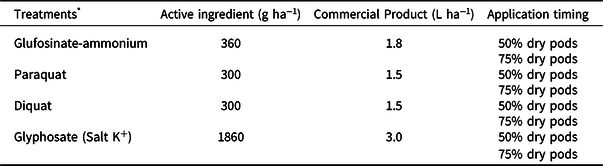
In the field, the experiments with nine treatments were arranged in factorial scheme 4 × 2 + 1, comprising four burndown herbicides and two herbicide application timings: with 50 and 75% of the pods ready for harvesting (Table 1). An additional control treatment, without herbicide application was also present, and treatments were replicated four times with plots measuring 3 × 7 m.
Burndown herbicides applied at pre-harvest of cowpea (Vigna unguiculata) bean at Embrapa Agropecuaria Oeste (Dourados-MS); Embrapa Agrossilvipastoril (Sinop-MT) and Embrapa Meio-Norte (Teresina-PI), 2013

* Applications performed based on pesticide’ amount used on field – 150 L ha−1.
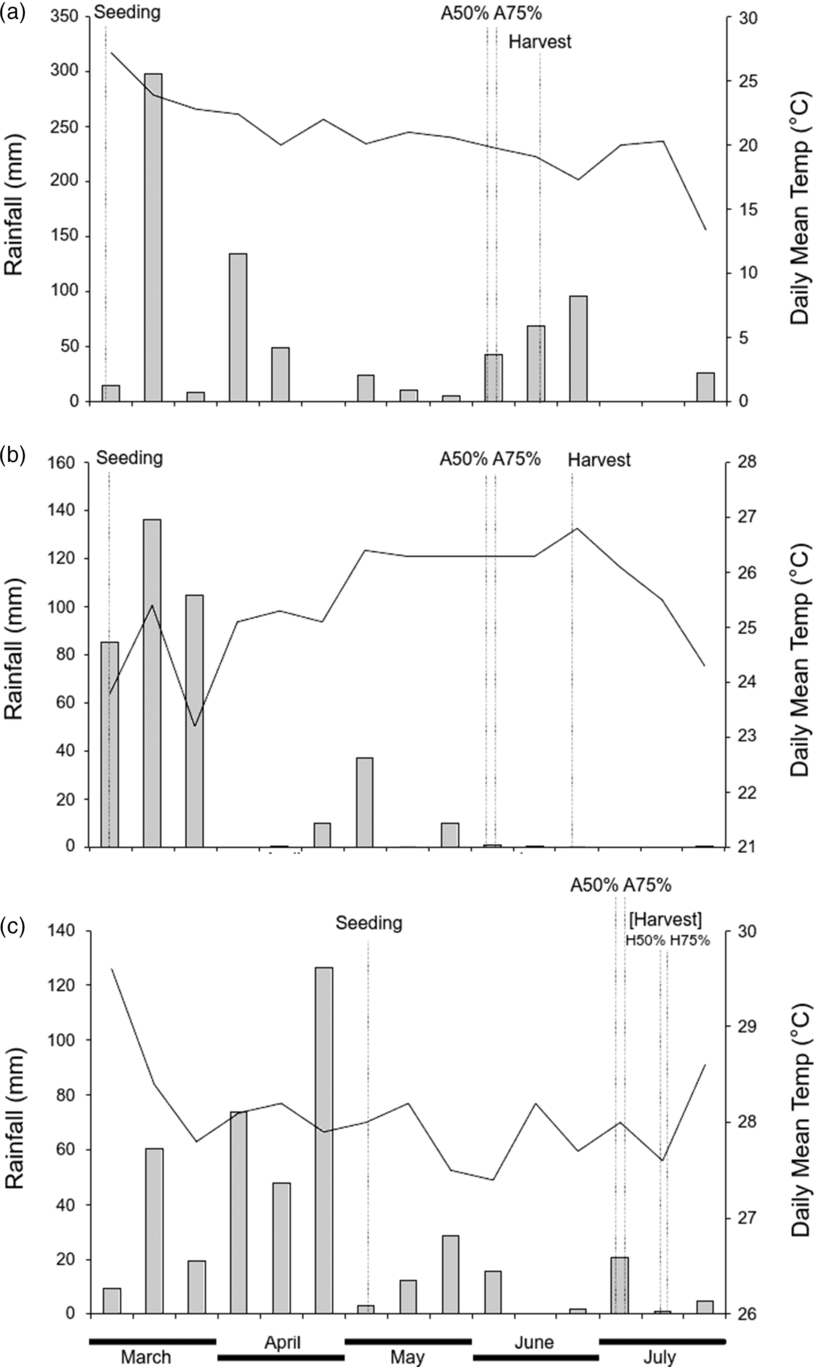
Considering edaphoclimatic requirements (climate and soil characteristics), different varieties, with similar genetic background, were used: the variety ‘BRS-Guariba’ was adopted for Dourados and Sinop and the variety ‘BRS-Novaera’ was adopted for Teresina. These varieties present advantages in grain yield and resistance to biotic and abiotic stresses, with good overall acceptability by consumers. Planting was performed in rows spaced in 0.5 m, at density of 15 plants m−2 to 20 plants m−2. All the work in the field was done according to the good agricultural practices (GAP) indicated by Bastos (Reference Bastos2017). The herbicides were sprayed when plants had 50 to 75% of the pods dry and ready for harvesting, according to the treatment (Table 1). For all locations, sprayers charged by a CO2 pressure source with constant flow rate were used, and herbicides were applied in the beginning of the morning, when climatic parameters (temperature, wind speed and air relative humidity) were favourable for pesticide application. The main climatic parameters and planting timings, herbicide applications and harvests for all locations, are illustrated in Figure 1.
Summarised climatic data for Dourados (Lat. 22° S) (a), Sinop (Lat. 11° S) (b) and Teresina (Lat. 5° S) (c), Brazil, from March to July 2013. A50%; A75% – application of the pre-harvest burndown treatments with 50 or 75% of the pods dry and ready for harvest, respectively; H50%; H75% – harvest of the treatments applied at A50% and A75%, respectively.

The harvest was accomplished by collecting pods in the centre of each plot, at timings shown in Figure 1, by workers wearing cleaned clothes and using brand new disposable latex gloves, which were exchanged and discarded between plots to avoid cross contamination. Pods were dried in shaded and ventilated locations to avoid excessive temperature, being grains removed from pods manually or by mechanical means. The machines were clean between processing of different treatments. The remaining impurities were removed by air flushes and grains were packed and shipped to laboratories for pesticide residue analysis.
Analytical techniques
Glufosinate-ammonium and glyphosate concentrations in the grains were determined by standard protocols in the laboratories of Embrapa Environment, located in Jaguariuna-SP, Brazil, Lat. 22.7278 S, Lon. 47.0156 W. Paraquat and Diquat determination required the development of a dedicated methodology for analysis, which was performed at the Federal University of Santa Maria-RS, Brazil, Lat. 29.7116 S, Lon. 53.7162 W, at the Center of Research and Analysis of Residues and Contaminants (CEPARC) laboratories, prior to analysing the treatments. The fully validated method to analyse paraquat and diquat is published (Pizzutti et al., Reference Pizzutti, Vela, Kok, Scholten, Dias, Cardoso, Concenço and Vivian2016).
The field experiments were installed with four true replications (four plots for each treatment, in all locations). For each field plot, 3 samples were extracted and processed independently into the lab for each one of the herbicides, resulting in 12 samples for each treatment, in the three locations.
Determination of glufosinate-ammonium, glyphosate and Aminomethyl phosphonic acid (AMPA)
The analysis of glyphosate and its metabolite residues (aminomethylphosphonic acid – AMPA), were done according to the methodology proposed by Cowell et al. (Reference Cowell, Kunstman, Nord, Steinmetz and Wilson1986). Glyphosate and its degradation product AMPA were transformed into fluorescent compounds by specific derivatisation reactions. In this case, glyphosate was previously oxidised to glycine, in alkaline medium and at temperatures above 40 °C. For the formation of a more stable fluorescent compound, the reaction was carried out in the presence of mercaptoethanol. This reaction process (post-column) of glyphosate occurs with hypochlorite at pH 9.1, then reacted with ophthaldehyde (OPA) and 2-mercaptoethanol in methanol (pH 9.2) (Cowell et al., Reference Cowell, Kunstman, Nord, Steinmetz and Wilson1986). Chromatographic separation of the compounds was performed on HRLC glyphosate analysis column (100 × 4.6 mm) – Bio-Rad and they were eluted with KH2PO4 at pH 2.1, being measured at 440 nm, with excitation at 350 nm with fluorescence detector RF-535 (Shimadzu). 20 g sample of cowpea bean was processed.
The method for analysis of glufosinate-ammonium was validated at Embrapa Meio-Ambiente, Jaguariuna-SP, Brazil. 1.0 g of cowpea bean was processed and extracted with 5 mL HPLC grade methanol. The mixture was mixed in a vortex for 1 min and 15 mL of water were added, ultrasound for 15 min and centrifuged for 12 min at 5000 rpm, 3836 g (Fiber of Carbon Rotor – Model F14-6 × 250 LE – Thermo Scientific) at 15 °C. Afterwards, in a total 2.5 mL of the sample was added 4.25 mL of acetone, vortex again for 1 min and centrifuged for 12 min at 5000 rpm (3836 g) at 15 °C. The supernatant was transferred to a round bottom flask and evaporated to dryness on the rotary evaporator at 60 °C. The residue was then resuspended with mobile phase (55:45, v v−1, ammonium acetate 10 mM, pH 4.5: acetonitrile), filtered on 0.45 μL filters, transferred to the vial and injected into the chromatograph for analysis. Chromatographic separations were performed using a Shimadzu coupled to the Bruker mass spectrometer – Amazon Model X – Type Ion Trap with ionization source – Electrospray (ESI) and Lichrosorb RP-18/100 column (250 × 4.6 mm × −5 μ). The monitored ion was 182 > 136.
Determination of paraquat and diquat
The determination of paraquat and diquat residues in cowpea bean was performed according to Pizzutti et al. (Reference Pizzutti, Vela, Kok, Scholten, Dias, Cardoso, Concenço and Vivian2016). The fundamental steps are summarised below.
Cowpea grains were milled to a powder. Then, in order to obtain a completely homogeneous sample, a slurry of cowpea and water was prepared. The final optimised method consisted into a weight of 12.5 g homogenised slurry (corresponding to 5 g original cowpea) and to add the isotopical labelled internal standards. This portion was transferred to a 50 mL polypropylene centrifuge tube. Then, 10 mL of extraction solvent and methanol/0.5 M hydrochloric acid (6:4, v v−1) were added and the tube was shaken vigorously, manually for 2 min. The tubes were thereafter transferred to a water bath (at 80 °C) and kept there for 15 min. The tubes were allowed to cool down to room temperature and then centrifuged for 15 min at 4000 rpm (3069 g). From the final extract, 10 μL was injected into the UPLC-MS/MS system.
Results and Discussion
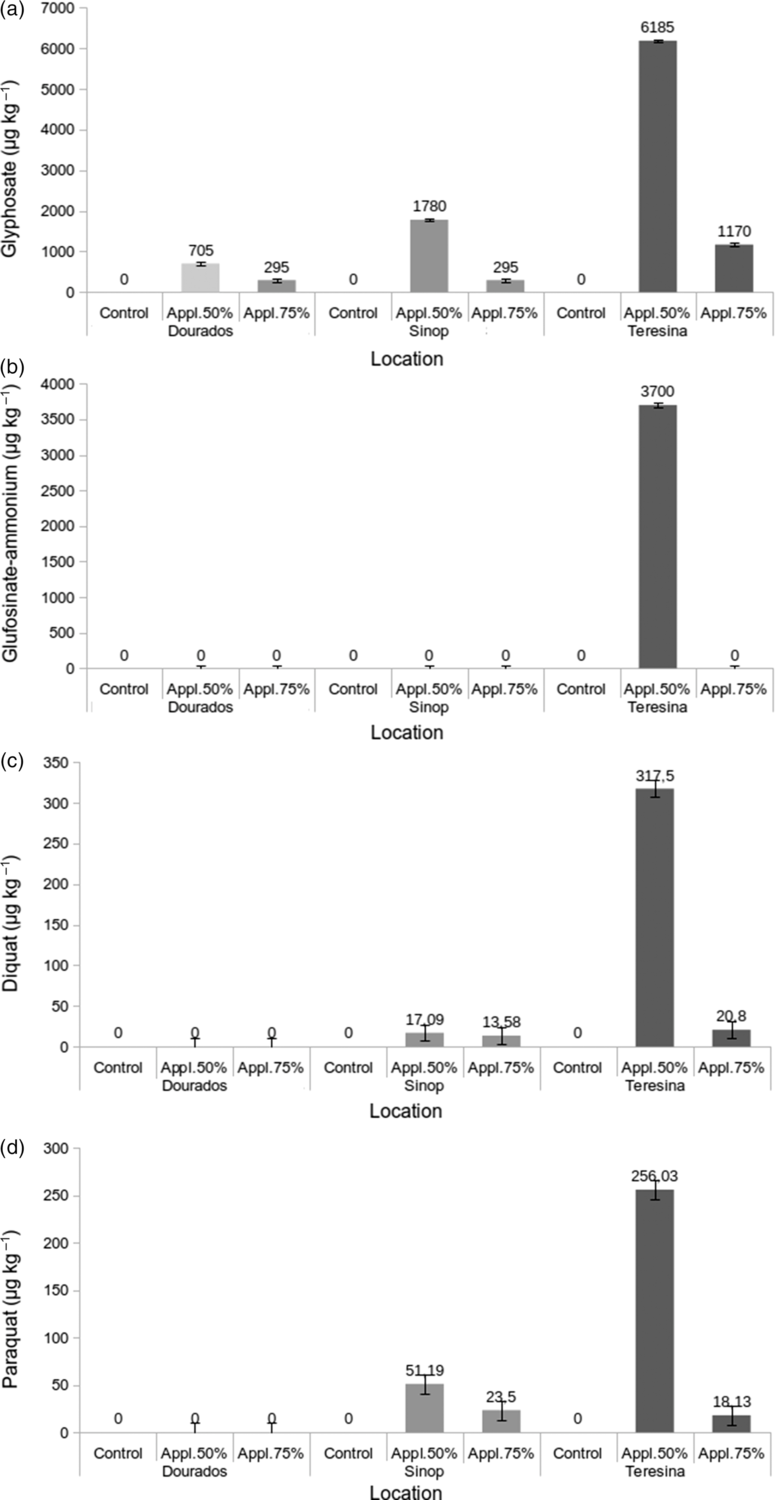
The overall residual levels of glyphosate, glufosinate-ammonium, diquat and paraquat, are presented in Figure 2. In general, there was remarkable effect of experiments location on the results, and herbicides residues in cowpea grains were also higher as earlier in the cycle the herbicide was applied (Figure 2).
Concentration (µg kg−1 cowpea grains) of glyphosate (a), glufosinate-ammonium (b), diquat (c) and paraquat (d) in cowpea (Vigna unguiculata) grains, as a function of location (Dourados (Lat. 22°S), Sinop (Lat. 11° S) or Teresina (Lat. 5° S), Brazil), and application timing (50 or 75% of dry pods) of desiccant herbicides preceding harvest. Paraquat and diquat: limit of detection (LOD): 3.0 µg kg−1; limit of quantification (LOQ): 10 µg kg−1. Glyphosate and glufosinate-ammonium: LOQ: 40 µg kg−1. Bars are a graphical representation of LOQ.

Glyphosate residues ranged from 295 to 6185 µg kg−1 in cowpea grains. In the experiment at Dourados, the application of glyphosate with 50% dry pods resulted in 705 µg kg−1 while the application with 75% dry pods accumulated 58% less glyphosate in cowpea grains (Figure 2a). This difference was of about 83% at Sinop, and 81% at Teresina, always in favour of the later application. Glyphosate is the most widely used herbicide in agriculture to control weeds pre-planting, post-emergence in tolerant GMO crops, and pre-harvest burndown of several crops. It is a broad-spectrum herbicide, controlling both broad leaved and narrow leaved weeds (Gillezeau et al., Reference Gillezeau, Van Gerwen, Shaffer, Rana, Zhang, Sheppard and Taioli2019). There are current strong discussions regarding glyphosate ban in agriculture as there are evidences it may be carcinogenic (Tarazona et al., Reference Tarazona, Court-Marques, Tiramani, Reich, Pfeil, Istace and Crivellente2017; Gillezeau et al., Reference Gillezeau, Van Gerwen, Shaffer, Rana, Zhang, Sheppard and Taioli2019). There are also suspicions about its impact on other issues, as the negative impacts on birth outcomes, both in populations directly exposed to it, as well as in populations located far from agricultural fields, but served by water streams passing through arable lands (Dias et al., Reference Dias, Rocha and Soares2019).
Glufosinate-ammonium was absent in cowpea grains corresponding to all treatments, except at Teresina, when applied earlier, with 50% dry pods (Figure 2b). In this sole situation, 3700 µg kg−1 of cowpea grains were reported. Glufosinate-ammonium is a broad-spectrum herbicide used for burndown applications prior to planting food crops, as well as a desiccant used in burndown (dry out) of the crop itself prior to harvesting. It is considered a contact-type herbicide – it is supposed not to move from its interception point to other parts of the plant (Krenchinski et al., Reference Krenchinski, Cesco, Castro, Carbonari and Velini2019). Glufosinate resembles glutamate, and acts by inhibiting the enzyme glutamate-synthetase, which is present both in plants (Brito et al., Reference Brito, Moraes, Marchesi, Carbonari and Velini2017) and mammals (Cooper and Jeitner, Reference Cooper and Jeitner2016); its absorption by the organism in mammals affects the nervous system in several animal species tested in laboratory (Jewell and Buffin, Reference Jewell and Buffin2001).
Diquat was absent in grains harvested at Dourados (Figure 2c). It was present at ~15 µg kg−1 of cowpea grains in treatments harvested at Sinop without distinction on application timing. In the experiment installed in Teresina at Embrapa Meio Norte, much higher diquat concentration (317.5 µg kg−1 of cowpea grains) were reported when application occurred earlier in the crop cycle (Figure 2c), contrasting with the much lower concentration reported when the herbicide application occurred with 75% dry pods. At the later application, diquat concentrations reported in cowpea grains resembled those found in the experiment planted in Sinop.
The behaviour of paraquat was similar to the one observed for diquat, with no residues being found in grains harvested at Dourados, independently of the moment of application, and presenting 25–50 µg kg−1 of cowpea grains for Sinop samples, with lower concentration reported for the treatment applied when most pods were dry and ready for harvesting (Figure 2d). In Teresina, the treatment applied with 75% dry pods resulted in paraquat residue concentration equivalent to those reported for Sinop, but again the treatment applied earlier, with only about 50% dry pods, showed the highest paraquat residue concentration (~256 µg kg−1 of cowpea grains). It was observed that the highest residues concentration of all herbicides in cowpea grains occurred at Teresina, in the application with only 50% dry pods.
As already mentioned, the effect of location on results was remarkable (Figure 1), being summarised in Figure 2. The overall herbicides residues concentration, pooling the treatments which received the application of any herbicide at any timing, increased as the latitude decreased and the mean temperature increased (Figure 1). The mean temperatures for the experimental period were 20 °C, 25 °C and 28 °C, respectively for Dourados, Sinop and Teresina cities, whose latitudes are also respectively 22° S, 11° S and 5° S.
In fact, cowpea is usually grown at the second cropping season (also called ‘dry season’) in Brazil as a crop for subsistence and in arid environments in other countries. As its grain yield is low, there are better options to mitigate famine in environments with moderate or higher water availability. Thus, it was raised a hypothesis that in arid environments the physiological metabolism of the cowpea plants is lowered and its natural ability to detoxify from chemicals is also lower.
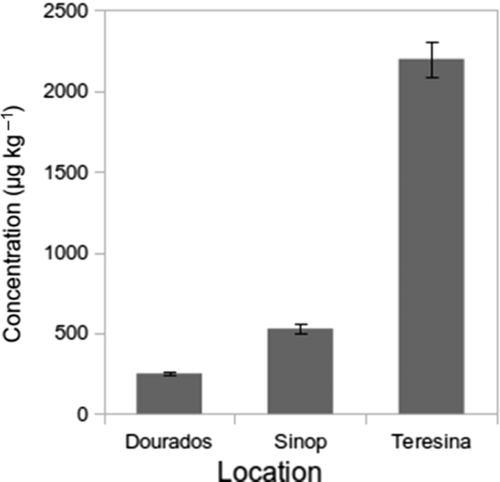
Regarding herbicide concentrations in cowpea grains by experimental location, there was a remarkable relationship between them (Figure 3). There was a tendency of increased herbicides concentration in the harvested grains as the latitude was reduced. This was partially attributed to differential water availability and temperature dynamics (Figure 1). Regarding rainfall, at Dourados city about 811 mm of rainfall was reported along the experiment; at Sinop and at Teresina cities, the mean rainfall was about 420 mm along the experimental period (Figure 1).
Concentration (µg kg−1 of cowpea grains) of glyphosate, glufosinate-ammonium, paraquat and diquat in cowpea (Vigna unguiculata) grains resulted of pre-harvesting burndown, as a function of location: Dourados (Lat. 22° S), Sinop (Lat. 11° S) and Teresina (Lat. 5° S), Brazil. Bars represent 95% confidence intervals.

Although the rainfall levels at Sinop and Teresina were similar, the evapotranspiration is different at these locations; for a typical day of May at Dourados, Sinop and Teresina, the evapotranspiration rates, estimated by Penman–Montheith, are respectively 3.1 mm; 3.6 mm and 4.4 mm (Flumignan et al., 2016; Gomes et al., 2005; Souza et al., Reference Souza, Almeida, Arantes, Martim and Silva2015). This is an indication that the evaporative demand differs among locations and that Teresina is usually drier than Sinop, even with equivalent rainfall amounts. These data evidence that as drier the location as slower probably is the herbicide degradation by plants.
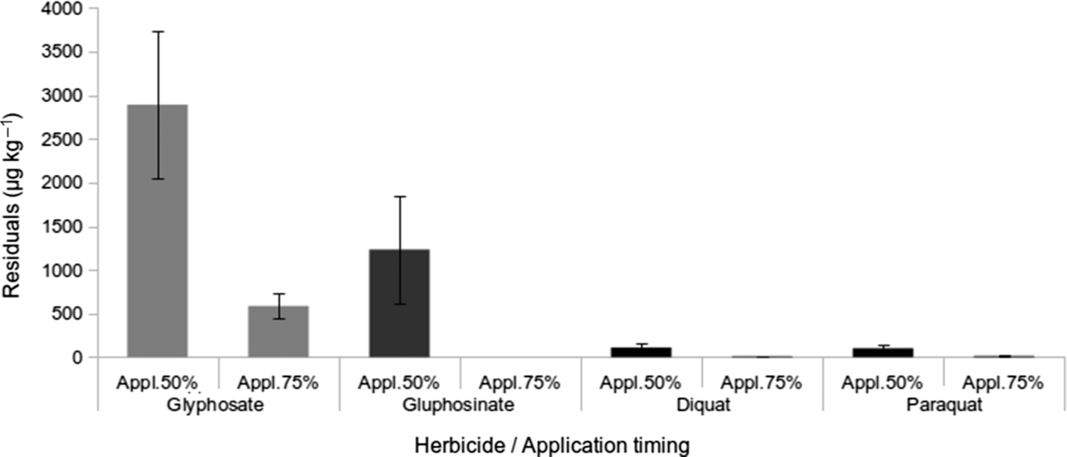
Regarding the application timing as function of the herbicide mode of action (Figure 4), it is evident that burndown applications at a later developmental stage resulted in lower contamination levels in cowpea grains. At later stages, a greater part of the seeds is already ripened and translocation is not pumping photoassimilates and other substances into them anymore – the main process in ripening grains is water loss (Nogueira et al., Reference Nogueira, Freitas, Torres and Leal2014). At earlier developmental stages a greater part of the grains is still actively receiving substances, and herbicides and their metabolites are most prone to be stored in grains (Figure 4). For the systemic burndown herbicide (glyphosate), the contamination levels were reduced from about 2780 µg kg−1 to about 520 µg kg−1 (Figure 4) by simply delaying the application from 50% dry pods to 75% dry pods; this would represent about a week of delay in field conditions (Figure 1). For contact herbicides (glufosinate-ammonium, paraquat and diquat), the residual levels in grains fell from ~480 µg kg−1 to about zero when the application was delayed (Figure 4).
Concentration (µg kg−1 of cowpea grains) of herbicides glyphosate (mean of all experiments/locations), glufosinate-ammonium, paraquat and diquat in cowpea (Vigna unguiculata) grains, as a function of application timing (50 or 75% of dry pods at application). Bars represent 95% confidence intervals.

By pooling all experiments/locations in the same statistical analysis (Figure 4), a wider overview reports the risk of using a systemic herbicide as glyphosate in pre-harvest burndown of cowpea. When the burndown application proceeded with 50% dry pods, glyphosate residuals are expected to be in the range of 2000–3750 µg kg−1 (Figure 4) according to the confidence interval; this residual was lowered to 480–700 µg kg−1 when the burndown occurred with 75% dry pods. For glufosinate-ammonium, about 600–1600 µg kg−1 of residuals were reported in the earlier burndown, and the residuals tended to zero with application with 75% dry pods. Both photosystem inhibiting herbicides, paraquat and diquat, showed to be relatively safe to use in pre-harvest burndown of cowpea, as residues concentrations were below 200 µg kg−1 and 50 µg kg−1, for burndown with 50 and 75% dry pods, respectively (Figure 4).
When the mean residual levels, as well as their expected ranges (Figure 4) are considered in view of the maximum residual level allowed in food grains (Table 2), it is possible to conclude that glyphosate should not be used, in any case, in pre-harvest burndown of cowpea. While the expected residual level of glyphosate is in between 480 and 3750 µg kg−1 of dry grains ready for human consumption (Figure 4), the legislation states that the maximum residual level (MRL) should be ≤50 µg kg−1 (Table 2). Glyphosate residuals were 57.8- and 11.73-fold higher than the allowed, with applications at 50 and 75% dry pods, respectively (Table 2).
Maximum residue level (MRL) and acceptable daily intake (ADI) of glyphosate, glufosinate-ammonium, paraquat and diquat herbicides, applied in pre-harvest of cowpea (Vigna unguiculata) at different timings. Common bean (Phaseolus vulgaris) safety interval is provided as reference as this data is not available for cowpea bean. Acceptable Daily Intake (ADI) for herbicides are the available at the website of the Brazilian National Agency of Sanitary Vigilance (ANVISA – http://portal.anvisa.gov.br), and is regulated by several specific regulatory documents available at the website

*not determined / not available.
Glufosinate-ammonium MRL is similar to glyphosate’s – 50 µg kg−1 (Table 2); when it was applied with 50% dry pods, the residual levels ranged between 600 and 1600 µg kg−1 (Table 2), which is far above the MRL (Figure 4). When glufosinate-ammonium was applied with 75% dry pods; however, its residual in cowpea grains ready for consumption falls to about zero (Figure 4). Thus, glufosinate-ammonium may be considered safe for pre-harvest burndown of cowpea aimed to human consumption, when it is applied later in the crop cycle, with at least 75% dry pods.
Diquat residue concentrations are expected to be below 200 µg kg−1 (Figure 4), considering 95% confidence intervals, while it’s MRL is 500 µg kg−1 (Table 2). Thus, diquat may be considered safe to be applied in pre-harvest burndown of cowpea from 50% dry pods stage onwards. In the worst-case scenario, diquat residuals would be only 0.22-fold the MRL (Table 2), according to the 95% confidence intervals (Figure 4). Paraquat presented residue concentration similar to diquat, but on the other hand it is allowed only in amounts of 10-fold lower than diquat. Thus, its residues only met the MRL when applied with 75% dry pods or later (Figure 4) where it reached only 0.28-fold the MRL (Table 2).
By considering the MRL and the acceptable daily intake (ADI), it was possible to estimate the allowed daily consumption of cowpea grains, under all conditions tested, for a hypothetical model as with a person weighting 70 kg (Table 2). For glyphosate, the model person would be able to consume between 1.02 and 5.01 kg day−1 of cowpea grains, respectively for the application with 50% and 75% dry pods, to reach the individual ADI (Table 2). For glufosinate-ammonium, about 1.14 kg day−1 of grains may be consumed by the model person in the worst-case scenario (Table 2).
Although less residues were found for diquat and paraquat (Figure 4), their respective ADI is also much lower (Table 2). Thus, diquat and paraquat allowed consumption of 1.26 and 2.73 kg day−1, respectively, for the hypothetical model person in the worst case scenario (earlier application), or between 12.22 and 20.18 kg day−1, also respectively, when the burndown application was accomplished with 75% dry pods.
Since there is not a specific legislation in Brazil for the safety interval between burndown herbicide application and cowpea harvesting (Vigna unguiculata), results were compared with the legislation regarding common bean (Phaseolus vulgaris), whose safety interval legislation includes those four studied herbicides (Table 2). Cowpea is considered a minor crop in Brazil, and herbicide registrations for these crops are based on field crops with similar cultural and biological similarity. In Brazil, common beans are considered the reference crop for cowpea bean (MAPA, 2014). The present study could be an instrument to help assessing the viability of extending herbicide registry (ammonium-glufosinate and diquat) to cowpea as they are registered for common beans.
For common bean, as already reported, glyphosate is not allowed for pre-harvest burndown operations when grains are aimed for human or animal consumption as well as paraquat. Glufosinate-ammonium is registered for pre-harvest applications aiming to speed harvesting, as well as diquat. The minimum safety intervals between herbicide application and harvest, for the allowed herbicides glufosinate-ammonium and diquat are 5 and 7 days, respectively, for common bean (Table 2).
By considering the variation on residues concentrations between experiments (Figures 2 and 3), the overall residues concentrations with the respective 95% confidence intervals (Figure 4) and the summarized application of MRL and ADI to a hypothetical case scenario (Table 2), it is possible to infer that the Brazilian legislation regarding pesticides residues in grains tends to be on the safe side. Even for those treatments where residues concentrations were far above the MRL, the hypothetical example showed that huge amounts of contaminated cowpea grains, sometimes superior to 20 kg day−1 for a model person, should be consumed by a person in order to reach the individual ADI (Table 2).
This is not a premise for farmers or technicians to disrespect the legislation. It is important to consider that not only cowpea is consumed in a single day, and glyphosate, glufosinate-ammonium, paraquat or diquat may also be present in other food grains consumed on the same day. By considering the residues concentrations of these herbicides, it seems to be unlikely that consumers would be exposed to frequent excessive residues of these herbicides in their daily diet. For example, the US Food and Drug Administration Bureal (FDA, 2016), in its 2016 year report, concluded that from 760 food samples (corn, soybean, milk and eggs) collected and analysed, there were complete absence of both glyphosate and glufosinate-ammonium in milk and eggs, and none of the soybean and corn samples violated the MRLs of these herbicides.
Zou et al. (2014) determined paraquat concentrations in commercially available vegetables (cabbage, Chinese cabbage, lettuce and spinach), comparing them with pesticide-free vegetables previously immersed in paraquat solutions with increasing concentrations (standard curve approach). The authors reported that only a few vegetable samples presented paraquat residues, and they were not higher than 20 ng g−1 (20 µg kg−1). For cowpea, it is possible to infer tendency to retain higher amounts of paraquat, from 18 to 256 µg kg−1 as reported in Figure 2d. Thus, the later moment of application for this herbicide, in pre-harvest burndown, should be preferred.
The safety and possible impacts of glyphosate use as herbicide in food crops is currently being questioned by several institutions worldwide, and the public opinion often tends to extrapolate the scientific data. The European Food Safety Authority (EFSA, 2018) conducted a wide range study aiming to assess also the impact of glyphosate and its residues in feed on animal health, reporting that glyphosate and its residues are not expected to have major impacts, if any, on animal health. Other study assessing the impact of glyphosate residues in pet food reported that glyphosate content is correlated with crude food fiber content, but not with crude fat or crude protein (Zhao et al., Reference Zhao, Pacenka, Wu, Richards, Steenhuis, Simpson and Hay2018). These authors also report that pets can be more exposed to pesticide residues than humans due to the lower control in pet food manufacturing compared to human food. Even this way, pets were averagely exposed to 0.68 and 2.5% of the allowable ADI of glyphosate for humans in the US and EU (1750 and 500 µg kg−1, respectively). There is a comprehensive review on the theme made available by the European Food Safely Authority (EFSA, 2018).
Conclusions
There seems to exist some relationship between climatic conditions and herbicides concentrations in cowpea grains. As hotter and drier the location as slower seems to be herbicide dissipation;
Systemic non-selective herbicides such as glyphosate, are not adequate for cowpea pre-harvest burndown;
Residues of glyphosate, glufosinate-ammonium and paraquat were above the maximum residue level stated by the Brazilian legislation when applied with only 50% dry pods; thus, burndown herbicides aiming to speed harvest should be applied with at least 75% dry pods in cowpea.