INTRODUCTION
Hey, even the Mona Lisa is falling apart.
— Chuck Palahniuk Footnote 1
Pablo Picasso once opined: “[A] picture is a sum of its destructions.” Footnote 2 Typically, when a person becomes the owner of property, it is within his or her rights to treat the property as he or she pleases. However, these types of liberties are not always available to an owner of a piece of art. There are restrictions on the way individuals can interact with works of art (Figure 1). This is because artists have special rights with respect to their work, which are called “moral rights,” which survive the sale of art to another person or entity such as a gallery. Moral rights are contained under the broad umbrella of copyright law. Justice Joseph Story once stated that copyright comes
nearer than any other class of cases belonging to forensic discussions, to what may be called the meta-physics of the law where the distinctions are, or at least may be, very subtle and refined, and, sometimes, almost evanescent. Footnote 3
What follows is a forensic discussion of the evolution of moral rights and their inability to properly accord with modern-day artistic practice. A critical examination of the social construction of authorship, the emergence of unique contemporary art forms, and the role of technology as a catalyst to intellectual property law reveals that the Western world’s legal moral rights scheme cannot survive in its current form. The endurance of moral rights depends on its ability to reconcile with a social and artistic climate that is alien to its origins.
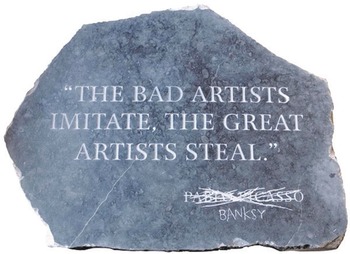
Banksy, Picasso Quote, 2009. Carved marble and reinforced wood. Courtesy of the Prest Control Office.

MORAL RIGHTS
Close by the rights of Man, side by side, at the least, are the rights of the Soul.
— Victor Hugo Footnote 4
Berne Convention for the Protection of Literary and Artistic Works
Moral rights are European in origin, emanating from nineteenth-century European legal theory. Footnote 5 The concept of moral rights was first developed in France and has historically been incorporated into the legal regimes of civil law countries. Footnote 6 These rights became internationally entrenched in, and were emphasized by, the Berne Convention for the Protection of Literary and Artistic Works (Berne Convention). Footnote 7 The Berne Convention was instigated by Victor Hugo in his position as the president of an international literary congress. The congress was organized in 1878 by the French Societe des gens de lettres following the ‘Universal Exhibition,’ which was held in Paris and hosted by the French government. In addition to Victor Hugo, the congress boasted distinguished authors, publishers, and prominent public figures from across Europe, the United States, and Russia. Footnote 8
The congress primarily concerned itself with the rights of the author with respect to his or her work, and it requested that the French government undertake an initiative to convene an international conference with the purpose of developing a uniform convention to regulate the use of international property. The French government did not act in response to this request, and, instead, the initiative was taken up by Switzerland six years later in the form of the Berne Convention. Footnote 9 In the interim, the international literary congress decided to establish the International Literary Association—a group open to literary societies and writers from all countries, again with Victor Hugo as its president. Footnote 10 Five years after its inception, the association expanded to include artists and again was renamed as the International Literary and Artistic Association (ALAI). Footnote 11
Since its establishment, the association has played an integral role in international copyright development, specifically advocating for a universalist integration of copyright laws in which the protection of intellectual property is consistent from country to country. Footnote 12 The association determined that a constitution of a union of literary property was required to best give effect to its universalist approach to intellectual property protection, and it proposed a conference of interested groups to discuss and determine this scheme. Footnote 13 It was against this background that the 1883 ALAI Conference was held in Berne, Switzerland, and the resulting Berne Convention came to fruition. The Berne Convention was signed on 9 September 1886 by 10 parties, including Belgium, France, Germany, and the United Kingdom. Footnote 14 This number has since increased to 168 signatory parties. Footnote 15 The convention has been revised and amended several times since its inception. The 1928 revision in Rome introduced moral rights.
Although the ALAI Conference was held in Switzerland, both it and its ensuing convention were strongly influenced by the French conceptions of intellectual property propagated by the ALAI. The ALAI has always been closely tied to France: its headquarters are in Paris, and, particularly in its nascent stage, is largely comprised of French members, led by Hugo. Thus, it was not surprising that the Berne Convention was inspired by, and reflected, the French concept of droit d’auteur (the right of the author). Droit d’auteur stands in stark contrast to the traditional Anglo-Saxon notion of copyright law, which is primarily concerned with the economics of intellectual property. Thus, modern intellectual property law developed, and a system was implemented, heavily influenced by the French preference to put the rights of the author at the center of intellectual property protection.
Although the Berne Convention has been broadly implemented, it does not mandate a particular form of copyright legislation, and, as such, countries were left to determine how and to what extent these rights would be protected. Not surprisingly, as a result of this freedom, copyright law is not universal. However, practice in common law and civil law systems are generally not as diverse today as they once were. Traditionally, it has been broadly accepted that the civil and common law treatment of moral rights of an author are distinct. Footnote 16 For example, the United States’s Copyright Act exclusively grants economic rights to authors, while the copyright statutes in France, Germany, Italy, and Canada protect the non-economic moral rights of an author. Footnote 17 This dichotomy has traditionally been attributed to philosophical differences, with the former being significantly less focused on the creator and the latter being primarily concerned with the interests of the author. Footnote 18 This sharp divide has recently been softened.
No matter the extent to which a country has legislatively enshrined moral rights, the importation of this type of protection into copyright law imagines, at its rudiments, moral rights as the rights of the author in relation to his or her work. The two branches of copyright protection (economic rights and moral rights) have converged, with common law jurisdictions tending toward the civil law scheme, which embraces moral rights. This shift toward emphasizing the rights of the author can be attributed to the importation of moral rights theory in common law copyright protection (in addition to previously established economic protections). These jurisdictions have moved to a copyright-based conception of moral rights that is notably centered on the author. Footnote 19
Moral Rights Theory
It is likely that the first example of artists truly claiming any sort of right to a work through the concept of authorship occurred in Greece in the seventh century bc when artists began to sign their sculptures and paintings. Footnote 20 In the following centuries, artists advocated for certain rights such as who could be an artist or what rights were conveyed through legal agreements with commissioners. A consistent right sought by artists, particularly during and following the Renaissance, was that of authorship and the protection of the artist’s individuality. Footnote 21 Once an artist sold a work, his or her claim to the piece was extinguished and an owner was entitled to do as he or she pleased with the art. It was not until the nineteenth century in France that artists were granted true rights of authorship that survived a sale of a work of art through moral rights.
Moral rights are a type of intellectual property right and are based on the idea that an author’s work is an extension of his or herself. Footnote 22 An attack on the work was regarded as a personal attack on its creator. Footnote 23 In European legal theory, an artist’s interest that arises from embodying a part of his or herself in a work was referred to as a moral interest, and, consequently, the ensuing right became known as a moral right. The moral right of an artist is typically classified as being a right of personality, distinguishable from property or patrimonial rights. Footnote 24 These rights are intended to recognize and protect an artist’s individual personality.
There are three broad justifications for moral rights for artists. The primary rationale stems from the notion that art is an extension of the artist’s personality or an expression of his or her innermost being. Footnote 25 Scholars have described this relationship between an artist and his or her art as one akin to that between a parent and child. The artist cares so deeply for the work and imbues so much of his or herself in it that the art is transformed into a child in the eyes of the artist rather than being a mere object. Footnote 26 This deeply rooted connection to the art is what gives rise to feelings of anguish in an artist when a work is somehow modified by an owner. Moral rights arise from a belief that an artist’s spirit is injected into his or her work during the creative process. Footnote 27 As a result of this emphasis on the personal connection between an artist and art, moral rights historically have been, and typically continue to be, classified as being of a spiritual and personal nature.
The second justification for moral rights concerns an artist’s economic protection. Although French scholars in their original conception of moral rights were quick to distinguish these interests from the Anglo-Saxon focus upon the economics of intellectual property rights, moral rights advocates recognize that an artist relies on his or her reputation in the art market. This right has been outlined in the following quotation:
As any artist can attest, in the art world with its network of galleries and specialized channels for disposition of works of art, the artist must be able to dissociate himself from work which has been so badly altered that it no longer expresses his creative efforts. Further, to mount exhibitions, especially retrospective ones, he should have access to works he has created earlier in his career. To do so, he must be able to locate the owners of the works and to prevent destruction of the works. To effectuate the right to restrain destruction, the artist should have the right to repair damaged works so that careless abandonment does not put the work or art beyond redemption. Footnote 28
The third rationalization for moral rights protection is concerned with the rights of the public. This rationale is a more recent development than the prior two and has become prominent in moral rights legislation and jurisprudence. Footnote 29 The premise of a public interest in moral rights is that the public has an interest in preserving the integrity of cultural property because art has an inherent public value and thus is deserving of protection. Footnote 30
The Rights
There are three rights generally recognized as being provided by the moral rights composite: attribution, integrity, and association. These rights apply to authors of an original work that is protected by copyright, whether or not the author still owns the original copyright. Moral rights exist for the life of the copyright and can be transferred to an author’s estate. These rights can be waived but not assigned to another person or entity inter vivos. Attribution protects an author’s right to be associated with a work as its creator (either by actual name or under a pseudonym) where it is reasonable in the circumstances. Footnote 31 The author may also insist on anonymity and object to others claiming to be the creator of the work. Footnote 32
The second right granted under the moral rights rubric is integrity. The right of integrity prohibits a work from being “distorted, mutilated or otherwise modified” in a way that prejudices the author’s honor or reputation. Footnote 33 The prejudice qualification allows for certain benign modifications of a work that will not be considered an infringement of an author’s moral rights. Parody, loyal cinematic adaptations of books, and good faith restorations of works are examples of such alterations. Footnote 34 Any alteration to a painting, sculpture, or engraving is presumed to prejudice an artist’s reputation and, consequently, to infringe his or her moral rights.
Association is the third class of moral right. Association allows an author to control the use of his or her work in association with a product, service, cause, or institution. Footnote 35 This right is closely tied to integrity, and, as such, it is only infringed if the use prejudices the author’s reputation or honor. Footnote 36 As noted, moral rights can be waived. The waiver does not need to be in writing and may be implied. An artist has significant freedom with respect to waivers of moral rights. They may extend either to a part or whole of the lifespan of the associated copyright or for all or some of the rights and may be granted gratuitously or in exchange for consideration. Footnote 37
The Value of Cultural Property
A significant assumption underlying moral rights theory and law is that art (and cultural property, more broadly) is unique in its value, deserving special treatment as compared with other types of property. Footnote 38 The following examples clearly illustrate societal reverence for visual art and cultural heritage. A French court, discussing the restoration of a piece of art and the application of moral rights, noted that these rights act to safeguard the highest concerns of human genius. Footnote 39 The court was adamant that the artwork in question be kept in its original form and protected from the questionable intentions of persons motivated by economic concerns or some transient fashion. Footnote 40 In an address made on 26 May 1944, General Dwight Eisenhower issued a directive for the United States’s invasion of Italy, stating that the army, in its fight across Europe, would come across monuments and cultural centers that were symbolic of what it was fighting to preserve. Footnote 41 Joseph Sax, a proponent of the public interest in art protection and of the significant value of cultural property, posited:
[T]o destroy a work of art is an act of vandalism, a triumph of ignorance over genius; so there is the rending of a value that is important to the community, a symbolic loss that can occur to others even though the thing destroyed was not theirs. Footnote 42
Academics and artists acknowledge that the exact reason art and cultural property is placed in a special category of its own, and why it has such an impact on society, is not easily put into words. Footnote 43 John Merryman, a champion of the protection of cultural property, recognizes the limits of language in fully capturing the merit of art but offers examples of the sources of public interest in cultural property: truth and certainty, morality, memory, survival, pathos, identity, and community. Footnote 44 He also emphasizes the utility of cultural property in preserving and embodying information as well as in contributing to political ventures. Footnote 45
Although it is difficult to articulate the reason that cultural property is integral to society, most arguments touch upon a broad public interest as justification for ensuring a unique legal protective scheme for the arts. Art and cultural property are valorized by society and held to be fundamental to the human experience. In answer to the question, “why do we care about art,” Albert Ensen explains that there is not one reason, but various reasons, that range from academic considerations to spiritual beliefs:
Art’s uniqueness in terms of irreplaceability and its capacity so often to survive its maker, his society, and the ages account for its being valued more than as a mere chattel. The old adage that “Art is long, and life is short” is still apt. For scientists and scholars even a minor work from the past encapsulates religious, political, social, economic, and technological systems. Preserving the art of the past is essential to knowledge and wisdom. A work of art can also exist out of time for an artist and connoisseur. It may inspire a new work of art and be an ageless testimony to beauty. On a more mystical level, in the past a great work of art was thought at times to contain the mana of its royal owner. From Nero to Napoleon, rulers would plunder art to capture the soul or mystical identity of its royal or urban owner. That magical mana or life spirit contained in art is now seen as belonging to a nation. (The Germans in 1914 bombarded cathedrals to break the French spirit.) As in China and Israel, an artistic heritage is a country’s identity card for the present and passport to the future. Footnote 46
Andre Malraux commented on the public interest in art, noting that there are two types of art: those that belong to the country where it was created and those that belong to the world. Footnote 47
It is this ineffable value of art that is cited by advocates of cultural property protection as the catalyst to preservationist policies. The common thread that unites the vast majority of theories about the importance of cultural property is that the value identified is with respect to the public or culture rather than to an individual artist or creator. When Melina Mercouri spoke about the infamous Elgin Marbles, stating: “this is our history, this is our soul,” she was not referring to the creators of the Parthenon but, rather, to the people of Greece. Footnote 48
THE RIGHTS OF THE ARTIST AND THE RIGHTS OF THE PUBLIC
In a world in which everything is subject to the passing of time, art alone is both subject to time and yet victorious over it.
— Andre Malraux Footnote 49
As noted, the value of art is seen with respect to its impact on the public whether that is educational, historical, political, spiritual, or otherwise. The appreciation of some type of cultural property or art seems to be a universal experience, and its influence reaches far beyond the scope of the original creator. However, this broad reach is not reflected by moral rights law. Moral rights vest protection of artworks with the artist. This difference in scope and assigning of value prompts a consideration of whether an artist’s interests and the broader public interest are always aligned and whether a true artist can ever really be identified. Further, if there are instances where an artist’s rights pursuant to moral rights law are inconsistent with public interest, which should be paramount? Modern moral rights law acts to grant certain authority with an artist even after he or she has parted with his or her work. However, is the artist always the best party to enforce his or her moral rights? Does an artist always know what is best for his or her work? These questions shine a light on two problematic features of moral rights. First, the concept of artistic authorship promoted by moral rights theory contradicts some contemporary forms of artistic creation. Second, artists do not always act in a way that is consistent with public interest.
The Artist as Genius: An Original Creator
Authorship is a recent conception and is indivisible from the relatively recent commodification of literature. Footnote 50 As Mark Rose notes, proprietorship is the distinguishing characteristic of the modern author. Footnote 51 Although Rose was referencing authors of written works, his point is easily extrapolated to other forms of authorship and creation, such as that of the artist. Scholars are quick to note that this notion of the author as an original creator is a myth. Footnote 52 The romantic and individualistic assumption that is inscribed in intellectual property law, and particularly in moral rights, belies the common collaborative process that often contributes to artistic works. Northrop Frye spoke to this myth of individual authorship, asserting that all art is conventional but that this quality has been veiled by copyright’s desire to treat works as though they are unique and were created in isolation. Footnote 53 Frye remarks with respect to this conception of individual authorship:
This state of things makes it difficult to appraise a literature which includes Chaucer, much of whose poetry is translated or paraphrased from others; Shakespeare, whose plays sometimes follow their sources almost verbatim; and Milton, who asked for nothing better than to steal as much as possible out of the Bible. It is not only the inexperienced reader who looks for a residual originality in such works. Footnote 54
Frye vehemently rejects any critical perspective that imagines that an author can sit down and produce a work in what he refers to as a “special act of creation ex nihilo.” Footnote 55 Instead, he asserts that artistic expression interacts with, and reflects, prior works of its kind, the way that scientific theory responds to something that already exists in nature. Footnote 56
This collaborative creation of artistic works became obscured with the rise in private enterprise for authors and artists, and the commodification of artistic works, as parties began to benefit both economically and in reputation from a presumption of originality. A sufficient degree of originality and invention, in which there is a clear end to one work before another begins, is required to attract intellectual property protection. Footnote 57 However, this conception is at odds with much modern literary and artistic thought in which collaboration between works and the enabling of one work from another is emphasized. Footnote 58 Jessica Litman speaks to this collaborative process, noting that the idea that every new work is somehow based on works that came before it is such a truism that it has become cliché. Footnote 59
The notion of the autonomous author is the child of artistic commodification. Michelangelo did not regard his art as a method of self-expression. Footnote 60 The Vatican viewed the Last Judgment as its own, altering it because it violated Catholic dogma. Footnote 61 Artists were once referred to as skilled manual workers. Footnote 62 The idea of the author as a creative genius gained favor in the eighteenth century during the Romantic movement of art and literature. Since then, Michel Foucault notes: “[T]he author has played the role of the regulator of the fictive, a role quite characteristic of our era of industrial and bourgeois society, of individualism and private property.” Footnote 63 Similarly, Rose emphasizes the recent development of intellectual property and the role of the author in its creation:
[C]opyright—the practice of securing marketable rights in texts that are treated as commodities—is a specifically modern institution, the creature of the printing press, the individualization of authorship in the late Middle Ages and early Renaissance, and the development of the advanced marketplace society in the seventeenth and eighteenth centuries. Footnote 64
It was this same social climate that gave rise to moral rights, and, thus, the notion of artistic authorship and the conception of intellectual property rights granted to the author developed in response to a similar cultural shift toward the individual, with the former acting as a catalyst to the latter. This Romantic construct of authorship created a hierarchy for evaluating art that attributed greater value to a work if it was thought to be truly original. Footnote 65 This notion of authorship has been highly influential in legal discourse and has catalyzed the development of copyright doctrinal structures rooted in the idea of an autonomous author.
This individualistic conception of the author no longer accurately reflects artistic practice, and it has been fervently denounced by contemporary artists for this failure. Footnote 66 Since copyright (and also, more specifically, moral rights) is framed as protecting the original works of a specific author, particular modern forms of artistic creation do not easily fit under its aegis. Non-legal and cultural scholars have let go of the Romantic vision of the author, but its grasp on the legal community remains steadfast as it expands to protect new forms of work, such as photography. Footnote 67 Copyright law was quick to embrace photography, emphasizing that the photographer, rather than the subject, is to be considered the author. Footnote 68 Clearly identifying an author of a photographic image has become difficult with technological advances. The idea of a professional photographer creating a studio portrait (as was the case in Burrow-Giles Lithographic Co. v Sarony) no longer represents the creation of most photographs. Footnote 69 A significant number of photographic images are created with camera phones and are uploaded to social media applications such as Facebook or Instagram. These images can in turn be redistributed by any number of other persons, and, in doing so, the photographs can be filtered, altered, or re-imagined. Is the individual who took the original photograph the only “author”? Moral rights do not easily account for this type of building of one work, and its usefulness is limited when applied to this type of artistic process. It seems logical that the party that created the first version of the image is an author and has a claim to moral rights protection. What is less clear is the role of all of the subsequent parties who interact with the image as if it were their own.
Moral rights may grant an original author a cause of action against persons that modify an image. However, it is common for individuals to use social media to make an image their own through the application of filters or particular types of editing (such as superimposing another image on the first one or stitching multiple images together into one larger photo). Moral rights can act to prevent this type of collaborative interaction with an original image if an author claims prejudice, but this does not accord with modern practice. To subjugate the artistic experience of the masses in favor of a narrow view of true authorship is not in keeping with normal social discord. Further, it is interesting to consider at what point a party’s interaction with an image transforms it into a second “original work.” Copyright law’s emphasis on original authorship does not allow for a later work that has been transformed through acts of another to be considered “original.” Although copyright has been interpreted to emphasize and require a creative component to authorship, it arbitrarily refuses to accept a creative process in which one author builds upon another’s work and adapts it into something else entirely.
Copyright’s fixation with the construct of the original author at the centre of creativity obscures the notion that the creative process always features degrees of artistic appropriation and transformation. T.S. Eliot indirectly referred to this myth of the original author in his dedication of the poem The Waste Land to Ezra Pound. In the dedication, Eliot calls Pound “the better craftsman,” apparently referencing Pound’s heavy editorial hand in the work. Footnote 70 Although the notion of authorship has evolved in the artistic world, the Romantic conception of authorship has maintained a hold on the legal imagination and on moral rights law.
The Public Interest: Preservation, Destruction, and Alteration
It is obvious that an artist’s interests and those of the public do not always converge, though Western moral rights law presumes this to be the case. Moral rights emphasize the importance of preserving works both for the public good and for the economic and personal benefit of the artist. This notion is premised on the assumption that an artist will enforce his or her moral rights in a way that is in the best interest of the public. However, it is clear that this is a faulty assumption and that public interest in particular types of cultural property is not always effectively served by the actions of the original artist or creator.
Preservation
Moral rights provides the artist with the privilege of doing what he or she wishes to do with his or her own work, including damaging or destroying it. An examination of the art world yields various instances where an artist or author has wished to destroy his or her own work in disregard of the public interest. Monet’s depression and failing eyesight caused him to destroy 30 of his impressionist water paintings prior to their intended exhibition in 1908–1909. Footnote 71 His severe self-doubt caused him to puncture holes in his work. Footnote 72 Gerhard Ritcher’s similarly harsh self-critique caused him to take a box cutter and matches to 60 of his paintings. Footnote 73 Ritcher took photos of his pieces before destroying them, which assisted one news source in valuing the works at an estimated $655 million if they had survived. Footnote 74 During the 1950s, Robert Rauschenberg travelled across Africa and Europe and created collages out of garbage and objects he found along his way. Footnote 75 Rauschenberg had an exhibit in Italy and then threw all of the unsold pieces into the Arno River. Footnote 76 At the age of 24, Jasper Johns destroyed all of his artistic work to start afresh. Footnote 77 While he was in a mental hospital suffering from tuberculosis, Franz Kafka directed his executor and friend Max Brod to immediately burn all of his unpublished works and miscellaneous writings. Footnote 78 Kafka repeatedly conveyed this wish, but Brod disobeyed Kafka, editing and publishing the writer’s unpublished novels, short stories, and diaries following his death. Footnote 79
Looking at these examples, it quickly becomes evident that an artist’s desire to destroy his or her work is not an uncommon experience and is a desire that is often successfully satisfied. It also becomes obvious that this self-destructive artistic tendency is not harmonious with public interest. As noted, there is a significant public interest in exposure to art and the ability to be moved, educated, or inspired by it. Although public exposure does not need to be permanent (as discussed below), these examples reveal that granting an artist the ability to destroy his or her work sometimes impedes any public access to influential works.
Destruction as Art
Passionate proponents of moral rights emphasize the importance of retaining an artist’s intention in art and preserving the author’s original meaning. Footnote 80 Leaving aside the issue of whether individuals are actually capable of discerning this type of artistic message, contemporary forms of art do not necessarily fit within this inflexible framework. Modern art is a fluid experience that can feature and result from modification or destruction. Thus, moral rights can have the effect of stalling the creation of contemporary art. Contemporary art, in its most avant-garde and ambitious form, embraces the destruction of venerable artistic expression. An examination of art history reveals that a true understanding of what has preceded and led to contemporary artistic expression necessitates the recognition of the inseparable relationship between art and the process of “de-arting.” Footnote 81 Works are often destroyed for political purposes (in an effort to symbolize change) when a new regime takes power. Footnote 82 The painter in revolutionary France, Jacques-Louis David, implored: “Thus we shall pile up in Paris the effigies of the kings and their vile attributes to serve as the pedestal for the emblem of the French people.” Footnote 83
In his expansive examination of the relationship between art and art destruction, Dario Gamboni declares “de-arting” to be a penumbra of art itself, Footnote 84 noting that the two are not fully distinct but, rather, closely related:
Art devalued by individuals or regimes as non-art; art destroyed for being pagan or primitive; art torn down for its politics (e.g., statues of Lenin after the fall of communism); art slashed or sprayed in museums for a variety of reasons; even art “thrown away” because it is supposedly not recognized as art: all these acts of de-arting are the other side “of the same coin” of creative art. Footnote 85
A fulsome study of the historical art context that has contributed to contemporary art’s warm embrace of art destruction is outside the scope of this article. However, it is clear that escalating acts of auto-iconoclam throughout the twentieth century have contributed to contemporary artistic practice. Footnote 86 Auto-iconoclastic movements early in the century were motivated by a vehement rejection of past art and by the belief that true art could only arise out of the immolation of the old. Footnote 87 Such critique evolved to a repudiation of the art world as a representation of commercialization and capitalism. Footnote 88 Artists such as Duchamp rejected the commodification of art and conveyed their disdain by throwing art back in society’s face. Footnote 89 This uprising is exemplified in Duchamp’s Fountain (in which the artist proclaimed a urinal art by placing it in a gallery) and his directive to use a Rembrandt as an ironing board. Footnote 90
Artistic irreverence for the precious treatment of art in the latter half of the twentieth century targeted the creative process itself. The notion of contemporary art emerged featuring the unmaking of works or the destruction of art as art. Footnote 91 Artists began to display their destruction as the art object. Rauschenberg’s Erased de Kooning Drawing was an erased Willem de Kooning sketch that was only left with faint traces of the original work. Footnote 92 Armand Fernandez’s Conscious Vandalism featured the artist using an axe to destroy a “lower middle class interior.” Footnote 93 Jean Tinguely’s Homage to New York was a machine designed for the auto-destruction of art. Footnote 94 Gustav Metzger created a series of conceptual artworks commenting on the role of destruction in art. Metzger described a project he considered:
[It] is in the shape of a 30 ft cube. The shell of the cube is in steel with a non-reflective surface. The interior of the cube is completely packed with complex, rather expensive, electronic equipment. This equipment is programmed to undergo a series of breakdowns and self-devouring activities. This goes on for a number of years—but there is no visible trace of this activity. It is only when the entire interior has been wrecked that the steel shell is pierced from within. Gradually, layer after layer of the steel structure is disintegrated by complex electrical, chemical and mechanical forces. The shell bursts open in different parts revealing the wreckage of the internal structure through the ever changing forms of the cube. Finally, all that remains is a pile of rubble. This sculpture should be at a site around which there is considerable traffic. Footnote 95
Metzger’s work has been taken to represent “the constant public and social reminder of destruction, its agents, processes, and results.” Footnote 96 Destructionist art continues to be at the forefront of the contemporary art movement both as a formal and informal process. Digital artists promoting acts of disturbance and hacking fit into this category.
Alterations
Public art by its very nature is particularly vulnerable to destruction and modification: art in public spaces is often outdoors and must conform to public taste and scrutiny. An interesting issue that has recently arisen with respect to public art is whether to preserve racist monuments. Their destruction undermines the educational benefit conferred upon the public, but preservation may reinforce the hateful sentiment behind the works. This dilemma has been put under a microscope in Germany due to its unique position resulting from its role at the heart of the Holocaust and its practice of erecting state-sponsored monuments during that time. Footnote 97 One of the responses to Germany’s monument conundrum is the rise of “counter-monuments.” Contemporary artists have erected works at the sites of these problematic monuments that challenge their reason for existing. The new developments simultaneously preserve and renounce the history and the memory of the past represented in the original monuments. Alfred Hrdlicka created a monument in Hamburg to respond to a nearby indestructible Nazi monument. Footnote 98
The East Side Gallery, a 1.3 kilometer-long section of the Berlin Wall, has become an international memorial for freedom. Footnote 99 The exhibit consists of over one hundred paintings from artists all over the world expressing a time of change and hope for a better future. Footnote 100 Interestingly, the East Side Gallery has become the site of significant conflict with respect to artist’s rights and expression. Since its creation in 1990, the murals covering the walls have not remained static; they have been altered largely as a result of vandalism and weather. Footnote 101 The Berlin city government made plans to restore the gallery and offered all original artists a sum to repaint their works. Footnote 102 A substantial number of the artists refused to contribute to the murals, arguing that attempting such a preservationist restoration of the gallery to its original 1990 state flew in the face of its purpose as a monument to freedom. Footnote 103 Artistic expression on the East side of the wall was prohibited for decades by the suppressive actions of communist guards. Gallery artists emphasized that the murals were meant to celebrate the freedom from state restriction of expression and that by strictly prohibiting graffiti on the murals and forcing the repainting of all original works, the Berlin government was acting in direct contrast to the wall’s symbolic purpose. Footnote 104 The East Side Gallery serves a political public interest, professing the freedom of a now democratic Germany. By forcing its preservation and preventing the evolution of the murals, the city is subverting this vital public interest.
These examples highlight the value in altering and attacking types of cultural property or art. Moral rights (especially integrity) presume that the public interest is always best met through true preservation and that the value in a work lies in its original form. Public interest in a work can change over the course of time—the interests served by Nazi monuments are not the same as those met by counter-monuments, for example. Thus, it is in the public interest to sometimes allow mutilation or modification of works, even if it prejudices the original artist or creator. This fluidity is both a mark and stimulus of contemporary artistic creation. John Ruskin clearly speaks to the destructive impact of pure preservation and restoration, describing these practices as the most fulsome destruction that a building can suffer. Footnote 105
Museum conservation of Aboriginal cultural property such as totem poles is another example that highlights the repressive impact of forced preservation. Totem poles have been the fixation of Euro-American conservation practices since the mid-1800s. Footnote 106 The competitive collecting of Aboriginal heritage in North America flourished from 1875 until the 1930s. Footnote 107 This rise in collection was likely the result of the emergence of anthropological museums, coupled with a recognition that Aboriginal cultures were disappearing and, with them, so were indigenous artifacts. Footnote 108 A culture of collection motivated by preservation became prominent in North American scientific communities. Footnote 109 At the center of this preoccupation with Aboriginal heritage was the totem pole, which quickly became a valued treasure in any collection. Footnote 110 Salvage operations were conducted to obtain and repair the poles. Footnote 111 In some instances, replicas were commissioned to replace the originals when they began to erode. Footnote 112 The University of British Columbia was involved in these types of efforts, hiring a First Nations carver to restore and replicate found poles. Footnote 113
The interplay between conservationists and First Nations communities with respect to Aboriginal property is complex, and there is some support among Aboriginal groups for the historical salvaging of totem poles. Robert Davidson, a respected Haida artist, has vocalized his appreciation (at least in this specific circumstance) of the collection of Indian art, stating that the collection of Aboriginal pieces by anthropologists prevented the death of that art form. Footnote 114 However, this viewpoint is far from universal, and one Aboriginal artist was ostracized by his community for painting totem poles for the Prince Rupert municipality. His work was considered an adulteration of the poles. Footnote 115 Although the value in preservationist efforts with respect to totem poles is controversial, it is accepted that totem poles are intended to decay the way all living things do. Speaking to this point, Gloria Cranmer Webster explains:
[W]e know what conservators do or try to do; that is, preserve objects for as long as possible. But, diametrically opposed to this is the general Indian view as I know it, which is that objects are created to be used and when those objects are damaged or worn out, they are thrown away and new ones are made. This applies to everything from small masks to large totem poles. For example, many Indian people feel that once a pole has served its purpose it should be allowed to go back into the ground. I think this attitude has a lot to do with the way Indian people look at the objects. The objects themselves are not important; what matters is what the objects represent. They represent the right to own that thing, and that right remains even if the object decays or is otherwise lost. Footnote 116
The notion of preserving art in its original form can sometimes have the effect of destroying existing art or subverting the purpose of the art form altogether.
It is important to note that the above examples are not necessarily breaches of an artist’s moral rights. De Kooning gave his drawing to Rauschenberg knowing its fate. Footnote 117 It is within an artist’s right to destroy his or her own work. Footnote 118 These examples are raised to undermine the ability of moral rights and integrity in order to identify when an artist’s rights are in the public interest and when they are not. Our current intellectual property regime is not capable of determining when the law should act to preserve a manuscript an author wants destroyed, when a politically charged wall must be allowed to fall into disrepair to properly serve its symbolic purpose, or when an artist can destroy art to make new art. These questions all strike at the heart of the integrity right and raise the questions of when is preservation the best option and when must integrity be set aside to serve a greater public interest?
STREET ART
The passion for destruction is a creative passion.
— Mikhail Bakunin (and the Splasher) Footnote 119
Street art (or what some refer to as guerilla graffiti; others as vandalism) is a form of contemporary artistic practice that repudiates the preciousness of art and, instead, embraces destruction. Decades after the popularization of spray paint graffiti, street artists are making their mark. Although the art itself varies in form, there is a common thread of commandeering and transforming a public space. One artist, Swoon, spends weeks on her intricate pieces before affixing them to walls lining the streets of New York City. Footnote 120 After placing her work, she leaves its future to the mercy of public reaction and interaction as well as the elements. Footnote 121 Swoon admits she does not experience any sentimentality with respect to her work but, rather, finds it interesting to see which pieces survive and which do not. Footnote 122 The limited life expectancy of the art is part of the work, allowing the art personality and a voice that would otherwise be absent. Footnote 123 A tandem team, Darius and Downey, take old street signs and turn them into billboards or sculptures with provocative messages and then reinstall the signs in the public space. The purpose behind their work is simple: to use the city against itself. Footnote 124 The art can be small and simple or bold and provocative. One street artist has arranged luggage locks with images on them on a fence and occasionally repositions the locks to create a new message. Footnote 125 Another piece that appeared in Lower Manhattan utilized an iPod advertisement as the basis to make a political statement about the Abu Ghraib torture victims. Footnote 126
One of the most well-known street artists, D*Face, incorporates popular culture into his work in a way that is reminiscent of Andy Warhol’s work in its ability to blur the lines between high and low culture and to critically comment on cultural consumerism. His piece, aPOPcalyse Now, is an appropriation of various sources. Footnote 127 The title itself is an obvious reference to the film Apocalypse Now, but the actual typography used in the piece makes deeper points through its specific nod to pop culture references. The letters “POP” are filled in with dots in the style of artist Roy Lichtenstien. Footnote 128 The “ca” is pictured as if it is ripped from Andy Warhol’s famous Campbell Soup print. Footnote 129 Lichenstein’s artistic stamp is also visible in the “l.” Footnote 130 The remaining letters are all symbolic of other sources of popular culture: the “y” is in the style of a varsity letter, the “p” in a neon light frequently used by postmodern artists, the “s” from the cover of Superman comics, and the “e” is a stencil, which is a technique heavily relied on by street artists. Footnote 131 Finally, the “now” is presented as if it is an emphasized product in a food advertisement. Footnote 132
These examples represent the characteristics of contemporary art forms that make it difficult to assimilate with the current structure of moral rights law: the great lengths the artists typically span to preserve anonymity undermines the concept of the prestige of authorship; the works are intended to be temporary and in this way embrace their own destruction; the art is destructive by its very nature in that it takes a space or an object and subverts its original purpose; and, finally, street art frequently borrows from another source to become a blending of current and past popular culture. A consideration of a final example brings into focus the incompatibility of street art and moral rights: the Splasher. Once referred to as “the Vandalism Vandal,” the Splasher is a figure who began to deface some of New York’s most cherished street art by splashing the images with house paint. Footnote 133 Below the splashes, he or she would leave a manifesto denouncing commodification and promoting the expulsion of bourgeois values. Once such display read:
REVOLUTIONARY CREATIVITY DOES NOT SHOCK OR ENTERTAIN THE BOURGEOISIE, IT DESTROYS THEM. OUR STRUGGLE CANNOT BE HUNG ON WALLS. DESTROY THE MUSEUMS, IN THE STREETS AND EVERYWHERE. Footnote 134
The news of the Splasher echoed across New York and became an instantly polarizing topic. Some found his actions to be highly distasteful and an affront to street art, while others argued that his work was a most authentic form of expression and properly critical of the rise in popularity and “big business” of artists such as Banksy and Swoon. Footnote 135 One unique response came from Patrick and Patrick, who make up the art collective Faile. When the Splasher threw paint on a Banksy mural, the pair took great offence and immediately painted over the Banksy, the splash, and the accompanying manifesto. Footnote 136 Interestingly, the Splasher returned and vandalized the painted wall. The Patricks again covered over the splash, and the Splasher’s work again appeared. This back and forth continued until Faile responded with an art piece specifically directed at the Splasher: a pair of sparring boxers surrounded by red ribbons with the words “WITH LOVE AND KISSES: NOTHING LASTS FOREVER” and a painting of the Hindu god Ganesh (thought to be the god responsible for the breaking down of obstacles). Footnote 137 Faile had admitted a degree of appreciation for the Splasher and his or her questioning of the growing preciousness and commercialization of street art. Footnote 138
This fusion of the destructive and creative process between two artists/vandals runs contrary to moral rights theory and its underlying presumptions about art and the artist. There is no clear artist and no clear distinction between the creation of one piece and the destruction of another. In fact, there is no true basis for calling each step in the creative/destructive process its own work—it might be argued that every successive act by Faile or the Splasher was merely an alteration of one artistic expression.
MOVING FORWARD
“What does it matter who is speaking,” someone said, “what does it matter who is speaking?”
— Samuel Beckett Footnote 139
The Dethroning of Authorship
As noted, copyright law is preoccupied with the identification of one true author of a work. This fixation is problematic when applied to the collaborative process. Cultural theorists have proposed moving away from the idea of authorship and toward a construct of anonymous creation. It may seem scandalous to accept that artistic works are not talismanic objects of originality, but it is important to recall that copyright and the artist as a genius are relatively recent concepts. As Frye stresses, authors are not extraordinary individuals who create ex nihilo, and a societal perspective or a legal doctrine that presumes as much is denying the reality of the artistic experience. Copyright and authorship are not untouchable natural concepts but, rather, recent formations developed in response to a particular social climate in the eighteenth century. As Foucault observes:
[i]t would be pure romanticism, however, to imagine a culture in which the fictive would operate in an absolutely free state, in which fiction would be put at the disposal of everyone and would develop without passing through something like a necessary or constraining figure. Although, since the eighteenth century, the author has played the role of the regulator of the fictive; a role quite characteristic of our era of industrial and bourgeois society, of individualism and private property, still, given the historical modifications that are taking place, it does not seem necessary that the author function remain constant in form, complexity, and even in existence. Footnote 140
Foucault’s conception of a new creative world in which works develop “in the anonymity of a murmur” is symptomatic of the growing consensus among cultural theorists that the concept of authorship cannot coexist with current artistic practices. Footnote 141
Technological Advances
Foucault recognized that at the time of his consideration of what is an author society was in the midst of a significant change that would catalyze the move away from traditional notions of authorship and intellectual property. Footnote 142 David Lange elaborates on the relevant social movements, pointing to technological advances and the increasing reverence for freedom of expression. Footnote 143 He is quick to note that the interests inherent in moral rights (plagiarism, attribution, distortion, mutilation, and the like) are a bourgeois obsession but that the broader effect of all intellectual property doctrines is the constraint and authorization of expression by the state (bourgeois or not). Footnote 144 Lange emphasizes that intellectual property law arose out of social and legal climates that largely deferred to the authority of the Crown and catered to bourgeois concerns. Any society today that is critical of the rationale behind state action and privileges personal expression cannot be easily reconciled with a legal doctrine such as moral rights and intellectual property that was developed in that larger history and at its core has remained stagnant. Footnote 145
An examination of the modern day suitability of intellectual property law necessitates a consideration of the current technological state. As mentioned, copyright law developed as a response to particular technological innovations that gave rise to the commodification of creative works. Scholars have begun to consider whether authorship as it is conceived in the current copyright scheme can persist in the face of evolving technologies. The innovation of the printing press gave rise to intellectual property law, though the contemporary background of evolving technologies has displaced the press as the primary means of communication. Modern society is more reliant on television and various forms of social media as forms of communication and personal expression. Technology and intellectual property are inextricably linked and as one advances so should the other:
The concept of personal and individual authorship, as we understand it today, was dependent upon the “invention” of the typographically fixed title page. Typographical fixity was also necessary to fix the identity of the text itself. Before the introduction of printing, works were copied and recopied, often introducing a multiplicity of minor errors, additions, or deletions by scribes. The proliferation of works attributed to classical authors (many now often cited with the prefix “Pseudo” before the name under which the work appeared) was a natural outcome of scribal culture. … Authorship and invention, the very acts to be rewarded by intellectual property law, may not be timeless concepts plucked from Heaven but may emerge in conjunction with—and be inextricably intertwined with—the technology that makes them possible. Footnote 146
The strain between this concept of individual authorship in light of recent technological advances in art is exemplified by George Legrady’s project Pockets Full of Memories. Classified as a type of self-organizing art, this work was featured in a physical installation at Paris’s Centre Pompidou in 2001. Footnote 147 The installation allowed gallery visitors to scan various objects (such as a set of keys, pictures, body parts) and then answer a brief set of questions about those objects. Footnote 148 The work would then display the objects on a digital mural in “unpredictable, surprising, and emergent patterns of proximity.” Footnote 149 This work blurred the line between artist and viewer: the gallery visitor becomes involved in the creative process in a way that makes it impossible to wholly attribute the work to Legrady.
A new mode of production has taken root that is hinged on collaboration. In the first half of the twentieth century, it was hypothesized that production was motivated and restricted by transaction costs. Footnote 150 More recently, creation has become more collaborative and, consequently, less concerned with economic and organizational efficiency. Footnote 151 A brief examination of this phenomenon generates an undeniable and simple point: collaborative efforts are emerging everywhere, creating a unique cultural production system. In his writings about what he refers to as “peer production,” Yochai Benkler highlights several forms of collaborative creativity. Importantly, he notes that this process leads to production on a “nonproprietary basis.” Footnote 152 He notes that that advent of computers and modern technological advances has led to a dramatic shift in the scope, scale, and efficacy of collaborative processes.
Benkler identifies three distinct functions of peer production. Footnote 153 First, there is the initial creation of a human statement, such as the writing of an article or the drawing of a picture. Footnote 154 Second, there is the mapping of that utterance onto a pre-existing knowledge base. Footnote 155 The utterance must be found to be relevant and credible. The final function is the distribution of the original piece to a new audience. Footnote 156 Peer production in this way is made easy via the Internet. Benkler points to various examples of online non-proprietary collaboration. Three notable examples are the advent and maintenance of Wikipedia, the simultaneous efforts of tens of thousands of individuals to map the craters of Mars (a task that would typically be completed by individuals with doctoral degrees), and Napster. Footnote 157
Peer production is a relatively modern conception, but it is now an established form of cultural production. This shift away from the notion of a singular creator and toward collaboration poses a problem for a legal scheme that is unable to bend to new trends. The dependence of intellectual property law on technological developments must mean that the continual innovation of technology may have the effect of rendering laws specifically tailored to, or addressing, previous generations of progress outmoded. Recent developments in technology and artistic expression exacerbate the ill fit of a legal scheme drafted in response to the soon-to-be-antiquated printing press.
Foucault’s New World
In his critique of authorship, Foucault predicts that the author function would disappear in the wake of social change. Footnote 158 He opines that it would be replaced by another system of constraint, but he does not articulate exactly what that system would look like and suggests that perhaps it could not be known until it was experienced. Footnote 159 As the critical examination of the copyright system has increased, scholars are rejecting the arguments that support its continuation in light of contemporary advances in the social conception of expression and art as well as technological innovation. Footnote 160 Foucault’s vision of the death of the Romantic construct of authorship has gained significant traction, and it is thought inevitable:
[W]hatever theoretical justification there may have been for copyright under the regime of the press and the linear text, in the post-literate millennium that lies ahead, given the technologies that are already at hand, we will surely encounter the end of authorship as we have known it. Footnote 161
The demise of the construct of autonomous authorship should not be equated with the complete displacement of any type of authorship. A certain desire for ownership and attribution of a work is logical and likely inevitable. Copyright cannot be immediately abandoned, but it does need to evolve to allow for a collaborative artistic process and to accept the role of appropriation in creation. The relentless emphasis on the author and the original work needs to give way to a more free-flowing, interactive expression that truly serves the public interest and facilitates the meaningful impact of art in society. As they currently are, the moral rights of authors and artists cannot stand.
COPYRIGHT
Art is the daughter of freedom.
— Friedrich Schiller Footnote 162
Copyright was born out of England’s Statute of Anne in 1710. Footnote 163 This statute marked the first codification of copyright. This legislative scheme was Parliament’s effort to regulate the book trade. The goal was to provide financial rewards and incentives to authors with the hopes of breaking the previous monopoly of booksellers. Footnote 164 Therefore, the basic purpose of copyright, at its beginning, was to facilitate the production and circulation of works. Footnote 165 Copyright was born out of a desire to regulate the book trade; providing economic incentives to the author was a means to this goal, not a recognition of the genius of artistic creation.
Importantly, there was nothing in this legislative scheme to suggest that the rights of the author were of primary importance. The author “was used primarily as a weapon against monopoly” with economic rewards ensuring production. Footnote 166 The result of this legal scheme was to attach rights to copies (instead of actual works), again, in an effort to encourage production and dissemination. Thus, at its heart, copyright was developed to advance creativity. The development of economic copyrights as a regulator of trade catalyzed nearly identical and simultaneous copyright laws in France and was a central feature of the Berne Convention. Footnote 167
Economic copyrights do not in and of themselves protect the rights of an author with respect to his or work but, rather, grant the copyright holder particular privileges. These privileges include copying, publishing, performing, translating, and adapting the work. Footnote 168 The original holder of a copyright can transfer each of these rights. Footnote 169 Economic copyrights recognize the role of the author, but this recognition only extends so far. Unlike with moral rights, which wholly focus on the creator, economic copyrights provide initial rights to an author until he or she is invariably required to give up control of the original work.
The creation of economic rights, as noted, is an incentive to creation and distribution of works by relatively modern processes (such as the printing press or the Internet). The effect of moral rights is to hinder mass production in favour of the rights of the author. When the holder of an economic copyright is not the original creator of the work, assuming the creator has not waived his or her moral rights, these rights act to hinder the copyright privileges of the right holder, including his or her power to grant further uses. Footnote 170 Moral rights do not similarly incentivize creators to circulate works, depriving the public of this social benefit. Economic rights affect public access to information, encouraging broad distribution. In this way, economic rights are better suited to protect the public interest in artistic work, including modern forms of artistic expression. Economic rights allow for adaptation and for the transfer of rights from person to person. The original work and the creator are not treated as being precious. However, this legal scheme still leaves something to be desired in terms of its impact on creativity.
Although economic rights typically do not remain with the original creator, those rights do vest with someone. It is thus within the power of the individual who holds a copyright to enforce that right to stifle the creative process (for example, through copyright infringement). An example of this can be seen with respect to artist Jeff Koons. Koons, while in an airport, saw a postcard that had a picture of a couple hugging a litter of puppies. Footnote 171 The artist enjoyed the image and instructed his understudies to build a sculpture version of it. Footnote 172 Koons then sold the sculpture to a museum and was subsequently sued for copyright infringement by the photographer of the image on the postcard. Footnote 173 The photographer was successful in his suit and was granted possession of the sculpture. Footnote 174 Similarly, copyright has worked to fetter the collaborative efforts of individuals in the digital mass distribution of music through sites such as Napster. Footnote 175 Economic forms of copyright long preceded Victor Hugo and the advent of moral rights and, in some ways, is better suited to accord with modern forms of artistic expression. However, it is not ideal. Copyright law as a whole has gradually lost sight of the goal of encouraging creation. Both economic and moral rights work to reward already-formed works and to limit further creations.
CONCLUSION
I was trying to make art and therefore I had to erase art.
— Robert Rauschenberg Footnote 176
The presence of public interest in artistic forms is undeniable. As Merryman expounds, “the empirical evidence that people care about cultural objects is imposing.” Footnote 177 Cultural property has been the catalyst to wars, international treaties, and complex legislative schemes. It has been the subject of study, analysis, and great debate. The feeling that an individual experiences through mere exposure to certain types of artistic expression has been likened to the “comfort of God’s splendor.” Footnote 178 While presumably not all persons will agree with this statement, art seems to universally fill a unique societal and individual role that might be referred to as “spiritual.” Artistic expression does not exist in a vacuum and is inextricably linked to, and reflective of, the social climate it is born out of. As society evolves and shifts, so too does its art and so must the law.
The evolution of the social conception of authorship, significant technological advances related to creative expression, and the emergence of unique contemporary art forms have rendered moral rights law archaic. In considering the relationship between intellectual property law and technology, Tom Palmer has arrived at an insightful question, asking: “If laws are dependent for their emergence and validation upon technological innovations, might not succeeding innovations require that those very laws pass back out of existence?” Footnote 179 Extending this question to the broader considerations of this article—the role of authorship, contemporary art, and the advancement of technology—the answer must be yes. Just as Foucault imagined, art is positioned to function according to a new mode. Footnote 180