If nature opposes us, we will fight against it and make it obey.
(Si se opone la naturaleza lucharemos contra ella y haremos que nos obedezca.)
Simón Bolívar
In the study of science in Spanish America there is still a void in the understanding of Darwinism and its importance for the area. Since Darwin's ideas arrived together with Herbert Spencer's views on evolution and the revival of Positivism and Lamarckianism, it is not clear in what respects the specifically Darwinian revolution transformed the thought of intellectual elites who were so interested in, and faithful to, European “civilized” ideas. After all, as George Gaylord Simpson has explained, the “Darwinian revolution changed the most crucial element in man's world – his concept of himself” (Simpson Reference Simpson1960, 966).
The transformation of the concept of humanity, as Simpson describes it, was not uniform. It had a different character in the peripheral regions in which humans were considered closer to nature and less evolved than the white population living in civilized countries. This fact explains why in Europe and the United States we find concern about evolution and the competitive advantages of superior males, while in Spanish America in general, anxiety was focused on the concept of extinction. Curiously, the optimism that Darwin's ideas introduced with his de-centering of the idea of species and his emphasis on variation in nature, which enabled a reconstruction of the idea of race, was negated by his reliance on the concept of extinction as crucial to the process of evolution.
Among Spanish American nations Argentina is probably the country that was most active in science by the 1860s. The government was the main promoter of scientific thinking and since 1865, with the creation of the College of Exact Sciences (Facultad de Ciencias Exactas), the new ideas on nature and evolution were part of the regular curriculum of the University of Buenos Aires. Darwin himself was a well-known figure, even before his publication of Origin of Species in 1859, for he had been to Argentina and published his account of his discoveries there. But with the dissemination of his theory of evolution his work gained recognition as a truly revolutionary departure from Enlightenment thought.
This essay will attempt to clarify how the introduction of this new way of thinking about nature, and man's role in it, altered traditional notions of the meaning of civilization. I will pay particular attention to how the introduction of the idea of extinction as a key concept in evolutionary theory transformed the previous understanding of assimilation and unity. I will also consider how the founding ideology of the nation was challenged by the Darwinian emphasis on the relationship between evolution and extinction, and take up the responses to this challenge.
Darwin and the concept of extinction
The adoption of Darwinism in Spanish America introduced many important concepts that would be invoked in scientific and non-scientific contexts alike. But four of them became particularly prominent in the discussion of the new theory: Extinction, Sexual and Natural Selection, and Atavism. Careful scrutiny reveals that all four were contextualized within a particular concern about their relationship with time. Extinction was the triumph of linear time; sexual and natural selection were mechanisms that explained continuity and discontinuity in nature; and atavism explained regression and the failure of linear time as a measure of change.
The analysis of evolutionary thought in terms of time and continuity had to do with the perception among Spanish American intellectuals that the new theory affected the Enlightenment's promise of a universal time that would at some point bring their societies up to date, overcoming their historical backwardness. Their faith in modernization was placed at risk in a context of a science that projected a future in which universal mechanisms might produce dissimilar results. For Darwin, we have a common past (common descent), but our future is dominated by instability and constant change. The same universal causes might affect each lineage in a different way. In this context it was very difficult to sustain the main promise of civilization since the days of Independence, that all the new nations will face a common future, a future of unification, thanks to their embrace of the culture of civilization, which meant the adoption of Enlightenment ideas. According to this view, universal laws brought universal effects. Universal time brought uniform conditions of existence.
But this faith had deteriorated by the 1880s, by which time Darwinian ideas had clearly introduced a different conception of the world. Curiously, this new vision was closer in its analogies to the ideas of the conservatives and colonial elites who had predicated their power on genealogy and a notion of time opposed to the idea of progress defended by those who supported a civilized transformation. There was a perceived contradiction in the new theory that was very well described by those who adopted Darwinism. The notion of extinction provides us with a good illustration of this problem. But first we need to understand the ways in which this concept was new.
At his death in 1984 the famous paleontologist George Gaylord Simpson was in the middle of writing an article on extinction, a key scientific term that had been redefined in the context of the Darwinian revolution. In it he explained that before Darwin we find descriptions of evolution without extinction (Lamarck), or extinction without evolution (Cuvier), but only after Darwin can we see the concepts of evolution and extinction working together. Maybe it is a fortunate coincidence that he starts the essay by citing Simón Bolívar and his ideas about unity and continuity in nature, since his article quite fits the way in which the concept of extinction evolved in Spanish America. It is for this reason that my analysis will follow Simpson's suggestions to understand the changes caused by Darwin's theory.
By 1850 most Argentine intellectuals interested in European ideas believed in a tree of life that divided into terminal branches, but did not pay much attention to extinction. According to Simpson, this same view characterized Lamarck's understanding of the subject, since the French naturalist “did not consider this [terminal branches] as extinction. For him the series, ladder, or chain that led to birds” still lived, “as birds.” Lamarck did not go further in his study of the “lost species” since they were never clearly “conceived as ancestors or related species that could explain the historical process of evolution.” Species “were always changing but never ceased to exist” according to this view (Simpson Reference Simpson1985, 410; emphasis in the original). The absence of the idea of extinction is related in this context to the persistence of Deist notions in Lamarck's work. “The idea of the linear tendency in complexity (‘echelle,’ ‘chaine graduéee’) is influenced by the notion of the ‘Chain of Being’, which excluded the possibility of interruption of communication in nature” (Tassy Reference Tassy1981, 198). As David Hull has explained, Lamarck “maintained that the basic structure of nature is eternal. Only the happenstance of exemplification is contingent.” Furthermore, extinction for him “was not all that serious; perhaps sperm whales might go extinct, either terminally or by evolving into some other species, but they would re-evolve” (Hull Reference Hull1988, 87).
Lamarckian ideas were very important for Argentine intellectuals who had faith in evolution as a way to overcome primitivism. They were particularly attracted to the possibility that culturally acquired traits could be transmitted to future generations. In 1850 Domingo F. Sarmiento, for example, mentions this possibility, “I believe firmly in the transmission of moral aptitude through the organs, I believe in the injection of the spirit of one man into another by word and example” (Sarmiento [Reference Sarmiento1850] 2007, 112). According to Peter Bowler, “in its simplest form, Lamarckism supposed that changes of structure produced by the activity of the adult organism (the acquired characters) might be transmitted at least in part to the offspring” (Bowler Reference Bowler2003, 236). The Argentine Generation of 1837 also knew Cuvier's work, but his ideas represented something very different. According to Simpson, we can say that his paleontological evidence suggested that “the history of the earth and of its animals and plants was punctuated by a series of revolutions, in each of which many extinctions occurred.” He hypothesized “a whole sequence of mass extinctions followed by quite different genera and species” (Simpson Reference Simpson1985, 410). Since the work of those militating for European ideas in Argentina was so committed to assimilation and continuity, Cuvier's work did not provide enough context to support theories of social change and progress.
The publication of The Origin of Species in 1859 changed the way nature would be regarded. Noting the context in which this book was received in Argentina, we can follow Simpson's suggestion that it was “Darwin who among many other things gave us evolution with extinction.” The way in which species ended was not well defined in Origin, and in fact the debate remains open today. According to Simpson, “we still can hardly ever tell” what the “causes of extinction are in general or in most particular instances” (ibid., 411; emphasis in the original). Darwin himself was not clear about how extinction occurred.
The concept of terminal extinction, in which the extinct population has no living descendents, had a particularly profound impact in Spanish America. After all, the idea of the extermination and annihilation of entire populations was not new in this region. Bolívar called the Spaniards “exterminators” in his Jamaica Letter, having in mind the indigenous peoples who were eliminated during the Conquest and the colonial years. But by 1870 the meaning of this fact had drastically changed. Since the concept of race was sometimes assimilated with the concept of species, and there was such a poor understanding of racial categories, the possibility that races were in danger of extinction, perishing like dead branches of a tree, challenged the notion that civilization was a cultural force that worked through the assimilation and cooperation of all. Just as Adam Smith's invisible hand of the market introduced a new way of seeing economic relationships, now the invisible hand of natural selection offered a new way of viewing struggles among humans.
The replacement of the idea of extermination with that of extinction is crucial to understanding one of the most important consequences of evolutionary ideas in Spanish America. After Darwin, invisible and uncontrollable forces directed the process of civilization. Natural law replaced rational law, and passivity, action. Darwinism, which many held to be identical with materialism, was responsible for the pessimism that would affect the younger generations by the last years of the nineteenth century since Darwinian ideas undermined the essential feature that attracted intellectuals to the Enlightenment – the possibility of imagining a future drawing ever closer to perfection. Moreover, survival replaced perfection as the main evolutionary rationale.
The following quotation from the Spanish Hegelian philosopher Antonio María Fabié Escudero is an example of how the plight of the Indians during Spanish colonization came to be viewed differently after Darwin. Writing on Bartolomé de las Casas, the priest who in the sixteenth century had complained about the treatment of the native population during the conquest of America, Fabié Escudero asks if one can rationally believe, as de las Casas did, that one thousand men were responsible for the extermination in three or four years of two or three million Indians. His answer is relevant because even if he was not a defender of Darwin, he recognized that natural principles, such as extinction, played an important role in History.Footnote 1
There must have been other reasons for the rapid extinction of the Indians, and indeed there were. The most important of these was unknown to Las Casas, despite his perspicacity, for experience had yet to reveal it. This cause was the operation of a mysterious but powerful law, as blind as those that govern the physical order, by which whenever two races come into contact, the superior annihilates the inferior, and with greater speed the greater the superiority. The agents or administrators of this phenomenon tend to be war, famine, and epidemic, all of which raged through America, but it would be unjust to blame the Spaniards in general for them, even though each individual Spaniard was responsible for any acts he may have committed in violation of the eternal principles and rules of morality and justice. (Fabié Escudero Reference Fabié Escudero1879, 37–38)
It is true that the diversity of the population of Spanish America had been seen as a problem by the followers of the Enlightenment ideas since the beginning of the nineteenth century, but the solution to it was mostly understood in terms of repairing the group through the blending of all the individuals into one family. “Even the most elitist and racist founding fathers understood that their project of national consolidation under a civil government needed racial hybridization” (Sommer Reference Sommer1991, 123). The idea of a union that created a family that would in turn give birth to the future nation was called into question by the new science. The need to preserve certain lineages overcame the needs of society as a whole. Recognition of the need to isolate populations, so as to identify and select the best traits, was a blatant departure from the attitudes that had emerged after Independence. After all this logic was similar to that employed by the Spaniards in protecting themselves and creating the Creole lineages. Darwin's writings introduced serious doubts about the possibility of final union and reconciliation among the different groups that populated a given nation. The forces of nature applied universally to all individuals, but in a departure from the Enlightenment view, they could no longer be counted upon to produce the same results in each of them. Quite the contrary, as Simpson tried to show, uncertainty is irreducible: “this blind, amoral process has not guaranteed indefinite maintenance of adaptation for any given lineages of populations. On the contrary, it usually leads to eventual extinction and the repeopling of the world by the newly divergent offspring of a minority of earlier successful lineage” (Simpson Reference Simpson1960, 973).
Spanish-speaking countries believed that Darwin's conception of nature contradicted the old civilized principles of harmony and union. Darwin's ambiguous views on blending inheritance also introduced an element of dissonance to earlier ideas on evolution. Here, too, his views were perceived as a clear departure from the past. This interpretation has various sources, but for purposes of this essay the most important source is Darwin's emphasis on the problem of reversion in nature and its relationship with extinction. Ernst Mayr wrote that Darwin “quoted reversion far more often as evidence of common descent than as evidence for a theory of inheritance” (Mayr Reference Mayr1985, 780). But regression was not a new concept in Spanish America, where it was related more to inheritance than to our common origins.
For Darwin, observation had revealed the presence of reversion and monstrosity in nature, both types of variation that were not explained by blending. He addressed this problem in his work. First, variation itself took place at the level of the individual; groups and populations were not themselves subject to it. Second, the fixation of positive variations in a population implied the culling or elimination of the negative ones. In addressing these issues, Darwin paid more attention to the negative aspects of natural selection. “In the Origin, negative selection took on more independent, less passive shades of meaning. Now, under a change of conditions, those organisms which do not maintain a minimal efficiency with respect to their environment will be eliminated” (Vorzimmer Reference Vorzimmer1963, 379). Furthermore, a population that cannot become more efficient over time can be destroyed entirely. If, intellectually, the project of Independence had been the result of a break with the colonial past, a new beginning under a universal ideology that would unify poorly integrated nations, Darwinism was perceived as contradicting this goal.
Interestingly, Darwinian emphasis on lineage and continuity resonates more closely with the colonial ideology than with Enlightenment thought in Spanish America. The idea of fusion, of union, offers no help with the problems introduced by selection and reversion. In fact, one of the most important effects of these ideas was that they negated the prospect of the future of unity of humankind. The stressing of variation in nature raised anxiety among those living in areas where population diversity was seen as the main obstacle to civilizing the country. If the future was always unstable, and the past always threatening to reappear, one of the basic premises of national reorganization was in crisis. This problem was accentuated by confusion regarding the actual mechanisms of inheritance. On one hand, Darwinian theory emphasized the importance of lineages and continuity in nature, but on the other it failed to provide a mechanism to explain how this process actually worked. This lack of explanation was very important because Spanish colonialism had imposed a genealogical system for classifying and organizing lineages. Continuity, discontinuity, and regression were not alien ideas in the culture of the colonies, as the Spaniard Pedro Alonso O'Crowley noted in 1775.Footnote 2
If the mixed-blood is the offspring of a Spaniard and an Indian, the stigma disappears at the third step in descent because it is held as systematic that a Spaniard and an Indian produce a mestizo; a mestizo and a Spaniard, a castizo; and a castizo and a Spaniard, a Spaniard. . . . Because it is agreed that from a Spaniard and a Negro a mulato is born; from a mulato and a Spaniard, a morisco; from a morisco and a Spaniard, a torna atras [return-back-wards]; and from a torna atras and a Spaniard, a tente en el aire [hold-yourself-in-mid-air], which is the same as mulato, it is said, and with reason, that a mulato can never leave his condition of mixed blood, but rather it is the Spanish element that is lost and absorbed into the condition of a Negro. . . . The same thing happens from the union of a Negro and Indian, the descent begins as follows: Negro and Indian produce a lobo [wolf]; lobo and Indian, a chino; and chino and Indian, an albarazado [white spotted]; all of which incline towards the mulatto. (Quoted in Katzew Reference Katzew2004, 192)
As Ilona Katzew has observed, “the need to devise such an artificial classificatory system was intended, at least from an ideological point of view, to emphasize the supremacy of Spaniards.” According to this type of classification, Blacks, “who were thought to embody a regression to an earlier moment of racial development, served as a foil for Spanish superiority. In other words, imagining the “descent or degeneration in which humanity could fall was a necessary part of imagining the exaltation to which it could aspire” (Katzew Reference Katzew1997, 7). This concern about regression and degeneration would resurface when Darwinism brought back an interest in lineages and the problem of evolution in certain racial types. Genealogy was hardly empty of meaning in areas that had once used this type of thinking to classify their societies. Curiously, the new science brought back values that were politically the opposite of what had come to be called civilized.
The publication of Descent of Man in 1871 further confirmed intimations of the extinction of certain races. In this work Darwin asserts that the “partial or complete extinction of many races and sub-races of man is historically known.” Using evidence provided by Humboldt, he mentions a South American “parrot which was the sole living creature that could speak a word of the language of a lost tribe,” an image that was very prophetic to those living in the areas defined as inferior and extinction-prone. Darwin also mentions that “ancient monuments and stone implements found in all parts of the world, about which no tradition has been preserved by the present inhabitants, indicate much extinction.” Competition explained the disappearance of complete groups since extinction “follows chiefly from the competition of tribe with tribe, and race with race” (Darwin [Reference Darwin1871] 1909, 236–237).
When civilised nations come into contact with barbarians the struggle is short, except where a deadly climate gives its aid to the native race. Of the causes which lead to the victory of civilised nations, some are plain and some very obscure. . . . The grade of civilisation seems a most important element in the success of nations which come in competition. A few centuries ago Europe feared the inroads of Eastern barbarians; now, any such fear would be ridiculous. It is a more curious fact, that savages did not formerly waste away, as Mr. Bagehot has remarked, before the classical nations, as they now do before modern civilised nations; had they done so, the old moralists would have mused over the event; but there is no lament in any writer of that period over the perishing barbarians. (Ibid., 238–239)
In this well-known paragraph Darwin associates civilization with evolution, but he emphasizes the duality of civilization, connecting the present superiority of European population to the perishing of those who were not part of civilization, the barbarians. Steven Jay Gould indicates in his study of the paintings of Henry Church, that nature became a “much bleaker place” after the debate begun by the publication of Origin (Gould Reference Gould, Beezley and Curcio-Nagy2000, 40). Nature and death were paired in descriptions of the anxieties brought on by a theory that implied the terminality of existence due to natural processes that were beyond the control of human agency. In an inversion of Platonic ideals of plenitude that determined that everything that can exist does exist, now not everything that exists can exist in the future. It is no coincidence that in those areas judged inferior the possibility of the end of reproductive life was quite traumatic. Most of the writers of works published from 1880 to 1900 in Argentina discuss a conflictive sexuality that is always associated with death, or with the loss of reproductive prowess. Prostitutes, emasculated men, and sick bodies all speak to the fear of degeneration and the end of continuity, the actual perishing of certain types of humans.
Extinction in Argentina
The generation that produced figures such as Domingo F. Sarmiento, Esteban Echeverría, Juan B. Alberdi, and Juan María Gutierrez, among others, was known as the Generación del ‘37.Footnote 3 They were the enemies of the governor of Buenos Aires, Juan Manuel de Rosas, who forced them into exile for their defense of European ideas he considered impractical and dangerous to his conservative system. The members of this group, born around 1810, wanted “a happy Argentina – urban, unified, goal of European immigration and capital, rich with profits of her unique resources, and eager recipient of the thought, technology, and amenities of the Anglo-French civilization they assumed was universal” (Needell Reference Needell1999, 553).
This generation's ideological make-up was very diverse and complex, mixing influences from literary Romanticism, the French Enlightenment, and also British political economists such as Adam Smith and Thomas Malthus. But regarding notions of nature and science the influence of Alexander von Humboldt was crucial. They were not alone in following the German traveler, since no one “did more to change and enhance science in the first half of the nineteenth century” than he. He was the “cardinal inspiration for men as diverse as Charles Darwin, Alfred Russel Wallace, Louis Agassiz (whom Humboldt financed at a crucial time), and Frederic Edwin Church” (Gould Reference Gould, Beezley and Curcio-Nagy2000, 29).
Humboldt's expedition with the French botanist Aimé Bonpland (1799–1804) influenced the culture of Spanish America through the publication of their travel reports and the emergence of a new artistic expression.Footnote 4 The travel reports were a must-read for the youth who favored European ideas, becoming the most important reference on how European civilization understood and classified the region. The influence of this scientific authority was felt in nearly all the former Spanish colonies, where Humboldt's writings were especially “usable to creole leaders and intellectuals seeking to re-envision their societies and themselves” (Pratt Reference Pratt1992, 182). According to Stephen Jay Gould, Humboldt “conveyed the Enlightenment faith that human history moved toward progress and harmony based on the increasing spread of intellect” (Gould Reference Gould, Beezley and Curcio-Nagy2000, 36). This view of progress was based “on the union and positive interaction between feeling and analysis, sentiment and observation” (ibid.). Argentine intellectuals shared Humboldt's ideas by the mid-nineteenth century. In 1855, Sarmiento complained that the “Cosmos of Humboldt, the Celestial Mechanics of La Place, the works of Buffon and Cuvier, Lacépède and Beaumont” had not been translated into Spanish, making the study of their ideas impossible for those who could not read French or German (Sarmiento Reference Sarmiento1855, 73). In the early 1870s, his political rival and author of the 1853 constitution, Juan B. Alberdi, also enumerated the crucial figures for Spanish American knowledge, adding the canonical figures of evolutionary thought to his list. According to Alberdi the most influential figures among the cultured elites were “Humboldt, Clavijero, Bonpland, D'Orbigny, Jouffroy, de Saint Hilarie [sic], Darwin, Lieutenant Maury, Agassis [sic] and other sages” (Alberdi Reference Alberdi1900, 81).
As Mary Pratt has suggested, the incorporation of European sources was not undertaken in a mechanical way that simply reproduced European design. The members of this generation “appropriated Humboldt's discourse into a problematics of nation building” (Pratt Reference Pratt1992, 188). But at the core of building a nation was what was perceived as a population problem, the fact that the country was not white and that the people reflected in their embodiment the differences that coexisted in the region. Thus it was on the ideal of the union of peoples that the aesthetic project of the harmony of the nation rested. The internal crisis that affected Argentina and in general all of Spanish America, the divisions that led to civil war after civil war, were solved through rhetorical solutions in which the mixing of people “is often the figure for subsuming the primitive or barbarous sector in color-coded flirtations between Creole liberals and Creole conservatives” (Sommer Reference Sommer2001, 383).
The influence of the Romantic movement, which was popular among such writers as Esteban Echeverría, José Mármol, and Domingo F. Sarmiento, reinforced interest in the idea of unity, manifested in seeing the world as constituted by families of nations. In her study of the founding narratives of Spanish American nations, Doris Summer observes that this literature derived “from a common project to build through reconciliations and amalgamations of national sectors cast as lovers destined to desire one another” (Sommer Reference Sommer1990, 110). The literary interest in blending was supported by a science that understood heredity in terms of blending inheritance. According to this idea the normal “population is likened to a bucket of white paint and the variant forms to a few drops of black. The effect of mixing the two paints is analogous to the effect of free intercrossing in Nature.” Moreover, the impossibility of “separating two once-distinct fluids after mixing is carried over as the impossibility of natural selection accumulating small changes under blending inheritance” (Vorzimmer Reference Vorzimmer1963, 373).
Blending inheritance was not a scientific theory, and was mostly based on naïve empirical observation. But by “the time the study of hereditary phenomena became a scientific discipline in the last quarter of the eighteenth century, blending inheritance had become accepted as axiomatic” (ibid.). It is important to note that books on “natural history, travel, popular geography and ethnography were in fact second only to novels in popularity in the nineteenth century,” and the division between literature and science “was not as wide as one might think” (Stepan Reference Stepan2001, 43). These facts explain the popularization of scientific views among those interested in European ideas.
Argentine intellectuals living in exile by the 1840s expressed political interest in the idea of fusion and mixing by their interest in the hybrid. José Mármol, author of the classic Amalia, had spoken positively of the mulattos “by virtue of that propensity that exists in every mixed race for raising their status and self-respect.”Footnote 5 This characteristic was associated with the aspiration to be part of a higher culture, represented by Rosas's rivals, “because they know that the Unitarians are the ones who are enlightened and cultivated, the ones whom they always take as their model (Mármol [Reference Mármol and Lane1851] 2001, 25). Against the harsher model of the conservatives, patterned on Colonial ideas, the liberals predicated the future union of the whole nation under the new ideology that would bring progress for all who embraced civilized ideals. Even when they considered the non-white population inferior, they rejected the old racial classifications to embrace an ideal of total unity that would eventually whiten the population.
The defeat of the conservative dictator Juan M. de Rosas in 1852 gave liberals an opportunity to put their ideas into practice. Science was named as the first priority for improving the country. The university opened new colleges dedicated to scientific disciplines and scientists were brought from Europe and the United States. In October of 1865 Domingo Sarmiento, who was to become president of Argentina in another three years, gave a speech to the Historical Society of Rhode Island in which he mentioned how new conceptions of evolution were changing previous perceptions. In his view “the political world of his time” had many similarities with what had happened “at the beginning of time in which spontaneous societies tried systems and principles of government and civilization according to the historical and geographical accidents that determined their internal development.” These civilizations fought among themselves to win, “until the weak organizations perished (sucumbiendo), as Darwin supposes in the natural selection of species.” The elimination of certain groups “set in motion a current that favored other tendencies, imposing itself on humanity over the course of centuries” (Sarmiento [Reference Sarmiento1865] 1870, 311).
In 1872, Juan B. Alberdi wrote about war, applying to his analysis the evolutionary ideas that were by then very important in Argentina. On the one hand he recognized that conflict was natural, following Darwin's ideas. But on the other, he talked about the need to establish a universal force among the civilized nations that controlled the extent of violence in order to administer it according to reason. In his understanding, the logic of evolution governed the articulation of continuity and discontinuity as a necessary condition for the progress of the species.
It is true that in order for the better types to persist and prosper, the destruction of the worse, the inferior, is an implicit condition of the law that Darwin calls the “natural solution” [solución natural], the struggle for life, or vital conservation, which serves the improvement and perfection of the society of nations and the human species in their systematic, organized destruction of the guilty peoples, those less worth of existence by virtue of their moral imperfections.
War will continue to exist by natural law, the law that makes it the condition of the improvement and progress of nature itself. But it will be prosecuted by the whole society of nations against any weak, evil people that is guilty, like an ordinary criminal, of the dual crime of injuring or ruining another people under the pretext of doing itself justice. (Alberdi Reference Alberdi1899, 252)
Alberdi understood correctly that if evolution took place it was because of the existence of extinction. In this he echoed Darwin himself. The latter had said in Origin that “extinction and natural selection go hand in hand.” Hence, “if we look at each species as descended from some unknown form, both the parent and all the transitional varieties will generally have been exterminated by the very process of the formation and perfection of the new form” (Darwin [Reference Darwin1859] 1883, 134). This passage would prove be very important, because in following its logic people like Alberdi concluded that all the imperfect races (non-whites) were transitional types that had to be eliminated in the process of building the final civilized (white) nation.
As these examples demonstrate, in a peripheral area like Argentina the dominance of Darwinian ideas on evolution was associated with the threat of extinction. Since Argentine intellectuals felt that their material underdevelopment was a consequence of the persistence of an evolutionarily backward population, they could not take evolution as the force that defined them. The danger of extinction was greater for those deemed inferior. Just as members of the superior races needed to protect their competitive advantages, those in peripheral areas needed to find ways to prove that their population was in fact evolving, not perishing. It is for this reason that Argentine Darwinists perceived that the elimination of those whom they imagined less favored by nature was a sign that natural selection was working quickly in the constitution of the nation. Their reading of Darwin understood extinction as a sign of the workings of natural selection. The latter had affirmed in Origin that the “extinction of species and of the whole groups of species which has played so conspicuous a part in the history of the organic world, almost inevitably follows on the principle of natural selection; for old forms will be supplanted by new and improved forms.” Darwin's conclusion in the following paragraph shows the extent of his difference from previous thought on this subject: “Neither single species nor groups of species reappear when the chain of ordinary generation is once broken” (ibid., 417). The terminality of the event negated the prospect of a final union of all those dissimilar parts that comprised the nation.
One good example of this attitude is the work of the naturalist Francisco Moreno. During one of his explorations in Patagonia, in 1875, he dedicated himself to a systematic profanation of Indian cemeteries for the purpose of acquiring a complete skull collection of those races that he identified as caught up in the process of extinction. In a letter he wrote to his father he gave a detailed account of a shipment he was sending to Buenos Aires containing the heads of prominent members of Indians tribes. He proudly informed his father that “although I doubt I can obtain the number of skulls I had wished for, I am certain that by tomorrow I will have 70. Today I shipped you a crate containing 17 of them, which I urge you to send for as soon as possible, as the courier remains unaware of the sort of merchandise he is carrying” (Moreno Reference Moreno1979, 53).
Moreno continues his letter with the boast that he expects to “acquire the bones of the entire Catriel family.” It is important to point out that the letter was written when this family was still alive and some of its members were people whom Moreno had met personally not long before. The reality that these individuals were not yet dead was clouded by the fact that in his mind they had life, but not the right to existence. They were living in the limbo of evolutionary time, awaiting the completion of the process of their extinction – not in the same time as those whose continued existence was consistent with evolutionary destiny. Proudly he informs his father that he already has “the skull of the illustrious Cipriano, and the whole skeleton of his wife Margarita. Now it appears that his younger brother Marcelino, the leader of the present uprising, hasn't long to live, either.” Obviously, he already had plans to secure the bodies.
Yesterday in the Nievas arroyo he surrendered to [Marcos] Levalle's Remingtons, and his dear brother Juan José, who turned over Cipriano, has promised to do the same with Marcelino. I have sat at a meeting with Juan José, who strikes me as a most vulgar and sly Indian.
I read with pleasure the article by Zeballos on the murder of Cipriano Catriel, and have had occasion to consult here with people who knew him, all of whom agree with what Estanislao [Zeballos] has to say on the subject. The head (Catriel's, that is) remains here with me. I examined it a while ago, but even after a bit of cleaning, it continues to stink. It will travel with me to the Tandil, as I am unwilling to separate myself from this jewel, for which I am greatly envied. (Ibid., 54)
Moreno's pride in his collection and the fact that he was observing day by day the head of a person who had been alive until recently as an object deprived of existential meaning reflects how extinction had transformed old ideas. Instead of disguising the deaths as necessary for blending the population, as previous generations had done, Moreno took the evidence of these skulls as a positive sign of how the struggle for life sustained natural selection and terminal extinction.
According to this view, extinction was proof that evolutionary changes were taking place in Argentina. His collection was envied because it was a historical artifact that proved that the country was actually surviving the struggle for life. The evidence of these bones provided a strong sense of relief, as it was associated with its counterpart, survival, in the workings of evolution. According to this logic the possession of the remains of the extinct was as strong a sign of progress as the emergence of libraries and other centers of civilized life had been in the past. Death and discontinuity parallel life and continuity. The Indians were now perceived as incapable of evolving and, as a consequence, extinct – even when they were still alive.
By the 1880s it was clear that the new evolutionism had been affecting all aspects of society and that its revolutionary nature was plain to all those who understood it. The dynamics of evolutionary thought were applied to all kinds of disciplines, not only to science. The logic of extinction and evolution was translated to popular education, for example. In 1883, The Nueva Revista de Buenos Aires published an article that described the reach of the new ideas, from science to pedagogy,
The scientific character of pedagogy is of recent vintage; not many years ago, talk of the “science of education” was unknown. Since the appearance of Darwinism, pedagogical studies have, to put it mildly, taken a new turn, in harmony with the revolution underway in the biological sciences. Under the brilliant lights that have illuminated the sciences for the past thirty years, the organic and inorganic worlds appear as if newly created. (De Pena Reference De Pena1883, 168)
In political terms, the importance of extinction can be observed in the government's interest in bringing to the country those who could provide a sense of continuity. The introduction of good evolutionary lineages became a crucial policy issue. A new and complex temporality dominated the minds of those in power, the product of a particular reading of the new scientific texts. A person's embodiment did not necessarily imply a linear sequence of past, present, and future. Inferior bodies lived only in the past, while superior bodies had a past that connected them to a future, even when they were all living in the present. Attending to this important issue Miguel Cané, the Argentine representative in Austria, wrote to the Minister of Foreign Affairs in 1883, discussing an offer to bring Germans to the country provided that colonies were created for them. Cané is skeptical, because of the past reluctance of German authorities to promote emigration to areas deemed inferior, but he allows that if the plan were to gain official sanction, shifting “the direction of the Germanic exodus towards the Río de la Plata . . . [then] in a few years the fundamental problem of our destiny, the [problem of] population, would be solved” (Memoria de Relaciones Exteriores 1884, 352). The same year saw the publication of the official report of the campaign sent in 1880 to “conquer” Patagonia and the Indians living in it. The accounts reveal the official attitude toward those whose existence was deemed not part of the solution, but of the problem of national continuity.
In sum, the result obtained by the forces under my command is the following: 354 Indian cavalry killed in combat; many wounded; 1721 cavalry and infantry captured or surrendered. But I can assure you without fear of being charged with exaggeration that more than 3,000 persons have disappeared from the conquered territory. For our part, we mourn the loss of four officers and 38 troops, with one senior officer, three junior officers, and 40 troops wounded, and most already recovered. (Campaña de los . . . 1883, 8)
While the Indians simply “disappeared,” and were thus effectively excluded from the nation, the deaths of officers and troops were considered losses. The “disappearance” of three thousand individuals, stacked against the “loss” of four officers, offers a striking picture of how death was weighed, and how some deaths were presented as profitable for the country. This attitude would persist, and Patagonia became the measuring stick for the evolution of the country.
During the 1890s the discussion of extinction persisted as an essential element in the analysis of the elimination of the less evolved members of the population. In 1898, for example, writer and journalist Roberto J. Payró discussed indigenous life in what was by then the standard language.Footnote 6 His narrative about the troubles afflicting the Indians is an example of how the idea of evolution had been popularized. In one section of his book, titled “The End of a Race,” he takes up the rapid extinction of the Indians of Tierra del Fuego. His own generation had born “witness to the final throes of an agony that had begun when the first white men set a foot on the island.” Payró asserts that in a few years “the two races that populate Tierra del Fuego” would be “disappearing almost without leaving traces of their passing through the world. Why?” Payró's answers are replete with the science of the time. “Darwin, Quatrefages, de Rochas, Blaine, Garnier, and many other anthropologists, noticed that whenever the European passes an Indian dies and disappears, attacked by natural and artificial enemies that tend to remove him so one more fit can replace him” (Payró Reference Payró1898, 232). The narrative continues, touching on the process of civilization in Argentina and making clear that what was happening in Patagonia was the culmination of a process that had involved the entire country.
In Tierra del Fuego, as in the Pampa and every other region inhabited by savages, the superior races have, in effect, supplanted the inferior, first destroying them – this being a more expeditious means than gradual education – so as to remove obstacles that might impede their own later development. The Indians of the extreme south of the American continent could hardly be an exception to this general law, and they have not been. (Ibid.)
A few pages later, the author proceeds to consider common causes of death among the Indians, all of which point to the operation of a particular political will. Famine, violence, exploitation, and the kidnapping of children are hardly actions without agency. But Payró explains that inevitability of the extinction of this population, still very much alive, made killing them scientifically respectable, “in order to enrich the museums of Europe with their skeletons!” (Ibid., 234). Foreign scientists’ interest in Indian remains was not exaggerated. In 1898 Antonio Cabred “embarked on a European trip on a lookout for ways to promote neuro-anatomy in psychiatric research,” which ended with the signing of Christfried Jakob “to a 3-year contract with the national government of Argentina to direct the Laboratory of the Psychiatric and Neurological Clinic at Hospicio de las Mercedes.”Footnote 7
This German scientist's key incentive to move to South America “was the prospect of obtaining 300 brains annually for pathological study, when in Germany the corresponding number was 2–3 brains” (Triarhou and Del Cerro Reference Triarhou and Cerro2006, 177). Like their skulls, Indian brains were an important part of scientific research. In 1904 Jakob published a study of the brains of several Indians, including the cacique [chief] Incayal, who was forced to live in the Museum of La Plata, under the protection of its director Francisco Moreno, after the campaign against the Indians in the 1880s. As soon as he died, his body was preserved for its scientific interest and became part of the anthropological collection (Jakob Reference Jakob1905, 67).Footnote 8
The case of a particular young Indian woman, Damiana, shows the extent to which extinction, and particularly the prospective extinction of the Indians, was important to the scientific enterprise of the era. In 1898, Fernand Lahille, the French naturalist in charge of the zoological collections of the Museo de la Plata founded by Moreno, published a study of the Guayaki Indians, who belonged – according to Lahille – to the Tupí peoples, and lived in the upper reaches of the Paraná, in the northeast of Argentina.Footnote 9 Basing some of his information on the account of the French explorer Vicomte Charles de La Hitte, who had studied this tribe since 1894, he tells the story of Damiana, who was the only survivor of an encounter between a group of Guayakis and some ranchers. She was one-year old, or perhaps a little more or less, “when she was taken in by those who had murdered her parents” (Lahille Reference Lahille1898, 455).
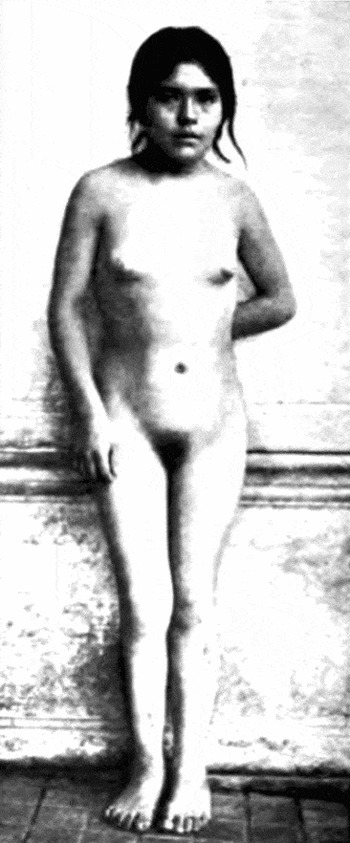
We hear of Damiana again in 1908, when Dr. Robert Lehmann-Nitsche, a German anthropologist at the Museo de la Plata, reminds the readers of the Revista del Museo de la Plata of this sole survivor of an attack by the colonists of the Sandoa Ranch, near Encarnación, “called Damiana, after the saint's day of the massacre” (Lehmann-Nitsche Reference Lehmann-Nitsche1908, 91).Footnote 10 Later in 1898, after being photographed and subjected to anthropological measurements, she was taken to San Vicente, in the Province of Buenos Aires, to live with the mother of the well-known physician Alejandro Korn, director of the Melchor Sanatorium, “as a maid and servant” to the family. She “developed normally,” but on entering puberty, her “sexual libido manifested itself in such an alarming manner that no amount of education and admonishment on the part of the family proved efficacious.” Damiana considered sexual acts “the most natural thing in the world, and she set out to satisfy her desires with the instinctive spontaneity of an innocent being.” She was expelled from the house, and in 1907 Dr. Korn sent her to work as an orderly in his sanatorium in the city of Buenos Aires, awaiting the opportunity to enroll her in a correctional facility (ibid., 92–93). There, with Korn's permission, Lehmann-Nitsche once again took photographs and anthropometric measurements, with a view toward chronicling her development. He was pleased to complete the series, for “two months later the unfortunate Indian died of raging consumption.” The author implies that this type of death was all too common among members of “the little Indian's” race. It is worth noting that despite the evident disapproval of Damiana's sexuality and incontinence expressed by the Korns and Lehmann-Nitsche, in the photograph reproduced here, the latter has had his subject pose nude, as was standard practice in anthropological photos of Indian women.
I treated her twice, finding her reserved, shy, and mistrustful; these characteristics are evident in the curious aspect of her gaze (see our photograph). I was quite startled to hear her speaking German, a language she had learned in San Vicente and spoke quite well, though with a certain amount of slang and pronunciation borrowed from Spanish, which was naturally her primary language. (Ibid., 93)
Though noting his own astonishment at hearing his subject speak German, Lehmann-Nitsche fails to draw any inference concerning their underlying commonality, or concerning her innate intelligence or other gifts. He confines his judgments to the analysis of the anthropometric data taken shortly following her abduction, and to the comparison of her final measurements with those of German girls of the same age. There he notes, with some surprise, “the development of the little Indian's frontal region, her seat of intelligence, was most attractive.” But this could not save her from the consummation of her extinction (ibid.).
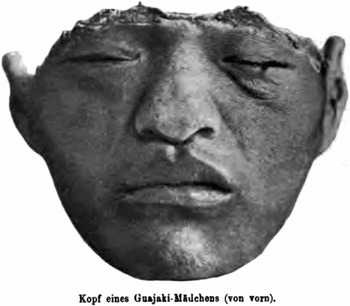
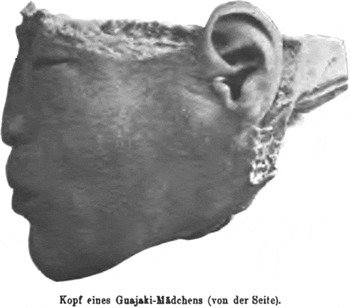
The little Indian's head, with her brain, was sent to Professor Juan [Hans] Virchow of Berlin, for the study of her facial musculature, brain, etc. The cranium was opened in my absence, and the incision placed too low. The preparation of the orbital musculature Professor Virchow had hoped for will thus prove impossible, but the brain has been most admirably preserved. The head was presented to the Berlin Anthropological Society . . . and we may soon expect further publications. (Ibid., 98)
Hans Virchow, son of Rudolf, wrote an article on the subject that consists almost entirely of a series of complaints about the way Damiana's head had been prepared, preserved, and shipped. He was particularly upset by the fact that the soft tissues of the face in which racial features were manifest had been damaged, making this sample less relevant for scientific study. Damiana's life was irrelevant and invisible. The only thing that mattered was the treatment of her remains, her life as a scientific subject after extinction. The world was divided between those who lived and those who were preserved.
We can assume that Virchow's interest in analyzing the head and his complaints about the preservation of the racial characteristics were related to the status that the Guayakis and Damiana had acquired at the time. The works of Charles de La Hitte and the Dutch anthropologist Herman ten Kate, published after the expedition they organized in 1897 with the support of the Museum of La Plata, increased public interest in this group as one of the most ancient human societies still extant. La Hitte had also published in Buenos Aires his early observations in the newspaper La Nación in February of 1895. According to Lehmann-Nitsche, this article interested European scientists to such extent that Karl von den Steinen published the news “about this tribe in Globus (vol. 667, p. 248–249)” (Lehmann-Nitsche Reference Lehmann-Nitsche1899, 399). Charles De La Hitte himself admitted in 1899 that his research with Ten Kate had made the Guayakis “even more known at the other side of the ocean than here [in Argentina]” (Lahitte 1899, 18).
Damiana pictured at the corrsectional facility. Robert Lehmann-Nitsche, “Revelamiento antropológico de una india Guayaquí.” In Revista del Museo de la Plata 15 (Reference Lehmann-Nitsche1908), 93.

Damiana pictured as an extinct subject (front). Hans Virchow, “Der Kopf eines Guajaki-Mädchens.” In Zeitschrift für Ethnologie 40 (Reference Virchow1908), 118.

Articles that emphasized the Guayakis’ unique place in evolutionary history reaffirmed their celebrity status among Europeans. The Geographical Journal, published by the British Royal Geographical Society, reported in 1899 that this indigenous group was “of special interest as living representatives of the Stone age, making use of a stone axe for obtaining honey from trees” (“The Guayakis” 1899, 568). Explorers described them as the original population of South America, unchanged since the beginning of their existence. They were depicted, in fact, as one of the few human societies whose blood was truly pure. The alleged uniqueness of the Guayakis made them particularly relevant as subjects imagined as illustrating the process of extinction. Damiana's head was not the only one to reach Germany. In 1898, the German naturalist Rudolf Endlich sent to the Museum of Leipzig the cranium of another victim killed in a confrontation, a boy around eight years old. La Hitte clearly explains the fascination that Europeans had for this particular indigenous group, based on its presumed status as the last ancient race alive.
[The Guayaki] belongs to the same formation as the Glyptodon, Mylodon and the Macrauchenia, who were contemporary to quaternary man. Their bones can be found in the Pampean soil, and now the chasm between the Guayaki and the modern men is so deep that it cannot be filled: as a separate group within the human family its disappearance is fatal. (Lahitte 1899, 17)
Damiana pictured as an extinct subject (profile). Hans Virchow, “Der Kopf eines Guajaki-Mädchens.” In Zeitschrift für Ethnologie 40 (Reference Virchow1908), 119.

With the full account of Damiana's short life before us, her mistrustfulness of Dr. Lehmann-Nitsche seems perfectly understandable. Civilization could only ascribe value to the bodies of Indians once they were dead. Virchow knew about her as a relic years before her head was sent to him. The article and measurements of De La Hitte and Ten Kate, and the others that followed, made of Damiana an object that verified the process of extinction, to be preserved as evidence of those who could not continue. Similarly, Moreno's profanation of Indian cemeteries was a necessary condition for the preservation in absentia of a group whose continuity was seen as threatening Argentina's evolution. The obsessive study of their skulls, physiognomy, and brains reserved the only place granted to them in civilized society, as museum or laboratory specimens. Photographing Damiana required that she be naked, stripped of all civilized associations, so as to display the essential immutability of the Indians, their primordial immunity to the passage of time, their irreconcilability with the culture of civilization. Thus is the Indians’ otherness embodied in their divergence from, or innate resistance to, the progress of those segments of the population with true evolutionary potential.
The idea of the original Adamic family that founded the nation and ensured its posterity through uninterrupted reproductive continuity became untenable after the introduction of Darwinism. Families became units within which individuals compete and struggle to survive, and their continuity was not so easy to predict. But this uncertainty led to a world that was divided between those destined to continue reproducing, and those who would become extinct. As I have noted, concerns about the mixed population of the country existed well before the advent of Darwinism, but both problems and solutions were articulated without the concept of terminal extinction. Once the notion of soft inheritance was called into question and extinction, atavism, and degeneration became the most feared forces threatening the country's future, the creation of a new race, a new civilized variety, became a political and scientific priority. Depending on which segment of the population was involved in this project, pursuing it could mean either evolution or extinction.
The adoption and adaptation of evolutionary ideas that dealt with extinction was particularly important when it came to the temporality to which they referred. The extinction of the Indians and of people of African descent pointed to the terminality of time for those deemed inferior, a fact that confirmed the continuation of progress. Selection was not possible without loss, but this loss was now experienced as grounds for celebration. Unlike many foundational acts that are based on the affirmation of life and fecundity, the basis of this modern nation depended on death and selective mating. In his account of a trip to Cape Verde in 1905, José Ingenieros, the father of evolutionary psychology in Argentina, expresses this sentiment clearly.Footnote 11
To campaign in support of the inferior races is to be antiscientific. The most we might do is to protect them in such a way as to allow for their gentle extinction, facilitating the provisional adaptation of those few who are capable of it. These discarded bits of human flesh are to be regarded with pity. They should be treated well, at least as well as the centenarian tortoises of the London Zoo, or the trained ostriches of Antwerp. We would not vote with the draconian jury of the poetically named Mississippi town of Magnolia, who recently sentenced Theresa Perkins, a white woman, to ten years of forced labor for the crime of having married a Negro. But it would be absurd to advocate the indefinite preservation of this race, as it would be to favor the crossing of Negroes with Whites. (Ingenieros [Reference Ingenieros1908] 1962, 167)
In 1908 Congress debated a proposal for a census of the Pampas, a region where the Indians had been prominent in the past. The intention was to establish whether there were enough civilized people in the area to warrant the creation of a new province. Representative Escobar, one of the proponents of the project, spoke passionately for the census law, calling it a transcendent moment in “our existence as a constituted nation.” The name “La Pampa” evokes powerful memories of “days of pain, sacrifice and glory.” In this area there once lived “a race of centaurs, a race that has perhaps been annihilated, perhaps disgracefully; the wave of progress has overwhelmed this place, and everything old has disappeared, leaving only a name, ‘La Pampa'“ (Diario de Sesiones 1908, vol. II, 1093). This outcome, described as both joyful and sad, was related to the law of time, natural and unyielding. “And the law of natural, evolutionary time, Mr. President, has decreed that the Pampa be the first national territory to clearly express its living desire, its vehement wish to become a Province” (ibid.).
According to this temporal law, the Pampas had experienced evolution. Natural laws had extinguished the bodies that represented backwardness, and the resulting emptiness was already a sign of evolution and prosperity. Like a lost language spoken only by a parrot, the meaning of the region had been reduced to its name. This mention of evolutionary time in a congressional debate was not unusual. In this same year another project was presented to the representatives, requesting funds for funding the Scientific Congress of Latin America. One representative argues that the only way to address the world's ignorance about Argentina was for the state to promote science, in order to prove that Argentina's people did not live “with hands full of money, but empty heads.” More importantly, while “the old peoples partook in a gradual evolutionary process – for the times were such as to permit slow deliberation, measured action, and the absolute coordination of the weightier elements of intellectual and material transmission,” in present times “the new peoples have suddenly entered the modern stage, full of febrile, multifarious activity, called to competitive feats of mind and labor, in which they most prove their economic mettle and technical competence, earning their rank in the concert of nations” (ibid. vol. I, 692).
The risk of extinction was very important in the consideration of social policy. Individuals who were considered prone to disappearance could be allowed to die without much attention paid to them, but both attention and resources were granted to taking care of those imagined to be involved in the creation of a new national race. The “higienista” movement, ably studied in recent years by Jorge Salessi and Julia Rodríguez, expresses this preoccupation with a threatening future, and the need to both protect the “good” population and let go of the “bad” one, for which the future has no place. The Ministry of Foreign Affairs warned in 1887 about the danger of cholera, whose microbe “lives in the environment that is convenient to it, and does not have a term assigned to the extinction of the [human] species” (Memoria de Relaciones Exteriores 1887, 35). In this volume, talk of extinction does not stop at dangers to humans. Discussing a complaint about the killing of seals by foreign fishermen, a report mentions that “there was a fear about the extinction” of these animals (ibid., 261).
The “higienista'“ program allowed for the creation of public health institutions that worked as “natural selectors” of the country's population. “The program had three goals: cleansing, selecting, and purging” (Rodríguez Reference Rodríguez2006, 179). In 1912 the eugenicist José Angulo defended the mission of a eugenic policy that waged “a merciless war against the degeneration that threatens our future humanity” (quoted in ibid.). The multiply voiced temporality that reflected both presence and loss, optimism and pessimism, and life and death, was particularly concerned, as Payró's example shows, with the conflictive meaning of Darwinism. Evolution required selection and extinction, continuity and discontinuity over time, a duality described in the literature of the time. A short story by Paul Groussac written in the 1890s, for example, refers to this fear of losing selfhood in the process of modernization. In it the protagonist travels to a future, ultramodern Buenos Aires, dominated by technology and a fast pace typical of modern places.Footnote 12 After a while he notices that he has become invisible, and that nobody notices him. Just as the Indians were driven to extinction because they could not be reconciled with a modern country, the protagonist cannot coexist with the reality of a truly civilized city.
. . . nobody was speaking to me, nobody was watching me, nobody saw me! [ . . . ] I want to scream: I can't, paralyzed with emotion . . . What a horrible mystery! I feel I'm losing consciousness of my personality, and I run to a mirror I see before me: I see the reflection of the groups closest to me, but I do not see mine. I draw closer and closer to the polished glass, until no other body fills the space. I see nothing; I have no image; I have no tangible body . . . I do not exist! (Grousssac Reference Groussac1896, 305)
In this literature, the remembrance of loss is connected with the new uses of memory that are part of the Darwinian sensibility. In a world where we are surrounded by loss and presence, we also find memory and forgetfulness working together. We need to remember what it is to become extinct in order to preserve it, but at the same time we need to forget the emotions brought on by the loss of the object in order to be able to continue the process. As Dame Gillian Beer explains in her essay on Darwin's travel writing, the “processes of change required forgetting as well as memory, extinction as well as continuity” (Beer Reference Beer, Fishburn and Ortiz2005, 22).
The nostalgic memoirs that reflect on the past, on origins, are very important among intellectuals of the late nineteenth century. Paradoxically, those who defended evolution and the social policies that went with it opened themselves up to the emotional trauma of those new ideas when writing literature. Carlos Iranguren, born in 1877 and one of the most distinguished young intellectuals of his time, wrote La historia que he vivido, a book of memoirs “populated with vast herds of the former species, all a seeming cross-breed of heroes from Plutarch and El poema del Mio Cid” (quoted in Needell Reference Needell1999, 560). These men were “the men who ‘made’ Argentina,” though in the book they are presented like specimens of an extinct species that could not persist in generations to come.
Conclusion
In 1994 David Raup questioned why the extinction of species “is not normally considered an important element of neodarwinian theory, in contrast to the opposite phenomenon, speciation” (Raup Reference Raup1994, 6758). Although Raup was talking about a time and a set of issues different from those discussed in this essay, it is still relevant to note how Darwinian thought in Argentina recognized that the relationship between evolution and extinction posed a question central to the development of the theory. Argentine intellectuals versed in Darwin's evolutionary thinking talked of evolution as inseparable from extinction, and the latter dominated the scientific and cultural life of Argentina by the end of the nineteenth century. The success in creating a new civilized race, a new species, was measured by the disappearance of those who were considered primitive types.
It is true that the notion that sacrifices were needed in the service of progress was already present in the works of intellectuals such as Domingo F. Sarmiento before the Darwinian revolution. Doris Sommer's analysis of his reading of James Fenimore Cooper shows his painful identification with the Indians, victims of modernization. But, as she puts it, if he cried for those who were uncivilized, it was probably with “tears that felt the profound injustice but also the ‘necessity’ of what had already become a policy of Indian removal or genocide in both the United States and Argentina” (Sommer Reference Sommer1991, 59). Even when he was not blinded by a Romantic sensibility, he felt uneasy about the reconciliation of death and violence with civilization. After the Darwinian revolution, though, there were no tears but a sense of celebration at the elimination of those lineages considered inferior in evolutionary terms. Nature was never unjust, it was simply implacable in its promotion of evolution and speciation.
This change hid a profound transformation in the notion of sacrifice and the meaning of civilization and progress. Extermination was the product of a design that infallibly worked toward progress. It was a necessary sacrifice that was addressed with displeasure and a sense of duty. Despite such necessities, life was ultimately harmonic and final unity awaited in the future. More importantly, those who were gone still were represented as part of the nation's blending. The concept of nation applied symbolically to the union of all the inhabitants of the territory who were culturally civilized. But, as Moreno's letter shows, extinction is about something different. It belongs to a national triumphalism that needed to tout extinction in order to prove evolution. The ugliness of flesh in the process of decomposition speaks to the disintegration of a force that holds the nation captive in time. The possession of these human remains was proof at the same time of the closeness of a common origin, and of the disparateness of the futures of different lineages.
The intellectuals who by the mid-nineteenth century defended a scientific enterprise to modernize the country had no inkling that a revolution was about to occur. Darwin's ideas changed the understanding of human nature and the role of human will. By 1852 the defenders of European ideas in Argentina thought that civilization was a historical force that would ultimately unite the world and all its inhabitants. But the new evolutionism contradicted this idea. In a world of perpetual variation final unity became impossible. More importantly, in returning to a notion of inheritance based on the building of lineages and genealogies the choices of the past could not be easily ignored. Time became a complex category devoid of universality, reflecting the incapacity of some individuals to transcend it. If blending symbolically incorporated the possibility of fusion, selection entailed culling.
As Francisco Moreno clearly perceived, evolution implied waste. If the population was changing it meant that some would be lost along the way, and now this loss was grounds not for shame, but national pride. Though Darwin always emphasized the graduality of evolutionary change, when talking about humans, Argentine intellectuals and scientists inevitably applied the logic of fast-paced modern life. In the case of human beings they expected changes in terms of a single generation, and were obsessed with observing their remains and with classifying their bodies, as a way to verify both continuity and discontinuity. Races mysteriously “disappear,” guided by an invisible process that continuously selects and culls. Human action and reason become incapable of controlling a process that was secretly underway inside the bodies of those who belonged to weaker lineages. Damiana is never presented as a person who died. She is a representation of a group destined to become extinct, a disappearing presence that can only speak as part of a museum or a laboratory.
Extinction meant that unity could only be found in the past, contradicting the Enlightenment ideas that had been dominant among those who took power in 1852. The future was uncertain for those who belonged to suspicious lineages and were classified as lacking the right evolutionary pedigree. Biological inheritance became more important than cultural inheritance, or the creation of the cultural traditions that organized the nation. The logic of natural law revived the racism that had existed before, but now discrimination was deprived of human agency. While before people had been exterminated, now they simply disappeared, yielding before powerful forces that dominated modern, civilized, life.
The exhibition of this waste, of what natural law had made invisible, was an essential part of modern Argentine culture. The Museum was not only a scientific institution. It was also a patriotic one, responsible for displaying the evolution of the country and the genealogy of progress. In a letter written in 1889 to Francisco Seguí, Minister of Government of the province of Buenos Aires, Francisco Moreno explains how the museum he had founded in La Plata was devoted both to scientific research and to the appreciation of the country's history. In anticipation of the 1892 celebration of “Columbus's landing” he proposed an “Argentinean retrospective exhibit,” that would reveal the “complete history of our country from the most remote times to the present” (Moreno [Reference Moreno1889] 1890–1891, 152; emphasis in the original). This would allow visitors to witness both the civilization of those who had persisted, and the remains of those who had perished. Evolution and extinction were, in Moreno's view, constitutive of the nation's modern life, and of the meaning of civilization itself. More importantly, the remains of those who were gone were as clear a sign of progress as the modern life now permeating the country. A respectful celebration of death became for him an affirmation of the nation's future.
To bring this exhibition to fruition would be to unite the oldest city of the Republic (the Buenos Aires of Pedro de Mendoza) with the most modern, commemorating the two extremes of human history in South America over the past four centuries, and unveiling, first, the present and the glorious future; second, the slow, prodigious past. The former would display the elements we need in order to continue onward, and the latter, the remains of those who have disappeared after playing their part in the long struggle for existence, from time immemorial to the present, so as to make us what were are today. The Museo de la Plata will be the basis of this exhibition. . . .
With thought, aided by their remains, we shall resurrect the organisms that acted upon the stages of the past; we shall excavate their tombs, parading before us the sequence of beings as they progress and transform. . . . And we shall witness the appearance and disappearance of those less favored in the unequal struggle we call progress, and proceeding thus from one biological epoch to the next, we shall finally find ourselves facing those like us (nos encontraremos frente a nuestro semejante). (Ibid., 153–154)
Acknowledgments
Alex Levine read several drafts and provided suggestions that were helpful in organizing the argument and the research. Herb Levine's comments were instrumental to revisions of the final version. I am also grateful to the editors and the anonymous reviewers of Science in Context for their careful reading and the time they invested in improving this article. Alexandre Métraux helped me to correct mistakes and to find ways to make my ideas clearer.