Introduction
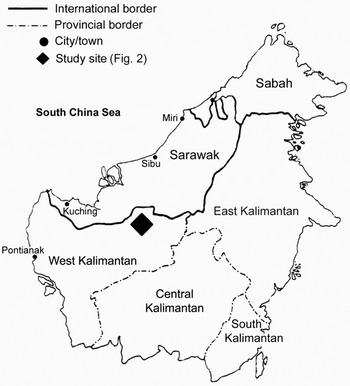
The politically muddled and violent processes of state-making that took place along Indonesia's longest land border (2000 km) on the Island of Borneo in the 1960s–1970s provide a vivid example of the ambiguous relationship between ethnic minorities inhabiting these margins and the central Indonesian state (see Figure 1). This is particularly so with respect to how the state's deep anxiety concerning ethnic minorities’ proneness to communist infiltration created an often strained and violent relationship. The idea of ‘backward’ ethnic minorities being especially prone to communist infiltration and subsequent engagement in subversive acts of insurgency against pro-western governments was a general fear among Western powers and allied states throughout Southeast Asia in the late 1960s and 1970s.Footnote 1 Here borderlands often became key battlefields in preventing the spread of communism and ‘saving’ Southeast Asia from falling into the hands of communist regimes.
West Kalimantan province on the Island of Borneo.

Based on personal interviews, secondary sources and newspaper clippings, the paper aims to illustrate how the immediate border population in West Kalimantan, under great pressure from both sides in the conflicts, was dragged into the conflicts and forced to choose the flexible strategy of betting on both sides, often compromising their loyalty to the Indonesian state. This meant that the degree of national loyalty among the majority of the border population was continually questioned by the central state resulting in severe punishment, violence and forced national indoctrination.
Throughout the highly authoritarian New Order regime of President Suharto (1965–1998), the fight against the perceived communist threat impinging on its national border on the island of Borneo was popularly portrayed as a grand success that induced great national pride. State rhetoric stressed how stern military actions effectively subdued and drove out the Communist insurgents from their hideouts in the hilly and heavily forested borderlands with the support of the ‘patriotic’ borderland populations. While such state rhetoric played an important role in maintaining the idea of the Unitary State of the Republic of Indonesia (NKRI), local narratives tell a rather different and less flattering story of state violence and broken promises of development. These undersides of state-making have created large-scale resentment and suspicion towards the Indonesian state project among the majority of the border population. The grievances of this recent past that remained concealed as part of the New Order regime politics of selective forgetting are now in the post-Suharto climate of reformasi politics coming to the surface.
Marginal histories—a case of the Kapuas Hulu Borderlands
Until recently, studies of border dynamics in Southeast Asia and elsewhere have primarily focused on state narratives, especially how states deal with borders and their unruly populations by inflicting control and exerting power. The major studies in this area have generally been centre-periphery approaches in which the periphery has been portrayed as passive and the relationships between border communities and the centre have been analyzed within the rhetoric of domination.Footnote 2 Modest attention has been given to the local practice and narratives of populations living in close proximity to state borders and how these communities have contributed in shaping the borderland environment. Several ethnographically focused border scholars have recently attempted to redress this one-sidedness by emancipating themselves from state centrist views and focusing on marginal histories.Footnote 3 Matthew Amster, in his studies of the borderlands of Malaysia and Indonesia, has (among others) pointed out the helpfulness of meticulous ethnographic case studies in highlighting localized processes through which mechanisms of state control are articulated, reaffirmed and manipulated.Footnote 4 Taking these studies as the point of departure this paper attempts to relate a little chapter in Indonesian national history, as seen from the margins—histories that for long have been diluted by powerful state discourses of national sovereignty and ideology. The main argument is that the militarization of the Indonesian border post-independence has had profound effects on local identity formation and national consciousness. It argues that somewhat similar experiences can be found among related ethnic minorities along other sections of the Borneo borderFootnote 5 and throughout borderlands in mainland Southeast Asia. For mainland Southeast Asia there are numerous examples like that of the Karen, Kachin and Shan in the Thai-Burma borderlands,Footnote 6 the Akha in the Thai-Burma-China borderlands,Footnote 7 the Hmong in the Vietnam-China borderlandsFootnote 8 and the Brao in the Laos-CambodiaFootnote 9 all ethnic minorities that in various ways have been violently caught up within the politics of state-making on these borders.
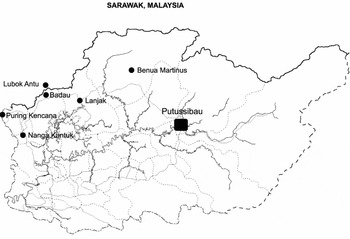
The stretch of border and adjacent borderland that make up the primary scene for this paper is situated in the remote district of Kapuas Hulu in the Indonesian province of West Kalimantan. It lies in the most northern corner of the province more than 700 km from the provincial capital Pontianak (see Figure 2).Footnote 10 To the north, the district shares the international border with Sarawak, Malaysia, while to the east it borders Central and East Kalimantan.Footnote 11 In many ways the borderland resembles the popular image of a frontier, accentuating remoteness, underdevelopment and dense forest landscapes. The hilly-forested areas along this part of the border are predominately occupied by the Iban—the ethnic label describing a widely distributed section of the population in Northwestern Borneo. They make up the largest single ethnic group in the Malaysian state of Sarawak, while across the border in the province of West Kalimantan they constitute a minority. The traditional economic foundation of the Iban communities was and still is based on subsistence agriculture and forestry with its fundamental component being rice farming in hill or swamp swiddens. As cash supplement to rice farming the Iban has for centuries been engaged in cross-border (labour) migration.Footnote 12
Border towns in the Kapuas Hulu district.

During the Dutch colonial rule in West Borneo, unauthorized Iban migration and raiding back and forth the border with British Sarawak was a contentious issue between the two administrations that often lead to violent attempts to subdue these recalcitrant subjects through punitive expeditions and the extension of colonial administrative discipline to the unruly border areas. Reed Wadley, for example, noted the anxiety experienced by colonial rulers concerning the shifting loyalties of their ‘rebellious’ border subjects.Footnote 13 The Iban border population never did become the submissive and ‘taxable’ subjects as envisioned by the colonial administrators. On the contrary, the border population continued their economic, social and political interactions with communities on the other side of the border. Despite Dutch politics of pacification in the mid nineteenth century the Iban communities, to a large degree, post-independence have maintained a certain amount of de-facto autonomy over local matters. Today they still practice traditional longhouse living[1], although in the 1960s and 1970s, during a period of strong military presence, some communities were forced to abandon their longhouses and move into single house dwellings. State authorities largely saw longhouses as primitive and unhygienic fire hazards, and not least because of their supposed communal structure and organization – ideal bases for communist infiltration. Despite the intense pressure, the military was only partially successful as the majority of the communities resisted and kept the longhouse as their prime organizational unit.
The politics of state formation on the West Kalimantan-Sarawak border
Confronted with widespread Indonesian nationalism, the Dutch colonial administration formally withdrew from West Borneo in 1949. The struggle for independence subsequently resulted in the creation of an Indonesian State, and in 1953 the Indonesians took official control of West Kalimantan and created their own government administration. In January 1957, the region received provincial status.Footnote 14 This early period of Indonesian state formation and nationalism went largely unnoticed in the remote borderlands of West Kalimantan, and in Kapuas Hulu in particular, until the early 1960s, when the Malaysian Federation, protected by its former colonial masters, the British, was in the process of being established.Footnote 15 The Malay Peninsula became independent already in 1957 as the Federation of Malaya. Subsequently in 1961, the Malayan Prime Minister suggested an enlargement of the federation to include Singapore, Sarawak, British North Borneo (the current Sabah) and Brunei.Footnote 16 The political turmoil and the spread of communism in the region greatly induced the former British colonizers to maintain their authority in the region by strategically supporting a Malay pro-western federation.Footnote 17 At that time the new Indonesian republic, under the leadership of President Sukarno, reacted strongly towards the creation of a Malaysian nation-state which, from the Indonesian side, was seen as no less than a neo-imperialistic threat to its interests in the region. In its place, Sukarno had a vision of a united Borneo under the administration of Indonesia.Footnote 18 Sukarno believed that the formation of a Malaysian federation was a British attempt to uphold its power base in the region which Sukarno coined the Nekolim (neo-colonialists-imperialists) threat.Footnote 19 In an attempt to undermine the hatchling Malay Federation before it could develop, Sukarno's left-wing government gave its support to a leftist militant group, the North Kalimantan National Army, in the form of training and arms—remnants of a 1962 failed rebellion against the British-protected Sultanate of Brunei and the British Crown Colonies of Sarawak and North Borneo.
The Borneo Bulletin, a Brunei weekly newspaper, published a front-page story on 26 May, 1962 that described how Sarawak tribesmen had seen about 1,000 men trekking through the jungle towards the Indonesian border. According to the newspaper, these men were on the way to Kalimantan to be trained for an Indonesian-led Borneo ‘Liberation Army’, which would return to ‘liberate’ the three states of Brunei, Sarawak and British North Borneo (which became Sabah upon independence through the creation of Malaysia in 1963) from the Sultan and the British colonizers.Footnote 20 On 8 December, 1962, an armed uprising broke out in the British-protected Sultanate of Brunei and in several nearby towns of the British Crown Colonies of Sarawak and North Borneo.Footnote 21 The armed revolt was a result of a long conflict between the Brunei left wing party named Ra'ayat (People's Party) and the government (the Sultan and the British) and was later known as the Brunei Rebellion.Footnote 22 The Ra'ayat opposed the British idea of creating a Malaysian State and wanted instead the federation to cede Sarawak and its eastern neighbour Sabah. The Ra'ayat Party drew their inspiration from Sukarno's Indonesia, and they wanted to unite all Borneo territories and form their own independent state: the North Kalimantan Unitary State (Negara Kesatuan Kalimantan Utara or NKKU).Footnote 23 At the onset of the rebellion the British military command in Singapore quickly dispatched a few thousand troops to fight the rebels in Brunei and the neighbouring Crown Colonies. The troops were a mixture of British Commandos and Ghurkhas.Footnote 24 The uprising was led and organized by a group of hard-core insurgents who had military training from West Kalimantan.Footnote 25 The rebellion was badly planned and the British soldiers defeated the rebels in two weeks. However, one group of rebels escaped and retreated to the border area between Sarawak and Kalimantan where they started guerrilla warfare against Malaysian soldiers and mixed brigades of British, Australian and New Zealand Commonwealth troops.Footnote 26 In 1964, 30,000 British soldiers were employed in this undeclared war, the largest British military operation since World War Two.Footnote 27 The leftist rebel army was called the North Kalimantan National Army (Tentara Nasional Kalimantan Utara, hereafter TNKU).
Under the pretext of supporting the TNKU's armed struggle against the creation of a Malaysian federation, President Sukarno's left-wing government dispatched Indonesian volunteers (Dwikora sukarelawan) to help. The term Dwikora (Dwi Komando Rakyat/People's Twin Commands) became the slogan for this anti-Malaysia campaign, encouraging the engagement of the ‘people’ in the fight. The volunteers were recruited among local Indonesians supportive of the cause, especially among those who leaned towards the Indonesian Communist Party (PKI). The majority of these were ethnic Chinese and Javanese, although Iban and other DayaksFootnote 28 from both sides of the border were also recruited.Footnote 29 On the Malaysian side these volunteers went under the less flattering name of the Indonesian Border Terrorists or IBTs.Footnote 30 A local man from the border town of Lanjak explains how he was recruited to the TNKU in 1963:
In 1960 I went abroad to Sarawak, tapping rubber. Then a few years later the dispute between Indonesia and Malaysia broke out and because I am Indonesian I was detained in Semanggang for one month and repatriated across the border together with 130 other Indonesians. Across the border we were quickly approached by the RPKAD (Resimen Para Komando Angkatan Darat/Army Para-Commando Regiment),Footnote 31 who asked if we wanted to be volunteers of the TNKU. They said now you must register. I kept quiet but those of us who were young and fresh were chosen anyway. . .for three month[s] we were trained by the RPKAD and a Lieutenant from Battalion 642/Tanjungpura in handling weapons and afterwards we marched to Hulu Kantuk with soldiers from Battalion 305 Siliwangi [Sundanese from West Java] from where we went into the jungle and attacked targets on the Malaysian side.Footnote 32
As recollected by another border inhabitant ‘persuaded’ by the Resimen Para Komando Angkatan Darat/Army Para-Commando Regiment (hereafter, RPKAD) to join the TNKU banner as a volunteer:
I told them that I was illiterate. They [the RPKAD] said ‘we don't care whether you are illiterate as long as you can be trained to shoot a weapon and hide from the enemy, this doesn't need high education. The most important thing is that you can shoot’. After being trained in Hulu Kantuk together with Malaysian volunteers [Sarawak Chinese] we went to the border. We were 45 persons, 25 were given weapons, and the other 20 just had grenades. Our first battle was at the Setikung River, here we were attacked by Ghurkhas [Nepalese Commonwealth soldiers] and many of us died, as we didn't know how to engage in [modern] combat.Footnote 33
In reality, the main actors on the Indonesian side of the border in this undeclared war were Indonesian volunteers, members of the TNKU and regular Indonesian military troops. Two companies from the RPKAD Battalion 2 were deployed to West Kalimantan in 1963, one in Nanga Badau and one in Senaning. They were employed in order to stage raids into Sarawak together with the TNKU, but the raids could not be staged as a regular Indonesian military campaign and were therefore disguised behind the TNKU banner. Besides the RPKAD brigades, units from the Marine Commandos (Korps Komando Operasi, KKO) Air Force Paratroops/Fast Mobile Force (Pasukan Gerah Tjepat, PGT) and the para-military Police Mobile Brigade (Brigade Mobil, BRIMOB) from the Indonesian National Police also took an active part in the fighting.Footnote 34
Later in 1963, the Indonesian army units and these volunteers began making incursions across the 857 kilometer-long West Kalimantan—Sarawak border, as part of Sukarno's ‘Crush Malaysia’ (Ganjang Malaysia) campaign. The first incident as recorded in a Malaysian Government White Paper:
12 April 1963. The first series of armed raids in Sarawak took place when a party of some 75 armed men in uniform attacked a Police Station at Tebedu in Sarawak three miles from the Indonesian border. They killed a corporal and wounded two soldiers. The attackers came from and withdrew to Kalimantan (Indonesian Borneo). They spoke an Indonesian form of Malay Language. A belt left behind by one of them had Indonesian army markings and two envelopes dropped by them were addressed to persons in Pontianak in Indonesian Borneo. Indonesians had previously been inquiring into the strength of the security forces in Tebedu.Footnote 35
The incursions developed into what is known as the Indonesian-Malaysian Confrontation or Konfrontasi.Footnote 36 Despite these initial Indonesian efforts to prevent the formation of a new federation, in September 1963 Malaya merged with the Borneo territories and became an independent nation-state, although at this stage it was not formally recognized by Indonesia.Footnote 37
A time of disruption—Nationalist aspiration and state violence
The primary Indonesian tactic during the Confrontation was to carry out small raids into Sarawak, attacking longhouses and terrorizing Iban and other Dayak communities in an attempt to provoke a native rebellion against the new Malaysian Federation. But the tactic largely failed as a result of the nearly complete lack of genuine support among the majority of the border population.Footnote 38
6 June 1963. A group of eight Indonesian terrorists raided a village shop and a longhouse in Ensawang, near Lubok Antu second division of Sarawak. One Iban was killed and one Security forces sergeant was wounded in this incident. The terrorists fled across the border into Indonesian territory.Footnote 39
17 June 1963. A party of 30 border raiders crossed into Sarawak and surrounded a longhouse at Wong Panjoi (near Lubok Antu) but dispersed when a Defence aircraft flew over the area. From subsequent investigations, three of the raiders were recognized as having come from Badau in West Kalimantan, which is a known base for border raiders.Footnote 40
Iban communities on both sides of the border were drawn into the conflict. On the Sarawak side, well-trained Malaysian soldiers assisted by British and New Zealand troops patrolled the border using Iban and other border-dwelling Dayaks as scouts. The Iban were greatly favoured by Commonwealth army patrols and often employed as trackers known as ‘Border Scouts’—a local border vigilante corps or auxiliary force. Their reputation as former headhunters and fierce fighters contributed to their popularity; during the British colonial rule in Sarawak, Iban were often employed as ‘help’ troops for the same reason.Footnote 41 The Commanding Officer of the Commonwealth forces stationed across the border in Lubok Antu, for example, recounts how he employed Kalimantan Iban ‘agents’ in providing intelligence on the location of the Indonesian Army bases in the Nanga Badau area.Footnote 42 During the early 1960s and until 1966 the Malay and Commonwealth troops, with the help of their Border Scouts, carried out numerous ‘hot pursuit’ operations codenamed ‘CLARET’ across the border.Footnote 43 Unofficially they were permitted by high command to venture 2000 yards into Kalimantan in order to counter the TNKU and Indonesian Army cross-border incursions, as long as the operations left no traces and were kept off record.Footnote 44 The Commonwealth countries did not want to be accused of violating Indonesian territory and thus provide more fuel to Sukarno's allegations of ‘imperialist aggression’.Footnote 45
A similar strategy of recruiting locals as scouts was applied by the Indonesian military across the border in Kalimantan.Footnote 46 Despite the fact that most Kalimantan Iban had no particular interest in the conflict, a group of local Iban from the Lanjak area were recruited (by force) as scouts. These scouts did their utmost to prevent clashes between the different border patrols, Indonesian and Malaysian. Former Iban scouts in the town of Lanjak recount how they purposely led the Indonesian military patrols in circles around the Malaysian patrols in order to prevent clashes and thereby prevent being forced to fight Iban kin employed as scouts by the ‘enemy’. One strategy employed by Iban trackers was to use different kinds of signals to warn the oncoming Iban trackers employed by the enemy. For example imitating different animal cries or simply wearing their caps backward as a signal that regular soldiers were following close behind. The Iban, being stuck between the two fighting parties and feeling no special commitment to the fight, tried to protect themselves as best they could by betting on both sides in the conflict.Footnote 47 During interviews senior Iban related how they attempted to appear neutral in the conflict despite their strong kinship bonds with Iban communities in Sarawak. These bonds posed a dilemma as several Iban tribal leaders from the Sarawak border region vocally expressed their anti-communism. For example, in 1963 two ethnic Iban leaders were appointed to strategic positions in Sarawak politics: Stephen Kalong Ningkam as Chief Minister of Sarawak,Footnote 48 and Tun Jugah Anak Barieng as Federal Minister of Sarawak Affairs. Both these men were strong anti-communists who actively resisted Sukarno's Confrontation. Tun Jugah, in his role as the Paramount Chief of the Iban in Sarawak, in particular, was greatly respected in Kalimantan where he had close kinship relations—although it was a wise strategy not openly to announce such admiration of one's famous Sarawak kin during this early stage of pro-communist border militarization.
Senior border inhabitants describe the years of Confrontation as a period of restrictions. The tense situation and militarization along the border made contact with relatives over the border difficult and dangerous. For many generations, crossing the border to visit family and to work or trade had been largely unhindered, and now suddenly the border was patrolled by military on both sides; consequently the border was officially ‘closed’ for several years. But with help from relatives across the border, locals continued their cross-border business throughout the Confrontation, although at considerable risk of being caught in the line of fire. Furthermore, several families took the radical decision to permanently immigrate and join their Sarawak kin, without permission from the Indonesian government. Almost all Iban longhouses visited during fieldwork had families who had immigrated to Sarawak during the time of Confrontation or during the later military anti-communist period. A senior Iban, originally from the Lanjak area but now a Malaysian citizen, conveyed during a visit to Kalimantan how, after immigrating to Sarawak, he was employed by British soldiers to fight the Indonesian army and later awarded an honorary military insignia by the Malaysian state for his courage in the fighting. Ironically before immigrating, the same person had been employed as a scout by the Indonesian forces.Footnote 49 Likewise, Iban fighting for the Indonesian army received similar honorary insignia and documents. For example, in one longhouse community four men had been given medals of bravery (pala berani) by the local army Commandant but despite such recognition of their national loyalty they have all since immigrated and settled in Sarawak.
Communities situated in close proximity to the border were particularly vulnerable to the fighting. As recounted by Brigadier Robert Gurr, the Commanding Officer of a company from the New Zealand Commonwealth forces stationed across the border in the Lubok Antu area (2nd Division of Sarawak):
Those who lived in proximity to the border were sandwiched between hostile forces. Mistaking the identity of groups of Dayaks was always a problem, particular those who ran the gauntlet of border crossing. . .Footnote 50
Several longhouses in the Badau and Lanjak area were hit by mortar fire from the Commonwealth forces while the Indonesia Army forcefully repositioned entire longhouse communities further away from the border. Senior inhabitants in the area tell how the heavy British bombing of the Indonesian soldier encampments in the hills along the border prevented local people from going to the forest and harvesting their hill rice, leading to a scarcity of food and subsequent hunger.Footnote 51 The military further employed many locals as forced labourers in carrying supplies of rice and ammunition from camp to camp along the hilly front line. Such incidents hardened local sentiments against military and government. As recounted by two senior Iban:
Soldiers patrolled the border and as Indonesian citizens we had to help our forces to carry the soldiers rice, their bullets and other supplies. We suffered deeply, we couldn't go to our rice fields, couldn't make gardens, couldn't do anything.Footnote 52
Day and night the British bombs hit our fields at Perayung hillsFootnote 53 trying to hit the [Indonesian] army dugouts in the hills, almost 300 bombs were dropped in this area, which made it impossible to clear the land for making fields.Footnote 54
What characterized these years of Confrontation was an unrelenting atmosphere of insecurity as combatants from each side of the border continuously carried out armed raiding back and forth across the forested boundary line with local communities caught in the middle. While the relationship between the Indonesian military and local borderlanders often were strained and violent the Commonwealth troops on the opposite side of the border developed a more benign approach to win the ‘Hearts and Minds’ of every border community, by supplying food provisions and medical services.Footnote 55
Operation ‘Destruction’
These low-impact cross-border incursions lasted until 1965, when General (later President) Suharto came into power after crushing a so-called failed ‘coup attempt’ by leftist troops from Sukarno's presidential guard.Footnote 56 The new right-wing Suharto regime quickly established peaceful relations with Sarawak. An official ceasefire was agreed upon in early 1966, which a year later culminated in the signing of the 1967 Basic Agreement between Malaysia and the Republic of Indonesia that formally recognized the border between the two nations. A memorandum of understanding was signed in August 1966 in Jakarta and a joint boundary committee was formed with members from both sides whose main purpose was to define the exact borderline between the two countries. Two other meetings were held in 1972 (Kuala Lumpur) and again in 1973 (Jakarta) to plan joint survey operations. However, the work of making an exact demarcation has still not been completed today (2011).Footnote 57
The anti-communist New Order regime of Suharto quickly established a firm military presence in West Kalimantan, including the remote borderlands of Kapuas Hulu. Shortly after Suharto's takeover of power, all Indonesian military support towards the TNKU was withdrawn. As stated by a former TNKU veteran now living in Lanjak:
The Malaysian soldiers sent us a letter saying, ‘we are not looking for war but peace’. So we went to the border in the Kedang area for a meeting with the Malaysians. Afterwards all the volunteers were called to Semitau [Kapuas Hulu district] by the Indonesian army and in 1965 all volunteers were dismissed. Those who still felt strong went straight into the [Indonesian] army as regular soldiers while others joined the groups fighting the Sarawak government. The rest of us were given a letter of passage and could return home.Footnote 58
After President Suharto came into power and the subsequent peacemaking with Malaysia, an alteration of Indonesian politics took place resulting in the launching of an anti-communist campaign, the banning of the Indonesian Communist Party (which led to large massacres in Bali and Java) and an uprooting of so-called ‘communist insurgents’ now taking refuge along the border.Footnote 59 Subsequently, from the mid 1960s until well into the 1970s, guerrilla warfare took place in the West Kalimantan borderland between communist guerrillas (former allies of Sukarno's war against Malaysia) and the Indonesian army. This was part of a larger coordinated military campaign against the ‘communist insurgents’ launched by the Indonesian and Malaysian security forces. In a 1968 state of address to the nation president Suharto pronounced the urgent need to crush these bands of ‘armed gangs’, remnants of the Indonesian Communist Party and supported by the People's Republic of China, that threatened the unity of the nation.Footnote 60 Besides being a national symbol, state sovereignty and power, the Kalimantan borderland became a crucial locale for the New Order regime to demonstrate its anti-communist sentiments and strong military powers.
The Indonesian army initiated a series of so-called ‘counter-insurgency’ operationsFootnote 61 along the border known by the overall name of ‘Operation Clean Sweep’ (Operasi Sapu Bersih).Footnote 62 To begin with, military operations were mostly concentrated in the lower district of the province with its large ethnic Chinese population; it was first in the late 1960s and early 1970s that military focus shifted towards the more remote and rugged inland border areas like that inhabited by the Iban.Footnote 63 The inland district of Kapuas Hulu (together with the districts of Sanggau and Sinang) was labelled the ‘Eastern Sector’ by the military command.Footnote 64 As part of the ‘Clean Sweep’ campaign, in 1968 the military embarked on ‘Operation Destruction’ (Operasi Penghantjuran) in the Eastern Sector whose purpose was, as the name implies, a total annihilation of insurgent activities in the borderland; the part of the sector inhabited by the Iban was given special attention—as the local population was seen as especially prone to communist infiltration.Footnote 65 In 1968 the Indonesian military commander in West Kalimantan, Brigadier General Witono, claimed that the military was on top of the communist problem and as many as 5,600 regular Indonesian troops were engaging the insurgents in the province.Footnote 66
Development through National indoctrination
The Indonesian New Order government saw indigenous minorities, especially borderland communities like the Iban, as a possible conduit for the infiltration of foreign ideologies such as communism into the country. Consequently the military operations were carried out on two fronts. Besides direct military action against insurgents, attempts were also made to win over the minds of the local Iban population and make them into compliant and loyal citizens. The Iban's long-term orientation towards Sarawak, both economically and socially, their low level of education and lack of ‘proper’ religion were of particular military concern.
As indicated in a historical account of the Regional Military Command in PontianakFootnote 67 the military were well aware of the strong kinship bonds between the Iban in Kalimantan and Sarawak and their ongoing socioeconomic interaction.Footnote 68 This interaction was partly a consequence of historical processes and shared ethnicity but also as a result of the low degree of development on especially the Indonesian side of the border. The military accounts emphasize how compared to Sarawak the Iban in Kalimantan were still relatively backward (terbelakang), both materially and intellectually. As stated in the military account:
Iban awareness of political engagement are[2] not yet developed (belum madju), the necessities of daily life are more primary for them, they therefore easily fall under the influence of the Chinese communists and they are highly prone to the agitation and manipulation of their [the communists] politics.Footnote 69
According to the military, one consequence of the above mentioned circumstances was that the majority of Iban communities generally took an uncooperative stance towards Indonesian military operations in the area.Footnote 70 The Indonesian military was aware of the possibility of communist infiltration among the border Iban, as coordination meetings in September 1969 with Sarawak's Special Branch (security police)—now allies of the Indonesian Army—conveyed information that many Sarawak Iban had already been influenced by communist propaganda.Footnote 71 The KODAM XXI military accounts stated that the main objective behind the Maoist/communist warfare strategy was to infiltrate the common people. As in Sarawak, so in Kalimantan: the Iban and Chinese communities had a long tradition of socializing, trade and intermarriage; consequently, the Iban were particularly prone to communist infiltration and not to be underestimated.Footnote 72 Ethnic Chinese communities in West Kalimantan were by and large labelled as communists and seen as a potential security treat. Not being able to achieve the status of Indonesian National Citizens (WNI, Warga Negara Indonesia) they were seen as foreigners (WNA, Warga Negara Asing) and were especially vulnerable to military harassment and forced expulsion.Footnote 73 Many ethnic Chinese (civilians) were living along the border in towns like Nanga Badau and Lanjak, and the Indonesian Army was supposedly afraid that these communities would support the insurgents with supplies, and other services. In order to prevent these communities from siding and interacting with the Communists, in 1970 the Army relocated approximately 70,000 ethnic Chinese, removing them from the border districts of Sanggau, Sintang, and Kapuas Hulu.Footnote 74 In other parts of the province (especially the lower Sambas and Bengkayang border districts), the military directly encouraged local Dayaks to engage in violent expulsions of Chinese farmers and expropriation of their land and property, leading to large massacres. Davidson and Kammen note how the ‘Dayaks’ were encouraged by the Indonesian military authorities to engage in violence and headhunting.Footnote 75 While such violence was felt to be justified as a necessary step to curb the spread of communism, the immediate motive behind the violence were struggles over access to land and resources.Footnote 76 Such violent outbreaks against ethnic Chinese did not take place in the borderland inhabited by the Iban.
Although much military effort was put into countering the Chinese influence by relocating Chinese communities, other less militaristic attempts were carried out in order to shift the loyalty of the Iban border communities and to win over their minds and souls. In 1971 Brigadier General Soemadi, a leading military general from the provincial Military Command stationed in the border area, emphasized that communist infiltration among the border communities could not be solved without taking immediate action to develop the area. According to local statements Brigadier General Soemadi often expressed sympathy for the difficult situation of the local population. His long presence in the border area further resulted in various tight knit relationships with the local Iban. As a peculiar twist to the story, the local Iban claim that Soemadi, while stationed in the border area, married an Iban from Merakai Panjai (now Puring Kencana). In a 1971 interview with the national Tempo Magazine, Soemadi stated that the border area was very underdeveloped, the local farming techniques were still that of swidden agriculture, and people's health condition and education were very weak. Furthermore, the problem of cross-border shared ethnicity—‘shared blood’—made it extremely difficult to control the movement of these populations and access their exact nationality, as many had been born across the border in Malaysia.Footnote 77 In order to solve the problem of development (problema pembangunan) and lack of national consciousness the military introduced different initiatives to help increase the standard of living.Footnote 78 In 1974, a team from the National Development Planning Agency (BAPPENAS) visited the West Kalimantan border region in order to assess future development initiatives along the border. They found six areas in special need of development projects, two of which were Nanga Badau and Nanga Kantuk in the Iban inhabited part of the borderland.Footnote 79 According to Governor (Colonel) Kadarusno, approximately 24 billion Rupiah was to be used on border development over the next five years.Footnote 80 As stated by Peluso and Harwell, such development programmes were a well integrated strategy in military counter-insurgency tactics.Footnote 81
In the Lanjak area, the military invested much energy in developing areas for irrigated rice fields or wet rice cultivation as an alternative to swidden cultivation in the hills, which was perceived as destructive and primitive.Footnote 82 Furthermore, by encouraging the growing of irrigated rice in the valleys, the military hoped that Iban communities would move away from the hilly areas closer to the border and thereby out of reach of the insurgents. This only partly succeeded and most communities remained in the hills. Davidson and Kammen, for example, describe how the Indonesian government invested large sums in similar projects throughout the province as part of what was known as the ‘Road and Rice’ campaign.Footnote 83 Only a few Iban embraced this new possibility as it meant leaving their customary land, over which they had user rights, and moving to areas already occupied by other Iban and Dayak communities.Footnote 84 In the 1920s, the Dutch colonial administration had used a similar tactic and constructed irrigated rice fields in the plains, meaning that the communities who were forcibly moved at that time already claimed most land suitable for this kind of cultivation. Furthermore, the land converted by the military was generally not suited to extensive wet rice cultivation, and the yield quickly went down to below what was produced through swidden farming.
The military were convinced that in order to direct Iban sentiments towards their own nation, programmes of social education in loyal and appropriate behaviour were needed in addition to development projects.Footnote 85 Such social education programmes included everything from learning catchwords, symbols, and acronyms associated with the nation to courses in health promotion and appropriate lifestyle (discouraging longhouse living, for example). The Regional Military Command states that: ‘Their [the Iban's] national attitude is indeed very low, you could even say it is not there at all’.Footnote 86 In an attempt to heighten national loyalties and promote the state ideology the military began constructing schools and initiating mass education.Footnote 87 Several hundred soldiers were posted as teachers along the border. Recalcitrant Dayaks like the Iban who were classified as particularly ‘difficult’ subjects (klasifikasi berat) were forced to endure ‘mental education’ in order for them to choose the ‘right’ side and oppose the enemy.Footnote 88 The Iban were, among other things, schooled in the national ideology of Pancasila,Footnote 89 the purpose of which was to guide them to correct action, action that would lead them to a unified understanding of the nation-state.Footnote 90 Under the threat of being labelled unpatriotic the Iban were persuaded to proclaim their allegiance to the Indonesian state ideology. As recollected by a senior Iban:
I was still young and there were no real schools in the area at the time. I remember how the officers from the military camp across the river came to the longhouse everyday in the evening when people returned from their fields. They brought books and we all had to listen so we could become good citizens. I did not learn to speak Indonesian before the soldiers arrived.Footnote 91
The first principle in the national ideology states the importance of religion, or more specifically, the belief in one God (monotheism) and as an Indonesian citizen you are required to be a member of one of the five state approved religions (Islam, Catholicism, Protestantism, Hinduism or Buddhism). As stated by Brigadier General Hartono: ‘I don't care what religion they have, the main point is that they have a religion’.Footnote 92
This posed another problem for the Iban. Especially the more conservative Iban living in the hills along the border who had resisted adopting the preaching of the early Christian missionaries and, unlike other Dayak groups, they had felt no need to convert. In 1908, Dutch Capuchin missionaries set up missions in the Iban-dominated town of Lanjak at the border. These missions were expected to have a ‘civilizing’ (beschaving) influence on the Iban, lifting them up to more humanly standing.Footnote 93 The missions were temporarily closed in 1915 and later completely abandoned in the 1920s as the Iban refused to convert and the missionaries consequently abandoned the mission.Footnote 94 As mentioned by the Capuchin, Pater Ignatius: ‘The Iban were not yet mature for schooling’—they had not yet reached an advanced stage of mental or emotional development.Footnote 95 At the onset of militarization the majority of Iban still retained their traditional beliefs and were consequently portrayed by state authorities as lacking religion. This was of special concern for the military, as it was believed that the Iban, like other conservative Dayaks lacking in religion, would be especially susceptible to the teaching of the godless communist insurgents and therefore more at risk of infiltration. In order to avoid military accusations of communist collaboration, many Iban felt forced, at least formally, to convert to either Protestantism or Catholicism. For example, in Lanjak the military supported the erection of churches and carried out missionary work. Battalion 308 stationed in the area at the time played a particularly important role. Battalion 308 consisted primarily of Protestant Christians from the Batak region in North Sumatra. Such military involvement in civil matters was later, in the 1980s, formalized as the government introduced an official programme of direct military development intervention called ADRI Masuk Desa (hereafter AMD, or ‘ABRI [military] enters the village’). In the border area the AMD programmes involved military personnel engaging in civic action projects such as teaching, and developing rice-schemes. Although development was the official rhetoric behind the AMD programmes in the borderland, it was foremost an attempt to prevent the local communities becoming influenced by foreign ideologies.
Despite considerable efforts by the military to win over the minds (and souls) of the recalcitrant border communities, the grounding of national sentiments was never a large success within Iban communities, and Iban relations to the Indonesian state remained ambiguous. This was partly due to military brutality and the long-term Iban history of self-autonomy and cross-border relations.Footnote 96
The North Kalimantan Peoples’ Army (Pasukan Rayakat Kalimantan Utara) (PARAKU)—subversive insurgents or liberation army?
During both Confrontation and the subsequent communist uprooting carried out by the Indonesian military, the majority of border communities avoided direct involvement in the conflicts. However, a group of locals (mostly Iban) were drawn into the conflict between the Indonesian Armed Forces (ABRI) and the predominately communist left-wing rebels. The rebels active in the Kapuas Hulu borderland were known as the North Kalimantan Peoples’ Army (Pasukan Rayakat Kalimantan Utara) (hereafter PARAKU).Footnote 97 The PARAKU consisted of a mix of former TNKU rebels, Sarawak Chinese communists and a small number of Iban and other Dayaks.Footnote 98 A large majority of the PARAKU were Sarawak Chinese, many from the Sarawak Communist Organization (SCO), which had supported the TNKU since the Confrontation in the early 1960s. Several local Iban interviewed in Lanjak further recount how a small group of Sarawak Iban actively joined the PARAKU ranks. One Iban man in particular, Ubong from the Rejang area in Sarawak, was described as a main figure and deputy commander of the PARAKU rebels in the Kapuas Hulu area.Footnote 99 He supposedly brought both his wife and children with him across the border. Ubong's jungle skills and bravery quickly made him a local legend in the borderland. Moving like a shadow in the forest, killing many Indonesian soldiers without being shot or captured himself, he was believed to hold supernatural powers.
The main goal of the PARAKU was, like the former TNKU, to liberate Sarawak from the Malaysian state. Consequently, fighting was primarily oriented towards Sarawak, but the military co-operation between Indonesia and Malaysia and the heavy engagement of the Indonesian Army in the border area meant that the PARAKU was forced to fight them as well.Footnote 100 Many of these PARAKU rebels, originally volunteers during the previous period of Confrontation, were trained and armed in the early 1960s by the Indonesian Special Forces, RPKAD, in camps along the border. The PARAKU therefore found it suitable to establish guerrilla base camps in the rugged and heavy forested Kalimantan borderland, from where they could launch attacks into Sarawak. The Malaysian Government's anxiety concerning the so-called expanding ‘communist threat’ in Sarawak is most evident in a Government White Paper published in 1972.Footnote 101 The White Paper quotes a document of the Sarawak Communist Organisation dated December 1967 that supposedly details its plan for armed struggle.
In view of the disadvantageous political situation in Indonesia, our Organization quickly withdrew our comrades to the border area in two batches; one retreated to the West and the other to the East. . .. By going to the border area we will be able to set up bases with excellent topographical conditions and launch a long term guerrilla war, gradually penetrate into the country with the border area as the stepping stone and then surround the cities from the rural areas, occupy the whole country and final[3] take over the power of Government.Footnote 102
In an interview with a former RPKAD captain named Untung Suroso, Conboy describes how three RPKAD military trainers in the early 1960s were parachuted into the border village of ‘Nanga Badan’ (misspelling of Nanga Badau) in West Kalimantan. These three soldiers supposedly trained 300 locals in guerrilla warfare. This group of volunteers was later divided into two groups led by two army lieutenants named Kentot Harseno and Mulyono Soerjowardojo.Footnote 103 As recounted by an Iban in Lanjak:
In 1962 I was still in school but I remember I saw them [TNKU] practice together with the RPKAD Special Forces. In Lanjak there were three military posts and three barracks and the Chinese from Sarawak and the volunteers were given weapons and food by the Indonesian government. I remember the TNKU commander during that time his name was General Peng. He was from RCC (Republic Rakyat Cina) Peoples Republic of China, he wore a broad hat with Peng written on it and there was a red picture of Mao.Footnote 104 He was a smart person on every August the 17th [Indonesian Independent Day] he held a ceremony and gave a speech of encouragement to his people. General Peng was fluent in Indonesian, English and Iban.Footnote 105
During military training, socializing between the volunteers and the Iban inevitably occurred and at that time the army actively encouraged Iban communities to provide supplies of rice and meat and logistic support in the form of longboats to transport the volunteers and their supplies upriver to the ‘front’ along the border. As an elderly Iban informant in Lanjak put it:
Old allies suddenly became enemies when the communists were forced into the jungle in 1965 and returned as the PARAKU a few years later. The PARAKU were well trained, because those who trained them were Indonesian Special Forces [the RPKAD]. But after being trained they separated, friends became enemies (kawan jadi lawan).Footnote 106
The sudden change in Indonesian politics from being pro-communist under Sokarno to anti-communist under Suharto deeply confused many Iban communities and they became increasingly unsure about who was friend and who was foe. Another peculiar twist adding to this confusion erupted in 1969 when Brigadier General Witono put forward allegations that some segments within the West Kalimantan Army Command supposedly supported the PARAKU. In the subsequent period several Army officers were arrested.Footnote 107
Shifting loyalties—a pragmatic strategy
The Iban were often caught in the struggle between the two conflicting parties and forced to choose to be loyal towards one party, which led to violent repercussions from the other. Some Iban men developed friendships with PARAKU rebels (several of whom were Iban) who came to their villages asking for supplies, which were often provided in return for helping out in the rice swiddens. If detected by the Indonesian army, such interaction with the ‘enemy’ was severely punished. Meanwhile, other Iban men were employed to track down the very same insurgents as scouts for Indonesian army patrols and as intelligence-gatherers at the village level. Local narratives describe the shifting relationships with both the ABRI and the PARAKU in the borderland during the 1970s. The Iban were not particularly interested in getting involved in a conflict that most thought was not their problem, and they therefore developed an arbitrary relationship with the two fighting parties. A senior border resident speaks of how Chinese communists often visited his longhouse, asking for food. Not having any grudges against these people, who often spoke Iban very well, the Iban often granted their wishes. During military operations against the PARAKU carried out by the Malaysian Forces, various documents were attained, such as communist publications in Iban language, Iban dictionaries and notebooks, that indicated that the PARAKU were actively trying to learn Iban,Footnote 108 As illustrated in extracts from captured letters:
Regarding what we need, please get me some Mao badges, Mao's Quotations, Mao stamps and so on. We also need Iban books, an Iban dictionary, a Chinese dictionary, the various new and old laws and ordinances of the puppet regime, materials concerning the history, geography and people of North Kalimantan, and shotgun cartridges. . ..Footnote 109
The communists entered into different kinds of relationships with the Iban, such as trading medicine and buying domesticated pigs and chickens from the longhouse inhabitants: Footnote 110
If the PARAKU came to the village [longhouse], we would give them food, because we are human beings, aren't we. If we gave food the government suspected us (dicurigai) of being communist collaborators but it wasn't our intention to be disloyal to the government. We felt squeezed (terjepitlah) in between the two [Military and PARAKU].Footnote 111
In many instances, the insurgents enjoyed a much closer relationship with the local population than did the Indonesian military, the latter relationship was more troubled because the military often forced locals to perform unpaid labour. An article from a 1971 issue of Tempo Magazine describes how the PARAKU operations in the border area were made possible through the PARAKU's extensive knowledge of the border area, its population, language and customs.Footnote 112
On the other hand local narratives also tell about young Iban men earning a salary by helping the Indonesian military track down these same insurgents—in the Lanjak area several army units used Iban ‘scouts,’ such as Battalion 323 Galuh, 324 Siluman Merah, 327 Brajawijaya and 642 Kapuas.Footnote 113 One example was that of an Iban man from the Lanjak area who worked as an intelligence-gatherer under the cover of ngayap, an Iban term for young men engaged in finding a wife. Such courtship pursuits often involve the bachelor visiting many different communities—a good cover for gathering intelligence. Adding to the ambiguousness of this case, two local men who, during Confrontation, were hired by the military to become TNKU volunteers were later employed by the same military command to track down the PARAKU (several of whom were former TNKU). One group of local scouts mostly consisting of former (local Iban and others) TNKU volunteers was stationed in Lanjak and assisting military so-called ‘counter insurgency’ efforts against the PARAKU:
The Javanese soldiers who came to the border couldn't find their way in the forest where the PARAKU were operating. They didn't know anything. We were always brought as guides to show the way although many didn't want to help the soldiers. My company was named ‘White Bear’ (Bruang Putih) and when we guided the soldiers they never met the PARAKU, but when the soldiers went alone they often clashed. The soldiers were confused and asked why is it that when we go by ourselves we meet them (the PARAKU) by chance, but if you join us we never meet. Maybe you have some kind of magic the soldiers said.Footnote 114
This is a well-known secret, before, the people who are now called PARAKU, used to be together with us (the former TNKU) but then we got separated in 1965–1966. After they left us and went to the jungle they sent us a letter saying ‘my friends we leave you all because Sarawak is now part of an independent Malaysia but we will stay in the jungle and keep fighting, and if you are our friends join the soldiers but do not shoot at us. We won't bother you either, this is our promise’. They kept their promise, we never got shot, although the soldiers walking behind us sometimes got fired upon from the jungle. When we arrived at a PARAKU camp they had just left and we only saw their wet footprints on the stones. The PARAKU knew the jungle; they had already been here for a long time.Footnote 115
Local and central government have later recognized such cases of Iban involvement as acts of loyalty towards the Indonesian State.Footnote 116 War veterans further received official certificates signed by President Suharto and were promised a lifelong war pension.
After the insurgency we were acknowledged as war veterans members (anggota veteran), but never received our pension. Several times we went to the Kodim's office [District Military Command] but we never got an answer. Some of us even went to Pontianak and Jakarta but to no use. We got very disappointed, as no one seemed to respect those of us who went to war to defend the country (membala Negara). We were not even given one cent in reward.Footnote 117
The flexible attitude towards the two fighting parties was not without certain risk. If cooperation with the communists was detected by the military, it could have serious repercussions for the Iban communities. There are several examples of the military bombing longhouses as punishment for such arbitrary loyalties.Footnote 118 Afraid of military punishment, many families and even entire longhouse communities moved to Sarawak. For example, in 1968, 13 families of one longhouse situated along the upper parts of the Leboyan River along the border moved, overnight, to Sarawak leaving everything behind, even their treasured heirlooms such as old brass gongs. Rice was still on the plates, pigs and chicken still roaming under the house. They followed the river until they reached Sarawak and never returned to get their belongings. As stated by an Iban informant: ‘They cannot return permanently because they are now [citizens] under another flag’.Footnote 119
In the town of Lanjak there were several cases of the Iban being tortured or executed for their alleged co-operation with insurgents.Footnote 120 Many stories of military brutality against civilians still flourish in the borderland, some more substantiated than others. Two episodes that were verified by all interviewees are the accounts of Rantai and Ranau. These accounts in many ways stress the difficult situation that especially the Iban leaders were confronted with in their ambiguous position of being caught between the military and the insurgents.Footnote 121 In 1966, a group of heavily armed PARAKU rebels ambushed an Indonesian army patrol in the vicinity of Lanjak, the patrol was totally taken by surprise and several soldiers were instantly killed, while only one rebel was hit before the PARAKU again withdrew into the forest. One Iban man named Rantai was subsequently arrested and accused of being involved in the attack by supplying the PARAKU with intelligence. Rantai was taken back to Lanjak and executed by being hung up in a tree in a rattan cage. The cage was afterwards shot full of holes and left on display.
Another example is Ranau the headman of an Iban longhouse in the vicinity of Lanjak. Since the early encampments of the PARAKU in the borderland, before the strong military presence, Ranau had engaged in a working relationship with the PARAKU. They helped him in the rice field sowing and harvesting and did other kinds of manual labour in exchange for food and shelter in field huts. This relationship evolved into friendship, and Ranau became blood brothers (bekempit darah) with two PARAKU rebels operating in the area, which according to Iban customary law means that you are mutually responsible for each other's safety and you are friends until death. As the military presence grew stronger in the early 1970s, rumours of Ranua's relationship with the PARAKU went from mouth to mouth and finally reached the ears of the Indonesian military commander and Ranau was consequently arrested. He was tortured in public by being submerged in a small river running through Lanjak for hours and beaten by soldier's rifles. The commander of the military company stationed in Lanjak supposedly announced in public that: ‘If he [Ranau] can catch the PARAKU, behead them and bring their heads he will be free to go, if not he will go to jail until he dies’.Footnote 122 Ranau supposedly felt there was no other way out than to follow this command; along with two other Iban men armed with military rifles he went to the forest and after a week he returned with the heads of two PARAKU rebels working under the command of General Peng (mentioned earlier). The two PARAKU rebels were not killed by the hands of Ranau but by his two followers, although he was the one who gave the order. Ranau was later appointed to the rank of local war commander and received a pension by the military for his deeds.Footnote 123
This incident created great internal condemnation, as breaking a blood bond is a great sin and was and still is among the greatest Iban taboos. As stated by several senior inhabitants of Lanjak: ‘He [Ranau] has a bad soul. It is not neutral’.Footnote 124 During the times of headhunting pre-independence, fear of losing one's head was constant amongst the Iban; one way of solving this uncertainty was to make sacred pacts with other (hostile) groups. The pact was made binding when the leader of each group attended a blood ceremony and became each other's adopted brother. Ultimately this meant that the groups were obliged not to engage in hostilities against each other.Footnote 125
These difficult years are locally referred to as the time of disruption or disturbance (musin kacau).Footnote 126 For example, in 1970 the ABRI initiated a massive military campaign in the Kapuas Hulu border area by having the Air Force bomb supposed Communist strongholds in the hills and dropping platoons of paratroopers to hunt down the PARAKU.Footnote 127 Besides using Iban scouts, the military created so-called ‘people's resistance’ units, Wanra (Perlawanan Rakyat),Footnote 128 whose main purpose was to form a local border defence. These groups were subject to military codes and laws.Footnote 129 They mostly accompanied the soldiers and acted as forced porters on the weeklong operations in the forest; often they were only armed with spears and traditional swords and were forced to walk in front of the soldiers as shields against enemy fire. According to several informants some Wanra unit members were equipped with rifles and ammunition given by the military and further received special food rations, although the majority had to do with homemade shotguns, swords and spears. The military supposedly were hesitant to arm the Iban because of their shifting loyalty. According to former Wanra members interviewed in Lanjak and Badau each person was given a certificate in the 1970s by the Military allowing them a salary of Rupiah 3,500 and 25 kilo of rice every month.
Each village had its own Wanra unit that was expected to guard the village and keep it free of enemy incursions and communist teaching.Footnote 130 According to locals there was a strict agreement with the military that if any regular soldiers were killed whilst stationed in the village area, the village head would be held solely responsible and executed. The function of the Wanra units on the Indonesian side of the border was in many ways similar to that of the Sarawak Border Scouts originally created by the Commonwealth troops. The Border Scouts was an auxiliary semi-military unit of local volunteers (Dayaks) from the immediate border area. The unit's main purpose was to protect the local community and provide intelligence to the military.Footnote 131 Unlike the Wanra units the Border Scouts became an effective tool in fighting the PARAKU. One reason for this was that they were volunteers, well armed and highly respected by the regular military, while the Wanra units were based on coercion and intimidation. Generally the border population in Kalimantan had a much more strained relationship with their military than their Sarawak neighbours had with theirs.
During the time of Confrontation, this period of militarization of the borderland also severely affected local lives. Everyday routines were disrupted, transportation was dangerous and limited and basic essentials were difficult to obtain. In an attempt to seal the supply lines of the insurgents the military heavily increased its surveillance and restrictions on border trading which had a ‘dislocating effect on the border economy’.Footnote 132 A five-mile wide ‘Free Zone’ was established on both sides of the border and only persons with special military approval could trade within this zone.Footnote 133 The Iban, being extremely dependent on cross-border trade (especially now as the remote borderland was empty of basic goods), were severely affected:
In the 1970s every time we wanted to visit communities in other areas in the district or bring produce back and forth across the border we had to pass military posts. We were not free to move around, we were anxious, our backpacks were checked. There were many restrictions for example we were only allowed to carry 5 kilos of rice, 1 kilo of sugar, and 5 matches. If we had more than that we were accused of supporting the PARAKU. For example no batteries were allowed. If we were caught carrying one battery the fine was one year in jail. Sometimes we were forced to leave everything to the soldiers. If the soldiers wanted to eat chicken they took your chicken they were free to do want[4] they wanted. If people resisted they got beaten. This created a feeling of hatred among communities towards the soldiers. . .. Many people began to smuggle goods like sugar and batteries over the border but if detected they were directly accused of feeding the PARAKU.Footnote 134
Despite the heavy militarization along the border the Iban maintained a certain degree of autonomy in some local matters and did not hesitate to assert their interest and authority, even in potentially dangerous situations. For example, at the end of the military uprooting of the PARAKU along the border the Iban were ordered to hand in their shotguns and rifles. More or less every Iban family in the borderland is in possession of one or two shotguns, predominantly used for hunting. Many of these guns are homemade and shells are smuggled from across the border where they can be purchased at a low price. The Iban rejected this military demand outright and, led by their tribal chiefs, a group of several hundred men in full ritual regalia descended on army headquarters. They said that they would only hand in their shotguns if the military promised to post soldiers in their swidden fields to protect them against marauding forest pigs and monkeys. The military command consequently decided not to carry out the confiscation of guns in fear of stirring local sentiments resulting in violent confrontations. Until today the borderland dominated by the Iban are the only places in the district, and perhaps the entire province, where citizens are ‘allowed’ to keep their shotguns at home and not registered at the local police station.Footnote 135
Such incidents of Iban-military confrontations convinced some factions of the military that the Iban issue was to be handled with care in order not to trigger a major local uprising that would only be of advantage to the PARAKU.Footnote 136 The Head of the Subdistrict Military Command (Koramil) in Lanjak conveyed the delicate situation of the time in the following way:
One day my superior, a military Captain named Pak Suma, ordered me to arrest a group of local Iban who allegedly were helping the PARAKU. The Captain had a list of 60 people from many different longhouses. These people were selected based on statements from two PARAKU insurgents captured in Lubok Antu. But I was not convinced that the information was valid enough and told the Captain that I was afraid to suspect and beat up the wrong people, because then later we would have to fight the whole community. If one Iban gets hit it could raise a war between the Iban and the soldiers, because the Iban think differently, if one gets hurt they will unite and take revenge. I suggested that it was better if we used the strategy of indoctrination first, and the use of force second, by explaining the PARAKU problem to the communities.Footnote 137
The Head of the Koramil later married an Iban woman from Lanjak and settled in the area. Several (Javanese and others) soldiers stationed in the area settled in the border area after the counter insurgency. Some became civil servants, others entrepreneurs and storekeepers but all became incorporated into the local society.
Alliance making on the border
Although a majority of the Iban kept their distance towards both fighting parties, not all Iban took such an arbitrary stance and vigorously joined the Indonesian military anti-PARAKU campaign. Several expressed their anti-communist sentiments by directly volunteering in the fighting on the side of the military and still today proudly reminisce about their involvement in the heavy jungle warfare.
Although their shifting relationships with the fighting parties meant that Iban loyalty was often questioned by the Indonesian authorities, a small handful of loyal Iban—especially those who managed to obtain good military connections—were appointed to the military rank of Panglima Perang (often translated as commander, but with connotations of honour and power), a position created especially for the situation. These officers represented local communities in their dealings with the military. They received a small salary from the government and in return were expected to uphold security and solve conflict situations.Footnote 138 Each subdistrict had its own Panglima, who in turn appointed his own ‘intelligence assistants’ to keep him up to date with developments in his area. Wearing official military uniforms the Iban officers were given their new titles of Panglima Perang and certificates signed by Suharto on 17 August 1970 during a public ceremony of Indonesian Independence Day. As conveyed by a Panglima:
Every time a new military Commander was stationed in the border area we were forced to take a pledge or customary oath (perjanijan adat) saying; ‘We as the people of Indonesia, do not help the PARAKU, but Indonesia’. This was said while stabbing a pig, as is the customary way of the Iban.Footnote 139
In order to impinge a sense of national loyalty on local leaders a chosen few of these Iban Panglima Perang were also taken to Jakarta where they were given medals of honour for good service in fighting the rebels and given an audience with the President.Footnote 140 Besides using the Panglima, the Indonesian army also took advantage of the system of tribal chiefs (Temenggong) originally invented by the Dutch decades earlier. Like the Dutch, the Indonesian army appointed certain loyal, anti-communist Iban as Temenggongs who could support the Panglima in keeping communists at bay. Since the 1960s, when the Indonesian government firmly began to establish its authority in the borderland, a local government council named MUSPIKA (Musyawarah Pimpinan Kecamatan) consisting of the subdistrict head, police and local military command has usually appointed the Temenggong, although local communities were still allowed to nominate candidates.Footnote 141 Several of the Iban Panglima Perang ‘adopted’ young military officers as their ‘foster sons’ (anak angkatnya). For example, one Iban Panglima made the young military officer, Mohamad Basofi Sudirman (who later in the 1990s became Governor of East Java), his adopted son, whilst another Iban Panglima adopted a young man named Kentot Harseno. Harseno arrived in West Kalimantan in the early 1960s where he became commander of a platoon in Battalion 602. In the 1970s he joined the Army Para Commando Regiment, RPKAD. Harseno was one of the two young army lieutenants mentioned previously who was parachuted into the border town of Nanga Badau in the early 1960s in order to train locals in guerrilla warfare. The fate of the other lieutenant Mulyono was quite different. He was in 1965, post-Sukarno, executed by the military accused of being a prominent sympathizer of the Indonesian Communist Party and was implicated in the so-called communist coup against former President Sukarno.Footnote 142 After serving in the borderland and other places Harseno became President Suharto's military adjutant (1978–1981), Commander of the Jakarta military garrison and later in the 1990s Inspector General of Development. Besides these two extremely well-connected ‘adoptive sons’ several other prominent figures were involved in the anti-PARAKU operations in the borderland such as Colonel Soemadi (Governor of West Kalimantan from 1967–1972),Footnote 143 Aspar Aswin (Governor of West Kalimantan from 1993–2003) and Yogie S. Memet (former governor of West Java from 1985–1993 and Minister of Interior from 1993–1998) as well as several others. Although the majority of the border population had a strained relationship with the military a small local elite, through their active involvement in the fighting, managed to establish powerful alliances with high ranking military officers that later were used strategically in extracting favours and gaining access to various resources.Footnote 144 For example, in the early 1990s two Panglima Perang and a local Iban member of the district assembly for the Golkar party went to Jakarta to rally for support for the development of a border road. Using their military contacts they managed to get an unofficial audience with General Mahmud Subarkah and eight other military persons in the Dharma Putera Hotel in Kebon Sirih, Jakarta. The general was a member of the People's Consultative Assembly and one of Suharto's advisers at the time. The Iban district assembly member claimed that he knew Mahmud Subarkah previously when the general was stationed in Putussibau the district capital. According to the Iban representatives the General's reply to their inquiry about road development was the following: ‘Don't be disappointed my brother, but there is no use for a road in the border area. It is too sparsely inhabited; there are more monkeys than people’. The Iban answer was: ‘So, General, how do we make people's living better than that of monkeys’.Footnote 145 Despite such harsh comments the General supposedly promised to send more development funds to the border area.
The militarization of the borderland has continued until recently and there are still unfounded rumours circulating about communists hiding deep in the forest. It is difficult to pinpoint the exact year the PARAKU left the border area, as the records differ considerably. In October 1973 in the town of Simanggang one of the PARAKU leaders, Bong Kee Chok, officially signed the so-called ‘Sri Aman declaration’,Footnote 146 a memorandum of understanding and peace agreement with the Sarawak government. The PARAKU were subsequently given amnesty. But factions within the PARAKU saw this surrender as a mistake and restored their bases in West Kalimantan a few years later. Moreover, after withdrawing from Kalimantan, the PARAKU continued their guerrilla warfare in Sarawak until another peace agreement in 1990.Footnote 147
Officially the Indonesian government declared that their anti-PARAKU efforts ended in the early 1970s by a total annihilation of the PARAKU rebels.Footnote 148 However, according to Fujio Hara and locals interviewed in the borderland the PARAKU were present in the upper part of the border area until at least the mid 1980s.Footnote 149 For example, Davidson and Kammen mention how in 1982 an ethnic Chinese man was arrested in the Lanjak area and accused of being involved with the PARAKU.Footnote 150 This incident, mentioned by Davidson and Kammen, fits well with local accounts that tell how, in the early 1980s, an ethnic Chinese PARAKU rebel named Pecin surrendered to a local Panglima Perang in Lanjak. Lumenta further mentions how several PARAKU rebels surrendered to the Iban in the upper part of the Embaloh River as late as 1986.Footnote 151 Local Iban who worked for the military further tell how the Indonesian Army in 1982 gave orders to hang flyers/letters on rocks and trees in the forest telling the PARAKU to surrender. According to an Iban informant the PARAKU at one time did reply by leaving a letter. The letter supposedly conveyed that the PARAKU still had more than 200 men in the area dispersed in 82 camps along the border. On the Sarawak side of the border Porrit describes how smaller groups of communists kept up the armed struggle until a final peace agreement with the Malaysian government in October 1990 ended the communist insurgency on Borneo.Footnote 152
Concluding remarks
Drawing on recent border studies that in various ways attempt to centre the marginal histories of the Southeast Asian borderlands, this paper has touched upon a little known though crucial chapter of Indonesian national history. Based on local narratives and military documents it has provided a detailed account of how the Indonesian state in the early 1960s and 1970s attempted to establish authority over people and territory along its national borders through strict military control and national indoctrination.
While the West Kalimantan borderland was largely left alone as an autonomous entity in the first decade after independence, nationalist aspirations towards neighbouring Malaysia swiftly turned the borderland into a combat zone of intense militarization and politics. The paper has demonstrated how local border communities in the remote border district of Kapuas Hulu were caught between the various conflicting parties and their ambiguous engagement with these, which either led to eminent rewards or brutal punishment. Here the pragmatic practice of betting on two horses at the same time in order to deal with often conflicting outside demands was a rational strategy applied among the ethnic communities in the borderlands. These initial Indonesian attempts to (violently) impose a sense of national consciousness among their border citizens resulted in paradoxical outcomes. The attempt to mould loyal citizens and disseminate the message of nationalism was only partially successful. While a small segment of the borderland population vividly expressed their strong nationalist loyalty by voluntarily joining the fighting and in return gaining some rewards, the nationalist indoctrination largely failed among the majority of the border population. This majority never developed a sense of belonging to a common Indonesian nation-state project, primarily because of military violence and lack of immediate genuine rewards. Ironically, and despite government intentions to the opposite, the borderlanders instead amplified their orientation towards neighbouring Sarawak, Malaysia, both economically and socially.Footnote 153 As declared by a disillusioned Iban war-veteran during a 2007 visit, ‘We fought during the communist era to defend the new republic. Many people suffered and died. But now we are left behind, forgotten just like that’.Footnote 154 The long-term militarization of the borderland and a general exclusion from national development during the early stages of Indonesian state formation quickly destroyed any growing ‘patriotic’ feelings among the borderlanders and is today locally understood as a prime indicator of the Indonesian state's indifference towards its marginal citizens. Moreover, the borderland and the often illicit practices carried out there continue to give rise to national emotions of condemnation and public pledges for tougher action against these rule-bending border people with their frequently shifting national loyalties—condemnations that only lead to further alienation of the borderlanders from the central scheme of things. Importantly, the ambiguous and strained relationships between central state authorities and border communities increasingly experienced in West Kalimantan today, through even more outspoken claims of increased self-autonomy,Footnote 155 were partly formed by the political transformations and border militarization during the early period of state formation.
By confronting inherent assumptions of a strong and united state lying dormant within Indonesian national history, local counter-narratives often provide alternative histories. In this case borderland narratives provide a great insight into how national borders have been constructed in tandem between central state actors and borderlanders and not least how Cold War politics played out in the margins of Southeast Asia. The borderland, situated on the territorial line between nations is an exciting study arena that can tell us important things about how marginal citizens relate to their nation-state and in particular how alliances, with their competing and multiple loyalties, are managed on a daily basis. However, because of the suspicion with which the state has often viewed the border communities and because of the marginal status of these communities as border dwellers, there is a paradoxical shifting allegiance to the state, which appears to be accentuated by the dual character of borders. As implied by many scholars on Southeast Asian borderlands, local border communities are often part of exceptionally complex and intertwined relationships with ethnic groups and states on both sides of the borders where they reside. Living in a borderland between different nation-states seems to confront the local population with a sense of duality as they often are simultaneous pulled in two directions: that of their own nation and that of the neighbouring nation across the border.