INTRODUCTION
Aidablennius sphynx (Valenciennes, 1836) is an endemic species of the Mediterranean Sea that lives on rocky shores from 0–1.5 m depth, with distribution extending to the northern Atlantic coast of Morocco (Zander, Reference Zander, Whitehead, Bauchot, Hureau, Nielsen and Tortonese1986; Illich & Kotrschal, Reference Illich and Kotrschal1990). It feeds on plant material and small invertebrates such as amphipods and polychaetes. Spawning season is from April to June. Males defend their territories while erecting the dorsal fin and lifting the head in rapid movements. Several females may lay egg masses in a tiny hole and a single male guards them until hatching (Golani et al., Reference Golani, Öztürk and Başusta2006). Herein we present the first record of the hen-like blenny Aidablennius sphynx caught from shallow water of the Syrian coast.
MATERIALS AND METHODS
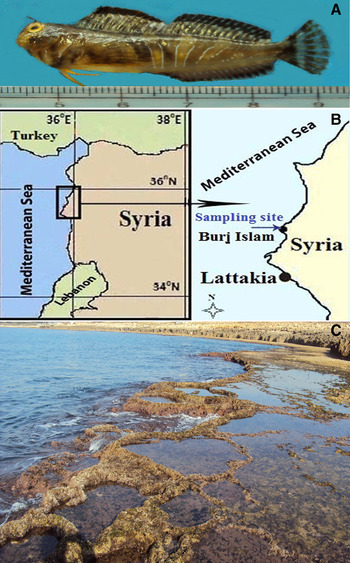
Monthly fish samples were collected by hand nets during the period 2012–2013 to study fish diversity changes related to fish invasion (Hallom, unpublished data). Samples were taken at morning times, at a depth of 0.5–2 m, from rocky terraces of the Syria coast, Lattakia (N35°39′6.86″ E35°46′37.58″) (Figure 1). The captured fish were identified according to Whitehead et al. (Reference Whitehead, Bauchot, Hureau, Nilson and Tortonese1986). Ten random specimens were weighed (to the nearest gram), and the basic morphometric measurements (to the nearest mm) and meristic counts were taken (Golani et al., Reference Golani, Öztürk and Başusta2006). These specimens were preserved in 4% formaldehyde and placed at the biodiversity museum of the High Institute of Marine Research, Tishreen University (Lattakia, Syria). The remaining specimens were returned to the sea.
Aidablennius sphinx: (a) caught from Syrian coast; (b) above vermetid terraces (c) in September.

RESULTS
During the sampling course, 21 individuals of the hen-like blenny Aidablennius sphynx were only captured during September 2012 and September 2013 (1 and 20 individuals, respectively). Shallow water temperature in the capture site ranged from 18.5°C to 26.4°C and water salinity ranged from 37.9 to 42.5 g/l. Many vermetid terraces are located in the capture site.
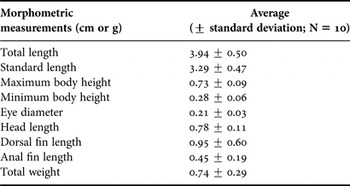
The morphometric measurements are shown in Table 1. Standard lengths ranged between 3.20 and 4.60 cm (average = 3.9), and weights ranged between 0.36 and 1.14 g (average = 0.66).
Morphometric measurements carried out on 10 individuals of Aidablennius sphynx captured from Syrian marine waters.

The meristic data were: D, XII + 16; P, 14; V, I + 4; A, II + 18 which confirm what is known about this species (Whitehead et al., Reference Whitehead, Bauchot, Hureau, Nilson and Tortonese1986; Golani et al., Reference Golani, Öztürk and Başusta2006). The distinctive characteristics are: the pelvic fin is located in front of the pectoral fin base; scaleless body; anterior (spinal) dorsal fin higher than posterior part, a single unbranched filament above each eye; and blue spot edged by red ring behind the eye (Orlando-Bonaca et al., Reference Orlando-Bonaca and Lipej2010).
The Aidablennius sphinx was caught in combination with many other fish species related to various families, they are: Diplodus sargus sargus (Sparidae); Siganus rivulatus (Siganidae); Liza aurata (Mugilidae); Thalassoma pavo (Labridae); Epinephelus haifensis (Serranidae); Clinitrachus argenteus (Clinidae); and Symphodus tinca (Labridae).
DISCUSSION
Aidablennius sphynx has never been recorded in Syrian waters before. Galiya (Reference Galiya2000) recorded only 6 species on the Lattakia coast, and another checklist showed 13 species in Syrian waters (Saad, Reference Saad2005). This is the only species from the genus Aidablennius recorded in Syrian waters, totalling the Blenniidae species to 14.
Despite the monthly sampling programme which lasted 2 complete years and covered 3 sampling stations of the Syrian coast, specimens of A. sphynx were only found in one station (Burj Islam) and only during September. The presence of this species at such a location and occasion is believed to be related to the distinctive algal growth at the Burj Islam site and to the higher water temperature during September.
Taking into account that this species is already recorded in other areas of the eastern Mediterranean, the absence of this species from the previous Syrian fish checklists is believed to be a result of the difficulty in catching the individuals due to their complex habitat and to the uncommercial value of the species. Anyway, further confirmation by genetic methods is needed to verify the origin (and rout) of the Syrian A. sphynx population.
ACKNOWLEDGEMENTS
The authors thank Tishreen University and the High Institute of Marine Research, Lattakia who provided the financial and logistic supports to this work.