

In November 1960, the New York Times reported on the looming revolution in Northeastern Brazil, describing how Marxist social movement leaders were organizing peasants. Reporter Tad Szulc claimed that “singers and violeiros—the traveling troubadors of the Northeast who act as human newspapers”—were spreading leader Francisco Julião's manifestos to the largely illiterate rural population and its “miserable, drought-plagued hamlets.” The human newspapers allegedly sung about agrarian reform as a form of liberation, comparing the process of revolution in Brazil with that of Cuba. Szulc wrote:
[The] nomad singers who once sang of the loves and the hatreds of the proud people here, now sing of land reform and of political themes. There is this refrain: The sugar that we sell to capitalist America/ If it serves to sweeten the milk of a Franco Spain/ For sure it will serve for the wine of the Socialist world./ What harm is there in a ship/ Carrying our common Brazilian coffee/ And selling it to a China/ Where there is no Chiang Kai-shek?
Although the poem suffers from a clumsy translation, it is most interesting that the New York Times quoted literatura de cordel (chapbook poetry) to demonstrate the severity of the communist threat in Northeastern Brazil, suggesting that violeiros were Marxist agents indoctrinating the rural poor with their anti-American songs. Szulc's portrayal contrasts with commonly held assumptions about literatura de cordel as “quaint” regional folklore, and violeiros as blind poets who performed silly stories in marginalized rural communities. In the late nineteenth century and much of the twentieth, literatura de cordel was a source of both entertainment and news for the largely illiterate rural population in the Northeast.Footnote 1 It is a textual genre often performed or improvised by singers (repentistas, cantadores, or violeiros), which has led scholars to define it as folk-popular culture since it is both a written and oral expression of the people.Footnote 2
This study focuses on analyzing literatura de cordel as a historical source for recovering the debates and discussions about the Cold War in rural Northeastern Brazil. Literatura de cordel provides a rare glimpse into rural Northeasterners’ perspectives during the Cold War on issues such as communism versus capitalism, modernity, agrarian reform, religion, and masculinity. This study attempts to evaluate the Cold War in Latin America from “within,” as Gil Joseph implores it should be done, examining local narratives that demonstrate the diversity of voices and complicate the overly simplified Cold War paradigm: capitalism versus communism.Footnote 3
Although a number of recent studies examine cultural production and social movements during the Cold War in Brazil, most tend to focus on the urban middle classes of Rio de Janeiro and São Paulo, analyzing student movements and the work of avant-garde artists such as Victoria Langland (Speaking of Flowers), Claudia Calirman's Brazilian Art under Dictatorship, and Christopher Dunn's Contracultura. Footnote 4 Such studies explore distinct forms of resistance during the dictatorship, often focusing on 1968 when the hard-liners took power and instituted repressive policies and practices.Footnote 5 Such studies propose to historicize the military dictatorship in Brazil (1964-85), but the Northeast remains glaringly absent from such accounts. Nonetheless, the Northeast played a central role in national and international politics during the Cold War.
The military legitimized its coup with the claim it had to restore order in the Northeast and quell the threat the rural social movements posed to the nation. Thus, in contrast to the urban Southeast, the Northeast felt the effect of the 1964 coup immediately, with arrests of state officials, the seizure of rural social movement leaders who were then tortured and disappeared, and the legitimization by large landowners and the military of violence against rural men and women. Such experiences reveal that the dictatorship was repressive from the onset, even though middle-class urban groups may not have recognized its brutality until 1968. This study reveals the discussions circulating throughout the rural Northeast prior to the coup and evidence of the repression in the Northeast afterward.
In the 1950s and 1960s, rural social movements such as Julião's Ligas Camponesas (Peasant Leagues) expanded rapidly throughout the region, pushing for agrarian reforms, rural labor rights, and voting enfranchisement for illiterates. Surprised by the sudden popularity of the movement, mainstream Brazilian and US media, government reports, and scholarly studies often explained the Ligas’ power by claiming that leftist social movement leaders and politicians had brainwashed Nordestino peasants. For example, US Vice Consul Edward Walters described Julião and the Ligas as “taking advantage of the ignorance and misery of the rural worker to foment rebellious movements.”Footnote 6 Similarly, a 1961 report by Brazil's secret police, the Department of Political and Social Order (DOPS), described the Ligas Camponesas: “Because of their [Nordestinos'] lack of education and social assistance, they are easily attracted to communism, becoming fanatics to an extent that terrifies the landowners.”Footnote 7 According to such accounts, rural men and women supposedly marched in protest and occupied lands only because of the charismatic social movement leader's mesmerizing tune as he led them down the dangerous path towards communism.
After the 1964 coup, perceptions of the rural population as brainwashed victims allowed the military and large landowners to target social movement leaders and repress rural workers while keeping most of them working in the fields. In the 1980s, scholars attempted to challenge the argument that the rural social movements were top-down by examining social movement organizational structures and politics. However, most of these studies could not recapture peasant voices. While literatura de cordel is not in itself a direct popular voice, the political ideas and representations in the poems circulated widely throughout the rural Northeast in the 1950s and 1960s. An analysis of literatura de cordel offers an avenue for reconstructing what many rural Nordestinos heard before and after the 1964 coup.
Since the 1970s, scholars have debated whether literatura de cordel can be defined as popular culture, or as an authentic expression of the people (povo).Footnote 8 Rural elites often hired poets to write poems, and many of the poets were not themselves members of the working class or peasants. Instead of defining a strict division between dominant/elite/erudite culture and subaltern/popular/folk culture, Latin American scholars have more recently chosen to use the idea of a “national” culture. In such studies, contestations over power between social classes are visible in the cultural realm. The state incorporates elements of popular culture as national culture and people redefine national identity through continuous cultural production and consumption. Stuart Hall argues that popular culture cannot be considered “authentic” or stable; instead, popular culture is the “ground on which transformations are worked, . . . an arena of consent and resistance.”Footnote 9 In recognizing literatura de cordel as the dialectic space where both containment and resistance occur, the issue of the poet's relative cultural position becomes less important. The political messages and struggles in the popular pamphlet poems illustrate how Northeasterners interpreted their world, fighting against the dominant culture while also being influenced by it.
Literatura de cordel can be a challenging source for a historian. Older pamphlets often lack basic information such as a publication date, an author or publisher name, and a place of location, and the quantity printed and distributed. This study draws upon archival literatura de cordel collections in the Folklife Reading Room at the US Library of Congress and the Castelo Branco Pernambuco State Library in Recife. I have also located poems published in non-mainstream newspapers produced by rural social movements such as the Ligas Camponesas and anthologies such as the anthology published in 1964 by the Fundação Casa Rui Barbosa in Rio de Janeiro. I examined over 200 poems to understand the debates circulating in the rural Northeast during the Cold War.
To address the limited publication information, I composed a database linking information I could find in secondary sources about authors and publishers with clues about dates in the stories. I also matched archival acquisition records to scholarly studies completed in the early 1970s and used anthologies to determine which poems were published before certain dates. In addition, I used the logic of the collections themselves, noticing that literatura de cordel collected at the same time had been placed together in boxes. To analyze the narratives, I draw from a much broader body of research I conducted on rural social movements in Northeastern Brazil during the Cold War, including DOPS files, mainstream and alternative media, Brazilian and US government documents, films and cultural critiques, and oral histories. The article examines in turn poems produced before the 1964 coup and the narratives of those produced during the coup and under dictatorship, offering reasons that cordel production changed during the dictatorship.
A Poem in the Hand
Literatura de cordel is published in folhetos (pamphlets) that consist of eight, 16, 32, or 64 pages that are printed on both sides of large sheets of newsprint paper, folded in multiples of four, and usually sold uncut. Generally, a folheto has a single illustration on the front cover, often a woodcut print. The poems are usually structured in six-line rhythmic stanzas with clever wordplay that hints at their strength as oral performance. Some poems tell about faraway lands with kings and princesses, while others are more journalistic, telling of natural disasters or well-known events and famous people. Two of the most common themes have been the travails of the cangaceiros, Lampião and Antônio Silvino and other bandits of the Northeastern backlands, and stories about the Northeastern folk saint, Padre Cícero. Poets would travel to local markets to sell their stories. People who could not read, hearing a story, might buy it to have it read later by friends or relatives who were literate.
Literatura de cordel has often been compared to the corridos of Spanish-speaking Latin America in terms of how it relates to the construction of regional identities.Footnote 10 Cordel is closely associated with Northeastern Brazil—o Nordeste—a region defined by historical narratives of inequality and poverty, violence and messianism, sugar production and exploitive labor relations, hunger and drought, and survival and resistance. The dominant national culture portrays Nordestinos as the impoverished, backward Other in the Brazilian nation, differentiated by a distinctive regional accent and customs and traditions often depicted as “folk” culture.Footnote 11 As an intended and unintended symbol of o Nordeste, literatura de cordel often contains spelling and grammar errors. Poets use regional expressions, and printed copies are often of poor quality. Within the nation, such characteristics have defined the folhetos as folk culture, thereby silencing the material conditions and social inequalities underlying the printed words. A number of recent studies have denounced the trope of o Nordeste by emphasizing its imagined discursive construction and showing how inequalities and discrimination are manifested in regional identity.Footnote 12 This article questions both the designation of Nordestinos as the impoverished, backward Other and literatura de cordel as quaint. Instead, I show how literatura de cordel was a political medium that people from the Northeast used to debate Cold War politics.
The Cold War in Northeastern Brazil
In the 1950s and 1960s, the rural poor in Northeastern Brazil composed one-third of Brazil's total population and lived in a highly inequitable society. Average per capita income in the Northeast was only 51 percent of the national average.Footnote 13 The unequal distribution of land, resources, and services such as education and health facilities meant that the majority of Northeasterners did not own land, were illiterate and malnourished, and died at an early age.Footnote 14 In the national view, the majority of Northeasterners were not even considered citizens, since only literate people had the right to vote. Large landowners used hired guns, or capangas, to threaten rural workers with physical violence. Even with high rates of malnutrition, the production of foodstuffs did not have a priority among landowners. Most of the arable land was taken for the export crop of sugar cane, a crop that had been grown in the Northeast for hundreds of years.
In the late 1950s and early 1960s, the rise of the Ligas Camponesas in the rural Northeast captured international attention. The movement tore through the impoverished region, in response to an initial legal victory in 1959 that awarded rural workers expropriated land in Pernambuco. In the context of the Cold War, the Ligas were soon being compared to the 26th of July Movement in Cuba. Such a comparison raised national and international concerns about the plight of rural workers in the Northeast, leading to an increase in the availability of funding and resources for development projects. From the mid 1950s to mid 1960s, discourses of modernization and development policies and projects opened the political landscape in Northeastern Brazil, challenging the land-owning elite's traditional power. In 1959, the Brazilian government inaugurated the Superintendency for the Development of the Northeast (SUDENE), a development agency for the Northeast. Two years later, John F. Kennedy made the Northeast a primary target of the Alliance for Progress, supplying the region with economic and technical assistance and establishing what was at the time the largest office of the US Agency for International Development (AID) in the world, in Recife.Footnote 15 The Ligas were joined by other rural social movements led by the Catholic Church and the Brazilian Communist Party, which competed with one another in some instances and collaborated in others.
As Cuban-US relations deteriorated, fears of the spread of communism in Latin America strengthened opposition to the rural social movements in the Northeast. Many of the region's social movements and state government officials were identified as Communist infiltrators or supporters of Fidel Castro. The perceived threat of communism fueled the persistent notions of the Northeast as backward, barbaric, and fanatical, impeding national legislation that proposed moderate agrarian reforms and the extension of federal labor laws to rural workers. On March 31, 1964, the Brazilian armed forces deposed President João Goulart, Pernambuco governor Miguel Arraes, and other democratically elected officials. Because armed resistance by rural social movements was expected in the Northeast, the armed forces used violence to seize governmental offices and buildings and arrest social movement leaders and participants considered subversive, particularly those involved with the Communist Party's rural unions and the Ligas Camponesas.Footnote 16 Although some individuals attempted to confront the military, the rural social movements did not take up arms. Following the coup, Brazilian general Marshal Humberto de Alencar Castelo Branco was appointed by the congress to serve out Goulart's term as president (1964-67). The coup ushered in a 21-year military dictatorship (1964-1985) that effectively silenced the Northeast's rural social movements.
Popular Poetry as a Political Tool
As a social movement, the Ligas Camponesas gained momentum following a 1959 Pernambuco state court decision in favor of rural workers that mandated the expropriation of the Engenho Galiléia. In the very first reports about Galiléia, journalists identified the Sociedade Agrícola de Plantadores e Pecuária de Pernambuco (the Agricultural and Cattle-Breeding Society of Pernambuco) with the Ligas Camponesas to suggest their purportedly communist inspiration.Footnote 17 By 1960, thousands of rural workers in the Northeast had joined the Ligas to strike against the latifúndios (large rural estates) and fight for agrarian reform and rural workers’ rights. At the same time, large landowners started their own organizations to oppose the rural social movements.Footnote 18 Conflicts between rural workers and landowners intensified in 1963 and early 1964 with increased conflict over land, suppression of protests, and death threats, assassinations, and other types of armed violence aimed at mobilized rural workers.
Examples from literatura de cordel illustrate the discursive strategies used by rural leaders to mobilize support for agrarian reform. Ligas Camponesas leader Francisco Julião claimed he had three tools for organizing the rural social movement: literatura de cordel, the law, and the Bible.Footnote 19 Julião devoted an entire chapter to literatura de cordel in a 1962 publication on the Ligas. He saw it at the heart of the Brazilian nation:
For those who have never listened in the moonlit nights of the Northeast, where the land is dry and man's soul remains bathed by its poetry, to guitar music, poets and singers, those who have not been able to saturate themselves with the energy that emanates from the guitar and the voice of these poets, they cannot understand that it is here, in this region, that the roots of Brazilian nationalism are found rooted firmly in the ground for now and always.Footnote 20
According to Julião, even though popular poetry was not explicitly political, it told the stories of struggle. As he wrote, it was “the weak against the strong, the poor against the rich, the peasant against the large landowner. At the fairs, they sing the news of the poor worker who killed the patrão, . . . because he deflowered the worker's beloved fiancée.Footnote 21
Along with tales of the outlaw life and exploits of the cangaceiros, such stories nourished the “dream of liberty” for the rural population.Footnote 22 The poets, singers, and publishers were a vital component of these rural struggles because they could spread news about the Ligas to areas where large landowners threatened political activists.Footnote 23 The Ligas published their own folhetos, and they also published poems in LIGA, the organization's weekly newspaper, to gain support for agrarian reform and rural workers’ rights.
Two folhetos intended to circulate among the rural population were the ABC do camponês (ABCs of Peasant Life)and the Carta de alforria do camponês (Peasant's Manumission Letter). Francisco Julião published the former in 1958 as a cordel, but not in lyric format. In the cordel, Julião defined the meaning of rural unions, agrarian reform, and the right to vote.Footnote 24 Julião ended the folheto with a rousing call to action: “PEASANT, use your head. The time has come. Unite your vote with the votes of your brothers. The rural union gives us strength. To liberate Pernambuco! To liberate the Northeast! To liberate Brazil!”
The poet Rafael de Carvalho, who wrote materials for the National Student Union's Popular Culture Center, composed a pro-Ligas folheto based on Julião's Carta de alforria do camponês, with an atypical 63 pages.Footnote 25 Carvalho called for a revolution, promoting a “leftist, Marxist, pro-Cuban, anti-capitalist, and anti-American vision.”Footnote 26 Like Julião's ABC do camponês, the Carta de alforria encouraged rural workers to join the Ligas. Carvalho's interpretation of Julião's Alforria emphasizes the rural elite's perpetual exploitation of Nordestino rural workers. Its final stanza is a rallying cry:

Many of the poems published in LIGA encouraged men to join the Ligas, to fight for land and their honor in confrontations with the large landowners. “Peasant Verses” was a regular feature in the LIGA section headed “Peasant's Almanac,” where it appeared along with snippets containing proverbs, herbal remedies, stories of saints' days and religious holidays, and horoscopes. Some poems were not in the traditional six-line stanza form, and most lacked a named author. Many were written in phonetic spellings that reflected an exaggerated Nordestino accent.Footnote 28 For the most part, the poems denounced the evils of the large landowners and the latifúndio system, or lauded contemporary protests as signs of the impending revolution. For example, one poem published three times in LIGA warned the rural worker about the maliciousness of the large landowner:
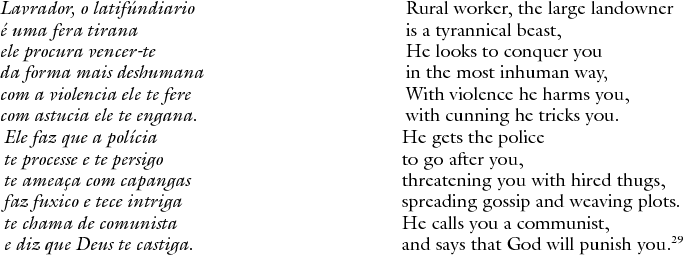
The poem shows how the Ligas Camponesas positioned the rural worker against the large landowner in the struggle for radical agrarian reform. It names the types of unlawful repression that rural men and women faced in their daily lives. The rural elite could rely on the police for their protection and hire thugs to repress rural social movements on their rural estates. The accusation of communism in the poem is an instance of how the rural elite used Cold War era fears to resist the rural social movements. However, the phrasing suggests that most rural workers did not consider themselves communists— “communist” in the poem is a name-calling tool of the large landowner, and not the lavrador's political identity. Indeed, Francisco Julião, in a 1977 interview for an oral history, claimed that the Ligas did not use Marxism as an organizing tool in the Northeast because most peasants there equated communism with the devil.Footnote 30
Another major theme in the LIGA poetry selection was encouraging rural workers to join the Ligas Camponesas. Poems described the miserable living conditions of the rural Northeast, comparing the rural workers to slaves and describing them as sick, starving, even close to death.Footnote 31
For the poor peasant/who plants on the hard earth/ If there's money, it doesn't rain/ If it rains, there's no money/ and he spends the whole year/ enslaved to the master. . . . Damned if you do/damned if you don't./ He carries around the world's misery/ For this reason, there is only one way out/ it is the only way without doubt:/ It's joining the Ligas/ that speak about Agrarian Reform/ and speak about making a government/ with the working class/ with doctors, banks and education/ and funerary assistance.Footnote 32
The instruction was often gendered, appealing to the courage and honor of rural men. As scholars have shown for other cases in rural Latin America, struggles for land rights often gained support through appeals to rural men's masculinity.Footnote 33 As one poem explains, “If before dying of hunger/ man runs away/ fearing fighting and winning/ this is ugly cowardice.”Footnote 34 Another poem applauds rural worker Ze Manoé’s strength in confronting a large landowner, protecting his wife and kids with machetes, and preferring to “die standing.”Footnote 35 In one of the final editions of LIGA before the 1964 coup, the moral instruction becomes far more urgent: “Povo: It is time to wake up! The fight is starting. . . . Hang your enemies, one by one with agave strings! We won't leave any of this useless race [alive] . . . Don't hesitate, because in a few days, the evil of cowardice will come out with the Revolution.”Footnote 36
While most of the poems in LIGA can be read as propaganda of the rural social movement, other cordel stories took up similar but less sweeping themes, emphasizing a rural man's need to defend his honor against the dishonorable latifúndiario as a way of encouraging resistance at a more local level. Maria José F. Londres describes such “stories of struggle” in literatura de cordel as tales in which a poor but brave man triumphs over a man of a higher social class.Footnote 37 Often, the hero is a brave, virtuous, and honorable hard worker who falls in love with a young woman described as a “flower,” and the villain stands in the way of the two uniting. The villain is wealthy, powerful, and dishonorable, characteristics demonstrated by his abuse of power and mistreatment of women. Candace Slater describes the distinction between “good” and “bad” as the difference between firmeza or “fortitude, stability, constancy, steadfastness,” and falsidade or “hypocrisy, deceit, slander, and double-dealing.”Footnote 38 In such tales, the hero first overcomes the villains’ animals and bodyguards, then rises to challenge and eventually defeat him, although the hero rarely kills the villain.Footnote 39 What is often left out in cordel stories is the reciprocity of the latifúndio systems, such as the social and moral ties between the (poor) hero and the (wealthy and powerful) villain.Footnote 40
A poignant example of such a story of resistance is João José da Silva's “Joãozinho's Revenge in the Alligator Pit.”Footnote 41 The story begins with the poor orphan Joãozinho and his delicate sister Maria da Soledade departing from their home in the sertão (rural Northeast) to avoid starvation because of the impeding drought. On their journey south, they come upon the territory of a wealthy sugar factory owner (usineiro) whose brother is the state governor. Notorious as the terror of the state, the usineiro has used his power and wealth to amass an army of vile hired thugs. He constructed 300 houses on his property for young virgins, whom he personally deflowered. If a girl's father protested, the usineiro would toss him into a pit of alligators, which was a cave with an opening in its floor that opened into a river inhabited by immense snakes, carnivorous fish, and wild beasts. If anyone complained to the government or police, the governor would call them liars and traitors and have them thrown in jail.
When Joãozinho and his sister pass through the area on their journey, the usineiro immediately sends his army of thugs to capture the beautiful flower, Maria. Joãozinho confronts them with the taunt, “If you are macho then come and fight this sertanejo.” Demonstrating his bravery, Joãozinho kills one of the thugs with a stick of firewood before succumbing to capture. The usineiro sends Joãozinho to the alligator pit, anticipating the fun he will have with Maria. But when the thugs throw Joãozinho into the pit, a rock cuts the rope binding his feet. The man-eating animals leave him alone because they know that God is on his side. Joãozinho escapes from the pit, kills ten thugs, and rushes back to the usineiro's house to save his sister. Just as the monster is taking advantage of Maria, Joãozinho enters the room and puts a gun to the man's head. Joãozinho then takes the monster to the hole in the cave (poço) and lowers him to the river ten times so he can see the teeth of the alligators. When the usineiro begs for mercy, Joãozinho allows him to live so that he can pay for all the girls he dishonored and all the fathers he murdered. After establishing peace and justice, Joãozinho and Maria leave the usina. Joãozinho finds work on a sugar plantation owned by a widower who has a beautiful daughter. Joãozinho falls in love and marries her, and Maria marries the widower. Soon, the evil usineiro of the alligator pit, haunted by memories of deflowering virgins, can no longer tolerate his life. He throws himself into the pit, and on the same day, the usineiro's thugs disband and the violated girls and their families seize control of the sugar factory. The tale ends with a moral: God condemns those who injure the honor of others.
In comparison to the poems published in LIGA, “Joãozinho's Revenge” stands as a less radical narrative on class struggle and agrarian reform, particularly in comparison to the LIGA poem that urged rural workers to hang their enemies. In “Joãozinho's Revenge,” the evil usineiro and state governor represent a specific conflict in which powerful men misuse their power to harm rural people, but those men are not necessarily depicted as representative of their entire social class. Instead of a call for structural change in terms of agrarian reform or social revolution as occurred in the LIGA poetry, “Joãozinho's Revenge” shows that the land is redistributed among the poor without social upheaval, because of God's will. The rural people themselves, represented as the virgins and their fathers, are powerless. They must wait until an outsider—Joãozinho—comes to liberate their daughters, and then wait again to seize the property until the landowner takes his own life. Thus, the rural workers never directly threaten the usineiro's power. In the LIGA poetry, rural workers are also depicted as victims, but the poems foster a broad awareness among them about their exploitation and urge rural men to find their courage and fight against the latifúndio system. In “Joãozinho's Revenge,” the only honorable, courageous masculine figure is the hero, whereas in the LIGA poetry all rural men are encouraged to become heroes in the fight for agrarian reform.
Yet, in its context, the Northeast in the 1960s, “Joãozinho's Revenge” can also be read as a story of resistance and perhaps even a poem in support of the Ligas Camponesas and other rural social movements.Footnote 42 The figure of Joãozinho is a foreigner to the usina. Although he has a personal stake in the battle because of his sister's capture, he also fights to rectify the situation for the entire community. In the 1960s, one of the most common complaints made against the rural social movements in the Northeast was that the leaders were “outside agitators” who came to “stir up the countryside.”Footnote 43 For example, the police chief of a town in the coastal area of Pernambuco wrote the state's secretary of public safety in 1962 requesting support to resist the “Communist instigators” who had come to stir workers to rebel against their patrões and to take by force the land of the sugar plantation.Footnote 44 The police chief complained that workers were starting fires in the cane fields, refusing en masse to work, and poisoning the potable water, all as instructed by the “outside agitators,” whom he and his sympathizers viewed as criminals.
In contrast, the story of Joãozinho and the alligator pit provides an alternative version of the outsider, which may explain why some rural communities accepted outsiders like Francisco Julião. Joãozinho was a hero who came from outside the town and liberated the people from the cruel tyranny of the usineiro, making it possible for the rural men and women to seize his lands and the usina for themselves. This narrative in “Joãozinho's Revenge” is comparable and compatible with the Ligas’ strategy. When Julião took the expropriation case of the Engenho Galiléia to the court system in 1959, the legal decision displaced the large landowner from the property and granted the disputed land of the Engenho Galiléia to the community association.
As fantastic as the alligator pit story might sound, it may have been based on actual people and places. In an interview with former Ligas member José Joaquim da Silva (“Zito de Galiléia”) in 2005, he described the violence that occurred on the Engenho Serra (near Galiléia) in the 1960s:
Many things were happening in this rural area. The engenho owner, Alarico Bezerra, grabbed and raped rural workers’ daughters, killed them, and threw them in the dammed up pond. Later, they dove in the pond and pulled out dozens of knives as well as skull, arm, leg, and other bones. Any little thing he threw in the pond would die there in the water. For this reason, we had a lot of anger towards Alarico. This Alarico was always doing this. He'd kill people and throw them in the dammed-up pond.Footnote 45
In both “Joãozinho's Revenge” and Zito de Galiléia's explanation of the violence on the Engenho Serra, the large landowner uses his power to rape young girls and indiscriminately kill his workers. The bodies disappeared in the alligator pit or a pond, precluding proper burial rites and emphasizing starkly the lack of justice in the rural Northeast.
But, the ending of the two stories differs. In “Joãozinho's Revenge,” the usineiro faces punishment and dies, with the violated girls and their families winning property rights. Neither justice nor the redistribution of land occurred in the case of the Engenho Serra. In my conversation with Zito, he explained that although the Ligas Camponesas had invaded the Engenho Serra in the 1960s in an attempt to depose the large landowner, the attempt failed because of the 1964 coup. The Engenho Serra still remains in the hands of the Bezerra family.
Modernization, Anticommunism, and Other Stories of the 1960s
Julião and the Ligas Camponeses were not alone in their quest to use literatura de cordel to disseminate information about rural politics in the 1950s and early 1960s. As Mark Dineen has argued, literatura de cordel became an important arena of ideological conflict.Footnote 46 While some poets and stories supported the struggles of the Ligas Camponesas, it is not possible to discuss them as a single voice of the povo.Footnote 47 Luiz Beltrão argues that the popular poets of the Northeast held differing opinions and beliefs on the struggle, although most did express the dissatisfaction of the Nordestinos and criticized the lack of assistance available to them.Footnote 48 In the 1950s and 1960s, journalistic folhetos often included criticisms of the United States and the Soviet Union and discussions of capitalism and communism, as well as tradition versus modernization.
Poems that debated the benefits of modernity often referred to Padre Cícero (1844–1934), who is commonly recognized as a saint in the Northeast. For instance, in “What Padre Cicero Says about Nuclear War,” the dead saint reappears to ask the poet to write down what he says about nuclear war.Footnote 49 The poem argues that men in “civilized nations” are not following God's laws, as evidenced by their traveling to the moon and trying to destroy one another in war.Footnote 50 “Atomic bombs,” he warns, “leave a smoky ash in the air that causes the worst epidemics: malaria, typhoid fever, flu, pneumonia, syphilis, leprosy and a flu without a cure that dissolves people's blood in 14 hours.” Modernity is thus a fearful evil that can bring incurable diseases to humankind.
Another poem, in contrast, praised the modernity and progress of Juazeiro, the sertanejo town where Padre Cícero was a priest. The poet writes, “From 1950 to 1960 . . . Juazeiro already looks like a capital city . . . with wide streets with sidewalks.” He goes on to explain that because of the blessing of the saint and its faithful inhabitants, the town has modern systems and continues to evolve, with banks, 250 “important” businesses, hospitals, schools, two movie theaters, a museum, automatic telephones, an airport, radio station, government buildings, and electricity from the Paulo Afonso hydroelectric dam.Footnote 51 In contrast to Padre Cicero's warnings about modernity as unholy in the folheto on nuclear war, the poem, written to honor the fiftieth anniversary of Juazeiro, portrays modernity as a blessing, emphasizing that it has grown out of the spirituality of the town and its people. These contrasting poems show that modernity was a key topic during the Cold War in the Northeast, but opinions about it could fluctuate between finding it desirable or terrifying.
In addition, a number of poems opposed the Ligas Camponesas and agrarian reform. In their arguments against the Ligas, poets frequently used religion to support their argument. For example, Josué Anacleto da Silva's poem “Weather Changes and the Value of Nature” questions the intentions of both the Ligas Camponesas and the rural elite, claiming that the only solution to poverty is in God's hands.Footnote 52 The first part of the poem describes the misery of the rural poor and the second part describes the natural beauty of the Northeast in the winter, when “God sends crystalline waters to fill the waterfalls, making all the poor people happy.” The poet claims that everyone hears propaganda about agrarian reform bringing change to Brazil, while the working class continues to suffer. But the poet also describes the unjust nature of class difference: “And to speak of meat is to speak in vain/ That belongs only to the bourgeoisie/The poor see it, but don't eat it.” In this folheto, the poet criticizes the conservative elites and the leftist politicians for not assisting the rural poor, but at the same time argues that the people's destiny is in God's hands. Although the poem appears to criticize the elites, large landowners have long used a similar religious argument, based on Divine Providence, to justify unequal social relations in the rural Northeast.
Joaquim Batista de Sena, or Poeta Seny, published “The History of Agrarian Reform and Communism in Brazil” in Fortaleza in the 1960s, making strong declarations against the Ligas.Footnote 53 Sena's poetry often used journalistic themes, and he was one of the few authors who continued writing folhetos after the 1964 coup. The cover illustration for his history depicted a cross above a sickle with both imposed over a map of Brazil. The back cover advertised other folhetos about agrarian reform, with a bold slogan in capital letters: “The fight against the socialist and anti-Christian agrarian reform is a right and an obligation!”
Inside the folheto, Poeta Seny begins by setting up a Manichaean conflict between Catholicism and communism, with communism (“Satan's jewel”) declared as a major threat to the world. Sena admonishes the audience, “The believer in God's laws doesn't accept communism,” and follows with a history of Jesus Christ's struggles on earth, including the “saints and martyrs” who died in the Coliseum of Rome, and the guidance that Christ provided to the Portuguese explorer Pedro Álvarez Cabral in 1500 to lead him to Brazil. According to Sena, this divine history is why Brazil owes its patriotism to Christianity and not to communism. He encourages the audience to “fight for the law of the true God to liberate Brazil from the foreign communism attacking the Brazilian nation.”
Sena then describes the quality of life in “communist Russia,” where people supposedly work as slaves for the government. The folheto becomes the setting for a peleja (fight) between poets as Sena aims to discredit popular ideas that are circulating about communism and agrarian reform. Describing the workers in the communist state, he writes:

As Sena continued, he challenged many stories then circulating about Russia. It is a lie that the poor bread baker makes the same salary as an engineer, or that the poor baker eats at the table next to the obstetrician, or that the son of the poorest worker studies at the same school as the son of Russian nobles. While the literacy rate may be higher in Russia than in the Northeast, Sena warns that the schools teach the children from the time they are babies that God does not exist. In Russia, to speak of God is a crime, he writes, and anyone who speaks against the government has his or her head cut off. Further along, he forewarns that if Brazil turns communist, the peasant will have to “work day and night like a poor, enslaved person who lacks the right to harvest an ear of corn from their plot,” since all the production will go to the government to be redistributed among the population.
Considering Sena's denouncement of what he calls “lies,” it is possible to make a reasonable assumption regarding the discourse circulating about agrarian reform during the Cold War. In trying to gain support, rural social movements mobilized for social reforms, including agrarian reform and rural education, and against unpaid forms of labor such as the cambão (corvée). Poeta Seny challenges ideas circulating about promises for equality and social justice by claiming that such ideas are false and not Christian. He also explains to rural workers that they would have to work longer days, and that they would not have the right to eat what they produce under a communist regime, a statement that deserves further analysis. On one hand, it would have probably been hard for most rural workers in the Northeast to imagine working even longer hours or having even less food than they did in the 1950s and 1960s. One of most common denouncements of large landowners in the 1950s and 1960s was the exercise of unjust violence against rural men and women, including the landowner beating or killing rural workers for eating from the landowner's crops. It is not clear that Poeta Seny intended the piece for rural workers, who might read the warnings against communism differently. They might even find communism attractive, since the poem suggests that one might be guaranteed food under a governmental redistribution program. This ambiguity suggests that the poem may have been addressed to landowners and not to rural workers.
Another indication that Sena's history may have been intended for a broader audience than rural workers is his explanation about why agrarian reform is wrong. Like the conservative mainstream newspapers and large landowners, Sena describes agrarian reform as a crime, justifying opposition to it through a singular interpretation of the Bible. Inequality, he writes, is a “Divine Phenomenon,” since God made some people completely healthy and others blind and crippled, and made some millionaires and others poor and homeless. Agrarian reform, he wrote, “belongs to the Communist law” and like a “thief” it comes seducing and preying on the “poor peasant who—not knowing the bottomless pit that awaits him—marches with his eyes closed straight for Communism.”Footnote 54
The idea of agrarian reform as criminal or deviant appears in other folhetos that criticize the Ligas Camponesas. For example, in “The Peasant League and the Response to Julião,” the author demonizes Francisco Julião and the Ligas:

O Diário de Pernambuco, controlled by conservatives, placed most of its reports on the Ligas Camponesas on the criminal pages of the daily newspaper. It frequently illustrated the stories with mug shots of rural workers or photographs of rural workers armed with hoes in confrontations with the police. In this way, the mainstream media framed the rural social movements as criminal, even when reports covered non-criminal actions such legal protest marches, court trials, or “agitation,” a loose term used frequently to describe the Ligas as a threat. The criminalization of the Ligas stood in contrast to the legal measures by which rural social movement leaders pursued their fight for the expropriation of large estates.
Another issue emphasized in anti-Ligas folhetos was peasants' ignorance and their inability to understand the “evils” of communism. In “The Peasant League and the Response to Julião,” the author describes Julião as leading the poor, innocent sheep to be massacred.Footnote 56 Poeta Sena writes in “The History of Agrarian Reform and Communism” about communist lies:

Conservative scholars, journalists, politicians, and large landowners commonly used this kind of discourse to emphasize the rural population's lack of awareness and the seductive powers used by the “communists” to attract rural people to their cause. They positioned the Ligas as a real threat to Brazilian democracy. The victimization of the rural workers in such folhetos differs from the victimization of rural workers in pro-Ligas folhetos and stories such as “Joãozinho's Revenge.” In conservative depictions, rural workers are simply ignorant sheep easily manipulated by communists, whereas in pro-Ligas depictions the poems try to show rural workers that they can change their current situation of hunger and misery by joining the fight for agrarian reform. There was widespread support for rural social movements, including the Ligas Camponesas, the Brazilian Communist Party rural unions, and the Catholic Church's Federation of Rural Workers. There were also state-sponsored projects and programs such as SUDENE. Considered together with Paulo Freire's rural education projects under the aegis of the Movimento de Cultura Popular, they suggest that communists were not “brainwashing” the rural population.
Both the conservative and pro-Ligas poetry demonstrate that rural Nordestinos were engaged with many of the social struggles and political debates of the Cold War in the era of the Cuban Revolution. A plethora of information about agrarian reform and other social reforms, capitalism and communism, and the United States and the Soviet Union circulated in literatura de cordel. While conservative and pro-Ligas poets commonly defined the rural poor as victims, conservative poets explained victimization as the exercise of Divine Providence, and pro-Ligas poets used victimization as a tool to empower rural workers by making them more consciousness of how they were being exploited. Both Conservative and pro-Ligas poems used the notion of criminals or criminality to portray the opposing side. This space, which allowed for political debate and potential discussion during performances in the countryside, would no longer be available after the coup.
Literatura de Cordel after the 1964 Military Coup
Anticommunist narratives appeared in folhetos before 1964, but one notable difference in the following years is the absence of any folhetos that discuss class conflict or agrarian reform. Conservative poets such as Joaquim Batista de Sena and Rodolfo Coelho Cavalcante continued writing after the 1964 coup, but pro-Ligas poets stopped writing and publishing folhetos, and the Ligas stopped publishing their newspaper. The pro-Ligas poet Rafael de Carvalho allegedly burned all his folhetos immediately after the coup.Footnote 57 Such an action suggests that Carvalho feared persecution for his poetry, probably based on his experience of the violent arrests of Ligas participants and leaders after the coup. The following paragraphs analyze depictions of the military coup and military government in the immediate years following the 1964 coup to show the changes that took place in terms of topics and messages.
A number of folhetos celebrated the “Revolution of 1964” and the military's program of bringing progress and order to Brazil. For example, Joaquim Batista de Sena's “Marshal Castelo Branco's Victory and the Overthrow of the Corrupt” explained how Castelo Branco had put an insecticide on the fleas of the Northeast, to get rid of the “corrupt” Francisco Julião and Miguel Arraes.Footnote 58 Mark Curran argues that Rodolfo Coelho Cavalcante's “A vitória da democracia no Brasil e o fim do comunismo” (The Victory of Democracy in Brazil and the End of Communism) was the most significant cordel of 1964.Footnote 59 In it, the poet thanks the Armed Forces for liberating Brazil from the Communists, and claims that the military takeover is the only patriotic and moral solution for Brazil. As Curran argues, many popular poets during the military regime acquired a role as the “moral guardians of the community.”Footnote 60 Other poems applauded the military's ability to bring progress and development to the Northeast. In “The Construction of the Dam,” Enoque Pinheiro Neto criticizes the democratically elected presidents Juscelino Kubitschek, João Goulart, and Jânio Quadros for not fulfilling their promises to build a dam. Instead, he declares that General Castelo Branco, “hero of the Armed Forces/with his values and progress” will complete the dam project.Footnote 61
Homero do Rêgo Barros's 1965 “Echoes of the Revolution of 31 March 1964” celebrated the first anniversary of the coup, praising the military leaders, criticizing the deposed leaders and the Communist Party, and expressing hopes for improvements in the national economy with the military in power.Footnote 62 The author uses a patriotic tone, exalting Castelo Branco and the achievements of the military in preventing a communist revolution. “Now Brazil lives/ in a period of hope/in the hands of good men . . . who are not red and atheists.” According to the folheto, legitimacy for military leaders was based on heroism, patriotism, and military history and its heroes. Barros claimed that better times would come to the Northeast because of the military, such as the end to carestia (high prices and shortages) and inflation.
These themes are probably fairly standard in terms of what was written and spoken following the coup of 1964, but one section stands out. It is a stanza that relays a threat. “Any subversive foco [guerilla operative] / was quickly dissolved/and by the real Brazilians/Castelo was applauded / But for those who don't have any sense / you can find them in the prison/[with] the punishment they deserve.” The folheto threatened anyone who failed to support the military regime with punishment and prison. The dictatorship undertook to silence the debates about agrarian reform, communism, and capitalism in literatura de cordel after 1964. Questions remain about what happened to other poets and their critical voices during the dictatorship. Did they, like other artists and social activists, face threats of arrest, imprisonment, and censorship?
Although very little record exists of how the military perceived the poets and literatura de cordel, a few clues suggest that poets no longer felt safe producing folhetos that criticized the government or discussed the need for social reforms. This is not surprising—many journalists and scholars writing about the Northeast, like the Rio-based reporter Marcio Moreira Alves, were also concerned.Footnote 63 According to anthropologist Antonio Augusto Arantes, poets reported difficulties selling folhetos at the markets and fairs because the police would not permit the buyers to gather in a group to listen to the stories.Footnote 64 During his field research in the late 1960s, Arantes noted that the sale of folhetos was explicitly prohibited in the name of preserving the “local color” [cor local] and the “picturesque” [pitoresco]. The stalls where the poets used to sell the literatura de cordel were filled in with flowerbeds. The police forbid public gatherings because they facilitated “criminal activity” [a atividade de malandros e ladrões].Footnote 65 In interviews with poets, folheteiros mentioned being imprisoned for writing “immoral” poems and spoke of being censored during the military regime.Footnote 66 Poets may have also self-censored their poetry during the military period to avoid such threats as imprisonment, torture, and disappearance.Footnote 67 In my research, I found a number of folhetos in the DOPS files in Recife, which suggests that the military perceived literatura de cordel and poets as subversive after 1964.
While it is difficult to locate actual instances of censorship measures, there are a few examples of mandated changes in folheto themes. During the presidency of Castelo Branco, for example, a poet wrote a parody of “Our Father” that he entitled “Our Father of Poverty.” The original version reflected lines of class conflict and distrust of the government. In the published version, lines that referred to the abuse of power by the rich, the low salaries, the hunger of the povo, and the failures of the government were completely rewritten.Footnote 68 A Paraíban poet reportedly was arrested in 1976 for releasing a folheto criticizing the minimum wage. He was held for three days for claiming that the minimum wage did not suffice to feed a family. The controversial stanza was reported in O Estado de São Paulo:

Certain authors and cordel themes were favored after the coup, and the production of poetry also changed. Popular poetry now appeared in booklets with new glossy covers, produced by commercial typesetters. During the same period, the “traditional” wood-carving prints formerly used for the covers increased in popularity, this time as a relic of Nordestino folk culture. New themes and new vocabulary appeared in literatura de cordel, following the more modern post-1964 format but focusing now on issues facing the urban southern regions of Brazil and displacing the characteristic themes and colloquialisms of the Northeast.Footnote 70 At the same time, there was a demand for folhetos with classical themes, and many were reprinted to meet an increased demand for kings and beautiful princesses in faraway lands. In 1970, the military regime implemented a tax on poets, varying between one and 18 cruzeiros, making it difficult for poets to continue to produce folhetos.Footnote 71
Such changes in literatura de cordel production have often been explained by reference to the introduction of new technology and changes in the consumer market. As Mark Dineen has noted, the major printing press of the Northeast, the Tipografia José Bernardo da Silva, saw a decline in its production from a peak of about 100,000 folhetos per week in the 1950s to just 1,000 to 2,500 folhetos a week in the 1970s.Footnote 72 Economic developments produced changes in the production and printing of literatura de cordel in the mid 1960s and early 1970s. New and costly methods of printing, along with the rising costs of ink, paper and type, meant that the production and sales decreased.Footnote 73
The decline in folheto production also may have been connected to the expansion of other media such as radio and television.Footnote 74 Yet another change often cited by scholars is related to changes in the consumer population.Footnote 75 During the dictatorship, migration of rural people from the Northeast to urban areas and the central and southern regions continued, and the rural labor force itself changed. With increased mechanization of agricultural production, tenant farmers and smallholders found themselves increasingly converted into itinerant day wage laborers.Footnote 76 According to one poet, the decline of literatura de cordel began in 1965, when the sugar-cane usineiros began to punish the rural population by cutting their salaries and the hours they worked.Footnote 77 For the folheteiros, this meant a swift reduction in their incomes since the rural population no longer had money to spend on entertainment.
Conclusion
But literatura de cordel never disappeared, as scholars once feared. For some, it is still a popular means of recording their own version of history and voicing social protest. When I met with former Ligas Camponesas participant José Joaquim da Silva (Zito) on the Engenho Galiléia in 2005, he showed me poems he has written but not published, due to a lack of funding. He was able to reproduce a small number of copies for “people who like to read them.”Footnote 78 He told me that he writes poetry because he had listened to the stories sung by the repentistas his entire life and that it was because he enjoyed them so much that he decided to try to be a poet. He found that he found he liked it, and so he continued writing.
Zito's unpublished folhetos present a wide variety of topics, all of which are both political and personal, detailing the political struggles of his life meshed with stories about the Ligas, his time working as a bus driver in São Paulo, and the crimes committed against political prisoners during the dictatorship.Footnote 79 Zito's “The Prison and Cell 106” describes present-day Recife's Casa de Cultura, a renovated prison that is now a tourist mall with its cells transformed into stores that sell “traditional” Northeast artisan crafts such as clay figurines, wood prints, and hammocks. As he writes about the violations of human rights that occurred in the prison, he imbues the prison cells with power, transforming them into a memorial. The poem insists on the necessity to remember what happened there, which has become part of Zito's political project to raise awareness about the history of the Ligas and the dictatorship. He wants to see this history incorporated into a national narrative of Brazilian history. Zito's poetry also reflects his participation in the Torture Never Again (Tortura Nunca Mais) movement in Pernambuco, which calls for legal action against the military officers who committed crimes against humanity during the dictatorship. Zito reminds us that literatura de cordel still exists as a form of protest and communication in the rural Northeast, even though it has gone through many changes.
The main argument of this article has been to show how literatura de cordel—a literature of popular culture—relates to the narratives of the Cold War as experienced by rural people in Brazil's Northeast. Most Northeastern rural workers would have heard debates encouraging them to support or oppose agrarian reform. Arguments often centered on religion and Divine Providence, rural workers as victims, and the power-holders that opposed them as criminals. Pro-Ligas poems tended to use such characterizations as tools of empowerment, encouraging rural men to fight for their honor and protect their families. Conservative poets painted rural social movements as communist, and portrayed communists as satanic liars and criminals. Folhetos such as “Joãozinho's Revenge” and “Weather Changes” exemplify how narratives of resistance and submission held back from urging rural workers to become revolutionaries and did not glorify landowning elites as God's favored class. Such narratives suggest that Cold War experiences for many rural Northeastern men and women included violence, hunger, poverty, struggles for justice, and heightened political activism.
My research also challenges the idea of literatura de cordel as a quaint vestige of folk culture and the imagining of o Nordeste as an area of defined by poverty, backwardness, rebellion and tradition. As with any form of popular culture, literatura de cordel has changed and also remained the same, uneven and diverse like its producers and consumers. Ella Shohat and Robert Stam have argued for the need to recognize the plurality and diversity of popular culture production and consumption. “Popular culture no longer evokes agrarian nostalgia. . . . [It] is fully enmeshed in transnational globalized technoculture.”Footnote 80 The wide range of themes and the changes in production show that Zito's poetry about the dictatorship, contemporary folhetos about Barack Obama, and Cold War folhetos about agrarian reform and communism justify the need to rethink the limiting notion of literatura de cordel as authentic folk or popular culture. The diversity of voices, objectives, and consumers also requires us to question dominant notions defining regionalism and the trope of o Nordeste in Brazil.


