


Psychometric Validation of the Taiwanese Version of the Job Satisfaction of Persons with Disabilities Scale in a Sample of Individuals with Poliomyelitis
Internationally, people with disabilities experience poorer employment outcomes than people without disabilities (International Disability Rights Monitor, 2004). Although legislation such as the Americans with Disabilities Act (ADA; 1990, 2008) in the United States, the Disability Discrimination Act (1992) in Australia, and the Equality Act (2010; formerly the Disability Discrimination Act, 1995) in the United Kingdom have reduced employment discrimination and increased employment opportunities for individuals with disabilities, people with disabilities still lag significantly behind those without disabilities when it comes to employment outcomes (International Disability Rights Monitor, 2004). According to the United Nations (2007), 50 per cent to 70 per cent of working age individuals with disabilities in industrialised nations are unemployed, with these estimates reaching 80 per cent to 90 per cent in developing countries. Across the globe, the official unemployment rate for persons with disabilities of working age is typically at least twice that for individuals without disabilities. In Taiwan, specifically, the 26.5 per cent employment rate for working-age people with disabilities is significantly lower than 57.9 per cent rate for people without disabilities (Ministry of Labor, 2009).
To address these disparities, vocational rehabilitation services are designed to support individuals with disabilities to obtain and maintain their employment goals. The success of services provided by vocational rehabilitation counsellors have historically been based on outcomes related to employment rates, job earnings, and length of time employed (Rubin, Chan, & Thomas, Reference Rubin, Chan and Thomas2003). However, vocational rehabilitation systems have been criticised for prioritising the placement of clients in jobs with only limited regard for the clients’ subjective evaluation of employment, such as level of job satisfaction (Lam, Chan, & Thorpe, Reference Lam, Chan and Thorpe1988). Clearly, placing people with disabilities into jobs is a very important goal for vocational rehabilitation counsellors given the high unemployment rate of persons with disabilities; however, in addition, to lower rates of employment, research has found individuals with disabilities are also at risk for lower pay, decreased job security, and more negative attitudes toward their jobs (Schur, Kruse, Blasi, & Blanck, Reference Schur, Kruse, Blasi and Blanck2009). All of these factors may lead individuals with disabilities to have lower levels of job satisfaction. Moreover, job satisfaction has been linked to positive work outcomes such as attendance and performance, as well as to greater satisfaction in other non-work roles in life (Fritzsche, Dhanani, & Spencer, Reference Fritzsche, Dhanani, Spencer and Strauser2014; Hulin & Judge, Reference Hulin, Judge, Borman, Ilgen and Klimoski2003). Therefore, without consideration for the subjective evaluations of employment such as job satisfaction, the long-term success, and quality of life of employees with disabilities may be undermined.
Locke (Reference Locke and Dunnette1976) defines job satisfaction as a state of positive or pleasurable emotions that results from the individual's evaluation of his or her job experience and has been associated with positive outcomes for both the employer and employee. Specifically, job satisfaction has been shown to lead to increased productivity, efficiency, tenure, and reduced absenteeism (Xie, Dain, Becker, & Drake, Reference Xie, Dain, Becker and Drake1997). Satisfied employees are more likely to perform and act in ways that promote organisational functioning, whereas dissatisfaction can lead to harmful work behaviours (Spector, Reference Spector1997). Therefore, the facilitation of a job match that leads an employee with a disability to have a high level of integration and job satisfaction would be very desirable for employers. In addition, job satisfaction has been shown to be related to increased psychological health and self-esteem in persons with disabilities (Griffin, Rosenberg, Cheyney, & Greenberg, Reference Griffin, Rosenberg, Cheyney and Greenberg1996; Jiranek & Kirby, Reference Jiranek and Kirby1990; Petrovski & Gleeson, Reference Petrovski and Gleeson1997).
Although research on job satisfaction for people with disabilities has been relatively scarce, in general, the literature suggests that people with disabilities report lower levels of job satisfaction compared to their non-disabled peers (Burke, Reference Burke1999; Hirst, Thornton, Dearey, & Campbell, Reference Hirst, Thornton, Dearey and Campbell2004; Uppal, Reference Uppal2005). Uppal (Reference Uppal2005) suggests that these discrepancies may be related to higher rates of low-paying jobs, discrimination and harassment in the workplace, and other negative workplace conditions faced by people with disabilities. In fact, a number of studies have documented that workers with disabilities are dissatisfied with their pay and opportunities for promotions or advancement (Houser & Chace, Reference Houser and Chase1993; McAfee & McNaughton, Reference McAfee and McNaughton1997a; McAfee & McNaughton, Reference McAfee and McNaughton1997b).
A study by Uppal (Reference Uppal2005) found that individuals with disabilities reported lower levels of job satisfaction than persons without disabilities. This finding held across disability types except for speech-related disabilities. Once workplace conditions, such as discrimination, harassment, and work demands were controlled for, differences in job satisfaction between persons with mobility disabilities and persons without disabilities disappeared. The negative effect in the other disability groups remained, but the magnitude decreased, which may be indicative of problems obtaining assistive technology or appropriate accommodations, but these were not included as study variables (Uppal, Reference Uppal2005). On the other hand, Pagan and Malo (Reference Pagan and Malo2009) examined Spanish data from the European Community Household Panel data, finding that individuals with disabilities were actually more satisfied in their jobs than persons without disabilities. However, this was only after controlling for other variables such as hourly wages, job tenure, and job matching. The authors argue that people with disabilities may have lower expectations about jobs of disadvantaged groups and as a result are happier in employment than persons without disabilities (Pagan & Malo, Reference Pagan and Malo2009). Similarly, the Danish National Centre for Social Research (2008) found that people with disabilities in Denmark were just as satisfied with their jobs as people without disabilities, despite the challenges that they experience in the labour market. Clearly, more research on the job satisfaction outcomes of people with disabilities is necessary to ensure the long-term employment success of persons with disabilities in the workforce. In particular, identifying underlying factors contributing to job satisfaction is important for informing strategies to address disparities in job quality and ultimately increase successful long term employment and quality of life for people with disabilities.
According to Locke (Reference Locke and Dunnette1976), job satisfaction results from a job providing opportunities to meet the particular psychological and physical needs of the individual. A number of factors leading to job satisfaction have been identified in the literature, including but not limited to: appreciation by others, pay, benefits, job conditions, nature of work tasks, opportunities for advancement, and interactions with co-workers and supervisors (Spector, Reference Spector1997). A good match between such factors and the characteristics (e.g., values and skills) of the individual is important in order to maximise the person's satisfaction with the job. It is for these reasons that rehabilitation counselling professionals have long advocated for job placement in integrated, competitive employment settings for people with disabilities as the ultimate goal of vocational rehabilitation (Ditchman et al., Reference Ditchman, Wu, Chan, Fitzgerald, Lin, Tu and Strauser2014). However, the assessment of the quality of the job placement from the consumer's perspective is an integral part of ensuring this goal is met. It is imperative that rehabilitation counsellors determine the degree to which the individual's personal needs are being met by the job, in order to maximise the chances of long-term job satisfaction and employment success. It is essential that psychometrically sound tools be developed to aid in this assessment. The purpose of this study, therefore, was to investigate the validity of the JSPDS for use with individuals with disabilities. Specifically, this study examines the factor structure of the JSPDS in a sample of Taiwanese persons with poliomyelitis. Poliomyelitis represents a chronic disability that can affect the whole body and is associated with varied symptomatology and severity. Moreover, people with poliomyelitis frequently encounter barriers to employment and work participation (Zeilig et al., Reference Zeilig, Weingarden, Shemesh, Herman, Heim and Zeweker2012). The research questions addressed were as follows:
1. What are the essential behaviours defining the domains of job satisfaction from the perspective of individuals with poliomyelitis?
2. What is the relationship between job satisfaction domains and life satisfaction in individuals with poliomyelitis?
Method
Participants
One hundred and thirty-two gainfully employed individuals were recruited from two community support organisations for people with poliomyelitis in Taiwan to participate in this study. Participants included 73 (55 per cent) males and 59 (45 per cent) females, and ranged in age from 22 to 63 years old (M = 45.67, SD = 8.97). A majority of the participants were either married (49 per cent) or were single (42 per cent), with 4 per cent divorced, 1 per cent widowed, and 4 per cent co-habitating; two participants (1.5 per cent) did not report their marital status. The educational attainment of participants included those who had not completed high school (19 per cent), those who had obtained a high school diploma (38 per cent), and those who had obtained an associate degree/bachelor degree (39 per cent), a master's degree (3 per cent), or a doctoral degree (1 per cent); one person did not report his level of education.
Measures
The Taiwanese versions of all psychological instruments used in this study were translated using the back-translation method (Brislin, Reference Brislin1970). The measures were first translated from English to traditional Chinese by one of the bilingual co-authors and then translated back from Chinese to English by a Taiwanese doctoral student majoring in rehabilitation psychology. A comparison of the translated Taiwanese versions of each instrument with the English versions revealed no important loss of meaning across items.
Job Satisfaction of Persons with Disabilities Scale (JSPDS)
The JSPDS was developed by researchers in the Rehabilitation Research and Training Centre on Evidence-Based Practice in Vocational Rehabilitation (RRTC-EBP VR) at the University of Wisconsin-Madison (Chan, Reference Chan2014). Psychometric validation of the JSPDS was the primary focus of the present study. JSPDS items were developed based on a comprehensive review of the vocational rehabilitation, job satisfaction, and human resources literature. Items were written to include diversity and inclusion, workplace support, and job satisfaction. The draft of JSPDS items was reviewed by 12 rehabilitation counsellor educators and vocational rehabilitation researchers who have published extensively in the areas of vocational rehabilitation, job placement, and job satisfaction. The final draft of the instrument comprised 21 items. Each item was rated on a five-point Likert type rating scale, ranging from 1 (strongly disagree) to 5 (strongly agree).
The Satisfaction with Life Scale (SWLS)
The SWLS was constructed by Diener, Emmons, Larsen, and Giffin (Reference Diener, Emmons, Larsen and Griffin1985) to measure life satisfaction in the general and geriatric populations. It consists of five items such as ‘In most ways my life is close to my ideal’ and ‘I am satisfied with my life’. Each item is rated on a seven-point Likert-type scale from 1 (strongly disagree) to 7 (strongly agree), with total scores ranging from 5 to 35, with higher scores indicating more satisfaction. Diener et al. (Reference Diener, Emmons, Larsen and Griffin1985) reported acceptable levels of internal-consistency estimates ranging from 0.61 to 0.81. The SWLS received validity support based on its correlations with other measures of subjective well being, such as the Self-Esteem Scale and the Affect Balance Scale (Diener et al., Reference Diener, Emmons, Larsen and Griffin1985).
Data Analysis
The Statistical Package for the Social Sciences (SPSS, version 18.0) programme was used for statistical analysis. An EFA using principal components analysis was performed to examine the measurement structure of the JSPDS. In addition, correlational analysis and Hotelling's T 2 test were used to evaluate the concurrent validity and criterion-related validity of the JSPDS.
Results
Exploratory Factor Analysis
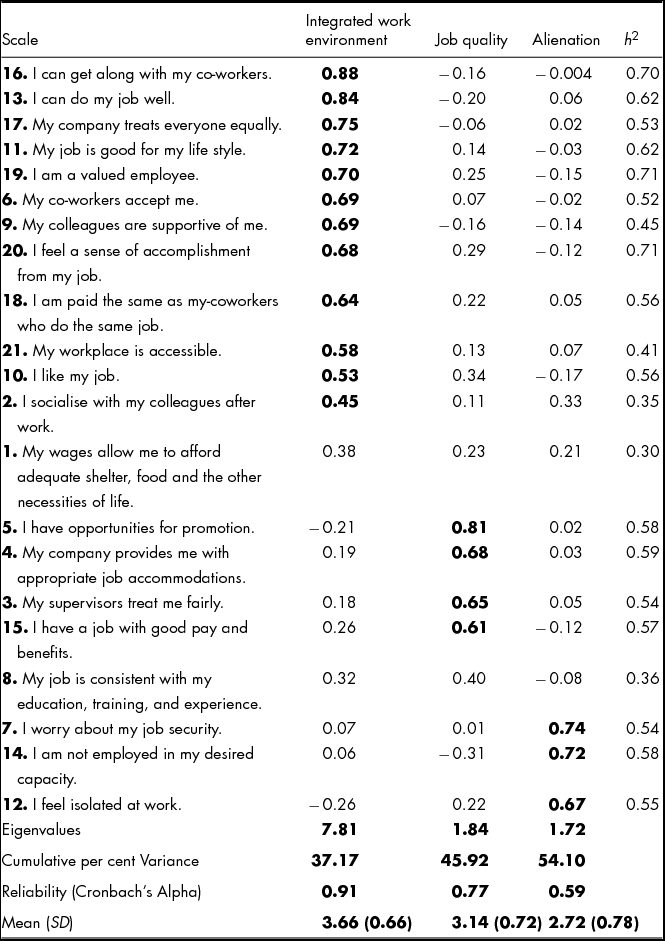
The 21 × 21 correlation matrix of the JSPDS was subjected to a principal components analysis. The Kaiser–Meyer–Olkin analysis resulted in a sampling adequacy of 0.86, and the Barlett's test of sphericity was significant (χ 2 [210, N = 132] = 1411.57, p < 0.001), indicating that correlations among the items were appropriate for factor analysis. Kaiser–Guttman's ‘Eigenvalues greater than one’ criterion and Cattell's scree test (Nunnally & Bernstein, Reference Nunnally and Bernstein1994) both indicated a three-factor measurement structure. The solution was rotated using oblique rotation to simplify the factor structure and enhance interpretation of the three-factor solution. The final solution accounted for 54 per cent of the total variance. Only items with factor loadings of 0.40 or higher and 0.30 or lower in other factors were retained, resulting in the deletion of two items (‘My wage allows me to afford adequate shelter, food and the other necessities of life’ and ‘My job is consistent with my education, training, and experience’) from the scale. The remaining items loaded significantly onto their respective factors (loadings ranging from 0.45 to 0.88). In examining the contents of the items in each factor, these three factors were labelled Integrated Work Environment, Job Quality, and Alienation.
Factor 1—Integrated Work Environment
This factor consists of 12 items. Items in this factor reflect job satisfaction associated with working in an integrated and supportive environment such as job matching (e.g., ‘I can do my job well’), social support (e.g., ‘My colleagues are supportive of me’), and equal opportunity (e.g., ‘My company treats everyone equally’). All items loaded significantly onto their respective factors (loadings ranged from 0.45 to 0.88). The internal consistency reliability coefficient (Cronbach's alpha) for this factor was computed to be 0.91. The mean for this factor was 3.66 (SD = 0.66), which was highest in all JSPDS subscales.
Factor 2—Job Quality
This factor consisted of four items represented primarily by job quality items including good wage, opportunity for promotion, and equity (e.g., ‘I have a job with good pay and benefits,’ and ‘I have promotion opportunity’). All items loaded significantly onto their respective factors (loadings ranged from 0.61 to 0.81). The mean for this factor was 3.14 (SD = 0.72).
Factor 3—Alienation
This factor is composed of three items represented primarily by alienation items (e.g., ‘I feel isolated at work’). All items loaded significantly onto their respective factors (loadings ranged from 0.67 to 0.74). The mean for this factor was 2.72 (SD = 0.78).
The integrated work environment factor correlated highly with job quality (r = 0.54, p < 0.001) but not with alienation (r = −0.11, p = 0.23). The alienation factor was not associated with integrated work environment or job quality (r = −0.05, p = 0.61). The results indicated that integrated work environment and job quality were inter-related but still represented distinct factors, with alienation being distinctly different from the integration and job quality factors. (Table 1) presents the means and standard deviations for each of the JSPDS subscales as well as factor loadings, communality (h 2) eigenvalues, percentage of variance explained, and reliability coefficients.
Exploratory Factor Analysis Results Using Principal Component Analysis with Oblique Rotation

Note. Item 1 and Item 8 were eliminated they did not meet the retention criteria.
Reliability
Internal consistency reliability estimates for each JSPDS factors were measured using Cronbach's alpha coefficients. The estimates for the integrated work environment, job quality, and alienation factors were computed to be 0.91, 0.77, and 0.59 respectively. Cortina (Reference Cortina1993) suggests that although an alpha coefficient of 0.70 is a commonly acceptable cut-off point for reliability estimates of psychosocial measures, the value of alpha changes as a function of the number of items. With a low number of items, as in the alienation subscale, the alpha coefficient of 0.59 could reflect a marginally acceptable level of reliability.
Concurrent Validity
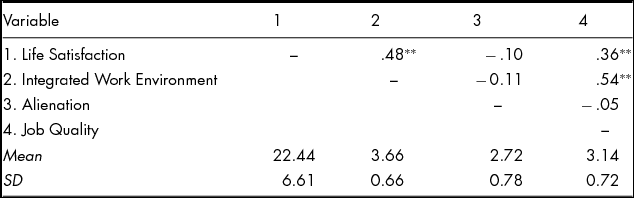
The correlation matrix and the means and standard deviations of the job satisfaction and life satisfaction variables are presented in (Table 2). As the relationship between job satisfaction and life satisfaction is well documented in the industrial and organisational psychology literature (Judge & Watanabe, Reference Judge and Watanabe1993), two of the job satisfaction factors were indeed correlated with life satisfaction in the present study. The life satisfaction construct was positively associated with the integrated work environment factor (r = 0.48, p < 0.001) and the job quality factor (r = 0.36, p < 0.001). The association between life satisfaction and the alienation factor was not statistically significant (r = −0.10, p = 0.25).
Means and Standard Deviations of the Job Satisfaction and Life Satisfaction Variables
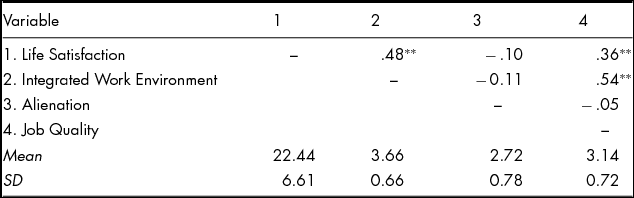
**p < .01
Simultaneous regression was used to further examine integrated work environment, job quality, and alienation as predictors of life satisfaction. The full model accounted for 25 per cent of the variance in life satisfaction, R = 0.50, R 2 = 0.25, f 2 = 0.33, F(3, 128) = 14.25, p < 0.001, which is considered close to a large effect size (Cohen, Reference Cohen1988, Reference Cohen1992). An examination of the standardised partial regression coefficients revealed that only the integrated work environment variable, β = 0.40, t(132) = 4.42, p < 0.001, was a significant predictor of life satisfaction. The positive association between job quality and life satisfaction was rendered not significant after controlling the effect of integrated work environment and alienation. Integrated work environment contributed most significantly to life satisfaction, indicating a one point change in integrated work environment is expected to produce an increase of +0.40 points in life satisfaction when job quality and alienation are statistically controlled.
Criterion-Related Validity
Three Hotelling's T 2 tests were computed to examine whether there was any gender, age, and educational attainment differences on the three job satisfaction factors. To control for Type I error, we divided the alpha by three (0.05/3 = 0.017). The results indicated both gender and age did not reach level of significance for any of the three job satisfaction subscales. However, Hotelling's T 2 results revealed that overall JSPDS scores differed significantly by educational attainment, Hotelling's T 2 (3, 128) = 3.33, p < 0.007. Participants with at least some college education had on average higher integrated work environment scores (M = 3.84, SD = 0.69) than participants with no college education (M = 3.53, SD = 0.60; η2 = 0.06).
Discussion
The health and mental health benefits of a good paying job in a supportive work environment for people with and without disabilities are well documented (Cottini, & Lucifora, Reference Cottini and Lucifora2013; Waddell & Burton, Reference Waddell and Burton2006; Yin, Shaewitz, & Megra, Reference Yin, Shaewitz and Megra2014). This is one of the primary reasons that the goal of vocational rehabilitation is to enable employment and economic self-sufficiency (Rubin et al., Reference Rubin, Chan and Thomas2003). However, vocational rehabilitation professionals have historically been more concerned about placing clients in jobs rather than placing emphasis on the quality of the employment. For example, in the United States, the mean hourly wage of people with disabilities whose cases were closed successfully in competitive employment by state vocational rehabilitation agencies is only 52 per cent that of the general workforce (Rehabilitation Services Administration [RSA], 2008). Moreover, less is known about the extent to which people with disabilities are satisfied in their jobs and how vocational rehabilitation services have aided in improving their overall quality of life. To improve quality of employment for people with disabilities, policymakers and vocational rehabilitation agency administrators should shift the focus from being solely on short-term employment outcomes, and, instead emphasise the importance of evaluating vocational rehabilitation service outcomes using a multidimensional framework, with a range of outcome components being assessed (Chan, Rubin, Lee, & Pruett, Reference Chan, Rubin, Lee and Pruett2003).
The purpose of the present study was to validate a multidimensional job satisfaction scale for people with disabilities that can be used as an important client outcome component in assessing vocational rehabilitation outcomes. To answer research question #1 (What are the essential behaviours defining the domains of job satisfaction from the perspective of individuals with poliomyelitis?), an EFA was conducted, which yielded a meaningful three-factor solution. The central themes of the 12 items of the first factor (Integrated Work Environment) reflect job satisfaction associated with working in integrated competitive employment settings. These sources of job satisfaction include the satisfaction of having a job, the opportunity to socialise with co-workers, receipt of natural supports from co-workers in the work environment, and equal treatment. The mean rating on this factor indicates that people with poliomyelitis in the present study were somewhat satisfied with this dimension of job satisfaction. The second factor (Job Quality) was comprised of four items dealing with decent living standards, wage equity, and wage mobility, which are typically considered indicators of employment quality. The mean rating for this factor was close to neutral, indicating that participants in the present study were not overly satisfied with the quality of their employment. The third and final factor (Alienation) consisted of three items reflecting social isolation, job insecurity, and under-employment. The mean rating for this factor indicates that participants in this study did not have strong feelings of alienation in the workplace. Because most of the participants were middle-aged adults, the low levels of alienation could be partially attributed to a relatively long tenure on the job. In addition, the relationship between alienation and the other two factors was low suggesting that alienation in the workplace may be a unique factor affecting job satisfaction. However, the internal consistency reliability estimate for this factor was the lowest among the three factors. Therefore, if alienation is an important component of job satisfaction, additional items may need to be developed to better define this construct.
To address research question #2 (What is the relationship between job satisfaction domains and life satisfaction in individuals with poliomyelitis?), the three job satisfaction factors were correlated with life satisfaction. As expected, life satisfaction was positively associated with integration in the work environment and job quality. This finding is consistent with findings in the business literature supporting the importance of job satisfaction to engendering life satisfaction (Judge & Watanabe, Reference Judge and Watanabe1993, Reference Judge and Watanabe1994). As mentioned, placing people with disabilities in low job quality positions is of concern as research has demonstrated that bad jobs can exacerbate health and mental health conditions and people in these jobs are more likely to quit because of low job satisfaction (Cottini, & Lucifora, Reference Cottini and Lucifora2013). In addition, people with higher levels of educational attainment reported higher levels of workplace integration. The development and validation of the JSPDS has led to a valuable psychological instrument that can be used in disability, employment, and health-related quality of life research to study the effect of job quality and job satisfaction on the health and well being of people with disabilities.
Importantly, the JSPDS can be used to augment existing employment outcome measures to improve the comprehensiveness of vocational rehabilitation outcome evaluation. There have been calls for standardised comprehensive employment outcome measures that supplement job acquisition in vocational rehabilitation research (e.g., Bond, Campbell, & Drake, Reference Bond, Campbell and Drake2012). More specifically, quality indicators of employment outcomes are sorely missing although some nations’ federal disability policies have called for increases in both the number and quality of employment opportunities for people with disabilities (e.g., U.S. Office of Disability Employment Policy, n.d.). Some researchers have explored a broader scope of employment outcomes that include not only objective descriptors but also subjective perceptions of employment (e.g., Tsaousides et al., Reference Tsaousides, Warshowsky, Ashman, Cantor, Spielman and Gordon2009). The JSPDS can contribute to the available psychometrically sound measures to assess clients’ subjective perceptions of the quality of their employment as a part of a multidimensional framework of employment outcomes in order to provide a common vocabulary as well as an opportunity for cross-disciplinary collaboration (Bond et al., Reference Bond, Campbell and Drake2012).
Limitations & Future Research Directions
The present study had several limitations which suggest directions for future research. This study was conducted with a convenience sample of Taiwanese people with poliomyelitis and limitations related to the size and generalisability of the sample are noted. EFA revealed a three-factor measurement structure for the JSPDS. However, the sample size for this study was only marginally adequate for factor analysis. Future research with a larger sample size sufficient for additional exploratory and confirmatory factor analyses will help confirm the three-factor measurement structure of JSPDS. In addition, the results may vary across years of employee tenure, disability, and cultural populations, thus limiting the generalisability of the present study. Although procedures were put in place with regard to the translation of the instrument, the psychometric properties may differ for the English version of the instrument. Further studies investigating psychometric properties of the JSPDS (and its English version) as well as predictors of job satisfaction for people with other types of disabilities are needed. It is also important to note the limitations related to the self-report measures used in this study, which are susceptible to social desirability (Livneh & Antonak, Reference Livneh and Antonak1994). Future studies using multi-trait multimethod matrix (MTMM) analysis would help provide additional evidence in support of the JSPDS. Finally, the internal consistency for the Alienation subscale was less that desirable, which may be due to this subscale only consisting of three items. Future research is needed to better flesh out the construct of alienation and examine its relationship to overall job satisfaction and life satisfaction with other disability populations.