The welfare of farm animals has become a matter of widespread concern for modern societies. Consumers demand high-quality food, something that is understood to be connected to, among other factors, animal welfare throughout the productive cycle (Blokhuis, Reference Blokhuis2008). To enable animal welfare on farms to be measured, various protocols based on animals and resources have been put forward. Current approaches to the assessment of animal wellbeing focus on the individual, but when anomalies are detected at this level, the resources that may be affecting the maintenance of the animal−environment balance also need to be analysed. Welfare Quality® Assessment is the most frequently used animal-based protocol (Welfare Quality®, 2009).
Reproductive performance has not been considered as a criterion for assessing animal welfare. Reproduction may be regarded as a ‘luxury’ function in the sense that animals subjected to basic welfare alterations will not discharge this function properly and will not conceive at the optimum time, reducing herd profitability. It is, therefore, very important to take care of the environment in which animals are reared and to ensure that the settings in which they are required to live provide them with the comfort they need. This accounts for the interest in studying the reproductive performance of dairy farms and its relationship with animal wellbeing.
Against the backdrop of the mounting interest and concern among members of the public and professionals in animal wellbeing, as well as the absence of welfare assessment on dairy cattle farms in southern Spain, the present study hypothesises that welfare monitoring could increase the profitability of dairy herds, and welfare status might impact on the reproductive performance of dairy cattle. The aim of this study was thus to evaluate the welfare status present on dairy farms and to analyse the relationship between wellbeing and productive parameters.
Material and methods
Animals and management
A total of 20 Holstein dairy farms, with high genetic merit, were selected as representative of this sector in southern Spain. The total number of animals covered by the study was 1650 (ranging from 33 to 189 cows per farm), and the welfare index and reproductive performance of each farm were assessed. On all farms the cows were milked twice a day and fed a total mixed ration in an intensive production system. Dairy cattle farming in this region exhibits some singularities linked to the climate, such as the relative absence of grazing. This area has two marked seasons: a cold, moderately rainy winter and a dry, hot summer. Rainfall is irregularly distributed throughout the year, with maximum rainfall in the autumn−winter period and minimum rainfall in summer, exceeding the annual average of 500 mm in the wider region, but with very marked local differences.
Welfare assessment and other data collection
The Welfare Quality® (WQ) protocol was used to assess animal wellbeing (http://www.welfarequalitynetwork.net). Accordingly, feeding, housing and health aspects were analysed, because it is generally accepted that this is feasible for on-farm welfare assessment (Winckler, Reference Winckler2006). The within-herd sample size of animals was calculated according to the WQ protocol recommendations and all measurements were recorded in accordance with the WQ scoring system (online Supplementary Table S1). The farms were designated as either ‘not classified’ (when welfare was determined to be low), ‘acceptable’ (when welfare met the minimal requirements), ‘enhanced’ (when welfare was good) or ‘excellent’ (when welfare reached the highest level). Only feeding, housing and health were evaluated; behaviour was not assessed due to the subjectivity of the protocol, a point made convincingly by Franchi et al. (Reference Franchi, Garcia and da Silva2014). All observations were made by the same trained advisor.
Reproductive indices relating to reproductive performance were obtained using ReproGTV software (Girona, Spain) for each farm. Data relating to average milk yield (measured as litres produced per cow) were recorded. The sequence followed for data collection is detailed in the online Supplementary File.
Statistical analysis
Data collected from each farm were graded according to the WQ protocol (Welfare Quality®, 2009). The SPSS 18.3 package (SPSS, Chicago, IL, USA) was used for statistical analysis. Descriptive statistics (mean, standard deviation and variation coefficient) were estimated for the different measurements collected on the farms. For qualitative measures, the percentage of farms belonging to each class was calculated. In addition, the Pearson correlation coefficient was used to determine whether any correlation existed between these measurements and between welfare scores and reproductive data. The significance level was set at P ≤ 0.05.
Results
The farms included in the present study had an average herd of 90 lactating cows. Forty-five per cent of the farms achieved an ‘excellent’ rating in the housing assessment, while the remainder obtained an ‘enhanced’ score. As far as the feeding and health parameters are concerned, although the overall results were good, the percentage of farms scoring ‘acceptable’ and ‘not classified’ were higher, as shown in Supplementary Figure S1.
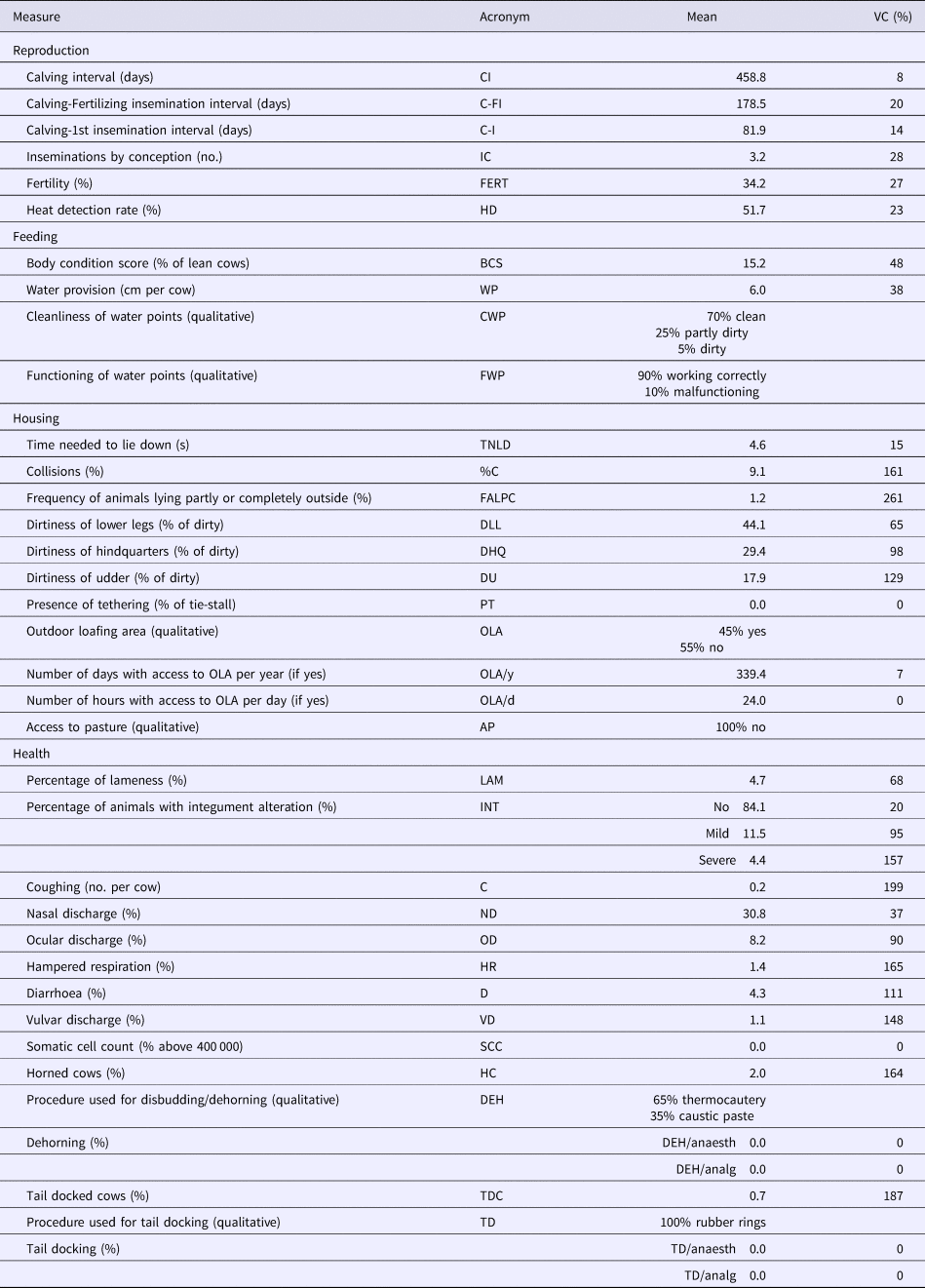
Table 1 shows the variability observed in the welfare parameters evaluated on 20 farms. In terms of feeding, low variability between farms was observed for body condition score (BCS) and water provision (WP) (48 and 38%, respectively). The most homogeneous feeding measurement among farms was functioning of water points (FWP), which was satisfactory in 90% of them. The analysis of housing values showed a high variability between farms for Frequency of animals lying partly or completely outside (FALPC) (261.0%), which was attributed to the influence of one farm showing a particularly high value (around 13.8%). High variability was also observed for collisions (%C) and dirtiness of udder (DU) (161.0 and 129.0%, respectively). No differences between farms were observed for access to pasture (AP), number of hours with access to outdoor loafing area per day (OLA/d) and per year (OLA/y) and presence of tethering (PT). Farms in this region of Spain had no presence of tethering or access to pasture, but some farms had outdoor loafing area (OLA) with permanent access.
Descriptive statistics (mean and variation coefficient) of the variables measured in the present study in accordance with the WQ protocol (2009)

CI, calving interval; C-FI, calving-fertilizing insemination interval; C-I, calving-1st insemination interval; IC, inseminations per conception; FERT; fertility; HD, heat detection rate; BCS, body condition score; WP, water provision; CWP, cleanliness of water points; FWP, functioning of water points; TNLD, time needed to lie down; %C, collisions; FALPC, frequency of animals lying partly or completely outside; DLL, dirtiness of lower legs; DHQ, dirtiness of hindquarters; DU, dirtiness of udder; PT, presence of tethering; OLA, outdoor loafing area; OLA/y, number of days with access to OLA per year; OLA/d, number of hours with access to OLA per day; AP, access to pasture; LAM, percentage of lameness; INT, percentage of animals with integument alteration; C, coughing; ND, nasal discharge; OD, ocular discharge; HR, hampered respiration; D, diarrhoea; VD, vulvar discharge; SCC, somatic cell count; HC, horned cows; DEH, procedure used for disbudding/dehorning; TDC, tail docked cows; TD, procedure used for tail docking.
In the health section, several parameters as percentage of lameness (LAM), animals with integument alteration (INT), coughing (C), ocular discharge (OD), hampered respiration (HR), vulvar discharge (VD), horned cows (HC) and tail docked cows (TDC) showed high variability between farms. During the 3 months preceding the welfare assessment, no farm reported any problem associated with increased somatic cell count (SCC) (Table 1).
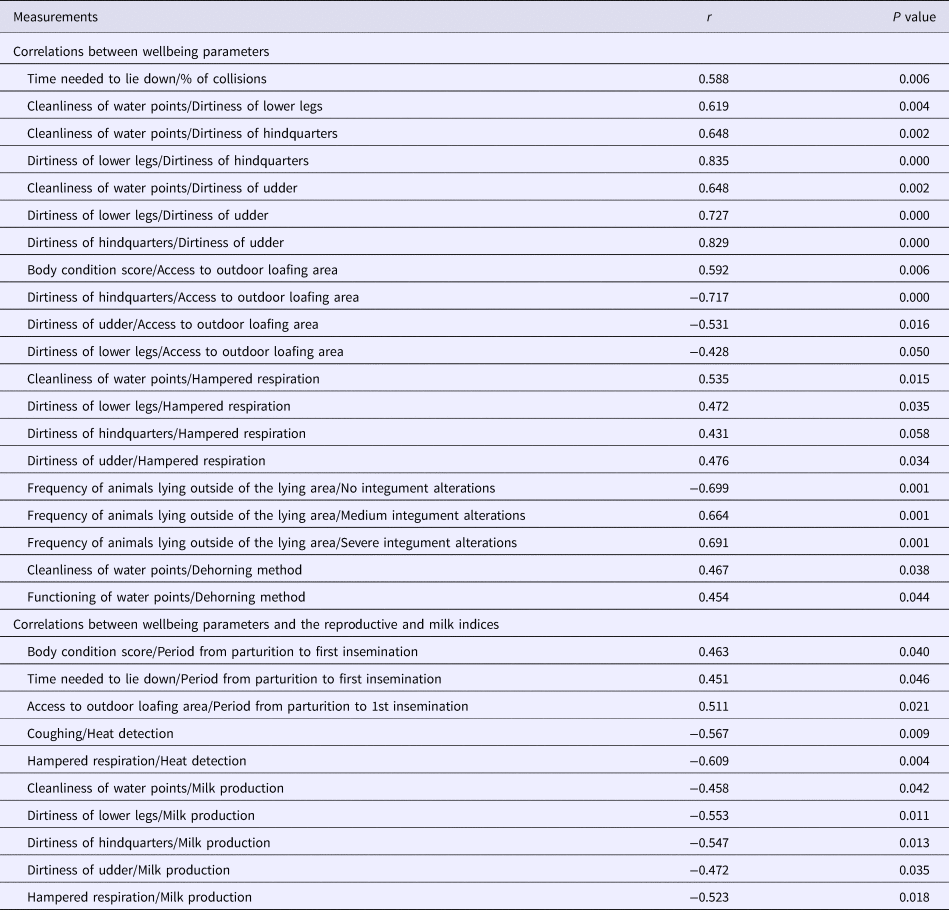
As shown in Table 2, positive correlations were observed between %C and time needed to lie down (TNLD), between cleanliness of water points (CWP) and dirtiness of lower leg (DLL), hindquarters (DHQ) and udder (DU), and between cleanliness of different animal parts. It was observed that farms providing access to outdoor loafing areas had a lower percentage of thin cows (measured as BCS) and cows were significantly less dirty. Furthermore, when the frequency of animals lying partly or completely outside the lying area was higher, the percentage of integument alterations increased. Respiratory problems were more frequently observed on those farms with relatively poor hygiene standards.
Bivariate correlation between different wellbeing parameters obtained on the dairy farms analysed, and between the mentioned parameters and the reproductive and milk indices

Table 2 shows the significant correlations between the parameters assessed by the WQ protocol, reproductive indices and milk production. The percentage of cows showing an inadequate body condition score and those farms where the cows took longer to lie down were correlated with the calving-first insemination interval. Animals showing higher incidence of coughing and hampered respiration presented a lower heat detection rate and milk production and, finally, farms with less clean animals had lower milk production.
Discussion
The welfare assessment carried out on dairy farms located in southern Spain offered an initial snapshot of the state of their wellbeing. As is evident from the welfare reports, the farms included in this study displayed moderately good results, suggesting that good management practices are being utilised in general. The present study showed that farms have welfare-friendly housing systems where cows could express their normal and expected behaviour.
The scores for feeding, housing and health obtained on the different farms did not reveal serious deficiencies, which is consistent with a study carried out on Danish dairy farms (Andreasen et al., Reference Andreasen, Wemelsfelder, Sandoe and Forkman2013). While housing assessment showed ‘excellent’ and ‘enhanced’ scores, with regards to the feeding and health parameters, the percentage of farms scoring ‘acceptable’ and ‘not classified’ were higher (Supplementary Figure S1), highlighting the main targets for enhancing animal welfare on farms in southern Spain. These results are consistent with those reported by DiGiacinto et al. (Reference DiGiacinto Villalobos, Rojas Gonzáles, Estrada, önig and Romero Zúniga2014) in Costa Rica, where the highest score (82.8%) was obtained in the housing assessment and the lowest values in health (40.1%) and feeding (38.1%). In the present study, the relatively good results obtained in housing could be attributable to the fact that farmers have usually focused attention to improving the facilities.
The WQ protocol treats water intake as associated with the number and size of water points available for animals. Considering that cows spend 20–30 min/d drinking water, these water points must have sufficient size and flow and there must be at least two access points to avoid the dominant cow effect, which reduces the access of other cows. As a general rule, the recommended size is 10–15 cm per cow, and this is particularly important in hot climates, as in the case of southern Spain. Only one farm reached this requirement in the present study, and this might partly explain why 70% of the farms obtained only an ‘acceptable’ score. A shortage of water points may be implicated in a decline in productive efficiency and animal welfare (Fraser and Broom, Reference Fraser and Broom1997), and inadequately sized drinking troughs may increase the number of agonistic interactions, limiting the access of some animals (Albright, Reference Albright1993).
The cleanliness of cows provides an indicator of the environmental circumstances in which they are living and dirty environment makes cows feel uncomfortable and reject it (Phillips and Morris, Reference Phillips and Morris2002). As Hauge et al. (Reference Hauge, Kielland, Ringdal, Skjerve and Nafstad2012) point out, cleanliness needs to be maintained since it has a knock-on effect on hygienic milk production, thermoregulation and health. A high positive correlation was observed between dirty appearance at different parts of the animal. This is consistent with the observations made in other studies (Popescu et al., Reference Popescu, Borda, Diugan, Spinu, Groza and Sandru2013) and suggests that the assessment of only one of these parameters could be sufficient to determine the degree of animal cleanliness.
The cleanliness of the cows varied according to the area of the animal assessed. When dirt is assessed in the lower legs, high percentages are reported, from 88 to 100% (des Roches et al., Reference des Roches, Veissier, Coignard, Bareille, Guatteo, Capdeville, Gilot-Fromont and Mounier2014). However, when this evaluation is carried out at udder level, lower percentages (around 22%) are observed (des Roches et al., Reference des Roches, Veissier, Coignard, Bareille, Guatteo, Capdeville, Gilot-Fromont and Mounier2014). Cleanliness aspects are usually linked to the overall management of farms, inasmuch as when farmers' management of housing systems is substandard, animals show deficient cleanliness. The results obtained in the present study show that the dirtiest cows were found on those farms with the dirtiest drinkers.
A positive correlation was detected between %C and TNLD, which is intuitively plausible since any poor design of housing equipment or unsuitable maintenance of bedding would induce cows to take longer to lie down or collide with the facilities. Other factors, especially health factors such as mastitis and lameness, also have the potential to increase TNLD, because they increase the pain and discomfort experienced by animals and reduce their mobility.
On most of the farms, no animals lying badly in the rest area were detected, although on one farm 13.8% of the animals presented defects while lying down. It should be clarified that on this particular farm, the cubicles had been recently built (around 1 month previously) and the animals were in the middle of the adaptation period. This observation highlights the importance of research into isolated events that could affect animal welfare. Skin lesions are a common occurrence in animals who find it difficult to lie down properly on concrete surfaces. This helps to account for the positive correlation that was found between FALPC and INT in the present study.
Around 95% of the farms obtained only an ‘acceptable’ level of health. This could be linked to the absence of health records kept at the farms, which impedes the design of efficient preventative protocols. This handicap has been partially overcome in some Nordic countries by the implementation of mandatory disease records at the farm level (Olsson et al., Reference Olsson, Baekbo, Hansson, Rautala and Østeras2001). In reference to respiratory problems, they were more frequently detected in farms with less rigorous hygiene (CWP, DLL, DHQ, and DU) as a consequence of higher concentrations of microorganisms and the presence of ammonia. Where hoof diseases are concerned, it is known that they have the highest impact on dairy cows' welfare and, as a consequence, negatively affect the production, reproduction and behaviour of the animals (Von Keyserlingk et al., Reference Von Keyserlingk, Rushen, De Pasille and Weary2009). Lameness prevalence rates in European dairy herds range from 1 to 21% in loose housing systems (Sogstad et al., Reference Sogstad, Fjeldaas and Osteras2005). In the present study, lameness (counting only severe cases) reached a rate of 4.7%, in line with the level reported by Naceur et al. (Reference Naceur, Frouja, Aloulou, Bouallegue, Kaur, Brar, Hamouda and Chaiyabutr2012). It was observed that farms exhibiting a high percentage of lameness were eventually visited by a podiatrist to diagnose and treat hoof defects. On those farms where the farmer was trained to recognise and prevent hoof problems, by contrast, the percentage of lameness significantly decreased.
As far as the procedures for disbudding and dehorning are concerned, it was observed that farms using caustic soda exhibited more problems in CWP and FWP. Far from establishing cause and effect relationships for these parameters, these correlations could indicate which farmers are aware of animal welfare (they take care of drinking fountains and avoid the most painful methods of disbudding and dehorning), and those who are oblivious of such bad practices.
In general terms, the time required for carrying out the welfare assessment per farm was around 6–7 h. In this context, the absence or low variability observed for some parameters (e.g. PT and AP) enables the authors to suggest that these measures (included in the WQ protocol) could be effectively ignored, thereby simplifying the protocol and making it less time-consuming. The existence of high correlations between some parameters (DLL, DHQ and DU) may also help to simplify the protocol, eliminating the measurements that provide similar information.
With regard to the correlations between the welfare and the reproductive data, the percentage of cows in the present study exhibiting an inadequate body condition score was positively correlated with the calving-first insemination interval. This means that lean cows need more time to express signs of heat and to be inseminated when the percentage of inadequate BCS is higher, which is consistent with the findings of Roche et al. (Reference Roche, Friggens, Kay, Fisher, Stafford and Berry2009). According to the present study, nutrition is a factor with an impact on reproductive performance, as is also the case with housing, health, genetic selection and management (Mee, Reference Mee2012).
Those farms classified as having an ‘enhanced’ score for housing showed heat detection rate (HD) between 21.5 and 67.5%, while ‘excellent’ farms showed a smaller range (41–67%). It could be that an inappropriate design of the rest area leads to lower oestrus expression and therefore deficient heat detection. In the present study it was also observed that the calving-first insemination interval was higher on those farms where the cows took longer to lie down, suggesting that animals in uncomfortable situations could delay their oestrus expression. These findings are in line with Relić and Vuković (Reference Relić and Vuković2013), who affirm that the risks associated with reproduction are multifactorial, and housing conditions are highly implicated. With regards to the health evaluation, those animals showing a higher incidence of coughing and hampered respiration presented a lower heat detection rate and milk production, highlighting the importance of monitoring animal health on farms.
It has become a requirement for various industries to demonstrate compliance with certain standards of wellbeing by means of animal welfare assessments and audits (Rushen et al., Reference Rushen, Butterworth and Swanson2011). The modern dairy industry, in which the pressure to increase milk yields poses a risk to wellbeing, requires technicians with certain skills and knowledge of animal welfare to ensure that cows are able to live happily in their productive environment. Both farmers and veterinarians must be trained with this goal in mind.
In light of the results obtained here, it is concluded that most of the farms included in this study exhibit an adequate welfare status in terms of the WQ protocol, although the housing assessment revealed higher scores than the feeding and health sections, highlighting potential remedial action that could be taken to enhance welfare on these farms. Findings also support the suggestion that time required for welfare assessment can be reduced, since there are high correlations between certain parameters. Finally, welfare indicators showed a positive correlation with some reproductive parameters, which suggests that the enhancement of wellbeing factors will be positive for increasing the reproductive indices of dairy cows.
This study may be seen as a preliminary step towards a more elaborate programme of welfare animal and devising future systems of certification such as quality seals.
Supplementary material
The supplementary material for this article can be found at https://doi.org/10.1017/S0022029919000207