INTRODUCTION
The leaf of vascular plants is the main photosynthetic organ across a wide variation in life forms. During their life, plants continue to turn over new leaves. The longevity of individual leaves characterizes the life history strategy of the plant, and is related to such leaf traits as photosynthetic rate, nitrogen concentration, leaf mass per area (LMA) and leaf toughness (Reich et al. Reference REICH, WALTERS and ELLSWORTH1992, Reference REICH, WALTERS and ELLSWORTH1997). Correlations between longevity and traits of leaves have been recognized to reflect the trade-off between productivity and persistence (Chabot & Hicks Reference CHABOT and HICKS1982, Coley Reference COLEY1983, Kikuzawa Reference KIKUZAWA1991, Reich et al. Reference REICH, UHL, WALTERS and ELLSWORTH1991, Reference REICH, WALTERS and ELLSWORTH1992). Short-lived leaves are designed to maximize short-term photosynthetic rates, whereas long-lived leaves show generally low assimilation rates reflecting high allocation to physical leaf persistence. Leaves with longer life spans need to supplement higher costs to construct their leaves with greater levels of protection, such as tough leaf structure and chemical defence against herbivores, pathogens and severe physical conditions (Chabot & Hicks Reference CHABOT and HICKS1982, Kikuzawa Reference KIKUZAWA1991, Turner Reference TURNER1994). Many studies describe such trade-off relationships between leaf longevity and other leaf traits. The same trade-off rule has been found to hold true across life forms and across biomes worldwide (Reich et al. Reference REICH, WALTERS and ELLSWORTH1997, Wright et al. Reference WRIGHT, REICH, WESTOBY, ACKERLY, BARUCH, BONGERS, CAVENDER-BARES, CHAPIN, CORNELISSEN, DIEMER, FLEXAS, GARNIER, GROOM, GULIAS, HIKOSAKA, LAMONT, LEE, LEE, LUSK, MIDGLEY, NAVAS, NIINEMETS, OLEKSYN, OSADA, POORTER, POOT, PRIOR, PYANKOV, ROUMET, THOMAS, TJOELKER, VENEKLAAS and VILLAR2004, Reference WRIGHT, REICH, CORNELISSEN, FALSTER, GARNIER, HIKOSAKA, LAMONT, LEE, OLEKSYN, OSADA, POORTER, VILLAR, WARTON and WESTOBY2005).
A tropical montane forest is a system characterized by non-seasonal thermal conditions and relatively constant humid environments due to cloud formation on montane slopes. Such moderate, moist conditions may facilitate the co-existence of diverse life forms. Epiphytes are more diverse there than in lowland rain forests (Gentry Reference GENTRY1988). Each life form in a tropical montane forest can exhibit respective leaf characteristics reflecting adaptation to the environment. Leaves are variable in such traits as size, shape and texture, as well as anatomical, chemical and physiological features (Turner Reference TURNER2001). Leaf traits can vary within the same species or even within the same individual. Leaves show different physiological and morphological traits (Rozendaal et al. Reference ROZENDAAL, HURTADO and POORTER2006) and longevity (Reich et al. Reference REICH, UHL, WALTERS, PRUGH and ELLSWORTH2004) between sun and shaded individuals in the same species, as a result of adaptation to the local environment. Trees change their LMA and leaf longevity in response to changes in environmental conditions as they grow in height (Osada et al. Reference OSADA, TAKEDA, FURUKAWA and AWANG2001). In the understorey of tropical forest, plant individuals live under a uniformly low light situation with little seasonal variation (Chazdon & Fetcher Reference CHAZDON and FETCHER1984), while in a somewhat stable environment regarding temperature and humidity, allowing the co-existence of small plants as well as juveniles of tall plants. The performance and traits of these species should reflect interspecific competition. However, information on the leaf phenology and longevity in tropical montane forests remains scarce (Turner Reference TURNER2001).
In this study, we observed many plant species at the same location and examine leaf longevity and its relationship to other leaf traits such as leaf area, leaf mass per area (LMA), mass-based leaf nitrogen (Nmass), penetrometer reading, the quantity of condensed-tannin-free total phenolics and condensed tannin, across life-form categories (trees, herbs, climbers and epiphytes) and taxonomic groupings (eudicots, monocots, magnoliids and chloranthales, and ferns). We monitored 101 species with different leaf traits and defensive levels in the forest understorey. The hypotheses we examine are (1) plants coexisting in the understorey show similar leaf longevity reflecting adaptation to low light and stable environment; (2) some leaf traits have strong influence on leaf longevity; and (3) life form and taxonomic grouping affect leaf performance.
METHODS
Study site
We carried out this study in Mt. Halimun National Park, West Java, Indonesia. The park is 40 000 ha and covered by well-preserved tropical montane forest ecosystems on volcanic substratum where weather differences between the dry season and the rainy season are slight. The average annual rainfall and monthly air temperature during the period from 1980 to 1989 at Cipanas (6°45′S, 107°81′E, 1100 m asl) were 3065 mm y−1 and 21.0 °C, respectively (Nakamura et al. Reference NAKAMURA, NOERDJITO and HASYIM1994). The rainy season is from October to April with monthly precipitation of 320 mm. The dry season is from May to September with monthly precipitation of 160 mm. About 500 plant species from 266 genera and 93 families have been recorded in the park (Simbolon et al. Reference SIMBOLON, WIRADINATA, YONEDA, Simbolon, Yoneda and Sugarjito1998).
A 1-ha permanent plot (6°44.57′S, 106°32.08′E) was established on the northern slope of Mt. Kendeng in Cikaniki area at the elevation of 1100 m asl (Suzuki et al. Reference SUZUKI, YONEDA, SIMBOLON, MUHIDIN, WAKIYAMA, Yoneda, Sugarjito and Simbolon1997, Reference SUZUKI, YONEDA, SIMBOLON, FANANI, NISHIMURA, KIMURA, Simbolon, Yoneda and Sugarjito1998). There were 116 species and 950 trees in the plot, with trunk girth at breast height greater than 15 cm. The crown top height of the tallest tree was 48 m, and the sum of basal area was 36.3 m2 ha−1. Dominant tree species were Altingia excelsa (Hamamelidaceae), Schima wallichii (Theaceae) and Quercus lineata Bl. (Fagaceae). The field survey was carried out in the 1-ha plot and along the route from the Cikaniki Research Station to the plot (c. 1 km).
Experimental design
The leaf phenology was monitored from August 2002 to March 2005 in the study site. For the basis of comparative study, 101 species were selected and marked. We chose understorey sites entirely covered by forest canopy. Only one species, Alocasia macrorrhiza, was collected from a riverine open site. Samples were selected from the wide range of taxonomic groups of vascular plants, which were classified into four life-form categories and four taxonomic groupings. We classified life forms into tree saplings (51 spp.), herbs (23 spp.), climbers (21 spp.) and epiphytes (6 spp.). Tree category includes the saplings of trees, small trees and shrubs with stems showing secondary lignification. Climber category contains epiphytic and creeping species that cannot stand independently. Taxonomic groupings were eudicots (51 spp.), monocots (27 spp.), magnoliids and chloranthales (9 spp.) and ferns (14 spp.). Because we sampled only one species from chloranthales, magnoliids and chloranthales were treated as one grouping. Three individuals of each species with their height less than 2 m were collected. For each sampled plant we recorded stem height, total leaf number on the leader shoot (at the highest position of the individual) and herbivory ratio of each leaf at the first census. The herbivory ratio was estimated with a five-point scale (0, 25, 50, 75, 100%) and the average calculated. The number of leaves that newly emerged or died were recorded over 30 mo at the interval of 1 mo (August 2002–December 2003) and of 2 mo (January 2004–March 2005). To identify the time of leaf emergence, we used different-coloured marker pens. Leaves that emerged within a monitoring interval were grouped into one cohort. Leaf birth was defined when the young leaf flushed and grew adequately as they were not injured by leaf marking. Leaf death was defined when the leaf colour turned brown. Leaf-flushing interval was calculated to average the interval that new leaf was monitored.
Leaf samples for the measurement of leaf traits were randomly chosen from three to five individual plants of each species, which were different from plants for the leaf longevity monitoring. Each leaf trait can change with increasing leaf age. To avoid selecting too young or old leaves and average the effect of leaf age, middle-situated leaves on a representative shoot were sampled. After scanning the leaf with an image scanner connected to PC, the image was analysed using NIH Image 1.63 and leaf area determined. The penetrometer reading of fresh leaves was indicated by the force (g) to punch holes in a leaf blade with a columnar steel-tip of 2 mm diameter using a push-pull gauge (CPU Gauge; Model 9500, Aikoh Engineering Co.). One leaf was used from each sample and the penetrometer reading was measured at three points on each leaf. After that, leaves were put into a plastic bag with silica gel until leaves were completely dried. After measuring leaf mass and leaf mass per area (LMA), leaves were ground by the Wonder Blender (Tokyo Grass). The concentration of total phenolics in 10 mg of leaf powder was determined by the Folin–Ciocalteu method (Folin & Ciocalteu Reference FOLIN and CIOCALTEU1927; modified by Julkunen-Tiitto Reference JULKUNEN-TIITTO1985). The concentration of condensed tannin was determined using the proanthocyaniden method (Bate-Smith Reference BATE-SMITH1977). The nitrogen and carbon concentration were measured using NC analyser (Vario EL, Elemental). Mass-based leaf nitrogen (Nmass) was calculated for each sample. Mean leaf traits of each species were used for the following analysis.
Data analysis
In this study, we adopted a statistical survival analysis applying the Cox proportional hazards regression, to estimate leaf survivorship and longevity, without assuming constant leaf turnover. At the same time, the effect of leaf traits on leaf longevity was estimated with the method. The method has been used for the analysis of root (Anderson et al. Reference ANDERSON, COMAS, LAKSO and EISSENSTAT2003, Wells & Eissenstat Reference WELLS and EISSENSTAT2001) and tree survivorship (Magnussen et al. Reference MAGNUSSEN, ALFARO and BOUDEWYN2005), although it is not so familiar for leaf populations.
We applied the Cox proportional hazards regression for all the monitoring data (101 spp. × 3 samples) to estimate species leaf longevity and to assess simultaneously the effects of the following leaf traits on leaf longevity: leaf area, LMA, Nmass, penetrometer reading, the quantity of condensed-tannin-free total phenolics and condensed tannin. The differences among life-form categories and taxonomic groupings were also determined at the same time. The Cox proportional hazards regression is a modelling procedure that allows the effects of each covariate (life-form categories, taxonomic groupings and leaf traits) to be evaluated, eliminating effects of other covariates (Allison Reference ALLISON1995, Cox Reference COX1972). Individual leaves are evaluated for their ‘hazard’ of mortality or the instantaneous probability of mortality. In the Cox proportional hazards regression model, the hazard of an individual leaf at age t (mo) from emergence is defined as the product of a baseline hazard function at the t, h 0(t), that is common irrespective of species, and the exponent of the linear combination of k leaf traits (Allison Reference ALLISON1995). h 0(t) is common function among species, having age dependency;
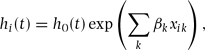
where i specifies species identity and xik is measurement of leaf trait k of species i; βk is the coefficient of xik. We used the statistical package SURVIVAL 2.32 (Venables & Ripley Reference VENABLES and RIPLEY2002) on R 2.5.1 (R Development Core Team, !http://www.R-project.org) to estimate the parameter βk by using Efron approximation in the maximum partial likelihood method (Venables & Ripley Reference VENABLES and RIPLEY2002). For nominal variables, such as life-form category and taxonomic grouping, one category, ‘trees’ and ‘eudicots’ were set as standard (i.e. zero) and each value of parameter estimates for other categories were interpreted as the difference of each category from trees and eudicots.
When interpreting the results of the analysis, a negative parameter estimate indicates that increasing the corresponding covariate is associated with decreasing the risk of mortality, and vice versa. We also show the risk ratio, exp(βk), to evaluate the relative contribution of the covariate k to the estimated instantaneous mortality. For covariates of life-form category and taxonomic grouping as nominal variables, the risk ratio demonstrates the ratio of the hazard of being a given life-form category, or taxonomic grouping, leaving all other covariates identical. For quantitative covariates such as LMA, subtracting 1.0 from the risk ratio gives the estimated relative change in mortality associated with one unit change in the covariate.
The model selection using the Akaike's information criterion (AIC) was carried out (Burnham & Anderson Reference BURNHAM and ANDERSON1998). From the selected best model, we calculated the estimated leaf survival curve of each species. For selected model, the Wald test was used to test the null hypothesis that each βk was equal to zero.
With the Cox proportional hazards regression, we could not calculate the survivorship beyond the length of the monitoring period. Leaf longevity was calculated by extrapolating the baseline survivorship curve with the mortality at t = 30 mo for the unrecorded period of t > 30 mo. To check the effect of seasonality and research period of monitoring, the result with 30 mo of data was compared with the result with 24 mo of data. Here we present the result with 30 mo, because the difference between these data sets was only slight and negligible. The generalized linear model with model selection using AIC was carried out to analyse the difference in leaf longevity between life forms. All statistical analyses were performed using R 2.5.1.
RESULTS
Comparison of leaf traits between life forms
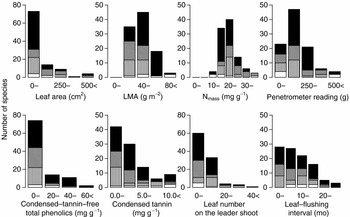
Leaf traits were compared between life-form categories. Figure 1 shows the distribution of measured leaf traits. The majority of examined species (72%) belonged to the smallest leaf-size class (< 125 cm2). Most of the climbers had small leaves, with the average leaf area of 67 cm2. LMA, Nmass and the penetrometer reading indicated unimodal distribution. Trees and epiphytes had greater LMA than other life forms. Nmass was variable (11–38 mg g−1) within each life-form category, except climbers that showed a narrow range of Nmass at 17–30 mg g−1. Some epiphytes and trees were tougher than others. Climbers had the weakest leaves. Condensed-tannin-free total phenolics and condensed tannin showed inverse J-shaped distribution. The leaf concentration of condensed-tannin-free total phenolics was high in trees, while the 96% of herbs and the 90% of climbers contained less than 20 mg g−1. The amount of condensed tannin was relatively uniformly distributed between life-form categories than condensed-tannin-free total phenolics. Climbers had the largest number of leaves on the leader shoot (17 leaves on average) among the four life forms; other categories had ≤ 10 leaves on the leader shoot on average. Some tree species showed long (more than 30 mo) leaf-flushing intervals, while average interval was similar among life-form categories at around 10 mo.
Observed distribution of morphological, physiological and demographic traits of leaves between each life-form category in a tropical montane forest, West Java, Indonesia. Closed, hatched line, vertical line and open indicate trees, herbs, climbers and epiphytes, respectively.

Relationships between leaf longevity and leaf traits
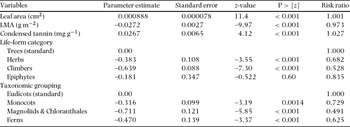
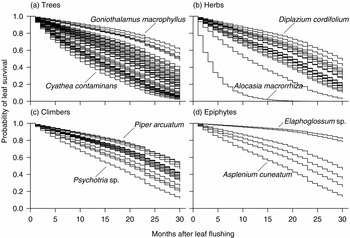
Results of survival analysis indicated that the leaf survivorship was related to leaf area, LMA and condensed tannin (Table 1). Although Nmass and the penetrometer reading were not selected as explanatory variables, the high intercorrelation among LMA, Nmass and the penetrometer reading (Appendix 2) implied the reason they were not selected. LMA showed a positive and the largest influence on the leaf survivorship (P < 0.001). Leaf area and condensed tannin showed a negative effect (P < 0.001) on leaf survival. The difference in life forms showed significant influence upon leaf survival. The risk ratio of trees was higher (thus shorter longevity) than those of other life-form categories; leaving leaf traits identical. Taxonomic grouping was also selected as an explanatory variable. Monocots and ferns had a lower risk ratio than eudicots, and the leaf mortality of the group of magnoliids and chloranthales was the lowest among four taxonomic groupings. Figure 2 illustrates the survivorship curves of each species. The longest leaf longevity in trees was found for Goniothalamus macrophyllus (61 mo) and the shortest was for Cyathea contaminans (11 mo). The longest and shortest species in leaf longevity were Diplazium cordifolium (43 mo) and Alocasia macrorrhiza (3.3 mo) for herbs, Piper arcuatum (48 mo) and Psychotria sp. (17 mo) for climbers, and Elaphoglossum sp. (145 mo) and Asplenium cuneatum (18 mo) for epiphytes. The species, which has shortest leaf longevity, Alocasia macrorrhiza (3.3 mo) was sampled from a riverine open site, with big leaves, low LMA and high Nmass. The species which have longest leaf longevity, Elaphoglossum sp. (145 mo) and Vittaria sp. (119 mo), were epiphytic ferns characterized by very small leaves with an extremely high LMA, low Nmass, high penetrometer reading and high condensed tannin concentration.
Results of the Cox proportional hazards regression, based on the maximum partial likelihood estimation on leaf longevity in a tropical montane forest, West Java, Indonesia. The signs of the parameter estimate indicate whether a variable is positively or negatively related to the hazard of leaf death. Risk ratios show the degree of estimation about the increased or decreased predicted risk.

Survivorship curves of each species over 30 mo reconstructed with the Cox proportional hazards regression model. Trees (51 spp.) (a), herbs (23 spp.) (b), climbers (21 spp.) (c) and epiphytes (6 spp.) (d). Observation was carried out from August 2002 to March 2005 in a tropical montane forest, West Java, Indonesia.

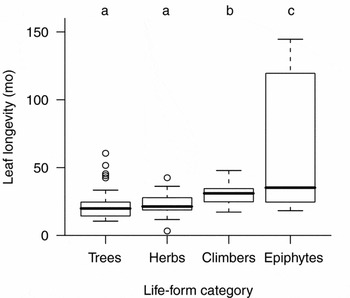
The estimated leaf longevity showed that climbers (31.1 ± 8.6 mo) and epiphytes (62.9 ± 54.6 mo) had slightly longer leaf life span than others (Figure 3). Unexpectedly, there was no significant difference between trees (21.9 ± 10.7 mo) and herbs (23.0 ± 8.2 mo). Figure 3 indicates that the leaf longevity of most species was from 10 to 50 mo, with a few exceptions.
Box plots of estimated leaf longevity for life-form categories in a tropical montane forest, West Java, Indonesia. The central box in each box plot shows the interquartile range and median; the whiskers are extended to the most extreme data point which is no more than 1.5 times from the interquartile range of each box. Open circles indicate outlier. Different letters indicate significantly different distribution between categories by the generalized linier model with model selection using AIC.

Relationships among leaf traits
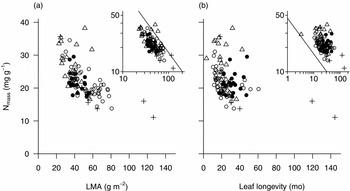
There was a trade-off relationship between LMA and Nmass (Figure 4a). Figure 4a also suggests that the trade-off relationship between LMA and Nmass is common irrespective of life-form categories. Unlike LMA versus Nmass pattern, leaf longevity versus Nmass pattern (Figure 4b) did not show clear negative correlation. Trees showed a tendency to have shorter longevity at the same Nmass than other life forms. Climbers showed an opposite tendency to trees.
Relationships between leaf traits among four life-form categories in a tropical montane forest, West Java, Indonesia. Relationship between LMA and mass-based leaf nitrogen (Nmass) (a), and leaf longevity and Nmass (b). Open circle, tree; triangle, herb; closed circle, climber; cross, epiphyte. The inserts show the log-log plots and regression lines of Wright et al. (Reference WRIGHT, REICH, WESTOBY, ACKERLY, BARUCH, BONGERS, CAVENDER-BARES, CHAPIN, CORNELISSEN, DIEMER, FLEXAS, GARNIER, GROOM, GULIAS, HIKOSAKA, LAMONT, LEE, LEE, LUSK, MIDGLEY, NAVAS, NIINEMETS, OLEKSYN, OSADA, POORTER, POOT, PRIOR, PYANKOV, ROUMET, THOMAS, TJOELKER, VENEKLAAS and VILLAR2004) for global leaf-trait patterns.

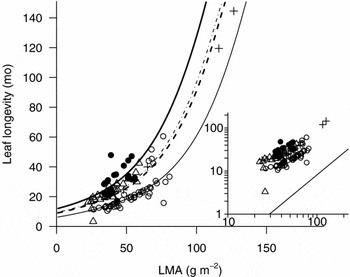
The discrepancy between Figures 4a and 4b reflects the life-form dependence of LMA-longevity pattern (Figure 5). Trees showed shorter leaf longevity than other life forms at the same LMA, and climbers had longer leaf longevity than other life forms. There was more than a twofold difference in leaf longevity between trees and climbers at the same LMA.
Relationship between LMA and leaf longevity in a tropical montane forest, West Java, Indonesia. Open circle, tree; triangle, herb; closed circle, climber; cross, epiphyte. Lines show relationship between LMA and leaf longevity, with mean values of other leaf traits and taxonomic groupings in each life-form category. Solid, dash-dotted, bold solid and broken lines indicate trees, herbs, climbers and epiphytes. The insert shows the log-log plot and regression line of Wright et al. (Reference WRIGHT, REICH, WESTOBY, ACKERLY, BARUCH, BONGERS, CAVENDER-BARES, CHAPIN, CORNELISSEN, DIEMER, FLEXAS, GARNIER, GROOM, GULIAS, HIKOSAKA, LAMONT, LEE, LEE, LUSK, MIDGLEY, NAVAS, NIINEMETS, OLEKSYN, OSADA, POORTER, POOT, PRIOR, PYANKOV, ROUMET, THOMAS, TJOELKER, VENEKLAAS and VILLAR2004) for global leaf-trait pattern.

DISCUSSION
We detected leaf traits explaining leaf longevity of plants in a tropical montane forest. LMA influenced leaf survivorship positively more than other leaf traits did. It is often suggested that LMA is a good indicator of leaf longevity (Reich Reference REICH1993, Reich et al. Reference REICH, WALTERS and ELLSWORTH1992). Generally, there is a negative correlation between leaf longevity and Nmass (Reich Reference REICH1993, Reich et al. Reference REICH, WALTERS and ELLSWORTH1992). In our results, however, the relationship between leaf longevity and Nmass was not so clear. Nmass was not selected as an explanatory variable of leaf longevity in our analysis, partly because LMA and Nmass showed negative correlation (Figure 4a) and LMA was more strongly correlated with leaf longevity (Figure 5). Because of the correlation with LMA, a penetrometer reading was not selected by regression model either (Appendix 2). The negative relationship between LMA and Nmass can reflect the trade-off between biomass investment to the leaves and leaf photosynthetic ability, although photosynthetic nitrogen-use efficiency is different between species (Hikosaka et al. Reference HIKOSAKA, HANBA, HIROSE and TERASHIMA1998). Because leaf N concentration is expected to be correlated with photosynthetic capacity, this implies that photosynthetic ability decreases with increasing LMA. The strong correlation of Nmass and the penetrometer reading with LMA (Appendix 2) implies that they have also important effects on leaf longevity associated with leaf productivity.
Condensed tannin negatively correlated with leaf survival (Table 1). It is the effect of condensed tannin on leaf longevity when other measured leaf traits are homogeneous. The result implies an intercorrelation between condensed tannin and other leaf traits; in such a case, the increase in condensed tannin may sacrifice some material associated with leaf survivorship. Moreover, phenolic compounds, such as condensed tannin, are usually a major component of carbon-based defences (Bryant et al. Reference BRYANT, HEITKONIG, KUROPAT and OWEN-SMITH1991, Coley Reference COLEY1986, Coley & Aide Reference COLEY, AIDE, Price, Lewinsohn, Fernandes and Benson1991, Rossiter et al. Reference ROSSITER, SCHULTZ and BALDWIN1988). Because condensed tannin works as a part of quantitative chemical defences (Waterman & Mole Reference WATERMAN and MOLE1994), it is difficult to reveal the direct effect on leaf survivorship. Condensed tannin did not lengthen leaf longevity, however it may suppress herbivory, although we could not find any correlation between herbivory ratio and leaf traits (Appendix 2). One-time monitoring of herbivory ratio was not enough to estimate the intensity of herbivory, because we recorded a cumulative value only for survivors.
The fact that the life-form category was selected as an explanatory variable suggests that leaf survival was not exclusively explained by the set of measured leaf traits. The high risk ratio of tree leaves was remarkable. The relationship between LMA and leaf longevity was different among life-form categories. This implies that the construction of leaf biomass is different among life-form categories (for example lignin versus cellulose versus others). However we did not measure the construction of leaf mass, otherwise, there would be more ecological traits related to our result. Taxonomic grouping also showed influence on leaf longevity. Magnoliids and chloranthales had the lowest risk ratio among four taxonomic groupings. At the same time, the estimated leaf longevity presented in Figure 3 indicates that trees and herbs have similar leaf longevity; this differs from the results in Table 1. The non-uniform distribution of measured leaf traits may affect the difference of leaf longevity among life-form categories. Table 1 shows that leaf area has a negative influence on leaf longevity, and climbers have relatively small leaves.
In this study, we used semi-parametric proportional hazards modelling over parametric approach with exponential distribution. The estimated leaf longevity here was 0.8 times shorter than that using exponential distribution on average; even so the leaf longevity in the understorey is longer than the global average reported by Wright et al. (Reference WRIGHT, REICH, WESTOBY, ACKERLY, BARUCH, BONGERS, CAVENDER-BARES, CHAPIN, CORNELISSEN, DIEMER, FLEXAS, GARNIER, GROOM, GULIAS, HIKOSAKA, LAMONT, LEE, LEE, LUSK, MIDGLEY, NAVAS, NIINEMETS, OLEKSYN, OSADA, POORTER, POOT, PRIOR, PYANKOV, ROUMET, THOMAS, TJOELKER, VENEKLAAS and VILLAR2004). The results of Cox proportional hazards regression show that the leaf survivorship curve drops slightly at first, then greatly 10 mo after leaves flushed. The increasing leaf mortality with leaf age is in accordance with previous results (Reich et al. Reference REICH, UHL, WALTERS, PRUGH and ELLSWORTH2004, Vincent Reference VINCENT2006). Reich et al. represented that the leaf mortality rate generally increased with leaf age until the median leaf life span, then decelerated at older leaf ages. Although we could not observe directly the complete range of leaf life lengths for long-lived leaves, 30 mo of records with semi-parametric Cox proportional hazards regression provides a reasonable estimate of leaf longevity. Estimated leaf longevity suggested that climbers and epiphytes had longer leaf longevity than other two life forms, trees and herbs. Climbers do not need to have strong stems for mechanical support of their body, though they can have special structures to climb up host plants and can change their position to attach. The species with the longest leaf longevity were two epiphytic ferns with a unique life style. However, the frequency distribution of the leaf longevity of climbers and epiphytes overlapped with those of trees and herbs. Craine et al. (Reference CRAINE, BERIN, REICH, TILMAN and KNOPS1999) estimated leaf longevity and compared ecophysiological differentiation between grasses and forbs. They did not find clear differences between these two life-form categories. Our results on leaf longevity show the same tendency with them. Moreover, we found rather small differences in some leaf traits between life-form categories (Figure 1).
A large number of studies have been made on the factors influencing leaf longevity (Chabot & Hicks Reference CHABOT and HICKS1982, Kikuzawa Reference KIKUZAWA1995) and their associations with other aspects of leaf physiology and plant growth (Reich et al. Reference REICH, WALTERS and ELLSWORTH1992, Reference REICH, WALTERS and ELLSWORTH1997). Leaf longevity is functionally related to various leaf traits, such as Nmass, LMA, and net photosynthesis, across species. High longevity is associated with low nitrogen concentration, low photosynthetic rate per leaf mass, and high LMA (Reich et al. Reference REICH, UHL, WALTERS and ELLSWORTH1991, Reference REICH, WALTERS and ELLSWORTH1992). It has been proposed that the long-lived leaves have to increase toughness and defence to escape from physical and ecological damage (Chabot & Hicks Reference CHABOT and HICKS1982, Kikuzawa Reference KIKUZAWA1991, Turner Reference TURNER1994). Our results did not fully detect these tendencies. Rather, these were only applicable within each life-form category, but were not across categories. Tree species showed relatively short-lived and high biomass investment to the leaves when compared with other life forms (Figure 5). Long leaf longevity compensates for low productivity and saves limited nutrients (Reich et al. Reference REICH, WALTERS and ELLSWORTH1992). Therefore the combination of low Nmass, high LMA and short leaf longevity of tree leaves compared with other life forms needs to be explained.
We suggest some possible explanations of the phenomenon of high biomass investment in short-lived tree leaves. Kikuzawa (Reference KIKUZAWA1991) indicated that leaves must be replaced when the net gain of a leaf per unit time over its longevity is maximized. In his model, the optimum leaf life span is defined by three parameters, i.e. initial net photosynthetic rate, leaf construction cost, and the rate of decline in net photosynthetic rate with time. The photosynthetic ability of leaves decreases with the degradation of light environment and leaf age (Ackerly Reference ACKERLY1999, Hikosaka Reference HIKOSAKA1996, Hikosaka et al. Reference HIKOSAKA, TERASHIMA and KATOH1994). Osada et al. (Reference OSADA, TAKEDA, FURUKAWA and AWANG2001) indicates that leaf longevity decreases with plant height. The plants need to shed their leaves in response to abrupt environmental change. Usually older leaves may suffer mutual shading by younger leaves and nutrients in older leaves can be retranslocated to new leaves, which may accelerate leaf senescence and reduce leaf longevity. Such regulation within a crown may be especially pronounced in trees, because they have high potential of branching, generating a larger number of shoot modules than other life forms. Mutual shading among leaves within a crown can thus be strongest for trees. Moreover, on shaded branches in the forest understorey, the individual leaves usually show such capacity to regulate their angle and azimuth by reversible heliotropic movement or petiole adjustment to intercept diffuse radiation (Ackerly & Bazzaz Reference ACKERLY and BAZZAZ1995). To keep such arrangement, physical support cost of laminae can also be important. In contrast to trees, climbers showed relatively long leaf longevity with low LMA. Most sampled individuals of climbers had only one stem and did not make any branches. In our monitoring, climber species showed a lower herbivory ratio than others. Although we did not find the direct relationship between herbivory and leaf traits associated with leaf longevity, a lower herbivory ratio seems to help long-term leaf survival and allows climbers to use each leaf over a long period. Particularly for herbaceous climbers (such as species of Araceae and Piperaceae), not only stems but also leaves are attached to and supported by a host-plant trunk, otherwise the leaves of climbers were usually hanging. In such a situation, the support cost to sustain laminae for a particular period will be minimized.
The alternative explanation we can propose is that the difference among life-form categories is attributable to ontogenetic distinction. In our study, because the samples were collected in the understorey, trees were measured at an earlier stage of ontogenetic development than species in the other life forms. Possibly, an individual tree waits for an opportunity until a light gap is created and then can achieve rapid height growth by using assimilates stored in leaves (that may result in high LMA).
We compared our results with the data of Wright et al. (Reference WRIGHT, REICH, WESTOBY, ACKERLY, BARUCH, BONGERS, CAVENDER-BARES, CHAPIN, CORNELISSEN, DIEMER, FLEXAS, GARNIER, GROOM, GULIAS, HIKOSAKA, LAMONT, LEE, LEE, LUSK, MIDGLEY, NAVAS, NIINEMETS, OLEKSYN, OSADA, POORTER, POOT, PRIOR, PYANKOV, ROUMET, THOMAS, TJOELKER, VENEKLAAS and VILLAR2004, Reference WRIGHT, REICH, CORNELISSEN, FALSTER, GARNIER, HIKOSAKA, LAMONT, LEE, OLEKSYN, OSADA, POORTER, VILLAR, WARTON and WESTOBY2005), the global leaf trends of sun leaves. In our data, the averages of LMA, Nmass and leaf longevity were 48.6 g m−2, 22.3 mg g−1 and 26.6 mo, respectively. LMA was relatively lower, while Nmass and leaf longevity were higher than the global average of sun leaves. Figures 4 and 5 show that the relationships among leaf traits in the understorey were mostly parallel to the global leaf trends. Figure 5 shows that shaded leaves had longer leaf longevity at a given LMA when compared with sun leaves. The comparison between life-form categories showed that, particularly in herbs, the average leaf longevity in the understorey was higher than the average in the open. The difference in leaf traits associated to light condition has been examined in a number of studies. Shaded leaves have a lower LMA and higher chlorophyll concentration per unit leaf mass than sun leaves (Poorter et al. Reference POORTER, KWANT, HERNÁNDEZ, MEDINA and WERGER2000). Some report a higher Nmass in leaves developed under shaded conditions (Bongers & Popma Reference BONGERS, POPMA, Werger, van der Aart, During and Verhoeven1988, Ellsworth & Reich Reference ELLSWORTH and REICH1992, Poorter et al. Reference POORTER, KWANT, HERNÁNDEZ, MEDINA and WERGER2000), although the average of area-based leaf nitrogen (Narea) here was 60% of the global trends of sun leaves, indicating a lower photosynthetic capacity in shaded leaves. Leaf longevity is extended in the dark understorey (Reich et al. Reference REICH, UHL, WALTERS, PRUGH and ELLSWORTH2004, Vincent Reference VINCENT2006). To summarize, understorey leaves maximize their efficiency in light capture per unit leaf mass with lower LMA and higher Nmass (Poorter et al. Reference POORTER, KWANT, HERNÁNDEZ, MEDINA and WERGER2000), and their extended leaf longevity compensates for low productivity and saves limited resources under low light resources.
In our research, LMA showed the largest positive effect on leaf longevity. On the other hand, leaf area and condensed tannin showed negative influence. Nmass, penetrometer reading and condensed-tannin-free total phenolics showed no effect on leaf longevity. Life-form categories and taxonomic groupings had different association with leaf longevity. Trees tended to have higher LMA, and shorter leaf longevity at a given LMA or Nmass compared with other life-form categories, while climbers showed the opposite set of differences and had small leaves that were less tough and with lower concentration of condensed-tannin-free total phenolics. The comparison between our data and global trends (Wright et al. Reference WRIGHT, REICH, WESTOBY, ACKERLY, BARUCH, BONGERS, CAVENDER-BARES, CHAPIN, CORNELISSEN, DIEMER, FLEXAS, GARNIER, GROOM, GULIAS, HIKOSAKA, LAMONT, LEE, LEE, LUSK, MIDGLEY, NAVAS, NIINEMETS, OLEKSYN, OSADA, POORTER, POOT, PRIOR, PYANKOV, ROUMET, THOMAS, TJOELKER, VENEKLAAS and VILLAR2004, Reference WRIGHT, REICH, CORNELISSEN, FALSTER, GARNIER, HIKOSAKA, LAMONT, LEE, OLEKSYN, OSADA, POORTER, VILLAR, WARTON and WESTOBY2005) indicated that understorey species show extended leaf longevity with a lower LMA and higher Nmass.
We also found marked overlap of leaf traits among life forms. In the understorey, the light availability is limited and photosynthetic capacities may be maintained within the low and narrow range; even though, there were marked differences in leaf traits among and within life forms in shaded environment. The foliar morphology such as LMA or leaf toughness is more plastic than assimilation rates or foliar chemistry such as nitrogen concentration (Niinemets Reference NIINEMETS1999). We conclude that each life-form category develops a wide and overlapping range of leaf traits reflecting functional differentiation and trade-offs. Such differentiation and trade-offs among and within life-form categories contribute to their coexistence in the understorey, deep-shaded environments.
ACKNOWLEDGEMENTS
We are grateful to the Research Center for Biology, Indonesian institute of Science (LIPI) for the permission to conduct our research. We particularly thank M. Mansur, H. Simbolon, and other staff of LIPI Bogor for kind supports. We also thank staff of the Mt. Halimun National Park Office and our field assistants for supporting our fieldwork. We appreciate K. Hikosaka, K. Kato, S. Kitaoka, T. Kubo, G. Kudo, S. Matsuki, K. Miyamoto, K. Ono, T. Seino, E. Suzuki, T. Takada, T. Tani, S. Tsuyuzaki and N. Watanabe for discussions and suggestions. We are also grateful to Will Cornwell, Ian Wright and an anonymous reviewer for providing valuable comments and suggestions on the manuscript.
Appendix 1. Species, life-form category, taxonomic grouping and leaf traits of examined species in Mt. Halimun National Park, West Java, Indonesia. Height indicates mean plant height and SD of sampled individuals

Appendix 2. Pairwise correlation coefficients of leaf traits in a tropical montane forest, West Java, Indonesia. Pearson's product-moment correlation coefficient with df of 99. ns, not significant; *, P < 0.05; **, P < 0.01; ***, P < 0.001, with Bonferroni correction