On 13 March 2008, Rob Wegman presented a paper with the title ‘The Other Josquin’ at Margaret Bent's Seminar in Medieval and Renaissance Music at All Souls College, Oxford. At the time of his lecture the paper was still, as Wegman later stated, ‘work in progress’, but shortly after his presentation he submitted his text to the Tijdschrift van de Koninklijke Vereniging voor Nederlandse Muziekgeschiedenis, where it was published in the spring issue of 2008.Footnote 1
In his paper, Wegman tried to demonstrate that over the past few years compositions have been wrongfully excluded from Josquin's oeuvre on the basis of evidence that, on closer analysis, does not hold up. The work he singled out for closer study is Inter natos mulierum (NJE **19.10), a six-part motet ‘whose authorship by Josquin has been questioned, and questioned again, for fifty years’.Footnote 2 Wegman was quick to state, however, that Inter natos was chosen as an example illustrating a broader, underlying problem and that the main purpose of his article would be to retrace why this motet was convicted without evidence and to look for a general remedy.
Remarkably enough, the article, though containing suggestions for an exchange of ideas on the topic of authorship issues in Josquin scholarship, did not lead to much of a response.Footnote 3 It may be wise, however, to take a closer look at Wegman's arguments to find out if the introduction of ‘another’ Josquin could possibly be to the benefit of present-day Josquin research and if so what the consequences could be. After all, authenticity continues to be a recurring issue in Josquin studies and the edition of his music.Footnote 4 In order to engage with Wegman's hypotheses, it is necessary to start with his discussion of the authorship of Inter natos mulierum.Footnote 5 Two main threads are woven into the discussion of this motet: sources and style.Footnote 6
Sources
The assessment of authorship issues often starts with an analysis of the source situation, which then leads to an evaluation of the reliability of all attributions involved. This is the area where Wegman first encounters methodological difficulties. He begins by taking us back to the 1950s, when Helmuth Osthoff was working on his Josquin article for the first edition of Die Musik in Geschichte und Gegenwart. In this article, which was printed in 1958, Inter natos is listed among twelve motets of dubious authenticity. Osthoff's reason for doubting these pieces was that for each of them there was only one Italian source that ascribes it to Josquin. In other words, ‘their attestation … appears to be weak’.Footnote 7 Before pursuing the question of authorship any further, Wegman pauses to ponder the criteria of transmission being invoked here. First he points out that Josquin's ‘“core” works are all transmitted in about five to ten sources (often many more than that) and that the majority of those sources carry ascriptions to Josquin’.Footnote 8 ‘On the other hand’, he continues, ‘we would also find that there is scarcely a work [by Josquin] that survives in only one or two sources or its authenticity has been questioned by some scholar.’ This is followed by the question why ‘numbers of sources, and numbers of attributions, make so much difference to the probability of Josquin's authorship’. The underlying rationale is explained as follows: ‘Since Josquin's music was sought after everywhere, every genuine work by him must have travelled very widely. Consequently we should expect to find it in a fair number of sources. By the same token, a work that turns up in only one or two sources must have a relatively weak claim to his authorship – especially if those sources are late, or survive in out-of-the-way places.’Footnote 9
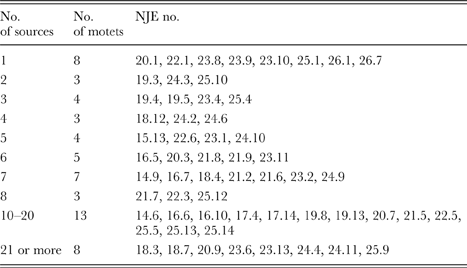
One wonders if this explanation is really accurate. For one, I cannot remember a single case where Josquin's authorship of a particular piece has been rejected because an author or editor deemed it to be transmitted in too few sources. Factual numbers seem to confirm this: there are some sixty motets in Josquin's work-list which are nowadays commonly accepted as authentic.Footnote 10 No fewer than twenty-two of these are transmitted in one to five sources (see Table 1). So it would seem that the actual number of sources is not the decisive factor in establishing authorship.
Authentic motets arranged by number of sources

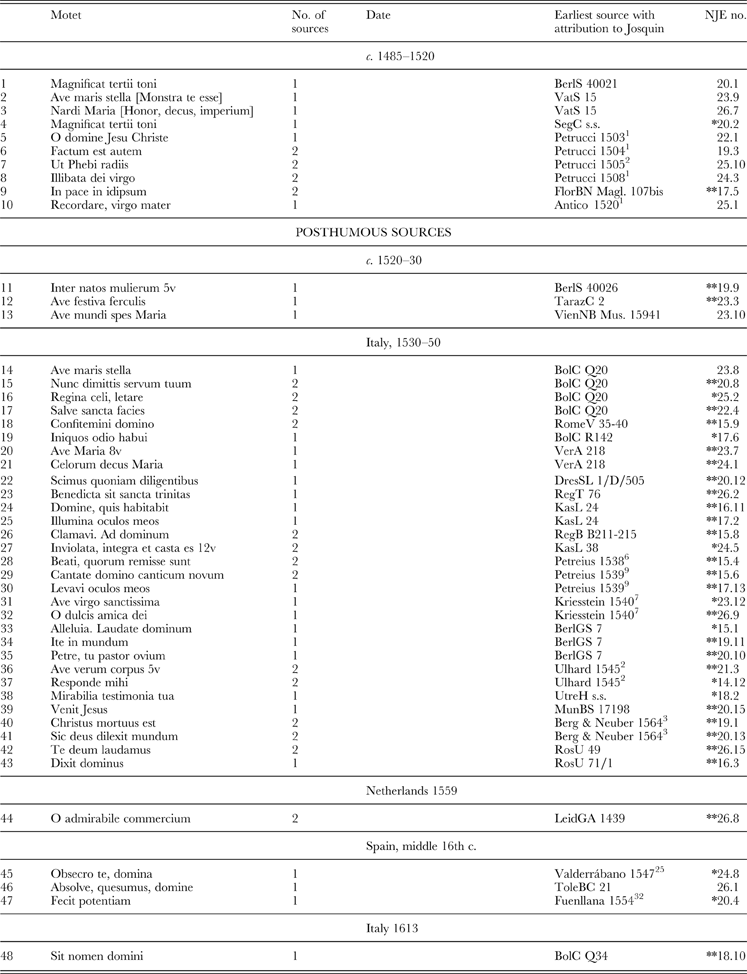
Although Wegman may be right that there is hardly a work by Josquin that survives in one or two sources whose authenticity has not been questioned by some scholar, the explanation for that fact is not one of simply counting sources. A quick look at a list of motets attributed to Josquin that are transmitted in one or two sources may be helpful to get a somewhat clearer picture (Table 2).
Motets attributed to Josquin and transmitted in one or two sources
There are forty-eight motets in this list – approximately 30 per cent of all motets (c. 170) that are attributed to Josquin in at least one source. As a quick glance demonstrates, ten out of the forty-eight motets are transmitted in sources that were copied or printed during Josquin's lifetime. These works, with the exception of a single piece (no. 9 in the table), are commonly accepted as authentic works. The other thirty-eight motets appear in printed editions and manuscripts that were compiled after Josquin's death and only three among them are considered to be authentic by NJE editors (Ave mundi spes Maria, Ave maris stella and Absolve, quesumus, domine). Nine motets are accepted as dubious pieces, and the remaining works – twenty-six pieces – are thought to be spurious works.Footnote 11
If this survey demonstrates anything, it is that posthumous sources with Josquin attributions seem to be regarded with extreme caution in Josquin scholarship. However, as some pieces in sources dating from after 1521 have been accepted as either authentic or dubious works, there must be slightly more to it. Indeed, in most discussions of authorship the provenance and repertorial contents of sources – and in some instances even the reputation of particular scribes or editors – are of great prominence.
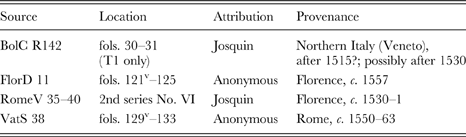
Now let us have a look at the source situation for Inter natos mulierum. The motet is preserved in four sources and is attributed to Josquin in two of them (Table 3). The repertory of Rome, Biblioteca Vallicelliana, MSS 35–40 (RomeV 35–40) consists of ninety motets for five, six, seven and eight voices. Half the pieces are attributed to just three composers: Verdelot, Willaert and Jacquet of Mantua. In addition to two authentic six-voice works by Josquin – Pater noster–Ave Maria (NJE 20.9) and Preter rerum seriem (NJE 24.11) – three other works for six voices bear his name: Inter natos mulierum, Victime paschali laudes (NJE **22.7) and Confitemini domino (NJE **15.9), two of which carry conflicting attributions in other sources. Wegman acknowledges that the conflicting ascriptions are not an encouraging sign and concludes that the overall picture is inconclusive, and that ‘[a]t the present state of knowledge we are not in a position to say much with confidence about this manuscript as a Josquin source’.Footnote 12
Sources for Inter natos mulierum
The partbook from Bologna – Bologna, Museo Internazionale e Biblioteca della Musica, MS R 142 (BolC R142) – however, is a different case for Wegman. He points out that the manuscript gives a reliable impression, that it transmits twenty works with ascriptions to Josquin, and an additional six that are dubiously ascribed to Josquin elsewhere but not here, that Josquin is the single most important composer in the set, that only one of its twenty Josquin attributions is wide off the mark, and that one further conflicting attribution – of Veni sancte spiritus – is ‘less serious’ because it is shared by at least four German sources. Wegman emphasises that the attribution of Inter natos is not only uncontradicted, but positively supported by the Vallicelliana manuscript, though he is quick to add that this in itself does not necessarily prove Josquin's authorship, but that neither does it support a prima facie case against it.Footnote 13 Wegman furthermore stresses that Josquin scholars have independently testified that the Bologna partbook is a relatively good source of reasonable authority and that this point needs to be underlined, because transmission is the only hard evidence left in this case, and it happens to favour Josquin's authorship.Footnote 14
The central question here is, of course, what precisely it is that makes a source reliable. In his short discussion of the Vallicelliana manuscript Wegman argues: ‘if we are to accept it as a reliable source, we need to be sure that all its ascriptions to Josquin are correct’.Footnote 15 Assuming that this observation should also hold true for the Bologna manuscript, it may be wise to have a closer look at the contents of that source.
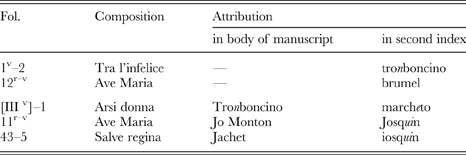
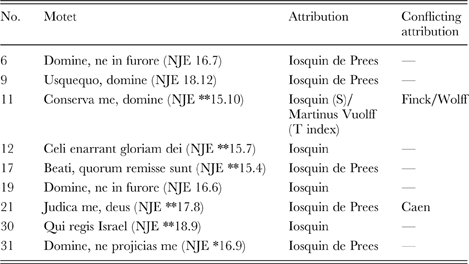
The Bologna (tenor) partbook contains fifty pieces and one incomplete textless work that was crossed out by one of the six scribes that worked on this manuscript. While most authors seem to agree that the manuscript was copied in the Veneto, several copying dates have been put forward – ranging from 1515–30 to 1530–50 – none of them based, however, on hard evidence.Footnote 16 The nucleus of its repertory, which was copied by two scribes, consists of thirty-six motets, the majority of which is ascribed to Josquin. The compositions are roughly organised by their number of voices: there are two pieces for three voices, eighteen for four, seven for five, twenty-two for six and one for seven voices. Thirty-seven of these fifty pieces carry an ascription in the body of the manuscript. Josquin's name occurs no fewer than twenty-one times. The partbook has two indexes at the beginning. The first one, according to Fenlon and Haar, was compiled by the first scribe, in all probability shortly after all the pages of the manuscript were collected into one volume. It was apparently designed to order all pieces according to their number of voices and to list them alphabetically in each category. Somehow, the scribe messed things up and the final result was not entirely satisfactory. At some stage, probably not very long after this first attempt, the second scribe started a second index, this time with an alphabetical ordering of all pieces with the names of their composers attached to them. However, once nineteen pieces were listed, the scribe abandoned his work and the index was left unfinished. It does offer, and this is of interest to us, the names of composers for two pieces that are transmitted anonymously in the body of the manuscript, and conflicting ascriptions for three other works that were assigned to specific composers in the partbook (Table 4).
Attributions in the second index of BolC R142 compared to those in the body of the manuscript
Tra l'infelice has, as far as I know, not surfaced in any other source. In the absence of the three other voices, no definitive conclusions can be reached regarding the Tromboncino attribution. The Ave Maria that is assigned to Brumel in the second index is, in fact, Josquin's little Ave Maria … benedicta tu (NJE 23.4), which is securely attributed to him in Petrucci's Motetti C.
Arsi donna per voi is given to Tromboncino in the body of the manuscript, but to Marchetto Cara in the second index. As to the authorship of this work, no conclusions have been drawn.Footnote 17 The four-voice Ave Maria is firmly attributed to Mouton in two earlier Italian sources and is certainly not by Josquin.Footnote 18 The six-voice Salve regina which is attributed to Jachet in the body of the manuscript but to Josquin in the second index has attributions in three other sources to Jacquet and Verdelot. The motet is now commonly accepted as a work of Verdelot.Footnote 19
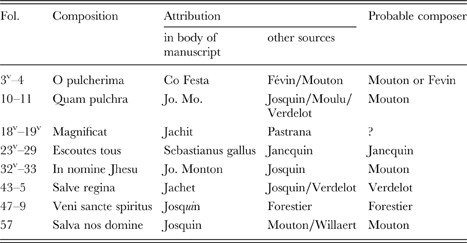
In all, the attributions in the second index do not seem to make a very reliable impression. But how about the ascriptions in the body of the partbook, several of which are also in the hand of Scribe 2? Here, too, we encounter some difficulties (Table 5). O pulcherrima mulierum is in all probability by either Mouton or Févin, but most certainly not by Festa,Footnote 20 and Escoutes tous is Janequin's La guerre. In nomine Jhesu is given to Mouton in the Bologna partbook, but is preserved under Josquin's name in three German sources from the second half of the sixteenth century. Howard Brown has argued that the piece is probably neither by Josquin nor by Mouton, but in more recent literature Mouton's authorship is not ruled out.Footnote 21 With Salva nos domine we are on safer grounds as the piece is ascribed to Mouton in several sources, including the Medici Codex (FlorL 666) and the Rusconi codex (BolC Q19). Finally, Veni sancte spiritus is now commonly considered to be by Forestier.Footnote 22
Conflicting attributions in BolC R142
The remaining ascriptions are, as far as I know, not contradicted by other sources. But among these there are two pieces that seem to warn against taking the partbook at face value. For example, the partbook contains a seven-voice Ave Maria with an ascription to Josquin. Many years ago the melodic contours of this voice-part were recognised as a version of the chanson Adieu mes amours. Subsequently, Martin Picker identified two further voice-parts belonging to this same piece in partbooks in the archives of the cathedral at Piacenza.Footnote 23 There, the work was copied as an anonymous Ave Maria for six voices.Footnote 24 It is not clear whether the piece originated as a six- or seven-voice motet, or possibly even as a secular work. As the isolated ascription to Josquin is not confirmed by the Piacenza manuscript, it cannot simply be taken at face value. Clearly the piece needs to be studied more carefully before conclusions can be drawn.
A second problematic piece is Iniquos odio habui, which is unique to the Bologna partbook. Judging from the textual incipit at the beginning of the tenor, the complete text that was set in this composition was probably Psalm 118: 113–16 of the Vulgate Bible. The actual text that is underlaid in the extant voice is a smaller portion of these verses and is printed below in italics:
(1) Iniquos odio habui: et legem tuam dilexi.
(2) Adjutor meus et susceptor meus es tu: et in verbum tuum supersperavi.
(3) Declinate a me maligni: et scrutabor mandata dei mei.
(4) Suscipe me secundum eloquium tuum, et vivam: et non confundas me ab expectatione mea.
If Iniquos odio habui should indeed be a concise psalm motet, its attribution to Josquin must seriously be questioned: it is a relatively short work, the musical phrases in the tenor part are very compact, the texting is almost completely syllabic and the diminution ostinato in bars 4–28 would be unique among Josquin's motets.Footnote 25 A cursory comparison of this tenor part to equivalent voices of psalm settings such as De profundis clamavi (NJE 15.13), Domine, ne in furore (NJE 16.6), In exitu Israel de Egypto (NJE 17.4), Memor esto verbi tui (NJE 17.14), Miserere mei, deus (NJE 18.3) and Qui habitat in adjutorio altissimi (NJE 18.7) shows that the Bologna tenor has nothing in common with these extended works.
However, the fact that the tenor part carries a Latin text may not necessarily mean that it was conceived as a motet. The Bologna partbook is well known for its transmission of contrafacts: no fewer than five of its ‘motets’ have been identified as disguised chanson settings. A similar origin for Iniquos odio habui would comfortably account for the shortness of its musical phrases, the syllabic nature of the musical lines and the limited length of the work. But if Iniquos were indeed conceived as a four-voice chanson setting, the ostinato motif mentioned earlier would still remain a very unusual trait.
To conclude the survey: when we take into account the Josquin attributions in the body of the manuscript only, we may agree with Wegman that the ascriptions of the Bologna partbook do not make a bad impression at all. Two out of the twenty-one Josquin attributions are contradicted by other sources and are patently false. Although this is not a bad score, it fails to meet Wegman's earlier mentioned criterion that, for a source to be considered trustworthy, all of its ascriptions to Josquin need to be correct. When the second index is also taken into account – and I would argue that it has to as it was compiled by a scribe who is also responsible for a number of attributions in the body of the manuscript – the number of problems starts to increase. This scribe attributed an authentic piece by Josquin to Brumel, and two pieces by other composers to Josquin. Interestingly enough, the ascriptions of the Magnificat (no. 19), of In nomine Jhesu (no. 32) and of Salva nos domine (no. 49) are all in the hand of Scribe 2, the scribe who, according to Fenlon and Haar, is also responsible for the incomplete second index and for copying Inter natos mulierum and Iniquos odio habui.Footnote 26
In all, we have to conclude that there are too many problems involved here simply to consider this manuscript as a reliable source whose attributions can be taken at face value. Its probable genesis in the Veneto area some twenty to forty years after Josquin had left Italy does little to improve this impression. The fact that the Vallicelliana manuscript confirms the Josquin attribution for Inter natos in the Bologna partbook is not of much help either, as a comparison of the Bologna and Vallicelliana voice-parts does not demonstrate that the two traditions are independent of one another.Footnote 27 It would seem that we are in need of additional proof before we can accept any of the Bologna Josquin pieces that are not known from earlier or more trustworthy sources as authentic compositions. Where should we find such evidence? There is only one place to look for it, and that is in the music itself, which brings us to Wegman's evaluation of the stylistic assessments of Inter natos.
Style
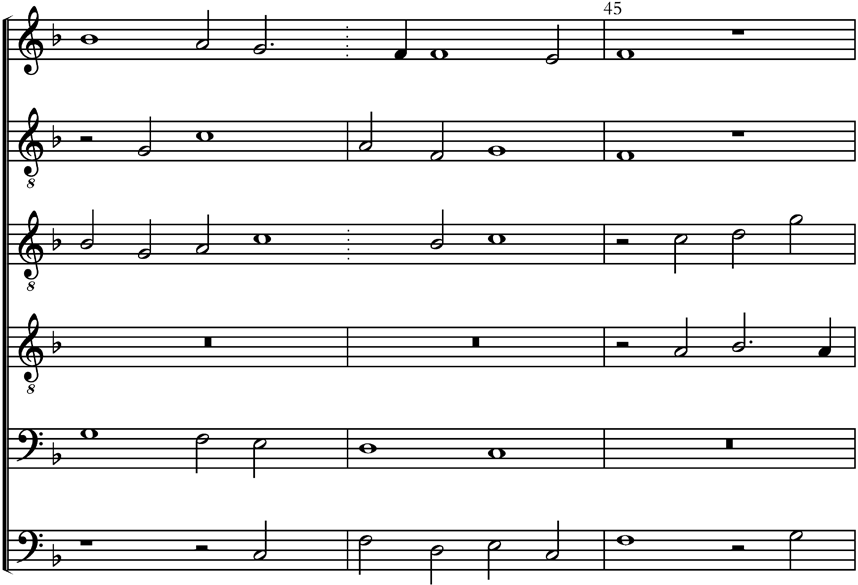
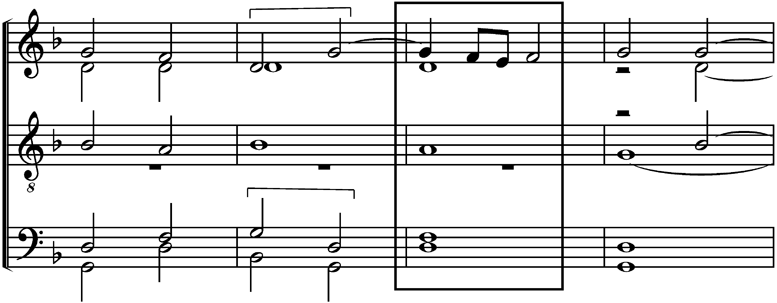
Wegman's discussion of elements of style begins, just like his discussion of the attribution issue, with Osthoff. While working on his monograph on Josquin, Osthoff changed his mind about the authorship of several pieces he had listed in the first edition of Die Musik in Geschichte und Gegenwart as dubious. He now accepted Inter natos, along with a handful of other motets, as authentic on the basis of a so-called ‘error of part-writing’ that he took to be distinctive of Josquin: the so-called Satzfehler (see Example 1).Footnote 28
Brunet/Josquin, Victime paschali laudes, bb. 43–5
The problem Osthoff had located was, to use Edgar Sparks's wording, the use of a ‘dominant cadence with leading-note and leading-note suspension sounding simultaneously in different voices’.Footnote 29 The identification of this ‘fingerprint’ in six motets – four motets for six voices and two for five – led Osthoff to believe two things: first that they were all by Josquin and second that he was evidently dealing here with ‘early efforts, which Josquin would surely not have published without correction of the questionable spots, if indeed at all. For all other motets as well as countless five-voice and six-part chansons are free from such crudities of sound.’Footnote 30
In 1971 Edgar Sparks demonstrated that Osthoff had been mistaken about the Satzfehler. Sparks located many examples of this type of cadence in the works of Mouton, L'Héritier, Hellinck, Clemens non Papa and Gombert, and went on to demonstrate that the Satzfehler motets could not possibly be early works, but were more likely to be products of composers of a younger generation.Footnote 31
Wegman states that both Osthoff and Sparks were mistaken about the Satzfehler since Stanley Boorman had uncovered – some fourteen years after the publication of Sparks's contribution to the New York Josquin Proceedings – the Satzfehler in at least eight more Josquin motets.Footnote 32 As all of these motets – works such as Benedicta es, celorum regina (NJE 23.13), Miserere mei, deus (NJE 18.3), Missa De beata virgine (NJE 3.3), O virgo prudentissima (NJE 24.9) and Preter rerum seriem (NJE 24.11) – are commonly considered to be authentic and late works by Josquin, Wegman wonders if we should really continue to call these cadences Satzfehler. He assumes that it must have been an oversight that caused Osthoff to miss the instances cited by Boorman, and a coincidence that he did happen to spot the Satzfehler in Inter natos and five other motets. Wegman's logical conclusion is that this particular oversight and coincidence has had far-reaching consequences, for ‘[w]ithout them there would never have been a “problem” of the Satzfehler motets, nor any basis for Sparks to accept or reject those motets as a group’.Footnote 33 However, on closer examination the situation turns out to be more complicated and in need of a more nuanced description.
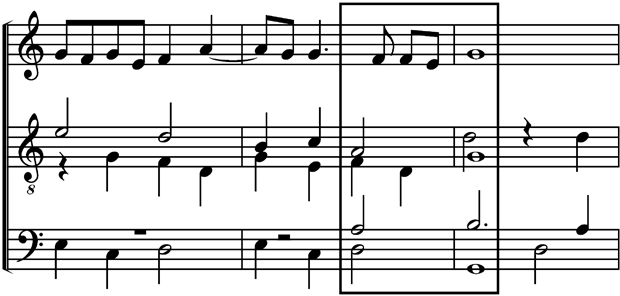
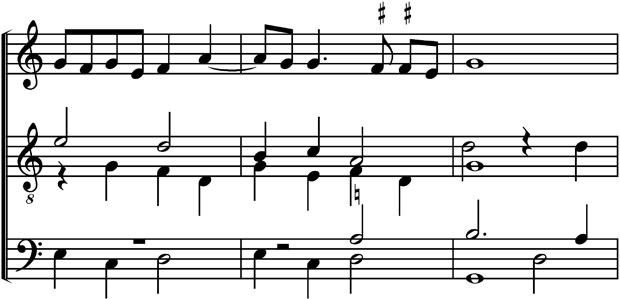
Example 2 shows three of Boorman's examples which are taken from uncontested works by Josquin. One might argue, as Boorman and Wegman clearly do, that from a contrapuntal point of view there is no difference at all between Osthoff's Satzfehler cadence (Example 1) and the cadences from Benedicta es, O virgo prudentissima and Preter rerum seriem. After all, fifteenth- and sixteenth-century counterpoint deals mainly in interval classes and not in specific intervals.Footnote 34 As local inflections (musica ficta) do not belong to the foundational pitch relations and could cause the leading notes in Boorman's examples to be raised, the cadences shown in Examples 1 and 2 are identical.
Three examples from Boorman's ‘False Relations and the Cadence’: (a) Benedicta es (bb. 63–5); (b) O virgo prudentissima (bb. 103–6); (c) Preter rerum seriem (bb. 81–3)
However, explaining the similarities between the Satzfehler cadence and Boorman's examples this way passes over an important aspect of Osthoff's argument. For Osthoff it must have been obvious to leave the cadences in Example 2 unaltered; raising the leading note here seems to have been out of the question for him. And if the leading note is not raised, there is an important difference – if not contrapuntally then at least in actual sound – between the cadences in Example 2 and Osthoff's Satzfehler cadence. But why would Osthoff have objected to applying ficta in cases such as these?
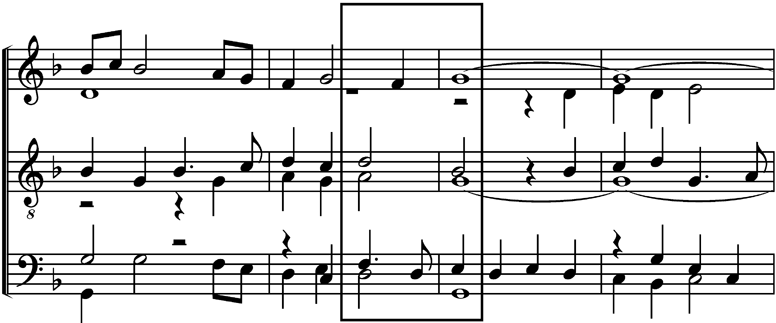
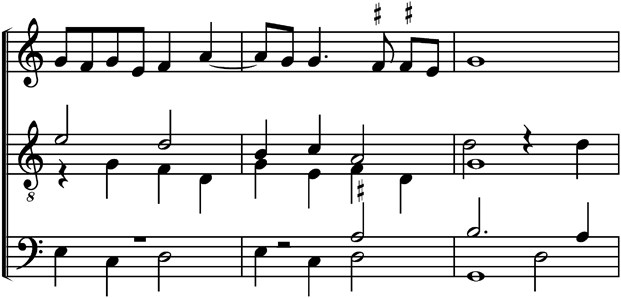
If one should want to introduce a true leading note into these specific cadences there are two approaches in applying ficta. The first would be to raise only the leading note (and its anticipation, if present) that is actually part of the two-voice cadential framework (Example 3(a)). However, as this causes a clash of an augmented octave with the unaltered F in the inner voice, some will prefer the second approach, which involves raising both the leading note in the inner voice and the suspended leading note in the superius (Example 3(b)). This alternative removes the clash but is not completely satisfactory either, as it introduces a sharp for which no clear melodic incentive is found in the inner voice. Furthermore, the second approach does not always work. It cannot be used, for example, for Boorman's Example 2(b) (from O virgo prudentissima), where the inner voice reaches its F by a leap of a perfect fourth, thus making it impossible to raise it to F♯.Footnote 35
Boorman's example from Benedicta es: (a) with raised leading note in two-voice cadential framework; (b) with raised leading note in both superius and inner voice
Osthoff is not specific about his predilections concerning ficta, but it is not difficult to see that he must have been convinced that Josquin would never have tolerated an augmented octave or unison in his music. This conviction may have been suggested to him by theorists who are explicit about avoiding augmented octaves.Footnote 36 But his predilection to leave the leading notes in cadences such as the ones in Example 2 unaltered may very well stem from the fact that he had been unable to find similar cadences in pieces by Josquin where the leading note is already present without applying ficta. After all, if Josquin would indeed have preferred to hear cadences such as the ones in Examples 3(a) and/or 3(b), one would expect to find such cadences, at least incidentally, in some of his works on C or F where the leading note is diatonically present for the pitch classes C, F and B flat. And this is precisely Osthoff's – and later also Sparks's – point: one does not find them on these pitch classes in authentic works of Josquin; they only occur in the so-called Satzfehler motets.Footnote 37 In other words, while Josquin does write 9–8 suspensions on pitch levels that would ‘normally’ entail a raised leading note, he does not write such suspensions in a diatonic context. This is a curious situation that needs explaining. Obviously Osthoff's (and Sparks's) solution to the problem is that authentic compositions with cadences on C, F and B flat demonstrate that Josquin did not want to have a leading note and its suspension sounding at the same time and that therefore no ficta should be applied to similar cadences on other pitch classes (such as the ones in Example 2).Footnote 38 In this scenario the Satzfehler cadences remain an exception in Josquin as they occur only in the six motets discussed by Osthoff and Sparks. If one chooses to disagree with this line of reasoning, another explanation is needed to explain why cadences on C, F, and B flat with 9–8 suspensions for the leading note do not occur in Josquin's authentic works. Neither Boorman nor Wegman offers an alternative explanation.
The Satzfehler was not the only stylistic aspect of Inter natos to raise questions. Osthoff accepted the work as authentic because of the Satzfehler, but was rather uncomfortable with the piece as a whole: ‘Josquin's motet consists of a contrapuntally extremely dense first part in triple metre and of strong “instrumental” character, and a second more vocally designed part in duple time. According to its overall style the composition belongs to those early, still very unbalanced, motets that are marked by a dominant cadence with the simultaneous sounding of leading note and leading-note suspension.’Footnote 39 It was the overall style – the ganzen Stil – which led to Osthoff to believe that this motet could not possibly be a late work by Josquin, and that it could only be allowed in the work-list as an early, uneven composition.
Sparks – although finding Inter natos of all Satzfehler motets ‘least easy to fault’, as Wegman observes – pointed out that the Satzfehler motets are far more likely to have been composed near the heyday of this type of cadences – the 1530s and 1540s – than in the second half of the fifteenth century, where one rarely finds them.Footnote 40 He also found traits in the motet that he considered unusual for Josquin. He mentions the thick scoring of the prima pars, the numerous suspensions with resolution and dissonance sounding simultaneously, and the lack – despite a great amount of repetition – of symmetrically balanced pairs of phrases. Wegman was not impressed with this argument – especially as the second reason was, to him, nothing more than another reference to the Satzfehler and thus a circular argument.
The story of the authenticity of Inter natos provisionally ends in Wegman's article with an analysis of Martin Just's stylistic assessment of the motet, which led Just to exclude the piece from the New Josquin Edition. Instead of dealing with the essence of Just's arguments, Wegman chose to itemise all of his statements by number and offer his ‘conjectures as to what they can be taken to mean’.Footnote 41 Without commenting on the form and tone Wegman has chosen to criticise Just, it may be observed that he does not always take Just's arguments into consideration. For example, Just draws attention to the fact that Inter natos does not use a cantus prius factus. This is, in itself, an interesting observation, not only because the motet is a setting of a responsory, but also because all five- and six-voice motets by Josquin generally considered authentic are either based on a cantus prius factus, an ostinato, or a canonic scaffolding. Wegman responds by saying that the editor merely addresses the question of whether there is a cantus prius factus and that this in itself is neither an argument for or against Josquin's authorship. Another example of this approach is found at Wegman's items nos. 8 and 9. Just first points out that the Satzfehler and the musical structure of Inter natos rule out an early date for the motet and then goes on to observe that the work, with its dense texture and absence of motivic correspondences and formal symmetries, does not correspond to Josquin's authentic late works either. Wegman separates these two related thoughts and responds by saying that they are both about chronology, not authorship. There is no need to review all of Just's arguments and Wegman's rephrasings, interpretations and comments. One simple question suffices: did Martin Just's arguments ever stand a realistic chance with Wegman? It seems not: before turning to the final section of his article, Wegman summarises: ‘Even if NJE had offered a more considered argument based on musical style, one wonders how conclusively that could have settled the matter…. [I]f a work is unanimously ascribed to Josquin in two or more independent and relatively trustworthy sources, are we able to accept that evidence – even when it tells us something that we didn't expect to hear?’Footnote 42
It is slightly disturbing to see that the Vallicelliana manuscript is now described as both ‘independent’ and ‘relatively trustworthy’ and that ‘relatively trustworthy’ is now good enough to qualify for hard evidence. Wegman repeatedly mentions the hard evidence of the sources.Footnote 43 Contrary to what he suggests about stylistic judgements, Wegman does seem to feel that one can objectively determine the reliability of a given source. This may be true for some sources,Footnote 44 but often it is far more complicated (as in the case of the Bologna partbook). Whereas Wegman presses hard to demonstrate that Josquin scholars use ad hoc stylistic criteria that can change almost on a case-by-case basis,Footnote 45 he is conspicuously silent on the criteria for trustworthy sources.
With his comments on Just's arguments Wegman comes to the end of his discussion of Inter natos. One might expect him to give a final, ardent plea for the reinstatement of this motet as an authentic piece by Josquin, as ‘none of the evidence against it has held up’.Footnote 46 However, the reader is quickly reminded of Wegman's announcement (on p. 34) that his aim is not to call for the reinstatement of Inter natos. He then introduces Josquin β and Josquin γ (the ‘other Josquin’) as a solution to the methodological problem he described at the beginning of his article. In this scenario, Josquin β is the composer as perceived by modern Josquin scholars, in Wegman's ironic description: ‘a composer who has a fairly consistent stylistic profile, and is known for his disinclination to depart from a clearly-defined set of compositional habits’,Footnote 47 or, in still other words, ‘a composer who is unlikely to have done something that we haven't seen him do before’.Footnote 48 Josquin γ, on the other hand – Wegman's alternative Josquin – we know less well; but, according to Wegman, this is a composer who was ‘perfectly prepared to engage with styles beyond the experience of Josquin β’.Footnote 49 This ‘other Josquin’ is introduced to put an end to the methodological problem of authorship issues in Josquin. After all, if a certain piece with a sound ascription to Josquin should not fit the stylistic profile of the beta Josquin, it surely would fit the profile of the gamma Josquin; Josquin's authorship would no longer be a truth-claim to be proved or disproved, but a working hypothesis to be explored. This makes one wonder what other pieces might possibly qualify for the oeuvre of our new ‘gamma’ Josquin. Before doing so, it may be wise to pause and see how Josquin's list of works has been evolving over the last few decades.Footnote 50
The changing work-list
Albert Smijers was the first scholar systematically to collect all works with an ascription to Josquin. He never published a list of the compositions he rejected for his edition of Josquin's music but, given what he did and did not publish, it is perfectly clear that he was aware of the authorship issues involved. His colleague Myroslaw Antonowycz, who, with the aid of Willem Elders for the final volumes, completed the edition after Smijers died in 1957, did provide a list of pieces that had been considered but were rejected for the edition.Footnote 51 At that point, in 1966, Helmuth Osthoff had already compiled a list of works which one may call the first catalogue raisonné of Josquin's works. The final results of his research were published in the second volume of his monograph on Josquin. which appeared in 1965. This catalogue contains 285 compositions, 191 of which are listed as authentic works. The remaining ninety-four works are found in the ‘Anhang’ as dubious and spurious works (‘zweifelhafte und unechte Kompositionen’).Footnote 52 Approximately half of the pieces that Osthoff rejected have conflicting attributions; the rest were rejected solely on the basis of stylistic considerations.
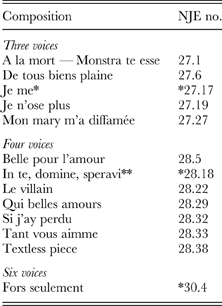
Since the publication of Osthoff's systematically organised Verzeichnis der Werke, forty-eight pieces which are ascribed to Josquin in at least one source were discovered in the second half of the twentieth century (see Appendix).Footnote 53 In many instances the works involved are either uniquely transmitted in late and peripheral sources or credited to other composers in other sources. It is not really surprising, therefore, that there are only two pieces among these forty-eight additions that have been considered to be authentic (two four-voice textless works). Some seven further pieces are listed as dubious works – though the editors of NJE and the authors of the NG II and MGG 2 articles are not always in agreement – and among these are four (two incomplete works and a duo) of which it is very difficult to argue for or against Josquin's authorship. In all other cases it is commonly assumed that the works are spurious.Footnote 54
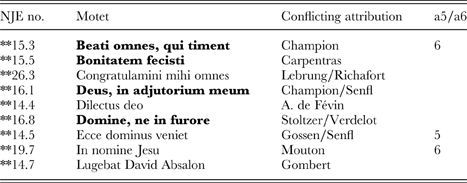
The first to revise Osthoff's Verzeichnis was Jeremy Noble, who prepared the list of Josquin's works for the 1980 edition of the New Grove Dictionary of Music and Musicians. Approximately half of the fifty additions mentioned earlier are listed by Noble. The most interesting changes, however, are found in the main part of the list: nineteen motets that had been considered authentic by Osthoff were listed by Noble as either doubtful or spurious pieces. As Table 6 shows, most changes took place in the category of five- and six-voice motets; in six cases a conflicting attribution was in play.
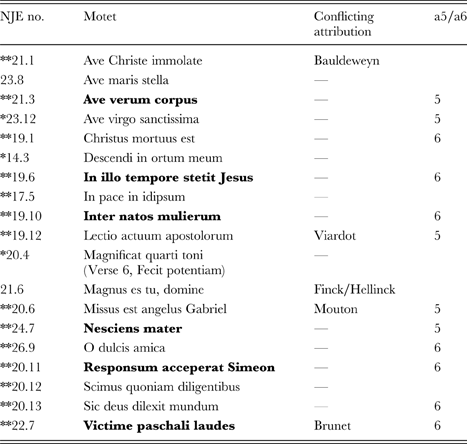
Noble's changes to Osthoff's Verzeichnis: motets moved from authentic to doubtful or spurious (Satzfehler motets in boldface)
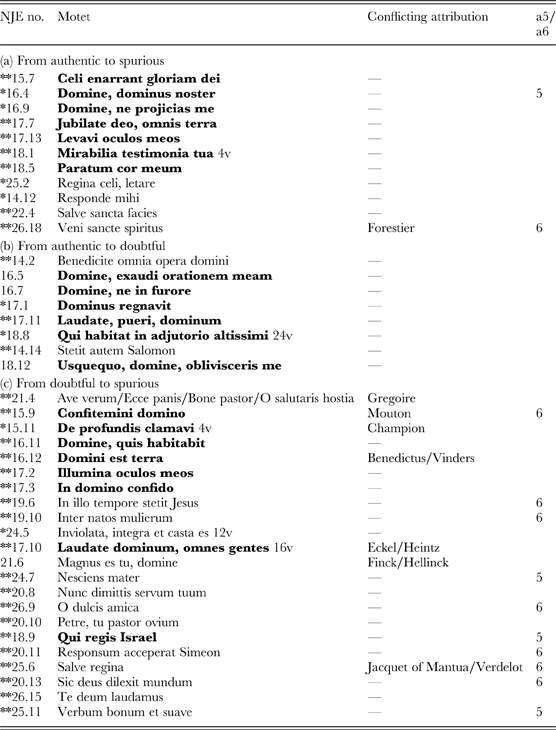
Among the pieces doubted by Noble are the six Satzfehler motets It is not difficult to understand why it was the six-voice motets in particular that caused worries for scholars after Osthoff: as Howard Brown and Joshua Rifkin later demonstrated, there are very few six-voice motets from the fifteenth century. Even if one allows for a single piece by Isaac, or Obrecht, six-voice motets make at best rare appearances before 1500. Remarkably enough, they hardly become abundant afterwards: Mouton is credited with seven pieces and Verdelot seems to be the leading composer of a slightly younger generation with ten six-voice motets.Footnote 55 And yet, sixteenth-century sources credit Josquin with more than twenty six-voice motets. This in itself is a clear sign that one should approach them with caution.
In nine cases Noble changed Osthoff's undecided zweifelhaft or unecht to a clear ‘spurious’ (Table 7). All pieces involved are attributed both to Josquin and to one or more other composers. More interestingly, however, is that a second category now clearly emerges as a problematic one: that of the psalm motets.
Noble's changes to Osthoff's Verzeichnis: motets moved from doubtful to spurious (psalm motets in boldface)
Noble's list was revised for NG II by Jeffrey Dean. Some twenty-five titles were added, but with the exception of two four-voice pieces all of these new works are listed as either opera dubia or spuria. More interesting are the shifts that took place among the authentic and dubious works. More than sixty pieces were assigned to a new category, and this time largely not on the basis of conflicting ascriptions but of musical style (see Table 8 for a listing of the motets).Footnote 56 The most important category of compositions that was reassigned to another part of the list is that of the psalm motets. Seven psalm settings that had been regarded by Osthoff as important specimens of Josquin's late style are now considered dubious or spurious works. Twelve out of nineteen sacred works that shifted from authentic to either dubious or spurious works are psalm motets. The category of five- and six-voice motets remains a problematic subgenre (ten are assigned to other parts of the list).
Changes to Noble's list for NG II (psalm motets in boldface)
Two years after the publication of this revised list, the ninth volume of the Personenteil of MGG 2 was published, with Ludwig Finscher's article on Josquin. A comparison of the NG II and MGG 2 lists shows them, on the whole, to be in close agreement. Over sixty works have been judged differently, but in only four cases there is a significant change: four works listed as authentic pieces in NG II are now considered dubious.Footnote 57
With a single exception, all works that are considered authentic in either NG II or MGG 2 are published in the New Josquin Edition.Footnote 58 Eight compositions listed as authentic in NG II and MGG 2 are published as dubious works in NJE (six of these being secular works), and eight pieces that were judged dubious in NG II and MGG 2 have been rejected by the NJE editors. Thus one might summarise that the NJE editors have formed their own opinions, which, on the whole, confirm the image of Josquin's oeuvre as reflected in the latest lists in NG II and MGG 2.
Josquin gamma
Let us now return to the question what other pieces might possibly qualify for the oeuvre of Wegman's ‘gamma’ Josquin. Wegman himself introduces three possible candidates: two six-voice Satzfehler motets – In illo tempore stetit Jesus and Victime paschali laudes – and the four-voice Missa Quem dicunt homines. The cases for In illo tempore and the mass can be understood on basis of the source situation for those pieces: they are attributed to Josquin only, in one or more sources dating from the 1530s or later. Victime paschali laudes is a different case, and I think that many will disagree with Wegman's analysis of the source situation for that piece.Footnote 59
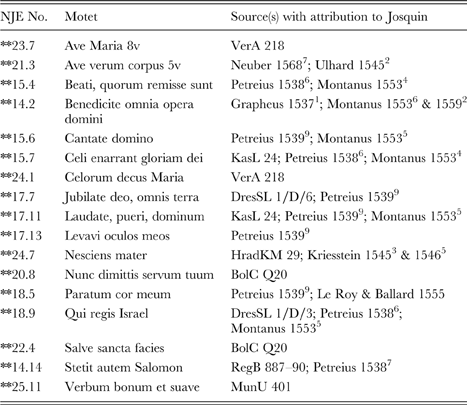
Following up on Wegman's ideas of trustworthy, or relatively trustworthy sources, one can think of more candidates for the ‘gamma’ Josquin. Table 9 shows an inventory of Petreius's Tomus primus psalmorum. This is a source that is looked upon with suspicion in Josquin scholarship, but it ought to make a favourable impression in the light of the gamma hypothesis: there is one internal conflicting attribution and one false ascription. The other seven attributions are not contradicted in other sources and the dating of the source to 1538 is not much better or worse than that of sources for pieces such as Inter natos, In illo tempore stetit Jesus, Victime paschali laudes and the Missa Quem dicunt homines. If any of the pieces in the Tomus primus psalmorum would not qualify for Josquin beta, it would certainly qualify for Josquin gamma. Proceeding along similar lines, a quick perusal of the list of Josquin works produces seventeen motets that are attributed in their sources only to Josquin but that have been expelled from his oeuvre on basis of their stylistic incongruity (see Table 10).
Motets attributed to Josquin in Petreius's Tomus primus psalmorum (15386)
Motets for Josquin γ
What happens when we attribute all of these works to Wegman's gamma Josquin? The first thing to notice is that the gamma work-list will be enlarged with quite a few pieces that were discarded many years ago. As a matter of fact, no fewer than four of the pieces listed in Table 10 were already judged spurious by Osthoff, who – of course – compared them to Josquin's authentic works and found they differed too greatly to accept them in Josquin's oeuvre. Given the fact that Osthoff had a wide-ranging conception of Josquin's output, these four pieces may be considered to deviate from a rather broad spectrum of stylistic possibilities. The second aspect to attract attention is the fact that the list contains all of the so-called imitation motets: compositions that have been identified as reworkings of portions from compositions attributed to Josquin: Ave verum (5v), Celi enarrant, Jubilate deo, Levavi oculos meos, Nesciens mater and Nunc dimittis. It seems superfluous to reintroduce all of these pieces; a short characteristic of Celi enarrant may suffice. Celi enarrant bears very distinctive markers of Josquin's style, but – as Patrick Macey has convincingly demonstrated – this is mainly due its quotation of the openings of three motets attributed to Josquin: Miserere mei, Ave caro Christi cara and Fama malum. The openings of these motets provide musical material for the initial measures of the three partes of the motet. This particular sort of polyphonic borrowing is not known to occur anywhere in the oeuvre of Josquin beta and seems to be at odds with the composer's aim not to repeat himself. Furthermore, whenever Celi enarrant departs from its models, it shows contrapuntal weaknesses and observes a lack of variety that is entirely uncharacteristic for other works by Josquin beta. As one of the cited models is, furthermore, most likely to have been composed by Bauldeweyn, Macey's conclusion that Celi enarrant must be regarded as a spurious work and was, in all probability, composed by a student or minor composer learning his craft by reworking established masterpieces, has been widely accepted.Footnote 60
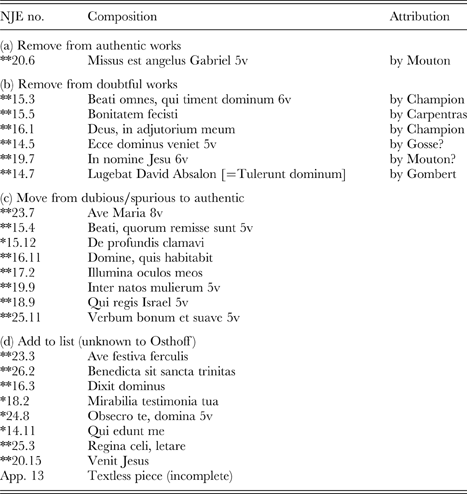
Let us take the argument just one step further. In Table 11 I have summarised all adjustments that need to be made to Helmuth Osthoff's Verzeichnis of Josquin motets in order to make it congruent with the gamma Josquin. On the whole they are rather minor. One motet should be removed from the authentic works, because it is convincingly attributed to Mouton in trustworthy sources. Some six motets, about which Osthoff already expressed serious doubts, can also be removed on account of conflicting, and more convincing, attributions to Champion, Carpentras, Gosse, Mouton and Gombert. Eight motets should be transferred from Osthoff's dubious works to the authentic ones (though I must admit that I am not sure how Wegman feels about KasL 24 as a Josquin source), and, finally, some eleven items need to be added: these are works for which no conflicting attributions exist that were unknown to Osthoff and have surfaced since the publication of his 1965 study. Four of these pieces, however, are incomplete (Missa Rosina, Mirabilia testimonia tua, Venit Jesus and the textless piece) and two are short duos which seem to be taken from larger works. In all, one could hardly say that these adjustments to a work-list of over 200 works could be considered radical or far-reaching. Therefore, with some caution one might argue that the oeuvre of the ‘Other Josquin’ was in essence already described by Osthoff, some forty-five years ago.
Changes that need to be made to Osthoff's Verzeichnis to reflect the works of Josquin γ
Now we could, of course, retrace our footsteps and entertain the hypothesis that all works considered either authentic or doubtful by Osthoff were composed by ‘γ Josquin’. What would be our advantage in returning to this particular stage of Josquin research? I must admit that at present I cannot think of any advantages. All sorts of questions spring to mind, however. For one, if pieces such as the four works that were already discarded by Osthoff and motets such as Celi enarrant and the other imitation motets are included in the list for Josquin gamma and placed alongside works such as Victime paschali laudes, Inter natos and In illo tempore stetit, our ‘Other Josquin’ will emerge as a stylistically extremely versatile composer; a sort of chameleon who swapped styles at will, who sometimes produced works of considerable musical strength and every now and then tripped over contrapuntally inadequate passages. He will emerge as a composer who was not afraid of reusing particularly successful portions of earlier works, even if it led to works that were far less compelling than the originals. He will be revealed as a composer who sometimes treated his motet texts with utmost care, and at other times seems not to have given them much thought. He may very well emerge as a composer who, at the end of his career, suddenly decided that he could boldly loosen the reins as far as the use of dissonance is concerned. This image will eventually force us to ask ourselves if such a stylistic profile has any historic probability at all.
Admittedly, for Wegman this is no problem whatsoever. After all, assigning a work to Josquin γ is, as he puts it, no more than entertaining the hypothesis that such a work was composed by Josquin, and not accepting his authorship as an incontrovertible fact.Footnote 61 As stylistic considerations do not determine whether a piece should be attributed to Josquin γ, it seems that such a hypothesis can only be proven wrong by demonstrating that the source that ascribes a specific work to Josquin has turned out to be untrustworthy, either because its scribe or editor can now be proven to have made strange mistakes, or because one or more new sources with one or more new, and more credible, ascriptions have come to light.
Proving the hypothesis right – thus demonstrating that a piece was beyond reasonable doubt composed by Josquin – does not seem to be an option in Wegman's scenario. After all, such an act would have to be based on stylistic criteria, and so any attempt in that direction would lead to his aforementioned objections. Such a solution is unlikely to be satisfactory to Josquin scholars and probably to any scholar who wants to edit or define the oeuvre of any composer. After all, why should one merely want to entertain the hypothesis that a certain piece was composed by a certain composer if there is no evidence at all to suggest that it cannot or may not have been composed by him?
Let us, by way of conclusion, return to the story of Inter natos. Was this motet unjustly excluded from the NJE? Is it true that ‘none of the evidence against it has held up’? The answers to these questions depend, of course, on the stand one is prepared to take. For Wegman the evidence of the sources firmly points towards Josquin and any stylistic element that would seem to direct us in another direction should be embraced as an enrichment of his style, or at least the style of the Other Josquin, as we knew it before accepting this piece. There are at least two problems involved here. First, the hard evidence itself: can we really, objectively determine the reliability of a given source, especially when we are dealing with posthumous sources? Second, should we really refrain from stylistic judgements, even if the evidence of the sources tells us something highly questionable (as with Celi enarrant, for example)? Viewed from a stance that allows for stylistic criticism, the answer to our questions about Inter natos would, of course, be completely different. The piece would have been justly excluded from Josquin's list of authentic works, not because it shows compositorial attitudes we do not know from Josquin's authentic works. Not because the motet does contain five examples of the Satzfehler, exactly as Osthoff and Sparks described. Not because there is an abundance of 9–8 suspensions in the work and neither because its structure is too dense for an authentic piece by Josquin. Not because it is a six-voice motet that does not use a cantus prius factus, ostinato or canon and neither because the musical fabric is not tight and coherent enough for Josquin. Not because of the gratuitous repetitions of musical material, which are highly unusual for Josquin. And neither because of the indifferent fit of words to music. Rather simply because this all happens in one piece at the same time: it is the accumulation of all these traits in this motet that speaks, from a stylistic point of view, strongly against Josquin's authorship. There is not a single six-voice motet in the oeuvre of our beta Josquin that shows a similar accumulation of such unusual traits, and this does seem important, as all of Josquin's authentic six-voice motets seem to have been composed after 1500.
Does this mean that the story of Inter natos has now come to a new end, and that, no doubt much to Wegman's horror, the file on it will be closed? I hope not and I think not. To repeat a few prudent, well-chosen words from the paragraph on authenticity in the Josquin article in NG II:
There is still plenty of room for doubt in individual cases, and in the revised work-list at the end of the present article indications of scholarly disagreement have been given both among those works the authors consider probably authentic and among those they do not. It must be emphasised that all scholars acknowledge a continuum of degrees of doubt between the extremes of those works generally accepted as certainly by Josquin and those recognised as certainly not by him; the main work-list is not confined to the former extreme but also includes many works the authors regard as probably but not certainly authentic, and a fair number of compositions are finely balanced between ‘probably’ and ‘probably not’.
Even though the NJE has decided not to publish Inter natos in the music volumes of the collected works, this does not mean that the piece has disappeared from the surface of the earth. On the contrary, it is a plain fact that Inter natos, along with numerous other works that have been ‘expelled’ from Josquin's authentic works, is conveniently available in a modern edition, that references to all sorts of evidence are given in the NJE, that the piece is listed in all Josquin work-lists, and that it is perfectly possible not only to disagree with any editor who has rejected the piece, but also to publish extensive articles in which one may give one's personal view on the matter, as Wegman's own article demonstrates.
APPENDIX I
Works not found in Osthoff's Verzeichnis der Werke of 1965 (A=authentic; S=spurious; D=doubtful)
APPENDIX II
Authentic and dubious works not found in Werken van Josquin des Prez, ed. A. Smijers
A. Authentic works
B. Dubious works