In the early 1960s John Le Carre's novel The spy who came in from the cold was top of the New York times best seller list for 34 weeks, and conservative politician Robert Menzies was in the final years of his 16-year Australian Prime Ministership. The Beatles touched down in Sydney, and the new, modernist wings of Fisher Library at the University of Sydney were being built and opened.
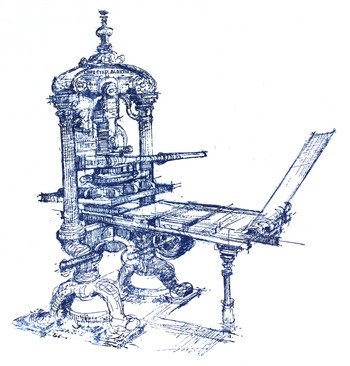
In this social and political climate, University of Sydney Librarian Harrison Bryan, a printmaking enthusiast, was delighted to discover that the University of Sydney owned an 1879 Improved Albion printing press, which had been acquired from the State Government Printing Office (see Fig. 1). Bryan wrote an article in the University Gazette, explaining his vision for the Albion letterpress and the creation of their own small publishing press - The Fisher Press.Footnote 1
Allan Gamble, Piscator Press: an original pen and ink drawing of the improved Albion hand-printing press. Sydney, 1964. Architecture lecturer Allan Gamble sketched the press as one of a number of buildings and artefacts drawn during his tenure at the University.

From the outset, Bryan's interest in the press was not driven by a nostalgia for the past but an innovative alternative to new technology that could provide an outlet for avant-garde literature not generally picked up by mainstream outlets. He wrote of his utilitarian approach to print useful texts and believed the role of a small publisher was to give undiscovered voices an opportunity to be heard. Most importantly for us in the library, he mentioned the press as a tool for experimentation:
… printing as an operation offers a most interesting opportunity for blending patience, skill and sheer hard work with a feeling for design, form and general aesthetic values, including an almost limitless field for experiment.Footnote 2
This was Bryan's vision for the press and one we have sought to bring to the present day.
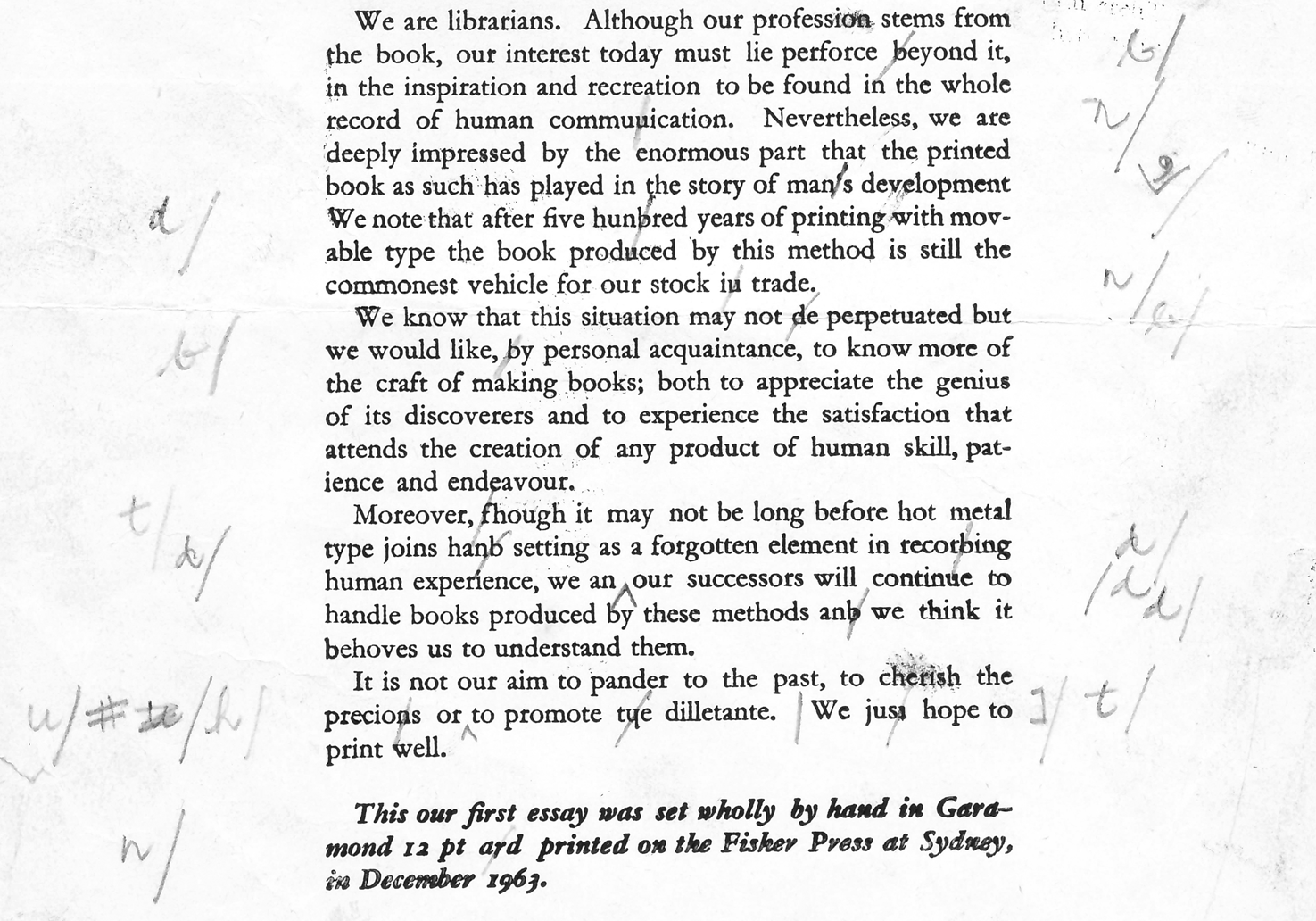
From time to time, Bryan used the press in seminars for Honours and Masters’ students in English, French, Italian and history, and to local students of librarianship. He would demonstrate how early works were printed and how easily typographical errors could alter the meaning of literary works and potentially corrupt later editions. Alongside these educational uses, Bryan formed a small group of interested University of Sydney Library staff who met in the evenings to learn the art of hand printing, albeit more as a hobby than as an academic pursuit (see Fig. 2). He thought it was valuable for modern librarians to understand the history of bookmaking and the print process, even though he had a progressive perspective on librarianship:
We are librarians. Although our profession stems from the book, our interest today must lie perforce beyond it, in the information and inspiration of the whole record of human communication. Nevertheless, we are deeply impressed by the enormous part that the printed book has played in the story of man's development.Footnote 3
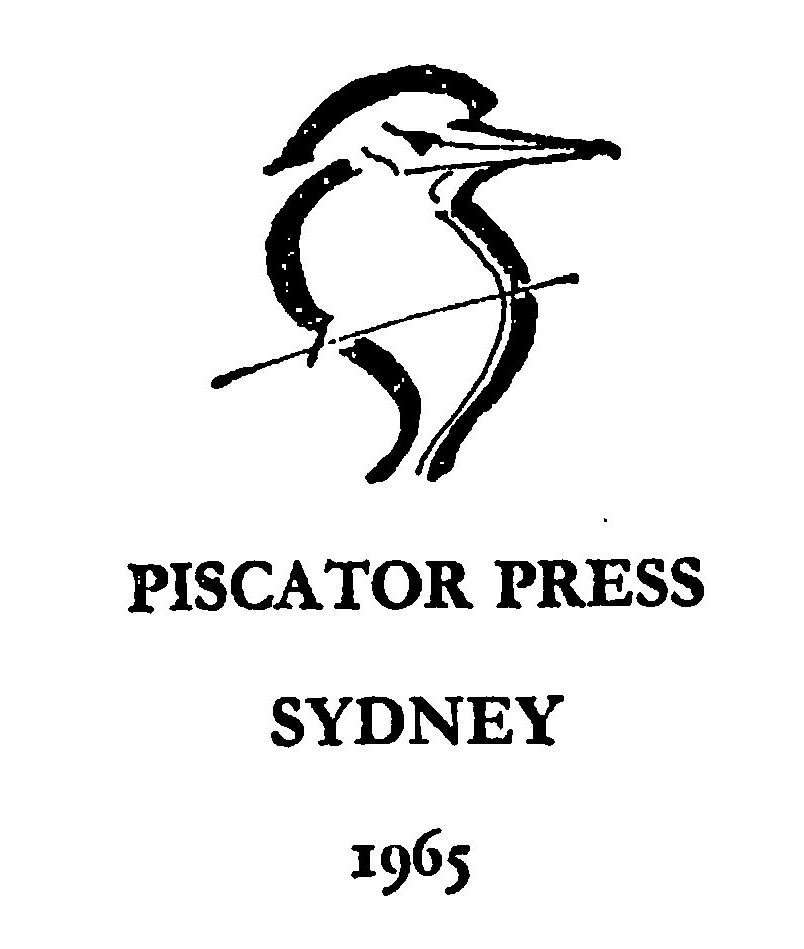
Not long after its inception, it became apparent that a commercial press in Sydney also used the name Fisher Press, so Harrison Bryan cleverly changed its name to the Latin word for Fisher (the kingfisher bird) and renamed the press the Piscator Press (see Fig. 3).
Mr Harrison Bryan regrets to announce that it has been decided to change the title of the Fisher Press since it has been discovered that there is in Sydney a commercial organisation of exactly the same name. The Fisher Press now becomes the Piscator Press, thus enlisting the artful aid not only of apt alliteration but also of pure, penetrating paronomasia.Footnote 4
A total of 15 occasional publications were produced by library staff between 1963 and 1978, including poetry and collection lists from the library. Several pieces of ephemera were also printed, including Christmas cards, wine lists and meeting notes. Their singular goal was always simply “to print well”.Footnote 5
Harrison Bryan, A press is born, original proof, 1963. A proof from the original vision statement shows mark ups from errors. Sometimes it's not so much ps and qs they needed to watch out for, but their bs and ds.

Allan Gamble, Piscator Press kingfisher, 1964. Allan Gamble designed this kingfisher image which became the symbol of the newly anointed Piscator Press and accompanied most of the publications made during this time.

Be bold, never regular
By 2017 the Piscator Press had lain dormant for around 20 years and was taking up a large workshop space in a busy academic library where space is at a premium. Almost 5 million students walk through the doors of the University of Sydney Libraries every year wanting a space to study and access to resources, primarily electronic. In response to an application by one of the Directors of the Library, Libby O'Reilly, the library received a grant from the Vice Chancellor's Committee, an active fundraising arm of alumni and interested parties at the University of Sydney. They gave $5,000 for an eight-week residency in the Piscator Workshop in the library, in what is now an annually awarded residency. The printmakers and their projects bring new life to the library, and the creative publications made with the press are added to our Rare Books & Special Collections. Partnering with the Friends of the Library, we have since increased the funding for the project and are hoping to run an emerging printer in residence program for students and recent graduates in alternate semesters.
Bringing the Piscator Press back to life provides a new way for the library to connect with students, the broader university community and the wider letterpress community in a tangible way. It builds connections with faculty and activates the space in new and engaging ways. It connects the modern library with its roots in traditional hand printing and allows for endless experimentation and creative expression between text, image, paper, ink, and everything that the book can be. The Printer in Residence is closely associated with our Rare Books & Special Collections and has reinvigorated our Artist's Book Collection (predominantly a teaching collection connected to the Sydney College of the Arts, the University of Sydney's contemporary art school). The program ensures that hand printing and book-making skills continue to flourish in the digital age and this dialogue between print and digital processes is one of particular interest.
The residency seeps into the everyday experience of library users with images from the residency used on the library homepage, the printmaker busying themselves in the workshop as well as regular interventions into library spaces and social media. A key focus of both the library's strategic vision and the university's student experience is the importance of place and a sense of belonging, and the Printer in Residence program fosters this through including our community in the processes of creating and sharing culture.
There are a number of print residencies in academic libraries around the world including Otago University in New ZealandFootnote 6 and the Bodleian Library at Oxford.Footnote 7 Whilst we looked to both these residencies as potential templates for us, we realised that we were less inclined towards the traditional fine art letterpress printing for which these residencies are known. Following on from Harrison Bryan's vision we were keen for the University of Sydney Library residency to be more experimental in nature and open to a variety of printmakers looking to use letterpress in diverse ways and utilise diverse technologies.
The initial announcement of this vision for the residency was not always kindly received within the traditional letterpress community. Initially we received some negative feedback around the openness of our approach. There was definitely a fine balance of not wanting to alienate fine letterpress artists who follow traditional practices, whilst still wanting to open the residency to a variety of printmakers, views and technical approaches. We continue to refine that balance and hope that we can foster a residency that is full of curiosity, playfulness and inquiry. We feel that every time a printer is awarded the residency it may result in a wildly different project - some very conceptual, some very engaged with the student community, some fun, and others more formal. We hope that, over time, Australia's printmakers will see this and we will build a collection of diverse creative publications reflecting the print (and sometimes political) landscape of the day.
As the printmakers delve into our collections, the history of the press, and intervene in library spaces, having an artist in the library gives us the opportunity to look and see library collections and spaces in new and creative ways. We've also discovered that many students are fascinated by the letterpress process and how much contemporary word processing stems from it.
It has also allowed the relationship between the library and the Sydney College of the Arts (SCA) print studio to flourish. One of the print academics sits on the selection panel for the residency and second year SCA print students come up to the library every year to have a workshop with the current printer in residence. This also allows for the opportunity to conduct hands-on, object-based learning using the artists’ books held in the Rare Books Collection.
The Printer in Residency program keeps the art of letterpress alive. Initially the Piscator workshop only held Garamond and Bembo typefaces. Although type has been donated by a variety of people over the years, much of it is only 8-16 point. However, in 2019 we were lucky enough to purchase some large metal type from the unfortunate closure of the Melbourne Print Museum and this will allow for more choice for future printmakers. Of course, necessity is the mother of invention, so the small type has also meant some interesting work-arounds for our printmakers thus far.
An artist is in the library or: “I just spent 4 hours trying to find an E!”
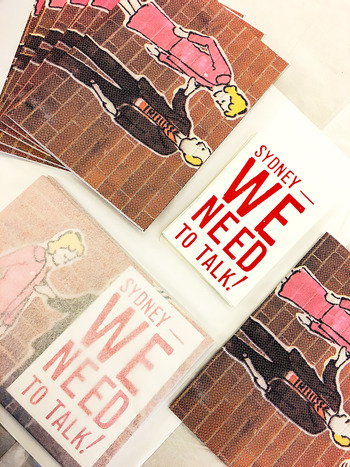
Wendy MurrayFootnote 8 came on board for the inaugural residency in 2018 with her project Sydney - We need to talk! a collaborative book of short, accessible explorations into the politics of urbanisation.Footnote 9
Wendy demonstrates a dynamic approach to printmaking and is part of a new face of letterpress: hipster enthusiasts who have a passion for the old technology and how it can intersect with current digital processes. Wendy provided the visual element to written essays from academics of the Departments of Geosciences and Architecture & Planning and brought them into the studio as part of the creative process, even calling on them in the eleventh hour to assist in the laborious task of hand stitching the 100 printed books (see Fig. 4).
Wendy Murray, Sydney- We need to talk! 2018. Book and screen printed poster cover.

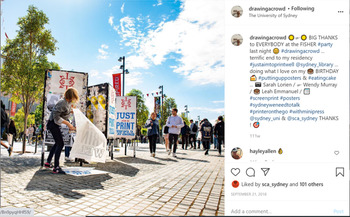
As primarily a poster artist, the small type available in the Piscator workshop presented a challenge. Wendy got around this by using a digital process, printing initially on the Albion, then scanning and digitizing the image to blow it up as a screen print and make the text poster size. Wendy took her posters out on campus and around the local streets for lively interventions. These also started an artistic collaboration between Wendy and the library photographer, Sarah Lorien (see Fig. 5).
Sarah Lorien Photography, I just aim to print well, 2018. Wendy Murray's campus interventions Eastern Ave, University of Sydney. Instagram grab. https://www.instagram.com/drawingacrowd/.

Blowing up the text printed by the Albion press to such a large size allowed all the fine idiosyncrasies and imperfections of the print to be clearly seen. A dirty print? No, this is one of the unique elements of the letterpress process, which Wendy embraces in her artistic process.
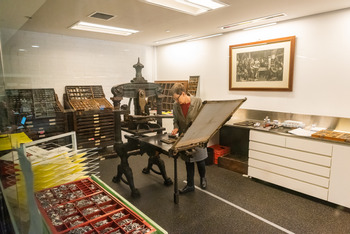
In 2019, Barbara Campbell,Footnote 10 a printmaker, performer and librarian brought a completely different perspective on letterpress, with her project A bird is in the library (see Fig. 6).
Sarah Lorien Photography, Barbara Campbell in the Piscator Workshop, 2019. Fisher Library, University of Sydney.

Barbara came without much letterpress knowledge, but spent time before her residency studying under the guidance of the expert printmakers at the Penrith Museum of Printing in outer Sydney.Footnote 11 They've been very supportive of our endeavour, generous with their time and they love passing on their knowledge to new and younger printmakers.
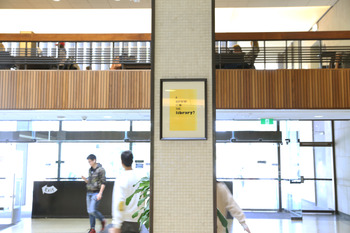
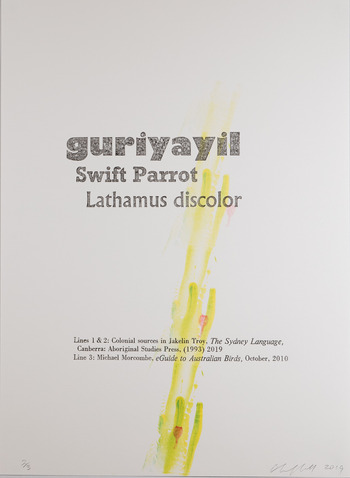
Barbara managed to lay and print a lot of text during her time, relishing the materiality of the hand printing process, having a presence in the library, and requesting pretty much all the bird books we have in the collection! A bird is in the library was both a series of prints mounted throughout the library (see Fig 7) as well as a small hand-made book. As Barbara's project evolved, her passion for libraries and their systems of classification became a dominant theme of the work, using classification systems from A field guide to Australian birds volume 2: Passerines by Peter SlaterFootnote 12 as well as the glossary The Sydney language Footnote 13 by indigenous author and University of Sydney researcher Jakelin Troy, which named various native birds from the Sydney region in their traditional language (see Fig. 8). The final outcome of Barbara's residency was Bird Voices,Footnote 14 a small hand-made book reciting the calls of various birds as found in The field guide.
Sarah Lorien Photography, A crow in Fisher foyer, 2019. Fisher Library, University of Sydney. These posters went up all over the library.

Barbara Campbell, guriyayil, Swift Parrot, 2019. Sydney, Piscator Press. This is one of a number of prints to employ a conceptual approach to the print. The guriyayil (or swift parrot) is a critically endangered species of southeastern Australia, so the more endangered the bird is, the fainter the print.

Though we had to stop the presses due to the pandemic for the 2020 iteration of the residency, the 2021 residence will be taken up by Caren FloranceFootnote 15 with her project ALT-SHIFT-PRINT, a look at alternative publications, poetry and campus culture from the University of Sydney.
There has come to be a lot of goodwill around the Printer in Residence program since its inception, from university marketing who love to promote the event, to interested library staff, Sydney College of the Arts academics, and printmakers across Sydney and surrounding areas. For us it's become clear that it's a successful program, which brings opportunity to printmakers as well as a richness to the library and the university more broadly. We just hope to keep printing well.