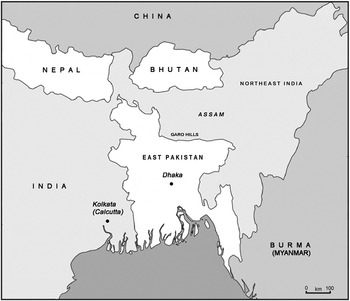
In 1964, the police identified Karim Nasir, a cultivator in the Indian state of Assam, as a Pakistani spy and quickly deported him to East Pakistan. Persecuted for being Muslim, a religious minority in India, and suspected of grabbing land in Assam, Nasir and other deportees recalled their arduous journeys cramped in military trucks as hurmuri jatra (rushed travel). By then Pakistan and India were warring neighbors. The virulent partition of the Indian subcontinent in August of 1947 had remapped the margins of British colonial Assam and Bengal as India and East Pakistan. The new border divided Pakistan's terrain into east and west, with Indian territory between them. A considerable part cut across geographically remote, northeastern India and the foothills of northern Mymensingh district of East Pakistan. Border guards physically pushed Nasir across Assam, northeastern India's largest state, into neighboring Mymensingh (Map 1).
Upon arriving there Nasir, like other deportees, claimed abandoned rice harvests. His sudden deportation occurred at the same time as the persecution of the Garos by East Pakistan, which had marked the mostly Christian, settled peasants engaged in wet rice cultivation as dangerous aboriginals and communists.Footnote 1 Harassed by the border police, the Garos in 1964 abandoned their rice fields and fled to Assam, where they sought shelter in relief camps. Among them was a young Theophil Marak. When Marak and others from his village returned from the camps to harvest the rice crops they had left behind in East Pakistan, they found that Muslim deportees such as Nasir had taken control of them. Along India's northeastern borders with East Pakistan, 1964 was a devastating year for those rice cultivators who states had identified as illegal migrants and traitors. The unprecedented, mass deportations that year were a culmination of colonial and post-partition tensions surrounding land. Through the 1960s, dispossessed peasants, compelled by states to converge on either side of the border, claimed each other's rice harvests and land.
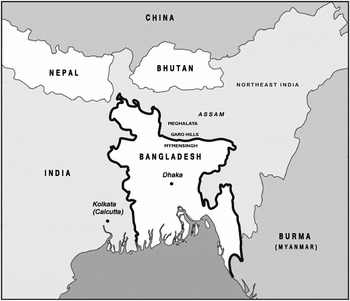
Marak and Nasir's entangled lives invite us to revisit the mid-twentieth century, when territories and identities were in flux in a region that today borders Bangladesh and India (Map 2). In this paper I explore the fragmentation of provincial rice fields into postcolonial territories before Bangladesh emerged as an independent nation-state in 1971 (comprising the former East Pakistan). Between 1930 and 1970, anti-colonial politics, Britain's exit from the subcontinent, and early postcolonial border dynamics transformed the shifting marshes and foothills of British provincial Bengal and Assam into nationalized military zones.Footnote 2 Peasants, and East Pakistan and India, battled over rice fields and raided each other's granaries in order to make claims on each other's territories. Geological shifts that made land elastic compounded territorial struggles. The changing course of rivers submerged and destroyed villages. Rivers also deposited silt in new locations to create chars (riverine islands) that frontier peasants were compelled to laboriously settle and cultivate. The unstable nature of the land clashed with its new status as an immovable, economic commodity, whether as agrarian property or as provincial and postcolonial territory.Footnote 3 When rivers wiped out villages, migrant peasants acquired stable land in forests and grazing reserves in defiance of state regulations regarding settlement. British land revenue policies, nationalist politicians, and postcolonial states all used rice to demarcate ecologies and peasants whose lives were previously entangled in affiliations, Natural disasters, oppressive revenue extractions, and state violence made ripened rice precious as golden grain. Furthermore, such events led peasants to acquire land and raid each other's harvests both to survive and to gain control over newly imposed borders. If ephemeral landscapes and agrarian extractions escalated the demand for rice as food, late colonial and early postcolonial territorial consolidations either prevented or facilitated hurried journeys across political margins.
India and East Pakistan (1947–1971)

Bangladesh and India (1971 onwards)

The entangled narratives of loss and gains surrounding rice, exemplified by Nasir's and Marak's hurmuri jatras, invite us to rethink the distinctions between sedentary peasants and mobile indigenous cultivators, and between cultivation and soldiering.Footnote 4 I suggest that their imprecisions are productively addressed from borders where territorial intrusions coalesced around rice cultivation and consumption. In such overlapping spaces of authority, politics and everyday life transcend what Liisa Malkki's once famously critiqued as a “sedentary metaphysics” that limits the possibilities of anthropological engagement by territorializing the study of nations and cultures.Footnote 5 As locations of strife and political actions, borders enable anthropology to rethink the relationship between politics and mobility. James Scott's book The Art of Not Being Governed has inspired new discussions among scholars studying Asia's border geographies and societies under the rubric of Zomia.Footnote 6 Scott drew on Willem van Schendel's proposition of Zomia as a geographically expansive political highland zone straddling South and Southeast Asia. While for van Schendel, Zomia enabled a departure from methodological nationalism and the dominance of political histories that had intellectually marginalized regions, for Scott the spatial isolation and political terrain of Asia's highlands and its inhabitants' mobile dispensations inspired an anarchist reading of politics embedded in mobility, flight, and escape. Highlanders' proclivities for abandoning land and the “utter plasticity of (their) social structures” that defines their politics led him to consider shifting cultivation as an “agro-political strategy” against “raiding, state making, and state appropriation.” Yet for the taxpaying, lowland rice growing peasantry who submitted to the fiscal regimes of empires and states, such strategies of escape were impossible.Footnote 7
Van Schendel's and Scott's engagements with Zomia invite us to rethink the relationships between non-state spaces and state control of borders. Rather than an absence of states, it was states' limited reach and fragmented sovereignties along frontiers that enabled people to move between territories and partake in different regimes of authority. Frontiers were productive sites for marginal people because social and legal governance had limited impact there.Footnote 8 In the Spanish and French borderlands and along China's frontiers, peasants, laborers, nobles, and itinerant traders who encountered uncertain boundaries forged new identities without abandoning their sense of place, or their ethnic, religious, and economic affiliations.Footnote 9 Even when territorial struggles among empires, colonial authorities, and autonomous polities created intersecting zones of control, as in Kashmir, social groups and political organizations conferred meaning on these as borders.Footnote 10 Jean Michaud, in an important reminder concerning Zomia's political history, has recalled its important relationships to surrounding polities as well as to global histories. In China's and India's borderlands, for instance, smaller territorial units were aligned with neighboring polities through trade and tributary relations as important nodes of global trading in opium and tea.Footnote 11
David Gellner, in underscoring historical and contemporary alliances that facilitate mobility across what he calls Northern South Asia, provides rich insights into border politics. In this region, which includes Nepal and Himalayan border societies, anthropologists encounter diverse political landscapes ranging from societies that acknowledge nation-states and demand special recognition and protection by them, to those that resist pressures of modern governmentality.Footnote 12 Central Himalayan societies that lead transnational lives simultaneously locate their political claim-making in multiple nation-states while remaining culturally committed to “ungoverned” aspects of their identities.Footnote 13
In what follows, I show how rice that came to redefine mercurial borders is central to histories that transcend nations and to the complex political fields that discussions of Zomia inspire us to study.Footnote 14 Our reliance on the sedentary to define the political is challenged by wet rice cultivation in shifting marshes and foothills and by the rice cultivators who, as territorial actors, made land and borders. The relationship between the creation and the militarization of the Northeast India–East Pakistan border was deeply tied to the actions of rice cultivators. I engage with the competing claims over rice along borders as rice wars, and reconsider the region's rural actors as paddy soldiers. Even when changing rivers and violent states displaced peasants, they proved to be canny actors who came to delineate borders by actively moving across fuzzy political margins and acquiring new land for survival. They also forged alliances with political authorities to guard borders as agrarian territories, and operated in the gaps of mass politics.
The concept of paddy soldiering reinstates rice's location at the intersection of the political and the intimate, especially in fulfilling people's longings for land. A focus on rice—a grain that was precious as territory and food, and held emotional connotations for its cultivators—can bring to us a different understanding of border-making than do commercial crops like tea, jute, and opium that have structured global histories of this region.Footnote 15 In South Asia's transition from the late colonial to the early postcolonial periods, the labor of cultivating land and producing food came under increasing state scrutiny. Agrarian aspirations were yoked to and mobilized around demands for postcolonial territories. Although rice became central to redefining boundary lines, battles over rice also reinforced the imprecision of the Northeast India–East Pakistan border.
Even today, along South Asia's northeastern borderlands, where old triangular boundary markers are hidden between ripe rice paddies and gun-toting border guards appear startlingly out of place in golden fields, we can find peasants gazing toward their imagined homelands. Their participation in large-scale political transformations of the mid-twentieth century tells us why these boundary makers and armed patrols are there. Other cultivators find mention in national and regional archives, in peasant petitions, revenue and administrative records, police and intelligence files, and official state correspondence. Official records splinter peasants along ethnic (Assamese/Bengali/Garo), religious (Muslim/Christian/Hindu), and national lines (Indian/Pakistani). Such neat orderings of entangled agrarian lives flatten rural politics by either criminalizing peasants as spies, traitors, and communists, or simplify them by imposing morally compelling discourses of victimhood, refuge, and recovery. For instance, in late colonial and early postcolonial Assam, political debates and discourses cast Muslim peasants of Bengali origin as either infiltrators or food producers. Conversely, in early postcolonial East Pakistan, official records affirm deported rice cultivators from Assam as Muslim victims of Indian oppression, while persecuting the mostly Christian Garos as pro-Indian suspects and Christian infidels. In Indian records of the same period, the Garos surface as helpless animists and tribal Christians who needed India's protection. In the following pages, I will show how paddy soldiering over the four long decades starting in the 1930s brought these categories closer together.
ASSAM AND PADDY SOLDIERS
Every morning since his deportation from Assam and resettlement in Mymensingh (East Pakistan) in 1964, Karim Nasir had walked toward the border. He sat on a bamboo bench and gazed at what he imagined to be Assam's hills.Footnote 16 I had arrived in his village seeking to explore, among other things, India's early postcolonial deportations.Footnote 17 Speaking to me in Assamese, Nasir thumped his fist on the bench to emphasize: “I am Assamese, not Indian or Pakistani.” His assertion related to his having been born in British colonial Assam. His forefathers, who resided in chars in eastern Bengal, had lost their land to rivers and migrated to Assam in search of new land for survival. Soon after, his father had left the riverine zones to claim stable land in a reserve forest. Nasir conveyed that he was born of “Assam's soil,” soil that he had cultivated for years without the burden of taxes. One day in 1964, rather suddenly, the police charged him with being a Pakistani spy. They ordered him to immediately abandon his rice harvests, and deported him to East Pakistan.
While Nasir's assertion of being Assamese did not surprise me, his ardent claims to land in Assam encouraged me to re-read the history of ecological flexibility, political distinctions, and colonial extractions that had structured boundary-making. In the nineteenth century, British fiscal and military interests in India and Burma redefined these frontiers with the annexation of the kingdom of Assam and its surrounding territories. Meanwhile, a drastic change in course of the river Brahmaputra in Mymensingh, Bengal's largest district that bordered Assam, resulted in widespread devastation and led to a shift from wet to shifting rice cultivation.Footnote 18 Bengal's frontier peasants from districts like Mymensingh, who were skilled at reclaiming alluvial riverine land for cultivation, migrated in the face of agrarian declines.Footnote 19 They moved between shifting chars of Bengal and Assam. Ecological conditions, landscapes in motion, and the “mobile character” of regional polities led to tense bureaucratic relationships between the East India Company and smaller territories.Footnote 20 British administrators imposed internal boundaries to prevent tea planters in Assam from encroaching upon land. These boundary lines divided the hills from the plains, the sedentary from the mobile, and forests from cultivable land.Footnote 21 New cartographies disrupted old connections and inflamed new animosities.
In twentieth-century Assam, agricultural improvement was immensely important. Tea garden expansion was accompanied by new, concomitant demands for rice that the subsistence, single-crop agrarian regimes could not cope with. Aided by their knowledge of riverine lands, migrating peasants from eastern Bengal improved techniques of rice cultivation to support the plantation and jute economies. Those who were better cultivators and had access to finance through moneylenders bought land from Assamese peasants and expanded the cultivation of rice, jute, pulses, and also small-scale poultry farming.Footnote 22 However, colonial land settlement policies forbade peasant migration between the provinces of Bengal and Assam.Footnote 23 Furthermore, the colonial state first partitioned and later reunified the province of Bengal (in 1905 and 1912, respectively) in ways that deeply entrenched religion, ethnicity, and language as bases for segregation.
Nasir's recollections of abandoning his rice harvests call attention to the contentious outcomes of British land settlement in Assam's wetlands, the political demands for postcolonial territories, and the peasant migrations in the late 1930s. Muslim peasant migrations from eastern Bengal that coincided with the clamor for territories to be incorporated within Pakistan and India made people either fear or hope that Assam would become a part of Pakistan. During this period the Indian subcontinent witnessed mass uprisings against the colonial state. In the geographic margins of Assam and Bengal, the Assam Provincial Muslim League, Assam Provincial Congress and the Bengal Provincial Muslim League were important political parties. Inspired by nationalist agitations, they led mass mobilizations to claim territory that would form Pakistan and India. Assam's legislative debates cast the migrants from eastern Bengal as either land encroachers who displaced Assamese interests or food producers and landless victims. Land policies alternated between prohibiting settled agriculture in villages and grazing reserves to opening more areas for food cultivation.Footnote 24
When the Assam Provincial Congress Party controlled the provincial legislature, migrants from eastern Bengal who had arrived in Assam after 1 April 1937 were declared illegal.Footnote 25 In 1939, the Assam Congress passed a resolution that barred peasants from settling in villages or on grazing reserves. In 1940, as soon as the Muslim League came to power, they reversed this policy by opening more land to cultivation. The Assam Provincial Congress protested that the League's “Grow More Food” campaign was intended to settle Muslim peasants from eastern Bengal. They interpreted peasant migration as a territorial takeover and regarded arriving Muslim peasants as marching paddy soldiers who would occupy Assam's land for a Muslim Pakistan. Legislative debates expressed the widespread moral panic in Assam over the arriving peasants, who were criminalized as trespassers and thieves intruding into land owned by Assamese peasants, raiding their granaries and cattle, and forcing adivasis to relinquish their land titles. Despite economic interdependencies between Assamese and immigrant peasants, land conflicts in Assam were compounded by cultural distance, crop failures in 1942–1943, and the 1943 famine in Bengal.Footnote 26 The availability of easy credit and the Assam Bengal Railways ensured that new migrants continued arriving from east Bengal. Furthermore, immigrant cultivators continued to purchase land in Assam despite ongoing public opposition by Assamese elites.Footnote 27
Frontier peasants and provincial politics, which sought to reclaim land in forests, defied British administrative land segregations and displaced forest inhabitants. Political leaders who differentially mobilized the peasantry in Assam defined them ethnically as either Assamese or Bengali and religiously as Hindu or Muslim. Ambikagiri Raychaudhuri, a member of the Indian National Congress in Assam and a leader of the Assam Jatiyo Mohaxabha representing Assamese interests, was concerned about immigration from east Bengal. Due to his efforts, the immigration question was publicly debated in Assam.Footnote 28 Syed Muhammad Saadullah, the Muslim elite leader and representative of the Muslim League in upper Assam, and Moulana Abdul Hamid Khan Bhashani, a charismatic saint-revolutionary peasant leader, represented the interests of immigrant peasants. Bhashani, who had migrated from eastern Bengal, traveled across Brahmaputra's chars. At the center of his subaltern leadership was the demand for land.Footnote 29
Fazlur Rahman's predicament as a young riverine peasant who migrated from Mymensingh's chars to Assam's forest reserves unsettles neat bifurcations of dominant discourses, and illuminates how economic and political forces came together in uncertain ways during the 1940s. In early 1940, floods had destroyed Rahman's homestead land in a char in Mymensingh district. He paid a few annas (cents) for a train ticket on the Assam Bengal railway and, subsisting on flattened rice sweets packed by his widowed mother, he arrived in Assam two days later. Like other landless peasants, Rahman was eager to acquire land to cultivate. He described how in Mymensingh it was widely known that Assamese society was more egalitarian than the oppressive, tax-ridden, and Hindu landlord-dominated Bengal. In many districts, he emphasized, a popular slogan was Assam Cholo, Bengali for “Let us march to Assam.” Although Rahman recalled the tedious journeys of peasants who arrived destitute and landless as char dwellers, he pointed to others who hoped to obtain some of the rich arable Assam land that the Muslim League had made available for settlement in the early 1940s: “They even traveled by boats that carried all their belongings and cattle.” Rumors in Rahman's village about the possibility of making a living from land in Assam, combined with his distressing personal circumstances, encouraged him to migrate rather than make explicit claims to Assam's territory for Pakistan. Upon his arrival, however, he joined other migrant peasants in grabbing land in forest reserves, activities that were by then intensely politicized as a means of realizing the Muslim League's larger, territorial goals. Soon, Rahman brought a small patch under the plough in a forest, a site where the colonial state had prohibited human habitation and cultivation.Footnote 30
Even when immigrants shared languages and religions they were fragmented; widespread suspicion and mistrust prevailed among frontier peasants and differentiated older and new immigrants. Karim Nasir had not only distanced himself from later settlers, but his claims to soil in Assam were grounded in a sense of belonging that predated the contentious 1940s. And Rahman, like other new migrants, willingly learned Assamese. In subsequent years, Muslim migrant assimilation would lead to the naming of a new category: natun asomiya musalmans (new Assamese Muslims).Footnote 31 Rahman's willingness to learn Assamese evinced a different perspective than Nasir's claims to being Assamese. Their respective assertions occupied distinct moral and political registers, which resulted in a fissure between the migrant communities.
British surveillance in Assam conflated these registers. It linked older patterns of land reclamation with new agrarian expansions that were tied to the demand for Pakistan. In early 1947, the year the subcontinent was partitioned, intelligence agents meticulously tracked political dissent along Assam's borders with eastern Bengal. They also intensified their scrutiny of individual and collective mobility. Their reports noted that the Muslim League in Assam had marked out for settlement locations normally used for trade and barter. Leaders mobilized the evicted as well as new immigrants to settle in prohibited areas. Interpreting reoccupation of lands as a means to stall further eviction of Muslim peasants, intelligence agents recorded that armed peasant resistors frequently attacked eviction officers. The colonial police responded by killing and wounding protestors. When state oppression escalated, officers reported that peasants resorted to passive resistance.Footnote 32 Intelligence agents noted that Bhashani, a claimant of Assam's land for Pakistan, encouraged his peasant followers to plant the Muslim League flag in every government building as a mark of territoriality and mobilized them to reoccupy land.Footnote 33 In defiance of police orders, Bhashani addressed a large gathering, having arrived there by concealing his motor-car with a sheet. Subsequently, the police arrested and imprisoned him in Darrang district.Footnote 34 The police also reported that his followers paraded around the prison demanding his release along with other political prisoners.Footnote 35
Peasant protestors are portrayed in intelligence reports as a mass of nameless soldiers obediently trotting on the heels of Muslim and Hindu leaders. The neat classifications under which these reports were filed—“communal,” “Hindu affairs,” “Muslim League,” “communist,” and “labor”—makes obvious that people were identified as troublemakers on the basis of their religion, political orientation, and migration, in ways that linked their relationship with land and labor to larger territorial gains. In May 1947, Deputy Inspector General of Police John Reid speculated that new migrants from east Bengal would not leave Assam, but instead wait until the rains; since the banks of the river Brahmaputra would be flooded, the state would be compelled to relocate them in Assam's grazing reserves.Footnote 36 The police anticipated territorial skirmishes and deployed additional troops to protect Assam's borders and prevent its incorporation into East Pakistan. They did so in ways that reveal a clear operational gap between claiming new territories and physically monitoring them.
British ambivalence and insidiousness were apparent in these provincial margins until the last moment of the transfer of power in the subcontinent. From uncertain provincial borders, police profiles differentiated migrant and evicted peasants, classifying the former under the categories “political” and “communal.” They thereby reinforced the image of Bengali peasants as land-encroaching troublemakers in Assam, and the moral panic surrounding Muslim immigration. By contrast, reports classified Muslim peasants leaving Assam for eastern Bengal as refugees under the “miscellaneous” category.Footnote 37 By leaving the word “refugee” ambiguous, colonial intelligence records underplayed what could be seen as a fearful exodus of rice cultivating peasants from Assam. Police records erased ecological and other agrarian factors that made paddy soldiering an urgent survival strategy, and instead portrayed border crossings as corrupt migrations driven by land speculation.
RICE AS POSTCOLONIAL BORDERS
In August 1947, with the partition of the Indian subcontinent and the creation of India and Pakistan, national allegiance replaced prior conceptions of land and locality. The ad hoc line truncated rural landholding patterns, disrupted trade routes, and led to large-scale displacements.Footnote 38 It violently ruptured kinship and familial ties.Footnote 39 Assam was incorporated within postcolonial India and its territory was repeatedly fragmented.Footnote 40 The Muslim-dominated district of Sylhet, formerly part of Assam, and Mymensingh were both included in East Pakistan.Footnote 41 As agricultural land became national territory, India and East Pakistan tried to gain control over rice field borders and chars. Changes in river flows persisted and physically shifted the border. When rivers silted after 1947 and created new chars along borders, these became sites of contention between India and East Pakistan.Footnote 42 New restrictions on mobility and trade led to food shortages in Assam's hill districts. The Garos, among others, depended for food on adjoining regions that were now in East Pakistan. Though Assam's state government tried to source food from the valley, the tedious process of transporting rice from there made it very expensive. Procuring a bag of rice from across the border was illegal, but it was easier and cheaper.Footnote 43
Even after the imposition of a new border, officials emphasized that Muslim peasants, who they now identified as East Pakistani citizens, were still arriving in Assam to reap paddy. It was noted that despite evictions peasants did not leave Assam, but instead “wandered around the countryside, seeking vainly for land to occupy, and taking shelter in previously established settlements of their countrymen.”Footnote 44 Such documents berated paddy harvesters as actors illegitimately jockeying between different political interests or as bandits and transgressive subjects. After August 1947 the English words “Pakistani infiltrators” and “refugees” became popular terms in vernacular Asomiya.Footnote 45 In India and East Pakistan, refugees as a governmental category, and refugee rehabilitation as an instrument of town planning, structured nations, citizenship, and borders.Footnote 46 Landless families mobilized refugee as an important political category with which to negotiate with state authorities in order to rebuild their devastated lives.Footnote 47 In addition, early postcolonial citizenship materialized through the actions of police constables and noncommissioned soldiers, who often ignored official rules, and those of ordinary, enterprising people such as cross-border settlers and labor migrants.Footnote 48 Acquiring land was key to establishing one's legitimacy as a new citizen. Collective land grabs were often responses to biased legal definitions in state policies, and to class and caste inequities that rendered policy implementation weak.Footnote 49 In South Asia's riot-torn cities—Amritsar, Delhi, Dhaka, Hyderabad, Karachi, Kolkata, and Lahore—forceful land grabs by those belonging to the majority religion intensified the displacements of minorities.Footnote 50 For instance, along what were then the fringes of Kolkata in eastern India, Hindu Bengali refugees led a well-organized squatter's movement that claimed marshes and wetlands as sites for squatter's colonies, in the face of inadequate state rehabilitation.Footnote 51 In the process, they aggressively occupied land and mosques of Muslim artisans.Footnote 52 Jason Cons has convincingly argued that such micro-politics of possession and dispossession, which defined histories of early state-making, still guide notions of territory and belongings at borders.Footnote 53
Neither the romanticizing of land loss nor attention to refugee as a governmental category that guided political dissent, which have engaged South Asia's partition histories, are adequate to explain the complexities surrounding rice cultivation along fuzzy borders. Far from South Asian cities and their abandoned houses, military barracks, schools, and other structures that new claimants had aggressively occupied, concurrent histories of border-making were unfolding in rice fields. These fields were key sites for warring states making claims on each other's territory. In the late 1940s and early 1950s, both East Pakistan and India controlled rice and imposed rice taxes to feed border patrols and deportees and to discipline cultivators who belonged to minority populations. What made rice field borders dangerous was not suspicious demographics of border villages, but rather state repression, looting, and indiscriminate arrests.
Although harvesting the produce of cross-border land owned by peasants was permitted, taking the harvest back to India was illegal.Footnote 54 The transportability of rice as a produce contrasted with the fixity of agricultural land and compounded spatial and political uncertainties. Rice control, protection, and raids were all crucial to surviving along the newly imposed border; paddy soldiering implied gaining control over both rice as food and the newly imposed border. In this complex political field, where neither claims to national territory nor trans-ethnic ties were certain, peasants raided each other's harvests to cope with state violence and starvation. Rice wars also racialized borders. East Pakistan's land policies stood in contrast with India's early postcolonial protective politics, which were aimed at preventing land alienation and assimilating adivasis as “noble savages” while thwarting their demands for sovereignty.Footnote 55 Despite their differences, however, both states differentiated adivasi cultivators, either as politically subversive or as victims. At the Assam-Mymensingh border, struggles over rice harvests reinforced their vacillating image between being communists and victims. When India and East Pakistan set up quasi-military forces and vigilante groups, using local recruits, this fed into the everyday anxieties of living along dangerous borders.Footnote 56
March 1950 brought the adoption of important legislation in Assam that would leave lasting imprints in rice field borders. The Immigrants (Expulsion from Assam) Act conferred on the Government of India the power to conduct deportations in Assam.Footnote 57 Huge crowds, declaring that Muslim peasants were illegal Pakistanis, burned Muslim houses in Assam, stole their cattle, drove them out, and robbed them as they fled to East Pakistan.Footnote 58 Newspapers in East Pakistan reported that the police detained and charged Muslims residing in India's border villages as Pakistani spies. Some reports alleged that they were arrested to prevent their exposing the illegal activities of Indian troops.Footnote 59 However, the 1950 Act did contain a significant clause of exception: it would not apply to those who would be persecuted or feared for their lives within East Pakistan. This meant that Hindu Bengalis from East Pakistan could easily seek shelter in Assam on grounds of religious persecution.Footnote 60
To save what were officially listed as “abandoned” land and rice harvests in Assam, the state government granted Hindu Bengalis from East Pakistan temporary leases of cultivated land. Muslim cultivators who had labored on these lands became invisible subjects, and the listing of land as “abandoned” concealed religious persecution of Muslims. With numbers of displaced Hindus increasing, ripened rice became a precious resource in Assam. Rice harvests functioned here as an instrument for recruiting the displaced into productive activities and making them work for their food. Temporary land transfers were made on the condition that the land had to be relinquished after the harvest, though Hindu Bengalis violated this clause.Footnote 61 Although their resettlement in Assam soon became politically explosive for other reasons, at this juncture the act of harvesting crops translated into land acquisitions and legitimized them as Indian citizens. In the context of early postcolonial rehabilitation, rice harvesting was seen as an urgent, productive, and state sanctioned action, reversing dominant late colonial discourses of political transgression that had surrounded rice and its cultivation.
By mid-1951, East Pakistan estimated that India had deported seven million Muslims from Assam and other states.Footnote 62 It alleged that politicians were publicly threatening Muslims in Assam and reported that the President of the Assam Provincial Congress Committee Siddhinath Sharma warned Muslims “that if they did not take India to be their country, they should leave the country.” In a letter to the Chief Secretary of Assam in July 1951, Deputy Secretary to the Government of Pakistan I. A. Khan wrote: “In view of the fact that Muslims had never wanted to leave Assam, and the migrants therefore have always been eager to return to their homes, the warning appears to be uncalled for and unjustified. It seems to create an unfavorable impression about local Muslims, and also to make them feel unwelcome in the land of their birth. Such a statement questioning the loyalty of Muslims … is very unfair in the least.”Footnote 63 In a clarification, Sharma denied that he was targeting Muslims. He emphasized that he had stated that it was “the duty of every citizen of India, no matter to what community he belongs, to be loyal and devoted to the state. India has no place for any person who is not loyal to the state.”Footnote 64
In Assam, the police often handed out deportation orders to Muslim peasants based on undefined charges. For instance, one morning the border police suddenly detained Abdul Kader, a Muslim cultivator in Assam, as a “threat to public order.” Much to his surprise, he was served a deportation notice and ordered to leave for East Pakistan immediately by train. In his petition to the Relief Commissioner of East Pakistan, Kader emphasized that he hurriedly returned to Assam to reclaim his land, but found that newly arrived Hindus from East Pakistan had taken possession of rice harvests, livestock, and houses. His petition noted that when resettled Hindu Bengalis clashed with Muslim cultivators in Assam, the police supported the former since they were a religious majority in India.Footnote 65 District officials rejected his desperate petitions to reclaim his land.Footnote 66 Though Indian official records make evident that state agents were concerned about saving abandoned rice harvests, they do not explain how rice harvests came to be deserted.
While East Pakistan condemned India's unjust deportation policies, it persecuted minorities living along its own foothill borders. In the immediate post-partition years, state officials and border police viewed the Garos, Hajongs, and other rice cultivators as an ambiguous and suspicious mass of “mongoloid aboriginals.” In the early 1940s, British administrators had debated the possible political future of “Mongoloid” regions as Crown Colonies that Britain would govern from a distance.Footnote 67 On the eve of the partition, a Garo Christian delegation in northern Mymensingh had unsuccessfully petitioned the Bengal Boundary Commission to append a Garo homeland called adibasisthan (homeland of adivasis, or indigenous communities) to Assam after the partition.Footnote 68 Due to anxieties over losing territory, as well as the long history of peasant insurgencies along the foothills of Mymensingh, in which Garo and Hajong peasants had participated, East Pakistan viewed the border as a zone inhabited by revolutionary communists and as a conduit for pro-India activities.Footnote 69 Its government opened the partially protected foothill regions for land settlement.
Contrary to the image of communist unity within the foothill borders of India and East Pakistan, boundaries between the Garos and the Hajongs there had sharpened since collective peasant rebellions a century before. The mass-based, revolution-oriented political solidarity that once existed had given way to a clear division between Garo Christian reformists and Bengal-inspired Hajong revolutionaries. Unlike the Hajongs, who fled to Assam in large numbers, the Garos were reluctant to leave their land, harvests, and religious congregations. For the East Pakistani state, political distinctions were unclear, and spatial and ethnic proximities implied political solidarities. When East Pakistan persecuted the Hajongs they took shelter in Garo villages, leading border police to doubt Garo loyalties, and they therefore raided their houses and interrogated them. When Garos crossed the border into India to maintain family and kinship ties and to trade in markets, this only increased East Pakistani authorities' suspicions that they sympathized with communist revolutionaries there. They used the hunt for communists as a pretense for persecuting minorities, and ordered border guards to arrest suspected communist rebels from Garo villages.Footnote 70
An official 1948 circular noted, “Though there is no movement of separation in these areas, the fact remains that on the frontier of this district and Assam, to a depth of 3 to 4 miles on our side, there is a belt of Garo villages from where people move freely to the Indian union. The political activities of the people in this area are being closely watched, with indication that there could be a circulation of unlicensed arms.” In March 1948, East Pakistan disarmed the inhabitants of Mymensingh's foothill borders with India.Footnote 71 Memorandums and intelligence reports contained racially pejorative descriptions of the foothills as infested with “armed tribals” and “disloyal elements” who hurled “primitive weapons” and “arrows and stones” at the border police. East Pakistan initially deployed additional police for six months, and later extended their duties at Mymensingh's borders.Footnote 72 The state instructed them to shoot suspected communists and rewarded those who did so. For instance, in 1948, cultivators who were ploughing their land near the border were frightened to see the East Pakistan police approaching them. The police report, however, said that upon seeing the nine armed constables, who were on their usual border patrolling duty, cultivators with arms raised an alarm at which three hundred men (suspected to be communists sheltered in Assam) attacked the patrol. The judicial enquiry that followed underscored that the border police wanted the cultivators to go with them to their station, but, unsure of the constables' intentions, they had refused. The enquiry's report condemned the border police for unjustified firing and their tactless handling of the matter, and observed that the peasants were merely attending to their fields. Yet, in the end, the official summary, following a long sequence of internal correspondence, justified the police shooting and restated the lethal image of rice cultivators as violent, aboriginal communists.Footnote 73
In the interests of early nation-building, East Pakistan ferociously guarded rice fields along its borders. Its violent methods of containing communism included punitive taxation to finance additional reserves of border police along the foothills. Taxes were monetary and in kind, the latter including rice, cattle, and corrugated iron sheets, all important resources in this region. By November 1950 rice taxes had been collected amounting to 2677 maunds of paddy (at that time equal to nearly 100,000 kilos) and Rs 3012 in cash.Footnote 74 Punitive taxation made rice still more precious as a food and a border resource, and also violently destabilized boundaries.
The Garos living in East Pakistan's foothills struggled to guard their harvests from Hajongs sheltered in India, Indian border police, and trans-border raiders. The repression that the East Pakistani border police perpetrated on the remaining Hajongs further intensified rice wars. For instance, when police destroyed Hajong rice harvests so as to starve them to death, they in desperation raided the granaries of Garos residing in India.Footnote 75 To further complicate matters, Hajong rebels who sheltered across the border in India now regarded East Pakistan as enemy territory and frequently staged raids into the foothills there. In September 1950, East Pakistan relaxed its arms restrictions and issued guns to peasants who volunteered as border guards.Footnote 76
RICE AS SUBTERFUGE
Through the 1950s, paddy soldiering had evolved from dispossessed, desperate peasants raiding each other's harvests into established border rivalries. Paddy soldiers, who now included the border police, were strategic actors making claims to rice harvests. Both India and East Pakistan recruited border villagers for undercover activities in ways that further complicated the territorial issues surrounding rice. Early postcolonial espionage encouraged peasants to act in the interests of the state whether through employment or by assisting border police with whom they shared ethnic and religious affinities. Sometimes peasants helped state agents conduct rice raids, and sometimes they sought police protection to raid granaries across the border. As cultivation and harvesting shaded into spying, state understandings of border villagers, especially those classified as adivasis and aboriginals, were unstable. In some contexts they treated them as able-bodied agents who could be entrusted with guarding national territories, but in others they became untrustworthy, revolutionary peasants.
Angry, official exchanges between India and East Pakistan expose the links between territorial intrusions, surveillance, and rice harvesting. We can see this clearly in cases of police disappearances and the unofficial recruitment of villagers into espionage. In 1951, India reported the disappearance of a Garo border constable named Elliram Marak and alleged that East Pakistani border police had trespassed into Indian territory and abducted him. East Pakistan responded that the police had found Marak in East Pakistani territory carrying five border area maps and petitions from Garos living in northern Mymensingh. They charged that he had been espying the number, strength, and military mobility of their border outposts, and imprisoned him.Footnote 77 They also arrested Polsom Marak, another Garo constable, for gathering intelligence in markets along the same stretch of border.Footnote 78
Then, in 1952, a young constable trainee with the East Pakistan border police, Abdul Halim, went missing. An official delegation searched unsuccessfully for him and soon after the Pakistani border police recruited Ananta Hajong to cross into India to investigate Halim's whereabouts, in border markets. Ananta had the advantage of common ethnicity and language with Hajongs (who were resettled in India), and he shadowed Indian plain-clothes police agents. Upon his return he reported that they were interrogating Halim under suspicion of espionage.Footnote 79
Territorial intrusions intensified when rice had ripened for harvesting. East Pakistan accused India of conducting 263 rice raids between January 1951 and 1952, when crops were ready for harvest. Raids on both sides of the border were intended to gain control over the harvests and starve the enemy nation's border citizens. The introduction of passports in 1952 only heightened suspicions. Records of arrests that year expose the everyday anxieties of living along Assam's borders with Mymensingh. Between January and June, Indian border guards arrested ninety-four East Pakistani nationals. Only seventeen were government employees and the rest were villagers. Just eight were convicted of any crime; five were released after trial, and forty-nine after being detained on suspicion without trial.Footnote 80
Records of rice raids and arrests testify to how agrarian territorialities and routine activities that shaded into nation-building challenge neat binaries between state agents and civilians. Paddy soldiers, police, and peasants formed complex alliances in attempts to gain control over the border. Paddy soldiers of each state acted as strategic agents who faced each other in preemptive combat. Rice raids gave way to warlike situations when peasants and police faced their counterparts as soldiers. For instance, in August 1953, East Pakistan accused Indian Garo peasants and police of plundering agricultural land and rice harvests on its side of the border. When its border police arrived to arrest the raiders, the Indian police and Garo peasants had retraced their steps. The respective forces maintained combative positions on the international boundary for several hours before retreating.Footnote 81 In none of these confrontations, though, did soldiering as destruction ever take precedence over the paddies that were such key food sources on both sides, and raiders seldom destroyed harvests. Disputes over rice harvests and trade accentuated the imprecise nature of the border. During enquiries, states-recruited officials and witnesses poured over local maps in inconclusive attempts to determine exact border locations.Footnote 82
Though the states incorporated adivasi rice cultivators as spies and border guards, this did not reduce oppression. Once again, state-led land grabs were a means to dispossess the Garos. East Pakistan selected Garo-inhabited areas, formerly partially protected from land acquisitions, in which to resettle large numbers of Muslim deportees arriving from India. It justified its resettlement plans by alleging that Garo border villagers could not be entrusted with nation-building and that “communist elements” who had moved to the Garo Hills in India were conducting “raids on loyal Pakistani subjects.” Its official investigations emphasized that Garos who had fled to India and were returning were anti-Pakistani and communist. In 1953, an official memorandum asserted, “These tribals cannot be trusted to settle along the borders. Besides, their possessions are now in the hands of Assamese refugees who went back and got nothing in return, neither their houses nor their lands. We cannot make room for these tribals at the cost of throwing out Assam refugees who have nowhere to go. The Hajongs and other tribes have come back leaving their families in the Garo Hills to claim their lands, with the intention of carrying out subversive activities on Pakistan soil….”Footnote 83
Intimidated by state repression, the Garos abandoned their rice harvests and fled into India. Theophil Marak and many others lived for three months in overcrowded refugee camps in the Garo Hills of Assam. Even though he shared ethnic affiliations with the Garos in Assam, they pejoratively identified Marak and others as delinquent refugees.Footnote 84 While East Pakistan's internal memoranda described the Garos as traitors and pro-India, in its official correspondence with India it portrayed them as East Pakistanis. Letters painted them as helpless East Pakistani peasants struggling to protect their rice harvests against Indian raiders. Administrators emphasized that Indian peasants assaulted East Pakistanis along the border, prevented them from reaping their harvests, stole their paddy, and torched their houses.Footnote 85 Such official accusations against India ignored East Pakistan's own attacks on the Garos.
Indian newspapers rendered the Garos in East Pakistan as infantile minorities, “helpless aboriginals” who needed India's protection. India alleged that Muslim refugees had settled on land the Garos had evacuated to build “natural frontiers,” and accused Muslim refugees of helping East Pakistani border police violate Indian territory.Footnote 86 India accused East Pakistan of forcibly converting Garos to Islam by withholding agricultural loans on religious grounds and compelling Garo women to marry Muslim border policemen.Footnote 87 East Pakistan responded that some Garo families had embraced Islam by choice.Footnote 88 India also charged that Muslim refugees in East Pakistan were kidnapping Indian Garo women and forcing them to marry and resettle there. India's print media reported that East Pakistan was persecuting “semi-tribal people” of “simple … Mongolian extract” who were “hardy, persevering, stocky-built and simple minded.”Footnote 89 India's official correspondence with East Pakistan, on the other hand, described rice-cultivating border peasants as a mass of persecuted tribes. India's attempts to recover the Garos residing in East Pakistan reinforced racial stereotypes of adivasis as physically strong but easily manipulated and disempowered subjects.
East Pakistan worried about Christian proselytization in northern Mymensingh. By the mid-1950s, there were sixty Catholic villages and Catholics were located in an additional 126 villages under the jurisdiction of one church. The Catholic Mission grew at an average of two hundred converts every year.Footnote 90 State officials filed charges against missionaries along the border zone for assaulting Christians who the state held had voluntarily embraced Islam. They accused churches of coercing converted Muslims back to Christianity “by threat, intimidation, and use of force.” The priests were warned that they should forget their “Mission Raj” or Christian colonies in these areas.Footnote 91 Meanwhile, India continued persecuting Muslim peasants. When Jaharullah Munshi refused to hand his newly harvested rice paddy over to his Hindu neighbors in Assam, the police assaulted him. In his petition, he claimed that the police had forcibly entered his house, intimidated him, and demanded that he leave for East Pakistan. India's widespread persecution of Muslim minorities pushed them across its foothill borders, and Munshi and other arrivals resettled in northern Mymensingh's border zone.Footnote 92
Religious persecution and loss of paddy continued alongside large-scale rice scarcity and smuggling. In 1957, the Pakistani army and air force guarded the border to prevent rice smuggling. In 1958, a quasi-military police force called the East Pakistan Rifles took charge of border duties.Footnote 93 Rice transports across agrarian borders threatened East Pakistan's national security. From being a grain widely consumed on both sides of the border, rice took on connotations of a national commodity, in ways that made the smuggling of rice from India an anti-national activity in East Pakistan. For the newly posted guards, who consumed wheat, rice did not have the same affective connotations, and at this juncture soldiering took precedence over paddy. With the arrival of unfamiliar border forces, rice fields became an even more precarious environment for cultivators and traders.
GOLDEN HARVESTS AND IMAGINED TERRITORIES
Political events in the 1960s, including state persecutions of minorities, once again made rice a crucial grain for displaced peasants. In 1961, the Registrar General of Census in Assam said that over two hundred thousand Pakistanis had “infiltrated” India.Footnote 94 The next year India intensified patrolling in Assam along the Garo Hills and other locations bordering East Pakistan. In Assam there were rumors that East Pakistani immigrants were assimilating with older settlers, and in response patrolling and surveillance were extended to forests and grazing reserves.Footnote 95 India's and East Pakistan's large-scale deportations and evictions of minorities reinforced the border between Assam and Mymensingh as a line separating nations, religions, and ethnicities. Entangled narratives of losses of rice and land voiced the predicaments of cultivators who states imagined to be either suspicious peasants or adivasis.
Two far away events in late 1963 and 1964 cast turbulent shadows over this scene, and radically altered both Nasir's and Marak's lives. In December 1963, a holy relic disappeared from a mosque in the state of Kashmir along India's northern border with West Pakistan. People suspected this was a deliberate, Hindu misdeed, and large-scale Hindu-Muslim rioting ensued in both India and Pakistan.Footnote 96 In 1964, a new legislation—the Prevention of Infiltration of Foreigners Scheme for Assam—set up Foreigners Tribunals and a special border police force.Footnote 97 The latter intensified surveillance and interrogations to identify Pakistani spies. The legislation underlined India's thinly disguised anti-Muslim policies and Assam's concerns about land alienation. It stressed the importance of religion and ethnicity, which political events and material uncertainties since the 1930s had solidified in the region and which had devastated the lives of so many in 1947 and after. One consequence was that, once again, Assam and Mymensingh's forests, grazing grounds, foothills, and marshes became interlinked.
Karim Nasir, in recalling the political confusions of 1964, reported that “one day, some riots somewhere else far away” made him illegal and a Pakistani. Although he was born in Assam during “British times,” the police randomly dubbed him a Pakistani spy and, much to his grief, deported him. Like Nasir, who by then considered himself an Assamese since his father and forefathers had arrived there long ago from the chars of eastern Bengal, Ayesha Khatun saw herself as Assamese. In 1964, her family had been living in Assam for two generations, but the deportation notice imposed gendered hierarchies by equating Khatun's identity with that of her husband, who had migrated to Assam in early 1940. Fazlur Rahman, the youth who had come to Assam by train and claimed land in a reserved forest, was conscious that he had migrated from eastern Bengal in the 1940s, at the peak of provincial animosities. He emphasized that his deportation order was long overdue, but he did not leave of his own accord and waited for the police to serve it.
Both Nasir and Khatun remembered that the police set up “mobile courts” by hastily assembling tables and benches near police stations, and the procedures themselves were also rushed. When the Assam Border Police summoned suspects to appear before the tribunals, it was to hand them deportation orders. Muslim peasants were given no opportunity to petition higher authorities. After serving notices and deporting Muslim families from one locality, the police would survey a new area and quickly set up their “mobile courts” in those. Khatun recollected: “Since the ‘Quit India’ (deportation) notice had been served, there was nothing we could do. Suddenly we were left with nothing. We were given 24 hours to pack our bags. Imagine! My father and my brothers argued that our forefathers were from this soil. They pleaded that my husband and I should not be expelled. Our pleading fell on deaf ears.” The police taunted her, saying, “You have eaten off of our lands for too long. Ayub Khan [the then President of Pakistan] is calling you back to Pakistan.” The metaphor of eating in this case anguished Khatun and Nasir, because it discounted their labor as food producers. Instead, the new legislation profiled them as land grabbers who parasitically ate off Assam. While for Khatun her father and husband were Assam's rice cultivators, the police labeled them unproductive Muslims. With a day's notice and an allowance of one bag per person, the police herded them into military trucks and physically pushed them across Assam's borders into Mymensingh. Ironically, “Quit India,” which had been an important slogan during the anti-colonial struggle, was now applied to accelerate hurmuri jatras of India's religious minorities.
East Pakistan's print media condemned India's deportation drives of 1964 as unlawful campaigns to evict Indian Muslims, but the expulsions of Muslims from Assam were not the only rushed journeys that year.Footnote 98 India's anti-Muslim policies affirmed East Pakistan's pro-Muslim ones. In February 1964, Catholic priests in East Pakistan reported large numbers of Garos fleeing across the border into India because the government was persecuting them as infidel Christians.Footnote 99 The Garos fleeing Mymensingh entered Assam amidst widespread political confusion and fear, which was heightened by nationalist propaganda. Border villagers heard conflicting news about riots because radio signals of both states converged at the border. They listened to Indian radio broadcasts about East Pakistan's persecution of Hindus and Christians and also Pakistani ones about India's persecution of Muslims. In the early months of 1964, the All India Radio reported that Muslim refugees along with “goondas” (thugs) had forcibly grabbed land that belonged to the Garos. Indian broadcasts called Muslim peasants criminals who harassed Christian adivasi minorities, while the stations withheld information about India's deportations and other actions that had physically pushed them into Mymensingh. India also claimed that Pakistani border guards were shooting Garos who were fleeing to Assam. Meanwhile, East Pakistan radio asserted that India had not only used rice rations and medical care to lure the Garos to migrate there, but had violently prevented their returning to East Pakistan.Footnote 100 Out of 17,000 laity under the jurisdiction of one Catholic church in northern Mymensingh, only 6,599 remained in East Pakistan.Footnote 101
The same state persecutions and political propaganda that compelled Theophil Marak and other Garo families to hastily abandon their precious rice harvests made rice available to people like Karim Nasir and Ayesha Khatun. When India's deportees arrived destitute in East Pakistan they were greeted by vast fields of ripened rice. Having lost their land in Assam, Khatun and Nasir turned their attentions to the abandoned harvests. Khadija, another deportee from Assam, sitting decades later in her courtyard, recalled, “Despite our rushed deportations and journeys, there was some comfort when we arrived in East Pakistan. Rice was abundant—there was food.” At the mention of rice, her till-then gloomy tone changed. Smiling at me, she emphasized, “The fields were golden with ripe paddy … when we were allotted lands … you should have seen the harvest! The fields were all golden. We did not have to go hungry … after leaving everything behind, and carrying nothing…. All at once we divided ourselves. We ordered those who were peasants, the Mymensinghas, the ones known for being sturdy and hardworking, to get into action; the rest of us worked less … we set about reaping harvests and eating rice.” For dispossessed Khadija, the sight of unattended rice harvests provided some sense of the familiar and offered an affective compensation for the humiliating journey. The waiting harvests offered the promise of food rather than sparking an immediate desire to gain new land.
In May 1964, the newspaper Pakistan Observer reported that 150,000 Muslim refugees had officially registered with authorities in East Pakistan.Footnote 102 With the future uncertain following the 1965 India-Pakistan war, Nasir and Khadija were distressed by the inadequate state rehabilitation services available and the lack of any prospect of reclaiming land lost in Assam. In 1965, after the war ended, India set up its Border Security Force, a state-led paramilitary force, along its western borders with Pakistan. It sent its officers to rural areas to recruit “sturdy types.”Footnote 103 The deployment of border patrols from other parts of India along Assam's rice field borders gradually distanced policing from cultivation. As with East Pakistan's border forces, rice was not an important food item to the newly posted, wheat-eating border guards. The act of reaping rice harvests took on religious and racial connotations. Once again, land acquisitions complicated the moral neutrality of rice as a food. While Khadija unselfconsciously told me how they had at once asked for sturdy char peasants, who were known for laboriously domesticating marshes and forests, but she and others were silent about the details of land allotment along East Pakistan's foothill borders.
East Pakistan made formal gestures of preventing the Garos from abandoning their land. District officials, along with border guards, visited Christian missions to ask priests to distribute notices urging Garos in East Pakistan not to leave, and those who had fled to India to return.Footnote 104 Though hurmuri jatras had ended for Assam's rice cultivators, rushed journeys continued for Mymensingh's rice growers. The Archbishop of Dacca, concerned with the dispersion of the Catholic congregation to Assam, persuaded priests to prevent Garos from leaving. He posted additional priests along East Pakistan's foothill borders to prevent the dispersal of congregations.Footnote 105 Although the missions were, like the state, invested in sedentarizing villagers, their objective was to retain their congregations. Meanwhile, the Garos who had temporary shelter in Assam were living unhappily in overcrowded camps in the hills, with meager rehabilitation facilities.Footnote 106 Out of concern for abandoned harvests and unattended land, Marak and others soon left relief camps and returned to East Pakistan. There, the state trumpeted their return as evidence of their disillusionment with India.Footnote 107
In the years that followed, East Pakistan's resettlement of deportees from Assam, along with peasant initiatives to gain land, deepened racial divides by pushing large numbers of Garo Christians into Assam. This time it was put forward as a territory that would match the supposed ethnic similarity of adivasis. Many dispossessed Garo families scattered in Assam's foothills and reserve forests, while others became town dwellers. By the decade's end, the Garos had acquired land in forest reserves, zones where human habitation was regulated. Marak came to live alongside the exiled Hajong peasants, former rebels, and communist dissidents who had resettled in Assam in the early 1950s.
Decades before that, Nasir and Fazlur Rahman had procured land and cultivated rice in similar locations. Though some people managed to claim land formerly sowed by Muslim peasants, their hold on it was sometimes temporary due to its “protected” status as reserved forest. In the years that followed, young Garo men sought legitimacy through India's affirmative policies for adivasis, especially by attempting to join the civilian police. Garos who remained in East Pakistan spoke about resettled Muslim cultivators enticing Garos with friendship. Some convinced Garo landowners to sell their land very cheaply, and others secured land deeds through deceitful friendships. One Garo landowner who was coerced to give up her land recalled, “We were confused, also, with all the events that were taking place.… When things calmed down, we fell for such friendships.… We felt that if we made friends with the settlers, peace would return…. We often lost much more than we had bargained for.”Footnote 108 Although the land they secured along the border belt materially compensated Karim Nasir and Ayesha Khatun for that which they had lost, their sense of belonging to Assam persisted. Cultivators on both sides of the border leveraged ethnic and religious differences to get access to rice, and later land and other resources. In the process, both the cultivators and the states sorted new, national populations out from larger groups that had once been intertwined, but they did so in ways that, ironically, re-inscribed the border's imprecision.
CONCLUSION
Let me return to Karim Nasir's unflinching gaze toward a territory he held in his imagination. His longing for abandoned harvests explains his daily presence on the rice field borders. Although he can see the hills just across the border, he cannot reach them. This reinforces his feelings about his expulsion and the unjust losses of his land and identity. Within this view, his gains become invisible to him. The predicament of Nasir and other rice cultivators reveals how the mobility of land and rice can complicate stories of agrarian initiatives and disenfranchisements. Here, at different historical junctures, political events and peasant actions granted rice contradictory meanings in terms of land and raids, food and espionage, rural territorialities and state violence. While rice established the border as a space for alterity, it intertwined the histories of societies variously dichotomised as peasants and adivasis.
In her insightful analysis of the political complexities surrounding rice in Japan, Ohnuki-Tierney illuminated how rice is a dominant metaphor for Japanese identities that reaches far beyond its use as a grain of sustenance. Although rice cultivation brought land expansion, political discourses harnessed agrarian cosmologies to shape exclusionary national ideologies in Japan. Ohnuki-Tierney not only reminds us that rice paddies linked notions of self to land, village, region, and nation; she shows, too, how, at different historical junctures, golden and ripened rice implied wealth and money as well as the entrenchment of the landless as transgressive subjects. However, on an island surrounded by sea like Japan, rice's powerful symbolism did not lead to demarcations of physical borders, but instead reinforced the importance of symbolic boundaries.Footnote 109
Ohunki-Tierney's study deepens our understanding of how nationalist politics that surround rice have privileged the sedentary. In East Pakistan and India, by contrast, battles over rice, with vacillations between deep senses of rootedness and violent uprootings, shaped imprecise national borders. Conversations in rice fields with Nasir and others, in regions that today comprise the heavily militarized Northeast India-Bangladesh border, expose how peasants occupy the gaps between nationalist histories and state paternalism. In nationalist accounts, peasants appear as a mass of nameless Muslim and aboriginal Christian dissidents and victims. However, rice wars show us how peasants—as food producers, attenders of abandoned harvests, and rice raiders—could transcend the clamor for national territories, but also be important territorial actors who marked borders when political entities were unsure about their geopolitical configurations.
From 1930–1970, hurmuri jatras for rice and land were not linear pathways to national legitimacies and material prosperity. Rather, peasants risked their lives to move back and forth across dangerous borders to create and reclaim land, and to petition new states to redress their grievances. Conflicts ensured that the border's location, traditional boundaries of arable land, and religious and political delineations were often at odds. Sometimes these all coalesced around rice cultivation, blurring the boundaries between cultivation and border maintenance. At other times rice battles were waged in the name of one state or another even as the grain itself defied national boundaries.
The increasing deployment of border troops from outside the region did not put an end to border crossings, but it progressively delinked soldiering from cultivation. Although forced harvesting and raids made cultivators important political subjects, their abilities to undertake border actions were gradually eroded by resettlements in new national contexts and the placement of unfamiliar troops. One consequence was that, by 1970, peasants had to operate under more constrained circumstances. Ultimately, displaced rice cultivators identified with neither India nor East Pakistan. Despite his controversial presence, Nasir's affinities were with the territory of Assam where he cultivated land. Marak's multiple displacements from Mymensingh, until he finally resettled in Assam as an Indian citizen, reinforced his identity as a Garo Christian while dispossessing him of his role as a rice cultivator.
I have argued here that attention to rice is crucial to scholarship that delinks Asian borderlands and their inhabitants from studies of national histories or of locally bounded communities. If Zomia's critics have ironically drawn and redrawn the region's maps, its advocates have reinforced ecological distinctions in order to demarcate static and mobile peasants. I have suggested that we must rethink rice as a grain that links ecologies—marshes, grazing territories, forests, and foothills—in shared historical and cultural anxieties. Historians have situated Assam within larger landscapes of empires, geographies, and commodity flows. However, an extension of anthropological sensibilities to Assam's surrounding regions and the peasants who made late colonial and early postcolonial Assam reveals the possibilities of a complex political field and its improbabilities in motion. Battles for rice demonstrate how historical contingencies and political forces that impinged upon landscapes and everyday lives realigned conjunctures, transcending any neat beginning or end. Soldiering for coveted grains and scarce land make 1964 as poignant and as forceful a historical turning point as 1947 was. Across South Asia's northeastern borderlands, even today, states violently gain control over regions, and peasants battle over chars and the boundaries of indigenous identities. Rice reminds people of their deep senses of displacement and alienation, even as it nourishes them to struggle another day against the same borders that the grain, and their own actions, have helped make and unmake.