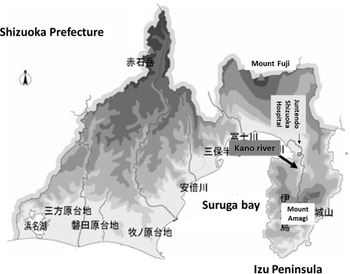
The Kano River (also called Kanogawa in Japan) is a first-class river in Shizuoka Prefecture, Japan. It rises from Mount Amagi in the Izu Peninsula and follows a generally northern path into Suruga Bay (Figure 1). Following a powerful typhoon in 1958 (known as the ‘Kanogawa Typhoon’), the flooding of the river resulted in heavy flood damage to towns along its banks and caused over 1000 deaths. A diversion canal was therefore constructed to divert the flood water into Suruga Bay in 1965.
Map of Shizuoka Prefecture. The Kano River rises from Mount Amagi in Izu Peninsula, and follows a generally northern path into Suruga Bay. Juntendo Shizuoka Hospital is located in Izunokuni Cityand the Kano River runs through the middle of the city.

Typhoon Hagibis hit Izu Peninsula on Saturday, October 12, 2019, and is one of the most extreme typhoons on record. Indeed, the estimated core atmospheric pressure was 915 hectopascals, and the estimated maximum wind velocity was 75 meters per second. The typhoon struck Japan with torrential rainfall, storm surge flooding, and strong winds hammering its largest island, Honshu. On October 20, Japan’s Fire and Disaster Management Agency announced that at least 80 people had been confirmed dead due to the storm, and that 10 people remained missing. Over 53000 houses were estimated to have sustained damages such as flooding above floor level, and over 80000 noticed a suspension in their water supply. This damage exceeded that which had been induced by the West Japan heavy rain incident in 2018.Reference Yanagawa, Nagawasa and Takeuchi1
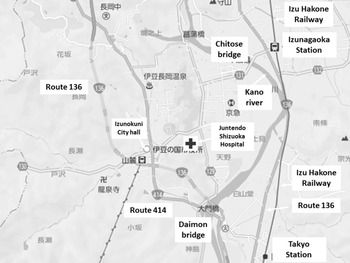
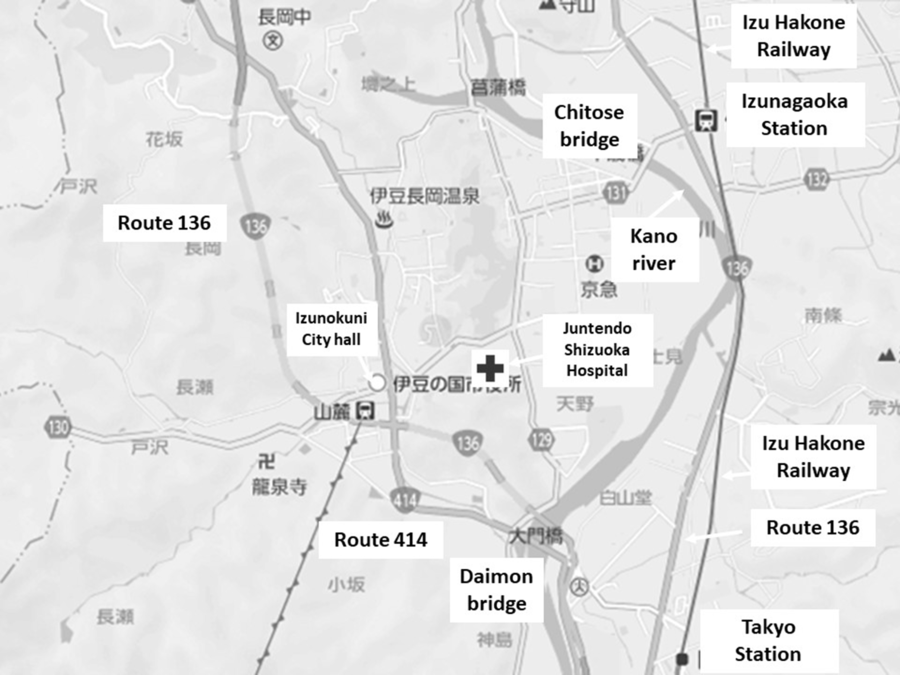
Our facility (Juntendo University Shizuoka Hospital) is an acute critical care center located in Izunokuni City on the Izu Peninsula. It serves as a disaster base hospital, as well as the base hospital for a physician-staffed helicopter (doctor helicopter) emergency medical service, serving eastern Shizuoka (population: approximately 1510000). It is also the leader of the Medical Control Council (MCC) system which oversees the activities of the fire department as members of the Japanese Medical Association.Reference Yanagawa, Onizuka and Nozawa2,Reference Yanagawa, Onitsuka and Nozawa3 Izunokuni City includes national route 135, national route 414, the Izu longitudinal expressway and the Izu-Hakone railway. The Kano River also runs through the middle of Izunokuni City (Figure 2).The passage of Typhoon Hagibis over Izunokuni City resulted in the city becoming an island due to the closures of roads, bridges, and public transportation following the flooding of a branch of the Kano River and landslides.
Map of Izunokuni City. Izunokuni City includes national route 135, national route 414, the Izu longitudinal expressway and the Izu-Hakone railway. The Kano River also runs through the middle of Izunokuni City.
We herein report the activities of the headquarters for disaster control, in the doctor helicopter control room of Juntendo Shizuoka Hospital. and the results of an analysis of Twitter posts (Twitter Japan Incorporation, Tokyo, Japan) concerning Izunokuni City on October 12, 2019, when Typhoon Hagibis hit the city.
METHODS
The protocol for this study was approved by our institutional review board, and the examinations were conducted according to the standards of good clinical practice and the Declaration of Helsinki.
First, we narrated the activity of the headquarters for disaster control in the doctor helicopter control room of Juntendo Shizuoka Hospital. We then collected information from Twitter from October 12-14, 2019, using the keyword ‘Izunokuni.’ The inclusion criterion was Typhoon Hagibis-related information. We investigated the contents of Twitter posts as well as the number of reactions (‘retweets’ and ‘likes’). Twitter information was classified into photo (+) and (-) groups, depending on whether or not the post had a photo or video included, as we felt that posts with photos would have a greater impact than those without photos. Twitter information was also classified into public and private groups based on whether the poster was a public organization or a private citizen. The number of reactions between the two groups was then analyzed. For the purpose of this study, a ‘retweet’ was considered important information that the user wanted to share with others, while a ‘like’ was considered useful information for the user (reader).
The non-paired Student’s t-test was used for the statistical analyses. P values of < 0.05 were considered statistically significant.
RESULTS
Activities of the Headquarters for Disaster Control
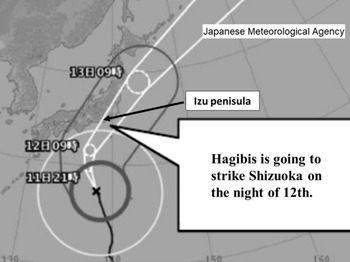
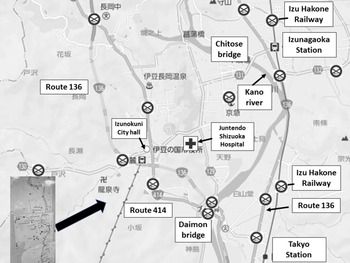
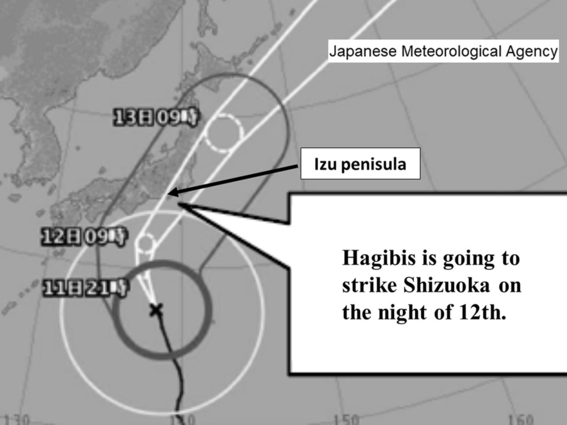
When the powerful Typhoon Hagibis was approaching Shizuoka prefecture, the Meteorological Agency had forecast that Hagibis would hit Izu Peninsula on the night of October 12, 2019, and recommended that its residents evacuate swiftly before the winds and rain become too strong while following safety evacuation advisories as issued by local bodies (Figure 3). The Izu-Hakone Railroad and Bus company decided to stop train, bus, and taxi services on October 12. When the storm zone of Hagibis reached Shizuoka prefecture on October 12, Izunokuni City hall announced the arrival of Typhoon Hagibis and members of the headquarters for disaster control at Juntendo Shizuoka Hospital gathered at the hospital. Initially, each member worked alone, collating information on Hagibis from television coverage and from the city hall’s crisis management division. At noon on October 12, a rest space was created on the first and second floors for out-patients, as some patients who needed regular hemodialysis were unable to return home due to the storm, and many hospital staff members who were on the night shift, had arrived earlier than usual. At around 2:00 PM, a staff member obtained information on road closures due to flooding from a branch of the Kano River from Twitter, so a headquarters for disaster control was established in the doctor helicopter control room. This location was selected because it contained many instruments that could be used to collect information and communicate with others, such as an anemometer, real-time local weather information, access to surveillance monitors around the hospital, a television that constantly broadcast information on Hagibis from public organizations, a local firefighting radio, transceivers, a personal computer with access to the internet, and telephones for general, and in-hospital use. The main members of the headquarters gathered in this room, drafted a time chart and gathered data from the City hall crisis management division, Twitter, and television. They then drafted a disaster map in order to share the information with the hospital staff and out-patients (Figure 4).
Estimated track of Typhoon Hagibis. The Meteorological Agency forecast that Hagibis would hit Izu Peninsula on the night of October 12, 2019.
Information on road and bridge closures. Members at the headquarters collected data and drafted a disaster map in order to share the information among the hospital staff and outpatients.
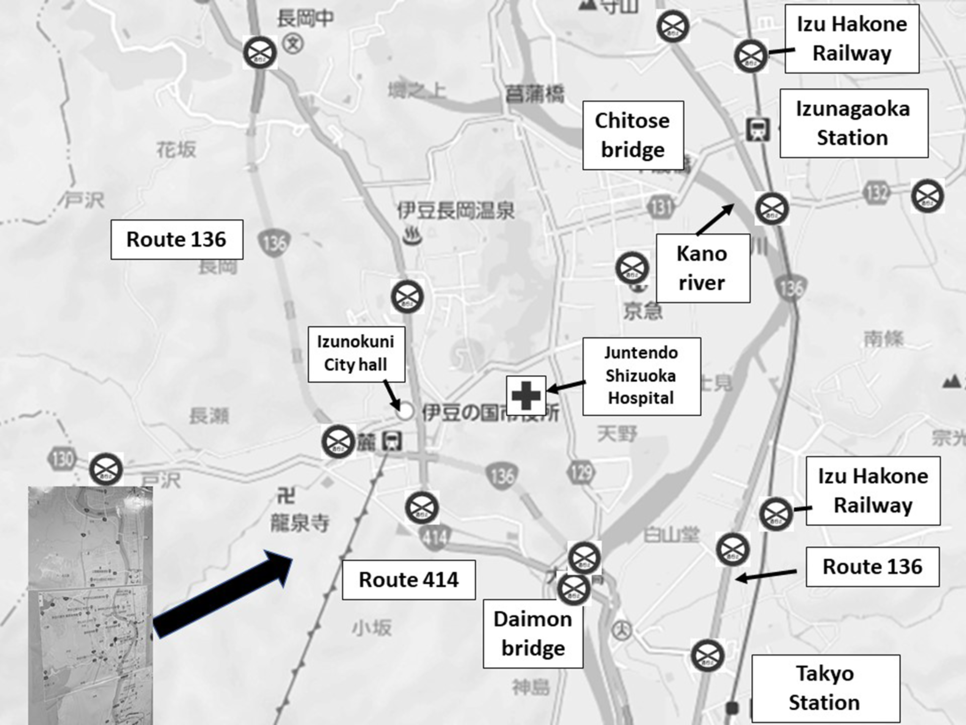
At 2:50 PM, an overflow warning for the Kano River was announced by the Ministry of Land. A number of families and staff members came to the hospital in search of shelter. Many roads and the two main bridges had been closed due to flooding and the storm, hence, Izunokuni City effectively became an island. Approximately 100 staff members on the day shift were unable to return home. The members of the headquarters for disaster control made arrangements for unoccupied beds and shower rooms to be allocated for use by staff members who were unable to return home. Towels, bedclothes, hot water and emergency food were also provided to all refugees. After the eye of Hagibis passed and the storm began to wind down, the overflow warning of Kano River was cancelled by the Ministry of Land at 10:00 PM on October 12.
The weather on the following day was fine, the floods had receded and most of the closed roads were opened once again. Staff members who had been trapped were finally able to return home. There were no outstanding medical demands at our hospital or in the medical facilities or refugee sites on October 12 and 13, 2019.
Our Analysis of Twitter
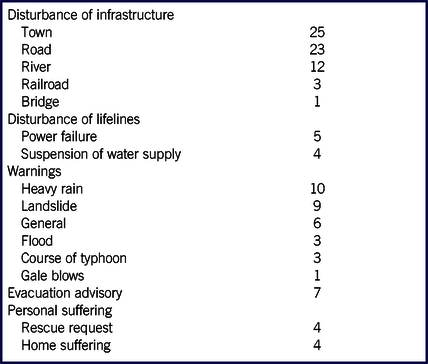
We counted 122 Twitter posts containing Hagibis-related information for Izunokuni City, including 23 in the public group and 99 in the private group. All 23 posts in the public group contained warnings without photos, among which were, 22 posts from Shizuoka Prefecture, and one from the Japan Broadcasting Corporation (NHK). The contents of these 122 posts are summarized in Table 1.The most frequent topic was the disturbance of infrastructure and lifelines, followed by disaster alerts.
Contents of Twitter

Table 2 shows the results of analysis concerning ‘retweets’ and ‘likes’ between the photo (+) and photo (−) groups. The average number of both ‘retweets’ and ‘likes’ in the photo (+) group were found to be significantly greater than those in the photo (−) group. All photos and videos depicted specific places in Izunokuni City.
A Comparison Between the Photo (−) and Photo (+) Group Concerning Numbers of Reactions

Table 3 shows the results of analysis concerning ‘retweets’ and ‘likes’ between the public and private groups. The average number of ‘likes’ in the private group was greater than that in the public group, although not to a significant degree. The average number of ‘retweets’ in the private group was significantly lower than that in the public group.
A Comparison Between Private and Public Groups Concerning the Number of Reactions

DISCUSSION
In this study, the average number of both ‘retweets’ and ‘likes’ in the photo (+) group were found to be significantly greater than those in the photo (−) group. All images and videos were sent from personal accounts (private group) and depicted actual footage of the disaster scenes or local warning signs such as actual images of the dangerous river levels which had heralded the flooding. Accordingly, users might have found the information included in these images useful for understanding the actual situation. Indeed, one user posted on Twitter that the flood warning concerning the Kano River, delivered by a public organization, had described an area which was too large to evacuate and that a more specific, limited area would have been preferred.
In the present study, Twitter was shown to be a useful tool for disseminating warnings from public organizations. Furthermore, due to their importance and accuracy, messages from public organizations received a certain degree of recognition despite not including images. A previous study reported that social network services (SNSs), including Twitter, were useful as a primary means of communication during cell carrier service interruptions.Reference Houston, Hawthorne and Perreault4-Reference Siskey and Islam6 SNSs appear to cover four key areas: (1) implementation, (2) education, (3) collaboration, and (4) communication.Reference Siskey and Islam6 Such services have also been used for a wide range of purposes during disasters, including locating family members and loved ones, requesting help, disseminating information, and facilitating psychosocial interaction. However, we are currently trying to establish and utilize the best practices for the use of SNSs in emergency management. Based on our experience at the headquarters for disaster control during and after the passing of Typhoon Hagibis, we felt that the information obtained from public organizations was useful for preparing for a huge disaster in advance. However, information concerning disturbances to local infrastructure or lifelines induced by Hagibis was largely difficult to obtain from public organizations. In our experience, Twitter posts containing information on road closures prompted us to establish a headquarters for disaster control at our hospital. We also felt that Twitter proved to be a useful tool for obtaining local disaster information based on its timeliness, reality and specificity concerning local damage information, especially in the context of a large-scale disaster. Unfortunately, we never tried asking Twitter users to tweet information concerning the hospital in order to gather more relevant information. This approach might facilitate the collection of more active information, rather than passive data. Therefore, it is important to establish such a framework during a calm and peaceful time, but not after a disaster has occurred.
One issue with using information obtained from SNSs is its reliability.Reference Sugimoto, Nomura and Tsubokura7,Reference Jones, Thompson and Dunkel8 In the present study, staff of the headquarters for disaster control believed that the information shown in the images were true, and as they were acquainted with the disaster sites, also believed that the creation of composite photographs in order to generate rumors in the middle of Typhoon Hagibis was unlikely. We also verified the information by contacting staff at the City Hall by telephone and gathering information from staff members who had come to our hospital seeking shelter in the middle of the typhoon. In addition, all information was confirmed by exploring the town and obtaining information from the City Hall after Typhoon Hagibis had passed. Information displayed on SNSs in a disaster setting may include misinformation or disinformation that is either intentionally or unintentionally misleading. Such shoddy information may hamper the response and make the situation dangerous for responders. However, previous reports have suggested that utilizing SNSs in an emergency situation would enable the prompt detection of disaster-stricken areas as well as the rapid and effective location and evacuation of casualties.Reference de Bruijn, de Moel and Jongman9-Reference Simon, Adini and El-Hadid12 Making decisions with limited health information can negatively affect emergency response activities and influence morbidity and mortality.Reference Chan and Purohit13 The rapid evolution of technology, in addition to the advent of information and communication technology interfaces, such as SNSs, communication is no longer a unidirectional source of information traveling from the newsroom to the public.Reference Buzzelli, Morgan and Muschek14,Reference Black, Dietz and Stirratt15 In the event of a disaster, time-critical information can be exchanged to and from any person or organization simultaneously, with the capacity to receive feedback.Reference Chan and Purohit13-Reference Black, Dietz and Stirratt15 As SNSs can contribute to the saving of lives during a disaster, a standard operating procedure should be developed in order to enable multiple responders to monitor, synchronize and integrate SNSs during emergencies.Reference Simon, Goldberg and Aharonson-Daniel10 This will lead to the better utilization and optimization of SNS resources during crises, thus providing clear guidelines.
One limitation associated with this study is that it analyzed just 122 tweets concerning the magnitude of Typhoon Hagibis and the damage it caused. We used the key word ‘Izunokuni’ to retrieve tweets on the disaster. However, if we had used other key words such as the name of the typhoon (Hagibis), Shizuoka Prefecture, Japan, or Kano river, the search criteria would have been expanded. In addition, focusing on the international community would have broadened the scope of the analysis. Unfortunately, as the time of peak interest had passed and a number of Twitter posts had been withdrawn, we lost the chance to learn more information about the actors and actual content of the tweets. However, it is possible that if the key words had been expanded the results of many Twitter posts might have lost the ability to detect specific information, regarding local damage occurring in the vicinity of the hospital.
Another limitation associated with this study is that it only analyzed posts on Twitter, with no other SNSs evaluated. Even as extreme global warming-induced climatic changes have increased the frequency of severe typhoons by bringing heavy rains, floods, and landslides, we must determine the best practices for SNSs based on a nationwide survey.
CONCLUSION
Based on our experience at the headquarters for disaster control during Typhoon Hagibis, Twitter was considered to be a useful tool for obtaining local disaster information due to its timeliness, reality, and specificity.
Conflict of Interest Statement
The authors declare no conflicts of interest in association with this study.
Funding Statement
This manuscript received funding from the Ministry of Education, Culture, Sports, Science, and Technology-Supported Program for the Strategic Research Foundation at Private Universities, 2015-2019; the constitution of total researching system for comprehensive disaster, medical management, corresponding to wide-scale disaster.
Author Contributions
Study concept and design (YY); obtaining funding (YY); acquisition of the data (KJ, HO, JS, MI, MS, YN); analysis of the data (YY); drafting of the manuscript (KJ, YY); critical revision of the manuscript (HO, JS, MI, MS, YN); approval of final manuscript, (KJ, HO, JS, MI, MS, YN, YY).