Introduction
Diffusion as a mechanism explaining policy innovation and institutional change has faced criticism for its static and mechanical connotations. Scholars have observed that policy programmes are not pre-packaged entities readily moved from one context to another (Lendvai and Stubbs, Reference Lendvai and Stubbs2009); rather, diffused items change as they cross boundaries and sites, with local actors playing important roles in the process (Campbell, Reference Campbell2004: 79; Czarniawska and Sevon, Reference Czarniawska, Sevon, Czarniawska and Sevon2005; Johnson and Hagström, Reference Johnson and Hagström2005; Sahlin and Wedlin, Reference Sahlin and Wedlin2008). This critique has proposed translation as a more apt concept for attending to a borrowed policy item's encounter with an adopting context and for emphasising translation agents’ role in the process of adjusting foreign policy programmes to suit local experiences (Campbell, Reference Campbell2004:163). In short, translation is a process that spatially and temporally disembeds a policy programme, idea or practice from its original context and uses it to propel and model institutional changes in a new context (Johnson and Hagström, Reference Johnson and Hagström2005: 369).
In this article we undertake a translation approach to analyse the adoption of a workfare programme in Israel. Workfare programmes and schemes require people to work in return for social benefits. These programmes are compulsory (i.e. non-compliance with work requirements carries the risk of lost or reduced benefits); they are about work (and not about training or upgrading of skills) and targeted to working age social assistance claimants and beneficiaries (Lodemel and Trickey, Reference Lodemel, Trickey, Lodemel and Trickey2000, pp. 7–9). Workfare programmes – through a combination of coercion, compulsion and (at times) financial incentives – endeavour to change the individual's conduct and induce a quick return to the labour market (Daguerre, Reference Daguerre2007; Korteweg, Reference Korteweg2003). By conditioning eligibility to social benefits on the fulfilment of obligations (Dwyer, Reference Dwyer2004), workfare programmes design a new social contract for working-age and able-bodied social assistance beneficiaries. This contract embodies a new balance between the rights and responsibilities of citizenship, i.e. the state has rights vis-à-vis its citizens, and citizens have obligations towards the state (Lessenich, Reference Lessenich, Brockling, Krasman and Lemke2011).
We situate the process of translation within the reform of the labour market and social policy in Israel, primarily between 1998 and 2010. We follow the trajectory of a specific model of activation from the US, Wisconsin-Works, where it was part of the 1996 welfare reform that revoked poor single mothers' entitlement to social assistance (Orloff, 2001).
Enacting a workfare programme is everywhere complex and contested, involving both changes in policy goals and administrative structures and requiring the participation of a multitude of actors engaged in policy design, coordination and implementation (Heidenreich and Rice, Reference Heidenreich, Rice, Heidenreich and Rice2016: 24). This complexity is exacerbated in this case, since Israel's adoption of an American workfare programme significantly challenged its labour market and social policy institutions. This contested process of translation illuminates the importance of enacting networks' resilience for the institutionalisation of translation-led policy change. In order for translation to have a lasting impact on its adopting institutional context, agents of translation must assemble a potent network of local actors and build consensus around specific claims or interpretations suitable for welcoming the borrowed item (Johnson and Hangstrom, Reference Johnson and Hagström2005; Mukhtarov, Reference Mukhtarov2014; Radaelli and Sitton-Kent, Reference Radaelli and Sitton Kent2016). Scholars regard the preliminary enrolment of actors into a network as essential for translation's success. However, analysis often stops short of asking how changes in a network's configuration – its membership, form and capacity – can shift over time and across policy-making levels and sites to affect a translation process's outcomes.
Based on the contested translation of workfare in Israel, we suggest conceptualising translation as a multi-level and multi-stage process that occurs via successive episodes on different levels and sites of policy formulation and implementation. At each level or site, disagreement or conflict may destabilize the network and alter the meanings of translated items (Johnson and Hagström, Reference Johnson and Hagström2005). Throughout these episodes, policy actors' changing configurations and positioning within the enacting network may bear important implications for policy translation's institutionalisation. We primarily focus on those actors engaged in the translation process and the assemblage of a network, its stabilization and destabilization.
We define networks as chains of associations, made up of evolving entanglements and/or relationships between actors, co-ordinated toward collective problematisation and action (Callon, Reference Callon1986; Mutzel, Reference Mutzel2009: 876). Our analysis follows the evolution of networks (i.e. the process through which actors are linked) via the identification and enrolment of potential allies, and the meaning of the translated programme is negotiated and constructed. By following the evolution of the network, the formation of agreement and emergence of conflict, the de-linking of actors from the original network and the development of an alternative network, we show the fragility and contingency of translation upon the network actors' support and legitimacy.
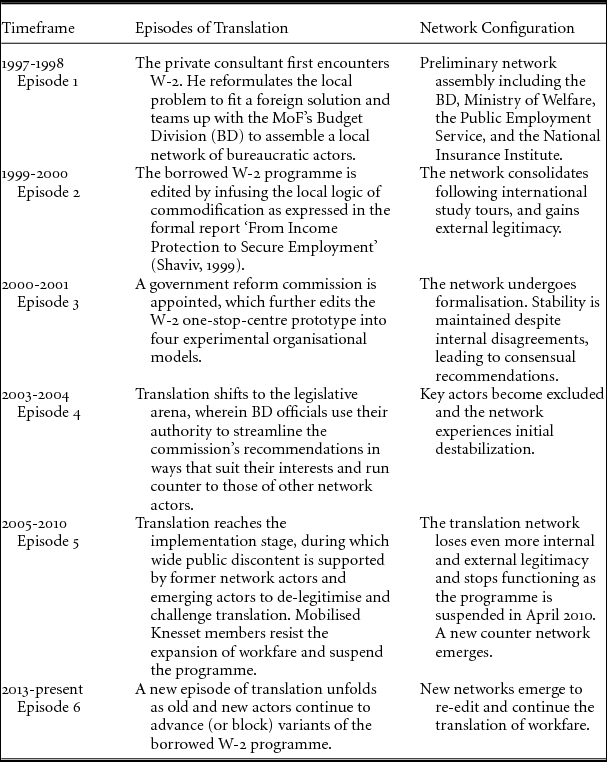
In the following section we elaborate on the challenges involved in the translation of workfare. We then describe the context in which Israeli translation took place and account for our research method. Next, we proceed to analyse six episodes of translation (See Table 1), demonstrating how shifting network configuration may stabilize or destabilize the translated programme's institutionalisation. We conclude by highlighting our analysis's contribution to the study of policy translation, its politics and repercussions.
Episodes of Translation and Changing Network Configuration

From international policy fashion to local change: the translation of workfare programmes
When and why do international policy ideas, programmes and practices draw local actors’ attention? At times, policy fashion plays a role. Czarniawska and Sevon (Reference Czarniawska, Sevon, Czarniawska and Sevon2005: 9–10) describe fashion as ‘the collective choice among tastes, things and ideas. . .that become typical of a given period of time’. According to Larsen (Larsen, Reference Larsen2002), activation policies – and workfare programmes in particular – became ‘a dominant policy fashion’ spread by international organisations in the 1990s. Starting in the mid-1990s, international organisations and states began to question ‘the desirability and usefulness of welfare payments’ (Lodemel and Trickey, Reference Lodemel, Trickey, Lodemel and Trickey2000: 2). International organisations, such as the OECD, the IMF and the World Bank (Deacon, Reference Deacon, Sykes, Palier and Prior2001), were active agents in designing models of action and behaviour to cope with long-term inactivity rates and rising social expenditures (Weishaupt, Reference Weishaupt2011). The United States, Denmark and the Netherlands launched activation programmes and soon became trendsetters attracting the attention of policy-makers in different countries (Daguerre, Reference Daguerre2007; Lodemel and Trickey, Reference Lodemel, Trickey, Lodemel and Trickey2000). This context made the state of Wisconsin a Mecca of policy tourism (Anderson et al., Reference Anderson, Kairys and Wiseman2011: 132).
The debate over the desirability and usefulness of welfare payments took place in the context of the neoliberal reconfiguration of the institutional architecture of national states and the rising dominance of pro-market oriented fiscal bureaucrats along with what Jessop (Reference Jessop1999) conceptualised as the transition from a ‘Keynesian welfare to a Workfare State’. Whereas, in the Keynesian type of welfare state, social policy was supposed to counterbalance the effects of the market, Jessop claims that, in the workfare state, social policies are subordinated to the imperatives of the market and the enhancement of the competitiveness of the national economies at a global scale. In order to enhance national competitiveness in global markets, labour markets became de-regulated and flexible; i.e. regulations on employment were loosened giving rise to new forms such as temporary employment and a-typical contracts especially in the lower tiers of the labour market, characterised by low levels of employment protection and occupational welfare. Women, unskilled workers, ethnic minorities and young people bore the costs of the expansion of temporary work and a-typical contracts, shifting between periods of employment and unemployment. For such categories of workers, who lacked continuous work histories, social assistance schemes provided temporary shelters (Peck, Reference Peck2001). It was in this context that the diagnosis of unemployment shifted from the structure of the labour market to the individual attributes of the long-term unemployed, such as their motivation and work ethics. Workfare programmes combining compulsion, conditionality and financial incentives were deemed ideal to change the individual's behaviour and to enhance their employability and quick transition to the labour market by the inculcation of ‘soft skills’ (Daguerre, Reference Daguerre2007; Moss and Tilly, Reference Moss and Tilly1996).
The Wisconsin-Works (W-2) programme served as a trendsetter for welfare reforms in many locations around the world (Covaleski et al., Reference Covaleski, Dirsmith, Samuel and Weiss2014; Peck and Theodore, Reference Peck and Theodore2001). The W-2 model received international acclaim for swiftly bringing about a drastic decline in the number of social assistance claimants and for conditioning benefits’ maintenance on a speedy transition to the labour market (Peck, Reference Peck2001; Peck and Theodore, Reference Peck and Theodore2000). It attained these achievements by changing the governance of unemployment: adopting new policy goals and reforming public employment services according to new public management principles (Weishaupt, Reference Weishaupt2011: 151–197).
The concept of policy ‘fashions’ can help us understand popular policies’ cultural attraction but is less helpful for grasping political motivations animating translation processes. Translation takes place in heterogeneous social fields inhabited by multiple actors with different interests, power resources, skills and capacities (Fligstein and McAdam, Reference Fligstein and McAdam2011). It follows that policy fashions do not circulate in a political vacuum, and that political struggles and contentions inevitably arise in translation processes (Alasuutari, Reference Alasuutari2015; Maman and Rosenhek, Reference Maman and Rosenhek2011; Waeraas and Nielsen, Reference Waeraas and Nielsen2016). In the case of activation and workfare in particular, disagreement among actors has derived from state welfare reform's character and the introduction of new policy arrangements and instruments (Maron and Helman, Reference Maron and Helman2017). Local actors who conceive the local translation of activation programmes as attempts to undermine their long-term policy roles and curtail their autonomy and institutional power resources may display resistance: as, for example, did labour unions in Germany and the Netherlands (Davidson and Emmeneger, Reference Davidson, Emmeneger, Bonoli and Natali2012; Lawrence, Reference Lawrence2008).
When conflicting interests seem unbridgeable and resistance substantial, bulldozing through and forcibly imposing change might prove untenable. In order to bypass a deadlock, powerful actors may mobilise policy fashions to build support for change. In such cases, actors do not simply embrace a policy fashion to emulate leading countries or to attain prestige (Sahlin and Wedlin, Reference Sahlin and Wedlin2008), but do so in an attempt to drive change amidst resistance. Notwithstanding this, policy fashions do not provide local actors with readymade tools of persuasion. In a new context, a policy fashion also requires translation and adjustment. Translation agents play the critical role of mediating between policy fashions’ logics and local policy legacies, practices and experiences – what Lindberg (Reference Lindberg2014) conceptualises as ‘ideas in residence’. This kind of translation occurs via an editing process, wherein a borrowed policy model or practice is first de-contextualized and then re-contextualized in a new policy domain, ascribing to it local meanings and experiences (Czarniawska and Sevon, Reference Czarniawska, Sevon, Czarniawska and Sevon2005; Sahlin and Wedlin, Reference Sahlin and Wedlin2008).
However, editing is not enough as the promotion of the borrowed policy model and its acceptance are contingent upon the assemblage of a network: i.e. the identification of potential allies, their enrolment and the ongoing mobilisation of their support and legitimation. It is through the assemblage of a network that the interests of the heterogeneous actors are aligned into an acceptable account of policy change. Thus we do not assume that policy networks share from the onset core values and beliefs and norms (see, for example, Daguerre, Reference Daguerre2007: 13–14; Rhodes and Marsh, Reference Rhodes and Marsh1992), but that the common meaning is an outcome of translation that creates associations between heterogeneous actors and between local and borrowed policy models. Such dynamics are inherently political, as translation networks play an important role in the articulation and intermediation of collective views and interests.
We concur with such accounts’ value, but regard them as lacking sufficient complexity, as translation is neither a finite nor a unidirectional process. We argue that we can gain greater insight into translation by studying it as a sequence of distinct episodes. Different translators participate in translation as it shifts among sites and levels of policy design and implementation. Through this process, new actors emerge and veteran actors acquire new positions, making networks either more or less stable. Respectively, translation's institutionalisation may either advance or stall and its outcomes may become either more robust or more superficial. Table 1 presents a summary of the argument and the shifting configuration of the network throughout episodes of translation.
Conflicting solutions to unemployment crisis and the emergence of a deadlock
Beginning in the mid-1980s, the Israeli political economy underwent a process of neoliberal restructuring with particular implications for the state's social policy regime, as it initiated gradual yet far-reaching changes. Powerful state agencies such as the Ministry of Finance proactively advanced and secured this transformation. The progressive elimination of employers’ role in financing social insurance transferred social security payments to the state's general revenue and thereby to employees, gradually undermining the social insurance basis of Israel's social security system (Koreh and Shalev, Reference Koreh and Shalev2009). Cost containment measures brought about the retrenchment of social programmes targeting the most vulnerable sectors of the population – the elderly, the unemployed and families with children (Shalev et al., Reference Shalev, Gal and Azary-Viesel2012).
Within this changing socio-economic and political context, Israel experienced several waves of unemployment in consonance with massive waves of immigration from the former Soviet Union, growing from 6.4 per cent in 1988 to 11.2 per cent in 1992. While unemployment rates declined from 1993 to 1995, by 1997 they had begun to rise again. This trend continued to grow at the beginning of the new millennium due to the worldwide recession and the Second IntifadaFootnote 1. In 2003, the unemployment rate reached 10.7 per cent of the working-age population and unemployment benefits rose to 0.68 of the gross domestic product. Low-skilled workers were especially affected, experiencing longer unemployment spells than others (Achdut et al., Reference Achdut, Lavih and Solah2000), due to decreased demand for their labour, wage erosion caused by liberalisation and an influx of migrant workers (Zussman and Frisch, Reference Zussman and Frisch2005).
Longer unemployment spells increased four-fold the number of working-age families receiving social assistance benefits from 31,818 in 1990 to 128,428 in 2000.
The social assistance programme comprised only seven per cent of National Insurance Institute (NII) expenditures, yet the increase in the number of claimants and the even more dramatic growth in expenditure – from 670 million ILS in 1990 to 3.7 billion in 2001 (Gal and Achdut, 2007) – became a focusing event for policy change (Beland, Reference Beland2005). Moreover, data provided by the NII and the Bank of Israel showed that, even in periods during which unemployment rates declined, the number of working-age social assistance beneficiaries continued to rise (Zussman and Frisch, Reference Zussman and Frisch2005, graph 2).
As unemployment became a more pressing problem, the Israel Employment Service (IES), the central bureaucratic agency responsible for managing frictional unemployment (the unemployment that results from time spent between jobs when a worker is searching for, or transitioning from, one job to another), drew significant public and political attention. The IES was established in 1959 as a statutory body entrusted with labour market mediation by professional bureaucrats, with representatives of labour and employers playing only an advisory role. Unemployment insurance became a matter of law in 1972 with the NII managing benefits and the IES administering eligibility tests.
State bureaucracy's role in Israel's administration of social and labour market policies helps explain why, in contrast with European welfare states, conflicts over activation took place within the bureaucratic apparatus, away from the public arena and partisan politics (Maron and Helman, Reference Maron and Helman2017). In comparison to European welfare states, unemployment benefits’ duration is brief in Israel, only 138 days, with persons over 45 and those heading families with three children or more being granted benefits for 175 days. Upon exhausting unemployment benefits, if beneficiaries remain unemployed and without other means of subsistence, they are transferred to the social assistance programme.
Over the years, the IES underwent processes of gradual institutional change. Its original goals became marginal as tasks shifted, accompanied by decreasing resources. Of particular importance was the dismantling of the IES's monopoly over labour market mediation and rescinding its compulsory binding of employers. One outcome of these changes was the defection of skilled and professional workers, making the IES a ‘poor agency’ with limited human and financial resources, relegated to administering eligibility tests (State Comptroller, 1993).
Swelling unemployment figures and expenditures at the end of the 1990s opened a window of opportunity for the Ministry of Finance (MoF) to undertake a moral crusade renegotiating the IES's form and function. MoF senior bureaucrats interpreted the unemployment crisis, and particularly growing public expenditures, as stemming from the IES's incompetent and irresponsible governance, which, according to a senior MoF officer, was ‘unwieldly, bureaucratic, highly politicized and manned by low quality employees’ (Senior Official, Budget Division, MoF interview, December 2010). The 1993 State Comptroller's Report advanced this position, stating the IES encouraged ‘comfortable unemployment’ as well as engaged in wide-scale abuse of public resources (State Comptroller, 1993).
In 1997, at the peak of an unemployment cycle, an inter-ministerial committee was appointed with the mandate to explore alternatives to the IES's functioning (Koreh, Reference Koreh2001). While all committee members expressed dissatisfaction with the IES during times of soaring unemployment, deep disagreements developed between ‘spenders’ (from the Ministry of Labor and Welfare and the IES) and ‘guardians’ (from the MoF)Footnote 2. Spenders interpreted the IES's inability to cope with growing unemployment as a result of its dearth of resources, suggesting a new allocation of resources and a reviving of new-old programmes such as retraining academics, reshuffling vocational training courses, initiating public works and providing employer subsidies (Senior Official, Ministry of Labor and Welfare, interview, June 2009).
Guardians interpreted the IES's inefficacy as reflecting its inefficiency and irrelevance, due to its strong union and opposition to modernisation and adaptation to changing conditions stemming from its enduring monopolistic status amidst the growing number of private manpower resource companies. Moreover, guardians blamed the IES for its inability to discipline the unemployed according to the needs of business. The MoF proposed an alternative strategy, privatising the IES by outsourcing the administration of work tests to private placement agencies, perceived as more efficient and more equipped to bring about a rapid transition of the unemployed to the labour market (Senior Official, Budget Division, MoF, interview, June 2010; Senior Official, Budget Division, MoF, interview, June 2009).
At this point, the different actors were unable to come to an agreement. The tensions between the logics of de-commodification and commodification underlying the labour market and the state's social policy regime re-emerged to foment a definitional conflict over the IES's purpose and function. The inter-ministerial committee interim report – released in September 1998 – thereby refrained from recommending change. Rather, it supported the status-quo and called on the relevant ministries to maintain the IES's public character. The status-quo was indeed maintained, leading to institutional deadlock.
Data and method
The paper reports on a research project examining the introduction, design and implementation of activation policies and programmes in Israel. We gathered empirical data from dozens of policy documents, media reports and parliamentary deliberations, issued or having taken place from 1998 to 2010, as well as conducting in-depth interviews – during the period of September 2009 to May 2010 – with ten senior policy makers involved in the formulation and implementation of the programmesFootnote 3. We analysed the data to identify the key events involved in W-2’s import to Israel. Policy documents and interviews helped us reconstruct the translation process – identify different translation moments, sites and translators. We drew upon Fligstein and MacAdam's (Reference Fligstein and McAdam2011) strategic action fields to locate activation in Israel: its incumbents, their positions and relative power, as well as its challengers.
Contextualising international policy fashions via local networks: Introducing workfare to Israel
As mentioned above, Israel was not alone in searching for solutions to swelling unemployment figures and their accompanying expenditures. Searching for alternatives to the IES's role, the MoF hired an external consultant to shop for policy ideas and programmes in the burgeoning international market. The consultant was a former MoF employee and well acquainted with the institutional legacies undergirding Israel's labour market and social policy regime (Private Consultant, June 2009, Jerusalem). By gathering knowledge through national and international contacts, the consultant became acquainted with W-2.
The consultant was in an ideal position to introduce W-2 to Israel. As an insider/outsider to labour market and social policy institutions, he had the capacity to embrace radical and potentially path-changing ideas (Djelic, Reference Djelic2004: 346). However, in order for W-2 to travel from the United States to Israel, it had to be translated into a text disembedded from its original context (Lindberg, Reference Lindberg2014). This initial translation appeared in the form of a proposal within a report the consultant submitted to the inter-ministerial committee. The report attributed soaring unemployment figures to the long-term effects of existing social programmes and the IES's monopolistic status (Kramer, Reference Kramer1998).
In order to travel from the policy debate's margins to its centre, the W-2’s initial translation was insufficient for taking action; it was further necessary to assemble a network of local policy actors in support of W-2’s introduction to Israel. Drawing on the social capital he had accumulated during his years as a senior MoF officer, the consultant succeeded in mobilising the interest and commitment of the MoF coordinator of Labor and Welfare (Private Consultant, June 2009, Jerusalem; Shaviv, Reference Shaviv2009). Together they recruited a network of heterogeneous actors from various offices: the MoF, the IES, the Ministry of Labor and Social Affairs and the National Insurance Institute (NII). The consultant and coordinator's positions granted them legitimacy, enabling them to bridge differences among various stakeholders in ways that facilitated access to disparate resources (Hardy and Maguire, Reference Hardy and Maguire2008). They initiated a process of negotiation and exchange with the network's potential members by offering positive inducements in exchange for support of their recommendations. This marks the end of the first episode of translation.
In 1999 and once the preliminary network was assembled, translation entered a second episode, wherein representatives from the different offices embarked on a series of ‘employment miracles’ policy tours in Europe and the US, encountering not only ideas and slogans but also in-situ insights into successful policy implementation. The touring group visited Wisconsin, New York, Boston and Washington DC in the US and the Netherlands and Denmark in Europe (Zohar, Reference Zohar2007). Although Denmark's and the Netherlands's activation reforms were only at their initial stages at the time, accounts of activation plans were presented on how the reforms were proceedingFootnote 4. The different translations and manifestations of W-2 conveyed order and uniformity and succeeded in aligning the network members’ different interests (Czarniawska and Sevon, Reference Czarniawska and Sevon1996: 35).
These study tours played a key role in consolidating the network, following which the experiences, images and lessons learned were packaged into a formal policy document drafted by the MoF's Budget Division. As its title suggests, ‘From Income Protection to Secure Employment’ (Shaviv, Reference Shaviv1999), this document puts forward an alternative scheme to the existing eligibility tests for unemployment and social assistance benefits. This proposed scheme claims to involve an original and comprehensive approach to reintegrating the long-term unemployed in the labour market and to address long-term dependence on subsistence allowances. While the document reviews cutting-edge models developed in the Netherlands and Denmark, it largely focuses on W-2, as only there did reform successfully ‘[bring] about a sharp decline in the number of dependents on welfare payments’ (Shaviv, Reference Shaviv1999).
The policy document de-contextualizes W-2 from its American context and re-contextualizes it in ways that enhance the similarities between Israel and the USA. Re-contextualization involves formulating W-2 in terms of ‘ideas in residence’ (Lindberg, Reference Lindberg2014), tapping a dormant local policy script promoted at the time of the legislation of the Social Assistance Act, which maintained that subsistence allowances would encourage high inactivity rates and a rise in expenditures (Bar, 2000). By reviving this script, the document's author brings the local logic of commodification to the fore: ‘The different kinds of subsistence allowances conceal the fact that numerous groups in Israel do not work or are not required to work in return for the allowances’ (Shaviv, Reference Shaviv1999: 6).
W-2 assumes what Somers and Block (Reference Somers and Block2005: 265) dub ‘the poverty to perversity hypothesis’ – whereby policies intended to alleviate poverty create perverse incentives towards welfare dependence and exploitation of state resources. The commodification logics reigning at the MoF provided useful language for employing the poverty to perversity hypothesis. The report blames the existing policy instruments’ de-commodifying premises for a variety of social ills: among them, long-term dependence on social benefits, inactivity traps, poverty's intergenerational transmission, social benefits’ constraining effects on liberalising the labour market and lowering wages, and the influx of migrant workers to overcome the shortage of cheap unskilled labour (Shaviv, Reference Shaviv1999).
In order to integrate working-age social assistance beneficiaries into the labour market and reduce their dependency, the translated model promotes adopting standards of selectivity and conditionality in allocating social benefits. The proposal couples social benefits with workforce development at the lower ends of the labour market by re-establishing the link between income and work, requiring beneficiaries to work for their benefits or to join the labour market. The proposed model also suggests eliminating automatic eligibility for in-kind benefits and services (including short-term vocational training) in exchange for linking them to an individually-tailored job-seeking plan (Shaviv, Reference Shaviv1999: 3–4).
A follow-up study trip to the Netherlands, headed by the Director General of the Ministry of Labor and Social Affairs, generated another report, this time by the nascent Commission for the Reform of the Treatment of the Long-Term Unemployed (henceforth Tamir commission). ‘Policy Trends in the Netherlands and Ideas for their Implementation in Israel’ presented the conditions leading to the Netherlands’ adoption of workfare and outlined Holland's and Israel's similarities. The report stated that, since both the Netherlands and Israel had been enduring long-term unemployment, welfare dependency and swelling social assistance rolls, the Netherlands's solution would also suit Israel (Zohar and Frenkel, Reference Zohar and Frenkel2011). This report consolidated the network by persuading new key members to join it, namely additional representatives from the Ministry of Labor and Social Affairs and the Director General of the IES, who had been some of the staunchest opponents to workfare.
Translating the prototype into local one-stop centres
The Tamir Commission establishment in 2000 marked the third episode of translation. As it already accepted the workfare prototype (Sahlin and Wedlin, Reference Sahlin and Wedlin2008: 230), its mandate was to undertake a policy experiment replacing existing public employment agencies with new agencies in four locales. These new agencies were to be charged with implementing new tests that conditioned benefit eligibility on participation in work, study or employment rehabilitation.
The Tamir Commission report (Reference Tamir2001) contained blueprints for establishing one-stop centres concentrating in one place the authority, instruments and personnel for service delivery, from the initial filling out of claims for social assistance to integration in the labour market or work-related activities. These centres would provide services such as short-term vocational training, supplementary education (mainly Hebrew language courses for new immigrants) and training and guidance in seeking and maintaining employment tailored to participants’ particular needs and skills. By way of experiment, the commission recommended managing each centre according to a different organisational logic: the first by a private contractor, the second by a non-profit organisation, the third by the IES and the fourth by an amalgam of private and non-profit contractors.
Policy programmes invariably change as they travel across organisational and institutional boundaries. The Tamir Commission's report preserved some components of the original prototype while rejecting others. It derived one-stop centres and conditioning social assistance benefits on employment from W-2, but rejected other features, such as the aim of ultimately ending entitlements to social assistance, regarding them as inappropriate to the Israeli setting.
‘Ideas in residence’ also changed via the translation process. While social assistance benefits are contingent on work search or availability to work (Gal and Doron, Reference Gal and Doron2000), this requirement had been more myth than realityFootnote 5. However, W-2’s translation not only activated this dormant condition but benefits became conditional on participation in work-related activities and/or employment. Moreover, the one-stop centres added another organisational layer aiming to eventually replace the IES with external contractors. At this stage, a wide consensus in support of the translated programme was well in place with network actors anticipating a smooth Knesset approval.
Policy redesign and implementation: network destabilization and the reemergence of conflict over workfare
Translation invariably faces contingencies. As translated models travel among different policy sites and levels, actors may seize on new opportunities to revise their forms and meanings (Czarniawska and Sevon, Reference Czarniawska, Sevon, Czarniawska and Sevon2005; Erlingsdóttir, Reference Erlingsdóttir and Sevón2005; Lofgren, Reference Lofgren, Czarniawska and Sevon2005). Moreover, some actors may strategize to enter friendly sites where they can enhance their participation and bolster their influence on the translation process (Johnson and Hagström, Reference Johnson and Hagström2005; Radaelli and Sitton-Kent, Reference Radaelli and Sitton Kent2016). Such revisions became possible when Israeli workfare shifted from the Tamir Commission's exclusive dominion to the legislative arena. This shift marked the beginning of the fourth episode of translation, during which newly appointed senior officials at the MoF used their positions in budget-making and social legislation to streamline the Tamir Commission's proposal in accordance with the MoF's objectives, mainly to reduce social expenditures and displace the IES.
Departing from the Tamir Commission, the 2004 passage of the Appropriation Omnibus Law excluded the IES from implementation, delegating operation of the one-stop centres exclusively to private agencies (Knesset, 2003; Koreh, Reference Koreh2003). This act also made the programme stricter and more demanding, emphasising future participants’ obligations without ensuring their rights (Koreh, Reference Koreh2003: 3–4). It allocated economic incentives to private agencies designed to achieve a dramatic drop in the number of social assistance claimantsFootnote 6.
Another threat to the translated programme's integrity arose in the form of disagreements over the target population's composition. The Israeli programme's target population was more heterogeneous than that targeted by W-2 and closer to those targeted in Western Europe (see, for example, Daguerre, Reference Daguerre2007). The Tamir Commission recommended that the programme should eventually include the different categories of actual recipients and future claimants of social assistance, such as mothers of children aged two years, ‘hard to place’, general disability and recidivist claimants (Tamir, Reference Tamir2001: 19). Several state agencies suggested conducting early screening of the heterogeneous ‘hard to place’ population (Knesset, 2003), but the MoF used its leading position to overlook these recommendations.
With the implementation of the programme in August 2005 translation entered its fifth episode, during which both existing and newly emerging actors rose within the first six months of operation to challenge it, culminating in a public uproar. The main point of contestation was the policy's conditioning of social assistance using a one-size-fits-all approach on a heterogeneous population (Comptroller, Reference Comptroller2007). Some half-dozen non-governmental organisations (NGOs) seized upon this discontent. These NGOs had been established during the 1980s and the 1990s to advance civil rights, social justice and the empowerment of disadvantaged populations and directly encountered their constituents’ daily grievances. An outpouring of complaints propelled their intervention (Badarne, Reference Badarne2006; Commission for Labor, 2005; Tanami, Reference Tanami2008). These NGOs quickly consolidated an alternative network able to attract the press by deploying images of beneficiaries' abuse for the sake of private profits. The emergence of this counter network de-legitimised the translated programme and its order and coherence began to be contested.
This widespread criticism engendered yet another episode of translation. The NGO coalition successfully lobbied the newly appointed Minister of Commerce, Industry and Employment and certain minority members of the coalition government to bring about changes in the design of the programme. Renaming it ‘Beacons of Employment’ (Orot Lata'asuka) the Minister succeeded in introducing changes to the programme, such as reducing economic incentives for private agencies and temporarily or permanently exempting certain categories of beneficiaries from the workfare programme (Dinur, Reference Dinur and Office2007: 29–31). However, these design changes did not end the NGO coalition's mobilisation. Rather, it continued to grow and join forces with both minority coalition and opposition Knesset members and representatives of the IES labour union and persisted in challenging the programme.
After an initial three-year experimental phase, the programme was extended for an additional two years while the MoF made plans to expand it to the national level. In early 2010, the programme expanded to include two more cities as an interim step towards nationwide expansion. However, mounting opposition to the programme even drew in members of the government coalition (Knesset, 2010b, 2010a). As the programme's renewal was undergoing deliberations, in April 2010, a government motion to expand the programme was defeated, leading to the entire programme's suspension (Lavie, Reference Lavie2010; Zarhia, Reference Zarhia2010).
Despite the programme's abrupt termination, the workfare prototype did not vanish, marking the sixth episode in the translation process. The MoF began preparing new policy initiatives to restore workfare as the primary institutional logic of the employment and social policy regime. In May 2013, a new coalition government brought before the Knesset a proposal to renew the programme, this time at a full national level. After a plenum approved the proposal, the MoF promoted two additional programmes together with the Ministry of Trade, Industry and Employment. The first one, ‘Circles of Employment’ was to operate through the IES with employment counsellors and coaches hired on a temporary basis. Implemented in early 2016, its main goal is to provide job search skills and coaching to new claimants of social assistance benefits, whose collection is conditional on participation in the programme. Sixteen branches of IES serve 15,000 working-age social assistance claimants. The second programme, ‘Back to Work’, targeted families of long-term social assistance beneficiaries with underlying goals similar to the ‘Beacons of Employment’ programme. However, adamant opposition from the Knesset Labor, Social Affairs and Health Committee blocked its implementation (Fostering Employment Act, 2014).
Discussion
This article presents a conceptualisation of policy translation as an inherently interminable multi-stage and multi-level process. This perspective expands upon previous claims identifying (1) the translation process as less linear, more multi-dimensional, polyvocal and messy than diffusion and policy transfer literatures admit (Kingfisher 2013) and (2) its outcomes as impossible to wholly prescribe from the starting point (Clarke et al., Reference Clarke, Bainton, Lendvai and Stubbs2015: 16). We additionally demonstrate the fragility of translation's institutionalisation, which rests upon an ever-changing configuration of networks drawn from within and outside the bureaucracy. More specifically, when networks become destabilized, translation may come to a complete halt. Translation projects require ongoing recruitment of existing and emerging policy actors in order to maintain legitimacy and to initiate and maintain implementation.
We analyse the journey of a workfare programme from Wisconsin to its ultimate translation in the Israeli context. We open by presenting the translation-induced policy-change argument, explaining how translation is always an incomplete process, such that at no point does it become safe to argue that a translation was a complete success or failure. We suggest paying special attention to the dynamics of local networks, since translation shifts (among policy sites and levels) as it moves towards institutionalisation in the receiving context. We advocate exploring how changes in network composition and power balance over time and across policy sites influence translation's institutionalisation and the ways it may be challenged and ultimately destabilized.
As a policy fashion, the W-2 attracted the attention of Israeli policy makers, primarily fiscal bureaucrats, during a time of a deep conflict over the Israeli Employment Service's functioning in the face of rising unemployment figures and expenditures. We follow translation agents in their attempts to use this fashion to introduce order and uniformity to the contradictory interests thwarting policy and institutional change and to establish a strong local network in favour of translation. Through positive inducements, such as having control over the programme and receiving increased resources in exchange for their support, translation agents succeeded in mobilising an effective network of heterogeneous actors.
Under the MoF's leadership, the translation network consolidated its power as more actors enrolled and alternative voices were marginalised. This first episode of translation took place within the state's bureaucracy, away from the public eye. It succeeded in translating W-2 into a detailed organisational design. As translation shifted from an appointed commission to the legislative arena, another episode of translation ensued. This shift opened a wide window of influence for the MoF, enabling it to revise the multi-agency commission's programme to better suit its interests. This shift in power and programme alienated and marginalized other network actors and threatened the programme's legitimacy and stability (see Table 1).
The translated programme's enactment further destabilized it, spawning an alternative network representing the interests of disadvantaged participants. This issue network and the public discontent it harnessed brought about another episode of translation, leading to the launching of a ‘renovated’ programme. Nevertheless, the shrinking capacity of the translation network that had turned workfare into an assumed fact, as well as the issue network's increasing power and capacity to mobilise opposition within the Knesset's Labor, Health and Welfare Committee, brought about the programme's abrupt termination.
Tracing this translation journey leads us to ask: what lessons can we learn from this rich case, illuminating how we cannot take the stability and institutionalisation of policy translation for granted? Studies of activation reforms centre around their initiation, the policy coalitions driving the reforms and their consolidation in different countries (see, for example, Daguerre, Reference Daguerre2007; Fleckenstein, Reference Fleckenstein2011), overlooking what may happen when networks transform. While some recent studies have attended to governance regimes and their change over time (Lodemel and Moreira, Reference Lodemel and Moreira2014; van Berkel et al., Reference van Berkel, Graaf and Sirovatka2011), including complexities involved in activation's coordination and delivery across policy levels and stakeholders, they only examine bureaucratic difficulties, such as implementation gaps and poor coordination, not conflict around the welfare state's core principles. We argue such conflicts – mediated via the dynamics of networks – may have significant ramifications for the prospects of policy translation. Ultimately, the re-contextualization of translated objects transpires throughout the different episodes of network evolution and reconfiguration.
We aim for our conceptualisation of this interrupted workfare translation to Israel to shed new light on activation reforms. Analysing them in terms of translation can contribute to our understanding of the intricacies involved in adopting policies developed abroad. Perhaps most importantly, we identify the centrality of local networks in translation reforms and suggest paying greater attention to factors engendering their stability – or lack thereof – over time and across policy sites.