Introduction
A mass gathering is characterized by the gathering of a great number of people for a specific purpose.Reference Arbon 1 There is no established consensus about the definition of mass gathering. Several authors defined mass gathering as events including attendees >1,000 people while others considered this border as >25,000 people.Reference Arbon 1 The World Health Organization (WHO; Geneva, Switzerland) defined mass gathering as “a planned or spontaneous event where the number of people attending could strain the planning and response resources of the community or country hosting the event.” 2 The importance of mass gatherings in the context of health care services is associated with the potential of delaying medical care of the potential patients located in the meeting area due to the gathering itself and the obstacles set around the mass.Reference Arbon 1 Although mass gatherings are commonly considered as events attended by healthy people, injury and disease rates are significantly higher than the general population.Reference Arbon 1 , Reference Milsten, Maguire, Bissell and Seaman 3 , Reference Milsten, Seaman, Liu, Bissell and Maguire 4 Prediction of possible medical conditions, the number of medical staff required, and the type of medical facilities and devices are critical to establish accurate organization and to avoid adverse outcomes.Reference Arbon 1 , Reference Hnatow and Gordon 5 - Reference De Lorenzo 7 Recognition of symptoms and the number of patients in previous mass gatherings might help estimation of the health care burden and the arrangement of required preparations.Reference Arbon 1 , Reference Arbon, Bridgewater and Smith 8 - Reference Zeitz, Zeitz and Arbon 10
Political parties in Turkey execute political public meetings (PPMs) during their election campaign for members of parliament (MoP) in order to inform people about their political views and commitments, as well as to promote their candidates for MoP. A great number of people are gathered in these meetings. Currently, there is no guideline regarding health care preparation and organization for these mass gatherings. Preparation and organization of these mass gatherings are traditionally based on the personal experience and knowledge of the health staff in charge. No health record is available about previous PPMs. Furthermore, there is no study analyzing health problems encountered during PPMs so far. In 2015, two separated general elections for MoP were held in Turkey. During both election campaigns, PPMs were held in all 81 cities. In the present study, the authors sought to investigate the context of health care services, the number of attendees, the distribution of assigned health staff, as well as the number and the symptoms of patients admitted in health care tents in these PPMs.
Materials and Methods
Methods
In 2015, two separated general elections for MoP were held in Turkey. After the election held on June 7, 2015, none of the political parties managed to be the sole ruling power, and attempts for establishment of coalition failed as well. General election for MoP was repeated on November 1, 2015. During the election campaign in a period of 42 days before June 7, 2015, 80 PPMs were held in different cities. Meanwhile, 17 PPMs were held in 27 days during the election campaign before November 1, 2015. Meetings took place in the biggest squares of city centers, during the day-time, outdoors, and surrounded by bars. Attendees were let in, after security checks at certain points, two hours before the speech of the political party leader. Meetings lasted for four to six hours, and the attendees were standing during that time period. No restrictions were applied for the exit of the attendees. Sale or consumption of alcoholic drinks or substances associated with behavioral change were not allowed around the meeting area. General moods of the attendees were in a calm nature, and they exhibited their support by shaking flags, applause, or cheers.
Health care services were provided by City Emergency Medical Services Department (CEMSD) in the cities. Health care tents were pitched near meeting areas and mobile health crew were located in certain locations in the meeting areas. Ambulances were located in strategical points near health care tents and meeting areas. A helicopter ambulance was kept ready for each meeting. Patients sought medical attention by themselves in health care tents or were carried by mobile health staff on the scene. All treatments were scheduled and supervised by doctors. Patients were treated in health care tents and then discharged, or they were transferred to pre-determined medical centers, when required. Health care in the tents and transfers to hospitals were free of charge. Medical registration forms were asked to be filled out for each patient with information including demographic characteristics provided by CEMSD, symptoms, final diagnosis and treatment, discharge, and transfer-to-hospital data. Medical registration forms were collected from CEMSDs after each PPM. Patients with appropriately filled out medical registration forms were enrolled. Patient registration forms were retrospectively assessed. Information including demographic characteristics, diagnosis, treatment, discharge, and transfer were analyzed. Medical conditions were categorized into traumatic diseases or medical diseases. Data about the number of attendees were collected from city directorate of security records by determination of person per square meter in the meeting area surrounded by bars using aerial photography. Patient presentation rate (PPR) was calculated as multiplication of the ratio of patient number to attendee number by 1,000. Transfer-to-hospital ratio (TTHR) was calculated as multiplication of the ratio of transferred patient number to total attendee number by 1,000. The relationship between the number of attendees and the number of patients and PPR were evaluated. The impact of timing of PPM (weekday or weekend) on the number of attendees, the number of patients, and PPR were evaluated.
Information regarding humidity and air temperature in the cities during the meeting period were obtained from General Directorate of Meteorology (Ankara, Turkey). Heat index was calculated by using the Heat Index Calculator (National Weather Service, Weather Prediction Center; College Park, Maryland USA). The impacts of heat index and humidity on the number of attendees, number of patients, and PPR were evaluated.
The number of health staff including doctor, paramedic, emergency medicine technician (EMT), nurse, ambulance driver, support staff, and the number of assigned ambulances and health care tents were collected in a retrospective fashion. The number of health staff, ambulances, and health care tents per 1,000 attendees were calculated. The study was approved by a local ethical committee, Ankara Numune Training and Research Hospital Clinical Researches Ethical Committee (Ankara, Turkey; Decision Number: 495/2015).
Statistical Analysis
Continuous variables were expressed as median (25%-75% quartiles). Categorical data were shown as frequencies and percentages. Normality was tested by calculation skewness and kurtosis for all continues variables. Mann–Whitney U test was used to test non-normally distributed continues variants as PPR between meeting day on weekday and weekend. The correlation coefficients were presented using Pearson’s correlation analysis to determine the association between PPR and heat index or humidity. A P value of<.05 was considered significant for all tests. Statistical Package for the Social Sciences (SPSS version 11.0; SPSS Inc.; Chicago, Illinois USA) was used.
Results
Demographics
A total of 1,991 patients required medical attention in health care tents and 1,174 of the patients (58.9%) were female. Mean age of the patient population (available in 1,408 patients) was 40 (SD=19) years old.
Number of Attendees and Patient Presentation Rate
Analyses of 97 meetings were performed. The number of total attendees was 5,265,450 and the median attendee per meeting was 20,000 (10,000-40,000). A total of 1,991 patients sought medical attention. Composite median PPR of all meetings was 0.5 (0.23-0.91) patients per 1,000 attendees. The PPR of 22 meetings was ≥one patient per 1,000 attendees; the PPR of 65 meetings was 0.1<PPR<one patient per 1,000 attendees; and PPR of six meetings was<0.1 patient per 1,000 attendees; while there was no medical event in four meetings.
Number of Attendees in PPMs
The number of attendees was positively correlated with the number of patients seeking medical attention (r=0.846; P<.001). The PPR was not correlated with the number of attendees in the meetings (r=‒0.145; P=.153).
Heat Index and Humidity
There was no relationship between the number of attendees and heat index or humidity (r=0.010; P=.920 and r=0.195; P=.060, respectively). The number of patients was correlated with heat index (r=0.214; P=.038), but humidity was not associated with the number of patients (r=0.110; P=293). There was a moderate correlation between heat index and PPR (r=0.356; P<001) while PPR was negatively correlated with humidity (r=‒.212; P=.040).
Weekend or Weekday Relationship
The number of attendees in weekend meetings was significantly higher than those in weekday meetings (37,500 [24,250-75,000] vs 15,000 [10,000-29,000]; P<.001). Similarly, the number of patients was higher in weekend meetings (19 [8.5‒43.0] vs 10 [3.5-18.0]; P=.001). However, PPR was not associated with the timing (weekend or weekday) of the meetings (P=.911).
Clinical Characteristics of Patient Admissions
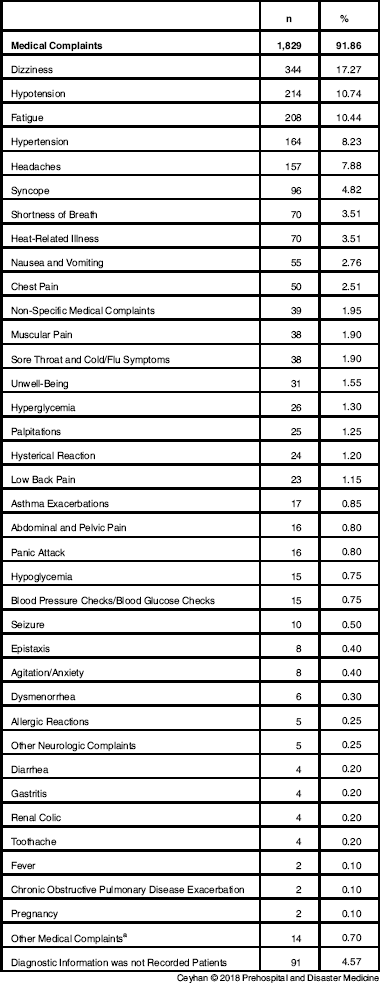
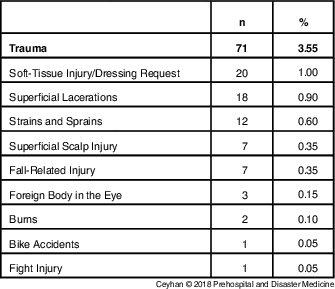
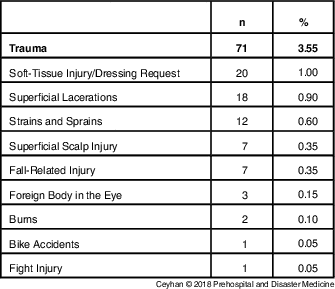
Medical diseases were the main causes of presentation in 1,829 (91.9%) patients admitted in health care tents. The most common complaints were dizziness (334 patients, 17.3%); hypotension (214 patients, 10.7%); fatigue (208 patients, 10.4%); hypertension (164 patients, 10.2%); and headache (157 patients, 7.9%; Table 1). The number of patients with traumatic diseases was 71 (3.6%). The most common traumatic diseases were soft-tissue injury (20 patients, 1.0%); superficial laceration (18 patients, 0.9%); sprain and strain (12 patients, 0.60%); and superficial scalp injury (7 patients, 0.4%; Table 2). Diagnostic information was not recorded in 91 patients (4.6%; Table 1). None of the patients suffered cardiac death or arrest.
Clinical Characteristics of Patient Admissions
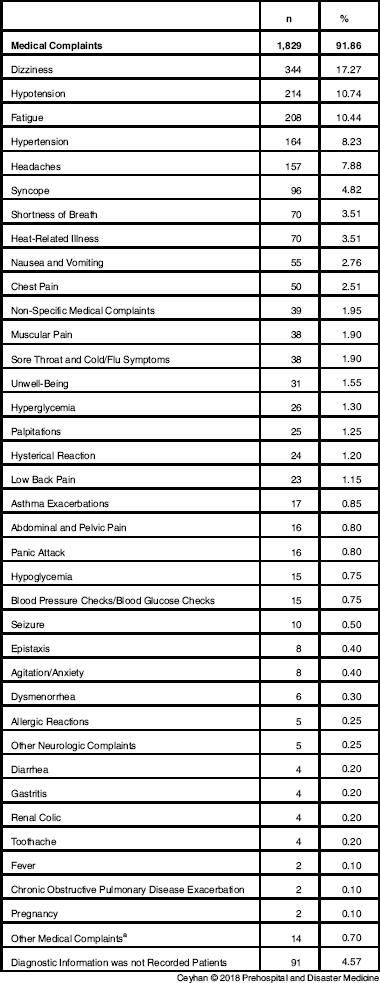
a Medical conditions recorded for once
Clinical Characteristics of Patient Admissions
Patients Dispositions and TTHR
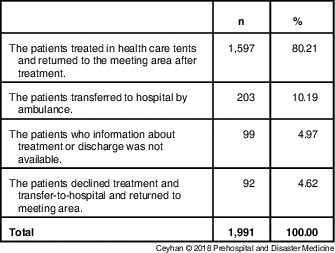
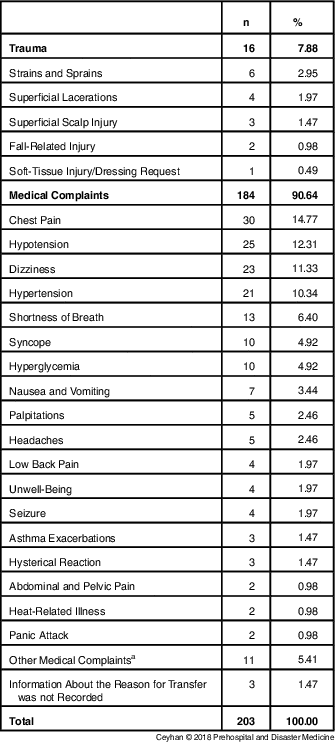
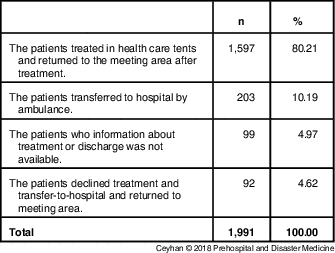
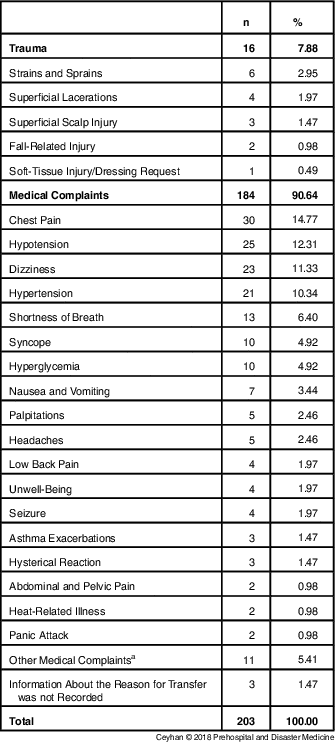
The number of patients treated in health care tents was 1,597 (80.2%), and they returned to the meeting area after treatment (Table 3). Of the patients, 203 (10.1%) were transferred to a hospital by ambulance, and median TTHR was 0.05 (0.0‒0.13) per 1,000 attendees. Medical diseases were the cause of transfers to hospitals in 184 patients. The most common complaint for transfer was chest pain (30 patients, 14.8%). Sixteen patients (7.9%) were transferred for traumatic causes. The most common cause of traumatic diseases in patients transferred to the hospital was sprain and strain. Information about the reason for transfer was not recorded in three patients (Table 4). All of the patients were transferred by ground ambulance. Ninety-two (4.6%) patients declined treatment and transfer-to-hospital, and they returned to the meeting area. Information about treatment or discharge was not available in 99 (4.9%) patients (Table 3).
Disposition of the Patients
The Clinical Conditions of the Patients Transferred to Hospital
Therapeutic Agents
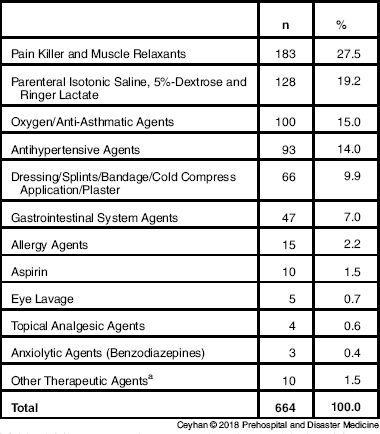
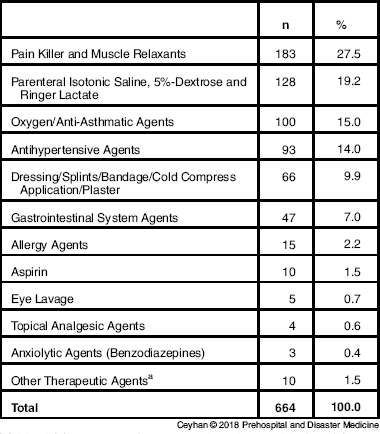
The most common therapeutic agents used in the health care tents were pain killers and myorelaxants, parenteral isotonic saline and 5%-dextrose, oxygen/anti-asthmatic agents, and antihypertensive agents, respectively (Table 5).
Therapeutic Agents Used in the Health Care Tents
a Medical drugs and treatments administered for once.
Number and Distribution of Health Care Staff
The total number of health staff assigned in all meetings was 6,224 with a median 2.4 (1.6‒4.1) per 1,000 attendees. The distribution of health staff was as follows: 610 doctors (9.8%) and median 0.25 (0.16-0.41) per 1,000 attendees; 929 paramedics (14.9%) and median 0.40 (0.21‒0.61) per 1,000 attendees; 2,066 EMTs (33.1%) and median 0.65 (0.39‒1.33) per 1,000 attendees; 339 nurses (5.4%) and median 0.08 (0.0-0.20) per 1,000 attendees; 366 medical staff (5.8%) and median 1.00 (0.17‒0.57) per 1,000 attendees; 763 ambulance drivers (12.0%); and the number logistical support staff was 1,151 (18.4%).
The total number of assigned ground ambulances was 763 and median 0.31 (0.17‒0.57) per 1,000 attendees, and the total number of health care tents was 150 and median 0.07 (0.03‒0.11) per 1,000 attendees.
Discussion
A comprehensive analysis of PPMs in 81 cities from seven different geographic regions of Turkey was targeted in the present study. To the authors’ knowledge, this is the first study investigating the concept of health care and related factors in PPMs. Therefore, the present study can play a significant guiding role in the arrangement and organizations of similar mass gatherings to be held in the future.
Demographics
The majority of patients in PPMs were female. Similarly, previous reports investigating patient profile in various mass gatherings declared female dominance.Reference Hnatow and Gordon 5 , Reference Grant, Nacca, Prince and Scott 11 - Reference Grange, Green and Downs 13 Hnatow and Pérez-Gómez reported a wide distribution of patient age in mass gatherings.Reference Hnatow and Gordon 5 , Reference Pérez-Gómez, Ramos-Zúñiga, Gutiérrez-Padilla, Gutiérrez-González, del Mar González-De la Peña and Preciado-Figueroa 14 Patient age in this study population exhibited a wide range in consistence with previous reports. Therefore, health care in PPMs should be arranged to serve patients in any age (from children to elderly people).
Patient Presentation Rate
Median PPR in PPMs was in the same range with previously reported values in other mass gatherings. Reference De Lorenzo 7 , Reference Zeitz, Zeitz and Arbon 10 , Reference Varon, Fromm, Chanin, Filbin and Vutpakdi 15 , Reference Alquthami and Pines 16 Although all of the PPMs in the present study had the same format, PPR was different in meetings held in different cities. Extremely high or low PPR values were detected. Therefore, PPR values of previous PPMs specific to the location should be taken into account for PPR estimation of the next PPM during the preparation period. Nevertheless, detection of different PPRs in different cities suggests variables other than mass gathering type are effective on PPR, as determined in previous reports.Reference Milsten, Maguire, Bissell and Seaman 3 , Reference Milsten, Seaman, Liu, Bissell and Maguire 4 , Reference Arbon, Bridgewater and Smith 8 , Reference Zeitz, Schneider, Jarrett and Zeitz 9 So, the effect of variables such as the number of attendees, heat index, humidity, and timing (weekend-weekday) of the PPMs on the number of patients and PPR were analyzed.
Number of Attendees in PPMs
The number of attendees was shown to be associated with the number of patients in mass gatherings.Reference Arbon, Bridgewater and Smith 8 The number of attendees showed great variation among cities. Minimum number of attendances was 2,000 while maximum was 1,581,000. The number of patients was proportional with the number of attendees in consistence with the literature.Reference Arbon, Bridgewater and Smith 8 , Reference Zeitz, Schneider, Jarrett and Zeitz 9 , Reference Michael and Barbera 17 , Reference De Lorenzo, Gray, Bennet and Lamprella 18 It can be assumed that the number of patients will be as high as the number of attendees in future PPMs, irrespective of PPR. There was no correlation between PPR and the number of attendances in PPMs. Zeitz, et al reported a powerful correlation between the number of attendance and the number of patients, but there was no correlation between PPR and the number of attendees.Reference Zeitz, Schneider, Jarrett and Zeitz 9 Moreover, Grange, et al reported no association between the number of attendance and PPR.Reference Grange, Green and Downs 13 Therefore, in author opinion, utilization of estimated number of attendances rather than estimated PPR would be a better predictor for the health care burden of a scheduled PPM.
Heat Index and Humidity
The significant impact of temperature and humidity on the number and symptoms of patients in mass gatherings was demonstrated in a great number of studies.Reference Milsten, Maguire, Bissell and Seaman 3 , Reference De Lorenzo 7 - Reference Zeitz, Schneider, Jarrett and Zeitz 9 , Reference Krul, Sanou, Swart and Girbes 19 Arbon, et al pointed out the use of composite parameters such as heat index rather than temperature and humidity would help better the understanding of the relationship between weather conditions and mass gatherings.Reference Arbon, Bridgewater and Smith 8 Nevertheless, in the present study, it was aimed to analyze the impact of heat index and humidity on the number of attendances, the number of patients, and PPR in PPMs.
Impact of Heat Index and Humidity on the Number of Attendance
Zeitz, et al demonstrated that weather condition was not associated with the number of attendances in mass gatherings.Reference Zeitz, Schneider, Jarrett and Zeitz 9 Consistently, there was no association between the number of attendance and heat index or humidity in this study, so it might be misleading to estimate the number of attendances on the basis of heat index or humidity in PPMs.
Impact of Heat Index on the Number of Patients and PPR
Perron, et al reported a powerful correlation between heat index and the number of patients.Reference Perron, Brady, Custalow and Johnson 20 Besides, a significant relationship between heat index and the number of patients in PPMs was detected. Another study reported a powerful correlation between heat index and PPR.Reference Locoh-Donou, Yang and Berry 21 Heat index had a moderate positive correlation with PPR in this study population in consistence with previous reports. Thus, increased number of patients should be expected in PPMs with a high estimated heat index. Furthermore, anticipated heat index would be helpful for estimation of the number of patients and PPR during the preparation workout of PPMs.
Impact of Humidity on the Number of Patients and PPR
Previous reports provided conflicting results about the impact of humidity on PPR and the number of patients in mass gatherings.Reference Arbon, Bridgewater and Smith 8 , Reference Zeitz, Schneider, Jarrett and Zeitz 9 Arbon, et al reported positive correlation between humidity and the number of patients.Reference Arbon, Bridgewater and Smith 8 Another study found a weak correlation between the number of patients and maximum daily humidity.Reference Zeitz, Schneider, Jarrett and Zeitz 9 In the present study, no relationship between the number of patients and humidity was detected. Arbon, et al reported positive correlation between PPR and humidity.Reference Arbon, Bridgewater and Smith 8 Meanwhile, Zeitz, et al detected no correlation between humidity and PPR.Reference Zeitz, Schneider, Jarrett and Zeitz 9 A moderately negative correlation between PPR and humidity in PPMs was detected. The negative impact of humidity on the number of patients and PPR in PPMs has been demonstrated for the first time, different from previous mass-gathering reports which detected positive or no correlation. The sophisticated interaction between humidity and between the number of patients, also PPR, is somehow supported with the findings of the present study. Consequently, it might be misleading to estimate the number of patients and PPR on the basis of humidity in PPMs.
Weekend or Weekday Relationship
Zeitz, et al suggested a significant relationship between the number of patients and timing of the mass gatherings (weekend or weekday) and reported increased attendance in mass gatherings held on weekend days.Reference Zeitz, Schneider, Jarrett and Zeitz 9 However, it was added that half-pricing of tickets on Wednesday might have affected the difference between weekend or weekday attendance and PPR was lower in weekend mass gatherings. There was no practice to encourage or restrict attendance, such as ticket pricing, in PPMs. The number of attendees and patients in weekend PPMs were higher than those in weekday PPMs. However, PPR was not associated with the timing of PPMs. Formal holiday of governmental institutions and most of the private workplaces in the weekend might have contributed in the increased attendance. After all, it would be reasonable to expect increased attendance and number of patients in weekend PPMs.
Clinical Characteristics of Patient Admissions
The number of patients with medical complaints was higher than the number of patients with traumatic complaints. Minor medical conditions and injuries comprised most of patient admissions. Similar findings were recorded in several studies in the literature.Reference Arbon 1 , Reference Arbon, Bridgewater and Smith 8 , Reference Varon, Fromm, Chanin, Filbin and Vutpakdi 15 , Reference Alquthami and Pines 16 The peaceful nature of the meetings, attendance of people with the same political aspect, absence of people with opposite political aspects, lack of competitive sportive activities or extreme activity, and restriction of alcoholic drinks might have played a role in occurrence of decreased injuries.
Dizziness was the most common medical complaint in PPMs. However, headache was the most common complaint in previous reports.Reference Milsten, Seaman, Liu, Bissell and Maguire 4 , Reference Pérez-Gómez, Ramos-Zúñiga, Gutiérrez-Padilla, Gutiérrez-González, del Mar González-De la Peña and Preciado-Figueroa 14 , Reference Alquthami and Pines 16 The most common symptoms related with temperature were headache, fatigue, and dizziness.Reference Alquthami and Pines 16 Dizziness might have been caused by increased temperature, long-standing period in a restricted area, and fluid loss.
The rate of heat-related symptoms in PPMs was 3.5%. This rate was reported as 1.0%-12.0% in previous mass gathering reports, consistently.Reference Alquthami and Pines 16
Consumption of alcoholic drinks was prohibited in PPMs; thus, no cases of alcohol or drug use were seen, unlike other mass gatherings such as rock concerts.Reference Milsten, Maguire, Bissell and Seaman 3 , Reference Milsten, Seaman, Liu, Bissell and Maguire 4 , Reference Alquthami and Pines 16
Incidence of cardiac arrest or sudden cardiac death (SCD) is rare in mass gatherings.Reference Arbon 1 , Reference De Lorenzo 7 , Reference Varon, Fromm, Chanin, Filbin and Vutpakdi 15 , Reference Alquthami and Pines 16 Despite great number of attendees in PPMs, no event of cardiac arrest or SCD was recorded. However, chest pain was the most common symptom in patients transferred to hospital. Therefore, health care staff should always be alert and accessible for rapid intervention in the meeting area.
Patient Disposition and TTHR
A total of 203 patients were transferred to hospital and combined TTHR was 0.05 (0.0-0.13) per 1,000 attendees. Combined TTHR was within the range of TTHR in previous reports about mass gatherings.Reference De Lorenzo 7 - Reference Zeitz, Schneider, Jarrett and Zeitz 9 , Reference Alquthami and Pines 16 Majority of patients (80.2%) were treated in health care tents and returned to meeting areas after treatment. Minor medical conditions and injuries were the most common admission causes in previous mass gathering reports, and initial treatment was adequate in most cases, thus reducing the number of TTHR.Reference Arbon 1 , Reference De Lorenzo 7 , Reference Alquthami and Pines 16 , Reference Grange, Baumann and Vaezazizi 22
Therapeutic Agents
Medical treatments in health care tents were mainly uncomplicated. The most common agents used for treatment were non-steroid, anti-inflammatory drugs in consistence with previous reports.Reference Milsten, Seaman, Liu, Bissell and Maguire 4 , Reference Thierbach, Wolcke, Piepho, Maybauer and Huth 6 , Reference Pérez-Gómez, Ramos-Zúñiga, Gutiérrez-Padilla, Gutiérrez-González, del Mar González-De la Peña and Preciado-Figueroa 14 , Reference Varon, Fromm, Chanin, Filbin and Vutpakdi 15
Number and Distribution of Health Care Staff
The number and content of health care staff to be assigned in mass gatherings are debatable. Assignment of health care staff to a specific activity is conventionally derived from experiences from past mass gatherings.Reference De Lorenzo 7 , Reference Arbon, Bridgewater and Smith 8 There is no regulation or guideline regarding the number and distribution of health care staff to be assigned in PPMs.
Previous reports about mass gatherings provided the ratio of total assigned health care staff as 0.6 per 1,000 attendees.Reference Arbon, Bridgewater and Smith 8 , Reference Krul, Sanou, Swart and Girbes 19 Total median number of health care staff assigned in PPMs was 2.4 (1.6-4.1) per 1,000 attendees. The number of health care staff in PPMs was four-times higher than the number recruited in previous mass gatherings.
The number and distribution of each PPM was different as it was in previous mass gatherings.Reference Hnatow and Gordon 5 , Reference De Lorenzo 7 , Reference Arbon, Bridgewater and Smith 8 , Reference Krul, Sanou, Swart and Girbes 19 Sanders recommended two paramedics per 10,000 attendees or one paramedic and one EMT per 10,000 attendees, and one or two doctors per 50,000 attendees.Reference Sanders, Criss, Steckl, Meislin, Raife and Allen 23 New York State Department of Health (New York USA) regulated assignment of one doctor, two EMTs, and two facilities capable of emergency health care services in mass gatherings with attendance >30,000 people. 24 Nonetheless, in mass gatherings with attendance<30,000 people, regulations required one paramedic or EMT, one facility capable of emergency health care services, and no doctor. However, the number of doctors, paramedics, and EMTs assigned in PPMs were higher than abovementioned references. In PPMs, the number of doctors was five-to 10-times higher, paramedics two-times higher, and EMTs six-times higher than the numbers suggested by Sanders.Reference Sanders, Criss, Steckl, Meislin, Raife and Allen 23
The main reasons were lack of a guideline or regulation to be used during preparation of PPMs, inability to predict the number of attendees and patients, and lack of data regarding previous similar mass gatherings.
Number of Ambulances Assigned on the Scene
Meites, et al reported that 46.0% of the ambulances on the scene in mass gatherings were not used.Reference Meites and Brown 25 In PPMs, 73.3% of the ambulances on the scene were not used. New York State Department of Health regulations suggested one ambulance to be on the scene in mass gatherings with attendance >5,000 people and three ambulances in mass gatherings with attendance >50,000 people. 24 The number of ambulances on the scene in PPMs were much higher (1.5- to five-times) than former recommendations.
The number of ambulances assigned in previous mass gatherings were almost equal to TTHR of the activity.Reference Thierbach, Wolcke, Piepho, Maybauer and Huth 6 , Reference Feldman, Lukins, Verbeek, MacDonald, Burgess and Schwartz 12 , Reference Krul, Sanou, Swart and Girbes 19 Median number of ambulances in PPMs were six-times higher of TTHR in PPMs (0.05 [0.0-0.13] per 1,000 attendees). The number of ambulances were five- to eight-times higher than those assigned in previous mass gatherings.Reference Thierbach, Wolcke, Piepho, Maybauer and Huth 6 , Reference Feldman, Lukins, Verbeek, MacDonald, Burgess and Schwartz 12 , Reference Krul, Sanou, Swart and Girbes 19 These data demonstrate unnecessary employment of resources in PPMs. It would be reasonable to determine the number of ambulances to be assigned according to TTHR of previous PPMs.
Number of Health Care Tents on the Scene
Median number of health care tents assigned in PPMs was 0.07 (0.03‒0.11) per 1,000 attendees. In a study by Thierbach, et al, the number of health care tents on the scene were 0.04 per 1,000 attendees.Reference Thierbach, Wolcke, Piepho, Maybauer and Huth 6 New York State Department of Health regulations recommended one facility capable of emergency health care services in mass gatherings with 5,000‒15,000 attendance and two facilities for attendance >15,000 people. 24 The number of health care tents in PPMs was almost two-times higher than the numbers in the literature.
Study Limitations
Medical records of the patients were not standard in all PPMs, as this was the case in previous mass-gathering reports. Some of the data regarding diagnosis, treatment, or discharge may be missing. Acute or chronic etiology of the symptoms were not evaluated. Follow-up of the transferred patients and their final diagnosis in the hospital were missing. Medical information of the patients who refused transfer to health care tents were not recorded. Although the size of the study population is large, retrospective design of the study may be considered as a limitation.
Conclusion
The majority of medical conditions encountered in PPMs are easily treatable in health care tents settled in meeting areas. The number of attendees, heat index, and weekend days are factors associated with the number of patients.