

I. Introduction
The European grapevine moth (EGVM), also known by its scientific name of Lobesia botrana (Lepidoptera: Tortricidae) (Denis & Schiffermüller), is arguably the most important insect affecting vineyards globally. The EGVM has up to four generations throughout the whole grapevine growing season (Heit, Sione, and Aceñolaza, Reference Heit, Sione and Aceñolaza2019). In its larval stage, the pest eats vines’ flowers or bunches, decreasing grape production and quality. Although endemic throughout Europe and common in some countries outside of Europe, the EGVM did not extend to the United States, Chile, and Argentina until 2008–2010 (Mutis et al., Reference Mutis, Palma, Venthur, Iturriaga-Vásquez, Faundez-Parraguez, Mella-Herrera, Kontodimas, Lobos and Quiroz2014). The U.S. government successfully implemented an EGVM eradication program, and programs are ongoing in Chile and Argentina.
The eradication program in Argentina was established through a national law and is funded by both the government and the private sector. While the eradication program targets all Argentinian provinces, this study focuses specifically on Mendoza, which is the most important wine-producing province in Argentina, accounting for 70% of the country's vineyard surface area (i.e., 153 thousand hectares). The scientific literature related to the EGVM is extensive; however, we failed to identify any study looking at the impact of the EGVM at the regional level. The aim of this research is to estimate the impact of the EGVM on Mendoza's grape production, controlling for other relevant factors that may affect production, and to develop implications for eradication programs, both in Argentina and in other countries.
II. Data
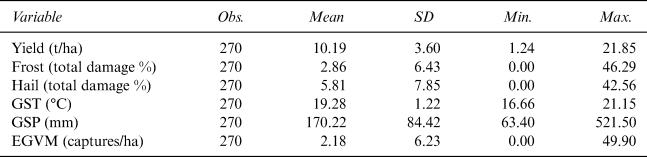
We used data provided by the Argentinian Wine Observatory, Mendoza's Institute for Agricultural Sanitation and Quality, and the government of Mendoza. With these data, we constructed a dataset covering the 2001–2002 season to the 2018–2019 season, for all 15 of Mendoza's grape-producing counties (totaling 270 observations). The dataset includes information on grape yield, percentage of area “completely damaged” by frost and hail (as defined by Mendoza's Climate Department), and the population density of EGVM. The dataset also includes information on the growing season average temperature (GST) and total growing season precipitation (GSP), based on averages from two to five weather stations in each of the three contiguous regions of Mendoza (i.e., Lujan-Maipu and the Northeast, Uco Valley, and the Southern region). Using weather stations’ data for wine regions is the most common approach in studies quantifying the impact of weather on grape or wine production, as meso-weather data are usually unavailable (Niklas, Reference Niklas2018). Table 1 shows the descriptive statistics.
Descriptive Statistics

Notes: GST = growing season average temperature, GSP = total growing season precipitation, EGVM = European grapevine moth density.
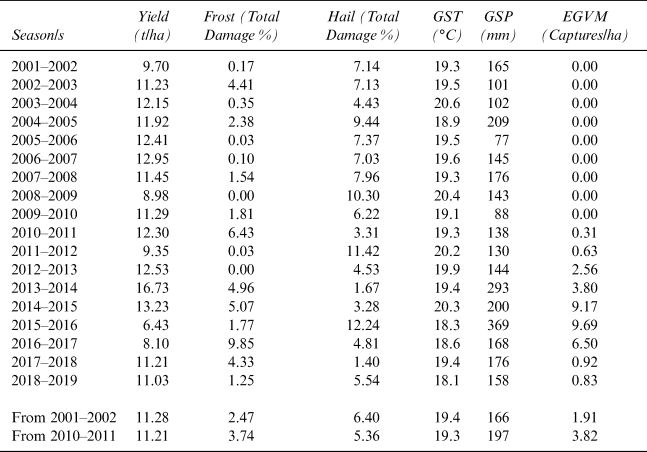
Table 2 shows the evolution of yield, percentage of area “completely damaged” by frost and hail, GST and GSP, and the density of EGVM. The average yield in Mendoza between 2001–2002 and 2018–2019 was 11.3 tons per hectare, with a standard deviation of 2.3 tons per hectare. The area “completely damaged” by frost or hail represents 2.5% and 6.4%, respectively, of the total surface. The GST (19.4°C) and GSP (166 mm) provide evidence of the warm and dry climate that predominates in the province. The average number of moths captured per hectare by Mendoza's trapping system provides a measure of the pest's population density. The number of captures per hectare increased considerably between 2010–2011 and 2015–2016. Strong eradication efforts started after the 2015–2016 growing season, leading to a substantial drop in the EGVM density.
Evolution of Yield, Area “Completely Damaged” by Frost and Hail, Area-Weighted Average GST and GSP, and EGVM Density in Mendoza, 2001–2002 to 2018–2019

Notes: GST = growing season average temperature, GSP = total growing season precipitation, EGVM = European grapevine moth density.
III. Methods
The aim of our model is to estimate the impact of the EGVM on grape production. Our baseline model is specified in Equation (1):

Yield is is the average yield per hectare for county i in season s; αi is an intercept specific for county i; EGVM is is the average number of moths captured (through Mendoza's trapping system) per hectare for county i in season s; Frost is and Hail is are the percentages of the vineyard area in county i that were “completely damaged” due to frost and hail, respectively, in season s; GST rs, $GST_{rs}^2$ , GSP rs, and $GSP_{rs}^2$
 are the GST and GSP and their squared values, in season s, for the contiguous region r that includes county i; and e is is an error term.
Mendoza's Climate Department defines the percentage of area “completely damaged” by frost and hail for every season. This is not a direct measure of the impact of frost and hail, as vineyards not considered as “completely damaged” may still have been affected by frost and/or hail damage.
In addition to being influenced by vineyard and pest management strategies, the EGVM population density depends on weather-related variables, such as temperature and precipitation (Heit, Sione, and Aceñolaza, Reference Heit, Sione and Aceñolaza2019). Since in this research the EGVM variable is the observed density of EGVM itself, we do not consider the potential effects that weather and other variables may have on the prevalence of the pest. In fact, between 2010–2011 and 2018–2019, the correlation between GST (GSP) and the EGVM density was of just –0.01 (0.01).Footnote 1
However, we included the control variables GST and GSP as these are important weather variables affecting grape production (van Leeuwen and Darriet, Reference van Leeuwen and Darriet2016; Schultz, Reference Schultz2016; Ollat, Touzard, and van Leeuwen, Reference Ollat, Touzard and van Leeuwen2016). Including the square of GST, which is a common approach in studies that model the impact of temperature on grape or wine quality (Ashenfelter, Reference Ashenfelter2017), is also justified when modeling grape yields. While higher temperatures are often correlated with higher yields, extreme temperatures can decrease yields (Ashenfelter and Storchmann, Reference Ashenfelter and Storchmann2016). Perhaps, more importantly, higher temperatures increase evapotranspiration, often creating water deficits (Gambetta, Reference Gambetta2016). Including the square of GSP is also justified in the context of Mendoza. While higher precipitation has the potential to mitigate the water constraints that Mendoza's growers often face when irrigating their vineyards, precipitation enhances the most relevant grape diseases (i.e., powdery and downy mildew, and rot). If precipitation is too high, these diseases become harder for grape growers to control, often leading to lower yields.
We estimated the within transformation of the model shown in Equation (1) using a county-fixed effects model with heteroskedasticity robust standard errors. Unlike random effects, the fixed-effects estimator allows correlation between counties, the explanatory variable (i.e., EGVM), and the control (weather) variables. Since some of these correlations may occur in practice, and considering that we are not interested in the county-specific effects, a fixed-effects estimator is preferred over random effects. Still, the fixed-effects estimator accounts for unobserved heterogeneities that are assumed to be constant over time. This unobserved heterogeneity includes the varietal mix of each county (some varieties are more productive than others are), the predominant trellis system, the age distribution of the vineyards, the efficiency of the irrigation systems, and the knowledge and experience of grape growers, among other county-specific characteristics.
We also estimated the model shown in Equation (1) using a first-difference estimator with Newey-West standard errors. We used the first differences estimation as a robustness check, as the fixed-effects estimator tends to be more efficient than the first-difference estimator, especially when the idiosyncratic errors e is are serially uncorrelated.
IV. Results
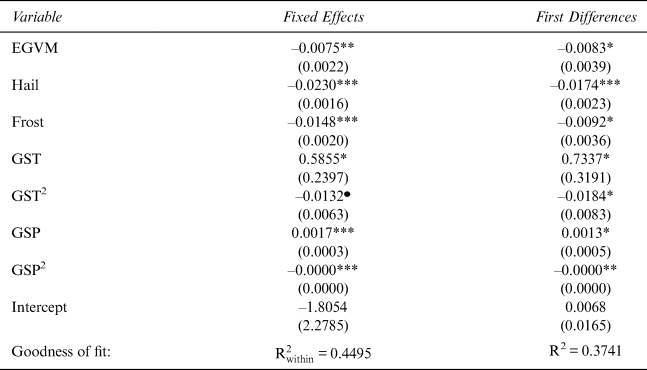
The model provides a good fit to the data. The variable of interest, EGVM, as well as the control variables are highly significant and with the expected signs (see “Fixed Effects” column in Table 3). The results are similar to the estimated by first differences with standard errors robust to heteroskedasticity and third order autocorrelation, which we used as a robustness check (see “First Differences” column in Table 3).
Impact of EGVM Density and Weather on the Logarithm of Grape Yields in Mendoza

Notes: ***p < 0.001, **p < 0.01, *p < 0.05, ●p < 0.1. Robust standard errors in (.). GST = growing season average temperature, GSP = total growing season precipitation, EGVM = European grapevine moth density.
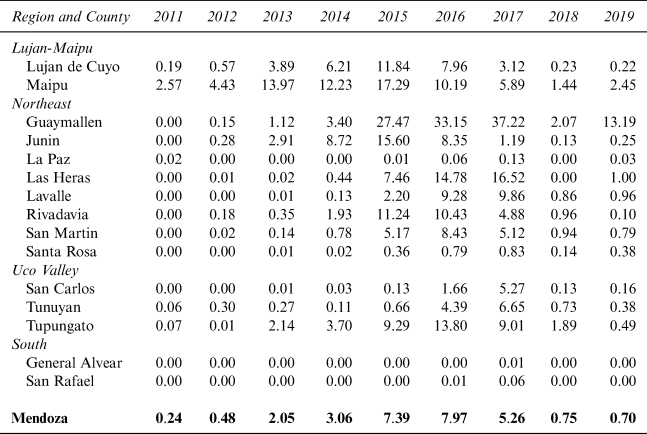
We used our regression coefficients (shown in Table 3), the average yield, and the average density of EGVM in each county and year to estimate the average impact of the EGVM on the average yield (and hence total grape production) in each county, and in Mendoza as a whole (see Table 4). The onset of the pest varies by county. The EGVM was first detected in Maipu and quickly expanded to Lujan de Cuyo and the counties in the Northeast. Lujan-Maipu and the Northeast are part of the same contiguous region, and the pest had an important incidence in all counties except for Santa Rosa and La Paz, which are further away. In Uco Valley, the estimated impact of the EGVM was higher in the counties that are closest to Lujan-Maipu and the Northeast (i.e., Tupungato, followed by Tunuyan). The Southern region is distant from all other regions, and the pest did not spread widely in the counties of that region. Overall, in Mendoza, there have been annual losses of up to 8% of the total grape production volume.
Estimated Grape Production Losses (%) Due to the EGVM by County and Harvest Year

Higher GSTs have positive but diminishing effects on yields, and these effects are only expected to become negative in seasons with a GST higher than 22.2°C, which is higher than any GST value in our sample. Higher GSP also has positive but diminishing effects on yields, and these effects are expected to become negative in wetter years (i.e., GSP > 266 mm). These negative effects of GSP may be explained by growers facing issues in managing diseases in growing seasons with high precipitation.
Very relevant has been the effect of the other weather variables—frost and hail. Between the 2002 and 2019 harvests, the estimated average grape loss in production due to frost (hail) has been 3.5% (18.4%). As expected, these values are higher than the area “completely damaged” by frost and hail (see Table 2), which we used as control variables in the model, as there are also areas that are partially damaged by frost and hail. Further, hail often enhances rot, and rot can also lead to lower yields.
From 2011 to 2019, in Mendoza alone, an estimated 490,000 tons of grapes were lost due to the EGVM. The quantity of grape production lost was equivalent to approximately 182.2 million USD (nominal value). Within this period, the highest impact of the EGVM was felt in the 2015 harvest, when an estimated 169,000 tons or 45.1 million USD (nominal value) were lost due to the incidence of the EGVM. While 2015–2016 was the season with the greatest incidence of the EGVM, a strong eradication program started after that season. Without the program, the incidence of the pest would have been greater, as the area affected and the density of the pest were still increasing when the program started.
V. Discussion and Conclusions
We estimated the value of grape production in Mendoza that was lost due to the EGVM based on the average farm gate prices of grapes. It is important to consider that grape prices in Mendoza tend to be higher when the total harvest in the province is lower (Puga et al., Reference Puga, Fogarty, Hailu and Gennari2019). As such, the average grape prices may have been higher due to the moth decreasing production. On the other hand, the EGVM results in quality losses as it provides a way of entry for Botrytis cinerea and the other fungus that cause rot (Kiaeian Moosavi et al., Reference Kiaeian Moosavi, Cargnus, Torelli, Bortolomeazzi, Zandigiacomo and Pavan2020). These quality losses are likely to negatively impact grape prices.
Further, there are other economic impacts not considered in the calculation. First, most of the EGVM control relies on the use of pesticides, which can have negative health-related externalities. Second, the use of pesticides, which was uncommon before the arrival of the EGVM, has led to perverse unintended outcomes such as an increase in the incidence of pests such as mites and Naupactus xanthographus, an insect that eats vines’ roots. Third, there are logistical issues caused by policies and regulations which were put in place to prevent the pest from spreading further. For example, grape growers in Lujan-Maipu and the Northeast cannot sell their grapes to wineries in Uco Valley or the Southern region. Fourth, table grapes must go through a chemical process that diminishes their shelf life, making Argentinian table grapes less valuable for export markets. Fifth, there are important costs of controlling the EGVM for both grape growers and the government. As such, the economic impact of the pest may well be greater than the estimated value of production lost.
Nevertheless, controlling for other variables, the results of this research suggest that a successful eradication program is likely to be cost effective. The estimated value lost the year before the strongest efforts started (i.e., 2016) was enough to cover 1.7 times the whole vineyard surface of Mendoza with mating disruption disposals. Mating disruption is arguably the most effective and socially accepted control method, and it is the most environmentally friendly (Lance et al., Reference Lance, Leonard, Mastro and Walters2016).
In Mendoza, the program has already been successful in lowering the moth's population density, and even eradicating the pest from many sub-counties. This success suggests eradication is achievable. The situation in Argentina could end up being similar to what happened in California, where a panel of experts doubted the feasibility of eradicating the EGVM at the beginning (Gutierrez et al., Reference Gutierrez, Ponti, Cooper, Gilioli, Baumgärtner and Duso2012), but then the pest was eradicated. The eradication program in California was very similar to the ongoing program in Argentina, with the use of quarantine areas and controlling the pest with mating disruption and insecticides (Schartel et al., Reference Schartel, Bayles, Cooper, Simmons, Thomas, Varela and Daugherty2019). Perhaps, the EGVM is easier to eradicate than what the scientific community originally believed. Further research could analyze the impact of the EGVM at the regional level in other countries, in order to derive implications on the feasibility of eradicating the EGVM from other wine regions.