Symptom checklists are utilized in both clinical practice and research to collect information about a patient and/or participant’s mental state. Among the most widely used is the Symptom Check-List Revised (SCL-90-R) (Derogatis, Reference Derogatis1994, Reference Derogatis2002). Its objective is to gauge the respondent’s level of psychological well-being using 90 symptoms of varying severity. Altogether they comprise nine Symptom Dimensions, an Additional Scale, and three Global Scores, which are considered distress scores.
Numerous studies have produced evidence for the SCL-90-R’s usefulness in clinical practice, specifically in screening (Bonicatto, Dew, Soria, & Seghezzo, Reference Bonicatto, Dew, Soria and Seghezzo1997; Derogatis & DellaPietra, Reference Derogatis, DellaPietra and Maurish1994) and in determining the quality or efficacy of psychological or medical treatments (Schmitz, Hartkamp, & Franke, Reference Schmitz, Hartkamp and Franke2000). However there is some controversy about its factorial validity (Bonynge, Reference Bonynge1993). Examining the reliability of the SCL-90-R’s dimensions, Derogatis, Rickels, and Rock (Reference Derogatis, Rickels and Rock1976) found values of internal consistency, measured using Cronbach’s alpha, between .77 and .90. More recently, Schmitz, Hartkamp, Kruse et al. (Reference Schmitz, Hartkamp and Franke2000) found internal consistency coefficients between .78, on the Hostility dimension, and .90 on the Depression dimension. In Spain, Caparrós-Caparrós, Villar-Hoz, Juan-Ferrer, and Viñas-Poch (Reference Caparrós-Caparrós, Villar-Hoz, Juan-Ferrer and Viñas-Poch2007) reported Cronbach’s alpha coefficients between .74 on the Paranoid Ideation dimension, and .88 on the Depression dimension, similar to the findings of Robles, Andreu, and Peña (Reference Robles, Andreu and Peña2002).
With respect to normative data, Derogatis (Reference Derogatis1994, Reference Derogatis2002) reported scales in a population of adolescents and adults from the community as well as clinical populations, both outpatient and inpatient. In Spain, too, we have normative data from inpatient and outpatient psychiatric patients in populations of adults and adolescents from the community (De las Cuevas et al., Reference De las Cuevas, González de Rivera, Henry Benítez, Monterrey, Rodríguez-Pulido and Gracia Marco1991; Martínez-Azumendi, Fernández-Gómez, & Betia-Fernández, Reference Martínez-Azumendi, Fernández-Gómez and Betia-Fernández2001; Robles et al., Reference Robles, Andreu and Peña2002) as well as university students (Caparrós-Caparrós et al., Reference Caparrós-Caparrós, Villar-Hoz, Juan-Ferrer and Viñas-Poch2007).
The studies reviewed above focused on using the SCL-90-R in clinical assessment of adults, but did not take into account the normative characteristics of the adolescence stage of the lifespan. This could lead to confusion between the challenges associated with this point in development, and psychopathology. Clinical assessment of adolescents should be able to differentiate between the challenges that are characteristic of this stage, and those originating in earlier stages that later become stable and persistent (Navarro-Pardo, Meléndez, Sales, & Sancerni, Reference Navarro-Pardo, Meléndez, Sales and Sancerni2012). Furthermore, they should enable researchers and clinicians to analyze such challenges’ progression, and their impact on the development of psychopathological symptomatology in adulthood (Widiger, De Clercq, & De Fruyt, Reference Widiger, De Clercq and De Fruyt2009). With that in mind, and so that this stage of the lifespan may be carefully studied, assessment instruments adapted for adolescents must be made available (Zubeidat, Fernández-Parra, Ortega, Vallejo, & Sierra, Reference Zubeidat, Fernández-Parra, Ortega, Vallejo and Sierra2009). Furthermore, like the SCL-90-R, such instruments should have previously demonstrated clinical utility in adults (Bonicatto et al., Reference Bonicatto, Dew, Soria and Seghezzo1997). That way, the same assessment tool can be used in adolescent and adult populations, and similarities and differences can be detected between the two age groups.
In this study, we aim to propose scales differentiated by gender and age, collected in a probability sample of adolescents from the community, and to improve upon and expand the body of research on the SCL-90-R’s psychometric properties in adolescents.
Method
Participants
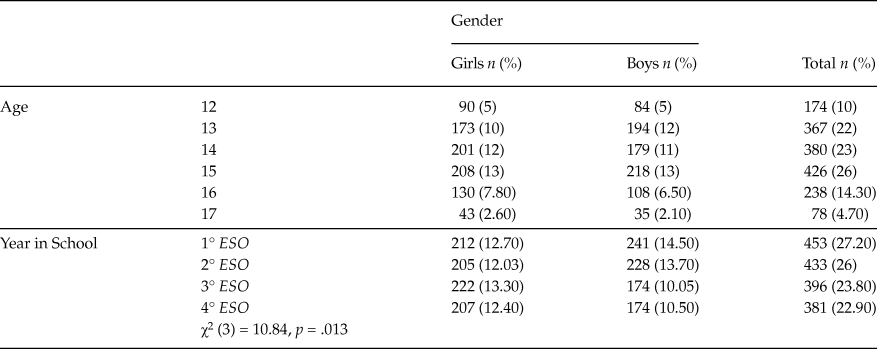
The sample was comprised of 1,663 adolescents, 845 girls (50.80%) and 818 boys (49.20%), with an average age of 14.26 (SD = 1.36). Of those, 1,185 attended public school (71.3%) and 478 (28.7%) attended a charter school. Table 1 shows participants’ distribution in terms of gender, year in school, and age.
Distribution of Participants According to Gender, Age, and Year in School

ESO = Obligatory Secondary Education.
Participants were selected through multistage statified cluster sampling, and groups were randomly selected from schools offering varied educational trajectories during Years 1 through 4 of ESO (obligatory secondary education). The strata considered were Teacher Resource Centers (TRCs), which divided the Spanish region of Extremadura into 18 geographical areas, each with designated secondary schools (IES [Secondary Education Institutions] or IESO [Obligatory Secondary Education Institutions]). Cluster sampling was carried out by randomly selecting two schools from each TRC. The number of participants was based on how many students were enrolled in each secondary school in Extremadura during the 2009–2010 school year (49,005 students, 3.4%). Sampling error was estimated at 4% with a 95.5% confidence level. We did not verify whether or not participants had a history of psychopathological disorder or medical illness.
Instruments
Sociodemographic questionnaire with questions about age, gender, and year in school. Symptom Checklist, SCL-90-R (Derogatis, Reference Derogatis1994, Reference Derogatis2002).
This 90-item questionnaire has a Likert-type response format with five choices (from 0 – not at all, to 4 –extremely). It asks adolescents how much the symptom described bothers them. It evaluates nine Symptom Dimensions: Somatization, Obsessive-Compulsive, Interpersonal Sensitivity, Depression, Anxiety, Hostility, Phobic Anxiety, Paranoid Ideation, and Psychoticism. It also includes seven additional items that together make up the Additional Scale, exploring aspects of diet and sleep; and three Global Scores: Global Severity Index (GSI), a general, non-specific measure of the intensity of overall psychological and psychosomatic distress; the Positive Symptom Total (PST), or sum of affirmative responses, refers to the breadth and diversity of psychopathology; and last, the Positive Symptom Distress Index (PSDI) indicates average symptom severity.
Procedure
To collect data, questionnaires were administered by classroom. Prior to data collection, we sought permission from each school, written informed consent from parents and teachers, and participants’ verbal informed consent. Participants were assured that their data would be kept confidential, and would only be used for research purposes. Administering the questionnaires took an average of approximately 15 minutes. Data collection took place over the course of three months during weekly tutoring sessions.
Statistical Analysis
Differences between groups according to gender, age, and year in school were analyzed using the chi-square statistic. The gender-age interaction effect on SCL-90-R Symptom Dimension scores and Global Scores was analyzed through ANOVA, with two fixed factors. Wilks’s lambda was used to analyze differences in the dependent variables, and partial eta-squared (η2) and Cohen’s d were computed as measures of effect size. Tukey’s test and Student’s t test were applied to calculate differences post-hoc, for age and gender respectively. Principal components analysis was conducted to determine the factor structure. Cronbach’s alpha was calculated as an index of scores’ internal consistency; values greater than or equal to .80 were considered good (Crocker & Algina, Reference Crocker and Algina1986). Normative data were calculated using percentiles. All analyses were done in SPSS 17.0.
Results
Differences were observed in participants’ distribution according to gender and year in school (see Table 1). Girls were underrepresented in Year 1 (adjusted standardized residuals = –2.0), and boys were underrepresented in Year 4 (adjusted standardized residuals = –2.3).
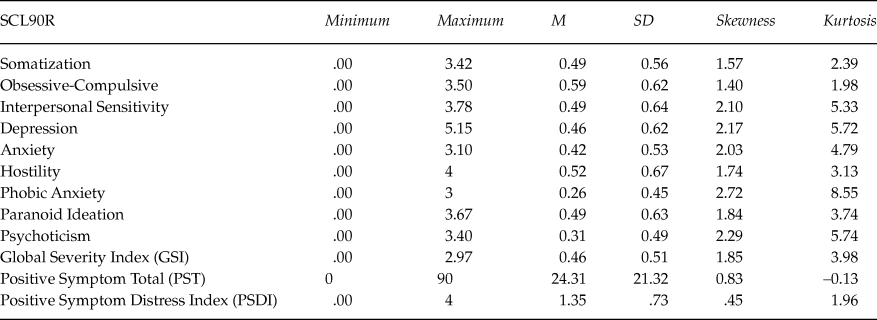
Table 2 presents our descriptive analyses of the SCL-90-R Symptom Dimensions and Global Scores, for the total sample. The highest average score corresponded to the Obsessive-Compulsive dimension (0.59), followed by Hostility (0.52), and the lowest average score pertained to Phobic Anxiety (0.26), followed by Psychoticism (0.31). Regarding standard error, the kurtosis index yielded a value of 0.12; and the index of standard error for skewness produced a value of 0.06. Both those values were under 1.96, indicating near normal distribution of scores.
Descriptive Statistics. Dimensions and Global Scores on the SCL-90-R in the Total Sample of Participants (N = 1663)

The internal consistency coefficients of Symptom Dimension scores were: Somatization (α = .83), Obsessive-Compulsive (α = .83), Interpersonal Sensitivity (α = .86), Depression (α = .87), Anxiety (α = .83), Hostility (α = .80), Phobic Anxiety (α = .76), Paranoid Ideation (α = .78), and Psychoticism (α = .84). According to these results, the sample’s scores were least consistent on the Phobic Anxiety dimension, and most consistent on the Depression dimension.
With respect to the factor structure of the SCL-90-R, the indices of sampling adequacy indicate exploratory factor analysis can appropriately be applied to the data (Kaiser-Meyer-Okin: .972; Bartlett’s test of sphericity: .000). We utilized principal components analysis with orthogonal rotation, and followed Derogatis’s (Reference Derogatis1977) recommendation by using only scores with variable-factor correlation coefficients over .30. A 15-factor solution was obtained, explaining 58.85% of total variance. Of those 15, the first explained 33.63% of variance. On a second test, we limited the number of factors to nine, which explained 51.27% of total variance, the first one explaining 38%.
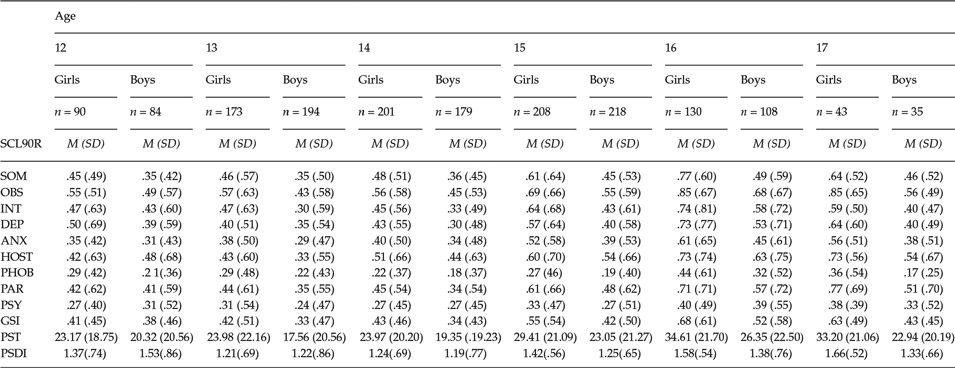
Table 3 presents means and standard deviations on the SCL-90-R’s Symptom Dimensions and Global Scores, according to gender and age. The results showed significant differences as a function of gender (Wilks λ = 0.959, p < .001, η2 = .041) as well as age (Wilks λ = 0.891, p < .001, η2 = .023). As for the gender-age interaction, the only significant result was found in the Positive Symptom Distress Index (PSDI) (F = 2.40, p = .035, η2 = .007); this entails that the difference in PSDI scores between boys and girls was not the same in all age groups. Post-hoc comparisons revealed the following differences: in the female group, significant differences occurred between 13 and 16 years of age (p < .001), 14 and 16 years of age (p < .001), 13 and 17 years of age (p = .003), and 14 and 17 years of age (p = .007) such that girls 16 to 17 years old scored higher than boys of the same age. As for the boys, significant differences were found between the groups 12 to 13 years old (p =.012), 12 to 14 years old (p = .006), and 12 to 15 years old (p = .040) such that 12-year-old boys scored higher than girls of the same age.
Descriptive Statistics Pertaining to Dimensions and Global Scores on the SCL90R by Gender and Age

SOM = Somatization; OBS = Obsessive-Compulsive; INT = Interpersonal Sensitivity; DEP = Depression; ANX = Anxiety; HOST = Hostility; PHOB = Phobic Anxiety; PAR = Paranoid Ideation; PSY = Psychoticism; GSI = Global Severity Index; PSDI = Positive Symptom Distress Index, and PST = Positive Symptom Total.
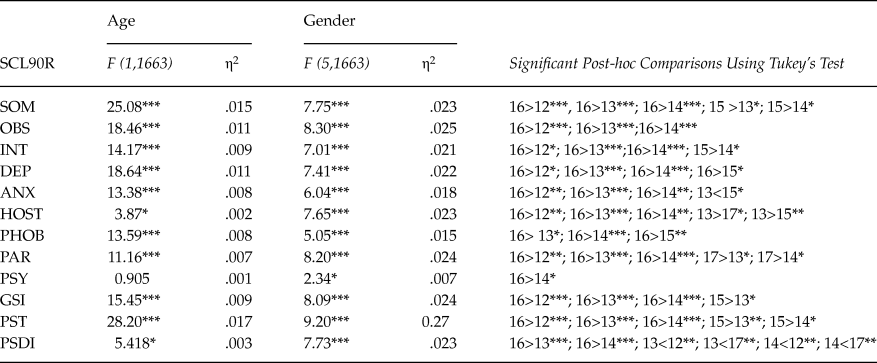
Regarding gender, statistically significant differences were found on all Global Scores and Symptom Dimensions such that on average, girls scored higher than boys across the board, except on Psychoticism, which showed no significant differences (see Table 4).
ANOVA by Age and Gender. Dimension Scores and Global Scores on the SCL-90-R

See Table 3.
*** p < .001;**p < .01; *p < .05.
As for age, we found statistically significant differences on all Global Scores and Symptom Dimensions, with the 16-year-old group scoring higher than all other age groups. In general, the older participants were, the higher they scored. There were two exceptions. First, on the Hostility dimension, the 13-year-old group scored higher than the 15 to 17-year-olds. Second, the 12-year-old group had higher PSDI scores than the 13 to 14-year-old group (see Tables 3 and 4).
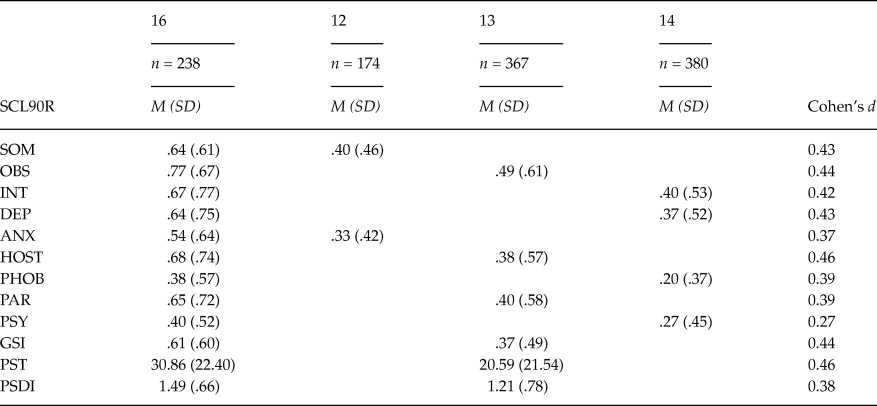
To estimate the effect size of differences between the 16- and 12-year-old groups, and the 13- and 14-year-old groups, Cohen’s d was calculated (Table 5), yielding values between 0.27 (Psychoticism) and 0.47 (PST). According to Cohen (Reference Cohen1988), these results are moderate, such that the average subject in the highest-scoring group scored higher than 50% of their own group, and higher than 69% of the lowest-scoring group on SCL-90-R Symptom Dimensions as well as Global Scores.

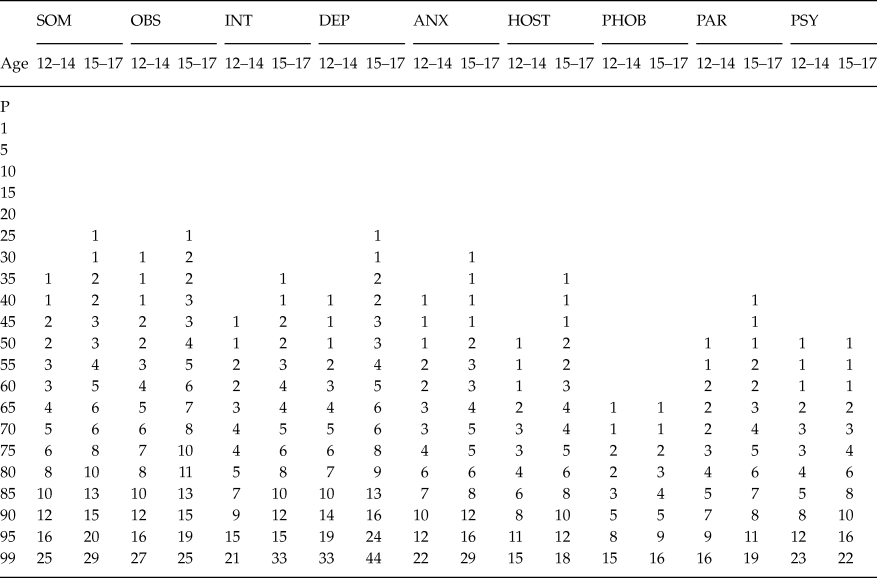
Percentiles. Primary Dimensions of the SCL90R. Sample of Boys

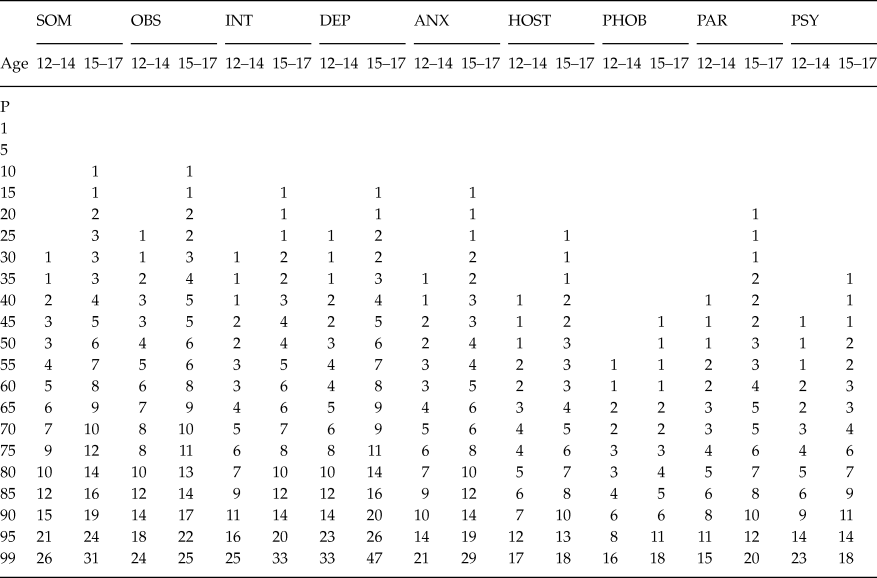
Percentiles. Primary Dimensions of the SCL90R. Sample of Girls

These results were taken into account when percentiles were calculated, so they were separately computed for boys and girls, and by age group within the male and female groups, specifically 12 to 14 years old and 15 to 17 years old (see Tables 4 and 5).
Discussion
The present study’s objective was to propose scales on the SCL-90-R, collected in a probability sample of adolescents from the community.
The results illustrate that the symptom areas most widespread in the sample were Obsessive-Compulsive and Hostility, while Phobic Anxiety and Psychoticism were least represented. Our results are consistent with the findings of Caparrós-Caparrós et al. (Reference Caparrós-Caparrós, Villar-Hoz, Juan-Ferrer and Viñas-Poch2007) and Gempp and Avendaño (Reference Gempp and Avendaño2008) in university students (except in their case, Depression took the place of the Hostility dimension), and the findings of Robles et al. (2002) in an inpatient non-psychiatric clinical sample.
The reliability scores obtained on Symptom Dimensions indicated highly acceptable levels of internal consistency similar to those reported by Caparrós-Caparrós et al. (Reference Caparrós-Caparrós, Villar-Hoz, Juan-Ferrer and Viñas-Poch2007), Derogatis et al. (Reference Derogatis, Rickels and Rock1976), and Robles et al. (Reference Robles, Andreu and Peña2002).
Regarding gender differences, girls had higher Global Scores and Symptom Dimension scores than boys, except on the Psychoticism dimension. Our results are in line with those of Caparrós-Caparrós et al. (Reference Caparrós-Caparrós, Villar-Hoz, Juan-Ferrer and Viñas-Poch2007), and González de Rivera, De las Cuevas, Gracia-Marco, and Henry-Benítez (Reference González de Rivera, De las Cuevas, Gracia-Marco and Henry-Benítez1991), who also reported non-significant scores on the Paranoid Ideation dimension. Some studies have questioned the notion that Psychoticism and Paranoid Ideation consitute distinct dimensions (Prunas, Sarno, Preti, Madeddu, & Perugini, Reference Prunas, Sarno, Preti, Madeddu and Perugini2012), so we believe this discrepancy is of little significance. Differences between male and female manifestations of psychopathology have been well documented in the general population and in adolescents (McCaffrey, Bauer, O’Bryant, & Palav, Reference McCaffrey, Bauer, O’Bryant and Palav2006; Zahn-Waxler, Shirtcliff, & Marceau, Reference Zahn-Waxler, Shirtcliff and Marceau2008). This may relate to two fundamental aspects of adolescence: social context (Muñoz, Jiménez, & Moreno, Reference Muñoz, Jiménez and Moreno2008), and patterns of socialization and upbringing (Werner, Reference Werner1995) that mold female and male behavior and may differentially influence their adaptive responses and symptoms under identical social circumstances. We found no significant differences according to gender on the Psychoticism dimension. Given that in community populations, its content is associated with feelings of social alienation (Derogatis, Reference Derogatis2002), we believe it would be interesting to further examine that result in future research as an aspect that describes adolescence for boys and girls alike.
With regard to age, we found that with age, SCL-90-R scores rose, except in the 17-year-old group, whose scores had stabilized. Interestingly, there was a significant interaction between age and gender on the Positive Symptom Distress Index (PSDI), on which boys scored higher at 12 years of age – in early adolescence – but girls scored higher at 16 and 17 years old, in late adolescence. PSDI measures a person’s characteristic style of experiencing psychological suffering, in other words, one’s tendency toward maximal or minimal emotional response. One possible explanation for this result is the differential effect of puberty on boys and girls; adolescent boys in late and early puberty tend to abuse substances and to perceive themselves more negatively (Harter & Whitesell, Reference Harter and Whitesell1996). Shifting our attention to the girls’ higher scores at 16 and 17 years old, differences in socialization by gender make women recognize emotions and behave emotionally more than men, and that difference is more pronounced as adolescence comes to an end (Brody, Reference Brody1999).
The results of principal components analysis did not support the model that Derogatis observed (1977, 1994, 2002), with nine primary factors; it is rather more consistent with studies that found one main factor explaining a large portion of total variance in scores. This result could be due to an inconsistency of factors in non-clinical populations. According to De las Cuevas et al. (Reference De las Cuevas, González de Rivera, Henry Benítez, Monterrey, Rodríguez-Pulido and Gracia Marco1991), one person experiencing symptoms of varying intensity has nothing to do with the symptomatological-symptomatic grouping of a person afflicted with a mental disorder. In that sense, it would be wise to replicate our study in a clinical, adolescent population.
In terms of the scales proposed, we consider them especially useful because they were derived from probability sampling, and because they take into account differences we found as a function of gender and age; furthermore, they complement the ones Caparrós-Caparrós et al. reported (2007).
By way of conclusion, we believe the SCL-90-R is a suitable instrument to assess psychopathological symptomatology during adolescence given its acceptable psychometric properties, similar to those obtained in other population groups, and its considerable reliability. We believe, however, that research must continue forward and should examinine variables such as history of psychopathological or medical disorder, academic performance, and place of residence (Zhang & Zhang, Reference Zhang and Zhang2013). We also recommend conducting studies of concurrent validity with other questionnaires of demonstrated utility at assessing psychopathology during this stage of the life span.