An integration of biological and environmental constructs “from neurons to neighborhoods” (Shonkoff & Phillips, Reference Shonkoff and Phillips2000) has been broadly accepted as the most fruitful approach to development (Collins, Maccoby, Steinberg, Hetherington, & Bornstein, Reference Collins, Maccoby, Steinberg, Hetherington and Bornstein2000). Research on Genotype × Environment (G × E) interactions has elucidated origins of multiple aspects of adaptive and maladaptive development in human and animal species (Caspi et al., Reference Caspi, Sugden, Moffitt, Taylor, Craig and Harrington2003; Champoux et al., Reference Champoux, Bennett, Shannon, Higley, Lesch and Suomi2002; Suomi, Reference Suomi2004, Reference Suomi2006). A G × E interaction occurs when environmental experience moderates the effect of a person's genotype on physical or mental health outcomes, or when a genotype moderates an environmental effect (Moffit, Caspi, & Rutter, Reference Moffitt, Caspi and Rutter2005; Rutter, Moffitt, & Caspi, Reference Rutter, Moffitt and Caspi2006).
Many studies of G × E interactions have focused on a polymorphism in the serotonin transporter linked promoter region (5-HTTLPR). The 5-HTTLPR polymorphism has two common alleles: short (s) and long (l). The short allele has been linked to reduced 5-HTT transcription, lower 5-HTT protein levels, and diminished serotonin reuptake compared to individuals with the long allele. Dysfunctions in the serotonergic system have been broadly implicated in regulation of mood, attention, executive skills, and various forms of psychopathology, including aggression, risk-taking, alcohol use, as well as depression or anxiety (Auerbach, Faroy, Ebstein, Kahana, & Levine, Reference Auerbach, Faroy, Ebstein, Kahana and Levine2001; Barr et al., Reference Barr, Newman, Lindell, Shannon, Champoux and Lesch2004; Champoux et al., Reference Champoux, Bennett, Shannon, Higley, Lesch and Suomi2002; Hariri et al., Reference Hariri, Drabant, Munoz, Kolachana, Mattay and Egan2005; Herrmann et al., Reference Herrmann, Huter, Muller, Muhlberger, Pauli and Reif2007; Lesch et al., Reference Lesch, Bengel, Heils, Sabol, Greenberg and Petri1996; Lucki, Reference Lucki1998; Posner, Rothbart, & Sheese, Reference Posner, Rothbart and Sheese2007; Propper & Moore, Reference Propper and Moore2006; Sourbrie, Reference Sourbrie1986; Suomi, Reference Suomi2004; van Goozen, Fairchild, Snoek, & Harold, Reference van Goozen, Fairchild, Snoek and Harold2007).
Human and animal studies have increasingly documented substantial G × E interactions between the genetic risk associated with 5-HTTLPR polymorphism (having a short allele) and environmental or experiential factors. Those effects have been typically interpreted as consistent with diathesis–stress or dual-risk model: individuals who carry a short allele develop a host of problems if they also experience adverse or suboptimal environments and stressful influences but have no worse outcomes than ll homozygotes if they experience favorable environments (Barry, Kochanska, & Philibert, Reference Barry, Kochanska and Philibert2008; Caspi et al., Reference Caspi, Sugden, Moffitt, Taylor, Craig and Harrington2003; Champoux et al., Reference Champoux, Bennett, Shannon, Higley, Lesch and Suomi2002; Fox et al., Reference Fox, Nichols, Henderson, Rubin, Schmidt and Hamer2005; Kaufman et al., Reference Kaufman, Yang, Douglas-Palumberi, Grasso, Lipschitz and Houshyar2006; Kochanska, Philibert, & Barry, Reference Kochanska, Philibert and Barry2009; Suomi, Reference Suomi2004, Reference Suomi2006). Furthermore, ll homozygotes are typically less affected by environmental variation (Belsky, Bakermans-Kranenburg, & van Ijzendoorn, Reference Belsky, Bakermans-Kranenburg and van Ijzendoorn2007; Belsky & Pluess, Reference Belsky and Pluess2009a, Reference Belsky and Pluess2009b). That research has been predominantly concerned with negative outcomes, for example, depression, anxiety, or substance use, and it has focused especially on the detrimental combination of the biological vulnerability and stressful or adverse environment, using the diathesis–stress model, prevalent in psychopathology studies. A beneficial environment, or one devoid of adversity, has been seen as a protective factor that may offset the risk conferred by biology.
Recently, however, particularly in developmental psychology, researchers have considerably broadened their interests in the interplay of genotypes and environment, and they have redirected their attention to a wider range of outcomes and environments than those typically studied. A broader approach that addresses both maladaptive and adaptive outcomes, including psychopathology, personality, social cognition and behavior, social competence, or emotion regulation, is clearly ascending in research on 5-HTTLPR polymorphism (Canli & Lesch, Reference Canli and Lesch2007; Lesch, Reference Lesch2007). That shift in the approach has coincided with and fueled newly emerging questions about possible models of G × E effects that may not conform to the diathesis–stress models.
Belsky and colleagues (Belsky, Reference Belsky1997; Belsky & Pluess, Reference Belsky and Pluess2009a, Reference Belsky and Pluess2009b; Belsky et al., Reference Belsky, Bakermans-Kranenburg and van Ijzendoorn2007; Belsky, Hsieh, & Crnic, Reference Belsky, Hsieh and Crnic1998), as well as Boyce and Ellis (Reference Boyce and Ellis2005) have proposed, and persuasively argued, that the diathesis–stress approach does not adequately describe another important form of G × E interaction: differential susceptibility. In this latter model, individuals are seen as differing in plasticity or malleability rather than in vulnerability or risk proneness. Certain genetic polymorphisms, including 5-HTTLPR, are seen not as “vulnerability factors,” but rather as “plasticity factors.” Children with such genotypes (or with other biological traits often seen as conferring “high risk”) are more malleable or susceptible than others to both negative and positive environmental influences. When subjected to adverse, stressful, and suboptimal environment, such children do have much worse outcomes than children who do not have the biological vulnerability. However, when provided with supportive, optimal, and enriching experiences, such children may actually do better than children who do not have “high-risk” biological profiles. Consequently, differential susceptibility model may be seen as one that subsumes two effects: a G × E interaction that occurs in the range of the poor environment (resembling the traditional diathesis–stress effect, where children with certain genotypes have worse outcomes than their peers without such genotypes) and an interaction that occurs in the range of beneficial environment (where children with those same genotypes actually have better outcomes than their peers).
In the G × E literature genotype can be seen as the main causal factor and environment as a moderator of the effect of the genotype, or environment can be seen as the main causal factor and genotype as a moderator (Moffitt et al., Reference Moffitt, Caspi and Rutter2005). The new broader approach to G × E interactions in developmental psychology has reinvigorated the ecological tradition by refocusing research interests on the environment. Belsky and Pluess (Reference Belsky and Pluess2009a, Reference Belsky and Pluess2009b) strongly urged scholars to study both adverse and suboptimal developmental circumstances, and positive, beneficial, supportive circumstances. Consequently, developmental scholars tend to adopt the perspective where the child's experiences and the childrearing environment are considered the main causal factors influencing child outcomes, and the child's genotype is typically conceptualized as a moderator of those effects. We have adopted such a view in the current article. We study children's experiences in their childrearing early environment as differentially predicting developmental outcomes for children with two different 5-HTTLPR genotypes, carriers of a short allele (ss/sl), and homozygotic on the long allele (ll).
Despite the growing and consistent body of evidence on G × E interactions in development, very few studies have examined G × E interactions in social–emotional development using longitudinal designs, a multitrait multimethod approach to the assessment of outcomes, and robust behavioral observations to measure environmental influence. We present a multitrait multimethod longitudinal study whose main goal was to examine, using a combination of research methodologies, interactions between the 5-HTTLPR genotype and the childrearing environment in the development of children's competencies assessed at kindergarten age (~5.5 years). That age represents a particularly important transition to expanded ecological contexts beyond the family. Although many children begin to participate in various out-of-family environments at earlier ages, the kindergarten age introduces a relatively uniform set of new daily expectations and demands. Those new developmental tasks include school and academic performance, and functioning in a peer group (Rimm-Kaufman & Pianta, Reference Rimm-Kaufman and Pianta2000).
Competence is a broad construct that describes how effectively a child meets his or her salient developmental tasks. Typically, in childhood, those tasks encompass academic achievement and school functioning, social functioning in the peer group, and effective internalization of rules and values (Masten et al., Reference Masten, Coatsworth, Neemann, Gest, Tellegen and Garmezy1995). Consequently, we aimed to assess all those domains: academic skills and school engagement, social functioning with peers (ability to get along with peers, social acceptance, prosociality, and absence of aggression, social isolation, and victimization), and aspects of moral internalization (prosocial, moral cognition and a positive view of self in terms of meeting moral conduct standards). The measures of academic, school, and social competence were a combination of well-established mothers' and fathers' reports, whereas the measures of internalization included children's narratives produced in standard laboratory paradigms and children's self-reports elicited in a puppet interview.
The early childrearing environment was conceptualized as a history of maternal responsive care, assessed repeatedly across the first 4 years of life (at 15, 25, 38, and 52 months). To assure sufficient variability in behaviors and emotions of the mother and the child, at each time, the dyads were observed in lengthy, naturalistic yet scripted, contexts in their homes and in the laboratory (cumulatively close to 4 hr per dyad). Multiple types of contexts were included, such as free time, chores, multiple demands, play, or meals. Consequently, the sampling of those diverse situations, varying in their psychological potentials, assured sufficient variability in behavior and emotion of the mother and the child.
Consistent with the existing animal and human research, we expected that variations in maternal responsiveness would predict future competence for children who carry the short allele (ss/sl genotypes), with children of more responsive mothers being more competent than children of less responsive mothers. The effects of maternal responsiveness were expected to be significantly weaker or absent for children who carry two long alleles (ll genotype).
An additional important goal was to examine the specific forms of the G × E interactions: diathesis–stress or differential susceptibility (Belsky & Pluess, Reference Belsky and Pluess2009a, Reference Belsky and Pluess2009b; Boyce & Ellis, Reference Boyce and Ellis2005). Given how recently this issue has been introduced to the field, this direction of analyses was exploratory.
To date, most conclusions about the form of the G × E interaction have not been based on a formal testing, but rather, on a subjective impression of the shape of the effect. In contrast, we have implemented a new formal approach to the testing of interactions that involves the analysis of regions of significance (Aiken & West, Reference Aiken and West1991; Hayes & Matthes, Reference Hayes and Matthes2009; Preacher, Curran, & Bauer, Reference Preacher, Curran and Bauer2006). Discussing ways to identify regions of significance, Hayes and Matthes (Reference Hayes and Matthes2009) stated: “Although this method has been around for decades, it is rarely used, to our knowledge, probably due to a lack of researchers' familiarity with the method and its lack of implementation in popular data analysis programs… .” (p. 925). They further provided a useful and simple computational method to conduct such analyses.Footnote 1
Generally, this strategy entails graphing the interaction effects beyond the traditional range from ±1 SD below and above the mean of the independent variable (in this case, the childrearing environment, measured as maternal responsiveness) to the broader range of ±2 SD below and above the mean. This considerably increases the chances of pinpointing interaction effects that occur beyond the traditional ±1 SD range (even though some interactions may occur at even lower or higher values that ±2 SD). The regression lines based on the predicted values extrapolate from the empirical observed values obtained in the actual sample. Such graphs allow for marking the upper and lower bounds of the regions of significance, that is, the specific values of the independent variable (maternal responsiveness) below which and above which the regression lines for the two studied groups (children with two different genotypes, ss/sl and ll) differ significantly in terms of a specific outcome (a given aspect of competence or behavioral problems).
Expanding graphs beyond the traditional ±1 SD increases the chances of identifying G × E interaction that occurs under either very poor or very beneficial environmental conditions (i.e., particularly low or particularly high maternal responsiveness). Imaginably, for some outcomes, children with ss/sl genotypes will show impairments already when maternal care is just below average, but for some other outcomes, they will show impairments only when maternal care is very poor. Likewise, for some outcomes for those children, maternal care that is just above average may be sufficient to serve as a buffer, but maternal care that is particularly responsive may lead to especially good outcomes (as in differential susceptibility model).
In summary, this approach allows us to make significant strides in thinking about G × E interactions because it provides answers to the following types of questions. For example, if a G × E interaction conforms to the traditional diathesis–stress model, how “good” does the environment (i.e., how responsive the mother) needs to be to offset the potential risk conferred by the child's ss/sl genotype? In what range of maternal responsiveness do children with ss/sl genotypes show significantly lower competence than their peers without the short allele? Likewise, if a G × E interaction effect conforms to the differential susceptibility model, how responsive does the mother need to be to help her child with ss/sl genotype become more competent than his or her less vulnerable peers?
In addition, this method illustrates what inferences could likely be drawn about the shape of G × E interactions if the current sample size and variation in the independent variable (maternal responsiveness) were increased to include values beyond the currently observed range, for example, by including extremely unresponsive and/or extremely responsive mothers. This is particularly important from the conceptual point of view. Often, a G × E interaction “appears” to conform to diathesis–stress model just because the given sample includes enough children from adverse environments, but not enough children from especially beneficial circumstances. If more children from particularly advantageous environments were included, the data might well show the differential susceptibility effect (Belsky & Pluess, Reference Belsky and Pluess2009b). We believe that in light of the tremendous interest in, and the current debate about the form of G × E interactions, implementing this approach is most timely.
Method
Participants and design
Two-parent families of infants, volunteers for a longitudinal study, ranged in education from high school (24% of mothers, 30% of fathers) to postcollege (21%, 20%) and ranged in annual income from under $20,000 (8%) to over $70,000 (34%). Ninety-one percent of mothers and 83% of fathers were White, 3% and 8% Hispanic, 1% and 3% African American, 1% and 3% Asian, 1% and 0% Pacific Islander, and 3% and 3% other non-White. In 20% of families, at least one parent was non-White.
Multiple lengthy home and laboratory sessions, all conducted by female experimenters, were videotaped for later coding. Here, we report data collected when children were 15 months (N = 101, 51 girls), 25 months (N = 100, 50 girls), 38 months (N = 100, 50 girls), 52 months (N = 99, 49 girls), and 67 months (N = 92, 45 girls). Most analyses in this report are for the subset of children whose parents consented to the genetic testing at 52 months. The independent variable, maternal responsiveness, was observed in lengthy interactions at 15, 25, 38, and 52 months. Children's outcomes were assessed at 67 months, using parents' reports and behavioral observations of children's behavior in laboratory paradigms. The moderator variable, the child's genotype, was assessed at 52 months.
Independent teams coded different behavioral measures, using at least 15% to 20% of cases for reliability. Coders realigned periodically to prevent drift. The measures were aggregated at multiple levels to produce robust constructs (Rushton, Brainerd, & Pressley, Reference Rushton, Brainerd and Pressley1983).
Mothers' responsiveness at 15, 25, 38, and 52 months
Observed contexts
Mothers and children were observed at each assessment in multiple naturalistic, yet carefully scripted and standardized diverse contexts: daily chores, meal preparation and cleanup, snack, play, leisure, routine care, mother “busy,” etc. The cumulative observed times ranged from 45 min at younger ages to 75 min at older ages (approximate total of 230 min for each mother–child dyad across all assessments).
Coding, reliability, and data aggregation
The coding of responsiveness was adapted from Ainsworth, Blehar, Waters, and Wall (Reference Ainsworth, Blehar, Waters and Wall1978). For each context (e.g., play, snack), the mother was given a score that integrated Ainsworth's original scales of sensitivity–insensitivity, acceptance–rejection, and cooperation–interference, from 1 (highly unresponsive) to 7 (highly responsive). Nine different coders were trained to code data up to 52 months; six coded only one time of assessment; not a single coder remained involved across all assessments or coded home and lab visits for the same mother. Intercoder reliability for those judgments (αs) ranged from 0.90 to 0.98, and κ values ranged from 0.60 to 0.82.
The scores for all contexts at the same assessment cohered: Cronbach αs ranged from 0.68 to 0.84. At each assessment, the scores were then aggregated across all contexts. Those aggregated scores cohered across longitudinal assessments (rs = .35–.56, ps < .001) and were standardized and aggregated into an overall maternal responsiveness score from 15 to 52 months (Cronbach α = 0.79, M = −0.02, SD = 0.82, range = −2.51–1.46).
Children's outcomes: Measures of competence at 67 months
The measures of children's competence at 67 months included school competence, social competence (both derived from mothers' and fathers' ratings in MacArthur Health Behavior Questionnaire [HBQ]; Essex et al., Reference Essex, Boyce, Goldstein, Armstrong, Kraemer and Kupfer2002) and moral internalization (prosocial, moral cognition, and moral self, assessed in observational paradigms in the laboratory). Depending on the HBQ scale, items were rated from 1 to 3, 1 to 4, or 1 to 7 to capture how well a certain item applied to or described the child. Below, the Cronbach α for mothers is reported first and for fathers second for each scale; interparent correlation is reported last. Finally, the α value for the combined final score (mother and father) is reported.
School competence
We selected three HBQ scales to capture children's school competence: math skills, four items, and reading skills, four items (for the combined eight items, αs = 0.92 and 0.90; interparent correlation = .60, p < .001), and school engagement, eight items (0.89, 0.87; 0.56, p < .001). The scales' scores were standardized and aggregated for each parent into an overall measure of child school competence; mothers' and fathers' scores correlated, r (87) = .61, p < .001. Consequently, mothers' and fathers' ratings were averaged into a new composite of school competence score (M = −0.01, SD = 0.68, α = 0.75). There was no gender difference, t (90) < 1.
Social competence
Two HBQ scales were selected to assess children's successful peer functioning: peer acceptance, 8 items (0.86, 0.87; 0.30, p < .005), and prosociality, 20 items (0.88, 0.91; 0.30, p < .005). Their scores were standardized and aggregated for each parent into an overall measure of child social competence; mothers' and fathers' scores correlated, r (88) = .36, p < .001, and were averaged into one score (M = 0.01, SD = 0.67). There was no gender difference, t (90) = 1.55.
Four HBQ scales captured children's social problems: peer victimization, three items (0.54, 0.61; 0.19, p < .10), overt aggression, four items (0.64, 0.55; 0.24, p < .025), peer isolation, six items (0.78, 0.76; 0.47, p < .001), and relational aggression, six items (0.81, 0.76; 0.21, p < .05). Mothers' and fathers' scores correlated, r (88) = .33, p < .0025, and were averaged into one score (M = 0.00, SD = 0.55). There was no gender effect, t (90) < 1.
The scores of successful functioning and social problems correlated, r (92) = −.55, p < .001. Consequently, we created a new composite of social competence, by averaging across mothers' and fathers' ratings (reversing the ratings of social problems; M = 0.00, SD = 0.52, α = 0.76). There was no gender effect, t (90) < 1.
Moral internalization
Prosocial, moral cognition
Paradigm
During the laboratory sessions, the experimenter administered a battery of seven stories, each accompanied by pictorial vignettes. Four stories involved hypothetical moral dilemmas. Each presented a conflict between the interests of the protagonist and those of others (e.g., deciding whether to run to a birthday party or to help another child find lost dog; use remaining paint to finish one's own picture or let another child use it). Originally based on Eisenberg-Berg and Hand (Reference Eisenberg-Berg and Hand1979), the stories have been rewritten during subsequent adaptations, but they all retained the core feature: a salient and inevitable conflict (either the protagonist or another child can benefit, but not both). All protagonists matched the child's gender. The experimenter asked what the child would do if he or she were the protagonist and why, then challenged the child's response by pointing out a prosocial concern in the case of a selfish choice, or a self-concern in the case of a prosocial choice, and asked the child to make the final decision.
Three remaining stories did not involve a conflict; instead, each described a (different) protagonist committing a transgression (e.g., cheating in a game, taking a toy from another child). Those were adapted from Thompson and Hoffman (Reference Thompson and Hoffman1980) and our earlier work (Kochanska, Aksan, & Nichols, Reference Kochanska, Aksan and Nichols2003). The child was then asked how he or she would feel if he or she were the protagonist, and why. The child then was asked to indicate, verbally and using pictorial depictions, the intensity of the feelings.
Coding
In the first set of four stories, we assessed the child's prosocial solutions to each dilemma, coded for each story as 0 (absent), 1 (chosen as the first choice but changed when challenged), 2 (second or changed choice that remained final), or 3 (first choice, unchanged when challenged, and final). Reliability (κ) was 0.83. In the second set of three stories, we assessed the wrongdoer's presence of bad feelings after the transgression and their intensity; κ values ranged from 0.95 to 1.00. For each of the seven stories, we also coded the presence of empathic rationales given by the child (e.g., “would feel bad because she was hurt,” “would share so the other would not be sad”; “it would make her happy”), as 0 (absent), 1 (present once), or 2 (present more than once). Kappa values ranged from 0.74 to 0.89.
Data aggregation
The scores for prosocial decisions were summed across the four pertinent stories (M = 7.28, SD = 3.43). The scores for bad feeling after transgressions were summed across the three pertinent stories (M = 17.45, SD = 7.03), and the scores for empathic rationales were summed across all seven stories (M = 1.00, SD = 1.30). Those scores were intercorrelated, rs ranging from .20 (p = .06) to .28 (p < .01, average r = .23), so they were standardized and aggregated into an overall moral cognition score (M = 0.00, SD = 0.70). There was no gender difference, t (88) < 1.
Moral self
Paradigm
The measure of the child's moral self was derived from a puppet interview that had been originally adapted from Eder's (Reference Eder1990) assessment of young children's selves. The interview was administered during the laboratory sessions. We had adapted it to assess the dimensions of “moral self” and used it successfully in another longitudinal study (Kochanska, Reference Kochanska2002a). The experimenter used two puppets to anchor the opposite ends of each of 31 items. The items all pertained to dimensions of early conscience (e.g., internalization of rules, guilt, empathy, apology, etc.). The experimenter presented each item as a very brief scenario, with one puppet representing one option and the other puppet representing the opposite option. The experimenter used equally “self-righteous” voices to speak for the puppets and varied the high and low end across the puppets. For example, one puppet would say, “When I break something, I try to hide it so no one finds out,” and the other one would say “When I break something, I tell someone about it right away.” The experimenter then asked the child, “What about you? Do you try to hide something that you broke or do you tell someone about it right away? Typically, children quickly “caught on” to the rhythm of the interview, and began to point to one of the puppets without the need for further prompting,
Coding
The child's response to each item was coded as 0 if the child chose the puppet that anchored the low end, as 2 if he or she chose the puppet that anchored the high end, and as 1 if he or she hesitated or endorsed both (e.g., “I am sometimes like him and sometimes like him”). All 31 items were then added into a composite of the child's moral self (Cronbach α = 0.65, M = 48.09, SD = 7.59). There was no gender effect, t (88) = 1.48.
Composite of moral internalization
The two scores, prosocial, moral cognition, and moral self were correlated, r (90) = .31, p < .005. Consequently, they were aggregated (following the standardization of the latter) into a composite of moral internalization (M = 0.00, SD = 0.69). There was no gender effect, t (88) = 1.14, ns.
Genotype measures: 5-HTTLPR status at 52 months
Mothers of 89 children consented to this assessment. There were no significant differences, on any variable examined here, between the families that did and did not consent. Child DNA was obtained using buccal swabs and genotype at the 5-HTTLPR was determined for each sample (Barry et al., Reference Barry, Kochanska and Philibert2008; Bradley, Dodelzon, Sandhu, & Philibert, Reference Bradley, Dodelzon, Sandhu and Philibert2005; Philibert et al., Reference Philibert, Madan, Anderson, Cadoret, Packer and Sandhu2007); 88 samples were successfully genotyped. There were 13 ss homozygotes (3 girls, 10 boys), 47 sl heterozygotes (23 girls, 24 boys), and 28 ll homozygotes (18 girls, 10 boys). Hardy–Weinberg equilibrium testing was nonsignificant (p < .66). The difference in gender distribution across the genotypes was not significant (χ2 = 3.35, df = 1, p < .10). Because of the small number of ss children, and following past research (Hariri et al., Reference Hariri, Drabant, Munoz, Kolachana, Mattay and Egan2005), children with ss and sl genotypes were combined into one group of children with either two copies or one copy of the short allele (ss/sl). The two subgroups (ss and sl) did not differ significantly on any of the outcome measures.
Results
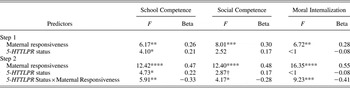
The analyses were straightforward. For each of the three outcomes (school competence, social competence, and moral internalization) we conducted a hierarchical multiple regression. Because there were no significant gender differences for any of the outcomes, child gender was not covaried. In each regression, at Step 1, the two main effects were entered: the effect of environmental influence (the overall maternal responsiveness score from 15 to 52 months) and child genotype (5-HTTLPR status, ss/sl vs. ll). At Step 2, their interaction, G × E, was added. Table 1 presents the results of the hierarchical multiple regressions.
Mothers' responsiveness at 15, 25, 38, and 52 months, children's 5-HTTLPR status, and their interaction as predictors of children's competencies and problems at 67 months

Note: For school competence, after Step 1, R 2 = .12, F (2, 80) = 5.20***; after Step 2, R2 = .18, F (3, 79) = 5.65***. For social competence, after Step 1, R 2 = .12, F (2, 80) = 5.33***; after Step 2, R 2 = .16, F (3, 79) = 5.08***. For moral internalization, after Step 1, R 2 = .09, F (2, 78) = 3.67*; after Step 2, R 2 = .18, F (3, 77) = 5.78***. 5-HTTLPR, serotonin transporter linked promoter region.
†p < .10. *p < .05. **p < .025. ***p < .01. ****p < .001.
In addition, for each outcome where the G × E interaction was significant, we examined, using the aforementioned “regions of significance” approach, whether the interaction effect conformed more to the diathesis–stress model or the differential susceptibility model (Belsky & Pluess, Reference Belsky and Pluess2009b).
School competence
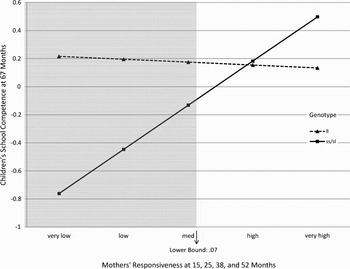
Both main effects and the interaction effect were significant in the final equation. To probe the interaction effect, we estimated the simple slopes for children with the ss/sl and ll genotypes (Aiken & West, Reference Aiken and West1991), and the regions of significance where the outcomes for the ss/sl and ll children were significantly different (Aiken & West, Reference Aiken and West1991; Hayes & Matthes, Reference Hayes and Matthes2009; Preacher et al., Reference Preacher, Curran and Bauer2006). Figure 1 presents the results.
Children's genotypes moderate the effect of mothers' responsiveness at 15, 25, 38, and 52 months on child school competence at 67 months. The solid line represents a significant simple slope, and the dashed line represents a nonsignificant simple slope. The shaded area represents the region of significance.

High and very high maternal responsiveness were represented by the scores 1 SD and 2 SD above the mean, respectively. Likewise, low and very low responsiveness were represented by 1 SD and 2 SD below the mean, respectively (recall that the final score was the mean of standardized scores at each of four assessments that ranged from −2.51 to 1.46).
The interaction effect qualified the main effects. The simple slope for ss/sl children was significant (b = 0.40, SE = 0.11, p < .0001), but for those with the ll genotypes it was not (b = −0.02, SE = 0.13, ns). The lower and upper bounds of regions of significance were 0.07 and 4.31, respectively. This indicates that two regression lines were significantly different for all possible points when the score of maternal responsiveness was lower than 0.07 or higher than 4.31. The shaded area of Figure 1 represents the region of significance within ±2 SD of the maternal responsiveness mean score.
In the abstract, the regression line for the predicted scores suggests that those ss/sl children would have showed higher school competence if they had been exposed to extremely high maternal responsiveness. That value, however, although calculable (4.31), was well beyond the observed range (recall that maximum was 1.46), and higher than 2 SD. Consequently, based on the empirical observed values of the maternal responsiveness, we can only infer that children with the ss/sl genotypes showed significantly lower school competence scores if their mothers' responsiveness was lower than 0.07, resembling the diathesis–stress model. Note also that ss/sl children of mothers whose responsiveness was higher than 0.07 (thus, approximately above the mean) were no less competent at school than their ll peers.
Social competence
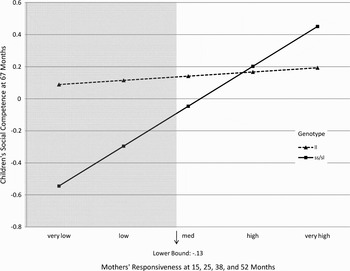
There was a robust main effect of maternal responsiveness: children of more responsive mothers were more socially competent (accepted by peers, likely to behave prosocially, having few social problems). That effect, however, was qualified by the significant G × E interaction. We estimated the simple slopes for children with ss/sl and ll genotypes (Aiken & West, Reference Aiken and West1991). Figure 2 presents the results.
Children's genotypes moderate the effect of mothers' responsiveness at 15, 25, 38, and 52 months on child social competence at 67 months. The solid line represents a significant simple slope, and the dashed line represents a nonsignificant simple slope. The shaded area represents the region of significance.

The simple slope for children with the ss/ss genotypes was significant (b = 0.31, SE = 0.09, p < .001), but for those with the ll genotypes it was not (b = 0.03, SE = 0.10, ns). The lower and upper bounds of regions of significance were −0.13 and 31.41, respectively. This indicates that two regression lines were significantly different for all possible points when the score of maternal responsiveness was lower than −0.13 or higher than 31.41. The shaded area of Figure 2 represents the region of significance within ±2 SD of the maternal responsiveness mean score.
In the abstract, the regression line for the predicted scores suggests that those ss/sl children would have showed higher school competence if they had been exposed to extremely high maternal responsiveness. However, again, that value, although calculable (31.41), was well beyond the observed range and 2 SD, and consequently, based on the empirical observed values of the maternal responsiveness, we can only infer that children with the ss/sl genotypes showed significantly lower school competence scores if their mothers' responsiveness was lower than −0.13, resembling the diathesis–stress model. Note also that ss/sl children of mothers whose responsiveness was higher than −0.13 were no less competent at school than their ll peers.
Moral internalization
In the final equation, maternal responsiveness remained significant, along with the significant interaction effect of Child Genotype × Maternal Responsiveness, G × E, that qualified the main effect. To probe the interaction effect, we estimated the simple slopes for children with ss/sl and ll genotypes (Aiken & West, Reference Aiken and West1991).
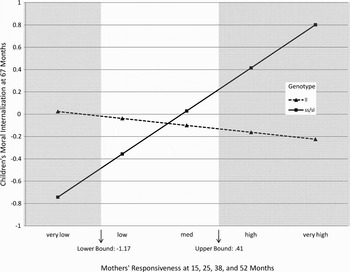
The simple slope for the children with the ss/sl genotypes was significant (b = 0.63, SE = 0.18, p < .001), but for those with the ll genotypes it was not (b = 0.14, SE = 0.21, ns). The lower and upper bounds of the regions of significance were −1.17 and 0.41, respectively; thus, the two regression lines were significantly different for all possible points when the score of maternal responsiveness was lower than −1.17 or higher than 0.41. The shaded areas of Figure 3 represent the regions of significance within ±2 SD of the maternal responsiveness mean score. Because both values (−1.17 and 0.41) were within the observed range of maternal responsiveness, we can draw empirical inferences about both the effects of low maternal responsiveness and high responsiveness.
Children's genotypes moderate the effect of mothers' responsiveness at 15, 25, 38, and 52 months on child moral internalization at 67 months. The solid line represents a significant simple slope, and the dashed line represents a nonsignificant simple slope. The shaded areas represent the region of significance.

It appears that when exposed to low maternal responsiveness (<−1.17, ~1.5 SD below the mean), the ss/sl children scored significantly lower on the moral internalization measure than did the ll children, resembling the traditional diathesis–stress model. When reared by more responsive mothers, however (whose responsiveness scores were >0.41, ~0.5 SD above the mean), the ss/sl children scored significantly higher than the ll children. Thus, the entire picture of G × E effects for moral internalization is consistent with the differential susceptibility model.
Discussion
This longitudinal study, using extensive observational, molecular genetic, and informants' measures, informs the ongoing debate on G × E interactions in development. We embrace the recent broadening approach to G × E interactions that expands the inquiry to include positive developmental outcomes (competence) and positive, beneficial environments (Canli & Lesch, Reference Canli and Lesch2007; Lesch, Reference Lesch2007). We further address the emerging intriguing issue of the form of the interactions: the traditional diathesis–stress model versus differential susceptibility (Belsky & Pluess, Reference Belsky and Pluess2009a, Reference Belsky and Pluess2009b).
This article elucidates the role of maternal responsiveness as an environmental mechanism that may not only merely buffer children from risks conferred by their genotypes (Rutter, Reference Rutter2009) but may also occasionally foster and enhance competencies in children with genetic vulnerabilities consistent with the differential susceptibility model. The relatively new statistical approach to the G × E effects allows us to begin to make tentative judgments about the range of the environmental variation (maternal responsiveness across the first 4 years of life) in which the diathesis–stress or differential susceptibility models emerged for the various aspects of child competence.
We examined children's competence at the age of a salient and uniform transition to expanded ecologies (Rimm-Kaufman & Pianta, Reference Rimm-Kaufman and Pianta2000). Following Masten at al. (1995), we conceptualized competence broadly as encompassing effective and engaged school functioning, successful social functioning in peer contexts, and moral internalization that included moral cognition and a view of self as moral. Both moral cognition and the moral self have attracted strong renewed interest (Hardy & Carlo, Reference Hardy and Carlo2005; Lapsley & Narvaez, Reference Lapsley and Narvaez2004a, Reference Lapsley, Narvaez, Lapsley and Narvaez2004b; Nucci, Reference Nucci, Lapsley and Narvaez2004; Thompson, Meyer, & McGinley, Reference Thompson, Meyer, McGinley, Killen and Smetana2006). An earlier study, using the same puppet interview strategy to assess 5.5-year-olds' moral selves, revealed that children's self-views on moral dimensions were internally consistent and meaningfully linked to moral conduct (Kochanska, Reference Kochanska2002a).
Those developmental outcomes were assessed using a combination of a multifaceted, well-established measure of child functioning as reported by two informants, children's narratives produced in response to standard stories, and their self-descriptive responses to a puppet interview. Consequently, our outcome measures provide a relatively broad, multimethod multitrait assessment of social–emotional development that compares favorably with the extant research on G × E interactions that has typically focused on single outcomes.
The expected significant G × E interactions were found for all three aspects of children's competence. The 5-HTTLPR polymorphism or genotype moderated the links between maternal responsiveness (environment) and children's school competence, social competence, and moral internalization. Differences in maternal responsiveness were significantly associated with those outcomes for children who had a short allele, ss or sl. Variation in maternal responsiveness was unrelated to future competence for children homozygotic for the long allele, ll.
The new analytic strategy of testing regions of significance (Aiken & West, Reference Aiken and West1991; Hayes & Matthes, Reference Hayes and Matthes2009; Preacher et al., Reference Preacher, Curran and Bauer2006) adopted in this study provided a formal way of testing the vigorously debated issue of the shape of G × E interactions. What have we learned from this application?
Two effects clearly resembled the diathesis–stress (genetic vulnerability, or dual-risk) model (Belsky et al., Reference Belsky, Bakermans-Kranenburg and van Ijzendoorn2007; Belsky & Pluess, Reference Belsky and Pluess2009a, Reference Belsky and Pluess2009b). Children traditionally considered more biologically vulnerable (ss/sl), when exposed to poor maternal responsiveness, had lower school competence and lower social competence than those who were less biologically vulnerable. Those presumably more vulnerable children, when exposed to favorable environments or responsive care (already at the point of the mean of maternal responsiveness), fared equally well as their less vulnerable peers. However, even given favorable conditions, they did not fare better than children with two long alleles (ll).
Despite the differences in the studied populations, age of children, the measures of parenting and outcomes, and designs, our findings dovetail with a recent intervention study with a large African American sample of mothers and their preadolescent and adolescent children (Brody, Beach, Philibert, Chen, Lei, et al., Reference Brody, Beach, Philibert, Chen, Lei and McBride Murry2009; Brody, Beach, Philibert, Chen, & McBride Murry, Reference Brody, Beach, Philibert, Chen and McBride Murry2009). The intervention (Strong African American Families) aimed to reduce youths' risky behaviors by targeting multiple aspects of mothers' parenting (nurturance, communication, monitoring, and control) and youths' adaptive strategies. Mother-reported supportive parenting served to offset the risk for an increase over time in substance use in children with ss/sl 5-HTTLPR genotypes. Furthermore, the effects of the intervention were consistent with the diathesis–stress model: the intervention significantly reduced risky behaviors in children with ss/sl genotypes but not in children with ll genotypes. Youth with ss/sl genotypes who received the intervention did as well, but not better, than youth with ll genotypes. The intervention offset the considerable risk conferred by ss/sl genotype (also documented in the study).
Our third G × E effect, for children's moral internalization, conformed to the differential susceptibility model (Belsky & Pluess, Reference Belsky and Pluess2009a, Reference Belsky and Pluess2009b). That G × E interaction incorporated the effects in both the lower range of maternal responsiveness (traditional diathesis–stress) and in its upper range. Thus, taken together, this phenomenon embodied a complete differential susceptibility model. Children with ss/sl genotypes fared less well than their ll peers if their mothers were unresponsive; those children, however, fared better than their biologically invulnerable peers when they had a history of responsive care. Notably, the “plasticity” effect (ss/sl children doing better than ll children when given responsive care) emerged for children of mothers whose responsiveness exceeded approximately half of standard deviation above the mean. Consequently, we can conclude that for some aspects of competence, even a relatively modest improvement in environmental influences, in this case the quality of the mother–child relationship, may be sufficient not only to offset the putative risk but also to enhance children's developmental outcomes.
How can we interpret the differences in the form of G × E interactions obtained for school and social competence versus the interaction obtained for moral internalization? One frankly tentative interpretation involves a possibility that the outcomes in the three areas of functioning call for different proportions of children's inner regulatory resources. It is possible that school and social competence engage, to a significant degree, attentional, intellectual, and executive capacities that relatively robustly regress on the child's genotype. Thus, a certain genotype (here, ss/sl) might introduce a constraint in terms of the child's upper achievable level of school and social competence. Consequently, although maternal optimal care could effectively offset such constraints, in that the child would perform no worse than his or her peers with “low-risk” genotypes, it may not be sufficient for the child to significantly outperform those peers.
In contrast, moral internalization may regress to a lesser extent on cognitive resources and to a greater extent on the quality of the child's emotional and relational early experiences (Thompson et al., Reference Thompson, Meyer, McGinley, Killen and Smetana2006). For example, the parent–child mutually responsive orientation during the first years of life has been implicated as a powerful factor in emerging conscience and internalization of family values (Kochanska, Reference Kochanska2002b). Consequently, maternal highly responsive care may have the potential of significantly fostering the child's moral internalization, such that even children with presumed biological vulnerabilities would outperform their less vulnerable peers. Such a possibility, however, is frankly exploratory and needs to be tested in future studies.
This study has several limitations. In particular, the most serious and most obvious limitation is the small size of the sample. Although our sample is comparable to some recent studies of the interaction between 5-HTTLPR polymorphism and environment (e.g., Fox et al., Reference Fox, Nichols, Henderson, Rubin, Schmidt and Hamer2005; Gilissen, Bakermans-Kranenburg, van IJzendoorn, & Linting, Reference Gilissen, Bakermans-Kranenburg, van JIzendoorn and Linting2008), a larger sample would allow for a separate examination of ss and sl children, which may elucidate better the studied processes. Thus, until the effects are replicated with a larger sample, considerable caution needs to be exercised while drawing inferences from the current study.
Another limitation is the normative and relatively homogeneous nature of the sample. The effects are likely to be stronger in children and families at a higher risk, for example, families where parental responsiveness is particularly impaired (Kaufman et al., Reference Kaufman, Yang, Douglas-Palumberi, Grasso, Lipschitz and Houshyar2006). Furthermore, although 20% of the families had at least one non-White parent, the ethnic range was relatively limited.
The above limitations constrain the variation in the studied constructs. The analytic strategy implemented in this study further highlights the importance of that variation, and particularly the need for samples with broad ranges of variation in the studied dimensions of the environment. As our analyses show, the larger the environmental variation, the better the chances that both lower and upper bounds of the regions of significance will fall within the range of the empirically observed values, allowing us to describe precisely the form of the potential G × E effects. Toward that goal, researchers studying G × E interactions in development should collect robust measures of environmental influences by sampling lengthy and multiple observational contexts, they should use instruments that can capture well variability of those influences (e.g., multiple and sensitive coding systems), and they should recruit large and diverse samples where variation in environments is likely to be substantial. It will also be important to include measures of both environmental adversity and environmental advantage (Belsky & Pluess, Reference Belsky and Pluess2009b). Such a strategy would increase the likelihood that G × E interactions emerging at both ends of the environmental spectrum would be detected.
In the context of this and other recent research, it may be worthwhile to rethink our traditional labeling of ss/sl and ll genotypes as “high risk” and “low risk,” respectively, derived from and related to the concept of diathesis. Just like the concept of diathesis, those labels are better suited to the study of maladaptive outcomes, such as depression, substance use, aggression, and other aspects of psychopathology, and adverse environments. However, with developmental inquiry broadening the G × E focus to include positive, competent outcomes and beneficial environments, and findings demonstrating that under some conditions so-called “high-risk genotypes” may be associated with superior outcomes, new labels (e.g., plasticity or malleability; Belsky & Pluess, Reference Belsky and Pluess2009a, Reference Belsky and Pluess2009b) may be more appropriate.
Finally, shared genes may influence both maternal responsiveness and children's competence. Future designs should aim at collecting molecular genetic data from parents and children.
Research that integrates molecular genetic information with rich behavioral measures of the environment and developmental outcomes and employs longitudinal designs is only beginning to flourish. That research embodies the goals of developmental psychopathology, because it allows for mapping divergent trajectories for children with similar biological profiles but differing experiences. In particular, bridging social relationships and molecular genetics holds promise for progress in understanding the complex nature of adaptive and maladaptive social and emotional development, and progress in research on risk, resilience, competence, intervention, and prevention.