Introduction
Aphids are, arguably, the single most damaging group of agricultural insect pests throughout the world. They are important in transmission of plant diseases, and they cause hundreds of millions of dollars in direct crop losses (Quisenberry & Peairs, Reference Quisenberry and Peairs1998). Moreover, because aphid reproductive rates are among the highest of any insect, population management is difficult. Insecticide resistance is common among aphids, plant resistance based on antibiotic factors can be relatively short-lived, and in many instances biological control agents are too slow acting to sufficiently reduce aphid numbers (Smith, Reference Smith2005). Plant tolerance, which is a plant response to an insect pest, has several advantages as a pest management tool from an ecological viewpoint: (i) it raises economic injury levels preventing early pest management action, (ii) pest populations are likely to stay avirulent to tolerant genes, and (iii) it reduces the selection pressure on pest populations (unlike other management approaches). In spite of its advantages, the use of tolerance for pest management is limited primarily because the mechanisms and the genetics of plant tolerance remain largely unknown (Smith, Reference Smith2005). Understanding these mechanisms at a molecular level could lead to the development of markers, as well as identification of phenotypic characteristics which could have a profound impact on breeding plants with enhanced tolerance to aphid species.
The Russian wheat aphid, Diuraphis noxia (Mordvilko), has been a significant pest of wheat and barley in the United States since its first detection in North America in 1986 (Anderson et al., Reference Anderson, Papa, Peng, Tahir and Lapitan2003). Diuraphis noxia usually feeds at the base of the youngest leaves of the plant, which are strong sinks for phloem-mobile mineral nutrients, amino compounds and carbohydrates (Macedo et al., Reference Macedo, Higley, Ni and Quisenberry2003). By feeding at these sites, D. noxia may have the potential to alter carbohydrate-partitioning patterns of wheat and alter sink-source relationships within the plant (Burd et al., Reference Burd, Webster, Puterka, Hoxie and Wellso1996). Diuraphis noxia can also cause ultrastructural and tissue level damage on susceptible hosts, which may affect phloem composition, and create a nutritionally enhanced phloem diet (Telang et al., Reference Telang, Sandström, Dyreson and Moran1999). Feeding by D. noxia elicits chlorosis, which takes the form of white or yellow longitudinal bands on leaves (Kazemi et al., Reference Kazemi, Talebi-Chaichi, Shakiba and Jafarloo2001) and leaf rolling on cereal plants. A proposed mechanism for the development of chlorosis by piercing-sucking insects (including D. noxia) is that chloroplast injury results from the introduction of salivary secretions, some of which may be toxic to the plant (Ni & Quisenberry, Reference Ni and Quisenberry2003).
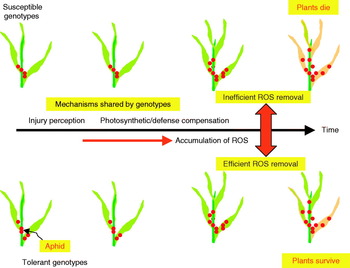
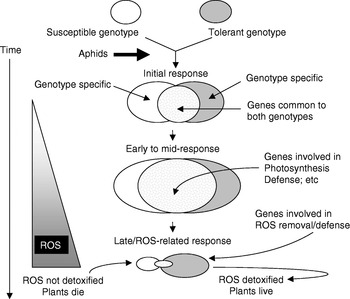
Understanding how aphid feeding affects plants may help to explain the physiological mechanisms underlying plant tolerance. Studies that have examined the physiological responses of cereals to D. noxia have focused on changes in chlorophyll and protein content, chlorophyll fluorescence and gas exchange (Miller et al., Reference Miller, Porter, Burd, Mornhinweg and Burton1994; Burd & Elliott, Reference Burd and Elliott1996; Rafi et al., Reference Rafi, Zemetra and Quisenberry1997; Haile et al., Reference Haile, Higley, Ni and Quisenberry1999; Ni et al., Reference Ni, Quisenberry, Heng-Moss, Markwell, Higley, Baxendale, Sarath and Klucas2002; Heng-Moss et al., Reference Heng-Moss, Ni, Macedo, Markwell, Baxendale, Quisenberry and Tolmay2003; Macedo, Reference Macedo2003; Macedo et al., Reference Macedo, Higley, Ni and Quisenberry2003). Our recent studies on D. noxia (Franzen et al., Reference Franzen, Gutsche, Heng-Moss, Higley, Sarath and Burd2007; Gutsche & Heng-Moss, unpublished data) have found that the short-term impact of aphid injury is primarily on sucrose transport, and resultant impairments of photosynthetic processes are a consequence of end product inhibition. These results have a direct relationship to plant defense and possible mechanisms of plant tolerance. The initial inhibition of photosynthesis is common to both susceptible and tolerant plants infested with aphids. However, we speculate that in tolerant and susceptible genotypes the initial responses to aphid feeding/injury are similar; but in the susceptible genotypes long-term inhibition to photosynthesis is followed by reactive oxygen species (ROS) mediated damage to cells, including loss of chloroplast function and eventual death of the leaves or plant (fig. 1). In marked contrast, tolerant genotypes in response to phloem-feeding insects appear to counteract deleterious effects of aphid herbivory on leaves through up-regulation of detoxification mechanisms (fig. 1). ROS-scavenging and other detoxification enzymes could be a critical long-term factor in plant tolerance to aphids by preventing damage from ROS generated through quenching failures associated with end product inhibition of photosynthesis. ROS are known to be important early signals for altering gene expression patterns in plant cells (Apel & Hirt, Reference Apel and Hirt2004; Kotchoni & Gachomo, Reference Kotchoni and Gachomo2006; Pitzschke et al., Reference Pitzschke, Forzani and Hirt2006). These physiological and biochemical data indicate that a detailed analysis of transcriptional activity of susceptible and tolerant plant genotypes in response to aphid feeding could yield promising insights into tolerance mechanisms and provide a foundation to apply similar strategies to other economically important crops. The differential and specific changes in gene expression during the early and late phase of aphid herbivory in contrasting genotypes then can be interpreted against the large body of literature on plant physiological responses (Miller et al., Reference Miller, Porter, Burd, Mornhinweg and Burton1994; Burd & Elliott, Reference Burd and Elliott1996; Burd et al., Reference Burd, Webster, Puterka, Hoxie and Wellso1996; Haile et al., Reference Haile, Higley, Ni and Quisenberry1999; Ni et al., Reference Ni, Quisenberry, Heng-Moss, Markwell, Higley, Baxendale, Sarath and Klucas2002; Franzen et al., Reference Franzen, Gutsche, Heng-Moss, Higley, Sarath and Burd2007) and provide insights into possible pathways of plant tolerance mechanisms during the continuum of the tolerance response.
Overview of plant responses to aphid feeding. In this model, both susceptible and tolerant genotypes exhibit a similar initial response to aphid feeding through photosynthetic compensation. However, with time and increased aphids and injury, there is an accumulation of ROS in both genotypes resulting in upregulation of ROS-detoxification mechanisms. However, susceptible plants are (genetically) unable to sustain ROS detoxification and subsequently die. In contrast, tolerant genotypes are able to maintain adequate levels of ROS-detoxification and survive. It should be pointed out that tolerant plants will eventually succumb to aphid feeding if aphid numbers cross a certain threshold. Such aphid densities will rarely be observed under field conditions.

Several recent studies have employed microarrays to study insect-plant interactions (Reymond et al., Reference Reymond, Weber, Damond and Farmer2000; Strassner et al., Reference Strassner, Schaller, Frick, Howe, Weiler, Amrhein, Macheroux and Schaller2002; Heidel & Baldwin, Reference Heidel and Baldwin2004; Hui et al., Reference Hui, Javeed, Lehmann, Gase, Saluz and Baldwin2003), but reports on aphid-plant interactions are limited (Moran et al., Reference Moran, Cheng, Cassell and Thompson2002; Voelckel et al., Reference Voelckel, Weisser and Baldwin2004; Zhu-Salzman et al., Reference Zhu-Salzman, Salzman, Ahn and Koiwa2004; De Vos et al., Reference De Vos, Van Oosten, Van Poecke, Van Pelt, Pozo, Mueller, Buchala, Metraux, Van Loon, Dicke and Pieterse2005; Divol et al., Reference Divol, Vilaine, Thibivilliers, Amselem, Palauqui, Kusiak and Dinant2005; Park et al., Reference Park, Huang and Ayoubi2005; Botha et al., Reference Botha, Lacock, van Niekerk, Matsioloko, du Preez, Loots, Venter, Kunert and Cullis2006; Couldridge et al., Reference Couldridge, Newbury, Ford-Lloyd, Bale and Pritchard2007), and no published literature exists on using full genome arrays to investigate aphid interactions with tolerant and susceptible plant genotypes. Our focus is to apply functional genomics in an explanatory role to help support and expand our existing physiological understandings of plant tolerance mechanisms. We have used the barley (Hordeum vulgare)-Russian wheat aphid (D. noxia) pair to differentiate between the responses of tolerant and susceptible plants to aphid herbivory. This model system was selected because the barley chip had become commercially available for microarray assays, the economic importance of barley and D. noxia, and our contributions towards understanding this system.
Materials and methods
Seeds of the susceptible barley cultivar ‘Otis’ and the tolerant cultivar ‘Sidney’ were planted in ‘SC-10 Super Cell’ Cone-tainers® (3.8 cm×21 cm) (Stuewe & Sons, Inc. Corvallis, OR, USA). Sidney was an experimental line (98BX 28-58B) developed through modified backcross breeding of STARS 9301B (Mornhinweg et al., Reference Mornhinweg, Porter and Webster1995) to Otis. Plants were grown for 14 days in a greenhouse under 400-watt high intensity lamps with a 16:8 h (L:D) photoperiod and a temperature of 27±3°C and were thinned to one plant per Cone-tainer® once seedlings emerged from the soil.
A colony of Biotype 1 D. noxia was obtained from the USDA-ARS research facility in Stillwater, OK, USA. Aphids were maintained on susceptible ‘Morex’ barley and were kept in growth chambers (Percival Scientific, Boone, IA, USA) at 21±1°C, 40–50% RH, and a photoperiod of 16:8 h (L:D).
The experimental design was a completely randomized design, with a 2×2×3 factorial treatment design that included two barley genotypes, two aphid infestation levels (0 and 12 D. noxia) and three harvest dates (three hours, three days and six days after aphid introduction). For infested treatments, six aphids were introduced onto the first and second leaf blade (12 aphids total) of each designated infested plant. Tubular Plexiglas cages (4 cm diameter×30 cm height) with organdy fabric fastened by rubber bands to the top were used to confine aphids on the plants. For consistency, control plants were also caged. After infestation, plants were kept in the greenhouse until the respective harvest date.
On each harvest date, plants were evaluated for leaf chlorosis using a 1–9 scale, where 1=plants appear healthy and 9=plant death or no recovery possible (Webster et al., Reference Webster, Baker and Porter1991). Chlorophyll measurements were also performed using a chlorophyll meter (Model Spad-502, Minolta Camera Co., Osaka, Japan). The total number of D. noxia on infested plants was assessed by removing and counting the aphids at each harvest date.
RNA isolation
Total RNA was extracted from frozen leaves using TRIzol reagent following the manufacturer's instructions (Invitrogen) and further purified using Qiagen RNeasy column (Qiagen). All RNA samples were quality assessed on a RNA 6000 Nano LabChip using Agilent BioAnalyzer 2100 (Agilent Technologies). Fifteen micrograms of total RNA was used to synthesize cDNA using Affymetrix One-Cycle cDNA Synthesis Kit according to the manufacturer's instructions (Affymetrix). All sample preparations followed prescribed protocols (Affymentrix Genechip Expression Analysis Technical manual). Hybridization was done on an Affymetrix Barley Genome Array, stained with streptavidin- phycoerythrin conjugate on an Affymentrix Fluidics Station 450, followed by scanning with the GeneChip Scanner 3000 (Affymetrix). Affymetrix GeneChip Operating Software (GCOS) was used for washing, scanning and basic data analysis.
Microarray data analyses
The GeneChip Barley Genome Array contains over 22,500 probe sets, representing more than 21,000 genes. Each probe set consisted of 11 probe pairs with a perfect match (PM) sequence corresponding to a specific region of a gene. For each PM sequence, there was also a corresponding mismatch (MM) oligo that differs by one base. In total, 24 microarray hybridizations were carried out (two replicates for each time point×2 treatments for each genotype×2 genotypes×3 time points), and each treatment sample was analyzed versus each of the two control sets (data from the hybridizations, as Excel files, are available upon request).
The data were analyzed with Affymetrix GeneChip Operating Software (GCOS) and then mined for significant genes with the AffyMiner program (Lu et al., Reference Lu, Nguyen, Xiao and Fromm2006). Data exported from the initial GCOS analyses were exported and reanalyzed by the Affyminer program (Lu et al., Reference Lu, Nguyen, Xiao and Fromm2006) with the following criteria: (i) detection call should be ‘present’ in the two experiment replicates; (ii) change calls from the pair-wise comparisons should be all ‘I’, increase or ‘D’, decrease; (iii) the fold change of average signal values between the treatments and the controls should be no less than 1.5. Five genes showing extreme values of fold change have been excluded from statistical analysis when determining the Pearson correlation coefficient. The quality of replicate arrays was evaluated using scatter plots and pair-wise correlations. The cutoff for average signal log ratio between the experimental and control samples was 0.5. This corresponds to ~1.5 fold change in intensity levels (amounts of expressed messages, respectively) between the experimental and control data sets.
Quantitative real-time PCR
A second study was conducted to provide additional insight into the expression of targeted genes. Procedures for barley establishment and aphid introduction were as previously described.
The experimental design was a completely randomized design, with a 2×2×5 factorial treatment design that included two barley genotypes, two aphid infestation levels (0 and 12 D. noxia) and five harvest dates (3 h, 1 day, 3 days, 6 days and 9 days after aphid introduction).
From our microarray data, we selected two barley peroxidase genes for qRT-PCR analysis because they were significantly up-regulated in response to aphid feeding. Based on our proposed hypothesis (fig. 1) and earlier studies (Franzen et al., Reference Franzen, Gutsche, Heng-Moss, Higley, Sarath and Burd2007; Gutsche & Heng-Moss, unpublished data), we anticipated that peroxidases could be a critical factor in plant tolerance to aphids. qRT-PCR assays were developed for these two peroxidases using Primer Express software (Applied Biosystems, Foster City, CA, USA). A control assay was also developed for barley ubiquitin-conjugating enzyme (UCE) using the same method. UCE transcripts have been shown to be excellent real-time PCR control assays in many systems (Czechowski et al., Reference Czechowski, Stitt, Altmann, Udvardi and Scheible2005) surpassing the dependability of other control assays. In our study, all assays were validated to produce a consistent single reproducible product and a consistent Ct value.
TaqMan assays were performed as directed by the manufacturer using an ABI 7500 Real-time PCR system (Applied Biosystems, Foster City, CA, USA). Cycle threshold data were analyzed using the ΔΔCt method with the UCE as an endogenous control (Livak & Schmittgen, Reference Livak and Schmittgen2001). Fold changes in transcript level were determined within each barley genotype (e.g. susceptible-infested vs. susceptible-control) at each time point (e.g. 3 h, 1 day, 3 days, 6 days, 9 days) and between genotypes (e.g. tolerant-infested vs. susceptible-infested) at each time point.
Results and discussion
No evidence of visible plant damage or difference in chlorophyll level was observed between infested Sidney and Otis at 3 h, 3 days and 6 days after aphid introduction. Although aphid populations increased over time on both genotypes, there were no significant differences (P>0.05) between the number of aphids on tolerant and susceptible infested plants over the course of the study.
Expression profiling of barley genes responsive to D. noxia feeding
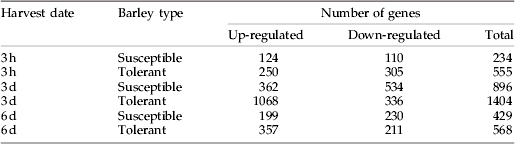
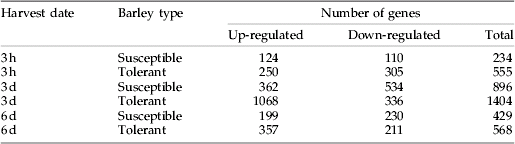
A total of 4086 genes were differentially expressed over the three harvest dates in tolerant and susceptible barley in response to D. noxia feeding (table 1). Across the three harvest dates, the greatest number of genes was differentially expressed in both tolerant and susceptible barley at three days after aphid introduction (table 1). A second set of overlap data was created by comparing the data for the tolerant and susceptible barley for each harvest date yielding a profile of genes that were either up- or down-regulated in the tolerant barley genotype in response to D. noxia feeding.
Total number of barley genes differentially regulated in response to Diuraphis noxia feeding at each harvest date.
Functional classification of genes
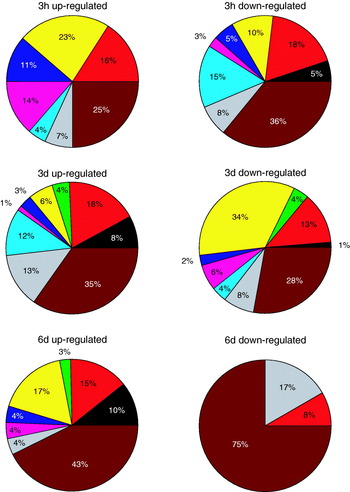
A total of 909 genes showed significant levels of change in the tolerant barley in response to D. noxia feeding as compared to susceptible plants infested with aphids. These genes were listed and categorized according to the putative function of each gene. Very few of these genes were annotated for molecular function using the Gene Ontology (GO) database, so the putative functions of the genes were inferred from metabolic processes known to be related to each gene. Genes involved in multiple metabolic processes were classified according to their main role in plant metabolism. The functional categories used here mimic those reported in Park et al. (Reference Park, Huang and Ayoubi2005) to facilitate comparison. The functional categories included signal transduction, oxidative stress/burst, photosynthesis, development, cell maintenance, cell wall fortification, abiotic stress, direct defense and unknown function (fig. 2).
Functional categories of the barley genes responsive to Diuraphis noxia feeding in tolerant plants. Percentages indicate the proportions of a number of genes in each category to the total number of genes differentially regulated at each harvest date (3 h up-regulated: N=43, 3 h down-regulated: N=39, 3 d up-regulated: N=165, 3 d down-regulated: N=81, 6 d up-regulated: N=76, 6 d down-regulated N=12) (■) Abiotic stress, ( ) cell maintenance, (
 ) cell wall fortification, (
 ) unknown, (
 ) defense, (
 ) oxidative stress, (
 ) development, (
 ) signaling, (
 ) photosynthesis.

Genes involved in oxidative stress
Throughout the three harvest dates, a total of 15 different genes that have been associated with oxidative stress were either up- or down-regulated in response to D. noxia feeding on tolerant barley plants. Included in this category were ten peroxidase genes, three genes encoding glutathione S-transferases (GST) and two alternative oxidase (AOX) genes.
Two of the peroxidase genes differentially expressed in the tolerant barley were up-regulated at three hours and again at six days after aphid introduction. Class III plant peroxidases play a role in cell wall building processes, auxin catabolism, wound healing, removal of H2O2, oxidation of toxic reductants and defense against pathogen or insect attack (Hiraga et al., Reference Hiraga, Sasaki, Ito, Ohashi and Matsui2001; Ni et al., Reference Ni, Quisenberry, Heng-Moss, Markwell, Sarath, Klucas and Baxendale2001; Kawano, Reference Kawano2003; Heng-Moss et al., Reference Heng-Moss, Sarath, Baxendale, Novak, Bose, Xinhi and Quisenberry2004). Evidence also suggests that elevated levels of plant peroxidases play a role in the defense response to aphids (Smith & Boyko, Reference Smith and Boyko2007). Increased levels of peroxidases after aphid feeding have been documented in wheat, barley and sorghum (Argandona et al., Reference Argandona, Chaman, Cardemil, Munoz, Zuniga and Corcuera2001; Ni et al., Reference Ni, Quisenberry, Heng-Moss, Markwell, Sarath, Klucas and Baxendale2001; Park et al., Reference Park, Huang and Ayoubi2005).
Three genes encoding GSTs were differentially expressed in resistant plants at three hours and three days after aphid introduction. Like plant peroxidases, GSTs have many functions in plants, including primary and secondary metabolism, stress tolerance and cell signaling (Dixon et al., Reference Dixon, Lapthorn and Edwards2002). The induction of GSTs has been documented in response to both biotic and abiotic stressors (Dixon et al., Reference Dixon, Lapthorn and Edwards2002). Increased levels of GSTs have also been implicated in the defense response of resistant sorghum to S. graminum (Park et al., Reference Park, Huang and Ayoubi2005).
Two AOXs were differentially regulated in resistant barley challenged by D. noxia. Both were differentially expressed at three days after infestation, although one was up-regulated and the other was down-regulated. AOXs are among the most highly expressed genes in response to stress and function, primarily to remove ROS accumulating during stress. However, AOX are part of a small gene family with significant variation in transcript abundance for individual genes in different tissues (Clifton et al., Reference Clifton, Millar and Whelan2006).
Photosynthesis-related genes
In total, 30 different genes associated with photosynthesis were differentially regulated in response to D. noxia feeding in the tolerant barley. Differences were only observed at three hours and three days after aphid introduction; no photosynthesis genes were differentially regulated at six days. Of those 30, 18 were genes encoding chlorophyll a/b binding proteins. In resistant wheat and sorghum, genes encoding chlorophyll a/b binding proteins were also differentially expressed in response to D. noxia and S. graminum feeding, respectively (Park et al., Reference Park, Huang and Ayoubi2005; Boyko et al., Reference Boyko, Smith, Thara, Bruno, Deng, Starkey and Klaahsen2006).
One enolase gene was up-regulated at three hours after aphid introduction. Few studies have linked enolase to plant defense responses; however, Park et al. (Reference Park, Huang and Ayoubi2005) reported an enolase gene in sorghum to be down-regulated in response to S. graminum feeding.
At three days after aphid introduction, an adenosine diphosphate glucose (ADPG) pyrophosphatase gene was strongly down-regulated (−3.425 signal log ratio). ADPG pyrophosphatase catalyzes the hydrolytic breakdown of ADPG to glucose-1-phosphate and AMP. Rodriguez-Lopez et al. (Reference Rodriguez-Lopez, Baroja-Fernandezm, Zandueta-Criado and Pozueta-Romero2000) demonstrated that ADPG pyrophosphatase activity declines in parallel with the accumulation of starch during development of sink organs and that it competes with starch synthase for ADPG, thereby blocking starch biosynthesis.
Two genes that encode the small subunit (ssu) of ribulose-1,5-bisphosphate carboxylase (RUBISCO) were up-regulated at three days. An up-regulation of RUBISCO was also documented in celery infested with M. persicae (Divol et al., Reference Divol, Vilaine, Thibivilliers, Amselem, Palauqui, Kusiak and Dinant2005). However, tobacco infested with M. nicotinanae showed lower levels of ssu RUBISCO protein 48 hours after aphid attack (Voelckel et al., Reference Voelckel, Weisser and Baldwin2004).
Signaling
Throughout the study, a total of 39 different genes related to signaling were up- or down-regulated in the tolerant barley in response to D. noxia feeding. Among these were genes encoding pathogenesis related proteins, MYB transcription factors, Zn finger proteins, basic helix-loop-helix (bHLH) transcription factors, a ras-like GTP-binding protein, an ethylene response element binding protein (EREBP) and a MADS protein. Genes in this category were differentially expressed on all six harvest dates.
Two genes encoding MYB transcription factors were differentially up-regulated at three hours and three days in the tolerant barley. Transcription factors in the MYB superfamily have been associated with regulatory roles in developmental processes, as well as defense and stress responses in plants (Yanhui et al., Reference Yanhui, Xiaoyuan, Kun, Meihua, Jigang, Zhaofeng, Zhiqiang, Yunfei, Xiaoxiao, Xiaoming, Yunping, Li, Xiaohui, Jingchu, Xing-Wang, Zhangliang, Hongya and Li-Jia2006). MYB proteins can be induced by wounding (Sugimoto et al., Reference Sugimoto, Takeda and Hirochika2000), dehydration stress (Urao et al., Reference Urao, Yamaguchi-Shinozaki, Urao and Shinozaki1993) or pathogen infection (Lee et al., Reference Lee, Loros and Dunlap2000).
Three ACC oxidases were differentially expressed in the tolerant barley. At three days after aphid introduction, all three were up-regulated (3.725, 3.05 and 1.55 signal log ratios). Aphid feeding significantly increased ethylene production in aphid resistant barley cultivars compared to susceptible cultivars fed on by R. padi and S. graminum (Argandona et al., Reference Argandona, Chaman, Cardemil, Munoz, Zuniga and Corcuera2001), as well as wheat fed on by D. noxia (Miller et al., Reference Miller, Porter, Burd, Mornhinweg and Burton1994).
Two genes encoding bHLH transcription factors were differentially expressed in the tolerant barley. One of these was strongly up-regulated with a signal log ratio of 8.475. Evidence shows that transcription factors in the bHLH family in tomato and Arabidopsis play a role in jasmonic acid (JA)-induced defense gene activation (Boter et al., Reference Boter, Ruiz-Rivero, Abdeen and Prat2004) and are induced by ROS (H2O2) stress (Gadjev et al., Reference Gadjev, Vanderauwera, Gechev, Laloi, Minkov, Shulaev, Apel, Inze, Mittler and Van Breusegem2006).
Defense-related genes
A total of 64 genes in the category of defense were unique to the tolerant barley. This category contains the second largest number of differentially expressed genes. Genes in this category were either up- or down-regulated at all three harvest dates during the study, although none were down-regulated at six days. In this category were genes coding for proteins involved in defense to pathogens, cytochrome P450s, beta-glucosidases, chitinases, wound response proteins, trypsin inhibitors and other proteins related to defense.
Ten genes encoding cytochrome P450s were differentially expressed in the tolerant barley. One of the cytochrome P450 transcripts was strongly up-regulated at three days with a signal log ratio of 5.55. In plants, cytochrome P450s, which are involved in JA-mediated defense responses (Park et al., Reference Park, Halitschke, Kim, Baldwin, Feldmann and Feyereisen2002), have been induced in aphid-resistant wheat and sorghum in response to D. noxia and S. graminum, respectively (Park et al., Reference Park, Huang and Ayoubi2005; Boyko et al., Reference Boyko, Smith, Thara, Bruno, Deng, Starkey and Klaahsen2006).
Four chitinase genes were differentially regulated in response to D. noxia feeding in the tolerant barley at three days and six days. Induction of chitinases has also been associated with defense against S. graminum in susceptible sorghum (Zhu-Salzman et al., Reference Zhu-Salzman, Salzman, Ahn and Koiwa2004).
Two phenylalanine ammonia-lyase (PAL) genes were up-regulated six days after aphid infestation in tolerant barley. Increases in expression of genes related to phenolic biosynthesis, such as PAL, are commonly associated with JA treatment or herbivory in plants (Moran & Thompson, Reference Moran and Thompson2001). A 1.5-fold increase in the mRNA level of PAL occurred in Arabidopsis in response to M. persicae feeding (Moran & Thompson, Reference Moran and Thompson2001).
Abiotic stress
A total of 24 different genes putatively in abiotic stress showed differential regulation in response to D. noxia feeding in the tolerant barley. Many of these genes were heat shock or cold-induced proteins. Two dehydrin genes were also differentially up-regulated in response to D. noxia at three days and six days. Dehydrins are expressed during drought stress; and, in drought-resistant wheat, the expression of dehydrins is initiated before stress occurs (Rampino et al., Reference Rampino, Spano, Pataleo, Mita, Napier, Di Fonzo, Shewry and Perrotta2006).
Cell maintenance
Sixty-five different genes were assigned to the category of cell maintenance. Genes in this category were differentially expressed on all three harvest dates with 41 genes either up- or down-regulated at three days after aphid introduction. Three beta-tubulin genes were up-regulated at three days by D. noxia feeding in the resistant barley. In resistant sorghum, genes encoding an alpha- and beta-tubulin were also differentially expressed in response to S. graminum (Park et al., Reference Park, Huang and Ayoubi2005).
Cell wall fortification
Only 12 different genes encoding proteins putatively involved in cell wall fortification were up- or down-regulated in response to D. noxia feeding in the resistant barley. None were differentially expressed at the earliest harvest date, three hours after aphid introduction. Two cinnamoyl-CoA reductase (CCR) genes were up-regulated at three days after aphid introduction. CCR is responsible for the CoA ester to aldehyde conversion in monolignol biosynthesis, which diverts phenylpropanoid-derived metabolites into the biosynthesis of lignin (Ma, Reference Ma2007). Two CCR genes from Arabidopsis are known to be differentially expressed during development and in response to infection with pathogenic bacteria (Lauvergeat et al., Reference Lauvergeat, Lacomme, Lacombe, Lasserre, Roby and Grima-Pettenati2001).
At six days after aphid introduction, a gene-encoding caffeic acid O-methyltransferase (COMT) was differentially up-regulated in the resistant barley. COMT is a key enzyme involved in the biosynthesis of lignin (Eckardt, Reference Eckardt2002). In a study that compared gene expression in resistant and susceptible sorghum challenged by S. graminum, a COMT gene was differentially up-regulated in the resistant genotype (Park et al., Reference Park, Huang and Ayoubi2005).
Development
Seventeen different genes encoding proteins putatively involved in development were differentially regulated by D. noxia feeding in resistant barley. An auxin binding protein and an auxin transport protein were differentially expressed at three hours after aphid introduction. Remans et al. (Reference Remans, Spaepen and Vanderleyden2006) demonstrated a link between auxin signaling in plants and resistance to bacterial pathogens. An abscisic acid (ABA)-induced protein was also up-regulated at three hours. A study using Arabidopsis supports the involvement of ABA as a signal for plant resistance to pathogens, specifically affecting JA biosynthesis and the activation of defense (Adie et al., Reference Adie, Perez-Perez, Perez-Perez, Godoy, Sanchez-Serrano, Schmelz and Solano2007).
Unknown
A total of 145 genes were categorized as having unknown function, making it the largest category among the nine. Genes were placed in this category if they failed to match any sequences from the GenBank databases by the BLAST search or matched to sequences whose functions have not yet been characterized. Some of these genes were either strongly up- or down-regulated in response to D. noxia infestation, suggesting that they play a key role in the defense response and, more specifically, the resistance to these aphids.
Quantitative real-time PCR
No evidence of visible plant damage was observed between infested Sidney and Otis at three hours, three days and six days after aphid introduction. However, by day nine, susceptible plants were starting to exhibit the characteristic leaf rolling caused by D. noxia. Although aphid populations increased over time on both genotypes, there were no significant differences (P>0.05) between the number of aphids on tolerant and susceptible infested plants over the course of the study (data not shown).
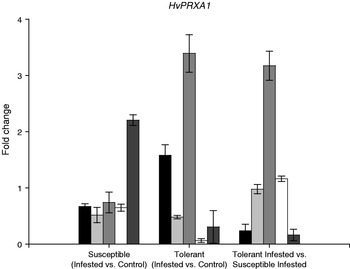
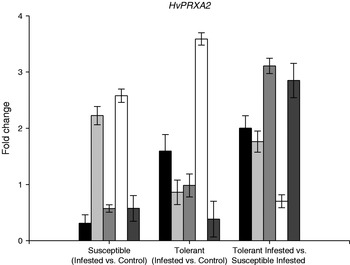
Differences between the tolerant and susceptible barley in response to aphid feeding were detected in the relative expression of the two peroxidase genes, designated as HvPRXA1 (accession number BF264390) and HvPRXA2 (accession number DN178361) (figs 3 and 4). At three hours and three days after aphid introduction, the infested tolerant barley exhibited a significant increase in expression of HvPRXA1 compared to control plants. By six and nine days, the infested tolerant barley showed a reduction in the level of HvPRXA1 compared to control plants. For the susceptible barley, the infested plants showed consistently lower levels of HvPRXA1 when compared to their respective controls until day nine, when the aphid-infested plants exhibited expression levels twofold higher than the control plants. Infested tolerant plants had similar or higher expression levels of HvPRXA1 when compared to infested susceptible plants at one day, three days and six days after aphid introduction; but, by day nine, the infested tolerant plants showed a reduction in the expression level of this peroxidase compared to infested susceptible plants (fig. 3).
Quantitative expression analysis of barley peroxidase gene HvPRXA1 in response to Diuraphis noxia feeding in susceptible and tolerant barley. Values are the means±SE (n=3) (■, 3 h; , 1 d;
 , 3 d; □, 6 d;
 , 9 d).

Quantitative expression analysis of barley peroxidase gene HvPRXA2 in response to Diuraphis noxia feeding in susceptible and tolerant barley. Values are the means±SE (n=3) (■, 3 h;, 1 d;, 3 d; □, 6 d;, 9 d).

For the second peroxidase gene, HvPRXA2, we again observed an increase in expression at three hours after aphid introduction in the tolerant barley. Starting at one day, the infested and control tolerant barley plants had similar expression levels; but, by day six, the infested barley showed a 3.6-fold increase in HvPRXA2 expression compared to expression in control plants. The initial increase in HvPRXA2 expression did not occur until one day after aphid introduction for the susceptible barley. It is interesting to note that the susceptible barley also showed elevated transcript levels at six days; however, the level of expression was only 2.6-fold higher than that of the control plants. Infested tolerant plants consistently had higher expression levels of HvPRXA2 when compared to infested susceptible plants at all time periods except at six days after aphid introduction (fig. 4). Both the aphid-infested susceptible and tolerant barley exhibited a decrease in expression of HvPRXA2 at nine days after aphid introduction.
Conclusions
Microarray analysis was conducted to compare gene expression profiles of tolerant and susceptible barley genotypes challenged by D. noxia at three time points, three hours, three days and six days after aphid introduction. The use of Affymetrix GeneChip Barley Genome arrays allowed us to examine the expression changes of nearly 22,000 genes. Comparison of control and infested array data and subsequent comparison of tolerant and susceptible arrays allowed for identification of genes showing significant levels of change in the tolerant barley in response to D. noxia feeding. Many of the changes documented in this study support those found in other studies with resistant and susceptible sorghum and wheat infested with S. graminum and D. noxia, respectively (Park et al., Reference Park, Huang and Ayoubi2005; Boyko et al., Reference Boyko, Smith, Thara, Bruno, Deng, Starkey and Klaahsen2006).
The class III peroxidase genes, HvPRXA1 and HvPRXA2, were newly identified to be involved in the plant defense response to aphid injury. These two genes are closely related to the peroxidase genes identified in wheat, specifically TmPRX3 and TmPRX4, which were shown to be up-regulated in response to powdery mildew infection (Liu et al., Reference Liu, Sheng, Greenshields, Ogieglo, Kaminskyj, Selvaraj and Wei2005). Zierold et al. (Reference Zierold, Scholz and Schweizer2005) also showed that a peroxidase gene, similar to HvPRXA2, is up-regulated in the epidermis of barley in response to powdery mildew.
Our microarray and qRT-PCR data documented the up- and down-regulation of the HvPRXA1 and HvPRXA2 peroxidase genes in response to D. noxia feeding on tolerant barley plants. Based on these findings, our proposed hypothesis is that tolerant barley plants have the ability to elevate their level of ROS-scavenging enzymes, such as peroxidase, which enable them to efficiently remove ROS that accumulate in response to aphid feeding (fig. 5). Furthermore, the up- and down-regulation patterns of these peroxidases suggest that ROS accumulation and detoxification of ROS occurs simultaneously in response to aphid feeding (Park et al., Reference Park, Huang and Ayoubi2005).
Integration of gene expression and physiological changes occurring in (○) susceptible and ( ) tolerant genotypes upon aphid infestation. Initial response (~3 h) to aphid feeding results in two types of gene expression profiles (a) one that is genotype specific and (b) that is similar for both genotypes. At this time there are no apparent changes to whole-plant physiology. Continued feeding results in increased ROS (shaded triangle on right) and is accompanied by a much greater increase in gene expression in both genotypes. At this point of time (~3 to 4 days), genes involved in photosynthesis and defense are apparently modulated in a similar manner in both genotypes, indicating the conservation of a core plant response to aphid feeding, for example increases in photosynthetic rates. Cellular damage from ROS appears to be initiated at this time as seen by up-regulation of peroxidases, although visible symptoms of damage are rarely observed. As tissue damage accumulates, the susceptible genotype is unable to sustain metabolism and displays a much smaller level of transcript changes (indicated by a smaller circle in the figure) and eventually dies (days 9–12). The tolerant genotype is able to sustain cellular metabolism and is able to detoxify ROS through production of appropriate mechanisms, including the synthesis of peroxidases and other ROS-detoxifying proteins. While we have simplified stages of response based on our data, it is likely that several signaling cascades will overlap and these gradations will not be apparent when analyzing plant metabolism at discrete time points.

In summary, our results provide the first analysis using barley gene arrays to investigate aphid interactions with tolerant and susceptible genotypes and insights into possible pathways of plant tolerance mechanisms during the continuum of the tolerance response. Peroxidases and other oxidative stress enzymes could potentially be playing multiple roles in the tolerant plant's defense response, such as the downstream signaling of plant defense reactions to aphid injury, lignin biosynthesis and/or efficient removal of ROS (Passardi et al., Reference Passardi, Cosio, Penel and Dunand2005). In order to more fully understand the role of specific peroxidases in the tolerance response, future studies aimed at down-regulating targeted genes could provide direct insights into the tolerant response; alternatively, over-expression of barley genes (possibly with their native promoters) in model plant systems could be used to evaluate their role in providing protection against aphid herbivory.
The identification of genes, such as peroxidases that could be involved in the tolerance response of barley, provides a baseline against which to screen other barley genotypes for the presence and specific up-regulation of these genes and, thus, may provide useful markers for tolerance. These procedures will shorten the timeline to identify and improve barley with superior Russian wheat aphid resistance, and these improved understandings at the molecular and cellular levels of aphid resistance in barley could benefit similar improvements in other economically important cereals.