INTRODUCTION
Now and then archaeologists encounter specially deposited materials in their excavations or in the field laboratory that are problematical with regard to the function or intent of the past behavior that created them. In other words, they differ in some aspect of content or recovery context from the expectations of the excavator (Coe Reference Coe1990:930; Parry Reference Parry, Levine and Carballo2014:303). In the Mesoamerican archaeological literature, especially of the Maya lowlands, such anomalous features are often referred to as problematical deposits (PDs). PDs are etic, site-specific constructs. They reflect the archaeologist's state of knowledge and ideas about that particular site, as can be seen, for example, in different interpretations at different sites for identically structured deposits. The category of PD is vague, equivalent to “unclassified” or “miscellaneous.” Its value is in flagging features that require further research. The widespread adoption of the term demonstrates the need for such a category. PDs have considerable potential to enhance understanding of the sites at which they occur because they represent challenges to our working assumptions and require a holistic approach to explain their origin and intent.
A sample of 223 PDs is reviewed here in an approach to understanding the intent of the behavior that created them. The sample was excavated by the Tikal Project of the University of Pennsylvania Museum between 1957 and 1970 (Coe and Haviland Reference Coe and Haviland1982) and includes only those deposits designated as PDs by the Project, including a few that were later reclassified as general excavations. Not included in this review are special deposits that did not receive PD designations (Coe Reference Coe1990:933) and PDs recovered by later archaeological projects such as the Proyecto Nacional de Tikal (Iglesias Ponce de León Reference Iglesias Ponce de León1987, Reference Iglesias Ponce de León and Braswell2003; Laporte Reference Laporte Molina1989; Laporte and Fialko Reference Laporte Molina and Fialko C1995).
In the lowland Maya area PDs are often compared with burials and caches (hidden offerings), two kinds of specially deposited features whose intents are assumed to be mortuary and offertory, respectively. The category of PD arose from Coe's (Reference Coe1959:94–95) recognition at the lowland Maya site of Piedras Negras of specially deposited material that did not appear to be a burial or cache, but required another designation. He later established the PD category at Tikal. The Tikal Project designated 207 features as burials, 209 as caches, and 223 as PDs. Although Coe initially only assigned PDs to deposits that appeared to have had a ritual function, the category soon expanded to include any kind of anomalous feature. Tikal PDs, therefore, encompass a good deal of variability. Coe viewed them as a provisional category flagged for future definition and reclassification when excavations were concluded. This step was never taken, however, which has led to a lack of consistency in designating PDs in the field or field laboratory and to a misunderstanding among some researchers that the term refers to some kind of past reality.
This is a good moment to revisit the Tikal Project PDs in view of the considerable amount of recent archaeological research in the Maya area, the incorporation of the term PD into the literature, and the publication by their excavators of nearly three-quarters of the sample reviewed here (see Supplementary Material). The Tikal Project's working definitions of burials, caches, PDs, and general excavations are briefly presented to explain why some features were deemed problematical. The PD sample is then described as preliminary types based upon content, further refined by contextual variables such as dates of deposition, associated structures, and distance from the city's Classic period epicenter. This typology indicates that Tikal PDs had three principal functions or intents, which can be broadly summarized as ritual, political, and site maintenance, with a residual category that includes de facto and unintentional accumulations of material.
TIKAL RECOVERY CONTEXTS
By the Late Late Preclassic period (Table 1) Tikal was governed by hereditary rulers (Harrison Reference Harrison1999:65; Martin and Grube Reference Martin and Grube2008), as inferred from abundant material evidence for civic-ceremonial architecture, stone stelae and altars, and richly furnished burials. The establishment of dynastic rulership was accompanied by the veneration of named ancestors, who were revered as intermediaries between the living and the supernatural world (Adams Reference Adams1999:156; McAnany Reference McAnany1995). The material expression of ancestor veneration took the form of richly furnished chamber burials, mortuary temples, numerous and often elaborate caches, and stelae and altars of stone carved with portraits and texts. Residential segregation was well established by the Classic period, demonstrated by variability in portable material culture, architecture, burials, and caches.
Tikal Chronology (Coe Reference Coe1990; Culbert Reference Culbert1993; Laporte Reference Laporte Molina1989; Moholy-Nagy Reference Moholy-Nagy2016).

Burials and Caches
Tikal's standard burials and caches differ from PDs in patterned aspects of placement, association with stone monuments and architecture, proximity to the epicenter of the site, dates, types, and in the condition and standardized arrangement of included materials. Burials and caches were always hidden from view, usually associated with other features, more numerous near the city's center, and always in primary context. Their contents were usually intact, of the same date, included indicators of status or goods unique to caches, and placed in structured arrangements within the deposit. Additional contents, such as sharp objects used for bloodletting, were probably used in rituals performed at the time of interment. In contrast to several Mesoamerican sites, there is no unequivocal evidence at Tikal for reverential reentry into a cache or burial.
Coe's (Reference Coe1959; Moholy-Nagy with Coe Reference Moholy-Nagy and Coe2008:18–21, Appendices 10–12) groundbreaking work on caches only considered those offerings associated with the stone stelae and temples of Tikal's uppermost social strata. Therefore, special deposits that resembled standard caches, but in contexts associated with commoners, automatically became PDs. Furthermore, the caches often included in Classic-period chamber burials were not distinguished from other offerings in the grave.
The positioning of caches along the central axes of temples and plazas, in the corners of rooms (Figure 1), and beneath stone monuments, and the standardized symmetrical configurations of structure groups (Figure 2; Becker Reference Becker1999:1–4; Carr and Hazard Reference Carr and Hazard1961) attests to the strong spatial component in ancestor veneration during Preclassic and Classic periods (Harrison Reference Harrison1999:182–191; McAnany Reference McAnany2004; Pendergast Reference Pendergast and Mock1998). The Maya may have believed that the performance of rituals at certain locations in space, particularly along the axes of individual structures and groups of structures, would open portals for communication with deities and ancestors. Field observations tend to support this hypothesis, rather than an alternative view taken from ethnography that Preclassic and Classic burials and caches animated or “ensouled” the structures (Mock Reference Mock and Mock1998:6–9; Vogt Reference Vogt and Mock1998).
Plan of Structure 5D-32, showing the symmetrical placement of caches and problematical deposits on the building axes and in room corners. The doorway of Room 1 is approximately 90 centimeters wide (Coe Reference Coe1990:Figure 202a).

Reconstruction of Tikal's epicenter, Group 5D-2, during the Late Late Classic period. Royal chamber burials, cached offerings, and problematical deposits were concentrated in this structure group. Redrawn from Martin and Grube (Reference Martin and Grube2008:43).

PDs
In contrast to standard burials and caches, the intent of PDs, whether mortuary, offertory, or something else, was unclear at the time of recovery. PDs were placed into specially dug or existing repositories, incorporated into construction fill and middens, or left exposed on room floors, stairways, and entrances of temples and residences, or on the ground outside. Several were not associated with any visible architecture or monuments.
Contents consisted mainly of broken, incomplete domestic utilitarian goods, a few incomplete goods indicating social status like jade or shell beads, production debitage of stone, shell, or bone, and human and animal remains, everything mixed together and deposited without order. Portable material culture, especially sherds, was often of different dates. Some types of PDs were more frequent in outlying residential areas than in the epicenter and occurred throughout the city's span of occupation.
Beyond the assumption that the materials constituting PDs were specially deposited, which turned out to have exceptions, the only trait common to all was that the intent of the behavior that created them was not apparent to the excavator at the time of recovery. Depending on specific details of contents, recovery context, and dates, the intents considered here are ritual, political, site maintenance, and other, including unintended. Other intents are also possible, even likely.
Religious ritual implies some kind of interaction with the supernatural. Rituals that terminated structures and stone monuments were an important tradition at Tikal in the Preclassic and Classic periods (Coe Reference Coe1990:932–933). Termination rituals are usually regarded as the reverential ending of the use-life of a monument or structure by closing its portal to the supernatural world (Pendergast Reference Pendergast and Mock1998). Coe (Reference Coe1990:936–937) reports the dismantling and burning of temples in epicentral Group 5D-2 (Figure 2), seen most prominently on floors and front façades, in preparation for new construction over those terminated. The presence of whole censers or censer fragments appears to be closely associated with termination ritual (Ferree Reference Ferree1972; Serra Puche et al. Reference Puche, Carmen, Lazcano Arce, García Méndez, Levine and Carballo2014). On the other hand, the presence of domestic trash and workshop debitage appears to be a firm indicator of desecratory termination, which is considered here to be political in intent.
Political activity concerns power, its structure, influence, and control. Political activity was strongly expressed as factional violence in Classic-period Tikal, which led to the destruction of stone monuments, burials, and caches of rulers and elites. For much of the pre-Columbian era Mesoamerica was a violent place. The destruction of an elite rival faction's memorials to its ancestors was aimed to disempower their ancestors and nullify territorial claims (Clark et al. Reference Clark, Guernsey, Arroyo, Guernsey, Clark and Arroyo2010:23; McAnany Reference McAnany1995; Moholy-Nagy Reference Moholy-Nagy2016). The damaged remains reinterred in their original repositories or relocated elsewhere were usually classified as PDs.
Besides ritual and political intent, the disposal of durable trash could create large, dense deposits, often of thousands of sherds and other objects (Clayton et al. Reference Clayton, David Driver and Kosakowsky2005; Iglesias Ponce de León Reference Iglesias Ponce de León1987; Laporte Reference Laporte Molina1989). Rather than comparing these large deposits with site maintenance practices in modern Mesoamerican rural settlements (Clark Reference Clark, Staski and Sutro1991; Hayden and Cannon Reference Hayden and Cannon1983) or regarding them as the remains of feasts (Guderjan Reference Guderjan2004), more appropriate comparisons would be with the site maintenance practices of preindustrial cities of similar population size, structure density, and civic-ceremonial architecture, and that were characterized by the large-scale production and use of stone and pottery artifacts (Halperin and Foias Reference Halperin and Foias2016:151; Rathje and Murphy Reference Rathje and Murphy1993). Humans can produce considerable amounts of biological and cultural waste. In larger cities that might have been occupied for centuries, trash could accumulate to the point where it had to be managed (Ferree Reference Ferree1972:16; Moholy-Nagy Reference Moholy-Nagy1997; Santley and Kneebone Reference Santley, Kneebone, Santley and Hirth1993).
The need to clean up trash and find places to dispose of it created a direct relationship between site maintenance procedures and PDs. Traits such as deposition in specially prepared repositories, inclusion of censer or stone monument fragments, fragmentary status goods, evidence of burning, and association with temples often led to a designation of PD for materials that would otherwise have been regarded as general excavations. Discussions of PDs often grapple with the question of whether they represent everyday site maintenance activities or ritual behavior (“ceremonial trash”; Navarro-Farr Reference Navarro-Farr, Iannone, Houk and Schwake2016; Walker Reference Walker, Skibo, Walker and Nielsen1995).
The scarcity of on-floor trash deposits in Classic-period residences, temples, platforms, and plazas at Tikal indicates that the central areas of the city were regularly maintained by a multistage process that shifted materials around the site, often mixing together those from different locations and times. Tikal's residents developed several solutions to site maintenance. One of the most important was the incorporation of trash into construction fill, particularly in the Late Preclassic and Classic monumental temples and building platforms of the epicenter (Halperin and Foias Reference Halperin and Foias2016; Rathje and Murphy Reference Rathje and Murphy1993). Until the Terminal Classic and the cessation of major construction, nearly all of our knowledge of Tikal's portable utilitarian and domestic material culture comes from middens incorporated into construction fill, especially the monumental architecture of the epicenter. Chert and obsidian debitage from the production of chipped artifacts was often deposited above chamber burials or within caches (Coe Reference Coe1990; Moholy-Nagy Reference Moholy-Nagy1997). Trash was also dumped into abandoned buildings, chultuns, quarries, and specially excavated repositories on vacant land, or disposed of in locations at some distance from the epicenter (Iglesias Reference Iglesias Ponce de León1987).
Surface middens were allowed to accumulate around houses in the smaller residential groups inhabited by Tikal's commoners (Figure 3), but the lack of space in larger civic and residential structure groups associated with the well-to-do and elites mandated underground deposition (Santley and Kneebone Reference Santley, Kneebone, Santley and Hirth1993). Specialized uses of space would have also have set constraints on the disposal of trash. The extensive paved areas of Tikal's epicenter were designed in part to divert rainwater to reservoirs (Scarborough and Grazioso Reference Scarborough, Sierra, Lentz, Dunning and Scarborough2015). Tikal may well have been a city of gardens that grew some of its food in the now apparently vacant areas between structure groups (Carr and Hazard Reference Carr and Hazard1961), where the deposition of lithic debris and sherds would have been particularly unwelcome.
A typical household midden from well-to-do Small Structure Group 4F-1 (Haviland et al. Reference Haviland, Becker, Chowning, Dixon and Heider1985:Figure 60b).

Present evidence, particularly from the epicenter (Coe Reference Coe1990), indicates decades of decline before final abandonment. Trash accumulated in the rooms of partially or completely abandoned elite residences and temples. These deposits are often considered to have been left by squatters, people who moved in when the original residents left. Some were designated as PDs by their excavators (Harrison Reference Harrison1999:199). The squatter explanation, however, is not supported by excavations at Tikal. Trash accumulations in disused rooms of upper-class residences and temples are more likely a result of the cessation of monumental construction and the breakdown of customary site maintenance.
Finally, a few recovery contexts designated as PDs in the field are now considered to be unintentional. It is likely that some of these features may represent de facto contexts, such as items that were lost, abandoned, or forgotten in temporary storage (Schiffer Reference Schiffer1987:58–59), natural accumulations in construction fill or drains, or traces of children's activities (Hammond and Hammond Reference Hammond and Hammond1981). In contrast to the used and discarded materials found in the same recovery contexts, they attracted attention because of the ritual or status marker functions attributed to them, or simply because they were still intact.
General Excavations
General excavations describes all other recovery contexts not classified as special deposits. These include low-density accumulations of trash in secondary context such as middens, construction fill, and surface finds. Most appear to be unstructured deposits that apparently accumulated over time.
CONTENTS AND RECOVERY CONTEXTS OF TIKAL PROBLEMATICAL DEPOSITS
An earlier classification of Tikal PDs demonstrated that content alone was insufficient to establish intent because of the low variability of the recovered materials (Moholy-Nagy with Coe Reference Moholy-Nagy and Coe2008:67–71). At Tikal, conditions for preservation of portable material culture of animal or plant origin were poor and the perishable components of a deposit that might have provided information about its intent may have vanished. Furthermore, several classes of durable material not only occurred in more than one type of problematical recovery context, but were also plentiful in general excavations. This was especially true of charcoal and ashes, pottery censer fragments, and fragmentary human and animal remains. Deposition in a specially excavated repository did not prove to be a consistent indicator of intent. Humans the world over dig pits to store, hide, discard, or offer things. Furthermore, deliberately breaking objects, incinerating them, or depositing materials in remote locations can be a sign of reverence, desecration, or site maintenance (Rathje and Murphy Reference Rathje and Murphy1993:33).
Crosscutting PDs grouped by content by their dates and three variables of recovery context (zones, structure group type, and structure type), however, permitted a provisional classification of 18 types and subtypes. These types seemed to manifest at least three kinds of intent in the behavior that created them: reverential or ritual, desecratory or political, and trash disposal or site maintenance. A small group of PDs apparently had no behavioral intent, such as de facto materials or materials that were naturally aggregated. These have been grouped together as of “other” intent.
Dates were usually assigned according to ceramic complex or by association with carved dated monuments and architectural stratigraphy. Zones measure distance from the epicenter of the city. They are conceptualized as concentric rings half a kilometer wide centered around Zone 01 in Square 5D of the Tikal Map (Carr and Hazard Reference Carr and Hazard1961), which has a diameter of 500 m (Figure 4). During the Late Preclassic and Classic periods, ritual, political, and elite activities were concentrated in Zones 01 and 02, Tikal's epicenter, as were the Tikal Project's excavations (Moholy-Nagy Reference Moholy-Nagy2003:Chart 1.3). Puleston (Reference Puleston1983:Figure 21) defined three irregularly shaped areas of settlement density that he called epicentral, central, and peripheral, which are also concentric to the city's monumental core.
A diagram of concentric zones each 0.5-km wide, centered upon Square 5D of the Tikal map, which was Tikal's epicenter during the Classic period (Carr and Hazard Reference Carr and Hazard1961).

Structure group types include nonresidential Civic-Ceremonial Groups (CCGs), such as Group 5D-2, and three types of predominantly residential function. The uppermost social ranks, as assessed by the form, size, and quality of their homes, caches and burials, and portable material culture, lived in Range Structure Groups (RSGs), which included multiroom range structures or palaces. Lesser nobility and well-to-do commoners inhabited Intermediate Structure Groups (ISGs). Hundreds of Small Structure Groups (SSGs) of pole-and-thatch houses were the homes and workshops of commoners whose associated durable remains form a continuum of material wealth from well-to-do to impoverished. SSGs occurred in all areas of Tikal, but were especially numerous in Zone 03 and beyond. Minor Centers, found on Tikal's peripheries in Zone 09 and beyond, combined civic-ceremonial and residential functions (Becker Reference Becker1999; Haviland Reference Haviland2014, Reference Haviland2015; Moholy-Nagy with Coe Reference Moholy-Nagy and Coe2008:4). The functional assessments of structure types are those of the excavators.
The PDs in the sample are listed in Appendix A of the Supplementary Material. The database codes are given in Appendix B of the Supplementary Material. The numerical PD type and subtype designations are taken from the arbitrarily assigned codes for context on the databases constructed for the two Tikal artifact reports (Moholy-Nagy Reference Moholy-Nagy2003; Moholy-Nagy with Coe Reference Moholy-Nagy and Coe2008). Descriptions of PDs were taken from published Tikal Reports wherever possible and are referenced in Appendix A of the Supplementary Material. Data for unpublished PDs are from excavation lot cards held at the University of Pennsylvania Museum of Archaeology and Anthropology in Philadelphia.
TYPES AND SUBTYPES OF PROBLEMATICAL DEPOSTS
Type 35: No Identifiable Contents (N = 1)
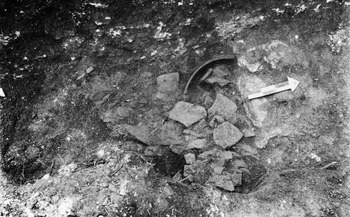
One feature, PD 237, a small cist that contained only earth and small stones, was included in the sample. It had been dug into the floor of the rear room of a temple in the Zone 01 epicenter (Figure 1). The cist had been sealed with a plaster patch that subsequently underwent burning, which indicates a deposit of biodegradable, probably foul-smelling material. Standard caches were often sealed with marl or plaster with something then burned on the seal that left charcoal, so it was a surprise to find this pit empty. It dates to the time of the Ik ceramic complex (Table 1; Coe Reference Coe1990:Table 122).
Actually, this PD was one of several similar pits without visible cultural contents that had been dug into the floors of Group 5D-2 temples, but that were subsequently reclassified as excavation units (Coe Reference Coe1990:575–576). The lack of observable contents suggests pit latrines in abandoned buildings or deposits of malodorous, completely decomposed garbage.
Type 36: Lithic Production Waste Deposits (N = 5)
Large deposits of debitage from the production of utilitarian and ceremonial artifacts knapped from chert and obsidian were encountered at Tikal in various recovery contexts. For most of Tikal's occupation, nearly all of this durable and potentially hazardous material was disposed of underground, especially in deposits exterior to epicentral chamber burials and in caches (Moholy-Nagy Reference Moholy-Nagy1997, Reference Moholy-Nagy2003). It was also incorporated into the construction fill of temples and residential architecture, and occasionally disposed of in household middens. A few such deposits that were not associated with burials or caches were designated PDs by their excavators.
The five deposits listed here came to light in Classic-period ISGs and SSGs in Zones 03 and 04. Four had been buried and one had been dumped onto the floor of an abandoned temple.
Tikal was situated on an abundant source of medium- and coarse-textured nodular chert suitable for many types of artifacts. Additionally, it imported quantities of obsidian from various sources, overwhelmingly from El Chayal in the highlands of Guatemala (Moholy-Nagy et al. Reference Moholy-Nagy, Meierhoff, Golitko and Kestle2013). During the Classic period the city was a major producer of flaked chert and obsidian artifacts, which generated large quantities of production debitage that had to be managed. The intent of Type 36 PDs was site maintenance.
Type 37: Deposits of Ash and Charcoal (N = 13)
Charcoal fragments and fine ash occurred in several kinds of recovery contexts. Small quantities were often present in caches, burials, and different types of PDs.
The contents of 13 PDs consisted of significant concentrations of charcoal and ashes and almost nothing else beyond a few chert flakes, obsidian blades, and sherds. One deposit included six worked sherds that might have been a set of gaming pieces for the patolli game incised on the plaster patch that sealed another Type 37 PD nearby (Becker Reference Becker1999:76–77).
Ten of the 13 were found in repositories, seven of which were sealed, and one had been inserted into an opening in a wall of a commoner residence. Only one, from the epicenter, seemed to have been created in situ. Four PDs were placed on large sherds (“ashtrays”). Three charcoal and ash deposits found as dense concentrations in fill appear to have been buried in perishable containers.
The Type 37 deposits in repositories may represent the disposal of burned materials to which special, ceremonial function had been assigned (Walker Reference Walker, Skibo, Walker and Nielsen1995:72). Smaller amounts of ash associated with sharp-edged stone flakes suggest individual autosacrifice by letting blood onto bark paper and then burning the paper. On the other hand, large concentrated deposits might well be the residue of everyday site maintenance activities (Becker Reference Becker1999:100). Besides contextual analysis, instrument testing to identify the burned materials would undoubtedly help in determining the intent of the deposit.
The earliest example of this type of PD dates to Late Preclassic Cauac times, but most were later and associated with Imix ceramics. They were concentrated in the shrines and temples of residential ISGs in Zone 04 (Becker Reference Becker1999). Overall, the contexts of Type 37 PDs suggest ritual intent in a nonelite tradition.
Type 39: Censer Deposits (N = 21)
Two variations were distinguished: (1) Subtype 39-1 PDs were complete or reconstructible censers (N = 6) and (2) Subtype 39-2 PDs consisted of censer fragments (N = 15).
Incense burners are generally considered indicators of ritual activities (Ferree Reference Ferree1972; Pendergast Reference Pendergast and Mock1998), especially of termination ceremonies (Coe Reference Coe1959:94–95, Reference Coe1990:930). This assumption probably holds for most of the censers from the PD sample, even though we do not have enough information to rule out the possibility that some fragments may be from artifacts that had utilitarian functions perhaps as lamps, braziers, or portable stoves (Carballo Reference Carballo and Robb2017:126). Fragments of censer types produced during the entire Classic period often occur in general excavations in all kinds of structure groups. This distribution suggests widespread use in domestic and public ritual. Type 39 PDs consisted of complete or reconstructible censers (Subtype 39-1) or, more frequently, large concentrations of censer fragments (Subtype 39-2) that were sometimes accompanied by charcoal, ash, or traces of copal resin incense.
Type 39 PDs were concentrated in and around temples and the broken and displaced stone monuments at Tikal's epicenter, and at the principal temple at the Minor Center of Uolantun (Ferree Reference Ferree1972; Puleston Reference Puleston1983:Figure 12). They were also found in chultuns, construction fill, on floors mixed with ordinary midden materials, and in pits of scattered cache goods that are interpreted as the remnants of vandalized offerings, described below as Subtype 41-4.
Complete censers or censer fragments were never included in Tikal's standard burials and caches. On the other hand, one or two fragments or very rare complete examples could appear in the Type 41, 42, or 43 PDs, described below, which strongly suggests that they were added to some kinds of special deposits to signify termination.
The earliest Type 39 PD dates to the Early Classic period, but they become more frequent in the Late Classic, peaking in the Terminal Classic. The chronological distribution indicates that the ritual burning of copal and other substances in censers, followed by smashing and scattering, may have been an important component of termination ceremonies. This does not exclude the possibility, however, that censers were incorporated into other kinds of rituals. A major problem is that Tikal censers are not yet fully published and information is not presently available about their total number, extent of refitting, recovery contexts, or spatial and chronological distributions to be able to speculate further about their specific use.
Type 40: Deposits of Whole and Complete Utilitarian Goods (N = 17)
Two subtypes were distinguished: (1) Subtype 40-1 (Haviland et al. Reference Haviland, Becker, Chowning, Dixon and Heider1985:Figures 59 and 60) consisted of one or more whole or complete artifacts (N = 14) and (2) Subtype 40-2 PDs were collections of specially deposited, used utilitarian artifacts predominantly of one type (N = 3).
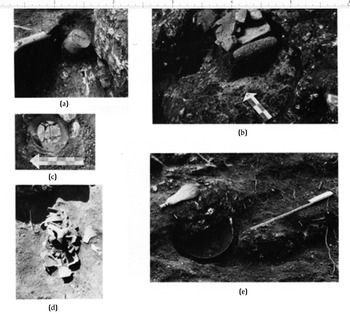
Utilitarian pottery vessels and other artifacts recovered from general excavations were nearly always broken and incomplete, so the rare finds of whole or restorable objects were often classified as Subtype 40-1 PDs (Figures 5a and 5b). A PD designation was also given to specially deposited collections consisting predominantly of just one type of artifact (Subtype 40-2). Although mostly complete, artifacts typically showed heavy usewear. The three Subtype 40-2 PDs comprised, respectively, small chert elongate bifaces, manos, and chert drills (Moholy-Nagy Reference Moholy-Nagy2003:Figures 13–20, 56, 76; Puleston Reference Puleston1969).
Classic period problematical deposits from Small Structure Groups 4F-1 and 4F-2. (a) PD 211, Subtype 40-1. (b) PD 46, Subtype 40-1. (c) PD 25, Subtype 41-2. (d) PD 216, Subtype 41-2. (e) PD 210, Subtype 41-2 (Haviland et al. Reference Haviland, Becker, Chowning, Dixon and Heider1985:Figures 59 and 60).

Most Type 40 PDs were found in the houses and chultuns of ISG and SSG residential groups. They occur as early as the Early Classic and as late as the Early Postclassic, with somewhat more frequency during Late and Terminal Classic times.
Intact utilitarian artifacts in Subtype 40-1 PDs are sometimes interpreted as termination offerings (Haviland et al. Reference Haviland, Becker, Chowning, Dixon and Heider1985:156; Kunen et al. Reference Kunen, Galindo and Chase2002). Their recovery contexts at Tikal, however, suggest de facto deposits caused by loss, goods forgotten in storage, materials left by children (Hammond and Hammond Reference Hammond and Hammond1981), and items too cumbersome to take along when a residence was abandoned. They cluster in Late Classic into Early Postclassic times, which makes deposition during residential abandonment likely.
Subtype 40-2 concentrations of complete but worn stone tools of only one kind suggest discards from specialized workshops with the intent of site maintenance. Two PDs were found in chultuns and one came from a quarry. They date to the Early and Late Classic periods.
Type 41: Caches with Anomalous Contents and Cache Material in Anomalous Recovery Contexts (N = 109)
The largest group of PDs, comprising almost half of the sample, included material otherwise specific to cached offerings or were configured as cached offerings but were found in anomalous contexts (Parry Reference Parry, Levine and Carballo2014:303). They attest to the importance of ritual and political activity at Tikal during the Classic and Terminal Classic periods.
They were classified into five subtypes: (1) PDs of Subtype 41-1 (N = 8) were scattered occurrences in general excavations of materials characteristic of standard cache; (2) Subtype 41-2 PDs (N = 43) were specially deposited materials of anomalous cache content or in anomalous recovery contexts; (3) Subtype 41-3 PDs (N = 7) consisted of caches of decapitated human heads with vertebrae; (4) PDs of Subtype 41-4 (N = 44) were standard caches later disrupted or relocated; and (5) PDs of Subtype 41-5 (N = 7) are probable cache offerings of sacrificed children.
All of the eight occurrences of Subtype 41-1 came from structure groups that also produced standard caches. None were defined for SSGs. They are regarded here as remnants of standard caches that were disrupted and scattered by activities perhaps related to construction, renovation, or site maintenance.
Subtype 41-2 PDs (Haviland et al. Reference Haviland, Becker, Chowning, Dixon and Heider1985:Figures 59 and 60) are intriguing because, together with Subtype 37, they suggest that alternative offertory traditions were practiced contemporaneously with the elite tradition of Tikal's standard caches. As mentioned above, Tikal standard caches were made during the Late Preclassic and Classic periods and are associated with the uppermost ranks of Tikal society. The contents and contexts of Subtype 41-2 PDs differed from standard caches. Some were found in recovery contexts expectable of standard caches, but contained domestic goods ordinarily found in general excavations. Several had been placed in standard axial and corner locations. In contrast to Subtypes 41-1 and 41-4, several were found undisturbed in repositories, some of which had been sealed with plaster or marl.
On the other hand, there were also exposed accumulations of materials expectable in caches, such as cache vessels, charcoal, and fragments of artifacts of jade and marine shell. These were found heaped on floors and stairways or in the construction fill of temples and plazas. They differ from Subtype 41-1 in the greater size and density of the deposit and showed clearer signs of having been deliberately deposited.
As with standard caches, Subtype 41-2 PDs were associated with structures and monuments, and almost half occurred in the Group 5D-2 monumental epicenter. Five were found in chultuns, quarries, and abandoned aguadas. They also occurred in residential structure groups, including the well-to-do commoner SSGs of Zone 03 (Figures 5c–5e).
Subtype 41-2 PDs date from the Early Late Preclassic into the Early Postclassic periods. The Late Preclassic deposits might be forerunners of standard cache inventories that were not carried over into the Classic period.
Subtype 41-3 PDs contained one or more adult human skulls, enclosed in pairs of flaring sided cache vessels in over half of the occurrences (Figure 6; Culbert Reference Culbert1993:Figures 149 and 150; Loten Reference Loten2017:Figures 64–67). Several crania were found with the mandibles and first three spinal vertebrae still articulated, indicating that the heads were buried shortly after decapitation. It is unlikely that they were ancestral or trophy mementos. Coe's Koxol cache complex consists of similar skull deposits (Moholy-Nagy with Coe Reference Moholy-Nagy and Coe2008:19). He may have excluded this group of PDs because of the lack of arrangement and the inclusion of other materials. The absence from Group 5D-2 of Koxol caches and Subtype 41-3 PDs, as well as the presence of Classic period deposits of decapitated heads at other Maya sites like Colha (Walker Reference Walker and Mock1998), suggest a political, rather than a ritual intent. They may represent executions rather than offerings.
Section and details of PD 170, Subtype 41-3, found in a pit and chultun associated with the Temple of the Inscriptions, Structure 6F-27 (Loten Reference Loten2017:Figures 65 and 66).

Coe (Reference Coe1990:872) proposed that in the political disarray of the last decades of the Late Classic period, the governing elite robbed earlier structure caches of their valuables for self-aggrandizement. The redeposited remnants of these disrupted caches constitute Subtype 41-4. They were concentrated in the temples of Group 5D-2 (Figures 1 and 2), the favored place for various kinds of ritual activities. In light of the plentiful evidence for the destruction of stone monuments, elite burials, and caches in earlier times (Jones and Satterthwaite Reference Jones and Satterthwaite1982; Moholy-Nagy Reference Moholy-Nagy2016), however, I would extend Coe's hypothesis back to Terminal Preclassic times. The extracted valuables might be the heirlooms occasionally present in the offerings in standard caches and burials. Cache disturbance could be interpreted as politically motivated, with one faction appropriating offerings to the ancestors and patron deities of rival factions.
The contents and recovery contexts of Subtype 41-4 PDs were created by sequential episodes of cache deposition, disuse of the temple, disruption of the offerings, and then refurbishment of the temple and resumed use (Coe Reference Coe1990:408). In addition to occasional finds of cache goods that are assumed to have been components of the original offering, these PDs included untraditional materials that were added when the temple was cleaned up and renovated for reuse, such as domestic trash, hundreds of tiny animal bones tentatively identified as the remains of owl pellets, charcoal and ashes, and occasional human remains.
Many of the pits had been resealed with plaster or marl. At some lowland Maya sites the addition of white marl is interpreted as an indicator of termination ritual (Freidel et al. Reference Freidel, Suhler, Palma and Mock1998:142; Garber et al. Reference Garber, David Driver, Sullivan, Glassman and Mock1998; Pagliaro et al. Reference Pagliaro, Garber, Stanton, Kathryn Brown and Stanton2003; Wagner Reference Wagner, Colas, LeFort and Persson2006). Present evidence tends to support this idea. The contents of these pits, however, have been sanitized by the passage of centuries and it is difficult to determine now what they originally contained. Abandoned structures worldwide are often used as garbage dumps and privies. Adding marl, ash, and charcoal to the contents of the repository and then sealing it might have been intended to reduce odors and prevent disturbance by animals. Chemical analyses of soil samples from these deposits might provide information about biodegraded contents.
The dates of final deposition of Subtype 41-4 show two peaks, which seem to correlate with Tikal's political history as it is gradually being deciphered from inscriptions on buildings, murals, stone monuments, and durable portable artifacts (Martin and Grube Reference Martin and Grube2008). The earlier peak dates to the Early Classic to Early Late Classic transition; the later one to the last decades of the Late Classic. The later turbulent sociopolitical conditions at Tikal and throughout the Maya lowlands are emphasized in the literature. The late episode of monument destruction, cache disruption, and PD formation may have occurred during a 60-year hiatus in the dates of Tikal's carved stelae that occurred between 9.19.0.0.0 and 10.2.0.0.0 (a.d. 810–869; Table 1; Carter Reference Carter2014:113–116; Coe Reference Coe1990:861).
Some of the PDs of Subtype 41-2 included the remains of infants and children. Most of them were found in pits and first considered to be the remnants of children's burials. But they also include goods usually found in standard caches, so they have been segregated here as Subtype 41-5. They were associated with temples, plazas, and in one case, a stela enclosure. They were apparently intended as offerings (Loten Reference Loten2018:7, Figures 8--12).
The intents of Type 41 PDs varied. Subtype 41-1 PDs appear to be the remnants of standard caches scattered and redeposited by various activities. PDs of Subtype 41-2, some of which showed patterned arrangements, may represent offerings in still undefined traditions. Subtype 41-5 may be a variant of the standard cache tradition that included children. The intent of the behavior that created Subtypes 41-3 and 41-4 appears to have been desecratory and political within the particular context of Tikal society.
Type 42: Deposits of Mixed Domestic and Status Goods (N = 23)
(1) Subtype 42-1 (N = 6) consisted of mostly broken and incomplete domestic goods with a few fragmentary status items in contexts that might have been offerings. (2) Subtype 42-2 (N = 14) consisted of similar materials in contexts that appeared to be trash dumps.
Type 42-1 PDs were composed of mostly of domestic trash with a few fragmentary artifacts assumed to be markers of elevated social status mixed in, such as stone monument fragments, reconstructible decorated pottery vessels, and small pieces of jade and shell ornaments. Four PDs were in repositories. The contents and recovery contexts do not rule out offerings, but not as clearly as the Subtype 41-2 PDs described above.
Subtype 42-2 consisted of larger concentrations of the same kinds of materials as Subtype 42-1. Their jumbled contents were recovered from specially prepared repositories, in dense accumulations on the surfaces of room floors or plazas, heaped up against stone monuments, or blocking the entrances to the temples and residences of the elite and well-to-do. Contents incorporated durable domestic trash such as botched, broken, or worn-out artifacts of chipped and ground stone, shell, bone, stucco, and pottery, as well as stone, shell, and bone debitage from artifact production, censer fragments, charcoal, and often large quantities of potsherds.
Much of the research on PDs has focused on the condition of the ceramics that typically were their largest component. The sherds are often of different ages, cannot be refitted to form reconstructible vessels, and may be burned and differentially weathered, all considered good indicators of secondary context (Clayton et al. Reference Clayton, David Driver and Kosakowsky2005; Halperin and Foias Reference Halperin and Foias2016). Most of these PDs can be assigned two dates: the date of the production of the contents and the date of their final deposition.
Despite the sparse presence of status goods, Type 42-2 PDs likely represent relocated domestic trash that occasionally incorporated materials from disrupted caches and burials. Very large deposits of sherds and other trash found at other lowland sites are often interpreted as the redeposited remains of feasts (Clayton et al. Reference Clayton, David Driver and Kosakowsky2005; Guderjan Reference Guderjan2004) or deposits of ritually destroyed household goods as occurred in the Aztec New Fire ceremony (Elson and Smith Reference Elson and Smith2012). This might be the case where the included sherds and other artifacts are of the same date, but large deposits whose contents are of different dates are more likely to represent trash dumps accumulated over time than the remains of single events. Furthermore, as more is learned about them, a few concentrations might be entirely fortuitous and represent materials washed into a depression or drain or unusually dense concentrations of ordinary trash included in construction fill (Culbert and Kosakowsky Reference Culbert and Kosakowsky2019; Haviland Reference Haviland2015).
Type 42-2 PDs occurred in all types of civic and residential structure groups. The largest, which included thousands of sherds and quantities of other durable artifacts, were found in Zones 02 and 03, at the edge of the center of the city (Haviland Reference Haviland2014; Iglesias Reference Iglesias Ponce de León1987:195–328; Laporte Reference Laporte Molina1989:215–220). They were more frequent during the later Late Classic and Terminal Classic periods, perhaps due to the abandonment of both previously established site maintenance procedures and monumental construction. Their intent was site maintenance.
Type 43: Human Remains in Trash Deposits, Burial Contexts with Untraditional Goods, and Disrupted and Secondary Burials (N = 34)
This group of PDs was classified into four subtypes: (1) Subtype 43-1 PDs (N = 14) were scattered human remains incorporated into general excavations contexts; (2) Subtype 43-2 PDs (N = 2) were disturbed, backfilled chamber burials; (3) PDs of Subtype 43-3 (N = 17) consisted of disturbed, relocated burials with trash; and (4) Subtype 43-4 (N = 1) was a disturbed, relocated burial without trash.
Most of the Subtype 43-1 PDs were found in the construction fill, middens, and chultuns of residential SSGs. The human remains were deposited without anatomical order and ranged from a few teeth and longbone fragments to almost complete skeletons. Over half date to the Early Classic and Early Late Classic periods.
The general impression is that these are the dislocated and dispersed remnants of burials of individuals of lower social rank whose graves had been disturbed by other activities such as construction or trash disposal, and perhaps also those of such low social rank that they had never received burial. Subtype 43-1 PDs are probably comparable in intent to Subtype 41-1 PDs that included scattered goods usually found in standard caches.
Two disrupted vaulted chamber burials from the North Acropolis of Group 5D-2 comprise Subtype 43-2. Both burials occurred in temples and are assumed to have been of rulers. Both were ransacked in late Late Classic times. The material refilled into the chamber of Ik complex Burial 200 after its destruction was designated PD 134 (Coe Reference Coe1990:399–406, Figures 114 and 117); the material refilled into Imix complex Burial 8 was designated PD 49 (Coe Reference Coe1990:487, Figures 161 and 162).
Some of the offerings from Burial 200 were recovered from the robbed cache pits described as Subtype 41-4, above, indicating contemporaneity of burial and cache desecration towards the end of the Late Classic period.
PD 134 included many bones and teeth of an adult and probably of two subadults. It is the latest known occurrence of sacrificed burial attendants at Tikal. Also present were some cache goods, as well as rubbish, such as tiny animal bones from owl pellets, charcoal, fluffy fill, and lithic debitage. PD 49 contained a few fragmentary artifacts that were probably original burial offerings and 114 teeth and bone fragments and the incomplete skull of an old man.
It is likely that the intent of the disruption of these chamber burials was political, the same that motivated the contemporaneous destruction of stone monuments and structure caches (Coe Reference Coe1990:408, 872, Table 89).
PDs of Subtypes 43-3 and 43-4 were the remains of redeposited burials; the former included trash and debitage, often in large quantities, while the latter did not. Some of the larger Subtype 43-3 PDs resembled larger Subtype 42-2 PDs, but with human remains.
Nearly all of the Subtype 43-3 PDs were found in specially dug pits and repurposed chultuns in civic-ceremonial and residential structure groups. Five came from areas without any visible structures. Half date to the late Early Classic and Early Late Classic periods. Fourteen examples included censer fragments and the others included charcoal. Associated goods included status indicators, such as ornaments of jade and marine shell, which suggest disturbed burials of elites and well-to-do commoners. However, none of the reburied individuals were accompanied by indicators of highest social status such as large or carved jade ornaments or Spondylus shell beads, carved pendants, or compound ear flares that are almost exclusively associated with undisturbed chamber burials and caches (Moholy-Nagy with Coe Reference Moholy-Nagy and Coe2008). Their absence supports Coe's suggestion that the graves had been looted. The contents of all examples showed some degree of exposure to fire. Refitted artifacts attested to a systematic procedure of breaking, burning, transport to another location, and final deposition. Censer fragments may have been added at redeposition to signify termination.
Some of the PDs of late Early Classic date incorporated artifacts of types and materials only found in PDs and general excavations, most strikingly artifacts of relatively rare black and gray obsidians from central Mexican sources (Moholy-Nagy et al. Reference Moholy-Nagy, Meierhoff, Golitko and Kestle2013). Occurrence in special, as well as domestic contexts supports Iglesias's (Reference Iglesias Ponce de León and Braswell2003) suggestion that most of the materials in Subtype 43-3 PDs were the furnishings and trash of well-to-do households. Contents usually included sherds and other material culture from one or more earlier time periods. Ceramics ranged from Terminal Preclassic into the late Early Classic and deposition dates from middle Early Classic into the early part of the Late Late Classic.
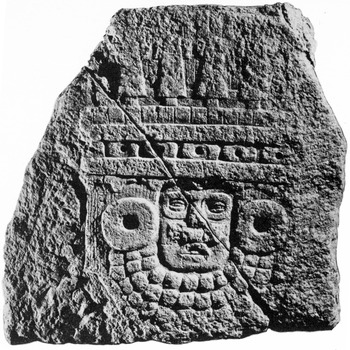
The co-occurrence of broken and burned high-status goods with ordinary household trash could imply desecratory intent, possibly of targeted individuals. Goods can be broken, burned, or otherwise destroyed in reverential rituals, as suggested by the breaking of censers in termination rituals. Excavations at Tikal, however, indicate that the inclusion of domestic trash in displaced burials and caches could well be a reliable indicator of desecratory intent. The large size and epicentral location of PD 22 in Group 5D-2 even suggest that the destruction and desecration of the grave of a man of very high rank was a major public event witnessed by many (Coe Reference Coe1990:324, Figures 9, 71e, 71f). The inclusion of several stone monument fragments (Figure 7) in this deposit also suggests political intent.
Stela 32 fragments from PD 22, a large Subtype 43-3 deposit from the court of Structure 5D-26 in Group 5D-2. Its surviving height is 70 cm (Moholy-Nagy Reference Moholy-Nagy1962:27).

The contents of the secondary burial of Subtype 43-4, PD 50, were distinguished by an absence of domestic trash or production debitage. The smashed and then burned burial contents had been reinterred in a pit in an area without structures that was used as a dump in Classic times.
PD 50 was of special interest because its fragmented and burned durable contents indicated its subject had been of very high social rank, possibly a ruler. The abundant offerings, which included pottery of the Manik 3A ceramic complex, closely resembled those of Burial 48 (Coe Reference Coe1990:118–123), the chamber burial of the ruler, Siyaj Chan K'awiil II, who is thought to have died in a.d. 456 (Martin and Grube Reference Martin and Grube2008:34). Although the partial remains of five children and a subadult were identified, the lavish grave goods suggest that these were sacrificed attendants of the subject of the burial, whose remains were not included in the deposit. A well-known offering from PD 50 was a large, almost complete, carved-incised, black, cylindrical, tripod pottery bowl (Culbert Reference Culbert1993:Figure 128a). The bowl is decorated with a narrative scene, unusual for Early Classic ceramics, which is widely interpreted as depicting a meeting of Mayas and a delegation of men from Teotihuacan in the Valley of Mexico (Millon Reference Millon and Berrin1988). The area of the site in which PD 50 had been relocated lay to the west of Group 5D-2 and had been used as a dump throughout the Classic period, so the date of deposition of PD 50 is uncertain. The included complete hourglass censer (Ferree Reference Ferree1972:73–74, Figure 6a), however, suggests it was destroyed during the late Early Classic period when the Manik 3B ceramic complex was in use.
While Subtype 43-1 PDs seem to represent remnants of the burials of individuals of lower social status that were subsequently incorporated into middens and construction fill, Subtypes 43-2 and 43-3 are the secondary burials of high-ranking individuals reinterred bereft of their status indicators and with their remains and their grave goods broken and burned. They may have been targets of factional violence. Subtype 43-3 PDs were further desecrated by additions of domestic trash and debitage. Subtype 43-4 of the Early Classic is the remains of a desecrated chamber burial, similar to Subtype 43-2. Its original location, however, is still unknown.
A PRELIMINARY CLASSIFICATION OF PROBLEMATICAL DEPOSITS BY INTENT
A review of the contents and recovery contexts of the sample of 223 PDs suggests a preliminary classification by intent, broadly defined as ritual, political, site maintenance, and other. The classification presented here could be further refined after the complete analysis and publication of Tikal excavations.
Type 37, Subtypes 39-1, 39-2, 41-2, and 41-5: Ritual Intent (N = 84)
Deposits that may represent reverential ritual behavior formed the largest group of PDs, a little over 40 percent of the sample considered here. They occurred throughout Tikal's entire span of occupation and even beyond into the Early Postclassic, when the city may no longer have had permanent residents (Figure 8). There were two peaks in chronological distribution, which may correspond to times of sociopolitical disarray during the late Early Classic-Early Late Classic and the Late Late Classic-Terminal Classic transitions, which are attested in the city's archaeology. The decline in PDs during the Late Late Classic period, the time of the Imix ceramic complex, may be related to the reigns of Jasaw Chan K'awiil and his immediate successors (Martin and Grube Reference Martin and Grube2008:44), who are assumed to have been strong rulers.
Problematical deposits by date, count, and intent. Graph by the author.

PDs with ritual intent were concentrated in Zone 01, with a steep drop-off beyond (Figure 9). The elite and commoner residents of Zone 02 may have celebrated their rituals in the epicenter, while the lesser elites and commoners of Zones 03–05 and 09 made their offerings closer to their homes. The majority of Tikal Project excavations were targeted, rather than randomly placed, so it is difficult to assess how much this has affected the number of recorded PDs and their spatial distribution. Nevertheless, alternative offertory traditions whose material signatures differed from standard caches apparently existed.
Problematical deposits by zones, count, and intent. Graph by the author.

The presence of alternative offertory traditions is more clearly indicated by the occurrence of ritual PDs in structure groups (Figure 10). The upper social ranks, who are thought to have lived in RSGs, most prominently the Central Acropolis, may have conducted most of their rituals in the epicentral CCG, Group 5D-2, across the Great Plaza. The wealthy and well-to-do residents of ISGs and SSGs made offerings within the temples and houses of their structure groups.
Problematical deposits by structure group type, count, and intent. Graph by the author.

The distributions of ritual PDs associated with individual structures within different types of structure groups is also informative. Temples and their associated platforms and plazas were the favored structure types for all kinds of PDs, but especially those thought to be the remnants of rituals (Figure 11). Over two-thirds of PDs thought to result from ritual activity were recovered from such contexts. In contrast to standard caches placed under stone stelae, no PDs of any kind were directly associated with stone monuments, although five PDs of apparent ritual intent had been placed near them.
Problematical deposits by structure type, count, and intent. Graph by the author.

Subtypes 41-3, 41-4, 43-2, 43-3, and 43-4: Political Intent (N = 71)
Evidence of deliberate disruption of standard caches and burials and deposits of freshly decapitated human heads are here interpreted as destruction and desecration arising from politically motivated factional competition. Such violence seems to have been part of the same longstanding tradition that led to the destruction of carved monuments and several hiatuses in Tikal's sequence of dated stelae (Moholy-Nagy Reference Moholy-Nagy2016). It may have been factional violence that left Tikal, a city with a dynastic history of at least a millennium, with only forty known carved dated stelae. Most of these are incomplete; the smallest fragment is only 18 cm long (Jones and Satterthwaite Reference Jones and Satterthwaite1982:76). By contrast, at least 80 plain stelae have been recorded (Carr and Hazard Reference Carr and Hazard1961:22), although not yet published, so information about their condition is not readily accessible.
The dates of PDs of political intent ranged from the early part of the Early Classic period into the Terminal Classic, from the time of the Manik 2 through Eznab ceramic complexes (Figure 8). The chronological distribution generally follows that of PDs of ritual intent with peaks at the late Early Classic-Early Late Classic and Late Late Classic-Terminal Classic transitions. The strong rulership of Jasaw Chan K'awiil may account for the apparent cecessation of politically motivated destruction during the initial decades of the Late Late Classic.
Over 70 percent of PDs considered to be of political intent came from Zone 01, nearly all from Group 5D-2. Almost 90 percent came from Zones 01 and 02 (Figure 9). None occurred beyond Zone 05. The concentration at the site's epicenter strongly suggests desecration by local elites rather than by commoners or in raids by external enemies.
A little over three-fourths were found in CCGs, notably the temples of epicentral Group 5D-2 (Figure 10). There were a few examples from residential and unclassified structure groups, and six examples from chultuns, reservoirs, quarries, test pits, or not associated with any visible structures or monuments. The PDs from CCGs were predominantly disrupted caches of Subtype 41-4 and the decapitated heads of Subtype 41-3. Those from residential groups and contexts without structures were mostly disrupted, apparently looted, relocated burials of Subtypes 43-3 and 43-4.
Associations of PDs of political intent with types of structures showed a strong association with temples, temple platforms, and plazas, with a weaker one in contexts with no visible associated structures or monuments (Figure 11).
Types 35 and 36, Subtypes 40-2, 41-1, 42-2, and 43-1, and probably Subtype 42-1: Site Maintenance Intent (N = 54)
The contents and imputed intent of this group of PDs do not appear to differ in any significant way from general excavations. They were present throughout Tikal's span of permanent occupation and afterwards (Figure 8). However, their chronological distribution shows peaks at the Early Classic-Early Late Classic transition and during the Late Late Classic into Terminal Classic transition and thus may provide a glimpse into Tikal's history. Both transitions were turbulent at Tikal as known from other data. The earlier peak may have occurred during an approximately 60-year period when there was little construction in Group 5D-2 (Coe Reference Coe1990:Chart 1) and less opportunity to get rid of trash in architectural fill. The later peak might also be due to a halt in monumental construction, as well as a breakdown in site maintenance systems or when adverse conditions might have forced residents to hastily abandon their homes.
Almost 60 percent came from the residential ISGs and SSGs in Zones 03 and 04 (Figure 9), especially SSGs (Figure 10). The Subtype 42-2 trash deposits in temples and range structures (Figure 11) tended to be of Late Late Classic and Terminal Classic date, while those associated with perishable houses or no visible structures had a more balanced chronological distribution.
Subtype 40-1: Unintentional Deposits (N = 14)
This group includes intact utilitarian artifacts and small collections of whole and fragmentary materials. The former were found in contexts that suggest lost, forgotten, or abandoned goods; the latter were found in contexts that suggest natural accumulations. Although present at all times, the lack of intent is somewhat supported by an increase in Late Classic times (Figure 8), as well as associations with several kinds of structures (Figure 11). They were somewhat more common in the ISG and SSG residential groups of Zones 03 and 04 (Figures 9 and 10).
CONCLUSIONS
The provisional analytical category of problematical deposit is especially useful in its focus on anomalous features that might otherwise be ignored. Here we have examined a sample of 223 PDs from the pre-Columbian lowland Maya city of Tikal, using content, recovery context, and date. This study within a framework of such site-wide variables generated some insights into Tikal's ritual, political, and economic activities, which are summarized here.
Many PDs appear to be the material remnants of alternative commoner offertory traditions, which indicates that the Tikal Project's definition of cached offering could be expanded. The inclusion of censers and censer fragments in a deposit at the moment of deposition seems to signify termination of some kind. On the other hand, the deliberate inclusion of domestic trash and production debitage in disrupted caches and burials is interpreted as a sign of desecration with political intent, although lithic debitage could have been part of the original feature.
The increase in disrupted burials and caches at the Early Classic-Late Classic transition, together with other evidence of destruction, suggests that the sociopolitical disorder of that time might have been as severe as that of the Late Classic “collapse.” The amount and intensity of political activity expressed in the destruction of burials, caches, and stone monuments tend to be underestimated. Factional violence among the elite appears to have been more pervasive at Tikal than at other lowland cities and may have been directed towards obliterating the ancestors of rival factions. Perhaps only the most powerful of Tikal's rulers could have temporarily suppressed this tradition.
The increased number of PDs of late times that included trash was likely related to the decline or abandonment of monumental construction during the two periods of political turbulence noted above. The general tidiness observed in the epicenter and higher ranked residential groups during the Late Preclassic and Classic periods attests to well-organized site maintenance systems that may have been coordinated with civic-ceremonial projects. This is suggested by the domestic middens incorporated into the construction fill of monumental structures and the impressively large deposits of chert and obsidian production debitage reverentially placed exterior to some royal chamber burials and within standard caches. In attempting to assess the intent of trash deposits, attention needs to be paid to settlement size, density, topography, disuse and subsequent refurbishing of structures, partial abandonment of structures, specialized land use for horticulture or water catchment, site history, and so on.
The paramount importance given to the siting of buildings, stone monuments, burials, and offerings has also been underestimated. Location in space is closely tied to veneration of ancestors, where the central axes of plazas and structures were apparently considered the most effective portals through which contact could be made with the supernatural. The application of ethnographic and ethnohistoric information from recent and contemporary Mesoamerica to understand the intents of Classic period behavior should be reconsidered. Data from Tikal and elsewhere in the Maya lowlands show that such analogies are not appropriate.
Features that excavators consider problematical offer an opportunity to reevaluate assumptions about past behavior. The study of PDs demands a wide-ranging view, which, in turn, can revise our theories and improve our understanding of past cultural behavior.
RESUMEN
En la literatura arqueológica mesoamericana las colecciones de material considerado de alguna manera anómala según las expectativas del arqueólogo a menudo se conocen como depósitos problemáticos (DP). Su aspecto problemático se origina en el estado actual del investigador de conocimiento del sitio en particular, no en el comportamiento pasado. Los DP son clasificaciones provisionales específicas del sitio y necesitan más estudio para definirse la función o la intención de la actividad que los creó. Una muestra de 223 DP designadas por el Proyecto Tikal del Museo de la Universidad de Pensilvania se examina aquí para entender su intención. Una tipología de la muestra, basada en el contenido, la fecha y las variables del contexto de recuperación, indica tres intenciones principales libremente resumidas como ritual, política y de mantenimiento del sitio, así como una categoría de DP de sin intención. El estudio de los DP exige un enfoque amplio. Proporciona la oportunidad de reevaluar ideas inadecuadas y obtener nuevos conocimientos sobre el comportamiento del pasado.
SUPPLEMENTARY MATERIAL
The supplementary material for this article can be found at https://doi.org/10.1017/S095653611900018X.
ACKNOWLEDGMENTS
I thank Johann Begel, Laura Kosakowsky, Christina Luke, and especially Antonia Foias, as well as several anonymous reviewers, for the time and thought they devoted to earlier drafts of this paper. Some of the ideas expressed here developed over many years of advice and encouragement received from William A. Haviland. I have also benefitted from the pioneering research on PDs by William R. Coe, Marshall J. Becker, and María Josefa Iglesias Ponce de León. Virginia Greene quickly located and supplied data.