Introduction
The accident at the Fukushima Daiichi Nuclear Power Plant following the Great East Japan Earthquake on March 11, 2011 caused 3 major disasters: the earthquake, tsunami, and nuclear meltdown, and brought about a major change in the lives of residents in Fukushima Prefecture. The level of radioactive contamination varied among the 12 municipalities in Fukushima Prefecture designated as evacuation zones. In some areas, radiation contamination levels were relatively low, and evacuation orders were lifted within 3 years. Reference Ishikawa1 However, the 10 other municipalities were forced to live in long-term evacuation for more than 5 years, due to delays in decontamination, and other factors. As of March 2021, evacuation orders for areas other than the difficult-to-return zone had been lifted, but as evacuation orders were prolonged, various psychosocial issues became apparent.
Social capital is considered an important factor influencing mental health outcomes, such as psychological distress in post-disaster situations. Reference Hikichi, Sawada and Tsuboya2–Reference Matsuyama, Aida and Hase4 Tsuchiya, et al. confirmed that low social capital increased the risk of psychological distress in post-disaster settings, especially among individuals with massive house destruction. Reference Tsuchiya, Nakaya and Nakamura5 Among participants who suffered severe disaster damage, high social capital plays an important role in protecting mental health. In the Fukushima case, Orui, et al. also showed a positive correlation between mental health recovery and desirable lifestyles and social networks, especially social roles. Reference Iwasa, Moriyama and Kuroda6 Thus, the provision of an active social role can facilitate disaster recovery as well as multifaceted support. The lifting of the evacuation order allows evacuees to return to their original communities, but at the same time, it means that the communities are dispersed. Reference Kuroda and Koyama7 After the evacuation order was lifted, the return rate was not necessarily high, and many of the returnees were elderly people. Many young people relocated to urban areas while evacuating, or when evacuation orders were lifted. So even if the evacuation order is lifted, social capital which protects mental health is still missing. Reference Kuroda, Koyama and Noriko8 Rather, the social networks newly established at the evacuation sites will also disappear.
Iitate Village is a farming village with a population around 6000, located in the Hamadori region of Fukushima Prefecture. Located 30 to 50 km from the Fukushima Daiichi Nuclear Power Plant, it was not evacuated immediately after the accident, but instead received evacuees from coastal areas. However, owing to the spread of radioactive material, the entire village became contaminated and was designated as a planned evacuation zone on April 11, 2011. Reference Chiba and Koshin9 The villagers were forced to collectively evacuate to prefabricated temporary housing units in the prefecture, or rent an apartment on their own within and outside the prefecture. Although they did not have to pay the rent in either case, their life as evacuees became long term, continuing until March 2017.
Previous research indicates that long-term evacuees experience multiple stressors, including uncertainty about the future, lifestyle changes, and psychological stress, resulting in the deterioration in both physical and mental health. Reference Kuroda, Iwasa and Orui10–Reference Kuroda, Iwasa and Orui13 This trend has also been reported for various disasters, with social support reported for improvements in Post-Traumatic Stress Disorder (PTSD), Generalized Anxiety Disorder (GAD), and Major Depressive Disorder (MDD). Reference Cherry, Sampson, Nezat, Cacamo, Marks and Galea14–Reference Agyapong, Juhas and Omege16 Analysis of the relationship between the evacuees’ living environment and their levels of mental health and social support indicated that those residing in rental apartments had poorer mental health and more difficulty getting social support than those residing in temporary housing. Reference Kuroda, Iwasa and Goto17 These results were shared with Iitate Village’s health authorities, and projects designed to strengthen the social ties between residents, such as a ‘Pop-Up Cafe Enterprise,’ have been undertaken in areas with high populations of evacuees. Reference Kuroda18 Although the villagers are now allowed to resume their lives, their lifestyles have diversified, with some moving back to their village homes, some having made new lives for themselves in their new towns, and others still living in temporary housing. At the time of the survey described here, only 259 residents (5%) had returned to Iitate Village, a lower rate than in other areas where evacuation orders have been lifted. In interviews, the villagers frequently spoke of the loss of social ties. Reference Kuroda, Koyama and Noriko8 Thus, the social ties that developed during the villagers’ long-term evacuation are once again severed with the lifting of evacuation orders, raising concerns about the worsening of physical and mental health.
Social ties are important in earthquake disaster recovery. Reference Aldrich3,Reference McGuire, Gauthier and Anderson19,Reference Arnberg, Hultman, Michel and Lundin20 For example, in the aftermath of the 1994 Great Hanshin Awaji Earthquake, social capital was the most influential factor in the residents’ recovery, even when earthquake damage, regional characteristics, and economic circumstances were taken into consideration. Reference Aldrich3 Research on the role of social ties in recovery from the Great East Japan Earthquake disaster has centred on the tsunami-affected regions of Iwate and Miyagi prefectures. Research focusing on the nuclear disaster has been limited to studies conducted by us. Residents of Miyagi Prefecture who were evacuated as a group experienced better preservation of social capital than evacuees who were relocated to individual rental apartments, Reference Hikichi, Sawada and Tsuboya2 moreover, low social capital was related to poorer mental health. Reference Matsuyama, Aida and Hase4 Therefore, rebuilding social ties is a pressing issue in regions where the community has been disbanded at some stage because of forced evacuation.
Several studies have shown long-term effects on mental health after the Great East Japan Earthquake, Reference Oe, Takahashi and Maeda21,Reference Suzuki, Yabe and Yasumura22 but the results have not necessarily been applied to public health activities. For example, subjects who score poorly on a mental health survey may already have social support, which did not fit the conventional correlation between mental health and social support that were widely assumed by many public health experts. However, their approach often overlooked the social condition (mental health and social support were not necessarily correlated) that were specific to the local community. For this reason, it was important that we involved local health professionals (often they were public health nurses in local government) in the assessments of the health survey and mobilized their local knowledge for the assessment. They were responsible for providing local people with health advice and welfare services, and at the forefront of risk communication with them. More importantly, not only are they closely involved in the life of the local people, but they belong to the same community, making them mediators between local people and external experts. Joint assessments of the survey results by local and external experts will enable greater practical application.
The main aim of this study was to examine the relationship between social support and psychological factors, and to investigate the status of social support among villagers whose evacuation order had been lifted, by using joint assessment by local and external experts among returnees to Iitate Village, and evacuees still living outside the village. This study is a practical report for evacuees who have faced serious needs and challenges in their communities. Therefore, the practical hypothesis of this study is that both returnees and those who decide not to return have their own psychological health problems, which are related to their social connections. In addition, different types of social connections (emotional or instructional) have different impacts. Clarifying the above will lead to better measures for evacuees.
Methods
Participants
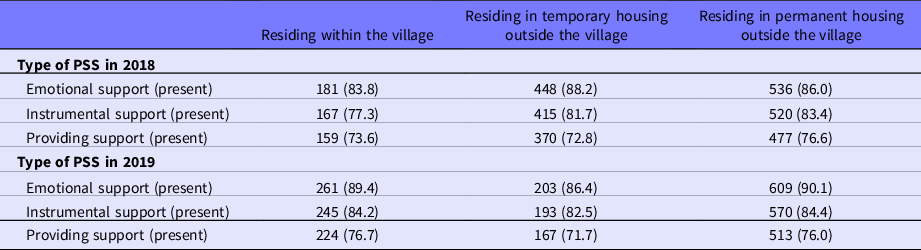
This study was a collaboration between Fukushima Medical University and the Iitate Village Municipal Government. In April 2017, a written questionnaire was posted to 4828 registered residents of the village aged 18 years or older and living within the prefecture, with a notification of a general health check-up. Responses were collected over a 10-day period in May 2017 at the check-up, or by return post. The check-up was carried out in Iitate Village and in 4 evacuation areas (Fukushima City, Date City, Soma City, and Minamisoma City). Out of the 1415 completed questionnaires, 10 were excluded because the main outcome variable (i.e., need for professional support) was missing data. Therefore, data from 1405 participants were included in the final analysis. As a reference, PSS was compared between the first year after the lifting of the evacuation order (FY 2018), and the subsequent year (FY 2019).
The Mental Health Questionnaire for the affected areas was launched in FY 2014. In Japan, local governments conduct comprehensive medical examinations every year, but they mainly conduct physical and blood tests, and do not conduct psychological evaluations. As the evacuation period was prolonged, the psychological status of the victims was a concern for health workers, and a preliminary psychological investigation was initiated in FY 2014. After that, the social support section was added in the discussion between the author and the village public health nurse. An important feature of this survey is that it is not only a questionnaire survey, but rather an interview survey to confirm the mental health of the victims at the request of public health nurses. At the same time, in order to provide timely support, doctors and clinical psychologists under the “Yorozu Health Consultation,” Reference Murakami, Sato and Matsui23 would provide consultation, support, and introduce medical institutions as necessary after the interview survey. This survey was conducted as part of a health programme of the health and welfare section of the Iitate Village government. Before a health examination, local government officials explained the nature of the survey and obtained written consent. The Ethics Committee of Fukushima Medical University granted its consent (No. 2609).
Survey Items
Main Outcome Variable
The main outcome was the presence or absence of ‘the need for professional support’ by an individual with some form of psychological stress for which social support is inadequate. Reference Orui, Harada and Hayashi24 Professional support from a psychiatrist or clinical psychologist was provided if the patient had a presence of ‘need for professional support.’ The need by each respondent for professional support was determined by 3 public health nurses from Iitate Village, 1 public health nurse from Fukushima Prefecture, and 1 university researcher, in order to increase the validity of the evaluation. There were 4 evaluation criteria: (1) content of questionnaire responses, (2) interview content (clinical information obtained by a local expert), (3) history of previous support, and (4) other background information (from local experts with long-term relationships with residents, including whether they had support before the disaster, their family structure, and their relationships with the community). Since the survey was conducted in the first year of the lifting of the long-term evacuation order, the living environment of residents is likely to change. Therefore, public health nurses interviewed residents not only about their health but also about their daily lives.
Main Explanatory Variables
The main explanatory variable was perceived social support (PSS). Generally, PSS is broadly categorised as ‘receiving support’ and ‘providing support.’ In this study, ‘receiving support’ was assessed using the 5 PSS items proposed by Muraoka, Reference Muraoka, Oichi and Ihara25 which comprise 2 items on ‘emotional support’ (‘someone to talk to when having difficulties’; ‘someone to talk to when feeling unwell’) and 3 items on ‘instrumental support’ (‘someone to help with activities of daily living’; ‘someone to take 1 to the doctor’; ‘someone to provide personal care’). ‘Providing support’ was assessed with the widely used item ‘Listening to worries and concerns.’ Reference Reblin and Uchino26 Items were answered as ‘present/absent.’
Related Factors
The investigation items used here were decided upon after discussion with village public health nurses. Information was gathered on (1) basic characteristics (age, gender, current family structure, presence/absence of co-morbidities), (2) living environment (residing within the village, in temporary housing outside the village, or in permanent housing outside the village), and (3) psychological variables (simplified Japanese version of the Athens Insomnia Scale [AIS] and presence/absence of stress).
The main living environment at the time of the survey comprised ‘residing within the village’ (persons who had returned to Iitate Village, were registered as residents, and spent most of their time there); ‘residing in temporary housing outside the village’ (evacuees who spent most of their time living in temporarily rented housing outside Iitate Village); and ‘residing in permanent housing outside the village’ (evacuees who spent most of their time living permanently in new homes outside Iitate Village).
The simplified Japanese version of the AIS consists of 8 sleep-related items (sleep quality, sleep-onset insomnia, night awakening, early morning awakening, insufficient sleep, decreased daytime well-being, reduced daytime physical/mental activity, and daytime drowsiness) rated as ‘present’ (1 point) or ‘absent’ (0 points), and the total score was calculated as the sum of item scores. Reference Iwasa, Takebayashi and Suzuki27
Statistical Analysis
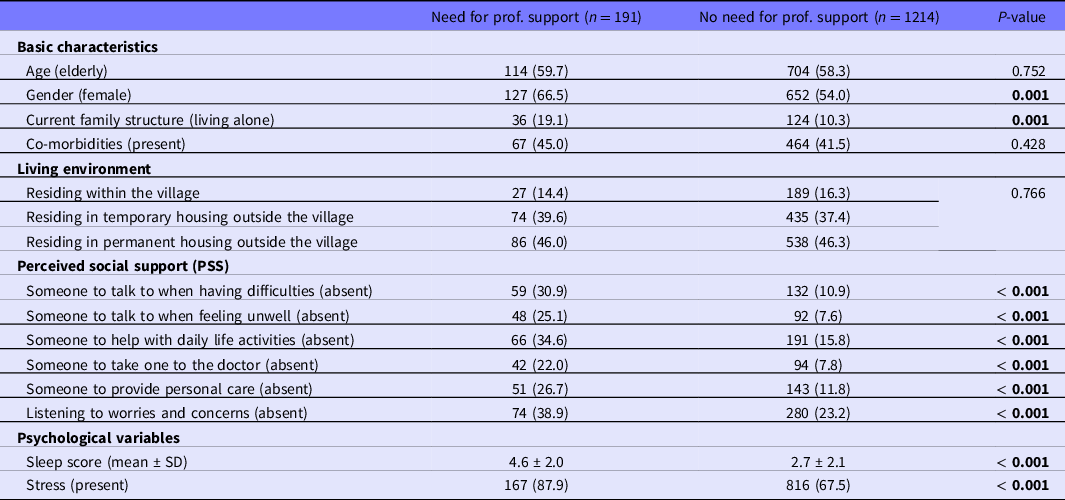
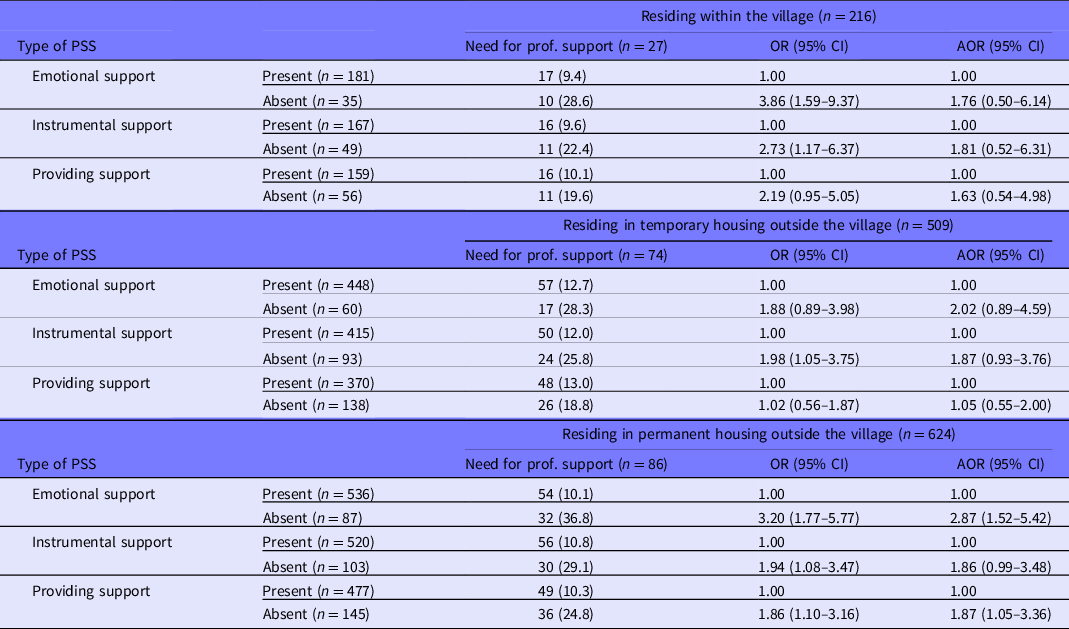
First, participants were sorted into 2 groups based on their need for professional support, and descriptive statistics for basic characteristics, living environment, PSS, and psychological variables were calculated (Table 1). The mean and standard deviation was calculated for continuous variables, and Student’s t-test was used to assess the differences between the groups. Frequency and percentage were used for categorical variables, and differences were tested by chi square test. Subsequently, for each living environment (i.e., residing within the village, in temporary housing outside the village, or in permanent housing outside the village), PSS types (i.e., emotional support, instrumental support, providing support) were set as explanatory variables, and presence/absence of need for professional support was set as the outcome variable, then logistic regression analysis was carried out. Odds ratios (ORs) and 95% confidence intervals (CIs) were determined for these relationships (Table 3). In addition, items with a significant difference in Table 1 (namely gender, family structure, AIS scores, sleep score, and presence/absence of stress) were input as moderator variables in a binomial logistic regression analysis, and adjusted ORs (AORs) and 95% CIs were calculated. Since the PSS used in the multivariate analysis was correlated with providing both emotional and instrumental support, the analysis was performed separately for each type of PSS (Pearson’s correlation coefficients of 0.321 and 0.294, respectively). The level of significance for all analyses was set at P < 0.01. All statistical analyses were conducted with SPSS Statistics for Macintosh, verzion 24.0 software (IBM Corp, Armonk, NY).
Relationship between need for professional support and study variables

Relationship between PSS and residential locations: FY 2018 versus FY 2019

Relationship between PSS and need for professional support in different living environments

Adjustment variables: gender, age, family structure, total sleep score, and stress.
Abbreviations: OR, odds ratio; AOR, adjusted odds ratio; CI, confidence interval.
Results
A total of 191 (13.6%) of the 1405 respondents expressed a need for professional support (Table 1). By living environment, 27 out of 216 (12.5%) residents residing within the village, 74 out of 509 (14.5%) in temporary housing outside the village, and 86 out of 624 (13.8%) in permanent housing outside the village needed professional support, with no significant differences. The need for professional support was significantly associated with being female, living alone, absence of social support on all 6 PSS items, high sleep score (poor sleep status), and presence of stress. Comparing the PSS of FY 2018 in this analysis with that of FY 2019 in the reference data, the PSS in FY 2019 showed a recovery trend in the PSS for residing within the village, compared with the FY 2018 PSS (Table 2). On the other hand, temporary housing residents showed a slight decrease in Emotional and Providing support domains, and residents in permanent housing outside the village showed an improvement in Emotional and Instrumental, while Providing support domains remained flat.
The associations between PSS and the need for professional support in each living environment (Table 3) indicated that village residents without emotional support or instrumental support were significantly more likely to need professional support than those who had such support. Residents of temporary housing outside the village without instrumental support were significantly more likely to need it. Residents in permanent housing outside the village without emotional support, instrumental support, or who did not provide support were significantly more likely to need it.
Multivariate analysis using moderator variables found no significant association between PSS and continued support among villagers residing within the village or in temporary housing outside the village. However, among those residing in permanent housing outside the village, those without emotional support (AOR = 2.87; 95% CI = 1.52 – 5.42), or instrumental support (AOR = 1.86; 95% CI = 0.99 – 3.48), or not providing support (AOR = 1.87; 95% CI = 1.05 – 3.36), were significantly more likely to need professional support.
Multivariate analysis including the AIS score as a moderator variable showed that those with poor sleep status were significantly more likely to need professional support than those with good sleep status across all living environments within the village (AOR = 1.50, 95% CI = 1.18 – 1.91), within temporary housing outside the village (AOR = 1.42, 95% CI = 1.24 – 1.64), and in permanent housing outside the village (AOR = 1.50, 95% CI = 1.30 – 1.74).
Discussion
Relationship between PSS and Need for Professional Support
We investigated the relationship between the need for professional (psychosocial) support and the PSS status of long-term evacuees from the Fukushima nuclear disaster in relation to their living environment following the lifting of the evacuation order.
The need for professional support did not differ between the 3 living environments considered. This suggests that village returnees, residents remaining in temporary housing, and those deciding not to return each had their own psychosocial health issues that required professional follow-up. Of particular interest were the results of stratified analysis by living environment, which indicated a significant relationship between the need for professional support and receipt of emotional support, receipt of instrumental support, and provision of support among residents in permanent housing outside of the village who had decided not to return to the village. Prior research has illustrated the importance of both receiving and providing emotional support for maintaining good health. Reference Reblin and Uchino26 Our survey was undertaken in the first year after the evacuation order was lifted, when many residents were still in temporary housing. As the community still functions within temporary housing, the relationships between residents are at least partially maintained. Many of those residing in permanent housing outside the village could not return to the village as their homes had been destroyed. Being cut off from their original community may have increased their need for emotional support. Despite the fact that belonging to a community maintains opportunities to provide support through involvement in various roles, including residents’ associations, many people residing outside the village belong to neither their original nor their new community, which severely restricts their opportunities to receive or provide support, as is evident in our results.
The tendency of being unable to belong to either of those communities was more apparent, hence tending towards isolation. In terms of strategic measures, there is a need for activities to increase evacuee PSS such as on-going provision of information using village magazines and increasing support through cooperation with local authorities in evacuee areas. It is also important to provide opportunities for evacuees living outside the village to comfortably gather together. The Iitate Village residents’ association of Minamisoma holds a monthly ‘small tea ceremony’ for evacuees who have built new houses in Minamisoma. Undertaking on-going efforts such as these and developing a framework to deploy them is important.
Relationship between PSS and Residential Locations: FY 2018 versus FY 2019
Another concern of this study is whether PSS, a protective factor for the mental health of residents, changes after the lifting of evacuation orders. The PSS of residents in the village was on a recovery trend, and Instrumental improved by 7 points. Therefore, it is inferred that residents gradually return to the village, and the relationship of mutual assistance is restored. On the other hand, the number of residents in temporary housing decreased because they moved in anticipation of the termination of temporary housing by the end of FY 2019, and the PSS also slightly decreased. The PSS for residents outside the village was the most worrisome, the PSS for the second year after the lifting of the evacuation order remained flat, while the Emotional was on a recovery trend. In other words, in order to enhance Emotional, it means that the villagers are beginning to connect with each other or with others outside the village. Thus, the changes in PSS are slightly different depending on the residential environment, and it is necessary to continue social support based on this.
Relationship between Sleep Status and Need for Professional Support
Sleep disorders tend to be common among evacuees dealing with changes in their living environment. Reference Bland, O’Leary, Farinaro, Jossa and Trevisan28 Our findings similarly indicate a significant association between sleep disturbances and the need for professional support. Compared with other conditions that can be revealed by clinical test results, the treatment of disaster-related sleep disorders tends to be delayed. However, as sleep disorders are known to increase the risk of circulatory and cardiovascular disorders and hypertension, Reference Kario29 the importance of dealing with such conditions needs to be shared with support teams. Sleep disorders exhibit a range of patterns such as sleep-onset insomnia and night awakening. Recent research indicates that it is possible to reduce these symptoms by incorporating cognitive behavioural therapy into sleep hygiene education rather than just relying on sleeping medications. Reference Nishinoue, Takano and Kaku30,Reference Soleimani, Motaarefi and Hasanpour-Dehkordi31
The findings of this study result in part from assessments conducted in collaboration with both local and external experts in a local clinical practice setting. Specifically, all subjects who needed support were visited by local public health nurses, and when more specialized support was needed, psychiatrists from the research team visited to provide advice and referrals to local medical institutions. Such efforts will contribute to the education of local public health nurses who must deal with future long-term mental health problems, and is an important example of desirable professional relationships.
Conclusion
This study has several limitations. First, residents evacuated to locations outside the prefecture did not participate. It cannot be ruled out that the social factors emphasized here may be worse for such evacuees. In addition, it was not possible to determine causal relationships because of the cross-sectional nature of our data. While longitudinal research including evacuees from outside the prefecture may become necessary, the strength of this study is in the clarification of ‘current’ issues, which can inform specific measures.
As the provision of temporary housing is scheduled to finish at the end of March 2019, residents are faced with the decision to return home. Regardless of their choice, professional support must be made available to all evacuees. The characteristics of the association between PSS and living environment as revealed here suggests the necessity of strengthening social support even in areas where evacuation orders will be lifted in the future, which will provide useful information with which to examine the effect of future support efforts. These results can also be used in disasters that require different evacuations, and can be used as a reference for supporting residents to adapt to new lifestyles.
Acknowledgements
We express our appreciation to Kumiko Matsuda and Chikako Yashiro, Iitate Village, for data collection. We thank Dr Masatsugu Orui for his insightful comments and suggestions.
Funding Statement
This work was supported by JSPS KAKENHI Grant Number 15K17296.
Conflict of Interest
The authors declare that they have no competing interests.