Introduction
The survival and successful establishment of insect populations are influenced by many biotic and abiotic factors, including nutrition supplement, natural enemies and environment. Among them, temperature is a dominant abiotic factor with a significant influence on many aspects of insect life processes (Sørensen et al., Reference Sørensen, Kristensen and Loeschcke2003). Extremely low temperatures can cause insect to die by tissue freezing, cold shock or other injury associated with low temperatures (Zhao et al., Reference Zhao, Chen, Qu, Zhang, Yin and Xu2010; Fahim et al., Reference Fahim, Wang, Cai, Bai, Yao, Anwar, Zhang, Zheng and Zhang2020). To cope with low temperatures and coldness, insects undergo a series of alterations in physiological state, such as decreased supercooling and freezing points (Bürgi and Mills, Reference Bürgi and Mills2010; Williams et al., Reference Williams, Nicolai, Ferguson, Bernards, Hellmann and Sinclair2014), exclusion or structural adjustment of ice-nucleated substances (Worland et al., Reference Worland, Leinaas and Chown2006; Li, Reference Li2012).
Insects could increase resistance to extremely low temperature damage after experiencing milder low temperatures, it is called cold domestication (Bale, Reference Bale1996). Bactrocera olea (Koveos, Reference Koveos2001; Ren, Reference Ren2006), Drosophila melanogaster (Kelty and Lee, Reference Kelty and Lee1999), Frankliniella occidetalis (Walters et al., Reference Walters, Bale and McDonald1997) and Sitobion avenae (Powell and Bale, Reference Powell and Bale2004) were promoted capacity of cold shock resistance after cold domestication. In insect cold tolerance biology, rapid cold hardening (RCH) and cold acclimation (ACC) are two main domestication strategies to resist low-temperature stress (Rajamohan and Sinclair, Reference Rajamohan and Sinclair2008). Short-time cold domestication, also known as RCH, is a domestication process that occurs within a few minutes or hours, and it predominantly protects insects against direct cold injury or cold shock (Lee et al., Reference Lee, Chen and Denlinger1987; Kang et al., Reference Kang, Chen, Wei and Liu2009). ACC, in which insects are trained at milder low temperatures for days or even weeks to gain resistance to low temperatures, is primarily applied to indirect cold injury and icing injury (Kim and Kim, Reference Kim and Kim1997).
Furthermore, insects can improve cold resistance by variation of physiological substances and aggregation of metabolic substances, such as many small-molecular weight antifreeze protective agents (Fuller, Reference Fuller2004). Currently, the known small molecule cryoprotectants are glycerol, sorbitol, mannitol, five-carbon polyol, glucose, trehalose, fructose and some amino acids and fatty acids (Kostal et al., Reference Kostal, Zahradnickova, Simek and Zeleny2007; Lehmann et al., Reference Lehmann, Lyytinen, Sinisalo and Lindström2012; Li et al., Reference Li, Song, Zhang, Chen, Zuo, Wang and Sun2012; Nieminen et al., Reference Nieminen, Käkelä, Paakkonen, Halonen and Mustonen2013). For instance, low-temperature stress can enhance the cold resistance of Haemaphysalis longicornis by trigger a reduction in water content and an increase in glycerol and proteins (Yu et al., Reference Yu, Lu, Yang, Chen, Wang, Wang and Liu2014). Young larvae of Parnassius bremeri exhibit the supercooling capacity to withstand ambient low temperature by elevating cryoprotectants accumulation, including glycerol, mannitol and glutamate (Park et al., Reference Park, Kim, Park, Lee and Lee2017). RCH induces glucose accumulation in Drosophila melanogaster (Teets and Denlinger, Reference Teets and Denlinger2013). Bactrocera dorsalis increased the production of cryoprotectants to improve cold resistance (Ahn et al., Reference Ahn, Choi, Huang, Al Baki, Ahmed and Kim2018).
The oriental fruit fly Bactrocera dorsalis (Hendel) (Diptera: Tephritidae) is a worldwide invasive insect pest that causes major financial losses in the fruit and horticultural industries (Clarke et al., Reference Clarke, Armstrong, Carmichael, Milne, Raghu, Roderick and Yeates2005; Benelli et al., Reference Benelli, Daane, Canale, Niu, Messing and Vargas2014). In China, B. dorsalis was mainly distributed in southern low-latitude and tropics regions (Zhang and Zhao, Reference Zhang and Zhao1994; Hou and Zhang, Reference Hou and Zhang2005). However, in the past years, B. dorsalis have gradually spread to the northern high-latitude areas and cool highlands of southwest China (Yin and Wang, Reference Yin and Wang2014; Zhu et al., Reference Zhu, Shang, Teng, Tan, Guo, Jin, Wan and Zhou2020). In the year 2019, a sudden outbreak of B. dorsalis in Zhaotong, a city in southwest China with an average altitude of 2500 m and an average temperature of 0–10°C in winter, and this pest continuedly to cause serious damage to the local apple industry. We supposed that B. dorsalis populations had developed a strong capacity for cold resistance in Zhaotong city. However, the physiological mechanism of B. dorsalis to adapt low-temperature environment by cold domestication remains unclear. Therefore, the aim of this work was to investigate the effect of RCH and ACC for B. dorsalis resistant to low-temperature stress, and reveals the transformation of physiological substances and cryoprotectants in B. dorsalis after these two domestications. The results could evaluate the overwintering situation of this insect in cold regions and further provide a basis for the prediction of occurrence and migration trend of B. dorsalis populations in the future.
Materials and methods
Insect source
B. dorsalis (adults, larvae and eggs) were collected from Yunnan Province. The colony was maintained by the method of Guo et al. (Reference Guo, Lu, Yang, Zeng, Liang and Xu2017) at a constant temperature of 25 ± 1°C, relative humidity of 75 ± 5% and photoperiod of 16:8 h (L:D). Larvae were reared on a maize-based artificial larval diet containing 150 g corn flour, 150 g banana, 0.6 g sodium benzoate, 30 g yeast, 30 g sucrose, 30 g paper towel, 1.2 ml hydrochloric acid and 300 ml water. Fully grown larvae were kept in wet sands for pupariation. Pupae were collected by sieving the sand and kept in a 15 × 5 cm container for adult emergence. Adults were fed a one-to-one mixture composed of yeast and sucrose. Flies of different growth stages were selected from the F30 generation for testing.
Determination of a test temperature for fly trial
Three-day-old B. dorsalis adults (separated by sex) were respectively exposed to 12 different treatment temperatures (0, −1, −2, −3, −4, −5, −6, −6.5, −7, −7.5, −8 and −9°C) for 2 h. Subsequently, insects from all treatments were maintained at normal conditions (25 ± 1°C) again. Mortality was recorded after 24 h. Insects were counted as dead if did not move or barely moved their legs. Eight to ten flies for each treatment and 20 replicates were performed.
Determination of cold domestication temperature
B. dorsalis could still be trapped at the end of November in Zhaotong city, so we determined the set domestication temperature based on the winter temperature of Zhaotong. Meteorological data show that the average daily minimum temperature and average daily temperature of Zhaotong in November were about 5 and 10°C, respectively, so 5 and 10°C were chosen as the domestication temperatures for B. dorsalis.
RCH treatment
B. dorsalis adults were exposed at 5 and 10°C for 1, 2, 3 and 4 h, respectively. After that, all treated insects were maintained at test temperature (−6.5°C) for 2 h. Mortality was recorded. The duration of survival rate improved observably was the most effective RCH treated time. Adults directly transferred to test temperature conditions for 2 h without RCH were used as the control. Eight to ten flies for each treatment and 20 replicates were performed.
Sustaining competency of RCH
B. dorsalis adults were placed from the most effective RCH temperature to normal conditions (25 ± 1°C) 0.5, 1, 2 and 4 h, respectively. Subsequently, all treated insects were maintained at test temperature for 2 h. The survival rate was recorded. Adults directly transferred to test temperature conditions for 2 h without RCH were used as the control. Eight to ten flies for each treatment and 20 replicates were performed.
ACC treatment and measured supercooling point (SCP)
B. dorsalis adults were exposed to 5 and 10°C for 1, 2, 4 and 8 d. Afterwards, half of the treated adults were measured for their supercooling point (SCP) and another half were immediately transferred to test temperature conditions for 2 h. Adults directly transferred to test temperature conditions for 2 h without ACC were used as the control. After 2 h, all treated insects were maintained in climate chambers with normal conditions. Mortality was recorded after 24 h. Eight to ten flies for each treatment and 20 replicates were performed.
Determination of physiological substances and cryoprotectants in B. dorsalis after ACC and RCH treatment
ACC treatment
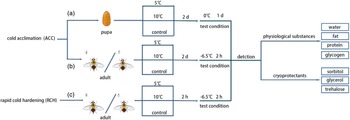
One-day-old pupae were subjected to ACC temperature of 5 and 10°C for 2 d, pupae at normal condition 25°C were used as control. Next, all pupae were exposed to a test temperature of 0°C for 1 d (Ren, Reference Ren2006) before determination of cryoprotectants. In addition, three-day-old male and female adults were subjected to 5 and 10°C for 2 d, flies at normal condition 25°C were used as control. After that, all flies were exposed to a test temperature of −6.5°C for 2 h before determination of cryoprotectants. Five individuals for each treatment and five replicates were performed.
RCH treatment
Three-day-old male and female adults were subjected to 5 and 10°C for 2 h, flies at normal condition 25°C were used as control. After that, all flies were exposed to a test temperature of −6.5°C for 2 h before determination of cryoprotectants. Five individuals for each treatment and five replicates were performed.
Measurement of variation of physiological substances and cryoprotectants
Water content
Fresh weight (WW) of pupae, male and female adults was determined by an electronic balance (model FA1004C, accuracy to 0.0001 g). Dry weight (DW) was measured by adults placed in an oven (model 101-OES) at 60°C for 48 h to dry until a constant weight remained. Water content is calculated by the following formula: (WW − DW)/WW × 100%.
Fat content
The chloroform-methanol method was used to determine the total fat content of B. dorsalis. Briefly, five pupae, male and female were respectively weighed in a 1.5 ml centrifuge tube (MW), ground into a powder with a grinding rod, 1 ml chloroform-methanol mixture (chloroform: methanol = 2:1) added. Then, the mixture was centrifuged at a speed of 2600 g for 10 min to collect the supernatant. Repeat once by adding 1 ml of the chloroform-methanol mixture. The supernatant was dried in an oven and leaving a residue with constant weight (LMW). Total fat content is calculated by the following formula: (MW − LMW)/LMW × 100%.
Protein content
The total protein content of B. dorsalis was determined by the biuret method with a protein detection kit (Beijing Solarbio Science & Technology Company, Ltd., Beijing, China).
Sorbitol content
The sorbitol content of B. dorsalis was determined by a micro sorbitol content assay kit (Beijing Solarbio Science & Technology Company, Ltd., Beijing, China).
Glycerol content
The glycerol content of B. dorsalis was determined by a glycerol content assay kit (Nanjing Jiancheng Science and Technology Company Ltd., Nanjing, China).
Glycogen content
The glycogen content of B. dorsalis was determined by a glycogen content assay kit (Beijing Solarbio Science & Technology Company, Ltd., Beijing, China).
Trehalose content
The trehalose content of B. dorsalis was determined by a trehalose content assay kit (Beijing Solarbio Science & Technology Company, Ltd., Beijing, China).
Data statistics and analysis
All statistical analyses were conducted using SPSS software version 26.0 (IBM Corporation, Armonk, NY, USA). Two-way ANOVA and Duncan multiple comparisons were used to determine test temperature, the best combination of temperature in RCH and ACC. One-way ANOVA and Duncan multiple comparisons were used to evaluate RCH duration. Data of physiological substances and cryoprotectants were analyzed by the generalized linear model (GLM). Meanwhile, dry weight was selected as a covariate to account for the effect of body size on content of water and fat. Differences were considered significant at P values <0.05, while differences were considered extremely significant at P values <0.01. In addition, Graph Pad 8.0 was used for graphing.
Results
Determination of test condition for B. dorsalis adults
To get the survival rate of B. dorsalis adults when suffered extremely low temperature, and to confirm whether RCH and ACC can promote resistance to low-temperature stress for B. dorsalis, a test temperature detection for fly trial were performed. Results (fig. 1) showed that exposure temperature had a significant effect on the survival rate of B. dorsalis adults (F=144.758, P < 0.01), but no significant difference between male and female was observed. Almost all adults (both sexes) exposed to 0, −1 and −2°C for 2 h were survived. But when exposed to −3, −4, −5, −6 and −6.5°C, the survival rate decreased rapidly from 95.9 to 28.74%. When exposed to below −7°C for 2 h, barely no adults could survive. The test temperature is an extremely low temperature that resulted in 70–85% mortality (Yang et al., Reference Yang, Wen, Han and Hou2018). Therefore, −6.5°C and 2 h were chosen as the test condition for B. dorsalis adults.
A diagram illustrating the experimental design for temperature treatment and determination of cryoprotectants in B. dorsalis. (a) Cold acclimation of pupa. (b) Cold acclimation of adults. (c) Rapid cold hardening of adults.

RCH exercise promotes survival of adults in extremely low temperature
Before exposure to test temperature, flies underwent non-lethal low temperature for several hours could had a significant effect on promoting its cold tolerance (F 4, 45 = 31.954, P < 0.01) (fig. 2). RCH treated with 10°C is better than treated with 5°C in cold tolerance improvement (F 1, 86 = 7.986, P = 0.006, P < 0.01). As RCH treat time prolongs, the survival rate of flies did not change significantly. After 2 h RCH treatment, the cold tolerance improve effect of 5 and 10°C were best both in male and female adults. The results showed that RCH with a relatively low temperature (10°C) and shorter time (2 h) can noticeably promote resistance of B. dorsalis to low-temperature stress.
Survival rate of B. dorsalis adults after 2 h exposure at 12 different low temperatures. Control: flies under normal condition. * indicates zero survival.

Whether this low-temperature stress resistance by RCH will be maintained or lost quickly, we measured the duration of RCH capacity of B. dorsalis adults. After experiencing 10°C and 2 h RCH conditions, flies were placed in normal condition (25 ± 1°C) for 0, 0.5, 1, 2 and 4 h, and later detected survival rate at test temperature −6.5°C. The results showed that low-temperature resistance obtained from RCH was sustained even flies later exposure to normal condition (fig. 3). The survival rate (60.59%) of flies under normal condition for 4 h after RCH was much higher than control (28.74%). The survival rate of RCH flies exposed to normal condition for 0.5 and 0 h was 84.08 and 87.77%, respectively. Results indicated that B. dorsalis adults had a sustained ability of low-temperature stress resistance after RCH for a longer period.
Survival rate of adults at test temperature (−6.5°C) after RCH treated. (a) Survival of female adults. (b) Survival of male adults. Statistically significant differences in survival rate means at 5 and 10°C with different treated times are denoted with different lowercase letters and capital letters, respectively (Duncan multiple comparison test at α = 0.05). Asterisks indicate statistically significant differences in survival rate between 5 and 10°C with the same treated time (*P < 0.05; **P < 0.01). ns, not significant.

ACC flies could enhance resistance to low-temperature stress
To further exposure B. dorsalis to non-lethal low temperature for several days before be placed to test temperature, results showed that ACC also improved the cold tolerance of B. dorsalis adults (F 3, 83 = 18.310, P < 0.01) (fig. 4). The ACC effect was not significantly difference between 10 and 5°C (t = 0.415, P = 0.679). However, there were significant differences between male and female (t = 0.784, P = 0.006). The survival rate (71.68%) of female acclimated in 10°C for 2 d was significantly higher than that of acclimated for 1 d (50.78%). The survival rate of male reached the highest until acclimation for 4 d. If ACC at 5°C, the survival rate of both male and female were highest after acclimation for 2 d (♀: 68.03%, ♂: 52.13%). As time went on, the ACC effect was decreased.
Survival rate of adults at test temperature (−6.5°C) after RCH treated (10°C + 2 h) and different treated times in normal condition. Statistically significant differences in survival rate means with different treated times are denoted with different lowercase letters (Duncan multiple comparison test at α = 0.05).

Insects will enhance cold tolerance by reducing SCP. We speculated that B. dorsalis adults could reduce SCP after ACC. Therefore, we measured SCP of male and female adults after exposure to 5 and 10°C for 1, 2, 4 and 8 h. Method is based on Ren (Reference Ren2006) and adults under normal condition were used as control. Results show that SCP could significantly decrease after ACC experience (F=91.718, P < 0.01) (Table 1). ACC at 5°C significantly decreased SCP than that of at 10°C. The SCP of female was −16.91 and −12.13°C after 2 d acclimation and without acclimation, respectively. The lowest SCP of male (−20.20°C) was after 4 d acclimation at 5°C, which was significantly lower than flies without acclimation (−8.10°C).
Mean SCP (±SE) of B. dorsalis adults after ACC treated

Compare every mean SCPs by ACC time of different ACC temperatures based on sex. Numbers with the same letter in a column are not significantly different (Duncan multiple comparison test at α = 0.05).
Effects of ACC on cold tolerance resistance for pupa
Pupa is an important status of many insects to overcome the low temperature of winter.
The average survival rate of B. dorsalis pupa at 0°C for 1 h is about 38% (Ren, Reference Ren2006), so we selected 0°C and 1 h for test condition for pupa. Pupae underwent ACC at 5 and 10°C for several days could had a significant effect on promoting its survival rate on test condition (F 2, 33 = 4.970, P = 0.013 < 0.05) (fig. 5). ACC effect was best when pupae exposure 2 d at both 5 and 10°C, whereas effect will weaken if exposure more time.
Survival rate of adults at test temperature (−6.5°C) after ACC treated. (a) Survival of female adults. (b) Survival of male adults. Statistically significant differences in survival rate means at 5 and 10°C with different treated times are denoted with different lowercase letters and capital letters, respectively (Duncan multiple comparison test at α = 0.05). Asterisks indicate statistically significant differences in survival rate between 5 and 10°C with the same treated time (*P < 0.05; **P < 0.01). ns, not significant.

Alterations in physiological substances and cryoprotectants of B. dorsalis after RCH and ACC
To clarify how RCH and ACC improved low-temperature resistance of B. dorsalis, we designed an experiment to detect content alterations of physiological substances and cryoprotectants in B. dorsalis (fig. 6). Physiological substances include water, fat, protein and glycogen. Cryoprotectants include sorbitol, glycerol and trehalose.
Survival rate of pupae at test temperature (0°C) after ACC treated. Statistically significant differences in survival rate means at 5 and 10°C with different treated times are denoted with different lowercase letters and capital letters, respectively (Duncan multiple comparison test at α = 0.05). Asterisks indicate statistically significant differences in survival rate between 5 and 10°C with the same treated time (*P < 0.05; **P < 0.01). ns, not significant.

Alteration of water content
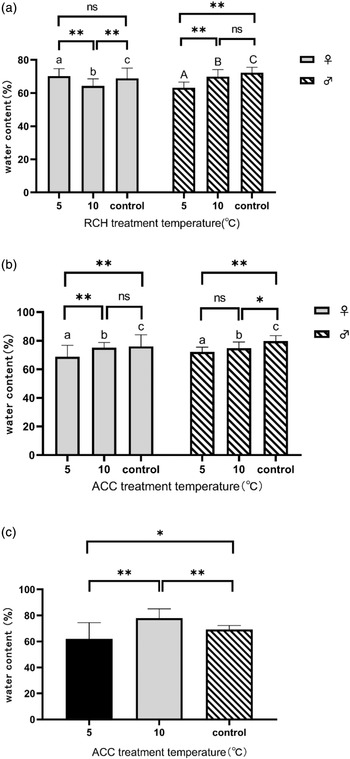
After RCH treatment (fig. 7a), the water content of female adults (P 10°C = 0.009 < 0.01) and male adults (P 5°C = 0.001 < 0.01) was lower than that of control. After ACC treatment (fig. 7b), the water content of female adults (P 5°C = 0.001 < 0.01) and male adults (P 5°C = 0.001 < 0.01; P 10°C = 0.011 < 0.05) was significantly lower than that of control. When pupae treated by ACC, water content was a significant difference with control. However, the water content of 5°C treatment was lower than control (P 5°C = 0.024 < 0.05), the water content of 10°C treatment was higher than control (P 10°C = 0.008 < 0.01) (fig. 7c).
Water content of B. dorsalis after ACC and RCH treated. (a) Adults by ACC. (b) Adults by RCH. (c) Pupae by ACC. Asterisks indicates statistically significant differences between temperature treatments (*P < 0.05; **P < 0.01). ns denotes not significant. Capital letters and lowercase letters indicate statistically significant differences between male and female adults at the same temperature (Tukey's HSD, P < 0.05).

Alteration of fat content
The fat content of male adults was significantly higher than that of control after RCH (P 5°C = 0.001 < 0.01) and ACC (P 5°C = 0.039 < 0.05) treatment at 5°C (fig. 8a, b). However, there was no significant difference in female adults whatever RCH (P 5°C = 0.349 > 0.05; P 10°C = 0.396 > 0.05) or ACC (P 5°C = 0.392 > 0.05; P 10°C = 0.819 > 0.05) treatment. Otherwise, the fat content of male adults was significantly higher than that of female at 5°C RCH (P = 0.001 < 0.01). After ACC treatment (fig. 8c), the fat content of pupae was significantly lower than that of control (P 5°C = 0.009 < 0.01; P 10°C = 0.001 < 0.01).
Fat content of B. dorsalis after ACC and RCH treated. (a) Adults by ACC. (b) Adults by RCH. (c) Pupae by ACC. Asterisks indicates statistically significant differences between temperature treatments (*P < 0.05; **P < 0.01). ns denotes not significant. Capital letters and lowercase letters indicate statistically significant differences between male and female adults at the same temperature (Tukey's HSD, P < 0.05).

Alterations of protein content
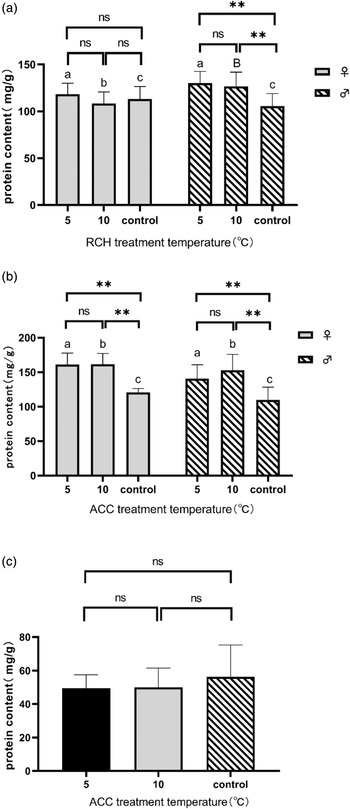
After RCH treatment (fig. 9a), the protein content of male adults was significantly higher than that of control (P 5°C = 0.001 < 0.01; P 10°C = 0.004 < 0.01). However, there was no significant difference in female adults whatever 5 or 10°C treatment (P 5°C = 0.511 > 0.05; P 10°C = 0.543 > 0.05). After ACC treatment (fig. 9b), the protein content of female adults (P 5°C = 0.001 < 0.01; P 10°C = 0.001 < 0.01) and male adults (P 5°C = 0.004 < 0.01; P 10°C = 0.001 < 0.01) was significantly higher than that of control. As treat temperature went down, the protein content of pupae was reduced, but no significant difference (P 5°C = 0.493 > 0.05; P 10°C = 0.505 > 0.05) (fig. 9c).
Protein content of B. dorsalis after ACC and RCH treated. (a) Adults by ACC. (b) Adults by RCH. (c) Pupae by ACC. Asterisks indicates statistically significant differences between temperature treatments (*P < 0.05; **P < 0.01). ns denotes not significant. Capital letters and lowercase letters indicate statistically significant differences between male and female adults at the same temperature (Tukey's HSD, P < 0.05).

Alterations of glycogen contents
After RCH treatment (fig. 10a), the glycogen content of female adults (P 5°C = 0.001 < 0.01; P 10°C = 0.022 < 0.05) and male adults (P 5°C = 0.001 < 0.01) was higher than that of control. Glycogen content was increased with treated temperature decrease. After ACC treatment (fig. 10b), the glycogen content of female adults (P 5°C = 0.001 < 0.01; P 10°C = 0.001 < 0.01) and male adults (P 5°C = 0.001 < 0.01; P 10°C = 0.001 < 0.01) was significantly higher than that of control. There was no significant difference in the glycogen content of pupae after ACC treatment (P 5°C = 0.384 > 0.05; P 10°C = 0.977 > 0.05) (fig. 10c).
Sorbitol content of B. dorsalis after ACC and RCH treated. (a) Adults by ACC. (b) Adults by RCH. (c) Pupae by ACC. Asterisks indicates statistically significant differences between temperature treatments (*P < 0.05; **P < 0.01). ns denotes not significant. Capital letters and lowercase letters indicate statistically significant differences between male and female adults at the same temperature (Tukey's HSD, P < 0.05).

Alteration of sorbitol content
The sorbitol content of male adults was significantly higher than that of control after RCH treatment at 10°C (P 10°C = 0.027 < 0.05) and ACC treatment at 5°C (P 5°C = 0.002 < 0.01). Whereas there was no significant difference in the sorbitol content of female adults after whatever RCH treatment (P 5°C = 0.109 > 0.05; P 10°C = 0.188 > 0.05) or ACC treatment (P 5°C = 0.433 > 0.05; P 10°C = 0.820 > 0.05) (fig. 11a, b). In addition, the sorbitol content of male adults was significantly lower than that of female at 5°C RCH (P = 0.03 < 0.05). There was no significant difference in the sorbitol content of pupae after ACC treatment (P 5°C = 0.421 > 0.05; P 10°C = 0.152 > 0.05) (fig. 11c).
Glycerol content of B. dorsalis after ACC and RCH treated. (a) Adults by ACC. (b) Adults by RCH. (c) Pupae by ACC. Asterisks indicates statistically significant differences between temperature treatments (*P < 0.05; **P < 0.01). ns denotes not significant. Capital letters and lowercase letters indicate statistically significant differences between male and female adults at the same temperature (Tukey's HSD, P < 0.05).

Alterations of glycerol content
After RCH treatment (fig. 12a), the glycerol content of female adults (P 5°C = 0.011 < 0.05) and male adults (P 5°C = 0.033 < 0.05; P 10°C = 0.009 < 0.01) was higher than that of control. After ACC treatment (fig. 12b), the glycerol content of female adults (P 5°C = 0.001 < 0.01; P 10°C = 0.001 < 0.01) and male adults (P 5°C = 0.001 < 0.01; P 10°C = 0.001 < 0.01) was significantly higher than that of control. But the glycerol content of female was higher than male at 5°C ACC (P = 0.001 < 0.01) and was lower than male at 10°C ACC (P = 0.001 < 0.01). There was no significant difference in the glycerol content of pupae after ACC treatment (P 5°C = 0.384 > 0.05; P 10°C = 0.977 > 0.05) (fig. 12c).
Glycogen content of B. dorsalis after ACC and RCH treated. (a) Adults by ACC. (b) Adults by RCH. (c) Pupae by ACC. Asterisks indicates statistically significant differences between temperature treatments (*P < 0.05; **P < 0.01). ns denotes not significant. Capital letters and lowercase letters indicate statistically significant differences between male and female adults at the same temperature (Tukey's HSD, P < 0.05).

Alterations of trehalose content
After both RCH and ACC treatments (fig. 13a, b), the trehalose content of female (RCH: P 5°C = 0.001 < 0.01; P 10°C = 0.001 < 0.01. ACC: P 5°C = 0.001 < 0.01; P 10°C = 0.015 < 0.05) and male adults (RCH: P 5°C = 0.001 < 0.01; P 10°C = 0.001 < 0.01. ACC: P 5°C = 0.001 < 0.01; P 10°C = 0.020 < 0.05) was significantly higher than that of control. Trehalose content was increased with treated temperature decrease. There was a significant difference in the glycogen content of pupae after ACC treatment (P 5°C = 0.003 < 0.01; P 10°C = 0.006 < 0.01) (fig. 13c).
Trehalose content of B. dorsalis after ACC and RCH treated. (a) Adults by ACC. (b) Adults by RCH. (c) Pupae by ACC. Asterisks indicates statistically significant differences between temperature treatments (*P < 0.05; **P < 0.01). ns denotes not significant. Capital letters and lowercase letters indicate statistically significant differences between male and female adults at the same temperature (Tukey's HSD, P < 0.05).

Discussion
This research reported the RCH and ACC promote resistance of the destructive pest fruit fly B. dorsalis to low-temperature stress by cryoprotectant accumulation and physiological substances conversion. By exposing to non-lethal low-temperature for hours or days, we confirmed that RCH and ACC could significantly strengthen cold hardiness of B. dorsalis. This situation had been observed in B. olea (Koveos, Reference Koveos2001), Drosophila melanogaster (Kelty and Lee, Reference Kelty and Lee1999), Frankliniella occidetalis (Walters et al., Reference Walters, Bale and McDonald1997) and Sitobion avenae (Powell and Bale, Reference Powell and Bale2004). Furthermore, sustaining competency of RCH in B. dorsalis was good. Adults were strongly remained resistance to cold shock after acclimating at 10°C for 2 h, and then placed 25°C for 0.5–4 h. Even though be placed at 25°C for 4 h after RCH, the survival rate of adults was significantly higher than control insects. However, the effect of RCH almost vanished in B. olea after 0.5 h at 25°C (Koveos, Reference Koveos2001). This showed that B. dorsalis adults had a remarkable sustaining competency of RCH. Besides, long time ACC also significantly improved the cold resistance of B. dorsalis adults. Supercooling capability of adult was improved after ACC by reducing SCP. A rapidly declined environment temperature was fatal for many insects without diapause, dormancy or other strategies to overcome low temperature in winter. So, insects had an acclimation with non-lethal low-temperature was effective (Wang and Kang, Reference Wang and Kang2003). For instance, Danaus plexippus will often experience low-temperature, heavy fog and frost while overwintering and migrating, and this insect relies on short-time acclimation to resist these sudden temperature variations (Larsen and Lee, Reference Larsen and Lee1994). Therefore, having a strong ability of RCH and ACC was very beneficial and essential for B. dorsalis adults to survive in winter.
For survival and reproduction in winter, insects will store large amounts of nutrients in response to overwintering or northward migration needs, and will transform some physiological substances in bodies to cope with low-temperature stress. Conogethes punctiferalis (Guenée) and Dendroctonus armandi will enhance cold resistance by consuming body water content and storing fat (Worland and Block, Reference Worland and Block2003; Xu et al., Reference Xu, He and Wang2012; Wang et al., Reference Wang, Gao, Zhang, Dai and Chen2017). In our study, except for female adults after 5°C RCH, the water content of adults after ACC and male adults after RCH were both significantly reduced. This indicated that B. dorsalis adults may resist low-temperature frozen damage by reducing water content in bodies, consistent with the alteration in water content of B. dorsalis adults reported by Wang et al. (Reference Wang, Zeng and Han2014).
In addition, a significantly higher fat content in male adults after 5°C RCH and 5°C ACC. Oppositely, after ACC, the fat content of pupae was significantly lower than that of control, probably due to fat was decomposed and transformed to other cryoprotectants, such as fatty acids and glycerol, to response to cold stress (Huang, Reference Huang2014). It could be fat in this experiment was not divided into free fat and bound fat, which is a limitation of this study, and further experiments can be conducted after dividing the fat into free fat and bound fat.
Proteins are important physiological substances for many insects to resist low temperature, particularly antifreeze proteins (Duman et al., Reference Duman, Bennett, Sformo, Hochstrasser and Barnes2004). For example, proteins play a critical role in overwintering of Rhagium inquisitor and Dendrolimus spectabilis (Han et al., Reference Han, Sun, Xu and Zhang2005; Kristiansen et al., Reference Kristiansen, Ramløv, Hagen, Pedersen, Andersen and Zachariassen2005). Our study showed that the protein content of male adults after RCH and both male and female adults after ACC was significantly higher than control. While it was not significantly different in pupae after ACC and female adults after RCH. The cold tolerance strategy of B. dorsalis adults could synthesis of cold tolerance relevant proteins. Nevertheless, only the total protein content of insect was measured in this study. Category and content alterations of antifreeze proteins could be clarified in future researches.
Digested and absorbed monosaccharides stored in the hemolymph and muscle, as well as lipid glycogen stored in the muscle, fat bodies and blood cells, are all used in insect energy metabolism (Yang et al., Reference Yang, Hu, Dong and Li2019). Many studies had suggested that glycogen and trehalose play an important role in overwintering of insect, such as Hypera postica (Gyllenhal) and Sphenoptera sp. Antheraea pernyi pupae, which improve cold tolerance by accumulating glycogen substances (Feng et al., Reference Feng, Zhang, Li, Yang and Zong2017; Saeidi and Moharramipour, Reference Saeidi and Moharramipour2017; Wang et al., Reference Wang, Ru, Wang, Ma, Na, Sun, Jiang and Qin2018). The glycogen content of both cold-acclimated and RCH adults increased significantly, this suggested that glycogen plays an important role in the process of promote cold tolerance in B. dorsalis adults.
Insect cryoprotectants include small molecule antifreeze substances such as sorbitol, glycerol, trehalose and mannitol, as well as antifreeze proteins (Chen et al., Reference Chen, Liang, Zou, Guo, Wu and Guo2010). Eurytoma plotnikovi has strong cold tolerance when its sorbitol concentration was high (Mohammadzadeh et al., Reference Mohammadzadeh, Borzoui and Izadi2017). Glycerol is the main cold-tolerant substance for the overwintering of Dendroctonus valens LeConte (Dong et al., Reference Dong, Pei, Shao, Zong and Hou2021). We found that there was a significant increase in sorbitol content only in the male adults after ACC, while there was no significant difference in rest of treatments. Therefore, it can be concluded that the effect of sorbitol on the cold tolerance of B. dorsalis is minor. The glycerol content of adults was significantly higher after ACC and RCH, similar to the study by Wang et al. (Reference Wang, Zeng and Han2014). This suggested that B. dorsalis adults may improve cold resistance by accumulating glycerol in their bodies. However, the glycerol content of pupae did not differ significantly after ACC, implying that glycerol may not be used as a cold-tolerant substance for B. dorsalis pupae. Most notably, trehalose levels were significantly increased in both adults and pupae after ACC, as well as in RCH adults. This indicated that trehalose is the primary cryoprotectants in response to cold in B. dorsalis.
Different insects accumulate different types and amounts of cryoprotectants, but studies have shown that most insects are made up of several cryoprotectants to forming a substance system. For example, Heydari discovered the lipid low molecular weight carbohydrate-polyol system of larvae of Ectomyelois ceratoniae (Heydari and Izadi, Reference Heydari and Izadi2014). Sadeghi revealed that the trehalose-glucose-sorbitol-inositol-lipid system of overwintering Agonoscena pistaciae adults improved its cold tolerance (Sadeghi et al., Reference Sadeghi, Izadi and Mahdian2012). A complex sugar-polyol cryoprotectant system facilitates Cinara tujafilin survive in unfavorable low temperatures (Durak et al., Reference Durak, Depciuch, Kapusta, Kisała and Durak2021). In this study, we demonstrated that RCH and ACC could promote resistance of B. dorsalis to low-temperature stress, by transforming physiological substances such as water reduced, increasing fat and proteins, meanwhile, cryoprotectants including glycerol and trehalose were accumulated abundantly in B. dorsalis. Determining variation of physiological substances and cryoprotectants when insects experienced low-temperature stress might be useful for forecast migration and occurrence of B. dorsalis.
Abbreviations
RCH, rapid cold hardening; ACC, cold acclimation; SCP, supercooling point.
Financial support
This study was supported by the Key Science and Technology Special Project of Yunnan Province (202102AE090006). The funders had no role in the study design, data collection and analysis, decision to publish or preparation of the manuscript.
Conflict of interest
The authors declare that they have no conflict of interest.
Ethical standards
This article does not involve any studies with human participants performed by any of the authors.