Introduction
Generalized anxiety disorder (GAD) is characterized by excessive or uncontrollable anxiety and worry, is associated with a range of physical symptoms (APA, 1994) and is highly co-morbid with depression at every stage of life (Angold et al. Reference Angold, Costello and Erkanli1999a;Kessler et al. Reference Kessler, Chiu, Demler and Walters2005; Moffitt et al. Reference Moffitt, Harrington, Caspi, Kim-Cohen, Goldberg, Gregory and Poulton2007b). Several lines of empirical research have established that GAD and depression share many, although not all, psychosocial and biological risk factors and correlates (APA, 1994). Depression is associated with elevated levels of pro-inflammatory cytokines and the proteins released in response to increasing cytokine levels. The acute-phase protein C-reactive protein (CRP) has been the focus of extensive epidemiological investigation because of the association of elevated plasma CRP levels (>3 mg/l) with cardiovascular risk (Shah et al. Reference Shah, Casas, Cooper, Tzoulaki, Sofat, McCormack, Smeeth, Deanfield, Lowe, Rumley, Fowkes, Humphries and Hingorani2009; The Emerging Risk Factors Collaboration, 2010) and aspects of the metabolic syndrome (Pradhan et al. Reference Pradhan, Manson, Rifai, Buring and Ridker2002; Ridker et al. Reference Ridker, Buring, Cook and Rifai2003; Tamakoshi et al. Reference Tamakoshi, Yatsya, Kondo, Hori, Ishikawa, Zhang, Murata, Otsuka, Zhu and Toyoshima2003). Recent work on depression has identified robust cross-sectional and longitudinal associations with CRP (Howren et al. Reference Howren, Lamkin and Suls2009; Copeland et al. Reference Copeland, Shanahan, Worthman, Angold and Costello2012). Are such associations also observable between GAD and CRP?
Several previous findings suggest that such an association should be identified. First, family and twin studies have documented co-transmission of depression and GAD (Kendler et al. Reference Kendler, Walters, Neale, Kessler, Heath and Eaves1995; Thapar & McGuffin, Reference Thapar and McGuffin1997; Eley & Stevenson, Reference Eley and Stevenson1999; Middeldorp et al. Reference Middeldorp, Birley, Cath, Gillespie, Willemsen, Statham, De Geus, Andrews, Van Dyck, Beem, Sullivan, Martin and Boomsma2005) as well as strong bivariate genetic correlations between depression and GAD (Kendler, Reference Kendler1996; Kendler et al. Reference Kendler, Gardner, Gatz and Pedersen2007). Second, hypothalamic–pituitary–adrenal (HPA) axis and autonomic nervous system activity have both been implicated in depressive symptoms and CRP production (for reviews, see Raison et al. Reference Raison, Capuron and Miller2006; Dantzer et al. Reference Dantzer, O'Connor, Freund, Johnson and Kelley2008); these systems are generally also activated in the context of anxiety (Toker et al. Reference Toker, Shirom, Shapira, Berliner and Melamed2005; Pitsavos et al. Reference Pitsavos, Panagiotakos, Papageorgiou, Tsetsekou, Soldatos and Stefanadis2006; O'Donovan et al. Reference O'Donovan, Hughes, Slavich, Lynch, Cronin, O'Farrelly and Malone2010), although few studies of physiological correlates have specifically focused on GAD. Third, depression and GAD tend to be responsive to the same active ingredients in drugs (Kuzma & Black, Reference Kuzma and Black2004). Finally, a number of studies comparing psychosocial correlates of depression and GAD have identified at least some similarities (Moffitt et al. Reference Moffitt, Caspi, Harrington, Milne, Melchior, Goldberg and Poulton2007a).
Recent studies have, however, also identified differences between depression and GAD, suggesting at least partially different etiological pathways. For example, divergence in correlates was found for a number of psychosocial adversities (Moffitt, Reference Moffitt, Caspi, Harrington, Milne, Melchior, Goldberg and Poulton2007a; Shanahan, Reference Shanahan, Copeland, Costello and Angold2008) and temperamental traits (Moffitt, Reference Moffitt, Caspi, Harrington, Milne, Melchior, Goldberg and Poulton2007). Furthermore, a family history of depression was specifically associated with depression, but not with GAD (Moffitt, Reference Moffitt, Caspi, Harrington, Milne, Melchior, Goldberg and Poulton2007; Shanahan et al. Reference Shanahan, Copeland, Costello and Angold2008), suggesting potential differences in at least some of the biological bases of these disorders.
The goal of this study was to test whether GAD would be associated with increased levels of the systemic inflammation marker CRP, both cross-sectionally and over time. Such an association would provide additional evidence for biological overlap between depression and GAD and provide some support for the combination of these disorders in the Diagnostic and Statistical Manual of Mental Disorders, fifth edition (DSM-5). A lack of association between GAD and CRP would implicate distinct biological processes in these otherwise closely linked disorders.
Method
Participants
The Great Smoky Mountains Study is a longitudinal study of the development of psychiatric disorder and need for mental health services in rural and urban youth (Costello et al. Reference Costello, Angold, Burns, Stangl, Tweed, Erkanli and Worthman1996, Reference Costello, Mustillo, Erkanli, Keeler and Angold2003). A representative sample of three cohorts of children, aged 9, 11 and 13 years at intake, was recruited from 11 counties in western North Carolina using a multi-stage selection process. All children scoring above a predetermined cut-point (the top 25% of the total scores) on a screening questionnaire, plus a 1-in-10 random sample of the rest, were recruited for detailed interviews. Of all subjects recruited, 80% (n = 1420) agreed to participate.
Subjects were assessed annually to age 16 years then again at ages 19 and 21 years. Participants were interviewed as closely as possible to their birthday each year. Across all waves, participation rates averaged 84% (range 74–94%). About 8% of the area residents and the sample are African American, less than 1% are Hispanic, and 3% are American Indian.
Procedures
The parent (biological mother for 83% of interviews) and subject were interviewed by trained interviewers separately until the subject was 16 years old, and subjects only thereafter. Before the interviews began, the parent and child signed informed consent forms approved by the Duke University Medical Center Institutional Review Board. Each parent and child received an honorarium for their participation.
Using a previously described procedure (Worthman & Stallings, Reference Worthman and Stallings1997), blood samples were obtained at the beginning of each in-person assessment, as follows: two finger-prick samples (yielding 10 spots total per visit) were collected at 20-min intervals, applied to standardized collection paper, immediately refrigerated upon drying, and express-shipped (without refrigeration) to the laboratory within 2 weeks of collection. Samples were then stored at −28 °C until they were assayed. This protocol is consistent with the rigorous quality-control program developed for newborn screening programs (Mei et al. Reference Mei, Alexander, Adam and Hannon2001) and has been used in a number of epidemiological studies involving blood spot CRP measures (McDade et al. Reference McDade, Hawkley and Cacioppo2006; Williams & McDade, Reference Williams and McDade2009).
Assessment
Generalized anxiety
Generalized anxiety is characterized by excessive anxiety and worry that a person finds difficult to control, and is associated with a range of physical symptoms (restlessness, easily fatigues, difficulty concentrating, muscle tension and sleep disturbance) (APA, 1994). GAD variables were assessed using the Child and Adolescent Psychiatric Assessment (CAPA) until age 16 years, and its upward extension, the Young Adult Psychiatric Assessment (YAPA) thereafter (Angold et al. Reference Angold, Cox, Prendergast, Rutter, Simonoff, Costello and Ascher1999b; Angold & Costello, Reference Angold and Costello2000). These structured interviews were coded by a trained interviewer and each interview was then checked by a supervisor. The time-frame for determining the presence of most behaviors was the past 3 months to minimize forgetting and recall biases, although onset dates were also collected for all symptoms. A symptom was counted as present if reported by either parent or child or both, as is standard in clinical practice. Scoring programs written in SAS (SAS Institute, Inc., USA) by the senior authors combined information about the date of onset, duration and intensity of each symptom to create GAD diagnoses according to DSM-IV (APA, 1994). The 2-week test–retest reliability of diagnoses is comparable with that of other highly structured child psychiatric interviews (Angold & Costello, Reference Angold and Costello1995). Construct validity as judged by 10 different criteria including comparison with other interviews and ability to predict mental health service use is good to excellent (Angold & Costello, Reference Angold and Costello2000). GAD status was measured by two variables: (a) current GAD (binary); and (b) the number of total generalized anxiety symptoms (range 0–6). Cumulative generalized anxiety exposure was assessed by looking at the total number of GAD episodes reported up until the current assessment (range 0–3). This variable was included because of the evidence that cumulative depressive episodes predicted later CRP levels and other studies linking perturbations in inflammation levels to repeated psychological distress (Danese et al. Reference Danese, Moffitt, Pariante, Ambler, Poulton and Caspi2008; Copeland et al. Reference Copeland, Shanahan, Worthman, Angold and Costello2012).
CRP
High-sensitivity CRP was assayed in whole-blood using a biotinstreptavidin-based immunofluorometric system (McDade et al. Reference McDade, Burhop and Dohnal2004). One assay was completed for each subject at each observation. Streptavidin A-coated microtiter plates bind a biotinylated capture antibody to CRP (clone C2). A second europium-labeled antibody then binds to the streptavidin A–biotin–C2–CRP complex; the fluorescence of the resultant complex is directly proportional to the CRP concentration in each well. The minimum detectable dose for the assay is 0.010 mg/l. For low, medium, high and very high controls (0.022, 0.259, 1.208 and 3.271 mg/l, respectively), the within-assay coefficient of variation (CV) (precision) is 2.0%, 1.2%, 1.6% and 1.4%, respectively, while between-assay CV (reliability) is 14.4%, 13.9%, 12.3% and 10.9%, respectively.
A validation study was performed with matched serum and blood spot samples assayed for CRP (n = 38). As has been reported for many other analytes including CRP (McDade et al. Reference McDade, Stallings and Worthman1997, Reference McDade, Burhop and Dohnal2004; Worthman & Stallings, Reference Worthman and Stallings1997), a close linear correlation was identified between serum and blood spot CRP values (n = 29, R 2 = 0.98, p < 0.0001). Serum equivalents therefore were calculated using the following algorithm based on the serum–blood spot regression: serum (high-sensitivity CRP) = 1.38 × (blood spot CRP value) – 0.97. Blood spot CRP measures have been used in a number of epidemiological studies (McDade et al. Reference McDade, Leonard, Burhop, Reyes-García, Vadez, Huanca and Godoy2005, Reference McDade, Hawkley and Cacioppo2006; Williams & McDade, Reference Williams and McDade2009). Observations with values above 10 mg/l indicate frank infection and were removed from statistical analysis (190 from a total of 6000 observations), whereas for values below 10 mg/l the extent of chronic low-grade systemic inflammation is associated with cardiovascular and metabolic risk (Pearson et al. Reference Pearson, Mensah, Alexander, Anderson, Cannon, Criqui, Fadl, Fortmann, Hong, Myers, Rifai, Smith, Taubert, Tracy and Vinicor2003).
Covariates
Covariates included variables typically associated with variation in CRP levels (Woodward et al. Reference Woodward, Rumley, Lowe and Tunstall-Pedoe2003; Elovainio et al. Reference Elovainio, Keltikangas-Järvinen, Pulkki-Råback, Kivimäki, Puttonen, Viikari, Räsänen, Mansikkaniemi, Viikari and Raitakari2006) or used as covariates in studies of CRP and depression (Gimeno et al. Reference Gimeno, Kivimäki, Brunner, Elovainio, De Vogli, Steptoe, Kumari, Lowe, Rumley, Marmot and Ferrie2009; Stewart et al. Reference Stewart, Rand, Muldoon and Kamarck2009; Janicki Deverts et al. Reference Janicki Deverts, Cohen, Dilillo, Lewis, Kiefe, Whooley and Matthews2010; Matthews et al. Reference Matthews, Schott, Bromberger, Cyranowski, Everson-Rose and Sowers2010). These included age, sex, race, BMI, medication use, substance use, low socio-economic status (SES) and recent physical ailments. BMI was calculated from weight and height measurements completed at each assessment. For all assessments completed before the subjects were 20 years old, BMI values were corrected for age and sex (Ogden et al. Reference Ogden, Kuczmarski, Flegal, Mei, Guo, Wei, Grummer-Strawn, Curtin, Roche and Johnson2002). The substance-use assessment of the CAPA and YAPA interviews assesses current nicotine, alcohol and illicit drug use. Dichotomous variables were included to indicate recent use of these substances. A physical health problems survey adapted from the CDC National Health Interview Survey Child Health Supplement (1988) was administered to assess 39 common ailments (e.g. diabetes, anemia, mononucleosis). A binary variable indicating any health ailments within the last 12 months was used for all analyses. Analyses were also tested using the following separate health categories: atopic (e.g. food/digestive allergy, asthma and respiratory allergy), injuries, infections (tonsillitis, ear infection, frequent diarrhea or colitis, and urinary tract infections) and chronic diseases (e.g. diabetes, epilepsy, cancer and chronic heart disease). Medication use within the prior year was also assessed from the Child and Adolescent Services Assessment (Ascher et al. Reference Ascher, Farmer, Burns and Angold1996), which focuses on psychotropic medications, but also assessed prescribed medications not related to psychiatric problems. All analyses were tested using broad-based medication-use variables as well as categories for individual medication groups (e.g. antidepressant, stimulant and other prescribed medications). Low SES coded whether the subject's family displayed any two of the following three indicators: income below the federal poverty line, low parental education attainment, and low parental occupation status. Additional physiological covariates evaluated alongside CRP in older samples at risk for cardiovascular problems (e.g. blood pressure, lipids or insulin) were not assessed.
Analytic framework
All subjects were assigned a weight inversely proportional to their probability of selection, so that the results are representative of the population from which the sample was drawn and not biased from the oversampling procedure. CRP values were positively skewed and were log10-transformed after scaling for non-negative values by adding 1. Models predicting GAD symptoms or cumulative GAD episodes employed Poisson regression, models predicting diagnostic status employed logistic regression and those predicting log10 CRP employed linear regression. All associations were tested using weighted regression models in a generalized estimating equations framework implemented by SAS proc genmod. For all analyses, multiple observations were used for each subject and robust variance (sandwich type) estimates adjusted the standard errors of the parameter estimates for the repeated observations. The covariance matrix was specified as autoregressive in all analyses.
All longitudinal models used values from the prior assessment to predict current levels of the outcome variable. As such, only subjects with multiple assessments were included and subjects with more than two assessments contributed multiple observations. For example, if a subject had five assessments, then they contributed four observations to the current analyses (wave 1 predicting wave 2, wave 2 predicting wave 3, wave 3 predicting wave 4, and wave 4 predicting wave 5).
Missing data
By the age of 21 years, 8806 total assessments had been completed. Of these, blood spots were obtained for 6087 (69.1%). Blood spots were not available either because the subject refused or because the interviews were completed by phone. For in-person interviews, 79.4% of subjects agreed to provide blood spots. Comparisons of observations in which blood spots were collected with those in which the subjects refused indicated no significant differences on any of the GAD outcomes. Of the 6087 blood spots collected, 6000 (98.6%) were successfully assayed for CRP (190 were removed due to elevated CRP levels indicating infection). Of the 1420 study participants, 1334 (93.9%) provided blood spot samples assayed for CRP in 1 year or more. The median number of CRP samples provided was five (mean = 4.77, s.d. = 2.24, range 1–9).
Results
Sample characteristics
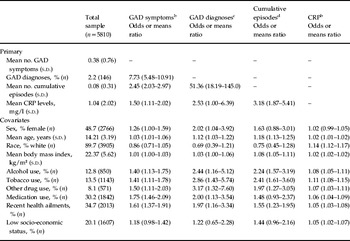
Table 1 shows the characteristics of the full analytic sample in-person observations (5810 observations of 1334 subjects). GAD-related outcomes were significantly associated with sex, age, BMI, tobacco use, alcohol use, illicit drug use, medication use and current health ailments. CRP was associated with age, BMI, tobacco use, alcohol use, other drug use, medication use, current health ailments and low SES. This pattern of findings suggests that all covariates merit inclusion.
Descriptive information and concurrent associations between primary variables and covariatesa

GAD, Generalized anxiety disorder; CRP, C-reactive protein; s.d., standard deviation.
a Reported CRP mean and s.d. values are from untransformed variables. All associations between CRP and other variables use log10-transformed values.
b Associations of the primary variable with the other variables were tested with linear regression.
c Associations of the primary variable with the other variables were tested with logistic regression.
d Associations of the primary variable with the other variables were tested with Poisson regression.
The overlap between GAD and depression variables was high. Of those meeting criteria for GAD, 39.9% also met criteria for a depressive disorder (odds ratio = 40.9, 95% confidence interval = 18.0–92.9, p < 0.0001). There was similarly high overlap between symptoms (r = 0.72, p < 0.0001) and cumulative episodes to date (r = 0.55, p < 0.0001). If CRP is associated with GAD, it is reasonable to ask if such associations are independent of depression.
Cross-sectional associations
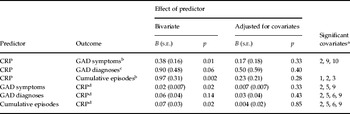
A series of regression models tested the cross-sectional associations between CRP and all GAD-related outcomes (Table 2). For each outcome, a simple bivariate model was tested as well as a model adjusting for covariates. There was strong evidence of association between CRP and GAD-related outcomes in bivariate models. All associations were attenuated to non-significance by the inclusion of health-related covariates. BMI and medication use were significant predictors in all models predicting CRP.
Cross-sectional associations between CRP and generalized anxiety

CRP, C-reactive protein; s.e., standard error; GAD, generalized anxiety disorder.
a Covariates include the following: 1 = sex; 2 = race; 3 = age; 5 = body mass index; 6 = current nicotine use; 7 = current alcohol use; 8 = current illicit drug use; 9 = current medication use; 10 = recent health ailments; 11 = current low socio-economic status.
b Model was tested with Poisson regression.
c Model was tested with logistic regression.
d Model was tested with linear regression.
Longitudinal associations
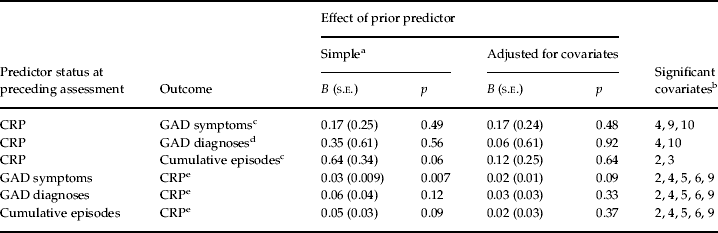
Longitudinal bidirectional associations were tested in a series of models similar to those for the cross-sectional associations (Table 3). The simple longitudinal model predicted the outcome using the predictor and prior status on the outcome variable (e.g. prior CRP and GAD symptoms predicting current GAD symptoms). As such, this model predicts change in the outcome variable across assessments. There was little evidence of either CRP predicting later GAD-related outcomes or vice versa in the simple models. The lone exception was GAD symptoms predicting later CRP levels adjusting for prior CRP. This association, like other marginal associations, was attenuated after accounting for current health-related covariates. The models testing effects of GAD-related variables on later CRP levels implicated a common set of covariates that included race, time since the last interview, BMI, nicotine use and current medication use.
Bidirectional longitudinal associations between CRP and generalized anxiety
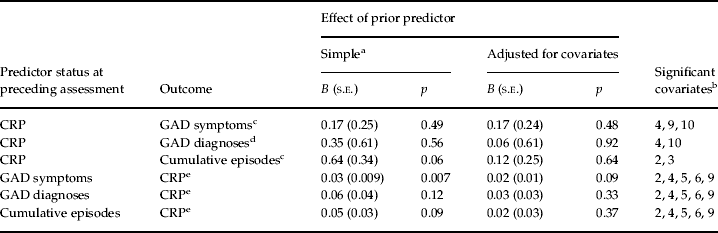
CRP, C-reactive protein; s.e., standard error; GAD, generalized anxiety disorder.
a Simple models include prior status on the outcome variable.
b Covariates include the following: 1 = sex; 2 = race; 3 = age; 4 = time since last interview; 5 = body mass index; 6 = current nicotine use; 7 = current alcohol use; 8 = current illicit drug use; 9 = current medication use; 10 = recent health ailments; 11 = current low socio-economic status.
c Model was tested with Poisson regression.
d Model was tested with logistic regression.
e Model was tested with linear regression.
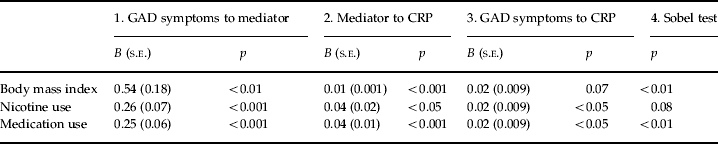
These concurrent covariates may mediate or account for the association between past GAD symptoms and current CRP as has been observed, in part, for depression (Copeland et al. Reference Copeland, Shanahan, Worthman, Angold and Costello2012). Each significant covariate was tested as a potential mediator using a multistage regression approach (Baron & Kenny, Reference Baron and Kenny1986; MacKinnon et al. Reference MacKinnon, Lockwood, Hoffman, West and Sheets2002). Identification of potential mediators required the following: (1) GAD symptoms were associated with the covariate (Table 4, column 1); (2) in models controlling for the GAD symptoms, the covariate was associated with CRP (column 2); (3) in models controlling for the covariate, the association between the GAD symptoms and CRP was either no longer statistically significant or was attenuated (column 3); and (4) a statistically significant indirect path existed between the GAD symptoms and CRP through the covariate, as measured by the Sobel test (Sobel, Reference Sobel1982) (column 4). Neither race nor time since last interview were associated with the GAD symptoms and, thus, were not included in Table 3. Both BMI and medication use mediated the association from prior GAD symptoms to current CRP.
Tests of potential mediators of the association between GAD symptoms and later CRPa
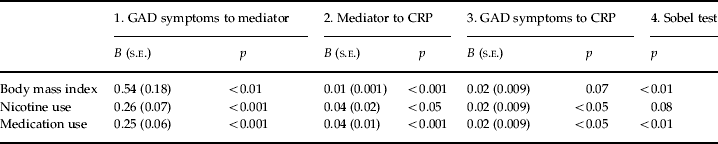
GAD, Generalized anxiety disorder; CRP, C-reactive protein; s.e., standard error.
a Models were tested with either Poisson or logistic regression. Columns numbered 2 and 3 provide results from models in which both the GAD symptoms variable and potential mediator predicted current CRP status. Models were adjusted for demographic covariates and prior CRP status. The Sobel test assesses the significance of the indirect pathway.
Follow-up analyses
CRP levels greater than 3 mg/l indicate increased risk for cardiovascular disease in adults (Pearson et al. Reference Pearson, Mensah, Alexander, Anderson, Cannon, Criqui, Fadl, Fortmann, Hong, Myers, Rifai, Smith, Taubert, Tracy and Vinicor2003). There was no evidence that changes to the definition of CRP, either by dichotomizing CRP levels at CRP > 3 mg/l or by including cases with CRP >10 mg/l (which is indicative of acute infection) affected the results of either the cross-sectional or longitudinal analysis. It is plausible that the association between CRP and GAD is found in some subgroups but not in others. To test for this pattern, interaction terms were entered into each of the simple/bivariate between the predictor and each demographic variable (sex and race) or significant covariate. Significant interactions occurred at the rate expected by chance and were no more likely to include one demographic variable or covariate than another. Finally, it is possible – albeit unlikely – that it is the part of GAD that is independent of depression that is associated with CRP levels. All analyses were rerun including depression variables as covariates. As expected, this did not change the pattern of associations.
Discussion
GAD is highly co-morbid with depression (Moffitt et al. Reference Moffitt, Harrington, Caspi, Kim-Cohen, Goldberg, Gregory and Poulton2007b), and depression is both directly and indirectly associated with elevated levels of CRP (Howren et al. Reference Howren, Lamkin and Suls2009). On this basis, we predicted that GAD would also be associated with elevated levels of CRP. There was evidence supporting this hypothesis in bivariate associations both cross-sectionally and over time. These associations attenuated, however, with the inclusion of health-related covariates and both BMI and medication use which mediated the longitudinal associations between GAD variables and later CRP levels. Thus, GAD does affect levels of CRP, but this effect is accounted for by the effect of GAD on health-related behaviors. The direct association with elevated low-grade inflammation is an area of divergence between GAD and depression for the age groups examined here.
Despite the extensive literature on the depression–CRP link, only a few studies have looked at the association between CRP and any measure of anxiety. The ATTICA study in Greece examined concurrent associations between State-Trait Anxiety Inventory scores and a number of markers of immunity/inflammation including high-sensitivity CRP in a sample of 853 adults (Pitsavos et al. Reference Pitsavos, Panagiotakos, Papageorgiou, Tsetsekou, Soldatos and Stefanadis2006). They found a small, but significant, association that persisted after controlling for relevant covariates. A case–control study of 27 anxious patients and 29 non-anxious controls found no association between CRP levels and anxiety as measured by a self-report questionnaire (O'Donovan et al. Reference O'Donovan, Hughes, Slavich, Lynch, Cronin, O'Farrelly and Malone2010). Finally, a test of the CRP–anxiety association in a large sample of employees completing a routine health examination at an Israeli medical center found no association (Toker et al. Reference Toker, Shirom, Shapira, Berliner and Melamed2005). These studies suggest a consensus for little evidence of association between CRP with anxiety. In our study that employed structured interviews to assess GAD, the aspect of anxiety most closely tied to depression, there was no independent association.
If indeed depression, but not GAD, is associated with CRP directly, what does this specificity suggest? Although the areas of overlap between GAD and depression are legion (Watson, Reference Watson2005; Moffitt et al. Reference Moffitt, Harrington, Caspi, Kim-Cohen, Goldberg, Gregory and Poulton2007b), divergence in biological correlates may reinforce the notion that these disorders have at least partially distinct neurobiological profiles. There is also evidence that GAD and depression are preceded by somewhat different profiles of psychosocial risk factors (Moffitt et al. Reference Moffitt, Caspi, Harrington, Milne, Melchior, Goldberg and Poulton2007a). The study of biological correlates has generally been limited to markers of HPA axis function. Here again, results have been mixed, with some studies showing increased levels of basal and peak salivary cortisol levels (Mantella et al. Reference Mantella, Butters, Amico, Mazumdar, Rollman, Begley, Reynolds and Lenze2008) and other studies failing to find any association of GAD with diurnal cortisol levels (Hoehn-Saric et al. Reference Hoehn-Saric, McLeod, Lee and Zimmerli1991). Similar mixed results have been reported regarding non-suppression of cortisol in response to the dexamethasone suppression test (Schweizer et al. Reference Schweizer, Swenson, Winokur, Rickels and Maislin1986; Tiller et al. Reference Tiller, Biddle, Maguire and Davies1988). Studies of HPA-related indicators and depression, however, have been plagued by similar inconsistencies (Kaufman et al. Reference Kaufman, Martin, King and Charney2001). One general conclusion from the literature is that disorder–biological correlate associations still tend to be small, affected by a range of health-related behaviors, and often limited to specific subgroups (by age, number of disorder episodes). Thus, while our findings are consistent with a conceptualization of GAD and depression as closely linked entities with distinct biological correlates, more work needs to be done on the conditions under which such associations are detectable for all psychiatric disorders.
Bivariate associations between GAD and CRP seem to be attenuated by a broad set of health-related variables including substance use, BMI and medication use. A similar set of variables attenuated the associations of depression-related variables on later CRP levels (albeit not to the point of non-significance for cumulative depressive episodes). Analyses testing bivariate associations ignore the normative clustering of these multiple health-risk behaviors and the elevated levels of CRP. Although the influence of any single risk factor may be important in terms of understanding the pathophysiology of mild inflammation, these risk factors are difficult to tease apart in the real world. Risk-reduction strategies may opt to use this normative clustering to identify subjects at highest risk for elevated inflammation patterns rather than focusing on individual risk factors.
Limitations
The Great Smoky Mountains Study has several strengths besides its longitudinal, prospective design: a population-based design that minimized selection biases; anxiety variables assessed repeatedly with structured interviews that allowed us to look at various aspects of anxiety; repeated collection of blood spots that allowed for subjects to provide up to nine values of CRP across 12 years; and assessment of a wide range of domains that allowed us to control for covariates of anxiety and CRP. However, the sample is not representative of the US population (Native Americans over-represented and African Americans and Latinos under-represented).
The criteria for GAD may change in DSM-5. The primary proposed changes for DSM-5 GAD include removing criterion B (difficulty controlling worry), reducing the threshold for criterion C (associated symptoms), and adding a behavioral avoidance criterion (DSM-5 Anxiety Disorders Work Group, 2010). The first change is only meant to remove a redundancy and the reduced threshold for criterion C already applies in children (Andrews et al. Reference Andrews, Hobbs, Borkovec, Beesdo, Craske, Heimberg, Rapee, Ruscio and Stanley2010). The primary change then, as it relates to the current study, is the addition of the behavioral avoidance criterion. One goal of this addition is indeed to increase differentiation with other anxiety and mood disorders (Andrews et al. Reference Andrews, Hobbs, Borkovec, Beesdo, Craske, Heimberg, Rapee, Ruscio and Stanley2010). While this new criterion is only propositional, this change, if adopted, may affect the association of GAD with CRP.
Conclusion
Our study provides little support for a robust association between GAD and CRP. Instead, significant cross-sectional or longitudinal associations were entirely attenuated by a cluster of health-related covariates known to predict both CRP and anxiety. In the case of depression, there is evidence for an independent effect of recurrent depressive episodes on later CRP levels (Copeland et al. Reference Copeland, Shanahan, Worthman, Angold and Costello2012), but this was not the case for GAD. This suggests caution in interpretation of the recent evidence of overlap between GAD and depression in developmental course and lifetime co-morbidity. Despite general similarities, it has not been demonstrated that depression and GAD share biological correlates related either to HPA-axis function or CRP levels. These differences may prove instructive in understanding the specificity of associations between negative emotions and inflammation.
Acknowledgments
This work was supported by the National Institute of Mental Health (grants no. MH63970, MH63671 and MH48085), the National Institute on Drug Abuse (grant no. DA/MH11301), a National Alliance for Research on Schizophrenia and Depression (NARSAD) Early Career Award to W.E.C. and the William T. Grant Foundation.
Declaration of Interest
None.