
Introduction
The existence of life-sized divine statues in the ancient Near East is well documented by historical sources and artistic representation. Yet no example of such a statue has survived intact in the Levant, despite the archaeological investigation of more than one hundred temples in the region. Indeed, across the Near East as a whole, including Iran, Mesopotamia and Anatolia, from the fourth millennium BC to the middle of the first millennium BC, the life-sized statue of the Mesopotamian goddess Ishtar from Mari in eastern Syria stands out as a rare example of a life-sized statue of a divine entity (Parrot Reference Parrot1959: 5–11, pls IV–VI). Now, a combination of contextual and iconographic analyses allows us to argue that a Canaanite temple at Tel Lachish in Israel also contained the remnant of such a life-sized divine statue, the first example to be identified in the region. Furthermore, these analyses enable us to identify a second such remnant, previously uncovered at Hazor in Israel.
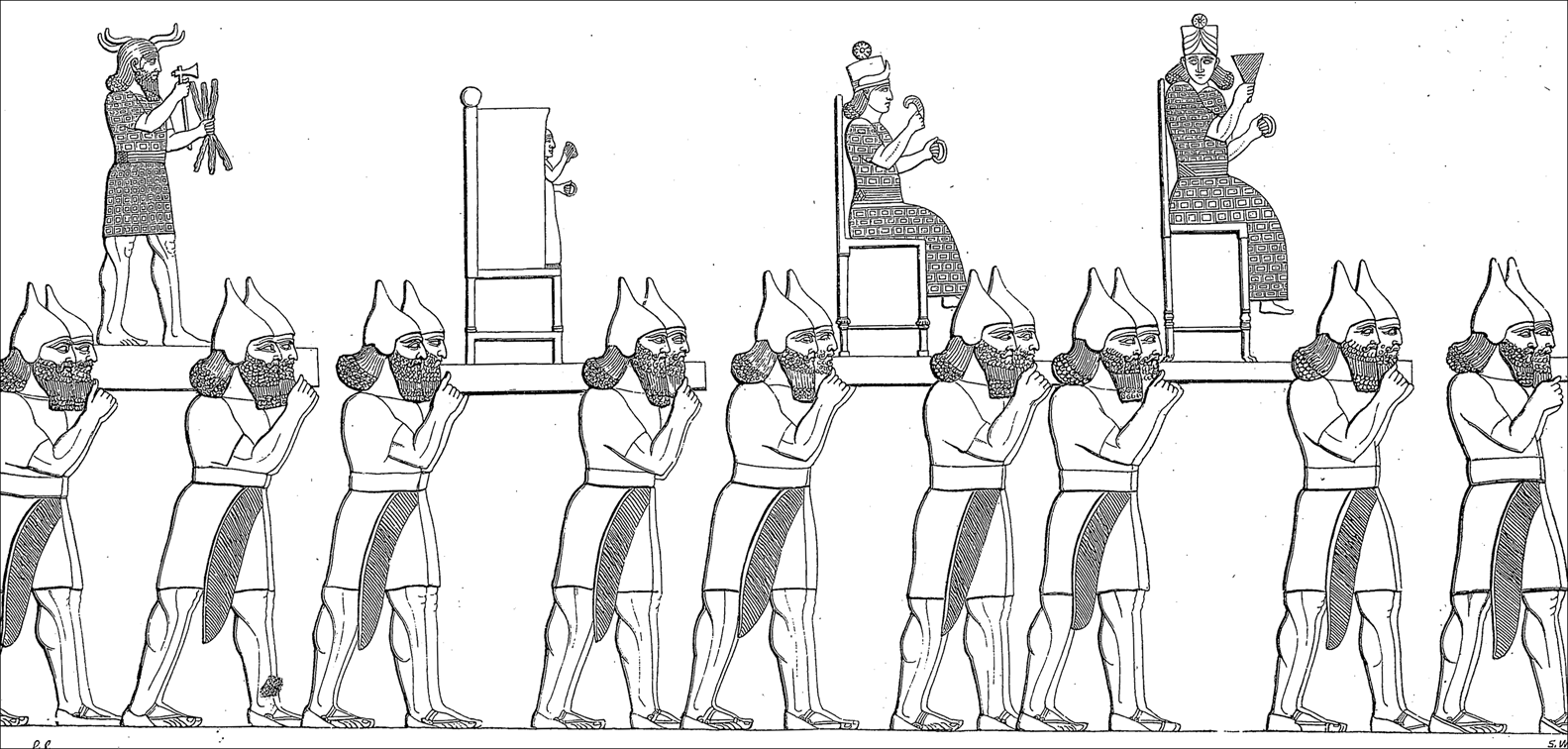
Numerous Mesopotamian texts report that life-sized divine statues stood in the most secluded part of the temple: the cella, or the Holy of Holies (Dick Reference Dick1999; Bahrani Reference Bahrani2003; Hurowitz Reference Hurowitz2003; Walls Reference Walls2005; Hundley Reference Hundley2013, Reference Hundley2015). Special ceremonies were held when such a statue was first introduced into the temple, and routine rituals were performed daily thereafter (Walker & Dick Reference Walker, Dick and Dick1999; Winter Reference Winter and Winter2010; Hundley Reference Hundley2015: 209–10). Realistic representations of such statues are depicted in a Neo-Assyrian relief from Nineveh, showing loot being taken by soldiers from conquered cities (Figure 1; Layard Reference Layard1856: pl. 65). The Hebrew Bible also mentions such statues, albeit from a negative and polemical viewpoint (Weeks Reference Weeks and Barton2007).
Life-sized statues being carried away from a looted city by Assyrian soldiers (Layard Reference Layard1856: fig. 65).

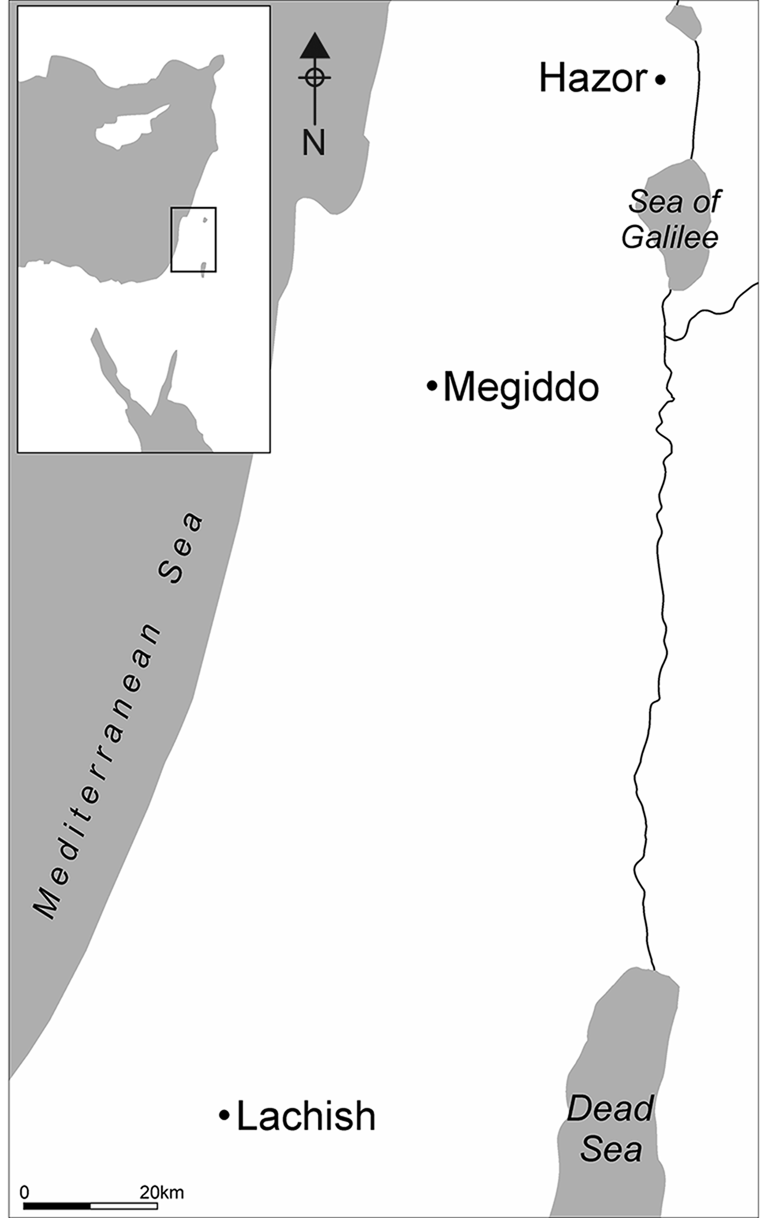
Small divine figurines made of metal or clay are well documented on ancient Near Eastern sites (Negbi Reference Negbi1976; Seeden Reference Seeden1980; Cornelius Reference Cornelius1994; Moorey Reference Moorey2003; Weissbein et al. Reference Weissbein, Garfinkel, Hasel and Klingbeil2016), while large metal figurines (some 250–350mm high), although rare, are known from a few sites, such as Hazor and Beth Shean (Mazar & Mullins Reference Mazar and Mullins2007: 618; Ornan Reference Ornan, Ben-Tor, Zuckerman, Bechar and Sandhaus2017). Two exceptionally large metal figures, measuring approximately 360 and 560mm in height, respectively, were found at Enkomi in Cyprus (Schaeffer Reference Schaeffer1971: pls I–VII). More than 130 years of excavation in the Levant, however, have failed to yield even one life-sized divine statue over one metre in height. There could be several reasons for this. The statues could have been made of wood and other perishable materials that have decayed. They may have been adorned with gold, precious stones and costly textiles, and therefore vulnerable to looting, for example, during periods of instability or war. Finally, early archaeological excavations, which employed hundreds of labourers, may have paid little attention to the exact findspot of objects. This dearth of evidence in the Levant is now changing, thanks to the discovery of a remarkable paddle-shaped bronze object coated in silver, interpreted as a sceptre. It was recovered from the cella of a Canaanite temple at Lachish in Israel. As discussed below, similar objects are also known from the Canaanite sites of Hazor and Megiddo (Figure 2).
Map of the southern Levant, with location of sites mentioned in the text (drawing by J. Rosenberg).

Life-sized statues of human figures that were objects of veneration are known from various periods in the ancient Near East. Such statues, made of stone, have been found at sites dating to as early as the tenth millennium BC, at Göbekli Tepe, and the ninth millennium BC, at Urfa and Nevali Çori (Schmidt Reference Schmidt2010). In ninth-millennium BC Jericho and ‘Ain Ghazal, large (approximately 1m tall) statues were made from mud and plaster (Grissom Reference Grissom2000). Finally, many large-scale examples of statues of divine figures are known from the Greek and Hellenistic world of the second half of the first millennium BC. Why are some periods characterised by a large number of life-sized statues, while in others they are rare or completely unknown? These differences may reflect ideological changes, such as a ban on cultic images (van der Toorn Reference van der Toorn1997), or may simply indicate variation in the numbers of statues produced in different periods. For the period discussed here (the Late Bronze Age), however, it seems that the main reason for the apparent abundance or scarcity of life-sized statues relates to the materials from which the statues were made. When stone, plaster and metal were used, life-sized statues are preserved; when perishable materials, such as wood and textiles, were used, the statues do not survive.
The sceptre from Lachish
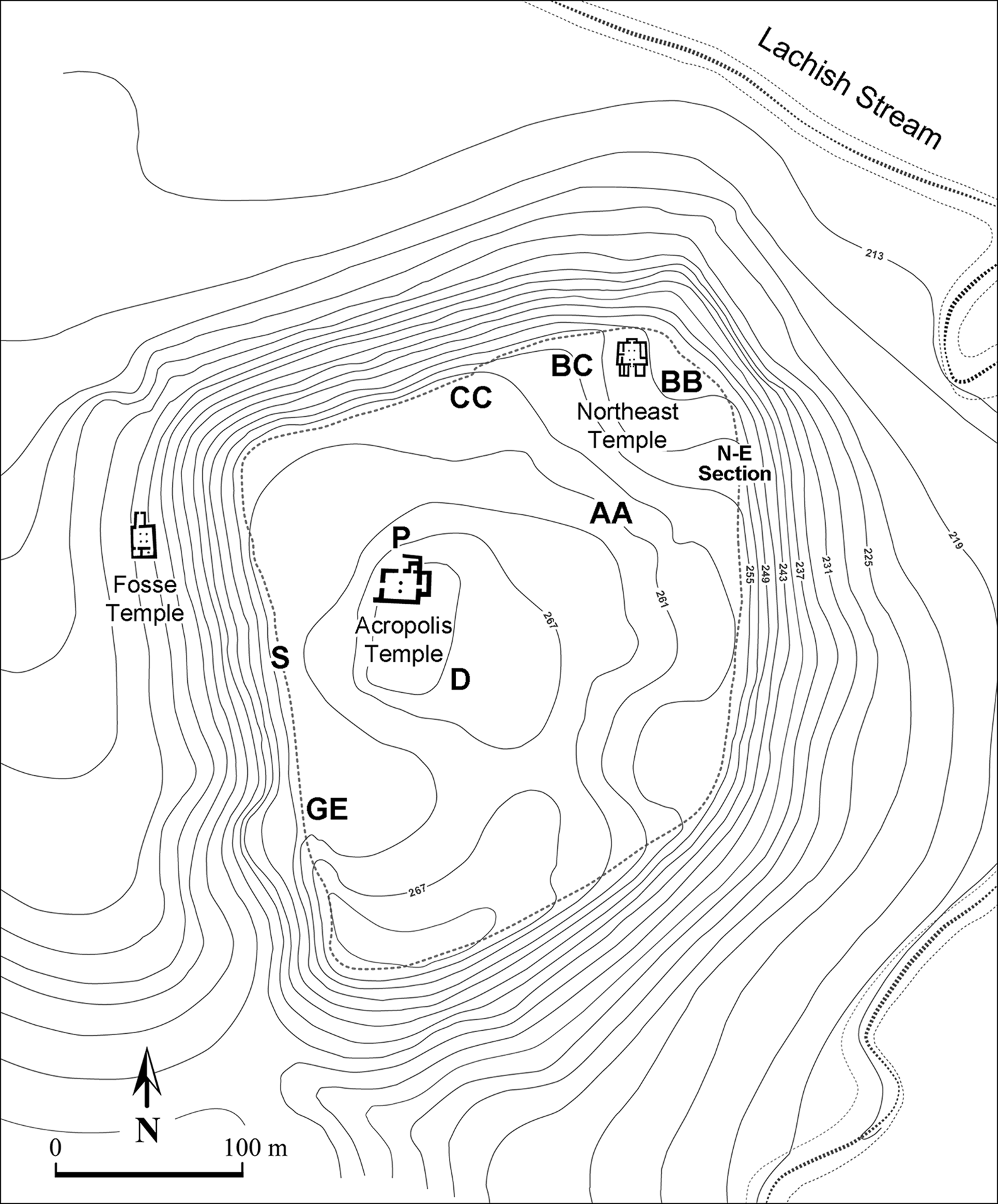
Ancient Lachish (Tell ed-Duweir) is a well-known site in the ancient Near East. It is mentioned in historical documents from Egypt (the Amarna archive) and Mesopotamia (the Sennacherib accounts), and 24 times in the Hebrew Bible. Covering some 7.5 hectares in area, the site has been excavated by four different expeditions. One of the most important discoveries of the fourth expedition (2013–2017; Garfinkel et al. Reference Garfinkel, Hasel and Klingbeil2013, Reference Garfinkel, Kreimerman, Hasel, Klingbeil, Maeir, Shai and McKinny2019a; Weissbein et al. Reference Weissbein, Garfinkel, Hasel, Klingbeil, Brandl and Misgav2019) is a Canaanite temple located in the north-eastern corner of the site (Figure 3). It was attributed to Level VI and dated to the twelfth century BC (as defined by Ussishkin Reference Ussishkin and Ussishkin2004). This date is now supported by new radiometric assays (Garfinkel et al. Reference Garfinkel2019b).
Plan of Tel Lachish, showing the main excavation areas and the three Canaanite temples uncovered at the site; the temple that yielded the sceptre is in area BB (drawing by I. Weissbein).

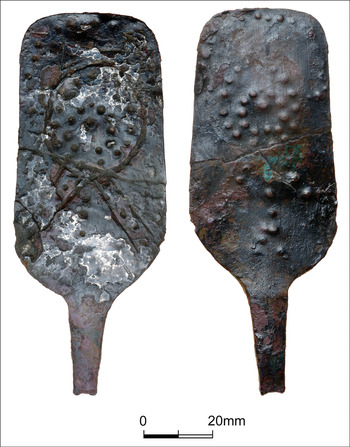
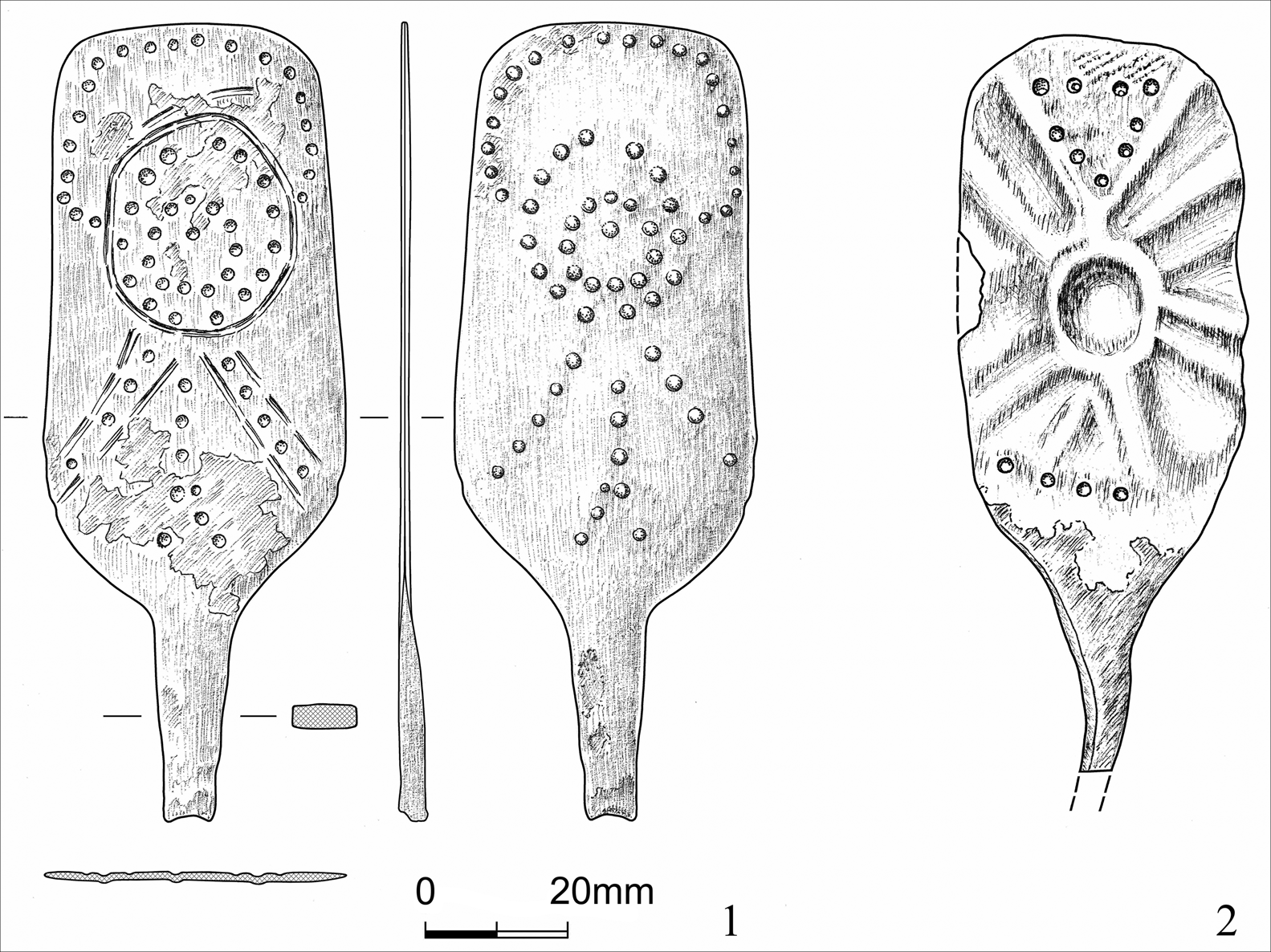
The object under discussion here is a spatula-like item measuring 112 × 42mm, cast from bronze and coated with thin silver leaf on its front (Figures 4 & 5.1). At one end is a 28mm-long tang. The tang is three to four times thicker than the rest of the artefact, indicating that it formed the lower part of the object, which was held from this end. After casting, decorative designs were added to the object's surface, employing two different techniques:
1. Incision, creating a large circle in the upper part of the object, and two pairs of parallel, diagonal lines in a symmetrical arrangement in the centre.
2. Percussion of the object's surface using an implement with a rounded tip, creating 64 dots in four areas. From top to bottom:
a. On the top edge and the upper parts of both sides, there are 20 dots parallel to the edges of the object.
b. Inside the large incised circle, there are 27 dots, organised in concentric circles. A single central dot is surrounded by two concentric circles of 11 and 15 dots each.
c. In the lower part, inside the space bordered by the parallel diagonal lines, there are four dots on the left and five dots on the right.
d. In the lower part, there are eight dots in a Y-shape, that is, a vertical line that diverges at the base into two short diagonal lines.
The two sides of the bronze sceptre from Lachish; note that the remains of silver coating are seen only on the front (photograph by C. Amit).

Drawings of two sceptres: 1) Lachish: life-sized sceptre; 2) Megiddo: miniature sceptre (not to scale; drawing by O. Dobovsky based on Figures 4 & 10 in this article).

The meaning of this complex pattern is unclear. It could represent a human figure with a large head, diagonal arms and a schematic lower body with legs. This interpretation, however, is not entirely convincing; it is possible that the pattern has no figurative meaning, but instead represents an astral or mythical symbol. A similar decorative motif on a sceptre from Megiddo (Figure 5) supports the conclusion that this pattern is not figurative.
The context: the cella in the north-east temple at Lachish
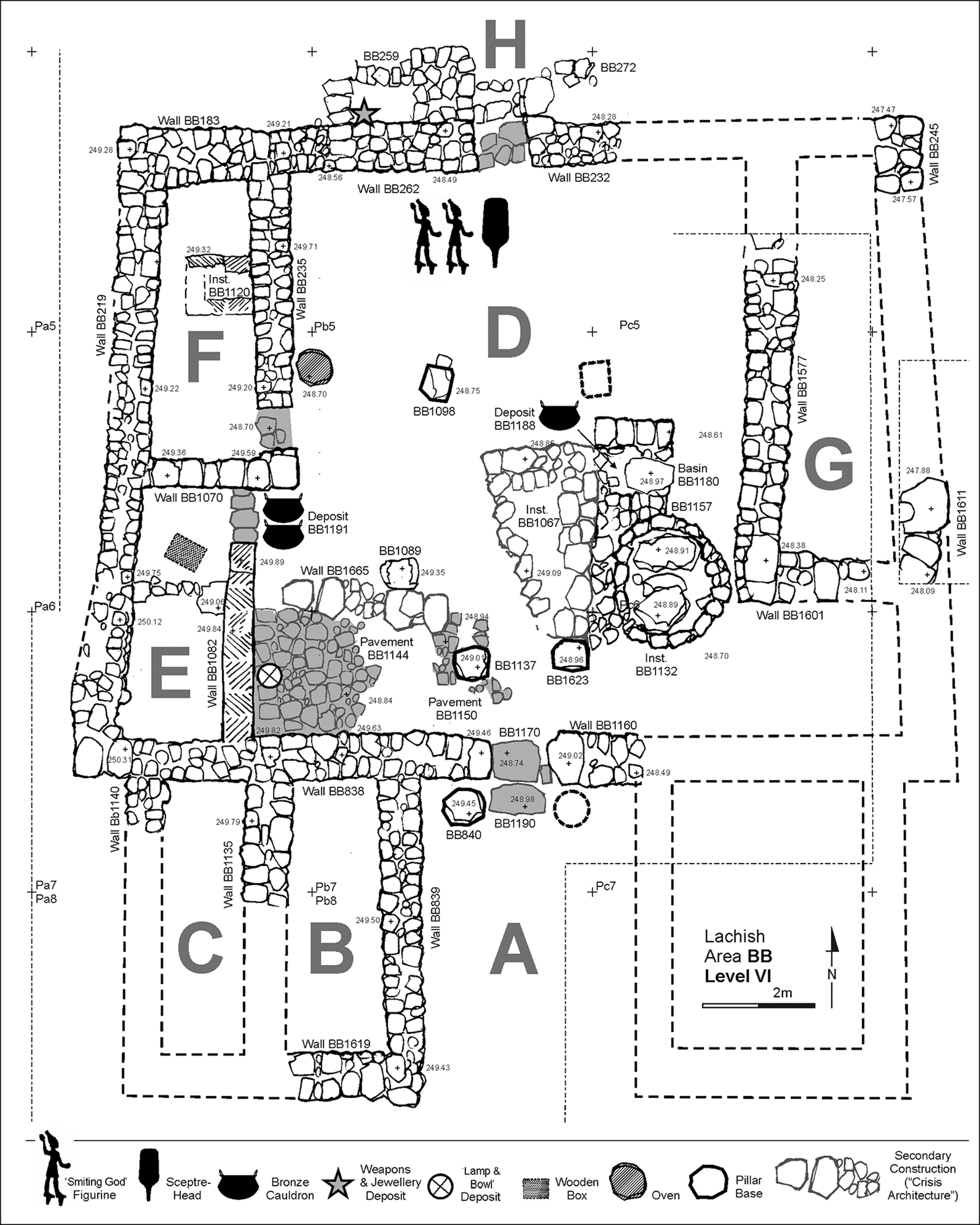
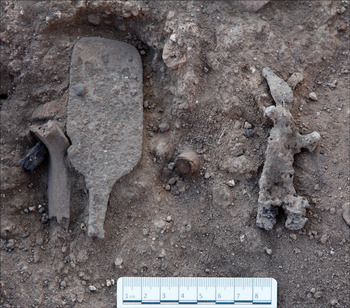
The sceptre was recovered from the temple discovered in area BB in the north-eastern corner of the site. Although the temple has suffered from erosion on its eastern and northern sides, its symmetrical plan permits reconstruction of its size: it is 19m long (north to south) and 16m wide (east to west), covering an area of approximately 304m2. The temple's entrance is flanked by two towers and two pillars. Three metal objects cast from bronze and coated with silver were found in the rear of the temple, in the cella (Figures 6–7). These include two figurines of a standing warrior-god, of a type known from various other sites (see Negbi Reference Negbi1976: 30–31 & 133; Seeden Reference Seeden1980: 92–95; Cornelius Reference Cornelius1994). The third object is a spatula-like item larger than the two figurines found nearby. Other notable objects discovered in the temple include bronze weapons, gold earrings, thick gold wire, fragments of thin gold sheets and a large quantity of beads.
The Canaanite temple at Lachish and the location of the sceptre in the cella (or Holy of Holies) at the rear of the building (drawing by I. Weissbein).

Lachish: close-up of the sceptre and a smiting god figurine in situ (photograph by Y. Garfinkel).

The sceptre from Hazor
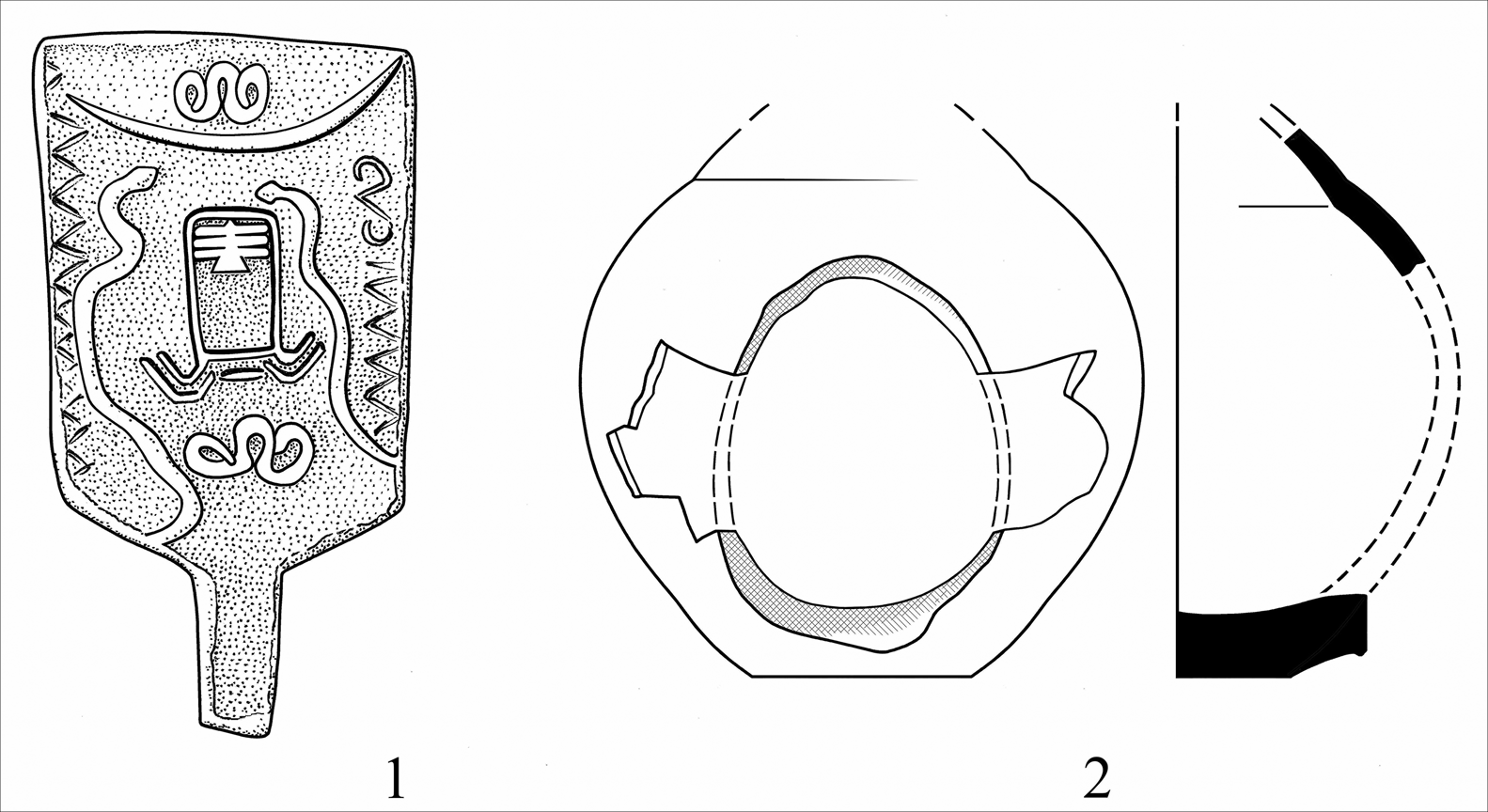
Hazor was the largest Canaanite city in the Southern Levant, covering an area of approximately 80 hectares (Yadin Reference Yadin1972). Large-scale excavations by the Hebrew University of Jerusalem took place at the site during the 1950s under the direction of Yigael Yadin, uncovering several Canaanite temples and cultic areas (Yadin Reference Yadin1972). These excavations also produced the only other object similar to the spatula-like find from Lachish known to date. It was found in layers related to the destruction of the last Late Bronze Age city, dating to the thirteenth century BC. The object is made of bronze, is coated with thin silver leaf and decorated by relief and incision. It measures 70 × 125mm and was defined as a “cult standard” (Yadin et al. Reference Yadin, Aharoni, Amiran, Dothan, Dunayevsky and Perrot1960: 117–18, pl. CLXXXI; Negbi Reference Negbi1976: 192, no. 1706) (Figure 8.1). Its lower part ends in a tang, which the excavators suggest was intended to be inserted into a wooden shaft or pole. Similarities with an object held by the figurine from Megiddo suggest that this object should be interpreted as a sceptre.
Artefacts from Hazor, area C: 1) bronze sceptre covered with silver; 2) the simple ‘portable shrine’ vessel in which the sceptre was found.

The Hazor sceptre was found near the temple in building 6211, a room with benches (Yadin et al. Reference Yadin, Aharoni, Amiran, Dothan, Dunayevsky and Perrot1960: 104–106; Yadin Reference Yadin1972: 36). As such rooms are characteristic of cultic activity, the room may have been a shrine (Tadmor Reference Tadmor1989). The object was found inside a pottery container described as a “house-shaped vessel” due to its shape and the large rectangular opening at the bottom of one side (Figure 8.2; Yadin et al. Reference Yadin, Aharoni, Amiran, Dothan, Dunayevsky and Perrot1960: 109, pl. CXXIII: 4; Katz Reference Katz2016: 26, fig. 69). As possible miniature representations of buildings, these vessels are commonly known as ‘shrine models’ (Bretschneider Reference Bretschneider1991; Muller Reference Muller2002, Reference Muller2016; Kletter Reference Kletter, Kletter, Ziffer and Zwickel2015). Alternatively, they are considered to be boxes made to hold sacred objects, and are thus called ‘naos/naiskos’, ‘tabernacles’, or ‘portable shrines’ (Mazar Reference Mazar1980: 82–84; Moscati Reference Moscati1988: 163, 353; de Miroschedji Reference de Miroschedji and Muller2001; Garfinkel & Mumcuoglu Reference Garfinkel and Mumcuoglu2015; Katz Reference Katz2016). The discovery of such a pottery vessel containing the bronze statue of a calf at Ashkelon in southern Israel (Stager Reference Stager, Stager, Schloen and Master2008) supports the second of these two interpretations. Some of these ‘portable shrines’ are elaborately decorated (Garfinkel & Mumcuoglu Reference Garfinkel and Mumcuoglu2016), although most are of modest manufacture. The vessel from Hazor belongs to the latter group (see, for example, Muller Reference Muller2002, Reference Muller2016; Katz Reference Katz2016), but the sceptre's placement inside such a container nevertheless indicates that it was imbued with divine powers (see below).
As a thick layer of corrosion obscures the sceptre's surfaces, Tadmor (Reference Tadmor1989: fig. 3) employed radiographic analysis to reveal a complex decorative pattern with a rectangle in the centre, a rounded line above it and four additional elements at the sides. Tadmor concluded that the pattern represents a crescent on top and a human face flanked by snakes (Figure 8).
The two sceptres from Lachish and Hazor date to the end of Canaanite occupation at these sites (twelfth and thirteenth centuries BC, respectively). Both come from cultic contexts, are of similar size and are made of bronze coated with silver.
Iconographic analysis: the Megiddo figurine
Megiddo was an important Canaanite city in northern Israel, located on the major route from Mesopotamia to Egypt (Kempinski Reference Kempinski1989; Ussishkin Reference Ussishkin2018). Its location meant that most large-scale military invasions of the Levant passed near the site, explaining its association with ‘Armageddon’, the battle at the end of time (Cline Reference Cline2000). Covering approximately six hectares, the site has been extensively investigated over the past century. The largest excavations were carried out by the Oriental Institute of the University of Chicago in the 1920s and 1930s.
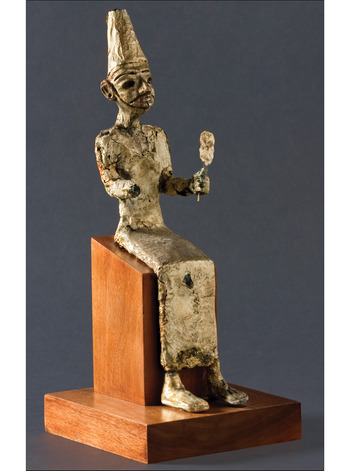
A large symmetrical temple was constructed in area BB at Megiddo during the Middle Bronze Age (eighteenth century BC) over a sequence of earlier temples dating from the third millennium BC. This temple underwent various renovations and was in use until c. 1000 BC. Excavations of a thirteenth-century BC layer of debris within the temple (level VII) has yielded the figurine of a seated god holding an object (Figures 9–10; Loud Reference Loud1948: 159, pls 237–38; Negbi Reference Negbi1976: 50, 172; Schroer Reference Schroer2011: 362, no. 933; Evans et al. Reference Evans, Green and Teedter2017: 74). Schroer (Reference Schroer2011) interprets the object being held by the figurine as a flower, a motif known in various Middle and Late Bronze Age representations. The Megiddo figurine is key to interpreting the objects from Lachish and Hazor as ‘sceptres’.
Canaanite figurine of a seated god from Late Bronze Age Megiddo (courtesy of the Oriental Institute of the University of Chicago).

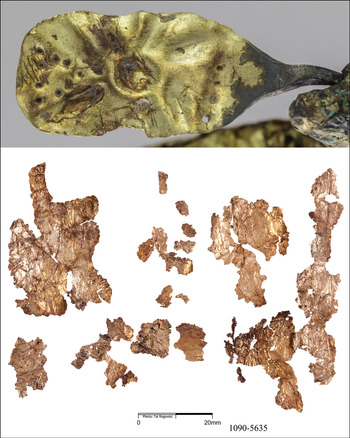
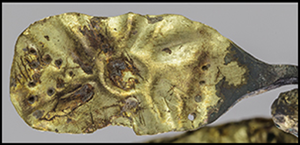
Top) close-up of the sceptre held by the seated god figurine from Megiddo (courtesy of the Oriental Institute of the University of Chicago); bottom) remnants of gold sheets found in the temple at Megiddo, possibly associated with a life-sized statue (photograph by T. Rogovsky).

The figurine is now exhibited in the museum of the Oriental Institute at the University of Chicago. This impressive 270mm-high bronze object is entirely coated in gold. It represents a seated god holding in his left hand a spatula-shaped sceptre with a 20mm-long narrow tang. The form of this sceptre is a miniature version of the objects discovered at Lachish and Hazor. Negbi (Reference Negbi1976: 46–59) classifies the seated figure as belonging to the “enthroned male deity” group, and it can be identified as the Canaanite god El, the head of the Canaanite pantheon. El's consort was Asherah, and their three most significant offspring were Baal, Anat and Mot (Pope Reference Pope1955; Cross Reference Cross1973; Day Reference Day2000). The older El is typically represented in a seated position, clearly differentiated from the younger warrior gods Baal and Reshef, who are shown standing with weapons in their raised right hands (Cornelius Reference Cornelius1994).
When the figurine was discovered, the sceptre was bent downwards and it remained in this position for decades; this feature of the figurine received little attention and it was never photographed separately (Loud Reference Loud1948: 159, pls 237–38; Negbi Reference Negbi1976: 50 & 172). Only much later was the sceptre restored to its original upright position in the figure's left hand (Evans et al. Reference Evans, Green and Teedter2017: 74). Recently, a close-up photograph of the sceptre was ordered (by the author) for the first time, in collaboration with the Oriental Institute. Examination of the Megiddo sceptre shows that it was decorated with a complex pattern (Figures 5.2 & 10) using two different techniques:
1. Hammering: in the centre of the object is a large circle, with a sunken inner part and raised rim. Straight, raised lines radiate from the circle.
2. Percussion: using an object with a rounded tip to create 13 dots in two areas:
a. Nine dots in the upper part in a triangular pattern.
b. Four dots in the lower part in a straight line.
While the meaning of this complex pattern is unclear, it resembles the decoration on the Lachish sceptre. Both objects have three similar components: a large central circle, straight diagonal lines and dots. There are also notable differences between the two. The Lachish sceptre is more detailed, with 64 dots and additional lines, creating a much more complex pattern. This, however, could be due to the difference in the objects’ sizes, the larger Lachish sceptre allowing for greater detail. The Megiddo sceptre's decoration, while exhibiting a very similar design, was created in a more schematic manner. Regardless, it is difficult to see the ‘blossom’ motif previously suggested by Schroer (Reference Schroer2011: 362, no. 933). The gold coating of the Megiddo figurine and sceptre recalls the manner in which golden sceptres were used to reflect the light of the Sun in New Kingdom Egypt during Akhenaten's reign (David Reference David2016). The central circle of the Megiddo sceptre may therefore depict the Sun and the diagonal lines the sunbeams.
Discussion
What is the most appropriate term for the spatula-like objects presented here and interpreted as sceptres? Yadin et al. (Reference Yadin, Aharoni, Amiran, Dothan, Dunayevsky and Perrot1960: 104–106) describe the object from Hazor as a “cult standard”, and Negbi (Reference Negbi1976: 192, no. 1706) labels it a “standard”, or “a rectangular plaque with tang for attachment at bottom”. She also noted the similarity between the Hazor example and the object held by the Megiddo figurine (Negbi Reference Negbi1976: 50, note 55). A standard, however, is a much larger object with a long handle, while that held by the Megiddo figurine is clearly handheld. Other terms include ‘emblem’ and ‘insignia’, with the online Merriam-Webster Dictionary defining an emblem as “a device, symbol, or figure adopted and used as an identifying mark”, whereas insignia is defined as “a badge of authority or honor” (https://www.merriam-webster.com/). These two terms, however, do not directly relate to an object held in the hand, and consequently the term sceptre seems more appropriate here.
The object from Lachish can similarly be interpreted as a sceptre held in the hand of a life-sized divine statue that had been placed in the temple's cella, even though the original statue has vanished. This interpretation is based on the combination of contextual and iconographic analysis. The Megiddo figurine holding a similar but miniature object can be used as a reference to estimate the size of the original statue at Lachish. The Megiddo figurine is approximately 270mm in height, with a 20mm-long sceptre. If we use this ratio, the (presumably seated) statue of Lachish can be estimated as between 0.8 and 1m in height.
The sceptres from Lachish, Hazor and Megiddo can be considered characteristic attributes of the Canaanite god El. The sceptre was the emblem of this god, an identifying marker and symbol of his power. This raises the question of whether the sceptre became powerful because it was held by the god, or whether the god received his powers from the sceptre. To address this question, several lines of evidence can be explored.
First, it is notable that the sceptre is held in the Megiddo figurine's left hand. In ancient Near Eastern art, figures are usually depicted holding objects in their right hand, as it was considered the dominant and stronger hand for holding functional items. Baal and Reshep, for instance, hold their weapons in their right hands (Cornelius Reference Cornelius1994), and seated figures with a cup always hold it in their right hands (Schaeffer Reference Schaeffer1971: figs 6–7; Winter Reference Winter, Kelly-Bucellati, Matthiae and van-Loom1986). Placing the sceptre in the god's left hand may suggest that, rather than being a functional tool, the sceptre was considered to be a symbolic, powerful object.
Second, the discovery of the Hazor sceptre inside a ‘portable shrine’ may be relevant. As a probable relic from a statue that had decayed, the sceptre was still considered to be imbued with supernatural powers and was thus placed in a special box and venerated by believers. This scenario would suggest that the sceptre was an object with powers of its own.
Third, the similar motifs on the Lachish and Megiddo sceptres suggest that the decoration may have held its own symbolic meaning. The sceptres, as is common with cultic artefacts, had to be made in a specific shape and with specific decoration (Garfinkel et al. Reference Garfinkel, Shlomo and Korn2010: 1; Garfinkel & Mumcuoglu Reference Garfinkel and Mumcuoglu2016: 178). Finally, it is possible that a Biblical tradition relates to such an item, when a term usually translated into English as a ‘rod’ or ‘staff’ is used. For example, Moses was thus able to perform miracles, a uniquely divine ability, after he “took the staff of God in his hand” (Exodus 4:20). This ability derived not from a spell or an action, but from actually holding the sceptre of God, an object imbued with intrinsic supernatural powers.
These examples suggest that the sceptre was an item of great importance to both the god and the believers. Held in the left hand, it was clearly not a utilitarian item, but an emblem, an object that effectively enabled apotheosis, just as it enabled Moses to perform miracles.
Excavations of the temple area at Lachish yielded metal weapons, gold earrings and, of potential significance here, the remnants of a gold sheet (Figure 10). This sheet may have covered the statue, just as the Megiddo figurine is covered with gold.
While life-sized statues of divine figures are extremely rare in the Levant, we do have thousands of metal and clay figurines (Negbi Reference Negbi1976; Seeden Reference Seeden1980; Cornelius Reference Cornelius1994; Moorey Reference Moorey2003; Weissbein et al. Reference Weissbein, Garfinkel, Hasel and Klingbeil2016). The direct iconographic connection between the Megiddo figurine and the sceptres from Lachish and Hazor suggests that the small figurines were made in the same shape as the large statues. Thus, these small figurines can be used as proxies through which to reconstruct the life-sized divine statues. A famous cult statue of a god located within a central temple probably inspired the production of small replicas, a notion previously suggested for Iron Age Judean pillar figurines (Moorey Reference Moorey2003: 14), the Neolithic figurines of Sha‘ar Hagolan in the Jordan Valley (Garfinkel et al. Reference Garfinkel, Shlomo and Korn2010: 3) and the Iron Age Near Eastern ivories depicting a woman looking through a stylised window, from Samaria, Arslan Tash, Nimrud and Khorsabad (Garfinkel & Mumcuoglu Reference Garfinkel and Mumcuoglu2016: 178).
Conclusion
This article has presented and discussed a unique artefact discovered in a temple in the Canaanite city of Lachish, Israel, and a similar artefact previously found at Hazor. The archaeological context of the object from Lachish and its iconography strongly suggest that it belonged to a life-sized statue of the Canaanite god El. An increased awareness and understanding of these discoveries may help to identify other such remnants of life-sized statues in the Near East and beyond, and stimulate discussion of the power embodied by these figures.
Acknowledgements
The excavations at Lachish were co-sponsored by the Institute of Archaeology at the Hebrew University of Jerusalem and the Institute of Archaeology at the Southern Adventist University, under the co-direction of Yosef Garfinkel, Michael Hasel and Martin Klingbeil. Consortium institutions include Seoul Jangsin University (Korea), Oakland University and Virginia Commonwealth University (USA), the Adventist International Institute of Advanced Studies (Philippines), Helderberg College (South Africa) and the Universidad Adventista de Bolivia. The excavation work was undertaken in cooperation with the Israel Antiquities Authority, the National Parks Authority and the Israel Exploration Society, and is affiliated with the American Schools of Oriental Research.