Introduction
Among the life history traits, the length of the reproductive period is one of the most relevant determinants of individual female fitness, for its short-term effect on number of progeny and long-term influence on a mother's and child's health and survival. Possible genetic factors have been hypothesized as underlying the aptitude towards late reproduction; in particular, the role of advanced age at menopause has been investigated in a large cohort of Australian twins, and the inheritance of female life history traits has been studied in the Finnish population (Kirk et al., Reference Kirk, Blomberg, Duffy, Heath, Owens and Martin2001; Pettay et al., Reference Pettay, Kruuk, Jokela and Lummaa2005, Reference Pettay, Helle, Jokela and Lummaa2007, Reference Pettay, Charmantier, Wilson and Lummaa2008). Since several other factors, including maternal health, family socioeconomic status and cultural background, probably contribute to this complex trait, the evaluation of the relative roles of genetic and environmental components is an exacting task.
At the population level, socioeconomic and cultural disparities, and microevolutionary forces such as natural selection and genetic drift, can lead to heterogeneities in the incidence of the trait and influence the genetic and demographic structure of local populations. Genetic isolates, in consequence of the reduced ground noise for the more homogeneous genetic, epidemiological, cultural and socioeconomic background, can be a suitable context in which to evaluate the relative weight of the determinants of the trait.
The Sardinian population represents a peculiar case because of its geographical and historical isolation, and appears very different from the mainland and other European countries (Golini, Reference Golini1967; Livi Bacci, Reference Livi Bacci1977; Modiano et al., Reference Modiano, Terrenato, Scozzari, Santachiara-Benerecetti, Ulizzi and Santolamazza1986; Zei et al., Reference Zei, Lisa and Astolfi1990; Cavalli-Sforza et al., Reference Cavalli-Sforza, Menozzi and Piazza1994; Caglia et al., Reference Caglia, Novelletto, Dobosz, Malaspina, Ciminelli and Pascali1997; Astolfi et al., Reference Astolfi, Ulizzi and Zonta2002, Reference Astolfi, De Pasquale and Zonta2007). Several factors have been reported to influence the demographic and genetic structure of the people: high levels of endogamy and consanguinity, low immigration, slow changes in the socioeconomic and cultural context and in the genetic makeup, deeply rooted traditional background, past malaria endemia and consequent high infant mortality. Cultural and socioeconomic factors, based on the patriarchal family structure and the sheep-rearing economy, have been invoked to explain both the aptitude towards a large family size, despite the late maternal age (Livi Bacci, Reference Livi Bacci1977), and the tendency to delay first childbirth, unusually associated with an extended span of the reproductive period (Zei et al., Reference Zei, Lisa and Astolfi1990). Moreover, favourable lifestyles and genetic factors have been hypothesized to contribute to the chance of childbearing at an advanced age, and homogeneous areas, characterized by women's aptitude towards reproducing later and by a reduced cost in terms of perinatal deaths, have been identified (Astolfi et al., Reference Astolfi, De Pasquale and Zonta2007, Reference Astolfi, Caselli, Fiorani, Lipsi, Lisa and Tentoni2009).
In addition, the chance of reaching the oldest ages, besides being in part genetically transmitted, seems to be largely modulated by lifestyle, nutrition and social context. Since on the island individuals of high and extreme longevity are particularly frequent, Sardinian centenarians have been chosen as a model to investigate human longevity (Deiana et al., Reference Deiana, Ferrucci, Pes, Carru, Delitala and Ganau1999; Gatti & Salaris, Reference Gatti and Salaris2004; Poulain et al., Reference Poulain, Pes, Grasland, Carru, Ferrucci and Baggio2004).
The main aim of the study was to explore the spatial heterogeneity of maternal age at last childbirth and to identify local excesses of mothers with an aptitude towards late childbearing. Through methods of spatial analysis on two data sets from different sources and covering different periods, at least 20 years apart, areas of interest were highlighted, characterized by post-reproductive longevity and a tendency to relatedness. A group of villages was eventually highlighted where all the considered indicators, namely late maternity, women's longevity and a tendency to consanguineous marriages, exhibited higher than expected intensities.
Data
Two different sets of Sardinian data on female fertility, provided by the Italian Central Institute of Statistics (ISTAT), were analysed. The first data set comes from a special investigation on women's fertility, carried out as part of the 1961 Italian Census, which collected 138,780 records of all the mothers who, at the census time, lived in Sardinian municipalities, the smallest administrative units. From the original data set mothers were selected who, in 1961, were more than 50 years old and had ended their reproductive period, had had children in the first half of the century, and gave information on children number and age at last childbirth. The second data set concerns birth records of all neonates born in Sardinia from 1980 to 1996; due to changes in the national birth registration policy, no more recent data are available. After exclusion of records with missing information on maternal age, the final data set amounted to 302,077 records. According to existing privacy laws, data were provided in aggregated form by municipality, birth year and birth order (1st, 2nd and 3rd and over) of the baby, and maternal age at childbirth.
In order to make the information from both data samples as comparable as possible, 109,248 records of mothers with at least three children were selected from the first data set, and 63,729 records of babies of 3rd-and-over birth order were selected from the second data set. In this latter subsample maternal age was considered as a surrogate of age at last childbirth.
During the period covered by both data sets, the number of municipalities changed. Therefore, on the basis of subdivisions/aggregations that some municipalities underwent, the data were adjusted and aggregated and 375 administrative units were finally analysed.
Data on female mortality were provided by ISTAT for the period 1980–2001. For each municipality the female Standardized Mortality Rates (SMR) was computed from the death records at age 80 years and over, and low mortality rates were assumed to be indicators of post-reproductive longevity (Caselli & Lopez, Reference Caselli and Lopez1996).
Information on the incidence of consanguineous marriages was derived from the records collected by Moroni and collaborators (Reference Moroni, Anelli, Anghinetti, Lucchetti, Rossi and Siri1972) in the bishoprics of Sardinia for the period 1880–1969. From such data collection records with complete and reliable information covering the period 1930–1969 were selected and the incidence of consanguineous marriages evaluated in each municipality.
Methods
Late maternity indicators
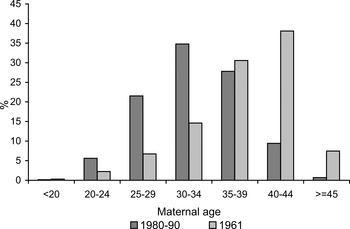
The distributions of maternal age at last or at 3rd-and-over childbirth were examined in both the first and the second data sets (Fig. 1). The 90th centiles, which roughly corresponded to 45 and 40 years in the first and second distributions, respectively, were assumed to be threshold ages for late reproduction. Those bearing their last or 3rd-and-over child beyond their respective threshold age are subsequently named ‘old mothers’.
Frequency distribution of maternal age at last or at 3rd-and-over childbirth in the examined data sets.

The investigation on the spatial distribution of old mothers was based on two indicators computed at municipality level: i) indicator I1, computed from the first data set as the proportion of mothers who were 50+ years old at the last childbirth over all the mothers with 3rd-and-over children; ii) indicator I2, computed from the second data set as the proportion of babies born to 40+ year old mothers over the total number of 3rd-and-over born babies. Values exceeding the regional average were considered as indicators of local aptitude to late reproduction.
Spatial analysis
Spatial analysis of the data was carried out with the aim, on the one hand, of providing effective and useful visual representations of the spatial course of each indicator, reflecting the true underlying geographic variation; and on the other hand, to highlight common ‘excess’ areas, where both late maternity indicators were higher than expected.
After preliminary visual inspection of the raw spatial distributions of I1 and I2 values by means of choropleth maps, a first fundamental step in the analysis was to check whether the observed heterogeneity of the geographical distributions was significant and not just the effect of random fluctuations. Consequently, to explore the true spatial structure of I1 and I2, kernel density estimates of both indicators were computed, smooth noise-free maps of their spatial course were generated and excess areas were singled out by means of critical isopleths (Silverman, Reference Silverman1986; Astolfi et al., Reference Astolfi, Caselli, Fiorani, Lipsi, Lisa and Tentoni2009).
Afterwards, through the intersection of the I1 and I2 critical areas, a common excess area was identified where both indicators were significantly higher than the average regional values, suggesting spatio-temporal persistency of the aptitude to late childbearing. Within such intersection area, the geography of the female mortality rates and the consanguineous marriage rates, similarly obtained by kernel smoothing, were further explored.
Global uniformity test
The spatial distribution of an indicator, such as I1 or I2, is obtained as a proportion:

, where m=number of municipalities, ci=number of cases in the ith municipality, ni=population size. To check whether its global pattern was truly heterogeneous and not ascribable to random fluctuations, it was hypothesized that factors affecting it might be uniformly distributed over the whole region (null hypothesis), i.e.

,
where  is the overall regional average rate. Expected values
 , under the uniform hypothesis, are therefore
 , and significant departures from the uniform hypothesis can be detected by means of the statistic:
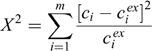
.
Through Monte Carlo simulations under the null hypothesis, for each municipality i pseudorandom patterns  were drawn from the binomial distribution with parameters
 , and the corresponding statistic
 was computed:
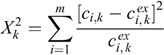
.
From the histogram of the values of  , which provides an empirical probability distribution of the test statistic under the hypothesis of regional uniformity, the significance level of the test was then drawn as the proportion of values in the distribution that exceeded the observed value (Dwass, Reference Dwass1957).
Kernel smoothing and identification of excess areas
Once it was verified that the geography of I1, I2 is truly heterogeneous, homogeneous high-incidence areas were identified, well geographically outlined, through a variable kernel-smoothing method (Silverman, Reference Silverman1986; Astolfi et al., Reference Astolfi, Caselli, Fiorani, Lipsi, Lisa and Tentoni2009). By this procedure, the prominent spatial structure is preserved while random fluctuations are reduced, and the visual bias due to arbitrary administrative divisions, which is a common drawback of discontinuous choropleth representations (Cressie, Reference Cressie1993; Lawson, Reference Lawson2001), is overcome.
The spatial variations of each variable were represented as a continuum through isopleth maps by means of a variable kernel method as follows. An equally spaced grid was first superimposed on the whole Sardinian territory. Then for each given frequency data set  , where m is the number of municipalities, the distance-weighted density of events at grid location
 was estimated as:

,
where  is a normalizing constant,
 are the coordinates of the ith municipality and
 is the standard bivariate Gaussian kernel. The kernel bandwidths hi vary between 5 and 12 km, with larger smoothing windows used in more sparsely populated areas to avoid spurious bumps in undersmoothed regions.
By taking the ratio of the kernel estimates of cases over population densities, the relative intensity of each studied indicator was obtained at each grid location. The values of the kernel ratios were further standardized with respect to the corresponding Sardinian average, so that values greater than 1 in the intensity scale correspond to higher-than-expected values in the hypothesis of constant rate equal to the regional average.
After computing the smoothed standardized rates, isopleths, i.e. lines connecting points of equal rates, were generated and a filled contour map was drawn for each indicator, I1 and I2, to provide a useful visual indication of the variation in their intensity. In both maps the excess areas, S1(I1) and S1(I2), were identified as the areas where each indicator takes values higher than 1.
Finally, the intersection area S1(I1)∩S1(I2) was obtained; that is the set of all locations where both indicators exceeded the reference rate. Subsequently in the paper such common excess area will be also referred to as area of persistent reproductive longevity.
Standardized smoothed estimates of SMR and consanguineous marriages (CM) were further computed by the same kernel density procedure. To investigate possible local association between reproductive longevity, post-reproductive longevity and consanguinity the SMR and CM intensity maps were then built within the area of persistent reproductive longevity.
Software procedures for uniformity testing, kernel smoothing, isopleth mapping and identification of critical areas were ad hoc developed in MATLAB R2007. Choropleth maps were produced by means of ArcView GIS 3.2, a geographic information system software produced by ESRI.
Results
Geography of late maternity and areas of persistent excess
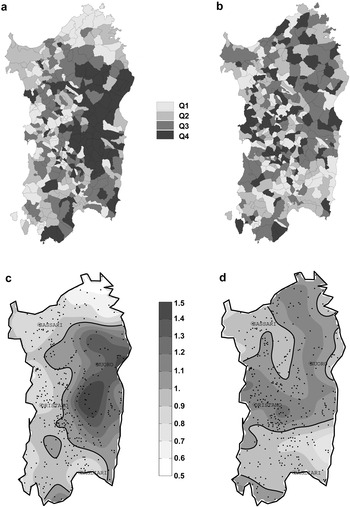
The geographies of both indicators I1 and I2 exhibit highly heterogeneous profiles, as reported in the choropleth maps of Fig. 2a and b. The non-uniformity of both patterns (p<0.0001) was confirmed by the test described in the Methods section.
Geographical patterns of indicators I1 and I2, reported through choropletic maps (panels a and b), and through kernel-smoothed maps (panels c and d). Increasingly darker areas correspond to increasing proportions of mothers with aptitude to late childbirth. In a) and b), the grey levels correspond to increasing quartiles (Q1–Q4) of the distributions; in c) and d), the thick black isopleths correspond to the average regional value and bound the excess areas, S1(I1) and S1(I2).

The true spatial structures of I1 and I2, not easily captured through the patchy patterns of the choropletic maps, are made more evident in Fig. 2c and d, which report kernel-smoothed isopleth maps of the two indicators. In each map increasingly darker areas correspond to increasing intensity in the mothers' aptitude to late childbirth; the isopleths corresponding to the average regional values bound the excess areas S1(I1) and S1(I2). The comparison of Fig. 2a, c vs b, d shows a temporal modification in the geography of the areas; the darker grey areas in the central-eastern region observed in Fig. 2c get less compact and extend to the western and northern coasts, as reported in Fig. 2d.
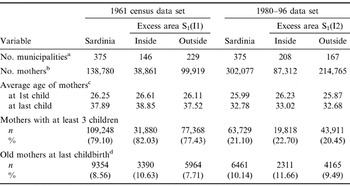
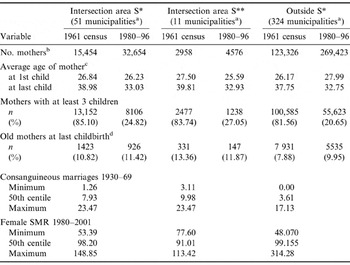
Table 1 reports the sample sizes of the two data sets and compares some maternal reproductive characteristics of the inside excess areas vs outside. Although in time the excess areas extend from 39 to 56% of the Sardinian municipalities, the proportion of mothers only slightly increases from 28.0 to 28.9%. The greatest temporal difference concerns number of progeny; in the past about 80% of Sardinian mothers had at least three children, while in the more recent period the percentage has decreased to 20%. Despite this drastic reduction, in both periods the frequency of mothers characterized by high fertility is greater inside than outside the excess area. As for maternal age, the average age at last childbirth and the incidence of old mothers are constantly higher inside than outside the excess zone.
Biodemographic variables in the two examined data sets, in the whole island and in the excess areas

a The number of municipalities was adjusted on the basis of subdivisions/aggregations that some municipalities underwent.
b In the 1980–96 data set information refers to newborns.
c In the 1980–96 data set maternal age at 1st and at 3rd-and-over childbirth was evaluated from data aggregated in 5-year classes.
d 45 years and over in the 1961 census data set; 40 years and over in the 1980–96 data set.
Percentages are computed for the mothers with at least three children.
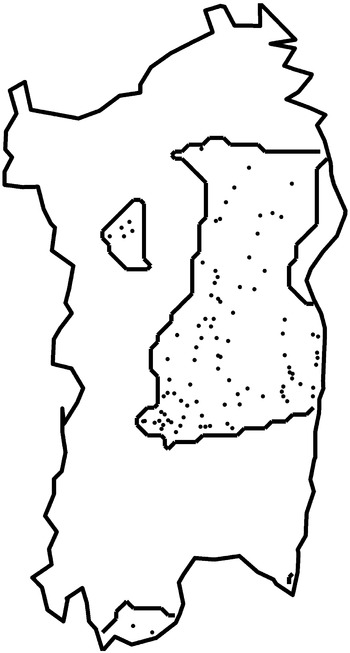
Figure 3 reports the outline of the S1(I1)∩S1(I2) area, which is located in the central-eastern part of the island and includes 96 villages where the intensity of both indicators was higher than expected. In this area the aptitude to late childbearing appears persistent in time: the percentage of old mothers at last childbirth amounted to 11.04% in the first period, and to 11.61% in the more recent one vs the regional values of 8.56 and 10.14% respectively. Average maternal age at last childbirth also exceeded the regional values: 38.94 vs 37.89 years in the first period, and 33.05 vs 32.78 years in the more recent one.
Intersection area S1(I1)∩S1(I2), characterized by persistent excess of maternal aptitude towards late reproduction.

Association between late reproduction, longevity and consanguinity
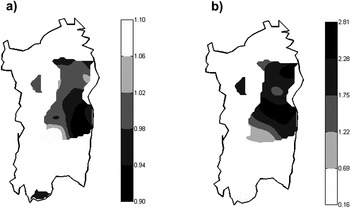
Besides the analysis of the geographical structure of indicators I1 and I2, a preliminary spatial study was carried out to explore whether the local persistent excess in late maternity could also be associated with a wider life span, and whether both characters are correlated with a peculiar genetic structure of the local population. The analysis focused on the S1(I1)∩S1(I2) area and, within it, the kernel-smoothed patterns of both the female SMR and the incidence of consanguineous marriages were explored. Figure 4a and b shows that a large portion of such an area, noticeably its south-eastern part, is characterized by SMR and CM values lower and higher/very higher, respectively, than the regional reference rate.
Kernel-smoothed maps of a) Standardized Mortality Rates, and b) percentage of consanguineous marriages in the intersection excess area, S1(I1)∩S1(I2).

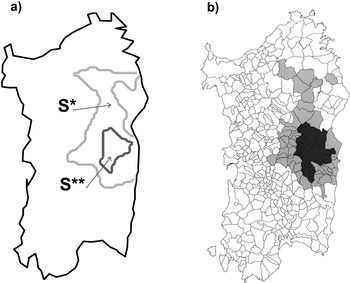
In order to highlight a possible zone of interest where the local persisting aptitude to late maternity combines with women's longevity and higher incidence of consanguineous marriages, the intersection area S*=S1(I1)∩S1(I2)∩S1(SMR)∩S1(CM), characterized by the four indicators all exceeding their respective regional average value, was examined. Figure 5 reports the outline of S* (panel a), and the map of the 51 corresponding municipalities whose territory is at least 50% included in it (light grey in panel b). The internal zone, highlighted in dark grey, corresponds to the area, denoted as S**, where all the indicators were above the fourth (below the first for SMR) quartile of their distribution. This ‘hot spot’ includes eleven municipalities where the highest deviations from the regional reference values were attained, namely high levels of late maternity and consanguineous marriages combine with low levels of female mortality.
Intersection area S* and hot spot area S**: a) outlines of the areas, and b) the corresponding municipalities. S** includes the following villages: Desulo, Fonni, Mamoiada, Orgosolo, Seui, Talana, Triei, Villagrande Strisaili, Urzulei, Ussassai and Arzana.

Table 2 reports some maternal reproductive characteristics and parameters of the CM and SMR distributions in the S* and S** areas. Inside S* the incidence of old mothers at last childbirth is 37% and 15% higher than outside, in the first and in the second period, respectively. The possible association between reproductive and post-reproductive longevity is supported by the differences in the SMR distributions between the inside and outside areas. Apart from the minimum, which characterized a single village outside S*, the 50th centile and the maximum of the distributions decrease from outside, through S* to S**. Outside S*, SMR shows a wider range of variation with an upper tail reaching a maximum of 314.28; differently, inside S* and S** the distributions are characterized by a narrower range, even more evident in the eleven villages of the S** area.
Maternal reproductive traits, and parameters of distributions of consanguineous marriages (%) and longevity (SMR), in intersection areas S* and S**

a The number of municipalities was adjusted on the basis of subdivisions/aggregations that some municipalities underwent.
b In the 1980–96 data set information refers to newborns.
c In the 1980–96 data set maternal age at 1st and at 3rd-and-over childbirth was evaluated from data aggregated in 5-year classes.
d 45 years and over in the 1961 census data set; 40 years and over in the 1980–96 data set.
Percentages are computed for the mothers with at least three children.
As for the percentages of consanguineous marriages, it has to be noted that in the areas of interest the distribution is right-shifted with respect to that of the outside area. Within S* and S** the 50th centiles account for 7.93 and for 9.98, respectively; these values are 2 to 3 times higher than the 50th centile (3.61) in the area outside S*.
Discussion
The study underpins previous results on the aptitude of Sardinian women to late childbearing (Astolfi et al., Reference Astolfi, De Pasquale and Zonta2007, Reference Astolfi, Caselli, Fiorani, Lipsi, Lisa and Tentoni2009) and, through the spatial analysis of two biodemographic indicators based on two different data sets, singles out an inland eastern zone (Fig. 3). This area includes 96 villages where the intensity of both indicators was higher than expected, thereby suggesting that the trait is locally persistent despite the temporal changes in the reproductive behaviour. In this zone the maternal aptitude to reproduce later seems to combine with an extended life span and the tendency to marry relatives. The underlying assumption was that i) the extension of both the reproductive and post-reproductive period might be influenced by common determinants, able to enhance the role of biological factors that oppose the effect of ageing and of the associated pathologies, and ii) in isolated villages the tendency to get married within a restricted familial group might modify the longevity traits. Concurrence of socioeconomic and cultural context and micro-evolutionary mechanisms might have favoured local excess of late maternities (Fig. 2, Table 1).
In Sardinia association between high fertility and propensity to delay marriage and reproduction has historical cultural and socioeconomic origins. It has been ascribed to the small size of the villages, mostly located in the mountainous inland area, the high endogamy rate, and the patriarchal structure of the family based on a sheep-rearing economy. Over the last century, among Sardinian brides age at marriage was constantly later by about one year than among mainland brides, and age at childbirth followed a similar pattern. The tendency to delay maternity always resulted in a higher proportion of mothers childbearing at 35 years and over in Sardinia than on the mainland (Golini, Reference Golini1967; Livi Bacci, Reference Livi Bacci1977; Astolfi et al., Reference Astolfi, Ulizzi and Zonta2002). Despite the negative impact this tendency has on women's fertility, during the past century Sardinian mothers experienced the highest fertility rate in the country: in 1961 it was 1.5 and 4.23 times higher in mothers aged 30–34 and 45–49 years, respectively (Golini, Reference Golini1967). Only recently has fertility decreased and approximated the lowest values on the mainland (ISTAT 1990–97).
Despite the deep-rooted traditions, the last century's improvement in socioeconomic status, the breakdown of the patriarchal structure of the family and internal and external migration have greatly modified women's reproductive behaviour. The distributions of maternal age differ noticeably between the two data sets over the two periods, 20 years apart, and reflect changes in women's reproductive behaviour and, in particular, the tendency towards a reduction in family size. Women who were born in Sardinia at the end of the nineteenth century and who had children in the first half of the twentieth century, were characterized by high fertility (more than 80% had at least three children), while in the 1980–1996 period only 21% of the mothers bore three or more children. The highlighted excess areas are also characterized by a greater incidence of mothers with a progeny number of three or more children: 82.03% inside vs 77.43% outside in the first period, 22.70% inside vs 20.45% outside in the second period.
The temporal variation in the spatial pattern of the tendency to delay maternity is clearly seen from the comparison of the I1 and I2 maps (Fig. 2). The inland zone of interest expands to the north and west, including an increasing number of municipalities, and, despite the changes in the area extension and the over twofold increase in the corresponding population, in both periods about 28–29% of all Sardinian mothers lived in the excess areas. Among these mothers the percentage of old ones remained fairly constant over time: 10.6% vs 11.7% in the first and second period, respectively (Table 1). Such figures on the one hand reflect the tendency of the population in the inland mountainous villages to internal migration towards developing zones and related job opportunities; on the other hand they highlight the persisting maternal aptitude to reproduce later.
The relation between the lengths of the reproductive and post-reproductive periods has been widely investigated, although with controversial results (Perls et al., Reference Perls, Alpert and Fretts1997; Westendorp & Kirkwood, Reference Westendorp and Kirkwood1998; Promislow, Reference Promislow1998; Perls & Fretts, Reference Perls and Fretts2001; Zeng & Vaupel, Reference Zeng and Vaupel2004; Helle et al., Reference Helle, Lummaa and Jokela2005). Since socioeconomic and cultural determinants, besides the genetic components, have been hypothesized to modify the extension of both periods, this study explored whether local aptitude to late childbearing combined with post-reproductive longevity. Within the excess area qualified for late maternity, a heterogeneous pattern characterized by a south-eastern area of lower than average values of female mortality was highlighted, corresponding to higher longevity levels (Fig. 4a). Such spatial correspondence might be the response to similar environmental and cultural determinants and to micro-evolutionary forces affecting common heritable factors, giving protection against the effects of ageing (Pettay et al., Reference Pettay, Kruuk, Jokela and Lummaa2005). It is interesting to note that this area matches well the ‘blue zone’ characterized by high prevalence of centenarians (Poulain et al., Reference Poulain, Pes, Grasland, Carru, Ferrucci and Baggio2004).
A positive association between reproductive and post-reproductive longevity had been directly proved by Zeng & Vaupel (Reference Zeng and Vaupel2004) on recent data from the Chinese population, Helle et al. (Reference Helle, Lummaa and Jokela2005) on historical data from Sami populations of northern Scandinavia, and Muller et al. (Reference Muller, Chiou, Carey and Wang2002) in a study on historical data from French-Canadian population. It is in contrast to the generally accepted theory of a trade-off between high fertility and life extension (Westendorp & Kirkwood, Reference Westendorp and Kirkwood1998; Kirkwood & Austad, Reference Kirkwood and Austad2000), and foreshadows possible alternative mechanisms, among which are the simultaneous influence of cultural and socioeconomic favourable factors. Among these a wide temporal extension of maternal care, even in the post-reproductive period, was found to be positively associated with the probability of survival in neonates born to aged mothers (Muller et al., Reference Muller, Chiou, Carey and Wang2002).
A further intriguing observation, which conflicts with the expected adverse effect of inbreeding on health and fertility, concerns a zone where reproductive and post-reproductive longevity correlate with higher incidence of consanguineous marriages (Fig. 5, Table 2). The positive association between population homozygosity and increased life span had been hypothesized in studies on Japanese and Sardinian centenarians (Takata et al., Reference Takata, Suzuki, Ishii, Sekiguchi and Iri1987; Bonafè et al., Reference Bonafè, Cardelli, Marchegiani, Cavallone, Giovagnetti and Olivieri2001; Cardelli et al., Reference Cardelli, Marchegiani, Cavallone, Olivieri, Giovagnetti and Mugianesi2006). Propensity to relatedness is expected to increase homozygosity in single or multiple genes, which influence complex traits, such as reproductive and post-reproductive longevity. Therefore, through mechanisms of positive selection and/or genetic drift, fertility in aged women may be enhanced by the tendency to get married within a restricted familial group (Montesanto et al., Reference Montesanto, Passarino, Senatore, Carotenuto and De Benedictis2008). Besides the potential genetic factors, the socioeconomic advantages associated with preserving land and flock (Cavalli-Sforza et al., Reference Cavalli-Sforza, Moroni and Zei2004; Bittles et al., Reference Bittles, Grant, Sullivan and Hussain2002), the kin help in improving neonate survival (Sear & Mace, Reference Sear and Mace2008) and a positive relation between kinship and fertility can also be considered (Helgason et al., Reference Helgason, Palsson, Guobjartsson, Kristjansson and Stefansson2008).
With regard to the S* area, it has to be noted that it well matches a well defined central-eastern region, the refuge land of Sardinians from past invasions and partially including the Ogliastra villages. With the exception of two of them, all 51 municipalities comprising S* are located in this central-eastern area, which had been previously characterized on the basis of archaeology, linguistic studies and a high frequency of ancient genetic markers (Contini et al., Reference Contini, Cappello, Griffo, Rendine and Piazza1989; Zei et al., Reference Zei, Lisa, Fiorani, Magri, Quintana-Murci, Semino and Santachiara-Benerecetti2003). In addition, eighteen of the S* municipalities and six of the ten municipalities in the hot spot S** are in Ogliastra, a sparsely populated area of 23 villages that, for their genetic homogeneity, have been considered proper candidates for studies on genetic isolates (Caramelli et al., Reference Caramelli, Vernesi, Sanna, Sampietro, Lari and Castrì2007; Pistis et al., Reference Pistis, Piras, Pirastu, Persico, Sassu, Picciau and Prodi2009).
In conclusion, by means of kernel mapping, this study shows the heterogeneous pattern of women's aptitude to late reproduction, and outlines critical high-intensity zones. In these S* and S** areas the persisting aptitude to reproduce later correlates with lower female mortality and higher population relatedness, and suggests that various environmental factors and evolutionary mechanisms affecting inheritable traits have probably interacted in determining such local differentiation.
The good match between the qualified areas and the formerly defined central-eastern zone suggests that common determinants might exist, and indicates that the highlighted regions might be the target of studies aimed at exploring possible associations between women's reproductive and post-reproductive longevity, and the involved biological, genetic and environmental factors.
Acknowledgment
Data on consanguineous marriages were kindly provided by Professor Gianna Zei (IGM–CNR, Pavia).