Introduction
Population aging is one of the major challenges worldwide. China has the world's largest aging population of older adults. By 2050, the number of Chinese people aged 60 and older is expected to reach 479 million (DESA, 2017). In parallel with this aging profile, the number of Chinese older adults with dementia is projected to reach 18 million in 2030 (Chan et al., Reference Chan, Wang, Wu, Liu, Theodoratou, Car and Campbell2013). Dementia makes a major contribution to disability and health care needs among older people. The enormous disease burden has made the prevention and treatment of dementia public health priorities for China.
Increasing efforts have been made to identify modifiable factors that may prevent or slow the progression of cognitive decline in older age, and impoverished social relationships – defined as social isolation or loneliness – have received considerable attention. Accumulated evidence has shown that both social isolation (Evans, Martyr, Collins, Brayne, & Clare, Reference Evans, Martyr, Collins, Brayne and Clare2018; Kuiper et al., Reference Kuiper, Zuidersma, Zuidema, Burgerhof, Stolk, Oude Voshaar and Smidt2016) and loneliness (Boss, Kang, & Branson, Reference Boss, Kang and Branson2015; Cacioppo & Hawkley, Reference Cacioppo and Hawkley2009) affect cognitive function. Although loneliness and social isolation are sometimes perceived to be synonymous, they are conceptually different. In essence, social isolation refers to the objective aspects of isolation, such as living alone, having few contacts, or little involvement in social activities (Holt-Lunstad, Smith, Baker, Harris, & Stephenson, Reference Holt-Lunstad, Smith, Baker, Harris and Stephenson2015). In contrast, loneliness refers to a subjective feeling resulting from a discrepancy between actual and desired social relationships (Peplau & Perlman, Reference Peplau and Perlman1982). Even socially connected individuals can feel lonely, just as socially isolated individuals can be satisfied with their social relationships. Studies have found that correlations between loneliness and social isolation are generally moderate (Cornwell & Waite, Reference Cornwell and Waite2009; McHugh, Kenny, Lawlor, Steptoe, & Kee, Reference McHugh, Kenny, Lawlor, Steptoe and Kee2017).
It has been suggested that analyzing both objective and subjective aspect of social relationship in the same study can allow us to better understand how these two social constructs affect health (Cornwell & Waite, Reference Cornwell and Waite2009; Holt-Lunstad et al., Reference Holt-Lunstad, Smith, Baker, Harris and Stephenson2015; Newall & Menec, Reference Newall and Menec2019). However, researchers have mostly examined the relationship with cognitive impairment of only one construct, either loneliness or social isolation (Boss et al., Reference Boss, Kang and Branson2015; Evans et al., Reference Evans, Martyr, Collins, Brayne and Clare2018; Kuiper et al., Reference Kuiper, Zuidersma, Zuidema, Burgerhof, Stolk, Oude Voshaar and Smidt2016). Among the few studies in which loneliness and social isolation were examined concurrently, there were mixed results. Some findings support the greater association of loneliness (Holwerda et al., Reference Holwerda, Deeg, Beekman, van Tilburg, Stek, Jonker and Schoevers2014) and some findings support the greater association of social isolation in predicting with cognitive decline (Beller & Wagner, Reference Beller and Wagner2018; Griffin, Mezuk, Williams, Perrin, & Rybarczyk, Reference Griffin, Mezuk, Williams, Perrin and Rybarczyk2018). Synergistic effects of loneliness and social isolation on cognitive function were also found by some researchers. For example, analysis from the Rush Memory and Aging Project found that participants who were lonely and those with limited participation in social activities were more likely to develop Alzheimer's disease (Wilson et al., Reference Wilson, Krueger, Arnold, Schneider, Kelly, Barnes and Bennett2007). A longitudinal study with English older adults also indicated that both social isolation and loneliness were significantly associated with poorer cognitive function (Shankar, Hamer, McMunn, & Steptoe, Reference Shankar, Hamer, McMunn and Steptoe2013). More information is needed regarding both the relative and synergistic influences of social isolation and loneliness on cognitive function.
Meanwhile, another gap in knowledge is the lack of studies on the cognitive consequences of social isolation and loneliness in non-Western countries. Most studies on this topic have been conducted in North America and European countries (Courtin & Knapp, Reference Courtin and Knapp2017; Evans et al., Reference Evans, Martyr, Collins, Brayne and Clare2018; Kuiper et al., Reference Kuiper, Zuidersma, Zuidema, Burgerhof, Stolk, Oude Voshaar and Smidt2016), and it is not established whether similar patterns occur in other cultures. The importance of such research is underscored by the fact that isolation and loneliness are equally prevalent in non-Western as in Western countries. The proportion of empty-nest families (refers to those older people with no children or whose children have already left home) in China is estimated to reach 90% by 2030 (Rafnsson, Orrell, d'Orsi, Hogervorst, & Steptoe, Reference Rafnsson, Orrell, d'Orsi, Hogervorst and Steptoe2017). It has been suggested that the association between social relationships and health could be more salient in Chinese populations, for whom cultural tradition emphasizes the family system and collectivism (Yang & Victor, Reference Yang and Victor2008). However, only a few studies have investigated the impact of social relationships on cognitive function among older adults and most were limited by small sample size or cross-sectional design (Fung, Lee, Cheng, & Lam, Reference Fung, Lee, Cheng and Lam2019; Wang et al., Reference Wang, Jin, Hendrie, Liang, Yang, Cheng and Murrell2012). Two recent publications based on the Chinese Longitudinal Healthy Longevity Survey using relatively large sample size have reported the negative impact of poor social relationships on cognitive function. However, both of these studies mainly focused on loneliness rather than social isolation (Zhong, Chen, & Conwell, Reference Zhong, Chen and Conwell2016; Zhong, Chen, Tu, & Conwell, Reference Zhong, Chen, Tu and Conwell2017).
Given that very few studies examined loneliness and social isolation simultaneously in relation to cognition in non-Western populations, and the inconclusive findings in this area, we used data from the China Health and Retirement Longitudinal Study (CHARLS) to examine the impact of social isolation and loneliness, individually and simultaneously, on cognitive function among Chinese older adults. We hypothesize that both social isolation and loneliness would be significantly associated with cognitive decline over 4 years. However, we made no specific assumption about which of these two factors might play a stronger role in the light of existing mixed results. Regarding previous evidence indicating possible gender differences in the association between social relationship factors and health (Shumaker & Hill, Reference Shumaker and Hill1991; Shye, Mullooly, Freeborn, & Pope, Reference Shye, Mullooly, Freeborn and Pope1995), we also tested the interaction of gender with social isolation and loneliness on cognitive function for our sample.
Methods
Participants
Data are from the CHARLS, a nationally representative longitudinal survey sampled residents from 150 counties across 28 provinces in China, with a response rate of 80.5% (Zhao, Hu, Smith, Strauss, & Yang, Reference Zhao, Hu, Smith, Strauss and Yang2012). The CHARLS is one of the most up-to-date longitudinal data sets collected in China to study the health and well-being of older adults. The survey assigned 23 422 dwelling units to interviewers at baseline in 2011. After excluding empty or non-resident dwellings, 12 740 were age-eligible for CHARLS (Zhao et al., Reference Zhao, Hu, Smith, Strauss and Yang2012). In the present study, we used data from two waves of the CHARLS collected in 2011 and 2015. The baseline sample included 17 708 respondents. Our analytic sample was restricted to those respondents aged 50 and older (n = 13 649). We excluded those respondents who had missing values on any predictor or cognitive test at baseline (n = 3506) or cognitive test at follow-up (n = 2382), which resulted in a final sample size of 7761 respondents (mean age = 60.97, s.d. = 7.31; male, 50.8%).
Measures
Loneliness
In our study, loneliness was measured with one single item included in the Center for Epidemiological Studies Depression Scale (CESD): ‘In the last week, how often did you feel lonely?’. The respondent chose among four ordinal responses scored 1–4: rarely or none of the time (<1 day), some or a little of the time (1–2 days), occasionally or a moderate amount of the time (3–4 days), most or all of the time (5–7 days). This one-item measure correlates highly with multi-item loneliness scales and has been used in a number of previous studies (Gow, Corley, Starr, & Deary, Reference Gow, Corley, Starr and Deary2013; Holwerda et al., Reference Holwerda, Deeg, Beekman, van Tilburg, Stek, Jonker and Schoevers2014; Luo & Waite, Reference Luo and Waite2014; Nummela, Seppanen, & Uutela, Reference Nummela, Seppanen and Uutela2011; Tilvis, Pitkala, Jolkkonen, & Strandberg, Reference Tilvis, Pitkala, Jolkkonen and Strandberg2000). Loneliness was dichotomized into two categories [0 (not lonely) = those who reported feeling lonely rarely or none of the time, and 1 (lonely) = those who felt lonely sometimes, occasionally or most of the time] (Teguo et al., Reference Teguo, Simo-Tabue, Stoykova, Meillon, Cogne, Amiéva and Dartigues2016).
Social isolation
Three items were combined to create an index of social isolation, which was adapted from previous research (Glei, Goldman, Ryff, Lin, & Weinstein, Reference Glei, Goldman, Ryff, Lin and Weinstein2012; Steptoe, Shankar, Demakakos, & Wardle, Reference Steptoe, Shankar, Demakakos and Wardle2013). One point was assigned if participants were not married; had less than weekly contact (by phone, in person, or by e-mail) with children, not participating in any social activities over the last month (e.g. interacted with friends; played chess or cards; going to the community club; went to a sport, social, or other clubs; did voluntary or charity work). Scores of social isolation ranged from 0 to 3, with higher scores indicating greater isolation.
Cognitive assessment
CHARLS included similar items for cognitive function as those used in the American Health and Retirement Study (HRS), which were the components of the Telephone Interview for Cognitive Status (TICS) (Crimmins, Kim, Langa, & Weir, Reference Crimmins, Kim, Langa and Weir2011). McArdle, Fisher, and Kadlec (Reference McArdle, Fisher and Kadlec2007)'s study of the HRS data suggested two factors to adequately capture cognitive function (McArdle et al., Reference McArdle, Fisher and Kadlec2007). Following McArdle et al. and based upon previous studies using the CHARLS data (Lei, Hu, McArdle, Smith, & Zhao, Reference Lei, Hu, McArdle, Smith and Zhao2012; Pan, Luo, & Roberts, Reference Pan, Luo and Roberts2018), we constructed two measures of cognitive function. The first is an episodic memory measurement. In CHARLS, memory was assessed through an immediate word recall based on respondents' capacity to immediately repeat in any order a list of 10 Chinese nouns just read to them, followed by a delayed recall that tests respondents' ability to repeat the same list of words 4–10 min later (Crimmins et al., Reference Crimmins, Kim, Langa and Weir2011). The episodic memory measure was created by averaging the immediate and delayed recall scores, and scores ranged from 0 to 10. The second cognitive measure is based on the components of the mental status questions of the TICS established to capture the intactness or mental status of individuals. Orientation was assessed by asking respondents to name today's date (month, day, year), and identify the correct day of the week. Visuospatial ability was assessed by asking respondents to accurately re-draw a previously shown picture. Numeric ability was assessed through the serial subtraction of 7 from 100 (up to five times). Scores on these items were aggregated into a single score that ranged from 0 to 10 and was labeled as mental status, as recommended by McArdle et al. (Reference McArdle, Fisher and Kadlec2007). For both measures, higher scores indicate better cognitive function.
Control variables in the baseline survey
The analyses were adjusted for several demographic variables and behavioral, psychological, and clinical risk factors. Age, gender, education, and area of residence (urban/rural) were measured by self-report. Education was dichotomized as lower than secondary school and secondary school or above. Health habits, including drinking and smoking, were collected using a standardized questionnaire (Zhao et al., Reference Zhao, Hu, Smith, Strauss and Yang2012). Respondents were asked whether they were current smokers and whether they consumed alcohol in the past 12 months. Two measures of functional limitation were considered. CHARLS asked respondents if they required assistance with any of six activities of daily living (ADLs: walking, dressing, bathing, eating, getting into and out of bed, and toileting) or five instrumental ADLs (IADLs: preparing a hot meal, shopping for groceries, making telephone calls, taking medicines, and managing money) (Lei et al., Reference Lei, Sun, Strauss, Zhao, Yang, Hu and Yin2014). Both ADLs and IADLs were treated as binary predictors (1 = functional limitations present; 0 = no functional limitations present) due to most respondents (ADL: 83.8%; IADL: 80%) denying any limitations. Chronic diseases including hypertension, diabetes, and heart diseases were obtained by asking respondents if a physician had ever told them that they had the condition. Depressive symptoms were measured with the 10-item Center for Epidemiological Studies Depression Scale (CESD-10). Modified CESD scoring was used to exclude the loneliness question in order to derive a separate depression score that was calculated as the sum of the remaining nine questions (CESD-9, range 0–27).
Statistical analysis
Characteristics of the overall sample at baseline were described using means and standard deviations for continuous data and percentages for categorical data. Rank order correlations were used to assess correlations between key predictors including loneliness (continuous scores ranged from 1 to 4 were used) and social isolation and other variables included in the analyses. To examine the association between isolation, loneliness, and cognitive function, we used lagged dependent variable regression models with Ordinary Least Squares estimation. The lagged dependent variable model is superior for analyzing the effects of predictor variables on an outcome with two-wave panel data while controlling for the influence of time-invariant variables (Johnson, Reference Johnson2005). Seven models were fitted for both cognitive measurements. Model 1A was constructed to examine the associations between loneliness at baseline and cognitive function at follow-up by partially adjusting for control variables including age, gender, education, area of residence, and baseline cognitive function. Other control variables including chronic diseases, smoking and drinking status, ADL and IADL disabilities were then added in Model 1B. Model 1C added CESD-9 scores in the fully adjusted model. Three similar models were fitted to test the independent associations of isolation with cognitive function (Model 2A, B, and C). Model 3 added both isolation and loneliness into the fully adjusted model. We tested whether there was an interaction effect between isolation and loneliness on cognitive function by including appropriate interaction terms into the fully adjusted model. The interactions between isolation, loneliness, and gender were also assessed. For all regression analyses, standardized regression coefficients (β) were reported as variables under study were measured on different scales. Analyses were carried out using SPSS version 20.0.
Results
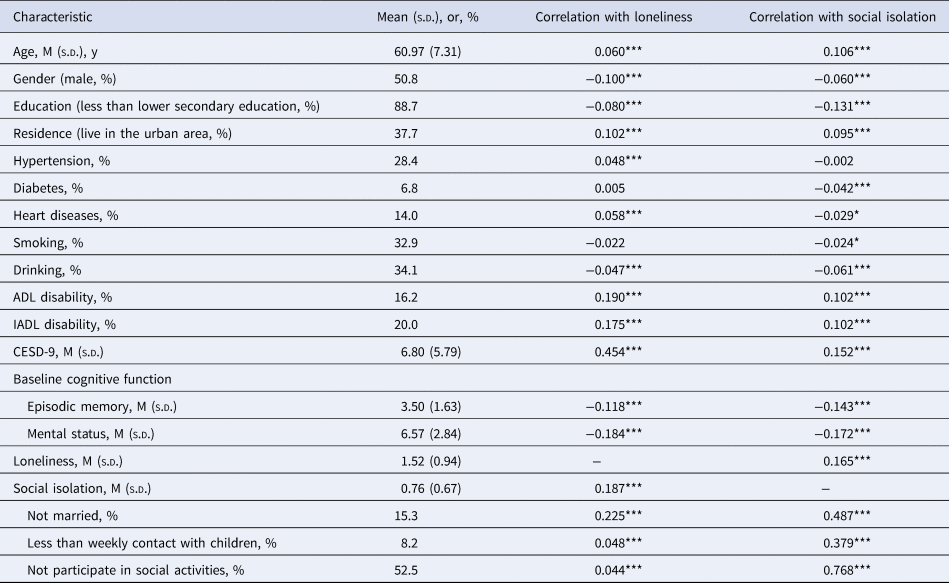
Table 1 shows the characteristics of the participants under study at baseline and their correlation with isolation and loneliness. The mean age of participants was just over 60 years, and more than half were men. When compared with those who were excluded from the original sample (n = 5888), participants included in the study sample (n = 7661) were more likely to be male (50.8% v. 47.9%; p = 0.001), younger (mean age in years: 60.97 v. 64.05, p < 0.001), and living in a rural area (62.3% v. 56.8%; p < 0.001). They were more likely to be a current smoker (32.9% v. 25.4%; p < 0.001) and drinker (34.1% v. 30.2%; p < 0.001), were less likely to have hypertension (28.4% v. 31.5%; p = 0.001), ADL disabilities (16.2% v. 24.1%; p < 0.001), and IADL disabilities (20.0% v. 30.3%; p < 0.001). In addition, individuals who were included into the study sample were more likely to feel lonely (35.7% v. 28.1%, p < 0.001), had a lower level of depressive symptoms (mean CESD-9 score: 6.80 v. 7.71, p < 0.001), lower level of isolation (mean score: 0.76 v. 0.90; p < 0.001), and both their episodic memory (mean score: 3.50 v. 3.09; p < 0.001) and mental status (mean score: 6.57 v. 5.50; p < 0.001) were better than those who were excluded from the analysis.
Baseline characteristics of the participants (n = 7761)

M, mean; s.d., standard deviation; ADL, activities of daily living; IADL, instrumental activities of daily living; CESD, Center for Epidemiologic Studies Depression scale.
*p < 0.05, **p < 0.01, ***p < 0.001.
Of all the participants, the mean scores (s.d.) for loneliness and social isolation was 1.52 (0.94) and 0.76 (0.67) respectively, with 28.1% reported that they felt lonely sometimes, occasionally, or most of the time. In total, 15.3% of the participants were unmarried. Unadjusted correlations between baseline control variables included in the analyses and isolation and loneliness were evaluated (Table 1). Being more socially isolated or lonelier was associated with being females, older, less educated, living in rural area, being a drinker, having more ADL and IADL disabilities, and a higher level of depressive symptoms. Diagnosed hypertension was positively associated with loneliness but negatively associated with isolation, as was diagnosed heart diseases. Diagnosed diabetes was only negatively associated with isolation. Loneliness was positively associated with every sub-dimension of isolation and moderately correlated with the total score of isolation (ρ = 0.17, p < 0.001). After 4 years, the mean scores on both episodic memory (from 3.50 to 3.12) and mental status (from 6.57 to 6.11) were significantly lower (t = 18.07, p < 0.001 for memory; t = 14.93, p < 0.001 for mental status).
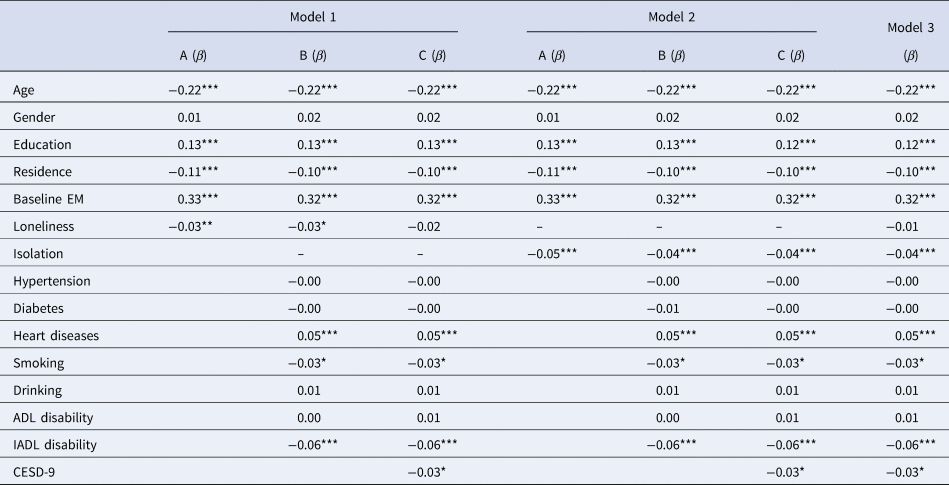
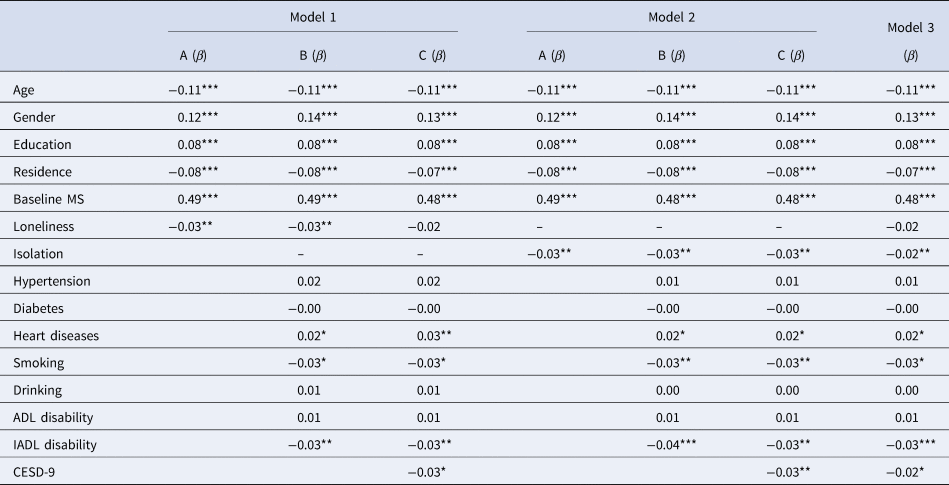
Tables 2 and 3 show the results of lagged regression on episodic memory and mental status, respectively. Loneliness was significantly associated with cognitive decline (episodic memory: β = −0.03, p = 0.002; mental status: β = −0.03, p = 0.002) after 4 years when five control variables including age, gender, education, area of residence, and baseline episodic memory or mental status score were adjusted (Model 1A). These associations remain significant when other covariates such as chronic diseases, health behaviors, and disabilities were included in the models (Model 1B). However, these associations were no longer significant (episodic memory: β = −0.02, p = 0.179; mental status: β = −0.02, p = 0.088) when CESD-9 were adjusted (Model 1C). In contrast, greater isolation was significantly associated with lower scores on episodic memory (β = −0.04, p < 0.001) and mental status (β = −0.03, p = 0.003) 4 years later even after all the covariates including CESD-9 scores were taken into account (Model 2C). Adding loneliness to the model did not reduce the association with isolation (Model 3). The interaction terms between isolation and loneliness were not statistically significant for episodic memory (p for interaction = 0.690) or mental status (p for interaction = 0.050), indicating that there was no synergistic effect between isolation and loneliness on cognitive decline. Isolation × gender interaction was tested by adding the terms into the fully adjusted model including isolation and loneliness. This interaction term was neither significant for episodic memory (p for interaction = 0.934) nor for mental status (p for interaction = 0.224). No significant interaction between gender and loneliness was found for either cognitive measure (all p for interaction >0.5).
Predicting episodic memory at follow-up

EM, episodic memory; ADL, activities of daily living; IADL, instrumental activities of daily living; CESD, Center for Epidemiologic Studies Depression scale.
β = standardized regression coefficient.
*p < 0.05, **p < 0.01, ***p < 0.001.
Predicting mental status at follow-up

MS, mental status; ADL, activities of daily living; IADL, instrumental activities of daily living; CESD, Center for Epidemiologic Studies Depression scale.
β = standardized regression coefficient.
*p < 0.05, **p < 0.01, ***p < 0.001.
To reduce the risk of reverse causation in analyses, we reran Model 3 after excluding the respondents with very low cognition scores at the baseline survey (bottom 10%), on the grounds that people with very impaired cognition may find it difficult to engage socially with others. The results were unchanged [for episodic memory: isolation (β = −0.04, p = 0.001); loneliness (β = −0.02, p = 0.064); for mental status: isolation (β = −0.03, p = 0.013); loneliness (β = −0.02, p = 0.111)].
Discussion
In this study, a large representative sample of Chinese older adults was selected to examine simultaneously the associations of social isolation and loneliness with cognitive decline over a 4-year follow-up period. In accordance with our hypotheses, both loneliness and social isolation showed association with decreases in episodic memory and mental status. However, this association becomes less significant for loneliness when all the other confounding variables, especially depressive symptoms, were taken into account. While the association for social isolation seems independent of loneliness and other confounding variables. Our results seem to indicate a stronger negative relationship between social isolation than loneliness and cognitive function, which is consistent with two recent studies. For instance, Griffin et al. found that social isolation was longitudinally associated with worse cognitive performance in older Americans whereas loneliness only cross-sectionally correlated with lower cognitive function (Griffin et al., Reference Griffin, Mezuk, Williams, Perrin and Rybarczyk2018). Another longitudinal study with German older adults also found that social isolation rather than loneliness can predict cognitive health (Beller & Wagner, Reference Beller and Wagner2018).
Substantial evidence indicated that loneliness is associated with a higher risk of cognitive decline at older ages (Boss et al., Reference Boss, Kang and Branson2015), and may contribute to the development of dementia (Rafnsson et al., Reference Rafnsson, Orrell, d'Orsi, Hogervorst and Steptoe2017; Wilson et al., Reference Wilson, Krueger, Arnold, Schneider, Kelly, Barnes and Bennett2007). However, contradictory evidence also exists that indicates no independent association between loneliness and cognitive decline (Okely & Deary, Reference Okely and Deary2018; Rawtaer et al., Reference Rawtaer, Gao, Nyunt, Feng, Chong, Lim and Ng2017). Two studies with Chinese older adults found a significant association between loneliness and cognitive decline. Although loneliness was measured with one single item in these two studies as ours, depressive symptoms were not controlled in their models (Zhong et al., Reference Zhong, Chen and Conwell2016, Reference Zhong, Chen, Tu and Conwell2017). Our study does indicate negative associations between loneliness and cognitive function. However, these relationships become non-significant when all the confounding variables including depressive symptoms were controlled. It is notable that in our study, the associations between loneliness and baseline poor health was stronger than the associations between social isolation and the same health index, especially for cardiovascular health and depressive symptoms. Therefore, our finding that loneliness no longer was associated with cognitive decline after these confounding variables had been controlled may reflect its association with baseline health. Accounting for depressive symptoms did more to reduce the association between cognitive function than accounting for the clinical and behavioral covariates. Loneliness was measured by one item from CESD in our study, and the two are significantly correlated (ρ = 0.45, p < 0.001). Thus, it is not a surprise that controlling for depressive symptoms would reduce the size of the association. Such a result is consistent with previous studies. In a longitudinal study of Scottish aging adults, the associations between loneliness and cognitive ability were no longer significant when the model included depressive symptoms as covariates (Gow et al., Reference Gow, Corley, Starr and Deary2013). Similar results were also found for studies of mortality (Steptoe et al., Reference Steptoe, Shankar, Demakakos and Wardle2013; Teguo et al., Reference Teguo, Simo-Tabue, Stoykova, Meillon, Cogne, Amiéva and Dartigues2016). In a cohort study adopted a same measurement of loneliness as ours, the association between loneliness and mortality also became insignificant when depressive symptoms (CESD scores excluding loneliness item) were adjusted (Teguo et al., Reference Teguo, Simo-Tabue, Stoykova, Meillon, Cogne, Amiéva and Dartigues2016). These results may not imply that loneliness is not important but rather indicate that the experience of loneliness may be characteristic of people who already have mental health problems. Future studies with more independent measurements of loneliness and depressive symptoms are warranted to clarify this issue.
Nevertheless, convincing evidence, including the present study, highlights the associations between social isolation and cognitive decline (Kuiper et al., Reference Kuiper, Zuidersma, Zuidema, Burgerhof, Stolk, Oude Voshaar and Smidt2016). Several theories have been proposed to explain the association of social isolation and cognitive function. One is the ‘use it or lose it’ theory (Hultsch, Hertzog, Small, & Dixon, Reference Hultsch, Hertzog, Small and Dixon1999), which argues that engagement in intellectual, physical, and social activities stimulates the brain. Decrease in engagement in social activities may result in the lack of use of mental faculties that may in turn lead to a decline of cognitive ability. Another theory is stress-buffering, proposing that social relationships are beneficial in stressful situations (Fratiglioni, Paillard-Borg, & Winblad, Reference Fratiglioni, Paillard-Borg and Winblad2004). Stress has been associated with cognitive decline due to structural changes in the hippocampus (Wilson et al., Reference Wilson, Evans, Bienias, De Leon, Schneider and Bennett2003). Social relationships may prevent or modulate responses to stressful events that are damaging to health.
Although previous studies provide evidence for the negative associations between social relationships and cognitive function, it should be noted that most findings are based on a Western sample and hence a limited cultural context (Courtin & Knapp, Reference Courtin and Knapp2017; Evans et al., Reference Evans, Martyr, Collins, Brayne and Clare2018; Kuiper et al., Reference Kuiper, Zuidersma, Zuidema, Burgerhof, Stolk, Oude Voshaar and Smidt2016). Westerners tend to have higher objective social isolation compared with non-Western populations. Taking the USA as an example, the percentage of single-person households within the same historical period is almost three times that of China (Hu & Peng, Reference Hu and Peng2015). Furthermore, Western countries tend to be more individualistic from a cultural viewpoint (Hofstede, Hofstede, & Minkov, Reference Hofstede, Hofstede and Minkov2005). Thus, our study expands knowledge about the role of social relationships in a more collectivistic culture.
Strengths of our study include the large sample size and the fact that CHARLS is designed to be representative of the community-dwelling Chinese population aged ⩾50. Cognitive function was assessed with a series of objective tests, and the study benefited from the detailed measures of potential confounders. The study also has limitations. First, loneliness was assessed with only one direct question regarding the perception of loneliness in the last week. Despite wide use in the literature and strong correlations with several established multiple-item scales, this measure may be less reliable than a composite measure that taps multiple aspects of loneliness (Holwerda et al., Reference Holwerda, Deeg, Beekman, van Tilburg, Stek, Jonker and Schoevers2014; Petersen et al., Reference Petersen, Kaye, Jacobs, Quinones, Dodge, Arnold and Thielke2016; Victor, Grenade, & Boldy, Reference Victor, Grenade and Boldy2005). The effects of loneliness became insignificant when depressive symptoms were adjusted, which also may be because the loneliness item is derived from the CESD-10. However, another study using a more complex and independent measure of loneliness has reported similar findings as ours (Griffin et al., Reference Griffin, Mezuk, Williams, Perrin and Rybarczyk2018). Second, the present study investigated the consequences of loneliness and social isolation longitudinally with a relative short-term of 4 years. This prevents us from examining the long-term association of social relationships with cognitive function, and whether certain aspects of social relationships become more or less important over time. Future work could test the relationship using longer-term panel data of Chinese population. Third, CHARLS does not give full neuropsychological testing for the large sample at baseline, and thus cannot provide formal diagnoses of mild cognitive impairment or dementia. However, we have applied a widely used way to exclude the respondents with very low cognition scores (bottom 10%) at the baseline survey (Ganguli et al., Reference Ganguli, Belle, Ratcliff, Seaberg, Huff, von der Porten and Kuller1993; Weuve et al., Reference Weuve, Kang, Manson, Breteler, Ware and Grodstein2004). A sensitivity analysis after the exclusion yielded similar results as the primary analysis. Finally, this is an observational study, and causal conclusions cannot be drawn. Although we took multiple covariates into account, there may be other unmeasured factors responsible for the associations recorded here.
Conclusion
In this prospective study, high levels of social isolation were associated with an increased risk of cognitive decline. By contrast, loneliness was not linked with the cognitive decline when other confounding variables were controlled. These findings expand our knowledge about the association of social relationships with cognitive function in non-Western populations. Cognitive decline is a strong risk factor for the development of dementia (Bennett et al., Reference Bennett, Wilson, Schneider, Evans, Beckett, Aggarwal and Bach2002). Efforts to reduce isolation may therefore have substantial benefits in terms of preventing dementia among older adults in China.
Acknowledgments
This work was supported by the National Social Science Foundation, China (grant numbers 18BSH118).
Conflict of interest
None.