The 12-lead standard electrocardiogram is a non-invasive and easily accessible tool to detect cardiac dysrhythmias. Reference Maron, Friedman and Kligfield1 The knowledge of the morphological changes and abnormal findings in the electrocardiogram is of great importance for healthy normal population. Some abnormalities during childhood and adulthood are life-threatening; Reference Gonzalez Corcia, Sieira and Pappaert2 therefore, screening will help us find the burden of arrhythmias and identify individuals who can benefit more from the implementation of early therapeutic interventions and advanced diagnostic modalities. Few studies have assessed the morphological abnormalities of electrocardiograms among healthy children, which have provided normal ranges for some parameters. Reference Rijnbeek, Witsenburg, Schrama, Hess and Kors3–Reference Lue, Wu and Wang7 The majority of large-scale studies among children have been conducted among targeted population, particularly athletes and/or before the initiation of sports activities. Reference Basavarajaiah, Wilson, Whyte, Shah, Behr and Sharma8–Reference Pelliccia, Di Paolo and Quattrini13 In addition, some retrospective studies have evaluated the morphological changes of electrocardiogram among healthy individuals. Reference Palhares, Marcolino and Santos14
The electrocardiographic screening of young population participating in sports activities and elite athletes has demonstrated that such a screening programme can reduce the incidence of sudden cardiac death in patients with hypertrophic cardiomyopathy. Reference Pelliccia, Di Paolo and Corrado15 Therefore, the American Heart Association/American College of Cardiology has recommended electrocardiographic screening not only for young population (12–25 years of age) participating in competitive athletics but also for healthy young population in any community. Reference Maron, Friedman and Kligfield1 Although several reports have explored the normal ranges of electrocardiographic intervals and durations among healthy children, Reference Rijnbeek, Witsenburg, Schrama, Hess and Kors3–Reference Semizel, Ozturk, Bostan, Cil and Ediz5 there are few large-scale studies for detecting abnormal electrocardiographic findings among healthy children and infants. Reference Pelliccia, Culasso and Di Paolo10,Reference Santini, Di Fusco, Colivicchi and Gargaro16,Reference Schwartz, Stramba-Badiale and Crotti17 Herein, in a large-scale population-based study, we sought to determine the prevalence of abnormal electrocardiographic findings and electrocardiographic intervals among healthy children and adolescents who were recruited in the SHED LIGHT study in Tehran urban area, Iran, and also to find the associations between electrocardiographic findings and anthropometric parameters and blood pressure measurements.
Methods
Study protocol and population selection
The SHED LIGHT study is a cross-sectional community-based investigation, in which we tried to find the prevalence of structural heart diseases among randomly selected school-aged population in Tehran urban area using echocardiographic examination concomitant with electrocardiographic examination. Reference Hosseini, Samiei and Tabib18 In summary, a multi-stage cluster-random sampling was used to choose schools from the Tehran urban area. All students were examined using a handheld Vscan device (GE Healthcare, Milwaukee, WI, USA) by echocardiographer, and the results were concurrently supervised and interpreted by cardiologists. All the major findings were re-evaluated in hospital clinics. A total of 15 130 children were examined in 7 districts of Tehran, between October 2017 and December 2018. Of individuals enrolled in the SHED LIGHT study, electrocardiographic evaluations in 15 084 participants were available to be included in this study. Of electrocardiograms taken from participants, we excluded two subjects from analysis of electrocardiographic parameters due to having implanted permanent pacemaker. All electrocardiograms were interpreted and reported due to lack of prior diagnosis of arrhythmic diseases. The measured features of electrocardiogram and rhythm abnormalities were used in this report. The protocol of study was approved by the Ethics Committee of the National Committee for Ethics in Biomedical Research. The informed consent was also obtained from all parents.
Anthropometric and blood pressure measurements
Blood pressure was assessed by experienced nurses using an automated device (Connex ProBP 3400, Welch Allyn, USA). The identification and classification of hypertension were determined based on the latest recommendations by the American Academy of Pediatrics published in 2017. Reference Flynn, Kaelber and Baker-Smith19 Among population aged 1 to less than 13 years old, the stage 1 hypertension was defined as blood pressure ≥ 95th percentile to < 95th percentile plus 12 mmHg, or 130/80 to 139/89 mm Hg (whichever is lower). The stage 2 hypertension was also defined as ≥ 95th percentile plus 12 mm Hg, or ≥ 140/90 mm Hg (whichever is lower). For population aged ≥ 13 years old, the stages 1 and 2 hypertension were interpreted similarly to the ACC/AHA guidelines for high blood pressure in adults. Reference Whelton, Carey and Aronow20 Height and weight were measured while shoes were taken off. Waist circumference was measured between iliac crest and the lowest rib. Body mass index was calculated as weight in kilograms divided by the square of height in meters (kg/m2). The classification of body mass index was performed based on the United States of America Centers for Disease Control and Prevention. Reference Kuczmarski, Ogden and Grummer-Strawn21 The central obesity is defined by waist circumference ≥ 90th percentile for age and sex. Reference Li, Ford, Mokdad and Cook22
Electrocardiographic examinations
A standard 12-lead electrocardiogram was recorded by a unique recorder (CP 150 model, Welch Allyn, USA) at a paper speed of 25 mm/s and a scale of 10 mm/mV standardisation. All electrocardiographic traces were provided by 5 technicians with at least 5 years of experience who take about 50 electrocardiograms per working day. Electrocardiograms were performed in students at rest and in a supine position. Electrocardiograms were re-taken if those were not interpretable and had significant noise. The detailed interpretation of electrocardiographic traces was performed based on the international guidelines. Reference Maron, Friedman and Kligfield23–Reference Sharma, Drezner and Baggish28
All electrocardiographic intervals were measured manually by 4 experienced nurses who completed an educational course for measuring electrocardiographic features by a unique protocol. Visual measurements were performed using a scale rounding to a quarter of small box. Inter and intra-reader variabilities were calculated for 4 readers, using repeated measurements on 30 traces. The readers measured PR, RR, and QT intervals, as well as QRS complex duration. All these measurements were performed in three consecutive beats and the average of three beats was used in this report. For patients with sinus arrhythmia, these values are measured in two separate leads with averaging three consecutive beats. The QT interval was calculated using the threshold method so that the end of the T-wave intersecting with the isoelectric line was considered as the duration of QT interval. The QT interval was measured in lead II, and it was corrected for heart rate (QTc) based on the Bazett’s formula. Reference Bazett29 We excluded U-wave during the calculation of the QT interval and in the cases of biphasic T-wave, the lead V5 was used for the measurement of QT interval. All mentioned electrocardiographic intervals were also calculated automatically by the electrocardiogram machine, and those were also used to compare with manual measurements. For measuring the degree of QRS electrical axis, the QRS complex in leads II and aVF were evaluated.
Some points were also considered in the identification of electrocardiographic abnormalities. Early repolarization pattern in electrocardiograms has been associated with sudden cardiac death, but clear criteria for separating at-risk patients from the normal population are lacking. Reference Haïssaguerre, Derval and Sacher30 We considered early repolarization as a normal finding in our population. Minimal pre-excitation patterns comprised of those without ful pre-excitation. Sinus pause as a minor finding was defined as pause duration < 3 s. Reference Brugada, Blom and Sarquella-Brugada31 In patients with incomplete right bundle branch block, repolarization criteria were used to differentiate it from epsilon wave. Reference de Alencar Neto, Baranchuk, Bayés-Genís and de Luna32 In addition to the measurement of electrocardiographic parameters, all traces were evaluated by a paediatric cardiologist certified with a fellowship in electrophysiology. He was unaware of clinical examination and students’ condition, except for age and sex. All electrocardiograms with major abnormalities were again evaluated by an electrophysiologist.
Statistical analysis
For electrocardiographic parameters, descriptive values were reported based on age and sex groups. All participants were categorised into four age groups, including 6–8-year-old, 9–11-year-old, 12–14-year-old, and 15–18-year-old age groups. Continuous and categorical values are presented as mean ± SD and number (percentage), respectively. Moreover, 95% confidence interval values were also provided. One-way ANOVA and chi-squared tests were applied to compare values between groups. The Tukey’s test was also used for pairwise multiple comparisons. The multivariate logistic regression analysis was used to find the predictors of electrocardiographic abnormalities, and results were reported as odds ratio along with 95% confidence interval. All p values refer to two-sided tests, and those less than 0.05 were considered statistically significant. All statistical analyses were performed using STATA software (StataCorp, TX, USA).
Results
Baseline characteristics
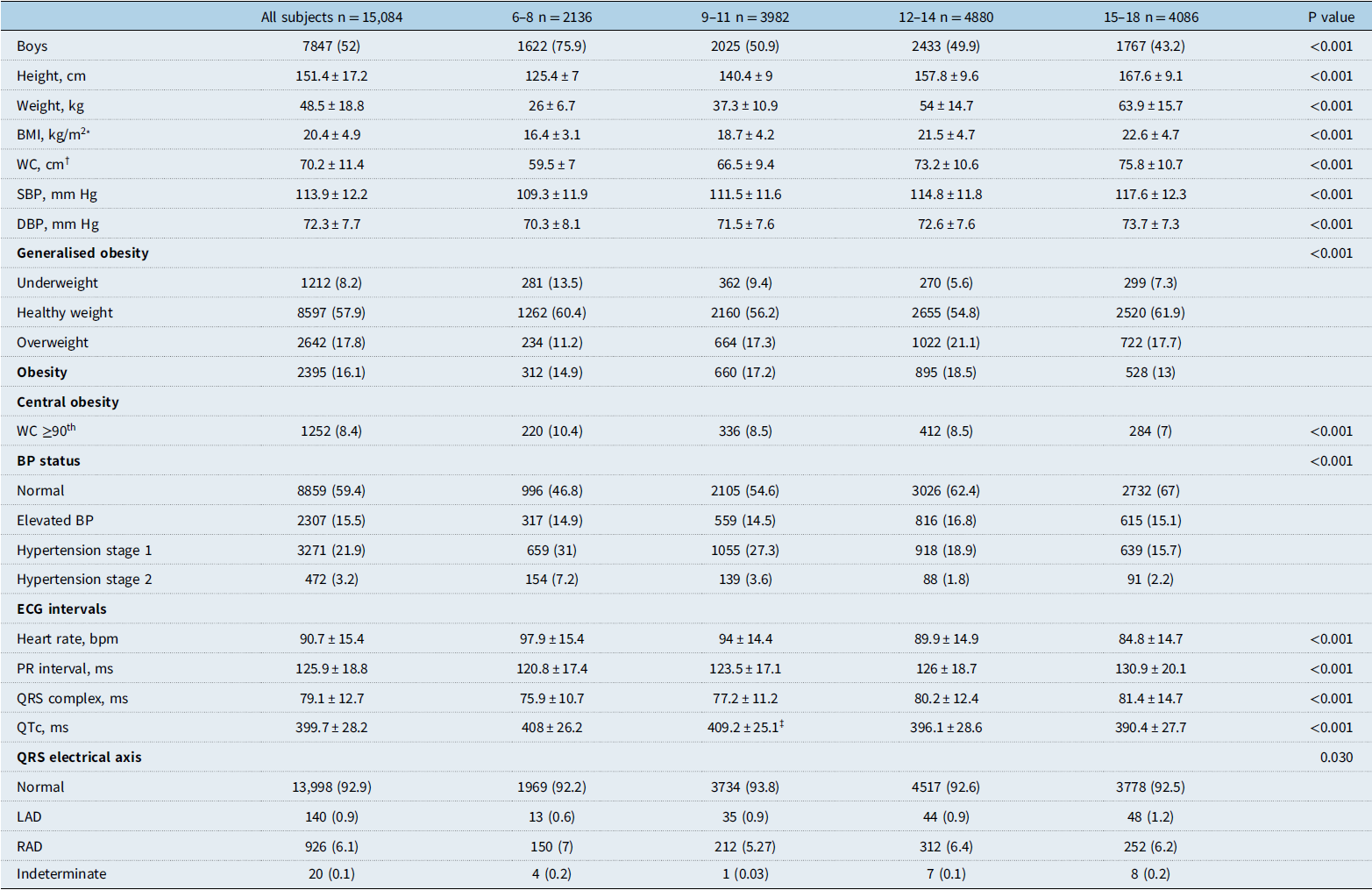
A total of 15 084 students with readable electrocardiographic traces were entered, and 52% were boys. All anthropometric values, including height, weight, body mass index, waist circumference, systolic blood pressure, and diastolic blood pressure steadily increased from 6–8 to 15–18 age group (p < 0.001). The highest rates of generalised overweight (17.7%) and obesity (18.5%) were detected in 15–18 and 12–14 years old age groups, respectively. On the other hand, the highest rate of central obesity by waist circumference (10.4%) values was identified in 6–8 and 9–11 years old age groups, respectively. The highest rate of hypertension was detected in 6–8 years old age group (Table 1). There were significant differences between boys and girls regarding the prevalence of obesity by waist circumference (10.4 versus 6.1%, respectively) and body mass index categorisation (20 versus 11.9%, respectively) (both p < 0.001).
Comparing baseline characteristics and electrocardiographic parameters in age groups

* It was available in about 99% of subjects.
† It was available in about 97% of subjects.
‡ All paired comparisons between 6 and 8 and other age groups by the Tukey’s test were significant (p < 0.05) except for this single comparison.
BMI = body mass index; BP = blood pressure; bpm = beats per minute; DBP = diastolic blood pressure; ECG = electrocardiogram; LAD = left axis deviation; ms = millisecond; RAD = right axis deviation; SBP = systolic blood pressure; WC = waist circumference.
Electrocardiographic intervals
The inter- and intra-observer variabilities for electrocardiographic intervals were good to excellent among four readers (intraclass correlation coefficients for heart rate, PR interval, QRS complex, and QT interval were 0.805, 0.925, 0.757, and 0.950, respectively). The means of heart rate, PR interval, QRS complex duration, and QT interval corrected for heart rate (QTc) were 90.7 ± 15.4 bpm, 125.9 ± 18.8 ms, 79.1 ± 12.7 ms, and 399.7 ± 28.2 ms, respectively. The values of QRS complex duration and PR interval decreased with increasing ages (p < 0.001), and the amounts of heart rate and QTc were significantly decreased by advancing ages (p < 0.001). The number of students with the left axis deviation in the QRS electrical axis significantly increased with advancing age, and those with the right axis deviation decreased with advancing age (p = 0.030). Moreover, we summarised these values measured by the automated software of device (CP 150 model, Welch Allyn, USA) which was available for 12 365 individuals. The automated values for heart rate, QRS complex, and QTc were significantly larger than those measured manually (Supplementary Table 1).
The duration of QRS complex increased with advancing ages, and it was significantly higher in boys than girls in age groups (p < 0.001). Heart rate steadily decreased with advancing ages, and girls had significantly greater values than boys. PR interval was significantly higher in boys than girls in 6–8 and 15–18 age groups (P < 0.001). The duration of QTc interval was comparable between genders in 6–8 and 9–11 age groups, while girls had significantly higher values than boys in both 12–14 and 15–18 age groups (Fig. 1).
The comparisons of (A) heart rate, (B) PR interval, (C) QRS complex duration, and (D) QTc interval based on genders in age groups.

Electrocardiographic abnormalities
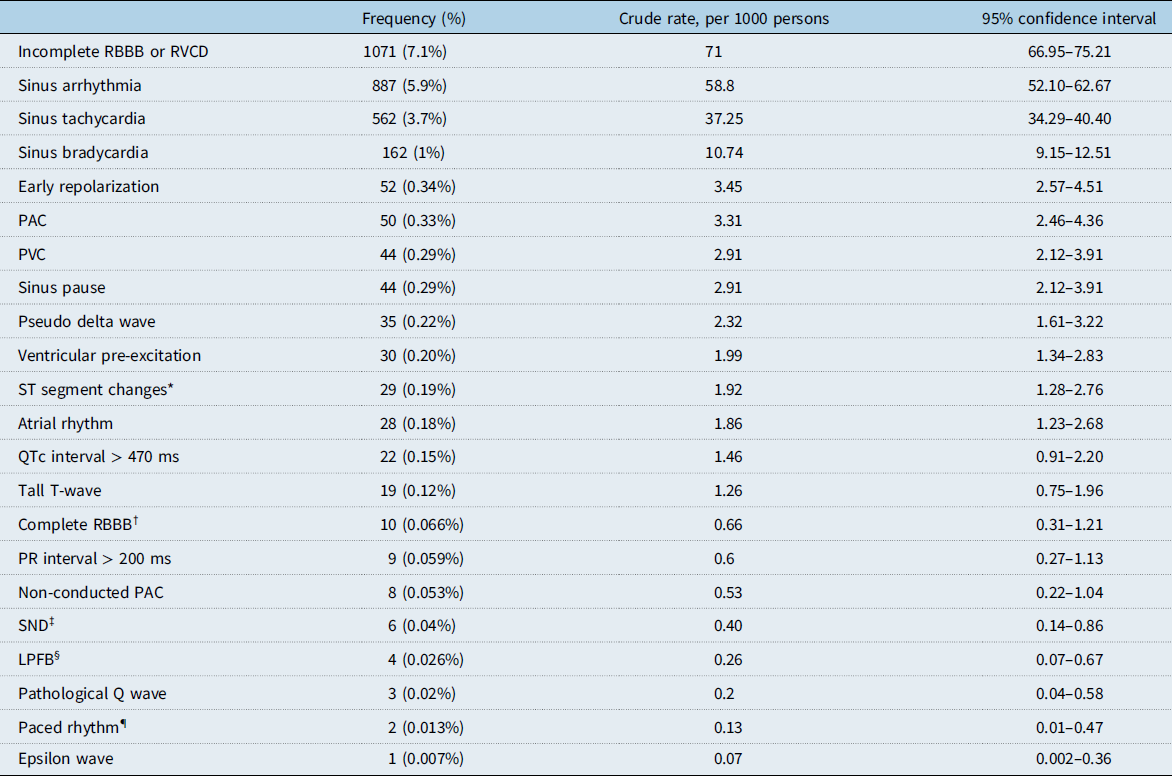
Based on the interpretation of electrocardiographic traces, 2900 students (19.2%, 192.2/1000 persons; 95% confidence interval 186–198.6) had abnormal findings. Three most common electrocardiographic abnormalities were incomplete right bundle branch block or right ventricular conduction delay (1071 [7.1%], 71/1000 persons; 95% confidence interval 66.95–75.21), sinus arrhythmia (887 [5.9%], 58.8/1000 persons; 95% confidence interval 52.10–62.67), and sinus tachycardia > 120 bpm (562 [3.7%], 37.25/1000 persons; 95% confidence interval 34.29–40.40). Premature ventricular contraction (44 [0.29%], 2.91/1000 persons; 95% confidence interval 2.12–3.91) and prolonged QTc > 470 ms (22 [0.15%], 1.46/1000 persons; 95% confidence interval 0.91–2.20) were also identified. Other electrocardiographic abnormalities were summarised in Table 2. The rates of electrocardiographic abnormalities (21.5 versus 16.8%, p < 0.001) were significantly higher in boys than those in girls. Electrocardiographic abnormalities were significantly different between genders in 12–14 and 15–18 age groups (Fig. 2).
Differences between both genders in age groups regarding electrocardiographic abnormalities. Blue and red colours denote boys and girls, respectively.

Electrocardiographic abnormalities in studied population

LPFB = left posterior fascicular block; ms = millisecond; PAC = premature atrial contraction; PVC = premature ventricular contraction; RBBB = right bundle branch block; SND = sinus node dysfunction; RVCD = right ventricular contraction delay.
* ST segments > 1 mm and < −0.5 mm are considered to be elevated and depressed, respectively.
† Without concomitant prolonged PR interval or right/left posterior hemiblock.
‡ Suspicious for sinus node dysfunction requiring further evaluations presented as pause > 3 s.
§ Without concomitant right bundle branch block.
¶ Patients with paced rhythm had cardiac block and sinus node dysfunction causing bradyarrhythmia which were counted once as mentioned diagnoses in this table.
The rate of electrocardiographic abnormalities in obese individuals was lower than that in non-obese ones (p < 0.001 and p = 0.019 for generalised and central obesity, respectively). In addition, when comparing individuals based on blood pressure status, there was a trend towards individuals with hypertension to have more electrocardiographic abnormalities (p = 0.063) compared with those with normal blood pressure (Fig. 3). When compared in subgroups by sex, the results for boys were similar to total population; however, among girls, electrocardiographic abnormalities were comparable between groups by obesity status. Moreover, girls with hypertension had higher rates of electrocardiographic abnormalities compared to those without it (p = 0.004; Data are not reported).
The prevalence of electrocardiographic abnormalities among groups by (A) generalised and central obesity and (B) blood pressure status.

Multivariable analysis
Based on the multivariable analysis, individuals with electrocardiographic abnormalities were less likely to be girls (odds ratio 0.745, 95% confidence interval 0.682–0.814, p < 0.001), and had lower body mass index levels (odds ratio 0.961, 95% confidence interval 0.944–0.979, p < 0.001). The results of analysis are depicted in Figure 4.
The multivariate analysis showing the predictors of electrocardiographic abnormalities among studied population.

Comment
This is the first population-based study to evaluate the electrocardiographic abnormalities and their relation to hypertension and obesity status among Iranian children and adolescents, from 6 to 18 years old. We found that the rateof electrocardiographic abnormalities among children and adolescents was 192.2/1000 persons (95% confidence interval 186–198.6). The electrocardiographic abnormalities were significantly higher in boys than girls among 12–14 and 15–18 age groups. A higher value of body mass index and female gender were less likely to have the electrocardiographic abnormalities. Moreover, this study revealed the feasibility and the applicability of community-based investigation for electrocardiographic evaluations among Iranian children and adolescents.
Prior studies have been mainly conducted among young athletes in an effort to maintain cardiovascular health and prevent sudden cardiac death in such a vulnerable population. Reference Basavarajaiah, Wilson, Whyte, Shah, Behr and Sharma8,Reference Pelliccia, Culasso and Di Paolo10,Reference Baggish, Hutter and Wang11,Reference Pelliccia, Di Paolo and Corrado15,Reference Marek, Bufalino and Davis33 Based on a meta-analysis, the electrocardiographic screening for detecting potentially lethal cardiac disorders in athletes is 10 times more sensitive than physical examination alone for detecting cardiovascular diseases. Reference Harmon, Zigman and Drezner34 The implementation of electrocardiographic screening can be pursued with regard to the magnitude of abnormal electrocardiograms among children and adolescents, the clinical outcomes of targeted population, and the cost-benefit ratio for such a screening protocol in any community. Given our study, we found that electrocardiographic abnormalities requiring further evaluations are relatively high, so it underscores further large-scale studies to find high-risk individuals requiring robust clinical evaluations to prevent sudden cardiac death and improve the prognosis of afflicted children and adolescents.
A population-based study was conducted among 24 062 healthy non-selected adolescents in Italy, aged 12–19 years old. Santini et al. Reference Santini, Di Fusco, Colivicchi and Gargaro16 showed that major and minor electrocardiographic abnormalities were found in 1.7 and 20.3%, respectively, and both findings were higher in males than those in females (2. versus 0.6% and 24.5 versus 16.6%, p < 0.001, respectively). In another large-scale study among 32 561 USA adolescents, 14–19 years old, the rates of abnormal electrocardiograms were 2.5% and the most common abnormalities in males and females were left ventricular hypertrophy (24.9%) and Wolff-Parkinson-White syndrome (6.8%), respectively. Reference Marek, Bufalino and Davis33 These findings are relatively similar to our findings. However, our population is somehow different from those of the studies in the USA and Italy. First, our study represents a mixed population of children, aged 6–11 years, and adolescents, aged 12–18 years, which might be associated with lower rates of electrocardiographic abnormalities compared to only adolescents and young athletes. Second, the adolescents are associated with higher rates of some abnormalities compared to children, as the prevalence of right bundle branch block increases with height, Reference Santini, Di Fusco, Colivicchi and Gargaro16 left ventricular dominancy enhances with advancing age and athletic activities, Reference Marek, Bufalino and Davis33 and major cardiac conduction disorders rise with increasing age. Reference Kofler, Thériault and Bossard35 In a community-based study among Japanese school-age children during 1980s, Reference Haneda, Mori and Nishio36 the prevalence of electrocardiographic abnormalities with high-risk conditions was found to be 0.029%. The low rate of high-risk abnormalities compared to our study may be explained by the implementation of old criteria for identifying electrocardiographic abnormalities. We think that the lack of comprehensive clinical evaluations of electrocardiographic abnormalities in children and the absence of consensus on criteria for categorising electrocardiographic abnormalities might preclude us from conclusion about the true impacts of such findings on screening protocols and further clinical consequences.
Based on Italian population-based study, the heart rate and the QTc declined with advancing age, and the QTc interval was longer in females than in males over 14 years. In addition, the PR and QRS intervals were steadily increased by advancing age, and males had greater values compared to females in age groups. Reference Santini, Di Fusco, Colivicchi and Gargaro16 Reports from small-scale children population have demonstrated similar results with regard to the electrocardiographic intervals’ changes by age and sex in different regions around the world. Reference Rijnbeek, Witsenburg, Schrama, Hess and Kors3,Reference Davignon, Rautaharju, Boisselle, Soumis, Mégélas and Choquette4,Reference Saarel, Granger and Kaltman6,Reference Lue, Wu and Wang7 Moreover, the rate of prolonged QTc defined as > 460 ms in accordance with Bazett’s formula was found to be 0.3% in British young athletes, about 0.3% among USA adolescents, Reference Marek, Bufalino and Davis33 and as low as 0.002% among Italian adolescents Reference Santini, Di Fusco, Colivicchi and Gargaro16 . A recent report among USA children and adolescents (1 month–18 years) showed that QT intervals differed from prior reports and differences in mean values correspond with significant clinically important differences in the 98th percentile that represent the practical criteria for identification of prolonged QT. Reference Saarel, Granger and Kaltman6 Given substantial differences in the prevalence of prolonged QTc, it warrants further studies with regard to the digitalised measurement of the heart rate and the QT interval versus manual measurements, the criteria used for calculating QT interval (i.e., tangent or threshold criteria), Reference Vink, Neumann and Lieve37 the effect of different age groups studied, and the clinical consequences of prolonged QTc in individuals and their families.
The impacts of obesity and hypertension on electrocardiographic findings have been investigated only in one non-selected adolescent in Italy. Santini et al. Reference Santini, Di Fusco, Colivicchi and Gargaro16 found that minor electrocardiographic abnormalities (mostly including incomplete right bundle branch block, sinus bradycardia, and repolarization features) were higher among adolescents with normal body mass index and thins compared to obese ones. In contrast, the major electrocardiographic abnormalities (mainly including complete right bundle branch block and left anterior fascicular block) have been found with a higher prevalence in taller subjects compared with normal or short subjects. However, they did not find any association between hypertension and electrocardiographic findings. In our study, we also found that electrocardiographic abnormalities were comparable between those with and without hypertension. On the other hand, similar to Italian report, the electrocardiographic abnormalities were significantly higher among individuals with low or normal body mass index compared with those having central or generalised obesity. This finding can be explained by a high rate of incomplete right bundle branch block, more than one-third of electrocardiographic abnormalities, in our population that has been found more in individuals with low or normal body mass index compared to obese individuals. We think that given the paramount role of obesity and hypertension in cardiovascular and metabolic parameters of children and adolescents, the relationship between electrocardiographic abnormalities, as a marker of cardiovascular diseases, and the obesity and hypertension status can be used as concomitant risk stratification tools during the screening protocols among young people.
Study limitations
Despite being a large-scale non-selected population of children and adolescents, it has some shortcomings that need to be considered during the interpretation of results. First, we recruited population from an urban area with different nutritional and behavioural features compared to rural and small cities; however, we implemented multi-stage cluster sampling method to select targeted population. Second, all diagnoses were performed based on a single electrocardiogram at single visit. Moreover, the absence of data on probable symptoms and follow-up outcomes can prevent us from providing the true impacts of electrocardiogram screening in big communities and show how much benefit can be proposed by such a screening programme. Third, as presented in the figures, electrocardiographic features have some overlaps in their values so we cannot absolutely consider that these values relate to a specific age range. Finally, all electrocardiograms were assessed by a single cardiologist with a fellowship in electrophysiology; however, it is worth noting that all electrocardiograms with major abnormalities were re-evaluated by electrophysiologist.
Conclusions
In this large-scale study among young Iranian population, there was a high prevalence of electrocardiographic abnormalities. In addition, the electrocardiographic intervals and rhythm abnormalities were gender-dependent and significantly changed with increasing age. Moreover, electrocardiographic abnormalities were also influenced by the presence of obesity and hypertension. This community-based study revealed the implications of electrocardiographic screening among healthy young population to apply preventive modalities and to improve care delivery and quality of life by early detection.
Supplementary material
The supplementary material for this article can be found at https://doi.org/10.1017/S1047951123004304.
Data availability
The data underlying this article were provided by the National Institute for Medical Research Development and the Rajaie Cardiovascular Medical and Research Center by permission. Deidentified data will be shared on request to the corresponding author via email address with the permission of both institutions 12 months after the publication of all results, after approval of a proposal, and with a signed data access agreement.
Acknowledgements
We would like to greatly thank Prof. Pedro Brugada who critically reviewed the final manuscript. We warmly thank the management members of Rajaie Cardiovascular Medical and Research Center who helped us with the transportation of team members and devices and with the study team planning, particularly Dr Eftekhari, Mrs. Hanifi, Mr. Kolouei, and Mr. Tavana. Moreover, the SHED LIGHT investigators would like to thank those who helped us during the electrocardiographic evaluations, particularly Ms Maryam Arvanesh, Mrs Akram Iranshahi, Mrs Akram Tabatabaee, and Mrs Maryam Alibakhshi.
Author contribution
MRK, YR, AT, and NS conceptualised and designed the study. YR, AT, and SH drafted the initial manuscript. MRK, GH, YR, and MO performed the statistical analysis and interpreted analysis. All authors revised critically and approved the final manuscript as submitted and agreed to be accountable for all aspects of the work.
Financial support
The study grant was mainly provided by the National Institute for Medical Research Development under the identification number 962126. The other portion of funding was provided by Rajaie Cardiovascular Medical and Research Center, Tehran, Iran.
Competing interests
SH reports grants from the National Institute for Medical Research Development, during the conduct of the study. All other authors have none to declare.