This study investigates fast mapping skills in both languages of typically developing sequential bilingual preschool children. Study participants began learning a single minority first language (L1) at home from birth and a second language (L2) during early childhood as their interactions with the broader majority language speaking community increased. A primary aim of the current study is to search for potential relationships between fast mapping performance in L1 and L2 and existing vocabulary knowledge in each language. We begin with a brief review of the relevant literatures.
Fast mapping
The term ‘fast mapping’ was introduced into the field of child language acquisition almost three decades ago (Carey & Bartlett, Reference Carey and Bartlett1978). Fast mapping may be viewed as the critical first stage of learning new words, requiring intact phonological and semantic processing skills (e.g. Ellis Weismer & Evans, Reference Ellis Weismer and Evans2002; Gray, Reference Gray2005). Researchers hypothesized that following a single exposure to a new phonological form that has semantic value, children create a preliminary mental recording, or form–meaning ‘map’ (Carey, Reference Carey, Halle, Bresnan and Miller1978; Carey & Bartlett, Reference Carey and Bartlett1978). This initial recording or representation may contain phonological, semantic or syntactic information. Young, typically developing children's skill in lexical–semantic fast mapping has been used to explain, at least in part, the prodigious rate at which they seem to acquire the vocabulary of their ambient language(s). In order to become part of the child's lexicon, this initial linguistic form–meaning map must be further refined and enriched through experience in communicative contexts (Alt, Plante, & Creusere, Reference Alt, Plante and Creusere2004; Capone & Mcgregor, Reference Capone and McGregor2006; Dollaghan, Reference Dollaghan1987; Ellis Weismer & Evans, Reference Ellis Weismer and Evans2002; Ellis Weismer & Hesketh, Reference Ellis Weismer and Hesketh1993, Reference Ellis Weismer and Hesketh1996, Reference Ellis Weismer and Hesketh1998; Gray, Reference Gray2003, Reference Gray2004, Reference Gray2005, Reference Gray2006; Hwa-Froelich & Matsuo, Reference Hwa-Froelich and Matsuo2005).
A typical fast mapping task consists of two phases. In the exposure phase the child hears a novel word form (e.g. kub) and sees its corresponding referent (e.g. a small piece of colored foam). In the probe phase the child is asked either to name the new object (expressive probe) or to identify the object that corresponds to the new word said by the examiner (receptive probe). Exposure and probe phases are typically embedded in developmentally appropriate activities, such as packing or unpacking a picnic basket using a combination of novel and familiar objects (e.g. Ellis Weismer & Evans, Reference Ellis Weismer and Evans2002) or in user-friendly computer activities (e.g. Alt & Plante, Reference Alt and Plante2006). The traditional fast mapping task is administered without specific feedback or teaching, over a very short period of time. Results of studies with monolingual preschool children show that receptive fast mapping skills are far better than expressive fast mapping skills (e.g. Alt et al., Reference Alt, Plante and Creusere2004; Gray, Reference Gray2003). In addition, children's fast mapping receptive scores may be a strong predictor of their skills at producing novel words during a word learning task – a task that provides additional exposures to the novel words (e.g. Gray, Reference Gray2003).
Evidence to date indicates that fast mapping performance in typically developing young children is related to a number of different and potentially interacting learner characteristics. First, there seems to be a positive relationship between age and fast mapping performance, with older children outperforming younger children (e.g. Alt et al., Reference Alt, Plante and Creusere2004; Gray, Reference Gray2005, Reference Gray2006). A second important learner factor in fast mapping performance is the integrity of the child's underlying language system. Studies have consistently showed that children diagnosed with primary developmental impairment or specific language impairment perform more poorly on fast mapping tasks than do their peers with intact language systems (e.g. Alt et al., Reference Alt, Plante and Creusere2004; Alt & Plante, Reference Alt and Plante2006; Dollaghan, Reference Dollaghan1987; Ellis Weismer & Hesketh, Reference Fenson, Resznick, Thal, Bates, Hartung, Pethick and Reilly1993, Reference Ellis Weismer and Hesketh1996, Reference Ellis Weismer and Hesketh1998; Ellis Weismer & Evans, Reference Ellis Weismer and Evans2002; Gray, Reference Gray2004, Reference Gray2005, Reference Gray2006).
A third important learner characteristic found to affect children's fast mapping performance is their existing language knowledge (e.g. Gray, Reference Gray2003, Reference Gray2004). For example, Ellis Weismer & Evans (Reference Ellis Weismer and Evans2002) found significant correlations between participants' fast mapping production skills and their vocabulary production scores on the MacArthur-Bates Communicative Development Inventories (Fenson et al., Reference Fenson, Resznick, Thal, Bates, Hartung, Pethick and Reilly1993), a parental report instrument of language development, and the expressive portion of the Preschool Language Scale-3 (Zimmerman, Steiner & Pond, Reference Zimmerman, Steiner and Pond1992). Gray (Reference Gray2004) also found correlations between monolingual English-speaking preschoolers' fast mapping performance and their scores on the Peabody Picture Vocabulary Test, a standardized measure of receptive vocabulary (PPVT-III; Dunn, Dunn & Williams, Reference Dunn, Dunn and Williams1997).
Wilkinson & Mazzitelli (Reference Wilkinson and Mazzitelli2003) examined fast mapping and novel word learning in typically developing children aged 3 ; 0 to 5 ; 6 who were learning English as either their first (and only) language or as their L2. All experimental tasks were administered in English. For present purposes, results of interest were that monolingual English-speaking children outperformed their L2-learning peers on the fast mapping task as well as on the standardized vocabulary measure (PPVT-III). For English-only speaking participants, Wilkinson & Mazzitelli (Reference Wilkinson and Mazzitelli2003) found positive correlations between novel word learning skills, chronological age and existing receptive vocabulary skills (as measured on the PPVT-III). The correlation analysis was done on the overall word learning scores, not on the fast mapping scores. Interestingly, in the case of the early sequential bilingual group there was no correlation between performance on the novel-word learning task and existing vocabulary knowledge in L2.
The validity of fast mapping tasks for clinical purposes with sequential bilinguals has received some recent attention (Hwa-Froelich & Matsuo, Reference Hwa-Froelich and Matsuo2005; Kohnert & Danahy, Reference Kohnert and Danahy2007; Roseberry & Connell, Reference Roseberry and Connell1991). For example, Hwa-Froelich & Matsuo (Reference Hwa-Froelich and Matsuo2005) used a variety of language-dependent processing measures, including fast mapping, to investigate language ability in Vietnamese-American preschool children. The fast mapping task was implemented using both English and Vietnamese in the same trial. That is, English was used as the primary language but if the child did not respond, the examiner switched to Vietnamese. Performance on fast mapping was correlated with performance on other language-dependent processing measures. However, no overall vocabulary measures or measures of language knowledge were utilized. Kohnert & Danahy (Reference Kohnert and Danahy2007) and Roseberry & Connell (Reference Roseberry and Connell1991) investigated novel morpheme learning in only one language of developing bilinguals and no comparison with other language measures was included in either of these studies.
To date, no published studies have investigated fast mapping skills in both languages of developing bilingual preschool children using a within-subjects design. In the current study, fast mapping performance and existing vocabulary knowledge are measured in both languages of preschool children who are learning Hmong (L1) and English (L2). Bilingual children's performance with respect to the fast mapping skills reflects the process of mapping L1 and L2 phonological forms onto the same referent, in contrast to the one-form-one-meaning mapping process in monolingual children (e.g. Alt et al., Reference Alt, Plante and Creusere2004; Capone & McGregor, Reference Capone and McGregor2006; Gray, Reference Gray2003, Reference Gray2004, Reference Gray2005, Reference Gray2006). For example, in experimental tasks, a bilingual participant learns an English novel word (e.g. coob) associated with a novel object. In another session, the same participant learns a Hmong novel word (e.g. je) referring to the same novel object. The context in which a fast mapping task takes place, then, is similar to the contexts in which sequential bilingual children learn new words in L1 and also in L2 during their preschool years. On a fast mapping task, children's experiences with L1 and L2 lexical forms as they relate to specific items is controlled, with responses interpreted with respect to this relatively constant and quantifiable experience.
Lexical–semantic skills in preschool children learning two languages sequentially
Children learning two languages do so in various ways, at various ages, under diverse conditions and, perhaps not surprisingly, to varying degrees of relative skill in each language. The timing of experience with two different languages can be used to classify children as either simultaneous bilinguals or early sequential bilinguals, the group of primary interest in the current study. As noted previously, early sequential bilingual children begin learning a single L1 from birth and an L2 at some point during childhood. The timing or age of acquisition of two different languages does not, in and of itself, determine ultimate language proficiency. Language development and use must be considered within the context of other interacting factors, including the available input in each language within diverse social circumstances (see Kohnert, Reference Kohnert2008, for a review).
Although no previous studies have investigated fast mapping performance in both languages of sequential bilingual children, a number of studies have investigated lexical–semantic attainment in both L1 and L2 in language minority children who are learning a majority language. These studies have used a variety of language tasks with speakers of various languages. Some studies have investigated performance by preschool-age children; many more have considered language performance by children of school age. For typically developing sequential bilinguals, attainment of early L1 skills may parallel that of monolingual children who share similar socioeconomic circumstances at least until the introduction of L2. This is because until the introduction of L2, sequential bilinguals are essentially monolingual in terms of their language experiences. What happens in L1 after the introduction of the majority L2 varies considerably and seems to be a function of the child's continued experiences in L1, of the child's age, of the level of L1 development at the time L2 is introduced, as well as of the particular aspect of language that is measured (see Kohnert, Reference Kohnert2008, for a review).
Acquisition of L2 is somewhat less of an issue than is the retention or the continued development of L1. Results from studies that have directly measured language performance in both home (L1) and community (L2) languages in two- to five-year-old minority language learners reveal more variability in L1 than in L2 in both rate and direction-of-skills development over time. For young minority language children, proficiency in L1 may be vulnerable to either backsliding or to incomplete acquisition in the absence of systematic support. Leseman (Reference Leseman2000) investigated vocabulary development in Turkish and Dutch of second and third generation immigrant children from low-income families in the Netherlands. The primary home language was Turkish (L1) but the children attended a Dutch (L2) preschool program beginning at age 3 ; 0. Performance on receptive and expressive vocabulary measures indicated significant and positive growth in Dutch. In contrast, performance in L1 did not change and, over time, lagged behind that of monolingual Turkish peers who did not attend preschool.
Kan & Kohnert (Reference Kan and Kohnert2005) used picture-naming and picture-identification tasks to measure expressive and receptive vocabulary in children aged 3 ; 4 to 5 ; 2 in the US who were learning Hmong (L1) and English (L2). For all participants, Hmong was the home language, English and Hmong were used in the preschool setting, and English was the majority language of the broader community. For older preschool children, Kan & Kohnert (Reference Kan and Kohnert2005) found evidence of a plateau or stabilization of lexical development in Hmong (L1). In contrast to this lack of growth in Hmong vocabulary, there were significant gains in English (L2) vocabulary. In other studies of children in preschool programs in which the minority language was systematically supported, typically developing children demonstrated gains in both L1 (Spanish) and L2 (English) (Campos, Reference Campos, Garcia and McLaughlin1995; Rodríguez, Díaz, Duran & Espinosa, Reference Rodríguez, Díaz, Duran and Espinosa1995; Winsler, Díaz, Espinosa & Rodríguez, Reference Winsler, Díaz, Espinosa and Rodríguez1999).
Study aims and predictions
The present study investigates fast mapping skills in L1 and L2 in sequential bilingual preschool children. A primary aim of the current study is to explore potential relationships between age, fast mapping skills and existing vocabulary knowledge, within and across languages and modalities. There are three interrelated research questions within this overarching study aim: (1) Is fast mapping performance comparable in the two languages or better in L1 or in L2? (2) Is participant age related to fast mapping performance in L1 and/or L2? (3) Is fast mapping performance in L1 and L2 linked to existing vocabulary knowledge in either language or across languages? Because no previous studies have investigated these questions in early sequential bilinguals, study predictions are necessarily tentative.
Consistent with previous research with single language learners, we anticipated that older children would outperform younger children. However, it was also possible that age could differentially affect L1 and L2 on fast mapping tasks, given that some studies with young sequential bilinguals have found that older children outperform younger children in L2, but not in L1, on vocabulary knowledge measures (e.g. Kan & Kohnert, Reference Kan and Kohnert2005). If overall length of language exposure is a driving force in fast mapping performance, L1 fast mapping should be superior to L2. On the other hand, if age, lexical knowledge and recency of robust language experience are major contributors, comparable performance between fast mapping in L1 and L2 would be expected. We anticipated relationships between vocabulary knowledge and performance on fast mapping tasks. Previous research with monolinguals points to strong positive relationships between existing vocabulary knowledge and fast mapping performance.
Although the current study was not designed to test specific claims of competing theories of bilingual development, the study is framed within a general dynamic interactive processing approach to dual-language acquisition (e.g. Kohnert, Reference Kohnert and Goldstein2004, Reference Kohnert2008). From this perspective, early sequential bilingualism is viewed as a product of individual experiences interacting with general cognitive processing mechanisms. Bilingualism is thus considered to be a dynamic system in which there is the potential for interplay between the languages within the developing speaker, within and across modalities, linguistic levels and task demands. Consistent with general dynamic interactive theories we expect both positive and negative relationships between L1 and L2.
METHODS
Participants
Participants were twenty-six typically developing Hmong–English bilingual children (thirteen girls, thirteen boys) ranging in age from 3 ; 0 to 5 ; 3 (M=4 ; 3, SD=0 ; 8). All children passed developmental, hearing and vision screenings. There were no reported teacher or parental concerns with behavior or with communication development. In addition, each child was administered the Leiter International Performance Scale-Revised (Leiter, Reference Leiter2002), a standardized measure of non-verbal intelligence. Even though Hmong children are not represented in the normative sample for this measure, all participants scored no lower than one standard deviation below the published mean (M=103·96, SD=9·4) (Leiter, Reference Leiter2002).
All participants were of Hmong ethnicity, born in the US and living in a large metropolitan community. Hmong people are originally from the mountains of Laos and southeast Asia. Immigration from southeast Asia to the United States began in 1975, after the end of the Vietnam War, and continues into the present. The Hmong population has become one of the fastest growing minority groups in the United States, increasing by 88% over the past decade (US Census Bureau, 2000). Hmong was the primary language spoken in the children's homes, and English was the language of the broader majority community. Participants learned Hmong as their L1, beginning at birth, and they learned English as their L2, beginning some time between the ages of 2 ; 0 and 4 ; 9. The Hmong language is monosyllabic and uses seven different lexical tones (marked in the final position in the written language) to distinguish the meanings of words. For example, paj with a high falling tone (marked as j) means ‘flower’, while pam with a low level tone (marked as m) means ‘blanket’ (Heimbach, Reference Heimbach1980).
All participants attended a bilingual Hmong–English preschool program at Southeast Asian Family Services in Minneapolis two or three half-days per week. This program provides educational services to children from low-income families. At the time of testing, participants had attended this early childhood bilingual educational program for an average of two years and seven months (SD=6 months). The total number of months that children attended the preschool was positively correlated with their chronological age (r=0·81, p<0·01).
Procedures, measures, materials and scoring
Children were tested individually in a quiet room in their preschool. There were two types of measures: vocabulary measures that served as an index for existing language knowledge and the experimental fast mapping measures. The vocabulary measures were always administered first, followed by fast mapping measures. Within each measure type, the language (Hmong or English) of administration was counterbalanced across children. Administration and scoring were completed by trained research assistants who were proficient in Hmong and/or English. Details for each type of measure are provided separately in the following sections.
Existing vocabulary measures in L1 and L2
A primary aim of the current study was to investigate potential links between children's existing abilities in L1 and L2 and their performance on fast mapping measures in each language. As such, measures of existing knowledge appropriate for preschool-age Hmong–English bilingual children were needed. Picture-naming and picture-identification tasks were used to measure expressive and receptive vocabulary, respectively. We chose picture-naming and picture-identification tasks that had been developed previously in our lab for Hmong-American children for this purpose (Kan & Kohnert, Reference Kan and Kohnert2005). Items for each measure were selected by Hmong–English bilingual and bicultural preschool teachers from the English version of the MacArthur-Bates Communicative Development Inventories (Fenson et al., Reference Fenson, Resznick, Thal, Bates, Hartung, Pethick and Reilly1993). Of the selected 238 items identified by preschool teachers as culturally and linguistically consistent with experiences of children attending their early childhood educational program, 100 were randomly chosen for the vocabulary knowledge tasks. From this set of 100, 50 items were chosen for picture identification and 50 items for picture naming. No items were repeated across expressive and receptive measures. Stimulus pictures were from Snodgrass & Vanderwart (Reference Snodgrass and Vanderwart1980) and from Microsoft clip art. All pictures were edited and presented as black-on-white line drawings (see Kan & Kohnert, Reference Kan and Kohnert2005, for a full list of picture-naming and picture-identification stimuli).
In the picture-naming task, pictures were presented individually. The examiner asked, ‘What is it?’ in the English session and ‘Yog dabtsi?’ in the Hmong session. In English, a point was awarded whenever the child succeeded in naming the target item or its semantic equivalent. For example, light or lamp was considered a correct response for the picture of a lamp. An English response given together with a Hmong classifier was also counted as correct (e.g. both flower and lub flower were considered correct.) On Hmong picture naming, alternative dialectal names for items were considered to be correct responses (e.g. the borrowed Laotian word don mai for Hmong paj, meaning ‘flower’, was counted as correct). In each language the total possible score for picture naming was 50.
In picture identification, our measure of receptive vocabulary, the picture of each target noun was presented with three different foils. The target picture and the foils were equal in size and were printed on a single 8½ by 11 inch sheet. The child was instructed, ‘Show me ___’ for the English session, and ‘Muab ____ rau kuv’ for the Hmong session. No classifier was given in the instruction. Children's responses were marked correct whenever the items were identified correctly. As with picture naming, the maximum number of points was 50 in each language.
Fast mapping measures in L1 and L2
Fast mapping stimuli and procedures were adapted from Ellis Weismer & Evans (Reference Ellis Weismer and Evans2002). There were four objects used in the fast mapping task: two were novel and two were familiar. Novel and familiar items are shown in the Appendix. The inclusion of only four items for fast mapping in each language has been suggested to increase on-task attention in young children as well as to avoid undue memory load that might confound the interpretation of fast mapping performance (Alt et al., Reference Alt, Plante and Creusere2004). Each novel object was paired with one Hmong label and one English label, simulating bilingual speakers' language experience in which each object has two labels. The phonological forms of the novel words follow the phonology of each language. The novel words used in the English fast mapping task were coob /kʊb/ and tade /teid/ (cf. Ellis Weismer & Evans, Reference Ellis Weismer and Evans2002). These words display the canonical English consonant-vowel-consonant combination (CVC). Hmong novel words consisted of an initial consonant, a vowel or a diphthong, and a lexical tone (CV plus tone). The two novel items ye and taiv were, respectively, pronounced as /je/ with a mid-level tone and /tai/ with a falling-rising tone. These two novel word forms had no semantic value in Hmong, according both to the Hmong-English Dictionary (Heimbach, Reference Heimbach1980) and to consultations with native adult Hmong speakers. Four native Hmong speakers were given the two novel labels in Hmong and were asked to name each item with a classifier. Each of the Hmong speakers named the two novel items with the classifier lub, a classifier usually used with objects. Therefore, in our testing the classifier lub was used for the two novel items in the presentation phase of the fast mapping task in Hmong. The fast mapping task was implemented in Hmong and in English in different sessions on different days. Administration of Hmong and English versions of the fast mapping task were identical (cf. Ellis Weismer & Evans, Reference Ellis Weismer and Evans2002). There were two phases in the fast mapping task; the exposure phase and the probe phase. For example, in the administration of English fast mapping, two novel objects – coob /kʊb/ and tade /teid/ – were introduced randomly with two other familiar objects (orange and corn) during play in an English context. During the exposure phase the examiner asked the participant to pack the picnic basket for Mr Frog. The examiner presented each word by saying, ‘This is X. Put it in the basket for me, please.’ Immediately following this exposure or familiarization phase, the examiner probed for ‘fast mapping’ by the child expressively and receptively. After all four words (two novel, two familiar) were presented, the probe phase started. The expressive probe was administered first for each child so that the child did not hear additional productions from the examiner. When assessing fast mapping in the expressive modality, the examiner asked, ‘What's this?’ while holding up an object (either novel or familiar) from the basket. For the receptive probes, two more foils were added to the four items (two novel objects and two common objects) in the basket. The examiner asked the child, ‘Can you get the ___ for Mr Frog?’ No feedback or additional cues were given during the probe phase.
The same procedures were followed in Hmong. After presenting the words in Hmong contexts, the examiner asked the children to produce each word by asking, ‘Yog dabtsi?’ (‘What is it?’) for the expressive fast mapping probe. For the receptive probes children were to identify each item after the examiner said, ‘Muab X rau tus qav’ (‘Give X to Mr Frog, please’). No classifiers were used by the examiner when giving instructions. As with the English task, no feedback or additional cues were given during the probes.
Scoring and reliability
For the expressive fast mapping score in each language, a point was awarded when the child's response to the production probe was exactly the same as, or phonologically very similar to, the target novel word. For the receptive fast mapping score in each language, a point was awarded when the child correctly identified the target novel object in response to the examiner's probe. That is, for either language, one point was awarded for each of the novel words that was produced or identified correctly. The range of possible scores in L1 and L2 – whether for expressive fast mapping or for receptive fast mapping – was 0 to 2. For the receptive probe, the probability of identifying the correct target object by chance was 1/6 (i.e. 0·167). One-sample t-test showed that the comprehension scores were significantly above the chance level when the novel words were presented in Hmong (t(25)=5·1, p<0·001) and in English (t(25)=3·56, p=0·002). Scoring was completed by the research assistant administering the task. Another trained research assistant independently re-examined 11% of the participants' data by viewing each videotaped session. The agreement between the two different raters of the fast mapping task was 100% for English and 96% for Hmong.
RESULTS
Results for the baseline picture-naming and picture-identification tasks in Hmong and English are shown in Table 1. Model checking was first conducted in order to explore both the normality and the homogeneity of variance with respect to the vocabulary scores. The results showed that the vocabulary scores were normally distributed and were with homogeneity of variance. The average participants' scores were slightly greater in Hmong (L1) than in English (L2) for both receptive (H=32·4; E=27·7) and expressive (H=26·1; E=24·4) vocabulary measures. Within each language, receptive-vocabulary scores were greater than expressive-vocabulary scores. Results of a two-way (language×modality) within-subjects ANOVA showed that there was no effect for language (F(1, 25)=2·60, p>0·05), thus indicating that the children's Hmong and English vocabulary scores were similar. There was a main effect of modality (F(1, 25)=28·34, p<0·001, η2=0·13). Post hoc analysis indicated that the receptive-vocabulary scores were greater than the expressive-vocabulary scores in both Hmong (d=1·34) and English (d=0·32). There was no interaction between language and modality (F(1, 25)=2·33, p>0·05).
Vocabulary scores in L1 and L2

note: Means (and standard deviations) for vocabulary scores in Hmong and English are shown as demonstrated on picture-naming (receptive) and picture-identification (expressive) tasks. The total possible score on each measure was 50. A two-way (language×modality) within-subjects ANOVA showed that there was an effect for modality (F(1, 25)=28·34, p<0·001, η2=0·13). Post hoc analysis indicated that the receptive vocabulary scores were greater than the expressive vocabulary scores in both Hmong (d=1·34) and English (d=0·32). There was no effect for language (F(1, 25)=2·60, p>0·05) and no interaction between language and modality.
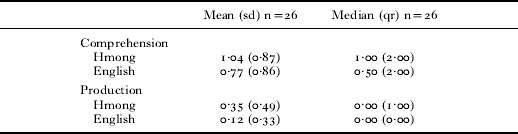
Scores for the fast mapping tasks in Hmong and in English are summarized in Tables 2 and 3. Model-checking was conducted in order to explore the normality and the homogeneity-of-variance in fast mapping scores. Results from the Kolmogorov–Smirnov (K–S) test showed a departure from normality for receptive and expressive scores in both languages. This asymmetric score distribution was anticipated given the limited number of trials in fast mapping tasks along with the discrete nature of scoring. Therefore, the non-parametric Wilcoxon signed rank tests were used to compare fast mapping scores between languages (L1 and L2) and modalities (receptive and expressive scores). The Wilcoxon signed rank test is similar to the paired t-test for the case of two related samples or for repeated measurements on a single sample but the test does not require any assumptions about the normal distribution of the data. Spearman's rank-correlation coefficients (r s) were also computed in order to describe the relationship between the two variables in each comparison.
The central tendency and the spread of the fast mapping scores in Hmong and in English
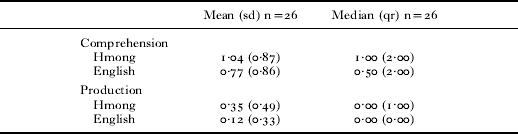
note: Means (and standard deviations) and medians (and quartile ranges) for novel word learning scores in Hmong and English, as demonstrated on comprehension (receptive) and production (expressive) probes. Participants did better in identifying novel objects than in naming them in Hmong (z=−3·35, p=0·001, r s=0·44) as well as English (z=−2·93, p=0·003, r s=−0·06). Within-language differences approached the conventional level for statistical significance on the expressive probes (z=−1·89, p=0·06, r s=−0·01) but not for the receptive fast mapping probes (z=−1·17, p=0·24, r s=0·17).
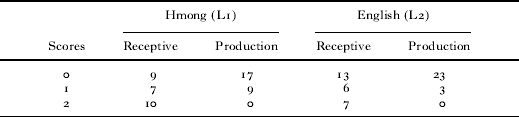
The distribution of fast mapping scores in Hmong and in English (n=26)
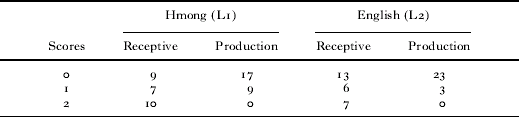
note: For receptive fast mapping probes, the distribution of scores was negatively skewed in Hmong (L1) and positively skewed in English (L2). For expressive probes the distribution of responses was positively skewed for both languages.
As a group, participants did better in identifying novel objects than in naming them in Hmong (z=−3·35, p=0·001, r s=0·44) as well as in English (z=−2·93, p=0·003, r s=−0·06). In addition, the variability of fast mapping scores was great in both modalities, in both languages. As shown in Table 2, average group scores were consistently greater in Hmong (L1) than in English (L2). These between-language differences approached the conventional level for statistical significance on the expressive probes (z=−1·89, p=0·06, r s=−0·01) but not for the receptive fast mapping probes (z=−1·17, p=0·24, r s=0·17). This lack of statistical significance on the expressive fast mapping probe may be due to the limited number of items combined with the large within-group variability. As shown in Table 3, nine participants (35%) were able to produce one of the newly introduced forms in Hmong (L1) as compared to only three participants (12%) in English (L2).
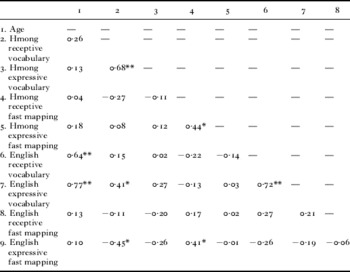
Receptive and expressive fast mapping scores in L1 and L2, vocabulary scores in L1 and L2, and chronological age were entered into a Spearman's rank-correlation analysis. Results are shown in Table 4. For vocabulary scores, there was a positive correlation between age and English (L2) receptive vocabulary (r s=0·64, p<0·01) as well as between age and English expressive vocabulary (r s=0·77, p<0·01). This result indicates that the older participants tended to obtain higher scores on L2 vocabulary measures than did the younger participants. There was no correlation between age and Hmong (L1) vocabulary scores. These combined age-related results for vocabulary measures are consistent with vocabulary findings reported by Kan & Kohnert (Reference Kan and Kohnert2005). There was a significant positive correlation for receptive and expressive vocabulary scores in both English (r s=0·72, p<0·01) and Hmong (r s=0·68, p<0·01) indicating strong associations within each language between children's picture-naming and picture-identification scores. For fast mapping receptive and expressive scores were positively associated in Hmong (r s=0·44, p<0·05), but not English (r s=−0·06).
Spearman correlation matrix for age, languages, tasks and modalities

* significant at the 0·05 level (2-tailed); ** significant at the 0·01 level (2-tailed).
There were no correlations between age and fast mapping measures either in Hmong (r s=0·04, p>0·05 for receptive scores and r s=0·18, p>0·05 for expressive scores) or in English (r s=0·13, p>0·05 for receptive scores and r s=0·10, p>0·05 for expressive scores). Relationships between vocabulary scores and fast mapping performance within each language were small and did not approach statistical significance. There was a significant positive (r s=0·41, p<0·05) correlation between receptive vocabulary in L1 and expressive vocabulary in L2. There was a negative cross-language correlation between expressive fast mapping scores in English and existing receptive vocabulary scores in Hmong (r s=−0·45, p<0·05), but a positive relationship between expressive fast mapping in L2 and receptive fast mapping in Hmong (r s=0·41, p<0·05).
In summary, the results of the existing vocabulary measures showed that participants had similar receptive and expressive skills in both Hmong and English. Performance on the receptive fast mapping probes was also comparable in L1 and L2. Participant performance was greater on the expressive fast mapping probes in Hmong (L1), although even here less than half of participants were able to accurately name newly introduced items. There were no observed links between age and fast mapping skills in either language. Moreover, there was no correlation between existing vocabulary skills and fast mapping skills within either language. Cross-language relationships were found between L1 receptive vocabulary and L2 expressive vocabulary and between L1 expressive fast mapping and L2 receptive scores on both vocabulary and fast mapping tasks.
DISCUSSION
This study investigates fast mapping skills in L1 and L2 in three- to five-year-old sequential bilinguals. Participants began learning Hmong as a first and primary language from birth and English, the majority language of the broader community, when they began attending a bilingual preschool program. Our overall study aim was parsed into three research questions addressing relative L1 and L2 performance, potential relationships between age and fast mapping skills and the possibility of links between vocabulary knowledge and fast mapping performance within or between languages. We discuss results related to each of these questions.
Comparisons between L1 and L2 in receptive and expressive modalities
Picture-naming and picture-identification tasks were administered as measures of existing expressive and receptive vocabulary knowledge in L1 and L2. Fast mapping tasks with expressive and receptive probes were administered in Hmong and English to determine participants' ability to quickly learn or ‘map’ new lexical forms. For vocabulary knowledge, scores were comparable for L1 and L2 on both and expressive measures (see Table 1). Small differences favoring Hmong (L1) over English (L2) were not statistically reliable. In both languages, receptive scores were significantly greater than expressive scores. These findings are consistent with results from a previous study in which we used the same picture-identification and picture-naming measures to investigate lexical–semantic abilities in another group of Hmong–English preschool children (Kan & Kohnert, Reference Kan and Kohnert2005).
On the fast mapping tasks, children did somewhat better in L1 than L2. For example, on receptive probes seventeen children (65%) demonstrated the mapping of one or two novel items in Hmong (L1) as compared with thirteen children (50%) in English (L2) (see Table 3). However, these differences were not statistically significance (p=0·24), perhaps due to the large amount of individual variation in performance along with the limited number of fast mapping trials (see Table 2). On the expressive probes, children did better in L1 (nine children or 35% producing one novel form) than in L2 (three children or 12% producing one novel form). This cross-language difference on expressive probes favoring Hmong approached the conventional level for statistical significance (p=0·06). Fast mapping is considered to be an important stage in learning new words. Study participants learned L1 from birth and started to learn L2 in school. This longer experience with L1 seemed to support the fast mapping of novel words in L1 to some degree, most notably when task demands were increased as evident on the expressive probes.
As with results from the vocabulary-knowledge measures in both L1 and L2, performance on fast mapping was significantly better on receptive probes as compared to expressive probes. These modality differences are consistent with other studies investigating fast mapping in monolingual children and are likely related to increased processing demands in the expressive probe phase (cf. Ellis Weismer & Hesketh, Reference Ellis Weismer and Hesketh1993; Gray, Reference Gray2003, Reference Gray2005, Reference Gray2006).
Relationships between age and fast mapping performance
Previous research with monolingual English-only speaking children found that fast mapping performance was related to maturational level as indexed by age, with older children outperforming younger children, as well as the integrity of the general language processing system, with typical learners outperforming peers with language impairment (Alt et al., Reference Alt, Plante and Creusere2004; Alt & Plante, Reference Alt and Plante2006; Dollaghan, Reference Dollaghan1987; Ellis Weismer & Hesketh, Reference Ellis Weismer and Hesketh1993, Reference Ellis Weismer and Hesketh1996, Reference Ellis Weismer and Hesketh1998; Gray, Reference Gray2004, Reference Gray2005, Reference Gray2006). Our findings for typically developing bilinguals differed from those reported with monolingual children in this regard. We found no evidence to support the idea that age was linked to success at fast mapping novel words in L1 or L2 in this group of preschool children, whose age spanned a two-year range. Correlations between age and fast mapping performance were very low, not exceeding 0·13 for either language. Thus, although the fast mapping skills may be linked to maturation in the case of monolingual children there may be other factors driving fast mapping performance in bilingual children. We should note that although this finding is at odds with studies of monolingual children, it is consistent with and extends findings for L2 learners reported by Wilkinson & Mazzitelli (Reference Wilkinson and Mazzitelli2003). Recall that these researchers measured novel word learning in the L2-only of sequential bilinguals as compared to English-only speaking peers. Results showed positive correlations between novel-word learning skills and age in the monolingual group but not the bilingual group.
Alongside the absent associations between age and fast mapping performance were robust positive correlations between age and English (L2) scores on the existing vocabulary measures for both picture identification (r s=0·64) and picture naming (r s=0·77).
That is, older children were more likely to name or identify more pictures in L2 than younger children. This was not true, however, for L1. These findings of a differential relationship between age and learners' two languages for vocabulary knowledge replicate findings from an earlier study, with a similar population (Kan & Kohnert, Reference Kan and Kohnert2005).
Vocabulary knowledge and fast mapping performance within or between languages
Results of the correlation analysis revealed a number of links between measures, languages and modalities. These associations were both positive and negative. A primary question was whether vocabulary knowledge, as measured by picture-naming or picture-identification tasks was related to fast mapping performance either within L1 or L2 or between the two languages. This question was of interest given the robust finding in the monolingual literature that vocabulary knowledge is related to fast mapping performance which, in turn, is related to novel word learning performance (Ellis Weismer & Evans, Reference Ellis Weismer and Evans2002; Gray, Reference Gray2003, Reference Gray2004).
For the vocabulary-knowledge measures, we found significant positive relationships between receptive and expressive scores in both Hmong (r s=0·68) and English (r s=0·72). There was also a positive cross-linguistic relationship between receptive vocabulary in Hmong (L1) and expressive vocabulary in English (L2) (r s=0·41), indicating that children who understood more Hmong words were likely to name more pictures in English. For the fast mapping tasks, there was a positive association between performance on receptive and expressive probes in Hmong (r s=0·44) but not in English (r s=−0·06). The lack of association across modalities for fast mapping in English may reflect the relative difficulty of the production probes in the context of early emerging L2 skills.
Our results provide mixed information about the association between existing vocabulary knowledge and the fast mapping of new information. On the one hand, no reliable relationships were found between existing vocabulary knowledge and fast mapping in Hmong or in English. Associations between receptive or expressive vocabulary and fast mapping within each language were both positive and negative, but very weak. Cross-task associations between fast mapping and existing vocabulary measures within L1 ranged from −0·27 to 0·12 and within L2 from −0·26 to 0·27 (see Table 4).
On the other hand, there were statistically significant relationships between vocabulary knowledge and fast mapping across the two languages. English expressive fast mapping was negatively correlated with Hmong vocabulary knowledge (r s=−0·45). This finding indicates that stronger vocabulary skills in Hmong were associated with poorer ability in making an initial representation of novel English forms. This negative relationship may represent some type of temporary cross-linguistic interference under the most demanding cognitive processing conditions (cf. Kohnert, Bates & Hernandez, Reference Kohnert, Bates and Hernandez1999; Kohnert, Reference Kohnert2002). It is possible that with cognitive maturation and/or continued language development the negative cross-linguistic relationship observed here could increase, disappear or change directions. The negative cross-linguistic relationship of language knowledge and fast mapping is consistent with theories that posit highly interdependent language and cognitive systems within developing sequential bilinguals. Within these general dynamic interacting systems the strength, even the fundamental nature, of cross-language relationships would be expected to change across development, variations in language experience and corresponding abilities as well as task demands (Kohnert, Reference Kohnert2008). That is, cross-linguistic interplay and competition for resources is predicted within a general interactive system but how this manifests is expected to change. Of course, it is also the case that the meaning of the cross-language links found here is open to interpretation as they are based on limited performance data, at a single point in time. That is, the simple cross-language correlations found here do not preclude the possibility that the children's languages are developing autonomously (De Houwer, Reference De Houwer, Kroll and de Groot2005). Word learning studies which investigate individual performance longitudinally using predictive versus correlational investigative tools are needed to further our understanding of cross-language relationships in early sequential bilinguals.
In summary, our findings for typically developing bilinguals differed from those reported for monolingual children in a number of important ways. First, we did not find the anticipated relationships between age and fast mapping performance in either L1 or L2. Neither did we find that fast mapping performance was clearly linked to vocabulary knowledge within either L1 or L2. The present results, then, raise the question about what variables might be associated with fast mapping skills in sequential bilingual children. In general, fast mapping performance was somewhat greater in L1 than L2, despite comparable vocabulary skills in the two languages. This may indicate that overall experience or exposure may play a role in the ability to form novel representations. It may be the case that vocabulary measures are not the most sensitive index of previous language experience or ability. That is, although these measures seem to be sufficient to expose salient relationships in monolingual learners, other combinations of measures tapping a different set of linguistic knowledge may be more telling with sequential bilinguals. This is, perhaps, because sequential bilinguals are at different cognitive and social stages of development than perhaps would be indicated by their vocabulary knowledge in either L1 or L2. It may also be that cross-linguistic relationships, such as those found here, provide a form of bootstrapping effect and these are the most relevant relationships at early stages of L2 learning.
We should also point out that individual variation on task performance in our study was great, consistent with findings from other studies investigating early sequential bilinguals. Individual variation combined with limited trials and the binary coding of responses may have resulted in the asymmetric distribution of children's performance on the fast mapping task. It is also the case that some typically developing bilingual children are able to do this simulated word-learning task and others are not (cf. Hwa-Froelich & Matsuo, Reference Hwa-Froelich and Matsuo2005; Kohnert & Danahy, Reference Kohnert and Danahy2007). This variation in performance among typical bilinguals presents some very real constraints on traditional fast mapping tasks, even when administered in both languages. Future investigations using multiple blocks of fast mapping tasks may more fully capture the variation of sequential bilingual children's fast mapping skills in both languages.
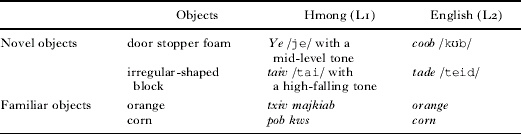
APPENDIX
Stimuli used in fast mapping task in Hmong and English

note: There are two novel objects and two familiar objects for the fast mapping task, in L1 and L2. Each novel object is paired with two labels: one Hmong label and one English label. The two novel English words were from Ellis Weismer & Evans (Reference Ellis Weismer and Evans2002). The Hmong novel words were composed according to Hmong phonology. Hmong is a monosyllabic tonal language. Each syllable contains an initial consonant, a vowel or diphthong and a lexical tone. The tonal markers in the written language are either final ‘consonant’ letters (e.g. v in taiv indicating a falling-rising tone) or ‘empty’ (e.g. as in ye indicating a mid-high level tone). For the fast mapping task in Hmong, classifier lub was used with each novel item during the exposure phase, whereas no classifier was given by the examiner during the probe phase.