


It has been well known that exogenous records such as sediment, sedimentary rock, loess, glacial moraine/tillite, ice core, stalactite/stalagmite and tree ring, etc., to name just a few, have been traditionally employed for decoding past environments of our dynamic planet. While high-temperature geological processes such as volcanic eruptions, magma degassing and metamorphic devolatilisation directly and/or indirectly impact environmental changes, the potential contribution of endogenous archives to palaeoenvironmental reconstructions has been less considered or at most empirically inferred.
As a complement, the meteoric hydrothermal system driven by magmatism or metamorphism can fill this gap. Previous studies extensively and/or intensively showed that oxygen and hydrogen isotopes of meteoric water are intrinsically fractionated by geographical, meteorological, hydrological, ecological and even anthropogenic factors on the global scale (cf., Craig Reference Craig1961; Dansgaard Reference Dansgaard1964; Gat Reference Gat1996; Alley & Cuffey Reference Alley and Cuffey2001; Galewsky et al. Reference Galewsky, Steen-Larsen, Field, Worden, Risi and Schneider2016; Jasechko Reference Jasechko2019; Surma et al. Reference Surma, Assonov and Staubwasser2021; Pepin et al. Reference Pepin, Arnone, Gobiet, Haslinger, Kotlarski, Notarnicola, Palazzi, Seibert, Serafin, Schöner, Terzago, Thornton, Vuille and Adler2022). These lines of environmental information can be therefore archived in rocks (and/or minerals in most cases) hydrothermally altered by the meteoric water. On the other hand, the low 18O/16O and 2H/1H ratios of meteoric water are usually far from thermodynamic equilibrium with most rocks being interacted with (Sheppard Reference Sheppard1986). Thus, the inflowing meteoric water can evidently and/or efficiently lower the δ18O and δ2H values of rocks within continental settings. Magmatic and/or metamorphic rocks externally infiltrated by the heated meteoric water have been whereby documented worldwide during the past decades (e.g., Taylor Reference Taylor1971, Reference Taylor1977; Valley et al. Reference Valley, Taylor and O'Neil1986; Walther & Wood Reference Walther and Wood1986; Taylor et al. Reference Taylor, O'Neil and Kaplan1991; Valley & Cole Reference Valley and Cole2001; Hoefs Reference Hoefs2021 and comprehensive references therein).
Palaeoenvironmental reconstructions with ancient meteoric water have been recognised a long time ago and numerous cases have been exploited with hydrothermally altered rocks and/or minerals (see summaries by Criss & Taylor Reference Criss and Taylor1986 and newly published by Grambling et al. Reference Grambling, Jessup, Newell, Methner, Mulch, Hughes and Shaw2022; Zakharov et al. Reference Zakharov, Zozulya and Colòn2023). Nearly all of the previous attempts, however, were carried out through the conventional straightforward modelling. That is, palaeoenvironmental clues were tried to be decoded from the final 18O/16O and/or 2H/1H ratios measured for hydrothermally altered rocks and/or minerals with a series of assumption. Among them, initial isotopes of meteoric water and rock, alteration temperature, water/rock (W/R) ratio and nature of hydrothermal systems (closed vs. open) were empirically presumed or loosely estimated. As pointed out by Wei & Zhao (Reference Wei and Zhao2021), the physicochemical boundary conditions noted above cannot be uniquely solved by conventional straightforward modelling from an individual mineral observed alone. These uncertainties not well resolved thereby largely limit the applicability of ancient meteoric water as one of the ideal candidates for reconstructing palaeoenvironments. However, the $\delta ^{18}O_W^i$ values of ancient meteoric water can be theoretically inverted from constituent minerals when their oxygen isotopes thermodynamically re-equilibrated each other (Wei & Zhao Reference Wei and Zhao2021, Reference Wei and Zhao2022). In other words, the palaeoenvironmental imprint can be uniquely unravelled through the $\delta ^{18}O_W^i$
 values of ancient meteoric water theoretically inverted from hydrothermally altered minerals (in particular rock-forming minerals in most cases).
Since magmatism and/or metamorphism are widespread within continental orogens worldwide, the meteoric hydrothermal systems accompanying them would be inevitably present. Thus, the terrestrial palaeoenvironment can be in principle reconstructed with continental rocks hydrothermally altered by the meteoric water. In order to address these issues, the early Cretaceous post-collisional granitoids and Triassic gneissic country rocks across the Dabie orogen in central-eastern China were studied herein as natural examples because some of them were appreciably overprinted by ancient meteoric water and thermodynamically re-equilibrated among major rock-forming minerals.
1. Geological settings and samplings
As previously summarised by Wei & Zhao (Reference Wei and Zhao2017), the largest occurrence of the microdiamond- and/or coesite-bearing ultrahigh pressure (UHP) metamorphic rocks in the world has been documented across the Dabie–Sulu orogens (Wang et al. Reference Wang, Liou and Mao1989; Xu et al. Reference Xu, Okay, Ji, Sengör, Su, Liu and Jiang1992; Ye et al. Reference Ye, Cong and Ye2000; Zheng et al. Reference Zheng, Fu, Gong and Li2003; Zheng Reference Zheng2012). Triassic ages of 200 to 240 million years ago (Ma) were dated with distinct geochronometers for the eclogite facies rocks and their cooling histories during exhumation processes were accordingly quantified (Li et al. Reference Li, Xiao, Liu, Chen, Ge, Zhang, Sun, Cong, Zhang, Hart and Wang1993, Reference Li, Jagoutz, Chen and Li2000; Ames et al. Reference Ames, Zhou and Xiong1996; Rowley et al. Reference Rowley, Xue, Tucker, Peng, Baker and Davis1997; Hacker et al. Reference Hacker, Ratschbacher, Webb, Ireland, Walker and Dong1998, Reference Hacker, Ratschbacher, Webb, McWilliams, Ireland, Calvert, Dong, Wenk and Chateigner2000; Liu et al. Reference Liu, Jian, Kröner and Xu2006; Cheng et al. Reference Cheng, Zhang, Vervoort, Wu, Zheng, Zheng and Zhou2011). Moreover, the ultrahigh ɛNd(t) values up to +264 ever measured for eclogites (Jahn et al. Reference Jahn, Conichet, Cong and Yui1996) and zircons with the lowest ever reported δ18O values down to about −11‰ were found (Rumble et al. Reference Rumble, Giorgis, Oreland, Zhang, Xu, Yui, Yang, Xu and Liou2002; Zheng et al. Reference Zheng, Wu, Chen, Gong, Li and Zhao2004; Fu et al. Reference Fu, Kita, Wilde, Liu, Cliff and Greig2013).
Compared with the sporadically outcropped lenses or blocks of UHP eclogites, composite plutons and batholiths of the early Cretaceous post-collisional granitoid are predominant igneous rocks although a number of coeval small mafic to ultramafic plutons have been documented in the Dabie orogen (Zhou et al. Reference Zhou, Chen, Li and Foland1992; Xue et al. Reference Xue, Rowley, Tucker and Peng1997; Ma et al. Reference Ma, Li, Ehlers, Yang and Wang1998; Jahn et al. Reference Jahn, Wu, Lo and Tsai1999; Zhang et al. Reference Zhang, Gao, Zhong, Zhang, Zhang and Hu2002; Bryant et al. Reference Bryant, Ayers, Gao, Miller and Zhang2004; Zhao et al. Reference Zhao, Zheng, Wei and Wu2004, Reference Zhao, Zheng, Wei, Wu, Chen and Jahn2005, Reference Zhao, Zheng, Wei and Wu2007, Reference Zhao, Zheng, Wei and Wu2011; Xu et al. Reference Xu, Zhao, Zheng and Wei2005; Wang et al. Reference Wang, Wyman, Xu, Jian, Zhao, Li, Xu, Ma and He2007; Xu et al. Reference Xu, Ma, Zhang and Ye2012; He et al. Reference He, Li, Hoefs and Kleinhanns2013; Deng et al. Reference Deng, Yang, Polat, Kusky and Wu2014; Dai et al. Reference Dai, Zhao and Zheng2015). The early Cretaceous age of 124 ± 0.8 Ma was dated with hornblende 40Ar/39Ar for the Hepeng pluton (Zhou et al. Reference Zhou, Chen, Li and Foland1992), whereas zircon uranium–lead (U–Pb) ages were averaged around 135 Ma for the Tiantangzhai batholith (Wang et al. Reference Wang, Wyman, Xu, Jian, Zhao, Li, Xu, Ma and He2007; Xu et al. Reference Xu, Ma, Zhang and Ye2012; Deng et al. Reference Deng, Yang, Polat, Kusky and Wu2014) and 130 Ma for the Tianzhushan pluton (Zhao et al. Reference Zhao, Zheng, Wei and Wu2004, Reference Zhao, Zheng, Wei and Wu2011), respectively. The upper intercept ages of Neoproterozoic for available zircon U–Pb dating indicate their affinities with the South China Block. Zircon hafnium (ɛHf(t) value) and whole-rock neodymium (ɛNd(t) value)–strontium ((87Sr/86Sr)0 ratio) isotopes suggest that an old enriched source(s) was petrogenetically linked to the studied granitoids.
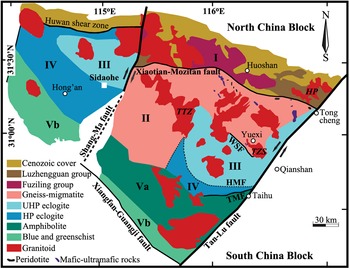
The studied granitoids and gneissic country rocks spatially occupy the northern and central-eastern lithotectonic units of the Dabie orogen (Fig. 1). From north to south, the Hepeng pluton (HP) outcrops in the utmost eastern portion of the Northern Huaiyang volcanic-sedimentary belt. The Tiantangzhai batholith (TTZ) distributes within the Northern Dabie gneissic and migmatitic belt, whereas the Tianzhushan pluton (TZS) is adjacent to the Central Dabie UHP metamorphic belt. The intrusive contact between granitoid and country rock was unambiguously observed in the field.
Geological sketch of the Dabie orogen in central-eastern China modified from Ma et al. (Reference Ma, Li, Ehlers, Yang and Wang1998), Zhang et al. (Reference Zhang, Gao, Zhong, Zhang, Zhang and Hu2002) and Ernst et al. (Reference Ernst, Tsujimori, Zhang and Liou2007). In terms of field relation and lithological assemblage, geological units bounded with faults were divided. Traditionally, the western portion beyond the Shang-Ma fault is termed Hong'an (or Xinxian) Block. The Dabie Block (DBB) is bounded by the Shang-Ma fault in the west and the Tan-Lu fault in the east. From north to south, the DBB was further subdivided into five belts: (I) the Northern Huaiyang volcanic-sedimentary belt (flysch series); (II) the Northern Dabie gneissic and migmatitic belt; (III) the Central Dabie UHP metamorphic belt; (IV) the Southern-central Dabie high pressure metamorphic belt; and (V) the Southern Dabie intermediate- to low-grade metamorphic belt, respectively. Boldface italic capital letters denote the abbreviations of studied plutons and batholith, other details refer to Online Supplementary Table 1. Abbreviations: WSF = Wuhe-Shuihou fault; HMF = Hualiangting-Mituo fault; TMF = Taihu-Mamiao fault.

Because most granitoids and gneissic country rocks are medium-grained in texture and collected from quarries and/or along road cuttings, the studied samples are thus less weathered and/or fresh. In addition to accessory zircon and magnetite, common constituent minerals such as quartz, feldspar, biotite and sometimes amphibole are petrographically present.
2. Analytical procedures of oxygen isotopes
Conventional crushing, gravimetric, heavy liquid and magnetic techniques were applied to separate and concentrate zircon, quartz and alkali feldspar from whole-rocks. In order to avoid metamict zircons and other impurities, the separated zircons were sequentially treated with concentrated hydrochloric acid (HCl), nitric acid (HNO3) and hydrofluoric acid (HF) under room conditions overnight. The purity of mineral separates is generally better than 98% with optical microscope examination.
Oxygen isotopes were analysed with the laser fluorination online techniques (cf., Valley et al. Reference Valley, Kitchen, Kohn, Niendorf and Spicuzza1995; Wei et al. Reference Wei, Zhao and Spicuzza2008), and an air-lock chamber was employed to avoid the ‘cross-talk’ of reactive alkali feldspar (Spicuzza et al. Reference Spicuzza, Valley and McConnell1998). The conventional δ18O notation in permil (‰) relative to Vienna Standard Mean Ocean Water (VSMOW) is reported in Online Supplementary Table 1 available at https://doi.org/10.1017/S1755691023000075.
In order to control the quality of δ18O analyses, the garnet standard, UWG-2, was routinely analysed. For 15 analytical days over three months, the daily average of measured δ18O values of UWG-2 varied from 5.54 to 5.89‰, and the daily analytical precision is better than ± 0.11‰. Raw δ18O values of mineral separates were accordingly corrected in terms of the accepted UWG-2 value of 5.80‰. The international standard, NBS 28 quartz, was analysed and the corrected δ18O values for NBS 28 are from 9.31 to 9.69‰ during the course of this study.
The reproducibility of fresh crystalline zircon δ18O analyses is excellent throughout this study. As shown in Online Supplementary Table 1, the 1SD of most duplicate measurements with one triplicate is less than ± 0.10‰, which is within the maximum routine analytical errors demonstrated by daily UWG-2 garnet standard measurements.
3. Procedures of theoretical inversion of $\delta ^{18}O_W^i$ value

For constituent minerals thermodynamically re-equilibrated with water, the $\delta ^{18}O_W^i$ value can be theoretically inverted (Wei & Zhao Reference Wei and Zhao2017). For a closed-system, two equations were derived for major rock-forming minerals such as alkali feldspar (Ksp) and quartz (Qtz), respectively:


and

where $\delta ^{18}O_{Ksp}^f$ and $\delta ^{18}O_{Qtz}^f$
 are final values observed for specified minerals; $\delta ^{18}O_{Ksp}^i$
 and $\delta ^{18}O_{Qtz}^i$
 values can be calculated by Eq. 3 with the observed zircon (Zrc) δ18O values at magmatic or metamorphic temperature ${\rm ( i}{\rm .e}{\rm ., \;}\;( \Delta ^{18}O_{Zrc}^{Ksp} ) _m\;{\rm or}\;( \Delta ^{18}O_{Zrc}^{Qtz} ) _m{\rm value})$
 ; and $( {\Delta^{18}O_W^{Ksp} } ) _r\;$
 or $( {\Delta^{18}O_W^{Qtz} } ) _r$
 value can be calculated with the re-equilibration temperature. Moreover, $n_W^O /n_{Ksp}^O \;{\rm and}\;n_W^O /n_{Qtz}^O$
 ratios are actually constants between water and alkali feldspar as well as quartz (last row in Table 1). In this case, both $\delta ^{18}O_W^i$
 value and (W/R)c ratio can thus be solved by combining Eqs 1 and 2.
Parameters of theoretical inversion for $\delta ^{18}O_W^i$ values of ancient meteoric water.

1 Initial quartz $( {\delta ^{18}O_{Qtz}^i } )$ and alkali feldspar $( {\delta ^{18}O_{Ksp}^i } )$
 values of sample 01HP05 are calculated with its observed zircon δ18O values (Online Supplementary Table 1) at 740 ± 1°C, which is retrieved from oxygen isotopes of the quartz–zircon pair from sample 01HP04 and a similar magmatic temperature is hereby assumed on the scale of the Hepeng granitoid pluton. For samples 01TTZ03 and 01TZS06, their initial values are calculated at 610±20°C, which is bracketed through samples 00DB63, 00DB64 and 01TZS07 and a common thermal regime on orogenic scale is assumed for these gneissic country rocks.
2 Re-equilibration temperatures are calculated with the observed oxygen isotopes of quartz–alkali feldspar pairs. Owing to the lack of repetitive measurements for sample 01TTZ03 (Online Supplementary Table 1), its 1SD of re-equilibration temperature is not statistically assigned.
3 Theoretically inverted from open-systems, other details refer to text.
4 Ratio of exchangeable oxygen content between water and an indicated mineral.
In order to be self-consistent, theoretically calculated oxygen isotopic fractionations at temperatures ranging from 0 to 1200°C (Zheng Reference Zheng1993) are adopted throughout this study. Because the discrepancy between theoretical calculation and experimental calibration or empirical estimation is not remarkable for oxygen isotopic fractionations of the studied constituent minerals (cf., summaries by Kieffer Reference Kieffer1982; Clayton & Kieffer Reference Clayton and Kieffer1991; Chacko et al. Reference Chacko, Cole and Horita2001; Schauble & Young Reference Schauble and Young2021), it will not considerably influence results of this study.
For an open-system, a similar inverse procedure can be applied. Due to the term of natural logarithm or exponential function (i.e., (W/R)o = ln[(W/R)c + 1]), an analytical expression cannot be obtained. Under this circumstance, the numerical reiteration with a goal precision of at least ± 0.0001 is conducted to theoretically invert the $\delta ^{18}O_W^i$ value and (W/R)o ratio herein.
4. Results
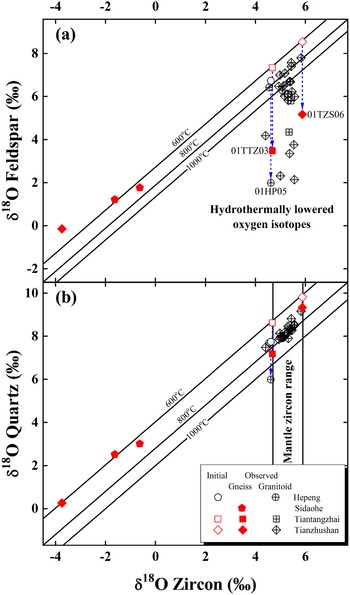
It can be seen that zircon δ18O values of the studied gneisses apparently scatter from −3.78 to 5.88‰ (Fig. 2), indicating that they were not homogenised during the Triassic regional metamorphism across the Dabie orogen. In order to identify the oxygen isotopic zonation of metamorphic rim overgrown under solid conditions from inherited core from their protoliths, the in situ analysis with ion microprobe would be beneficial for further studies. On the contrary, zircon values of granitoids cluster around 5.20 ± 0.35‰ (n = 31) and overlap with the ranges of mantle zircon. These results suggest that the granitoids with uniform zircon δ18O values cannot isotopically derive from those heterogeneous gneisses, which are almost seven times larger than zircon δ18O variability of the granitoids (9.66 vs. 1.42‰).
Diagrams of zircon vs. alkali feldspar (a) and quartz δ18O values (b) for the granitoids and gneisses from the Dabie orogen. Lines labelled with temperatures are isotherms after Zheng (Reference Zheng1993) and two vertical solid lines in (b) denote the mantle zircon δ18O ranges for comparison (cf., Valley et al. Reference Valley, Kinny, Schulze and Spicuzza1998). Arrowed lines denote samples theoretically inverted in this study. The observed and initial oxygen isotopes of constituent minerals refer to Online Supplementary Table 1 and Table 1, respectively. The error bar is omitted for clarity herein.

Many observed alkali feldspar δ18O values, however, steeply depart from isotherms downwards and show evident disequilibrium with zircon oxygen isotopes (Fig. 2a). In contrast, equilibrium fractionations are well preserved by most of the available zircon and quartz oxygen isotopes (Fig. 2b). Moreover, further check-ups show that quartz oxygen isotopes were concurrently lowered with alkali feldspar for a granitoid from the Hepeng pluton (sample 01HP05) and gneissic country rocks from the Tiantangzhai batholith (sample 01TTZ03) as well as the Tianzhushan pluton (sample 01TZS06), respectively (the labelled data points in Fig. 2).
As recently pointed out by Wei & Zhao (Reference Wei and Zhao2022), 18O-depleted metamorphic rocks were regionally documented across the Dabie orogen (Zheng et al. Reference Zheng, Wu, Chen, Gong, Li and Zhao2004; Fu et al. Reference Fu, Kita, Wilde, Liu, Cliff and Greig2013; Wei & Zhao Reference Wei and Zhao2017). Thereby, oxygen isotopes of the studied granitoids could be lowered through the magmatic assimilation by metamorphic country rocks (in particular gneisses in most cases). While subtly low zircon δ18O values are indeed observed from the Hepeng granitoids (4.54 to 4.64‰ for samples 01HP04 and 01HP05 in Online Supplementary Table 1 and Fig. 2), their extreme homogeneity is fundamentally inconsistent with the progressive assimilating on the pluton scale. Moreover, magmatic temperatures lower than 800°C for the Hepeng pluton (see footnote in Table 1) seem less favourable for the assimilation during magma cooling processes because the latent heat is energetically limited with the crystallisation of a cold granitoid (cf., Miller et al. Reference Miller, McDowell and Mapes2003). On the other hand, the country rocks intruded by the Hepeng pluton are volcanic-sedimentary rocks (Fig. 1), which are in fact 18O-enriched rather than -depleted in most cases. Furthermore, these upper continental crusts themselves are too cold to substantially assimilate oxygen isotopes of the Hepeng granitoids.
Owing to the complexity and sluggishness of metamorphic reactions, the lowered oxygen isotopes of gneissic country rocks studied herein could alternatively inherit from their protoliths with original nonequilibria. However, two gneisses from the Sidaohe in the Hong'an Block well maintain equilibrium fractionations between zircon and quartz as well as alkali feldspar oxygen isotopes (samples 00DB63 and 00DB64 in Online Supplementary Table 1 and Fig. 2). Moreover, the equilibrium fractionation between zircon and quartz oxygen isotopes is also retained for sample 01TZS07 from gneissic country rock of the Tianzhushan pluton (Online Supplementary Table 1 and Fig. 2b). While their oxygen isotopes among constituent minerals are evidently varied, similar equilibrium fractionations were thermodynamically achieved for the above samples (particularly between zircon and quartz oxygen isotopes in Fig. 2b). Thereby, it is less likely that original nonequilibria of oxygen isotopes were exceptionally inherited from their protoliths both for the less mobile quartz and reactive alkali feldspar for samples 01TTZ03 and 01TZS06, the latter one is spatially no more than three kilometres apart from sample 01TZS07 (see Global Positioning System (GPS) data in Online Supplementary Table 1). Furthermore, most available studies showed that the inert samarium–neodymium (Sm–Nd), lutetium–hafnium (Lu–Hf) and U–Pb radiometric systems were explicitly homogenised and/or reset during the Triassic metamorphism across the Dabie orogen (Li et al. Reference Li, Xiao, Liu, Chen, Ge, Zhang, Sun, Cong, Zhang, Hart and Wang1993, Reference Li, Jagoutz, Chen and Li2000; Rowley et al. Reference Rowley, Xue, Tucker, Peng, Baker and Davis1997; Hacker et al. Reference Hacker, Ratschbacher, Webb, Ireland, Walker and Dong1998; Liu et al. Reference Liu, Jian, Kröner and Xu2006; Cheng et al. Reference Cheng, Zhang, Vervoort, Wu, Zheng, Zheng and Zhou2011). Thus, it is less likely that the actively liable oxygen of rock-forming minerals could survive the continental deep subduction and be inherited from their protoliths.
Therefore, the concurrently lowered oxygen isotopes of quartz and alkali feldspar in this study are best attributed to hydrothermal alteration by the low δ18O water during the post-magmatic and/or exhumation processes of the retrograde metamorphism across the Dabie orogen. This is in good agreement with the low re-equilibration temperatures discussed below.
4.1. Theoretical inversion of ancient meteoric water from granitoid
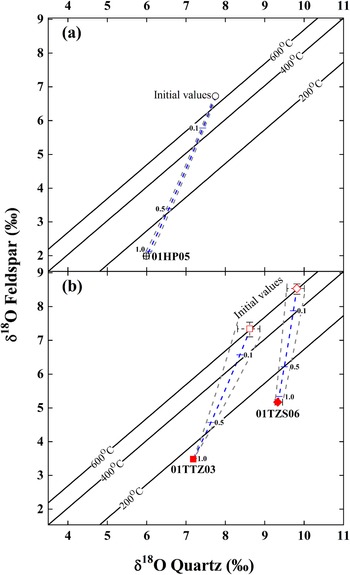
As shown in Online Supplementary Fig. 1 and Fig. 3a, quartz oxygen isotopes were re-equilibrated with alkali feldspar at 140 ± 5°C for sample 01HP05 from the Hepeng granitoid pluton. In terms of procedures described in section 3, its $\delta ^{18}O_W^i$ value is theoretically inverted as −11.01 ± 0.43‰ for the open system and clearly of meteoric origin. Based upon parameters listed in Table 1, the observed oxygen isotopes of rock-forming minerals are well reproduced, and a minimum (W/R)o ratio of 1.10 ± 0.02 is accordingly yielded. It is worthwhile pointing out that a high (W/R)c ratio is systematically quantified if a closed system is adopted (arrowed solid vs. dashed lines in Online Supplementary Fig. 1).
Diagrams of quartz vs. alkali feldspar δ18O values for the granitoid (a) and gneissic country rocks (b), respectively, from the Dabie orogen. The blue curves with grey envelopes denote the maximum variability for the concurrently lowered oxygen isotopes of rock-forming minerals thermodynamically re-equilibrated with ancient meteoric water throughout this study. Small ticks with numbers are (W/R)o ratios. For clarity, only the trajectories for the open systems are illustrated whereas those for the closed systems with corresponding high (W/R)c ratios refer to Online Supplementary Figs 1–3. For other details see Fig. 2.

4.2. Theoretical inversion of ancient meteoric water from gneissic country rocks
For the gneissic country rocks intruded by the Tiantangzhai batholith and Tianzhushan pluton, samples 01TTZ03 and 01TZS06 yield re-equilibration temperatures of 160 and 130 ± 5°C (Table 1, Online Supplementary Figs 2, 3 and Fig. 3b), respectively. Their $\delta ^{18}O_W^i$ values of the externally infiltrated ancient meteoric water are thus theoretically inverted as −7.61 ± 0.07 and −8.52 ± 0.56‰ for the open systems. Furthermore, the minimum (W/R)o ratios ranging from 1.02 ± 0.05 to 1.19 ± 0.05 are correspondingly yielded to reproduce the observed oxygen isotopes of rock-forming minerals.
5. Discussion
5.1. The reliability of δ 18OWi values of ancient meteoric water
As shown in Eqs 1–3, both re-equilibration temperature and initial oxygen isotopes of constituent minerals are prerequisites in order to theoretically invert the $\delta ^{18}O_W^i$ value. The re-equilibration temperatures are calculated with concurrently lowered oxygen isotopes of the hydrothermally altered quartz–alkali feldspar pair for corresponding samples herein. The initial oxygen isotopes of rock-forming minerals, however, are constrained with observed oxygen isotopes of the resistant zircon at magmatic or metamorphic temperatures. In these cases, the role of temperatures is evaluated to validate $\delta ^{18}O_W^i$
 values theoretically inverted above.
5.1.1. Construction of the relationship between temperatures and δ 18OWi values
In order to verify the potential effects of re-equilibration temperature and magmatic or metamorphic temperatures on theoretical inversion of $\delta ^{18}O_W^i$ values for the ancient meteoric water in this study, two strategies are applied to deal with these issues separately:
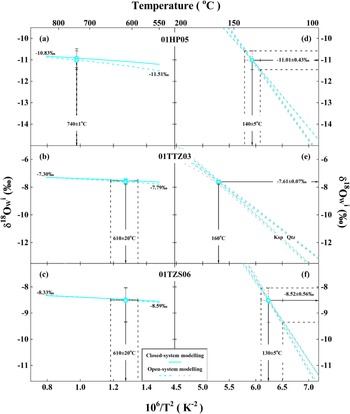
(1) The mean re-equilibration temperature is fixed for each studied sample. Because the magmatic temperature of 740 ± 1°C and metamorphic temperature of 610 ± 20°C are adopted throughout this study (Table 1 and Fig 4a–c), their maximum variations are arbitrarily set from 550 to 850°C. Then, the initial oxygen isotopes of rock-forming minerals are calculated with the observed zircon oxygen isotopes at a hypothetical temperature through Eq. 3. From the low- to high-end, five to seven temperature intervals are usually conducted herein (e.g., 550, 600, …, 850°C). Substituting these new initial oxygen isotopes into Eqs 1 and 2, a hypothetical $\delta ^{18}O_W^i$
value can be theoretically inverted for the closed system. Similar procedures can be applied to the open system. These results are thereby illustrated as labelled curves in Fig 4a–c.(2) Due to the susceptibility of common rock-forming minerals to subsequent hydrothermal alterations (in particular feldspar), an apparent rather than true re-equilibration temperature could result under some circumstances. In order to test the potential influence of varied re-equilibration temperatures on theoretical inversion of $\delta ^{18}O_W^i$
values, the following procedures are carried out. First, the observed oxygen isotopes of alkali feldspar are fixed for each studied sample. Then, quartz δ18O values are reasonably adjusted to either higher or lower ones (five to seven adjustments are usually adequate in most cases). A hypothetical re-equilibration temperature is accordingly calculated with the combination of the observed alkali feldspar and adjusted quartz oxygen isotopes. Substituting these values into Eqs 1 and 2, a hypothetical $\delta ^{18}O_W^i$ value can be theoretically inverted for the closed system. Similar procedures can be applied to the open system and these results are illustrated as curves labelled with Qtz in Fig 4d–f. When the observed oxygen isotopes of quartz are fixed and alkali feldspar δ18O values are adjustable, the resulting curves are labelled with Ksp. It is worthwhile pointing out that the mean magmatic or metamorphic temperatures with maximum variations are adopted for constructing curves with grey envelops in Fig 4d–f.


The relationship between temperatures and $\delta ^{18}O_W^i$ values of ancient meteoric water theoretically inverted from the Dabie orogen. Curves with grey envelopes denote $\delta ^{18}O_W^i$
 values theoretically inverted from the early Cretaceous post-collisional granitoid (sample 01HP05) and the Triassic gneissic country rocks (samples 01TTZ03 and 01TZS06), respectively. Arrowed vertical lines with envelopes illustrate the maximum variation of magmatic (a), metamorphic (b, c) and re-equilibration temperatures (d to f) adopted for the studied samples. Symbol points with error bars denote the maximum variability of $\delta ^{18}O_W^i$
 values and temperatures. For other details see text.

5.1.2. The impact of magmatic or metamorphic temperatures on δ 18OWi value
It can be seen that $\delta ^{18}O_W^i$ values of ancient meteoric water gradually increase with higher magmatic or metamorphic temperatures (Fig 4a–c). Moreover, a subtle increase of $\delta ^{18}O_W^i$
 values is systematically inverted for the closed system and converged with those inverted for the open system (solid vs. dashed curves in Fig 4a–c). With the labelled $\delta ^{18}O_W^i$
 values, their maximum variability is generally less than 0.23‰ along with the temperatures varied for every 100°C for all studied samples herein. On the other hand, since the actual variation of temperatures is much more limited (see footnote of Table 1 and arrowed vertical lines with envelopes in Fig 4a–c), the corresponding variability of $\delta ^{18}O_W^i$
 values would be much less than the maximum variability of 0.23‰. For example, the 1SD of ± 0.07‰ is yielded for $\delta ^{18}O_W^i$
 variability of sample 01TTZ03 (Table 1 and Fig. 4e), which is only dependent upon the varied metamorphic temperatures adopted. Nevertheless, these results suggest that magmatic or metamorphic temperatures adopted in this study cannot significantly affect the variability of $\delta ^{18}O_W^i$
 values and their reliability is thus robust.
5.1.3. The influence of re-equilibration temperatures on δ 18OWi values
While the impact of magmatic or metamorphic temperatures is limited, the variability of $\delta ^{18}O_W^i$ values is sufficiently evident (Table 1 and symbol points with error bars in Fig. 4). In this regard, the influence of re-equilibration temperatures is further assessed in more details.
Compared with the limited impact by magmatic or metamorphic temperatures, the variability of $\delta ^{18}O_W^i$ values are more sensitive to re-equilibration temperatures. It can be seen that a large range of $\delta ^{18}O_W^i$
 values is theoretically inverted with the varied re-equilibration temperatures (curves with grey envelopes in Fig 4d–f). A cross point, however, appears for each studied sample. This means that both quartz and alkali feldspar oxygen isotopes were uniquely re-equilibrated with a water at the same temperature for individual samples, which just correspond to $\delta ^{18}O_W^i$
 values theoretically inverted with concurrently lowered oxygen isotopes of hydrothermally altered quartz and alkali feldspar (Table 1 and symbol points with error bars in Fig 4d–f). In this respect, this suggests that thermodynamic re-equilibration was attained and/or achieved at least between the studied rock-forming minerals and water and $\delta ^{18}O_W^i$
 values of ancient meteoric water are therefore validated. Moreover, it is worthwhile pointing out that an evidently low $\delta ^{18}O_W^i$
 value of −11.01 ± 0.43‰ is theoretically inverted from sample 01HP05 although its re-equilibration temperature is similar to that of sample 01TZS06 (Table 1 and Fig 4d, f). This confidently enhances the reliability of $\delta ^{18}O_W^i$
 values theoretically inverted for ancient meteoric water in this study.
Since re-equilibration temperatures of the studied samples are overall less than 200°C (Table 1 and Figs 3, 4d–f), this spatiotemporally suggests that the ancient meteoric water could externally infiltrate and be heated at shallow depth during the late-stage of the early Cretaceous magmatism and/or Triassic metamorphism. Meanwhile, the ancient meteoric water could become concentrated in 18O as it travelled along its flow-path downwards under the condition with a low W/R ratio. As shown in Online Supplementary Figs 1 to 3 and Fig. 3, however, W/R ratios quantified herein are generally over 1. This 18O-concentrated process for the ancient meteoric water therefore seemed less likely. On the other hand, the admixing with the heavy magmatic and/or metamorphic fluids enriched in 18O could also lead to increasing $\delta ^{18}O_W^i$ values of the ancient meteoric water. Thus, the $\delta ^{18}O_W^i$
 values theoretically inverted throughout this study could be viewed as the upper-limit values of true ancient meteoric water considering those ultimate scenarios outlined above.
5.1.4. Assessment of the uncertainties of theoretical inversion
During theoretical inversion for $\delta ^{18}O_W^i$ values, there are at least three input variables required (i.e.,$\;\delta ^{18}O_{Ksp}^f$
 or $\delta ^{18}O_{Qtz}^f$
 values, $\delta ^{18}O_{Ksp}^i$
 or $\delta ^{18}O_{Qtz}^i$
 values as well as $( {\Delta^{18}O_W^{Ksp} } ) _r\;$
 or $( {\Delta^{18}O_W^{Qtz} } ) _r$
 values in Eqs 1 to 3). Thus, their direct and/or indirect contribution to the uncertainties of theoretical inversion is assessed individually.
For the initial oxygen isotopes of rock-forming minerals, their uncertainties inherit and/or propagate from both analytical error of zircon δ18O values and varied magmatic or metamorphic temperatures adopted. While the analytical error of zircon δ18O values is the best for sample 01TZS06 among all of available data in this study (±0.01‰ in Online Supplementary Table 1), the uncertainties of initial oxygen isotopes of their rock-forming minerals are not correspondingly the smallest (Table 1 and Online Supplementary Fig. 3, Fig. 3b). In contrast, owing to the limited variation of magmatic temperatures (740 ± 1°C), the smallest uncertainties of ±0.02‰ are yielded for the initial oxygen isotopes of rock-forming minerals for sample 01HP05 (Table 1). In these cases, it suggests that the uncertainties of initial oxygen isotopes of rock-forming minerals are more dependent upon the variation of magmatic or metamorphic temperatures adopted. Furthermore, because the oxygen isotopic fractionations between quartz and zircon are systematically larger than those between alkali feldspar and zircon (cf., Zheng Reference Zheng1993; Chacko et al. Reference Chacko, Cole and Horita2001; Schauble & Young Reference Schauble and Young2021), slightly evident uncertainties of initial oxygen isotopes for quartz accordingly occur (Table 1 and Online Supplementary Figs 2, 3 and Fig. 3b).
The re-equilibration temperature is calculated with the observed oxygen isotopes between quartz and alkali feldspar throughout this study. Consequently, its uncertainty is essentially regulated by the analytical precision of the constituent minerals. Owing to the comparable precision for quartz (0.10 vs. 0.11‰ in Online Supplementary Table 1), a similar uncertainty of ± 5°C is yielded for the re-equilibration temperatures of samples 01HP05 and 01TZS06 (Table 1 and Fig 4d, f).
The smallest uncertainty of ± 0.07‰ for $\delta ^{18}O_W^i$ values is yielded for sample 01TTZ03 (Table 1), this is probably due to the least variation of its re-equilibration temperature (Fig. 4e). On the contrary, the largest uncertainty of ± 0.56‰ occurs for sample 01TZS06 owing to its varied re-equilibration temperature (Table 1 and Fig. 4f). While the variation of their re-equilibration temperatures is statistically comparable (±5°C), the uncertainty of $\delta ^{18}O_W^i$
 values for sample 01TZS06 is relatively larger than that for sample 01HP05 (±0.56 vs. ± 0.43‰ in Table 1 and Fig 4f, d). These values could further result from the large uncertainties of initial oxygen isotopes of rock-forming minerals for sample 01TZS06 (Table 1 and Online Supplementary Fig. 3, Fig. 3b). Nonetheless, the uncertainties of $\delta ^{18}O_W^i$
 values could be further improved and/or refined in the future with more precise re-equilibration temperatures as well as less varied magmatic or metamorphic temperatures being adopted. The accuracy of $\delta ^{18}O_W^i$
 values theoretically inverted in this study, however, is statistically reliable.
While the limited variation of less than ± 0.05 appears for the (W/R)o ratios from the open systems, a larger variation of (W/R)c ratios from the closed systems is systematically yielded (Table 2 and Online Supplementary Figs 1–3 and Fig. 3). The variation of (W/R)c ratios for sample 01TZS06 is statistically larger than that for sample 01HP05 with similar variation of re-equilibration temperatures for the closed systems (±0.38 vs. ± 0.15 in Table 2). These values could be attributed to the distinctive uncertainties of initial oxygen isotopes of their rock-forming minerals (Table 1). As a result, the variation of the re-equilibration timescale between rock-forming minerals and ancient meteoric water is coherently large for sample 01TZS06 (Table 2).
Parameters of surface-reaction oxygen exchange.

1 Re-equilibration temperature from Table 1.
2 Closed system (W/R)c ratio refers to Online Supplementary Figs 1–3.
3 Mole fraction of mineral oxygen re-equilibrated with water.
4 Mineral density from Anthony et al. (Reference Anthony, Bideaux, Bladh and Nichols2023).
5 Rate constant after Cole et al. (Reference Cole, Ohmoto and Lasaga1983, Reference Cole, Ohmoto and Jacobs1992).
6 Grain radius.
7 Time required for attaining 99% oxygen exchange (i.e., F value in the following equation) between a spherical mineral and water. As previously formulated for the closed system (Cole et al. Reference Cole, Ohmoto and Lasaga1983, Reference Cole, Ohmoto and Jacobs1992), $t={{-\ln ( 1-F) \bullet {( W/R) }_c \bullet X_s \bullet a \bullet \rho } \over {3 \bullet [ {1 + {( W/R) }_c} ] \bullet r \bullet {10}^{{-}4}}}$ , where all variables are listed in Table 2 for corresponding samples.
5.2. Palaeoenvironmental implications of δ 18OWi values of ancient meteoric water
5.2.1. Constraints on oxygen isotopes of the modern local precipitations
A comparison between oxygen isotopes of modern local precipitation and ancient meteoric water is one of the vital pathways to reconstruct palaeoenvironments. On the basis of the regional models across China published by Liu et al. (Reference Liu, Tian, Chai and Yao2008) and Zhao et al. (Reference Zhao, Hu, Tian, Tie, Wang, Liu and Shi2017), oxygen isotopes of the contemporary meteoric water are calculated for corresponding localities in this study.
Although oxygen isotopes of modern precipitation are complicated by many factors, the geographical variables such as latitude, longitude and elevation are the crucial parameters and quantitatively formulated within continental settings. Since two sets of formulation were proposed by Liu et al. (Reference Liu, Tian, Chai and Yao2008) and Zhao et al. (Reference Zhao, Hu, Tian, Tie, Wang, Liu and Shi2017), both of them are adopted to calculate the statistical mean values herein.
Based on GPS data listed in Online Supplementary Table 1, oxygen isotopes of modern meteoric water are calculated as −7.21 ± 0.39‰ for sample 01HP05 from the Hepeng granitoid pluton. A mean value of −8.17 ± 0.14‰ is quantified for sample 01TTZ03 from gneissic country rock of the Tiantangzhai batholith, whereas an intermediate value of −7.58 ± 0.27‰ is constrained for sample 01TZS06 from gneissic country rock of the Tianzhushan pluton, respectively. Considering the uncertainties of ± 0.50‰ given by Liu et al. (Reference Liu, Tian, Chai and Yao2008) and Zhao et al. (Reference Zhao, Hu, Tian, Tie, Wang, Liu and Shi2017), these are statistically acceptable values.
5.2.2. The evolutionary palaeoclimate
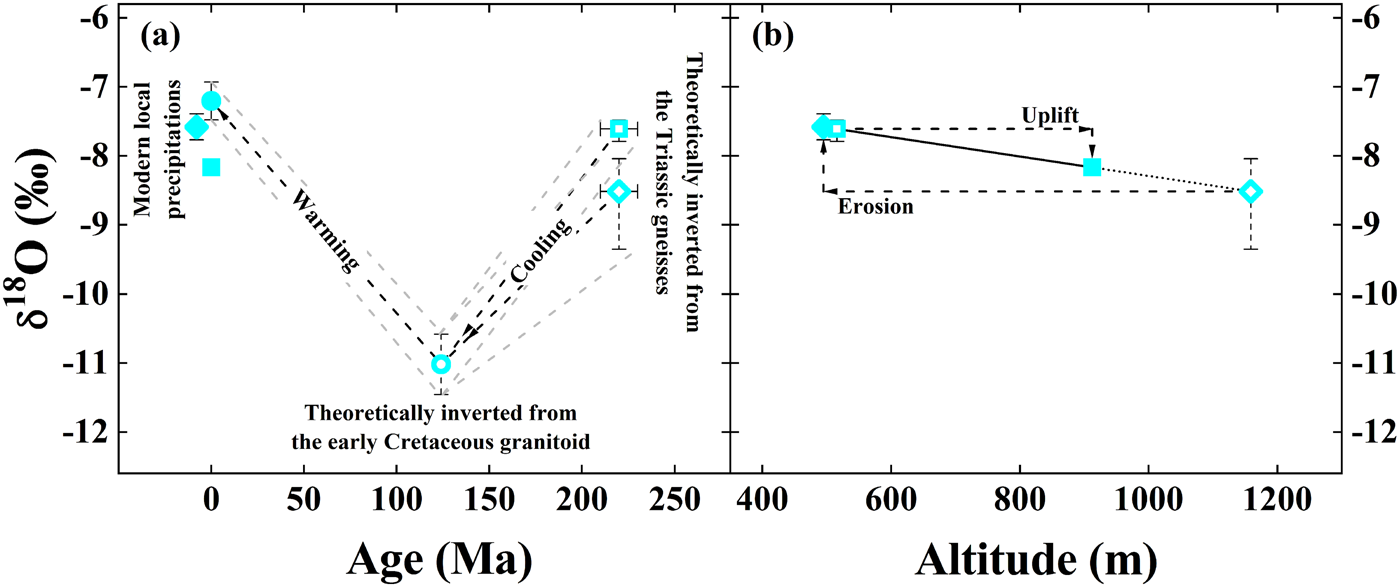
Compared to the oxygen isotopes of modern precipitations constrained above, the $\delta ^{18}O_W^i$ values of ancient meteoric water theoretically inverted in this study are statistically deviated from the local ones (Table 1 and Fig. 5). Because the continental collision between the North and South China Blocks for the Dabie orogen was Triassic (Li et al. Reference Li, Xiao, Liu, Chen, Ge, Zhang, Sun, Cong, Zhang, Hart and Wang1993; Zheng Reference Zheng2012), the palaeolatitude has been tectonically fixed since then. In other words, the horizontal motion between these two continents is relatively limited along the northern–southern direction. Therefore, the systematic deviation of $\delta ^{18}O_W^i$
 values of ancient meteoric water from those of modern local precipitation can be ascribed to the evolution of either palaeo-climate or -topography (e.g., Alley & Cuffey Reference Alley and Cuffey2001; Poage & Chamberlain Reference Poage and Chamberlain2001; Chamberlain et al. Reference Chamberlain, Ibarra, Lloyd, Kukla, Sjostrom, Gao and Sharp2020; Passey & Levin Reference Passey and Levin2021; Grambling et al. Reference Grambling, Jessup, Newell, Methner, Mulch, Hughes and Shaw2022; Pepin et al. Reference Pepin, Arnone, Gobiet, Haslinger, Kotlarski, Notarnicola, Palazzi, Seibert, Serafin, Schöner, Terzago, Thornton, Vuille and Adler2022).
Palaeoenvironmental reconstruction with oxygen isotopes of modern and ancient meteoric water across the Dabie orogen. The $\delta ^{18}O_W^i$ values of ancient meteoric water theoretically inverted for the open systems are illustrated as open symbol points with error bars (see Table 1 and Fig. 4 for other details), whereas oxygen isotopes of modern precipitations are calculated for corresponding localities after Liu et al. (Reference Liu, Tian, Chai and Yao2008) and Zhao et al. (Reference Zhao, Hu, Tian, Tie, Wang, Liu and Shi2017) and illustrated as solid symbol points. Arrowed lines with grey envelopes denote the evolutionary palaeoclimate in (a), but grey envelopes for the varied palaeotopography are omitted for clarity in (b). Triassic age of 220±10 Ma for the gneissic country rocks is after the compilation of metamorphic rocks without coesite in the Dabie orogen (Zheng Reference Zheng2012), and the early Cretaceous age of 124±0.8 Ma for the Hepeng granitoid pluton is from Zhou et al. (Reference Zhou, Chen, Li and Foland1992). Solid and dotted lines in (b) denote data constrained and linearly extrapolated relationship, respectively.

Since the fossil meteoric hydrothermal systems in this study were driven by the Triassic metamorphism or the early Cretaceous post-collisional magmatism, respectively, this probably suggests that the palaeoclimate with a precipitation $\delta ^{18}O_W^i$ value down to −11.01 ± 0.43‰ could be colder than the present at least during the early Cretaceous (Fig. 5a). This new insight is in good agreement with an independent study in East Asia (Amiot et al. Reference Amiot, Wang, Zhou, Wang, Buffetaut, Lécuyer, Ding, Fluteau, Hibino, Kusuhashi, Mo, Suteethorn, Wang, Xu and Zhang2011). In addition, if the relationship between mean annual temperature (MAT) and oxygen isotopes of modern meteoric water all over mainland China is methodologically applicable (cf., Fig. 5f in Zhao et al. Reference Zhao, Hu, Tian, Tie, Wang, Liu and Shi2017), a low MAT around 2°C is correspondingly yielded for the ancient precipitating settings across the Dabie orogen. Thereby, it seems highly likely that the palaeoclimate was once much colder than the present.
It can be seen, however, that the evidently low $\delta ^{18}O_W^i$ value of −11.01 ± 0.43‰ could be alternatively accounted for by the varied geomorphology. With the linear extrapolation between altitude and oxygen isotopes of modern meteoric water illustrated in Fig. 5b, a palaeoelevation up to 3000 m is unexpectedly yielded to reconcile the evidently low $\delta ^{18}O_W^i$
 value theoretically inverted in this study. As previously pointed out by Poage & Chamberlain (Reference Poage and Chamberlain2001), oxygen isotopes of modern precipitations decrease linearly with increasing elevation in most regions of the world mountain belts at elevations less than 5000 m. A net change in elevation of at least 1500 m is thus yielded if their linearly fitted regression line is adopted (cf., Fig. 2 in Poage & Chamberlain Reference Poage and Chamberlain2001). Yet, an elevation of 2220 m is yielded when the simplified relationship of the altitude-only-dependent linear fit across China is applicable (cf., Fig. 5c in Zhao et al. Reference Zhao, Hu, Tian, Tie, Wang, Liu and Shi2017). Compared to this simplified relationship, a similar slope (i.e., lapse rate) is linearly regressed for our Fig. 5b although its intercept is systematically shifted approximate 0.9‰ upwards due to the potential effect of latitude and/or longitude incorporated. Nevertheless, a palaeoelevation ranging from 1500 up to 3000 m has to be necessarily set in order to reconcile the evidently low $\delta ^{18}O_W^i$
 value theoretically inverted in this study.
While this likelihood cannot be completely ruled out, the following lines of evidence argue against this intuitive inference: (a) the higher landscapes mainly develop within the core complexes across the Dabie orogen, whereas the Hepeng granitoid pluton intruded along its north-eastern margin (Fig. 1). Moreover, the altitude of the highest peak for the summit of Baimajian is less than 1800 m now, which is geodetically lower than the supposed higher palaeoelevation up to 3000 m; (b) the infiltrating depth down to 3000 m for meteoric water seems less commonly documented from modern geothermal and/or fossil hydrothermal systems worldwide. In addition, the limited re-equilibration temperature of 140 ± 5°C for sample 01HP05 is consistent with the shallow infiltration of ancient meteoric water within the upper and/or outer portion of the Hepeng granitoid pluton; and (c) even regardless of the difficulties outlined above, a maximum erosion rate over −20 m/Ma has to be implicitly assigned to enforce the palaeoelevation decrease from original 3000 to the present 147 m for sample 01HP05 since the early Cretaceous. Erosion and uplift rates no more than −/+3 m/Ma, however, are quantified for other samples since the Triassic in this study (Fig. 5b). Furthermore, there seem to be no reasonable geodynamic mechanisms to abruptly accelerate the erosion and uplift rates during the transition from Triassic to the early Cretaceous. Geologically, the country rocks intruded by the Hepeng granitoid pluton are volcanic-sedimentary rocks (Fig. 1). The preservation of the upper continental crust around the intrusion suggests limited rather than extreme weathering and/or erosion processes. Thereby, the evidently low $\delta ^{18}O_W^i$ value of −11.01 ± 0.43‰ theoretically inverted from the northern Dabie orogen seemed to witness a cooling event at least during the early Cretaceous on the regional (or even global) scale. Afterwards, the palaeoclimate could progressively return back to the current conditions (labelled warming in Fig. 5a) owing to the emission of heat energy and greenhouse gases by the voluminous post-collisional magmatism developed across the Dabie orogen (Fig. 1).
5.2.3. The tectonic evolution of palaeotopography
In order to reconcile the modest deviations between $\delta ^{18}O_W^i$ values of ancient meteoric water theoretically inverted from the Triassic gneissic country rocks (−7.61 ± 0.07‰ for sample 01TTZ03 and −8.52 ± 0.56‰ for sample 01TZS06, respectively, in Table 1 and Figs 4 and 5) and those of modern local precipitation (−8.17 ± 0.14 and −7.58 ± 0.27‰ for corresponding locations), the potential influence of varied MATs is hereby considered. The ancient MATs from 18 to 14°C, however, are somewhat in contrast to the present-day regional MATs from 16 to 18°C (note the opposite order or trend between them). Considering their statistical uncertainties, it actually seems that MATs are not remarkably different between ancient and modern ones. Furthermore, owing to a limited distance less than 85 km apart between those two localities (Fig. 1), these modest deviations seem not reasonably accounted for through the subtle variation of MATs over a restricted area. Yet, it is interesting that the $\delta ^{18}O_W^i$
 values of ancient meteoric water theoretically inverted from the Triassic gneissic country rocks are contrary with their present-day altitudes (−7.61 ± 0.07‰ vs. 912 m for sample 01TTZ03 and −8.52 ± 0.56‰ vs. 495 m for sample 01TZS06, respectively, in Online Supplementary Table 1, Table 1 and Fig. 5b). Therefore, this probably suggests that differential uplift and/or erosion have occurred across the central-eastern Dabie orogen since the Triassic exhumation processes.
When the elevation-dependent relationship of oxygen isotopes of modern precipitations is applicable to the ancient meteoric water theoretically inverted in this study, a mean uplift rate of approximate + 1.8 m/Ma is accordingly yielded for the gneissic country rock of the Tiantangzhai batholith (labelled arrowed lines in Fig. 5b). In order to reconcile the discrepancy of oxygen isotopes between modern and ancient meteoric water, an erosion rate of approximate −3.0 m/Ma is linearly extrapolated for the gneissic country rock of the Tianzhushan pluton. It is worthwhile pointing out that constant rates of uplift and erosion are adopted herein, they could actually fluctuate in the real scenarios.
In fact, these palaeoaltimetric adjustments during the isostatic rebounce processes across the Dabie orogen are spatiotemporally consistent with the well-developed nature of the middle to late Mesozoic clastic sedimentary sequences within the adjacent Hefei basin (cf., Meng et al. Reference Meng, Li and Li2007). The absence of chemical sedimentary rocks such as limestone, dolostone and chert further indicates that physical weathering and erosion were dominant processes within settings of the basinal infill. This is in good agreement with the transition of ancient environments to a cold and/or dry condition from Triassic to the early Cretaceous discussed in the preceding sub-section 5.2.2.
On the other hand, it has been well known that rates of uplift and/or erosion for the continental orogens have been globally characterised with the low-temperature thermochronometry (cf., Jäger & Hunziker Reference Jäger and Hunziker1979; Faure & Mensing Reference Faure and Mensing2005; Reiners & Ehlers Reference Reiners and Ehlers2005; Dickin Reference Dickin2018; Reiners et al. Reference Reiners, Carlson, Renne, Cooper, Granger, McLean and Schoene2018 and comprehensive references and case studies therein). Compared to other radiogenic daughter isotopes, noble gases are extremely mobile during thermal events. Consequently, thermochronometers of potassium/argon (K-Ar) and argon/argon (Ar/Ar) have been widely applied for quantifying thermal history with certain potassium-bearing rock-forming minerals and rocks. Similarly, thermochronology of uranium–thorium/helium (U-Th/He) of accessory minerals can sensitively monitor the late-stage and/or shallow-depth processes of the continental orogenesis. As one of the radiation-damage dating methods, the annealing of fission track (FT) from zircon, titanite (sphene) and apatite is also quantitatively dependent upon the low-temperature end in the course of magmatic emplacement and/or metamorphic exhumation. Therefore, it would be more desirable for further integrated constraints on the geodynamic stability of the continental orogenic belt through interdisciplinary combination of stable isotope geochemistry such as ancient meteoric water theoretically inverted in this study with thermochronology outlined above (cf., Kohn Reference Kohn2007 and case studies cited in details therein).
As discussed in sub-section 5.2, rather limited datasets and/or localities are involved in this study. These limitations arose from two sides. One is the exceptional rarity of thermodynamic re-equilibration for oxygen isotopes between constituent minerals and cold meteoric water externally infiltrated at low temperatures; another is owing to only two geological events developed across the Dabie orogenic belt, i.e., the Triassic metamorphism and the following early Cretaceous post-collisional magmatism. Undoubtedly, more samples hydrothermally altered by ancient meteoric water would be ideal for enhancing palaeoenvironmental reconstruction from the Dabie and other continental orogens in the future.
5.3. Kinetic modellings of oxygen exchange
Ancient meteoric waters with low $\delta ^{18}O_W^i$ values are theoretically inverted from hydrothermally altered minerals and their palaeoenvironmental implications are accordingly addressed in the preceding sub-section 5.2. Yet, how did oxygen exchange between mineral and ancient meteoric water? Was the lifetime of fossil hydrothermal systems developed across the Dabie orogen geologically reasonable? These issues are further discussed below.
5.3.1. Diffusive oxygen exchange
As an elementary process, diffusion plays one of the essential roles for oxygen exchange between mineral and water. Because oxygen diffusivity of zircon is systematically lower than that of quartz and alkali feldspar under similar conditions (Online Supplementary Fig. 4a), zircon is thus one of the most resistant accessory minerals to hydrothermal alteration and can faithfully retain its original δ18O value (cf., Giletti et al. Reference Giletti, Semet and Yund1978; Giletti & Yund Reference Giletti and Yund1984; Fortier & Giletti Reference Fortier and Giletti1989; Watson & Cherniak Reference Watson and Cherniak1997; Zheng & Fu Reference Zheng and Fu1998). Disequilibria of oxygen isotopes therefore appear between the resistant and susceptible minerals during short-lived hydrothermal processes (Fig. 2), in qualitative accordance with their kinetic behaviours.
In addition, it has been well known that the diffusion is thermally activated (i.e., Arrhenius relationship in the caption of Online Supplementary Fig. 4a). Thereby, the timescale of diffusive oxygen exchange between constituent minerals and ancient meteoric water is quantified at corresponding re-equilibration temperatures with the model of spherical minerals herein (see caption of Online Supplementary Fig. 4b). As listed in Table 1, the re-equilibration temperatures range from 130 ± 5 to 160°C in this study. Because oxygen diffusion rates of zircon and quartz are rather slow at this temperature interval (i.e., D values in Online Supplementary Fig. 4a), the timespan is therefore unrealistically long to reset their δ18O values via diffusive oxygen exchange with ancient meteoric water. Moreover, an unreasonable duration from 385 up to 120,520 Myr is kinetically quantified even for the susceptible alkali feldspar to diffusively exchange oxygen with ancient meteoric waters (arrowed lines in Online Supplementary Fig. 4b). Thereby, this quantitatively suggests that diffusion is a less likely mechanism for oxygen exchange in this study.
5.3.2. Surface-reaction oxygen exchange
Compared to diffusive processes, oxygen exchange rates of surface-reaction between rock-forming minerals and water are several orders of magnitude high (Cole et al. Reference Cole, Ohmoto and Lasaga1983, Reference Cole, Ohmoto and Jacobs1992 and r values in Table 2). Given that thermodynamic re-equilibrations were achieved and/or reproduced between quartz and alkali feldspar oxygen isotopes for the studied samples (Online Supplementary Figs 1–3 and labelled data points in Fig. 3), this probably suggests that surface-reaction instead of volume diffusion eventually controlled the oxygen exchange herein. Mechanisms of surface-reaction such as dissolution, reprecipitation and exchange along micro-fractures and/or within networks were proposed to account for the varied quartz and/or alkali feldspar oxygen isotopes during hydrothermal processes (Cole et al. Reference Cole, Ohmoto and Lasaga1983, Reference Cole, Ohmoto and Jacobs1992; Matthews et al. Reference Matthews, Goldsmith and Clayton1983; Valley & Graham Reference Valley and Graham1996; King et al. Reference King, Barrie and Valley1997).
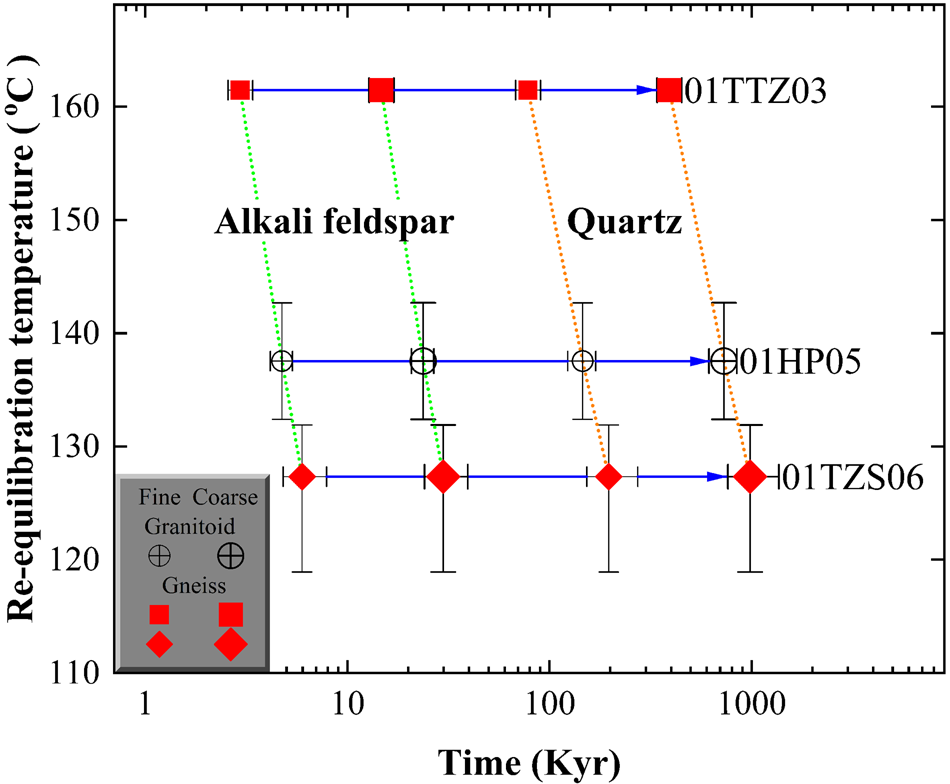
In terms of parameters listed in Table 2, the time for attaining 99% oxygen exchange between rock-forming minerals and ancient meteoric waters is accordingly calculated. Since the oxygen exchange rate between alkali feldspar and water is more rapid than that between quartz and water (Cole et al. Reference Cole, Ohmoto and Lasaga1983, Reference Cole, Ohmoto and Jacobs1992), thermodynamic re-equilibrations with ancient meteoric waters were readily approached for the fine-grained alkali feldspar at the temperature interval throughout this study (Table 2 and Fig. 6). Then, a longer timescale is systematically yielded for the coarse-grained quartz. Owing to the slightly high re-equilibration temperature of 160°C for sample 01TTZ03, a duration from 3.0 ± 0.2 to 390 ± 20 thousand years (Kyr) is hereby quantified for alkali feldspar and quartz sequentially re-equilibrated with ancient meteoric water, respectively. For the gneissic country rock from the Tianzhushan pluton, a maximum timescale was shifted up to 980 ± 190 Kyr at 130 ± 5°C. Overall, the lifetime of fossil hydrothermal systems developed across the Dabie orogen in central-eastern China would be no more than 1.2 Myr for surface-reaction oxygen exchange between rock-forming minerals and ancient meteoric waters.
The relationship between time and re-equilibration temperature of fossil hydrothermal systems developed across the Dabie orogen. Symbol points with error bars denote the maximum variability of rock-forming minerals with varied grain size sequentially re-equilibrated with ancient meteoric water through the surface-reaction oxygen exchange in the closed systems (Table 2). Note that log10 scale of X axis is adopted for clarity. For other details see text.

6. Conclusions
The $\delta ^{18}O_W^i$ values of ancient meteoric waters are theoretically inverted from concurrently lowered oxygen isotopes of rock-forming minerals, which thermodynamically re-equilibrated each other from fossil hydrothermal systems developed across the Dabie orogen in central-eastern China. The $\delta ^{18}O_W^i$
 values theoretically inverted from Triassic gneissic country rocks range from −8.52 ± 0.56 to −7.61 ± 0.07‰, and these modest deviations from oxygen isotopes of modern local precipitation suggest differential tectonic evolution of the palaeotopography on the orogenic scale. On the other hand, the evidently low $\delta ^{18}O_W^i$
 value down to −11.01 ± 0.43‰ theoretically inverted from the early Cretaceous post-collisional granitoid implies that the palaeoclimate in central-eastern China could be colder than the present. Kinetically, the surface-reaction can reasonably account for oxygen exchange between rock-forming minerals and heated meteoric waters, and fossil hydrothermal systems could geologically sustain up to 1.2 Myr for the external infiltration of ancient meteoric waters across the Dabie orogen in central-eastern China. Nevertheless, there is no doubt that $\delta ^{18}O_W^i$
 values of ancient meteoric water theoretically inverted from hydrothermally altered minerals can be analogously utilised for quantitative reconstructing of palaeoenvironments for the continental orogens elsewhere around world and the long-term geodynamic evolution of orogenic belts can be further inferred.
7. Supplementary material
Supplementary material is available online at https://doi.org/10.1017/S1755691023000075.
8. Acknowledgements
Yong-Fei Zheng is thanked for initiating this study and Zhi Xie is thanked for help during field trips. John W. Valley and Michael J. Spicuzza are appreciated for hosting and assisting analytical aspects of this work during the senior author's sabbatical visit at UW-Madison. Two anonymous reviewers are sincerely acknowledged for their detailed and constructive comments. Thanks are due to Editors Chris Soulsby and Susie Cox for editorial handling, and Abisheka Santhoshin is grateful for rounds of skillful and patient correction at the proof stage. The senior author is, however, responsible for any errors if present.
9. Financial support
This study was funded by the National Natural Science Foundation of China (40173008, 40033010 and 41888101), the Chinese Academy of Sciences (KZCX2-107 and XDB41000000) and the China Scholarship Council of Ministry of Education (20G05006).
10. Competing interests
None.