INTRODUCTION
The genus Adansonia belonging to the Bombacoideae, a subfamily of Malvaceae, consists of nine species. Two species originate from mainland Africa, six are endemic to Madagascar, and one can be found only in northern Australia (Wickens 1983; Baum Reference Baum1995; Wickens and Lowe Reference Wickens and Lowe2008; Pettigrew et al. Reference Pettigrew, Bell, Bhagwandin, Grinan, Jillani, Meyer, Waybuyele and Vickers2013).
In 2005, we started an in-depth research program to elucidate several controversial or poorly understood aspects related to the architecture, growth, and age of the African baobab (Adansonia digitata L.). This research is based on our new approach to investigate and date standing and live specimens. The methodology consists of accelerator mass spectrometry (AMS) radiocarbon dating of small wood samples, collected especially from inner cavities and/or from deep incisions/entrances in the stems and from the outer part of baobabs (Patrut et al. Reference Patrut, von Reden, Lowy, Alberts, Pohlman, Wittmann, Gerlach, Xu and Mitchell2007, Reference Patrut, Mayne, von Reden, Lowy, Van Pelt, McNichol, Roberts and Margineanu2010b, Reference Patrut, von Reden, Van Pelt, Mayne, Lowy and Margineanu2011). Due to the special ability of baobabs to produce stems periodically during their lifecycle, over time they develop architectures of increasing complexity. The obtained results have demonstrated that all large baobabs, with a girth of over 16 m, are multistemmed. We identified the so-called open and closed ring-shaped structures, which are the most important architectures that enable African baobabs to reach old ages and large sizes. We also documented the presence of false cavities, which are large natural empty spaces between fused stems disposed in a closed ring-shaped structure. The oldest dated A. digitata individuals were found to have ages greater than 2000 yr (Patrut et al. Reference Patrut, Mayne, von Reden, Lowy, Venter, McNichol, Roberts and Margineanu2010c, Reference Patrut, von Reden, Mayne, Lowy and Patrut2013, Reference Patrut, Woodborne, von Reden, Hall, Hofmeyr, Lowy and Patrut2015a, Reference Patrut, Woodborne, Patrut, Hall, Rakosy, von Reden, Lowy and Margineanu2015d). Dated growth rings of several studied African baobab specimens, which may act as a proxy climate archive, were used for past climate reconstruction in southern Africa (Robertson et al. Reference Robertson, Loader, Froyd, Zambatis, Whyte and Woodborne2006; Woodborne et al. Reference Woodborne, Hall, Robertson, Patrut, Rouault, Loader and Hofmeyr2015, Reference Woodborne, Gandiwa, Hall, Patrut and Finch2016).
We extended our research on the architecture, growth, and age of the Adansonia genus by starting to investigate using the same approach on large individuals of the most representative three Malagasy species, namely the fony baobab (Adansonia rubrostipa Jum. & H. Perrier), the za baobab (Adansonia za Baill.), and the Grandidier’s baobab or Reniala (Adansonia grandidieri Baill.) (Baum Reference Baum1996; Patrut et al. Reference Patrut, von Reden, Danthu, Leong Pock-Tsy, Patrut and Lowy2015b, Reference Patrut, von Reden, Danthu, Leong Pock-Tsy, Rakosy, Patrut, Lowy and Margineanu2015c, Reference Patrut, Patrut, Danthu, Leong Pock-Tsy, Rakosy, Lowy and von Reden2016). We found that their characteristic features, as assessed by AMS 14C dating, are similar to those of the African baobab.
One should mention that the identification of very complex architectures and the accurate dating of large and old baobabs are not possible by means of traditional dendrochronological methods, which are based on tree-ring investigation. The existence of growth rings in African baobabs has generated much controversy (Guy Reference Guy1970; Patrut et al. Reference Patrut, von Reden, Lowy, Alberts, Pohlman, Wittmann, Gerlach, Xu and Mitchell2007, Reference Patrut, Patrut, Danthu, Leong Pock-Tsy, Rakosy, Lowy and von Reden2016; Wickens and Lowe Reference Wickens and Lowe2008). We used 14C dating to determine age sequences along wood samples collected from different baobabs, which were compared against growth ring counts. Results indicate that baobabs (Adansonia spp.) produce distinct growth rings that correspond in many cases to one rainy season, i.e. to 1 yr in the investigated regions. However, in a sufficient number of cases, particularly in old baobabs, we found an anomalous ring frequency. For such cases, the number of rings between two dated segments of a sample was found to be significantly lower or significantly higher than the calendar age determined by 14C dating. That is why the determination of stem ages and growth rates of large and old baobabs mandates the use of AMS 14C dating of wood samples collected from determined positions. In such cases, ring counting and ring width analysis are not effective (Patrut et al. Reference Patrut, Patrut, Danthu, Leong Pock-Tsy, Rakosy, Lowy and von Reden2016). On the other hand, for certain baobabs the outermost rings were found to be old, with ages of several hundreds of years, instead of being very young. Such results show that baobab stems can stop growing due especially to old age or stress factors. Here, we present 14C dating results that demonstrate the existence of the “growth stop” phenomenon in Adansonia species.
MATERIAL AND METHODS
The Baobabs and Their Location
We investigated six baobabs belonging to the A. digitata species. Two African baobabs, which were single-stemmed, died naturally in South Africa over the past years. These trees are the following:
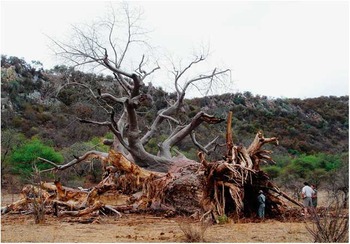
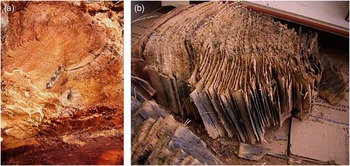
The Pafuri Outpost baobab [Outpost area, Pafuri section, Kruger National Park (NP), Limpopo, South Africa; GPS coordinates 22°26.647′S, 031°04.745′E, altitude 200 m, annual rainfall 424 mm] fell over and died in 2008 (Figures 1 and 2). It had a height of 18.0 m, a circumference at breast height (cbh; at 1.30 m above ground) of 14.20 m, and an overall wood volume of ~60 m3. Pafuri Outpost was one of the largest single-stemmed African baobabs.
General view of the Pafuri Outpost baobab, which fell over and died in 2008, in the Pafuri section of the Kruger National Park, South Africa.

Details of samples collected from the fallen Pafuri Outpost baobab: (a) the large quasi-complete radial section, with the pith intact and without hollow parts, which was extracted from the trunk; (b) the individual rings, which were separated mechanically from the radial section.

The Leokwe-A baobab (Leokwe camp, Mapungubwe NP, Limpopo, South Africa; 22°15.834′S, 031°16.614′E, 579 m, 366 mm) fell between 2003 and 2008, when it was found toppled but intact. It had a circumference of around 7–8 m.
The other four investigated A. digitata are of large size, possess multistemmed trunks, and are, with one exception, alive (even if some of their older stems died). These individuals are as follows:
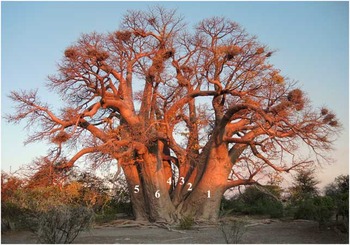
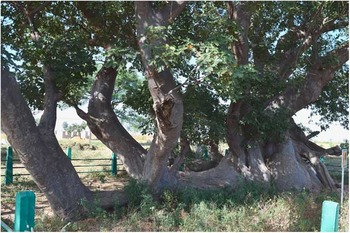
The historic Chapman baobab (Ntwetwe Pan, Makgadikgadi Pans, Central, Botswana; 20°29.404′S, 025°14.971′E, 907 m, 360 mm) had an open ring-shaped structure consisting of six partially fused stems (Guy Reference Guy1967; Pakenham Reference Pakenham2004). Its height was 22.6 m, the circumference 25.90 m, and the wood volume 275 m3. Unfortunately, in January 2016, the six stems of this iconic tree, which was a symbol of Botswana, collapsed to the ground and died (Figure 3).
The Chapman baobab, the historic landmark tree of the Makgadikgadi salt pans of Botswana, is a typical example for the open ring-shaped structure. Its six main stems, which are numbered in the picture, were fused only at the base. In 2016, the six stems toppled and died.

Die Dorslandboom (in Afrikaans, i.e. “the Thirstland tree”) (south of Khaudum NP, Otjozondjupa, Namibia; 19°18.061′S, 020°39.636′E, 1132 m, 468 mm) is another historic tree (Watson Reference Watson2007; Stutchbury Reference Stutchbury2013). It has a height of 14.3 m, a circumference of over 25 m (which cannot be measured exactly), and a wood volume of ~150 m3. With its eight toppled or standing knitted stems, some of them broken and a few regenerated with new shoots, Dorslandboom can be considered a kind of “Schrödinger’s baobab,” which is at the same time dead and alive. Two stems collapsed before 1880, but their remains are still alive. One leaning stem is also alive, while three stems toppled and new young branches grew at the ends of broken stems. The largest stem, which consisted in reality of two fused stems, toppled and died in 2006.
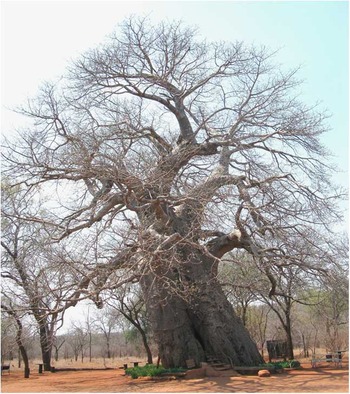
The historic Leydsdorp baobab (Gravelotte, Mpumanalanga, South Africa; 23°57.427′S, 30°34.509′E, 565 m, 357 mm) has a height of 21.0 m, a circumference at breast height of 19.20 m, and a wood volume of 230 m3 (Pakenham Reference Pakenham2004). It possesses a closed ring-shaped structure with a false cavity inside. The ring consists of three perfectly fused stems that close the false cavity (Figure 4).
The leaning Leydsdorp baobab has a closed ring-shaped structure, defined by three perfectly fused stems, that close a false cavity; the cavity was used in the past as a bar. The old tree rises solitary in Mpumanalanga, South Africa.

Gouye Ndiouly (in Wolof, i.e. “baobab of the circumcised”) (Kahone, Kaolack, Senegal; 14°09.372′N, 016°01.644′W, 46 m, 496 mm) might be the oldest baobab of Senegal and in the Northern Hemisphere, as well (Figure 5). Kahone is the old capital of the Saloum Kingdom. From 1593 to 1939, the 49 kings of the Guelewares Dynasty have been enthroned under this historic baobab. This was also a site for education of the circumcised. Gouye Ndiouly toppled sometime in the past. Several fallen old stems generated an amorphous mass, out of which five new stems had emerged. Only one toppled stem, which lies horizontally, had survived and three new shoots/stems grew at the end of its broken part. Today, the reconstructed baobab has a height of 16.0 m, a restored circumference of 14.40 m, and a volume close to 80 m3.
The historic Gouye Ndiouly from Kahone, the old capital of the Saloum Kingdom, as it looks today. One can notice the only surviving old stem, which lies horizontally, and the new shoots that emerged from the remains of the fallen stems.

Sample Collection
Large samples were collected from the two fallen single-stemmed baobabs. These were radial sections, from the outermost rings (adjacent to the bark) to the innermost rings (pith), which were found to be intact, without hollow parts. These sections were large enough to separate individual growth rings. For ring separation, a thin stainless steel spatula was inserted between the rings. The separated individual rings fell apart from one another. Several individual rings were processed and investigated by radiocarbon dating.
For the four standing and live multistemmed baobabs, several samples were collected from their inner cavities and/or from different areas of the trunk, by using Haglöf increment borers (0.60–1.00 m length, 0.00515–0.012 m inner diameter). A number of tiny pieces/segments were extracted from predetermined positions/distances along each sample.
Sample Preparation
Individual rings from the two fallen single-stemmed baobabs selected for 14C dating were converted to α-cellulose (Loader et al. Reference Loader, Robertson, Barker, Switsur and Waterhouse1997). For segments extracted for dating from samples collected from the four standing multistemmed baobabs, the standard acid-base-acid (ABA) pretreatment method (Olsson Reference Olsson1986; Patrut et al. Reference Patrut, von Reden, Lowy, Mayne, Elder, Roberts and McNichol2010a) was used for removing soluble and mobile organic components.
The pretreated samples, which originate from the six baobabs, were finally reduced to graphite (Vogel et al. Reference Vogel, Southon, Nelson and Brown1984). The resulting graphite samples were 14C dated.
Radiocarbon Measurements
The CO2 derived from combustion of the Pafuri Outpost baobab samples was 14C dated at QUADRU (Quaternary Research Unit), Pretoria, South Africa, by the gas proportional counting (GPC) technique. The graphite samples that originate from the Leokwe-A baobab were investigated by AMS 14C dating at the Beta Analytic Radiocarbon Dating Laboratory, Miami, USA.
The AMS 14C investigation of the graphite samples that originate from the other four baobabs was performed at the NOSAMS Facility of the Woods Hole Oceanographic Institution, Woods Hole, MA, USA, using a Pelletron tandem 500kV AMS system (Povinec et al. Reference Povinec, Litherland and von Reden2009; Roberts et al. Reference Roberts, Burton, Elder, Longworth, McIntyre, von Reden, Han, Rosenheim, Jenkins, Galutschek and McNichol2010). The obtained fraction modern values corrected for isotope fractionation were ultimately converted to a 14C date.
Calibration
14C dates were calibrated and converted into calendar ages with OxCal v 4.2 software for Windows (Bronk Ramsey Reference Bronk Ramsey2009), by using the IntCal13 atmospheric data set (Reimer et al. Reference Reimer, Bard, Bayliss, Beck, Blackwell, Bronk Ramsey, Buck, Cheng, Lawrence Edwards, Friedrich, Grootes, Guilderson, Haflidason, Hajdas, Hatté, Heaton, Hoffmann, Hogg, Hughen, Kaiser, Kromer, Manning, Niu, Reimer, Richards, Scott, Southon, Staff, Turney and van der Plicht2013) for Gouye Ndiouly located in the Northern Hemisphere, and the SHCal13 atmospheric data set (Hogg et al. Reference Hogg, Hua, Blackwell, Niu, Buck, Guilderson, Heaton, Palmer, Reimer, Reimer, Turney and Zimmerman2013) for the other baobabs, which are located in the Southern Hemisphere.
RESULTS AND DISCUSSION
Radiocarbon Dates and Calibrated Ages
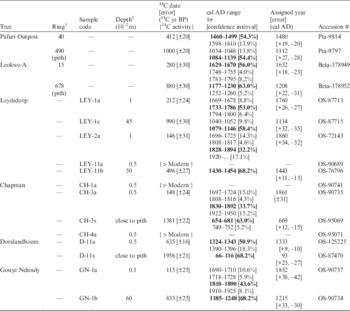
The 14C dates and calibrated ages of the dated rings and samples are listed in Table 1. The 14C dates and errors were rounded to the nearest year. The 1σ probability distribution (68.2%) was selected to derive calibrated age ranges. For three samples, the 1σ distribution is consistent with one range of calendar years. For six samples, the 1σ distribution corresponds to two ranges, for two samples to three ranges, while for the other three cases it is consistent with four ranges. For these 11 samples, the confidence interval of one range is considerably greater than that of the others and this range is usually consistent with the age sequence along the corresponding sample; therefore, it was selected as the cal AD range of the sample (marked in bold) for the purpose of this discussion. For obtaining single age values, which correspond each to an assigned year, we derived a mean value for the 14 selected age ranges; this mean value divides the range into two equal areas.
Radiocarbon dating results and calibrated ages of rings isolated from toppled single-stemmed baobabs and of samples collected from standing or toppled multistemmed baobabs

1 The rings are counted in reverse order.
2 Depth in the wood from the sampling point.
We would like to stress that the use of AMS 14C dating in tree research, for determining ages, growth rates, architectures or ring frequencies of large and/or old trees, as well as its use in climate research, for determining age sequences prior to the stable isotope analysis, requires mandatory single age values or assigned years for each 14C date. Finally, for three samples, which correspond to a depth of 0.5–1 cm into the wood, practically the outermost rings that are adjacent to the external/outer bark (or to the innermost rings adjacent to the cavity bark, for samples collected from false cavities), the fraction modern values were greater than 1 (Fm >1). Such values, with fraction modern greater than 1, correspond to negative 14C dates and are termed greater than Modern (>Modern). The high negative 14C dates cannot be calibrated with the standard calibration curves. In such cases, the dated wood of trees is young, being formed after AD 1950. We were not interested in calibrating the fraction modern by using (post)bomb curves; we only considered that the growth in the respective stems was still active.
Growth Stop
Pafuri Outpost was the first baobab for which the growth stop phenomenon was identified. The inner part of this single-stemmed baobab, which toppled in 2008, was found to be intact and without hollow parts in the stem. Therefore, it was possible to collect a sample for dating right from the pith. Its 14C date was 1000±20 BP, which corresponds to a calibrated age close to 900 yr; the assigned year is AD 1112 (+27, –28). We collected a large radial section, from which we separated 434 individual growth rings (out of 490 rings of the stem), much more than expected. Ring 40 (rings are counted in reversal order, from the youngest to the oldest) was found to have a 14C date of 412±20 BP; the assigned year for this value is AD 1480 (+19, –20). The result indicates that the baobab stopped growing around AD 1520, when it was 410 yr old, but it stayed alive until AD 2008, continuing to produce leaves, flowers, and pods.
Leokwe-A was another single-stemmed African baobab that fell over between 2003 and 2008 and was found to be relatively intact. A large radial section was collected from its stem, out of which individual growth rings were isolated. The 14C date of its pith (ring 678, in reverse order) was 880±30 BP, which corresponds to a calibrated age close to 800 yr when the tree died; the assigned year is AD 1208 (+22, –31). One of the outermost rings, i.e. ring 15, was 14C dated to 280±30 BP; the assigned year is AD 1652 (+18, –23). According to this result, the Leokwe-A baobab stopped growing around AD 1670, when it was 560 yr old.
The single-stemmed baobabs were also sectioned across the whole stem; both show evidence of growth stop around the full circumference and neither showed any indication of asymmetry that would accommodate hundreds of missing rings. We suspect that both baobabs stopped growing due to stress, triggered by the change of climate factors during the Little Ice Age, which was cold and very dry in southern Africa (Woodborne et al. Reference Woodborne, Hall, Robertson, Patrut, Rouault, Loader and Hofmeyr2015, 2016).
As mentioned, the vast majority of large and old baobabs are multistemmed. This fact is due to the ability of baobabs to produce new stems during their lifecycle, such as other tree species produce branches. For these trees, the growth may stop for the oldest stems, usually after the age of 1000 yr. We exemplify our statement by presenting the growth stop for several very old African baobab specimens, such as Chapman and Dorslandboom.
The historic Chapman baobab had an open ring-shaped structure, defined by six main stems that were fused from the base up to a height of around 2 m. According to AMS 14C dating, the six stems belonged to three different generations, which were 500, 800–1000, and over 1300 yr old. The 14C activity of the outermost rings of stems 1 and 4, corresponding to the sample segments CH-1a and CH-4a, was found to be greater than Modern. On the other hand, the 14C date of sample segment CH-3a, which consists of the outermost rings of the largest and oldest stem 3, was 148±24 BP; the assigned year for this value is AD 1861 (±31). Stem 3 was the biggest and also the oldest stem of Chapman. Due to the presence of a large fire scar, it was possible to collect a sample very close to the pith of stem 3. Its 14C date was 1381±22 BP; the assigned year is AD 669 (+12, –15). These results demonstrate that the old stem 3 stopped growing around AD 1860, while the other stems have continued their growth at a moderate rate. Nevertheless, no significant differences were found between the leaves, flowers, and pods produced by the six stems.
The stem that survived the longest after it has stopped growing belongs to the historic Dorslandboom of Namibia. The outermost rings of this stem, which consisted in fact of two fused stems, were dated by 14C. The 14C date of sample D-11a was 635±16 BP; the assigned year is AD 1333 (+9, –10). This double stem survived the growth stop for around 675 yr, until AD 2006, when it toppled and died at an age greater than 2000 yr. The 14C date of the oldest dated sample D-11x was 1956±21 BP; the assigned year is AD 93 (+23, –27).
The growth stop phenomenon is not limited to A. digitata. We reported that stems belonging to Tsitakakoike, the biggest and oldest known A. grandidieri, as well as to Grandmother, the oldest known A. rubrostipa, stopped both growing 250 yr ago, around AD 1760 (Patrut et al. Reference Patrut, von Reden, Danthu, Leong Pock-Tsy, Patrut and Lowy2015b, Reference Patrut, von Reden, Danthu, Leong Pock-Tsy, Rakosy, Patrut, Lowy and Margineanu2015c).
Beside the climate factors and old age, we identified a third factor that may produce growth stop of baobab stems. This factor is the tendency to keep a stable internal architecture of the tree. The Lebombo Eco Trail baobab was the first specimen for which we identified the closed ring-shaped structure. For samples collected from the false cavity walls, the age values increase with the distance into the wood up to a point of maximum age, after which the values decrease toward the outer part. This anomaly of age sequences is due to the fact that false cavities are only empty spaces between several fused stems disposed in a ring-shaped structure (Patrut et al. Reference Patrut, Woodborne, von Reden, Hall, Hofmeyr, Lowy and Patrut2015a, Reference Patrut, von Reden, Danthu, Leong Pock-Tsy, Rakosy, Patrut, Lowy and Margineanu2015c, Reference Patrut, Woodborne, Patrut, Hall, Rakosy, von Reden, Lowy and Margineanu2015d).
We found that for the Lebombo baobab, the five stems (with ages between 900 and 1400 yr) stopped growing over the past 500 yr only toward the false cavity, which reached a highly symmetrical and very stable shape. At the same time, the five stems of Lebombo continue growing toward the outer part at a moderate rate (Patrut et al. Reference Patrut, Woodborne, von Reden, Hall, Hofmeyr, Lowy and Patrut2015a).
Here, we present dating results of the Leydsdorp baobab, another specimen with a closed ring defined by three perfectly fused stems, which stopped growing toward the false cavity. Sample segments LEY-1a (1 cm depth in the wood) and LEY-2a (1 cm), collected from the false cavity, are composed of the innermost rings adjacent to the cavity walls. The 14C dates of these segments, which originate from two different stems, are 212±24 and 146±31 BP; the assigned years are AD 1760 (+26, –27) and AD 1860 (+34, –32). These results demonstrate that the two dated stems stopped growing toward the false cavity at different times in the past, i.e. 255 yr (toward the west) and 155 yr ago (toward the east). The oldest sample segment LEY-1c (45 cm) had a 14C date of 990±30 BP; the assigned year is AD 1114 (+32, –35).
We dated two segments extracted from sample LEY-11, which was collected from the outer part of the trunk. The 14C activity of segment LEY-11a (0.5 cm), which includes the outermost rings, was greater than Modern, showing that the stem has continued growing toward the outer part. The 14C date of segment LEY-11b (50 cm) was found to be 496±27 BP; the corresponding assigned year is AD 1443 (+11, –13). Dating samples collected from the outer part of other stems produced comparable results. Such values reveal that the stems of Leydsdorp baobab grew toward the outer part by 0.50 m over the past 570 yr. Thus, in the case of the Leydsdorp baobab, the three stems stopped growing over the past 155–255 yr only toward the false cavity that reached a stable shape, which compensates the significant lean of the tree (around 20–25° toward the west). The relatively tall false cavity (4.80 m) has a roughly triangular base and its roof is slightly rounded. Had the stems continued growing toward the cavity, this would have affected its stability and the baobab would have collapsed.
Finally, we mention an additional factor that may induce growth stop. This factor is a major trauma suffered by baobab stems. Such a case is the collapse of one or several stems that survived this event, but stopped growing. We investigated the only one remaining toppled stem of Gouye Ndiouly, which survived the major collapse of the baobab. Sample GN-1a, which consists of the outermost rings, had a 14C date of 115±25 BP; the assigned year is AD 1852 (+38, –42). This value suggests that the surviving stem stopped growing around AD 1850, which is very probably the point in time when the historic baobab toppled. The oldest remaining wood of this stem, represented by sample GN-1b, was 14C dated to 833±25 BP; the assigned year is AD 1215 (+33, –30). Because some parts of this fallen stem are missing, we estimate that its age in the presumptive pith would have been close to 1000 yr.
We identified a new and unexpected phenomenon, which seems to be specific only to baobab trees, i.e. to tree species belonging to the Adansonia genus: the growth stop. The growth stop may affect the whole tree or only its oldest or its severely impacted stem(s). Under this condition, the affected baobabs may survive for several centuries, continuing to produce leaves, flowers, and fruits.
The growth stop can be associated with the fact that baobabs are the only known trees that survive when the bark is stripped off around the full circumference of the trunk/stem. This is a common practice of the local population in many parts of Africa; the locals may remove not only the bark, but also several centimeters of wood adjacent to the bark. This unique feature is a consequence of the fact that, during the rainy season, baobabs transport water and nutrients through the entire volume of their trunks/stems rather than only through the youngest outermost rings.
The baobab’s trunk/stem, which contains a high number of parenchyma cells, stores water during the rainy season and swells, increasing its girth. The baobab wood has a very high water content, up to 79% by mass (Chapotin et al. Reference Chapotin, Razanameharizaka and Holbrook2006). This large reservoir of water is used partially during the dry season and allows the baobab to survive many years of severe drought. When using the stored water, the trunk/stem shrinks gradually, decreasing its girth. The variations of the baobab’s girth, according to its water content, are independent from the proper growth, which consists in the production of new wood under the form of rings. The capacity of baobabs to store large amounts of water in their trunks/stems allows the trees belonging to the Adansonia genus to survive in a good state of vegetation even after the growth stop.
For multistemmed baobabs with the more or less fused and erect stems, we found only minor differences (<5%) between the water content of the old stem(s) that stopped growing hundreds of years ago and the water content of younger stems that continue to grow. On the other hand, for the same stem(s) that stopped growing, we found significant differences (up to 15%) between the water content during the rainy season and in the dry season. These results indicate that the water transport in old stems of baobabs is not significantly affected by the growth stop and is not concentrated in the outer rings. They also suggest that the known mechanisms of water transport in trees does not seem to apply to baobabs.
CONCLUSIONS
This research describes the growth stop, a newly reported phenomenon, which appears to be specific only to baobabs, i.e. to trees that belong to the Adansonia genus. We found several anomalies while performing a complex 14C investigation of samples collected from large and old baobabs, for determining their age, growth, and architecture. Thus, in some cases, the outermost rings of baobabs, which were close to the bark, were found to be old, with ages of several hundreds of years, instead of being very young. The only reasonable explanation for this anomaly is the fact that the trunk/stems of these baobabs stopped growing; however, they remained alive for centuries.
14C dating results of six baobabs were disclosed and discussed. Two of these are single-stemmed specimens (Pafuri Outpost, Leokwe-A), which died recently. The other four baobabs are multistemmed and alive (Chapman, Dorslandboom, Leydsdorp, Gouye Ndiouly), with the exception of one specimen (Chapman), which toppled and died in 2016. For multistemmed baobabs, the growth stop may affect only one or several stems.
We identified four factors that may determine the growth stop. These factors are (i) stress induced by severe climate conditions (Pafuri Outpost and Leokwe-A stopped growing in AD 1520 and 1670, during the Little Ice Age, but they stayed alive until AD 2008 and 2003–2008); (ii) old age (the oldest stem of Chapman stopped growing around AD 1860 and survived until AD 2016, while the oldest double stem of Dorslandboom stopped growing around AD 1370 and survived until AD 2008); (iii) the need to preserve a stable internal architecture (the stems of Leydsdorp stopped growing sequentially toward the false cavity between 1760 and 1860, but they continued to grow toward the outer part of the leaning trunk); (iv) the collapse of a stem that survives this traumatic event (the old stems of the historic Gouye Ndiouly toppled around AD 1850; the only surviving stem stopped growing at that time and new shoots emerged from its broken part).
The baobabs and their stems affected by growth stop may survive for several centuries, continuing to produce leaves, flowers, and fruit. The growth stop phenomenon was associated with the capacity of baobabs to store during the rainy season large amounts of water in their trunks/stems. This reservoir of water is used in the dry season and allows baobabs to survive periods of severe and prolonged drought.
The obtained results also suggest a very special mechanism of water transport in trees belonging to the Adansonia genus. Additional work is needed to understand the processes that move water in baobab wood.
ACKNOWLEDGMENTS
The investigation and collection of samples from the trees was approved and authorized by The South African National Parks, The Kruger National Park, The Mapungubwe National Park, The Ministry of Environment and Tourism of Namibia, The Ministry of Environment and Protection of Nature of Senegal, and The Direction of National Parks of Senegal. Special thanks to Ralph Bousfield, Steve Bolnick, and Michael Turner for facilitating the investigation and sampling of baobabs. The authors thank Diana Mayne for assistance and helpful discussions. The research was funded by the Romanian Ministry of National Education CNCS-UEFISCDI under grant PN-II-ID-PCE-2013-76. The AMS 14C investigations of Chapman, Dorslandboom, Leydsdorp, and Gouye Ndiouly were performed at the NOSAMS Facility of the Woods Hole Oceanographic Institution. AMS 14C dating and fieldwork on Leokwe-A were supported by the African Origins Platform of the National Research Foundation of South Africa (Grant Number 82596).