On January 8, 2008, the United States Supreme Court heard arguments in Crawford v. Marion County Election Board, a case related to the discriminatory effects of voter-identification laws in the state of Indiana. Indiana has one of the most stringent voting requirements in the nation, as voters are required to present an up-to-date photo identification issued by the federal or state government in order to cast a ballot. Plaintiffs argued that the Indiana requirements prevent significant and unequal obstacles to the right to vote. The state argued that Indiana had the right to enforce strict requirements to prevent fraud and uphold confidence in the electoral process. Similar laws have also been proposed in many other states, typically related to charges of vote fraud, and often times tied into the divisive debate regarding undocumented immigrants or African American felons. Therefore the recent decision of the Court has tremendous implications to the future of photo-identification laws across the United States.
This article analyzes the impact that voter-identification laws may have on the electorate in the state of Indiana. Cross-state comparisons are interesting, but they are insufficient if we are to investigate the disparate impact strict voter-identification laws will have on unique sub-populations. The ability to analyze representative data for specific segments of the Indiana electorate allows for a direct test of whether photo-identification laws negatively impact the poor, the elderly, and racial/ethnic minorities as the plaintiffs in Crawford v. Marion contend. Numerous claims have been made that voter-identification laws do and do not have a discriminatory affect, however such claims have not been based on individual-level datasets. This analysis hopes to shed some light on the actual consequences of these laws.
THEORETICAL RELATIONSHIP BETWEEN IDENTIFICATION LAWS AND PARTICIPATION
The impact of electoral laws on political participation is central to many theories in the political-participation literature. However, very little is known about the direct effects of voter-identification (ID) laws. Institutional and social impediments to participation play a central role in the theoretical models used by social scientists to explain the elements that influence political behavior. Attempts to analyze the impact of restrictive laws on voter registration and turnout have consistently concluded that turnout rates are higher when costs associated with voting are low (Campbell et al. Reference Campbell, Converse, Miller and Stokes1960; Wolfinger and Rosenstone Reference Wolfinger and Rosenstone1980; Katosh and Traugott Reference Katosh and Traugott1982; Jackson Reference Jackson1993; Blank Reference Blank1974; Kim, Petrocik, and Enokson Reference Kim, Petrocik and Enokson1975; Bauer Reference Bauer1990).
The set of administrative prerequisites for voting, including photo-identification laws, are one of the greatest sources of cost to potential voters, requiring time and political knowledge to engage the various levels of government to satisfy the rules for participation. Institutional burdens to participating have long been established to have the largest impact on individuals who have fewer resources, less education, smaller social networks, and are more institutionally isolated. Adding photo-identification requirements creates an additional barrier to voting that is likely to have the largest impact on these groups, and we find strong evidence to support our thesis that strict voter-identification laws would substantially affect lower-income, minority, and elderly voters.
This research project is grounded in the extant literature indicating that when changes are made to electoral rules, including voting requirements, opportunities to participate are significantly affected (Downs Reference Downs1957; Riker and Ordeshook Reference Riker and Ordeshook1968; Sanders Reference Sanders1980). Further, due to varying levels of political resources (time, money, political sophistication, etc.) the impact of additional hurdles, like voter-ID laws, is most pronounced on specific segments of the electorate, including the elderly, racial and ethnic minorities, immigrants, and those with less educational attainment and lower incomes (Verba, Schlozman, and Brady Reference Verba, Schlozman and Brady1995). We thus expect these groups to be significantly impacted by Indiana's photo-identification laws.
THE INDIANA VOTER-ID LAW AND THE INDIANA ELECTORATE
Prior to Indiana's current voter-identification laws, voters who were not voting for the first time were required to sign a poll book at the polling place where the signature was then matched to the signature recorded in the poll book. Voters must now present a state or federal photo identification at the polling place under Indiana law unless the voter lives in a nursing home (see Indiana Code §3-11-8-25.1.e). However, absentee voters are not required to show identification under Indiana Code §3-11-10-1.2. Proof of identification must show the name of the individual to whom the document was issued, and the name on the identification must conform to the name in the individual's voter-registration record. The identification must have a photograph of the individual to whom the document was issued and the identification must include an expiration date that has not expired at the time of the election (see Indiana Code §3-5-2-40.5 and Indiana Code §3-11-8-25.1). If voters are unable to or refuse to present a valid identification, they may submit a provisional ballot under Indiana Code §3-11-8-22.1 or Indiana Code §3-10-1-7.2. The voters would then have 10 days to file an affidavit claiming an indigency exception or they must produce valid identification. Poll officials may also challenge voters if they believe the voters are ineligible or their identifications are not valid. While the law states the conditions under which challenges may occur (see Indiana Code §3-11-8-21), the law gives wide discretion to the poll official to determine eligibility. In the event of a challenge, the voter will be allowed to vote using a provisional ballot.
The 2000 decennial census reports 74% of Indiana's 6,080,485 residents are of voting age, and over 12%, or 754,980 residents, are over 65 years of age, a group we believe may be uniquely impacted by the voter-ID laws. More than 3% of the state's population is foreign born and over half a million residents, or 8.4%, are African American, while 3.5%, or 212,817 residents, are Hispanic. There is also a sizable segment of individuals within Indiana who may be highly impacted by stricter voting requirements because of their socioeconomic status. Specifically, 21% of households earned less than $20,000 in 2000, and 18% of the adult population does not have a high school diploma. All together, these groups make up a substantial number of residents that would face a greater burden on their ability to participate when the costs of voting increase. These groups have been consistently shown to possess fewer resources, lower levels of political knowledge, and thus are more susceptible to be disenfranchised through additional layers of bureaucratic regulations, seen here as voter-identification laws. We test this assertion by exploring the impact of more stringent voting laws on the voting-age population of Indiana, as well as specific segments of the state that are theoretically most vulnerable to increased costs associated with voting.
DATA AND METHODS
The objective of this research project is to determine the rates of accessFootnote 1 to valid photo identification among voters and non-voters in Indiana, with an eye towards specific demographic groups, such as the elderly and racial minorities. We explore access to identification using a unique survey of registered voters, and adult non-registered residents in Indiana, where the U.S. Supreme Court will decide whether Indiana requirements are constitutional. Previously, similar research has found a strong correlation between the lack of access to valid photo identification and racial minorities, immigrants, the elderly, and low-income populations in Washington state, California, and New Mexico (Barreto, Nuño, and Sanchez Reference Barreto, Nuño and Sanchez2007). However, because Indiana has unique and stringent laws, it is essential that research be extended to the Hoosier State in particular.
In October 2007, we fielded a statewide telephone survey in the state of Indiana.Footnote 2 Registered voters were identified using a voter list and cross-checked with the secretary of state for Indiana.Footnote 3 In all of the analyses and tables reported below we provide an accurate weighted sample of the state of Indiana. The registered voter sample included a random statewide component (n = 500), and oversamples of African American registered voters (n = 300) as well as low-income registered voters (n = 200). These two oversamples were targeted based on population patterns at the census-tract level and greatly help increase the sample size of African American and lower-income voters in the study, therefore providing much greater reliability in the estimates reported among these specific sub-populations.Footnote 4 In the final data, we weight each demographic group to its appropriate share of the total Indiana population. In addition, a sample of non-registered voters was obtained using random digit dialing (RDD) and screening out those individuals who stated they were presently registered to vote. In full, 1,000 interviews were collected among registered voters, and 500 interviews among non-registered adults. This approach provides the best data available for an analysis of how photo-identification laws impact the Indiana electorate.Footnote 5
We take this approach because using a registered-voter database as a starting point ensures that the respondents in the survey are in fact registered voters.Footnote 6 We also employ a purely random-dial technique to choose which voter phone numbers to call, so that each registered voter in Indiana has an equal chance of being included in the survey. This technique provides the most reliable results and prevents the data from being biased in any way (see Keeter et al. Reference Keeter, Miller, Kohut, Groves and Presser2000). Our oversamples of blacks and low-income voters also provide more reliable estimates when looking only at these two sub-populations. Because blacks represent 7% of the Indiana voting population a random sample of black respondents would result in a margin of error of 15 points or more. Thus, we are wary of comparing data points for whites and blacks unless an oversample has been employed, such as in this study. Finally, because we have added a sample of non-registered voters, this study provides the means by which to analyze registered voters as well as a profile of the entire eligible voting adult population in Indiana that is comprised of those currently registered as well as those who are not registered to vote. According to U.S. Census figures from 2004, 68% of the adult citizen population in Indiana is registered to vote compared to 32% that is not registered to vote.Footnote 7
DEFINING VALID PHOTO IDENTIFICATION
The State of Indiana requires that a precinct voter show identification at the polling place that meets four key requirements: (1) has a photo of the voter, (2) contains an expiration date that is current, (3) is issued by the State of Indiana, and (4) has the full legal name of the voter that matches the voter-registration records. To determine whether or not the adult eligible population and registered voter population of Indiana has “valid” identification, using a series of branching questions we examined four different versions of what could be considered valid photo identification. These variables are: (1) Driver's license, (2) Current DL or State ID card, (3) Valid ID plus full name, and (4) Valid ID plus name match. The details of each variable are outlined in the Appendix. This comprehensive measurement strategy allows the analysis to accurately determine which segments of the Indiana population are less likely to have any forms of valid identification needed to vote in the state.
RESULTS
To evaluate access to valid photo identification in Indiana, as well as the subsequent political implications of these trends, we report a series of simple chi-square tests to determine whether different demographic groups in Indiana witness statistically different rates of access to valid ID. Following the chi-square tests for race, gender, education, income, and age, we examine whether or not people with proper photo ID in Indiana are distributed equally along party lines, or whether the excluded voters (i.e., those without valid ID) are more likely to support the Democratic or Republican parties. In short, we find strong and statistical differences with respect to access to valid photo identification that significantly reduces the opportunity to vote for minority, low-income, less-educated, and the youngest and oldest residents of Indiana, who also tend to be correlated with Democratic partisanship.
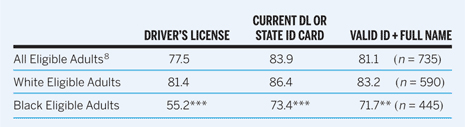
We begin by examining the entire adult citizen population in Indiana, those eligible to register and vote. Table 1 presents the results for access to valid photo identification in Indiana for whites and blacks, and shows an 11.5-point gap in access to ID. Among eligible adults, 83.2% of whites in Indiana have the correct credentials to vote compared to 71.7% of blacks, which is a statistically significant difference.
Access to Valid Photo Identification among Citizen Adult Population

Pearson Chi-square: *** Pr < .001 ** Pr < .010 * Pr < .050 ‡ Pr < .100
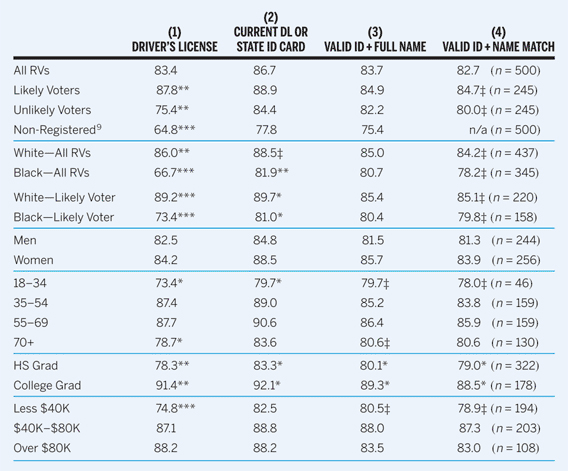
However some may argue that even though all citizens have a right to the ballot, that among those actually registered to vote, or among regular/likely voters, the gap in access to ID will disappear. Thus, a more politically appropriate test is to examine rates of access to ID among those currently on the voter rolls, as we do in Table 2. Rates of access to valid photo identification for various demographic subgroups of registered voters in Indiana have significant differences in access. First, there is support for the idea that likely or consistent voters have higher rates of access to ID. However, even among likely voters, differences persist with respect to race. Among all registered voters, 84.2% of whites have the correct ID credential in Indiana compared to 78.0% of blacks, statistically significant at the 0.10 level. When we only focus on likely voters, those who consistently voted in 2002, 2004, and 2006, a 6-point gap between blacks and whites is still evident. Thus, if the Indiana law is applied strictly to the letter of the law, about 14% of likely white voters could be turned away from the polls and over 20% of likely black voters could be turned away. While both numbers are regrettable, the data demonstrate that blacks are disproportionately impacted by the Indiana law.
Access to Valid Photo Identification among Registered Voters in Indiana

Pearson Chi-square: *** Pr < .001 ** Pr < .010 * Pr < .050 ‡ Pr < .100
With respect to gender, no differences are noted. With respect to age, a curvilinear pattern emerges with the youngest and oldest voters being less likely to have proper ID while middle-aged voters witness higher rates of access. Among college-educated voters, 88.5% have proper ID compared to 79.0% among those with only a high school degree. Finally, income demonstrates a predictable pattern with the lowest-income category of voters significantly less likely to have acceptable photo ID. Further, these effects should not be seen in isolation, but rather confounding given that race, education, and income are known to be correlated, thus creating much more significant gaps in access to voter ID between lower-income and less-educated blacks, and higher-income and more-educated whites.
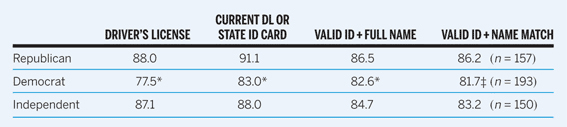
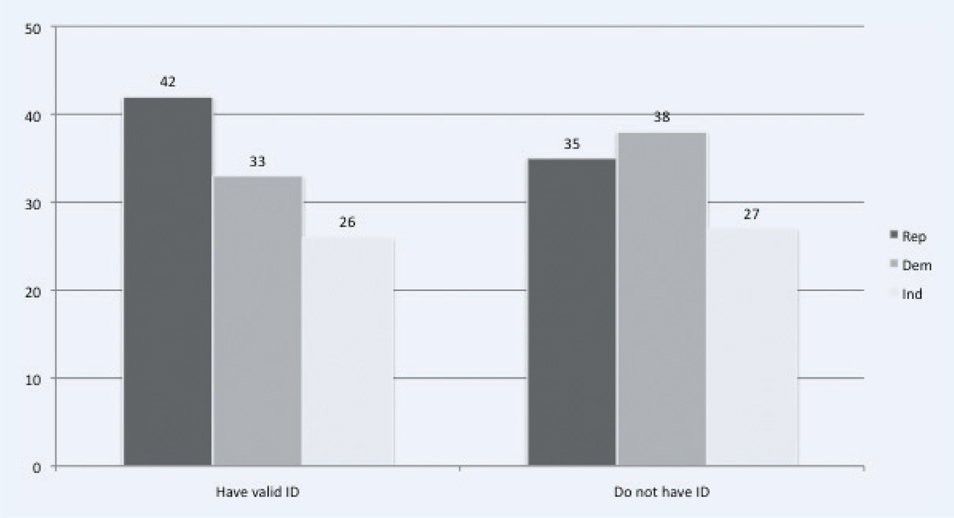
Finally, we turn our attention to the impact of voter-identification requirements on election outcomes. Examining the partisanship of the haves and have-nots can offer a glimpse at how the strict application of the law may affect election outcomes. Registered voters in Indiana who identify as Republicans were more likely to have proper ID credentials than those who identified as Democrats (see Table 3). While the gap of 4.5 points is not huge, it is large enough to affect election results in a close or competitive contest. The partisan implications are best displayed in Figure 1. Among registered voters who have correct photo identification required in Indiana, the partisan breakdown is 42% Republican, 33% Democrat, and 26% independent. If the law truly had an equal impact, we would expect to see the same rates of partisanship among the have-nots, but that is not the case. Among those without ID, 35% are Republican, 38% are Democrat, and 27% are independent. While Republicans outnumber Democrats in the haves, Democrats outnumber Republicans in the have-nots.
Partisan Implications of Access to Valid Photo Identification

Pearson Chi-square: *** Pr < .001 ** Pr < .010 * Pr < .050 ‡ Pr < .100
Party Identification by Access to Voter among ID Indiana Registered Voters, 2007

CONCLUSION—OUR FINDINGS IN LIGHT OF THE SUPREME COURT'S DECISION
With the Supreme Court providing a decision on this issue of the voter-identification laws of Indiana, it is necessary to briefly review the outcome of the Crawford case, as well as how our results compare with the decision of the Court in our concluding remarks. The majority opinion relied on previous cases where the Court addressed voting restrictions to ultimately determine that the appropriate standard for reviewing the constitutionality of the restriction was to use a balancing test, in which the state's interest in imposing the restriction is weighed against the burden placed on voters. Any state law that places a burden on a particular voter, party, or discrete class of voters must be justified by a relevant and legitimate state interest. It is clear that the Court found that the protecting the integrity and reliability of the election process to instill voter confidence was a relevant and legitimate state interest.
However, the Supreme Court conceded that there is no evidence that falsely impersonating a voter has occurred in Indiana. Instead, the decision found that its occurrence is possible because it has occurred in other parts of the country. Our research of extant findings in this area clearly indicate that voter impersonation is extremely rare, and more importantly strict laws such as the Indiana case upheld by the Supreme Court do not effectively limit the much more rampant mail-in based fraud. Despite the lack of empirical evidence of fraud, the Court found that these interests outweigh the burdens the law imposes on voters.
The Supreme Court also claims that obtaining a free ID card does not qualify as a substantial burden on the right to vote, or amount to an increase over the normal burden of voting. This is an area where our data directly contradicts the Court's decision. We find that age, race, and income significantly impact the likelihood of having proper identification required to vote under the Indiana statute. In short, the Court decided that the additional effort required of the Indiana electorate identified in our data to be disproportionately impacted by this law does not outweigh the state interest of preventing fraud.
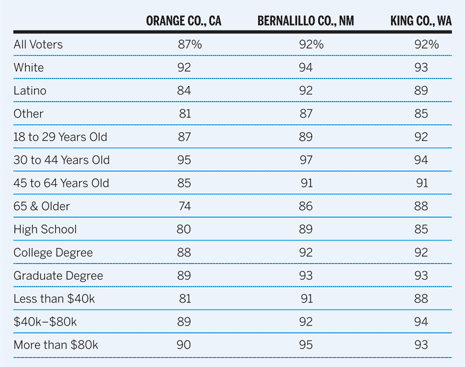
Despite the Court's decision, we feel that our unique survey sample of a random statewide component provides the ability to analyze the impact of these requirements on these specific segments of the Indiana population. The results in Indiana are consistent with findings of Barreto, Nuño, and Sanchez (Reference Barreto, Nuño and Sanchez2007), who also found that minority, low-income, and less-educated residents are less likely to have access to valid photo identification across three states. Table 4 illustrates that across all three states in the 2006 study, California, New Mexico, and Washington, whites were more likely to have driver's licenses than non-whites. Similarly, middle-aged voters were more likely to have access than elderly voters, and higher-income voters were more likely to have driver's licenses than lower-income voters. Thus, the new findings for Indiana are not an anomaly, but rather, quite consistent with the ID access rates in other diverse states across the U.S. This implies that the Indiana voting laws significantly reduce the opportunity to vote for these segments of the state electorate. ■
Percent with Driver's License by County and Demographic Characteristics

Source: Replicated from Barreto, Sanchez, Nuño (Reference Barreto, Nuño and Sanchez2007)
APPENDIX
-
(1) Driver's License—0,1 variable for whether or not the respondent has a currently updated driver's license based on two questions:
-
Q8. “Switching topics, do you happen to have a current Indiana driver's license?”
-
Q9A. “And do you happen to know if your current license has been updated, and had a new photo taken, within the last six years, meaning since October 2001, or do you think your current license might be more than six years old?”
-
-
(2) Current DL or State ID card—0,1 variable for whether or not the respondent has a currently updated driver's license, and if not, whether they have a state-issued ID card. In addition to the two questions described above, based on the following two questions:
-
Q9B. “Instead of a license, do you happen to have another form of photo identification such as a state ID card, US Passport, Military ID, or public university ID card from here in Indiana?”
-
Q9C. “And do you happen to know if that ID has an expiration date on it? If you have it with you, it's OK to take it out to check.”
-
-
(3) Valid ID + full name—0,1 variable for whether or not the valid ID has the respondent's full legal name or some other name, based on the follow up question:
-
Q9D. “A lot of people go by a nickname, or after getting married change their name. Is the name that is printed on your ID your full legal name, or does it contain a nickname, or something different from your full legal name?”
-
-
(4) Valid ID + name match—0,1 variable for whether or not the name on the voter-registration records matches the voter's actual name, based on the follow up questions:
-
V1. “That's all the questions we have for you. So we can take your name off our list, can you tell me the full legal spelling of your first name as it might appear on your identification?”
-
V2. “Okay, thank you [MISTER / MISS: INSERT LAST NAME]. I'm going to read you the spelling of your last name as it appears on the public voting file here in Indiana. We want to make sure that the voting file has the correct spelling of your name. Please tell me if this is correct: [NAME IS READ].”
-