Introduction
Loneliness has been defined as one's unpleasant experience or feelings associated with a deficiency in intimate relationships (de Jong Gierveld, Reference de Jong Gierveld1998), or as the perceived discrepancy between one's desired and actual social relationships (Shiovitz-Ezra and Leitsch, Reference Shiovitz-Ezra and Leitsch2010). Some have distinguished between emotional loneliness and social loneliness. Emotional loneliness arises out of the loss or absence of a close emotional attachment, such as with a spouse, child, or friend. Social loneliness occurs in the absence of an engaging social network, stemming, for example, from infrequent contact or lack of participation (Drennan et al., Reference Drennan2008).
The estimated prevalence of loneliness in older adults varies and has been found to be as high as 45% (Savikko et al., Reference Savikko, Routasalo, Tilvis, Strandberg and Pitkälä2005; Cohen-Mansfield et al., Reference Cohen-Mansfield, Shmotkin and Goldberg2009; Victor and Bowling, Reference Victor and Bowling2012). Given that the terms “lonely” and “loneliness” have a certain stigma associated with them, older adults may not admit to being lonely, and rates might actually be higher than those reported thus far (Pinquart and Sorensen, Reference Pinquart and Sorensen2001). Older persons are particularly vulnerable to loneliness since they are highly susceptible to age-related changes and losses (Fry and Debats, Reference Fry and Debats2002), such as the loss of one's partners and friends through death, deteriorating health, and loss of social roles through retirement (Pinquart and Sorensen, Reference Pinquart and Sorensen2001).
Loneliness is an important public health issue, predicting low quality of life among older populations (Chalise et al., Reference Chalise, Kai and Saito2010) and adverse mental and physical health outcomes (Wilson et al., Reference Wilson2007; Golden et al., Reference Golden2009; Luo et al., Reference Luo, Hawkley, Waite and Cacioppo2012). In addition, loneliness has been identified as an indirect predictor of mortality in older persons through links with chronic disease, function, and self-rated-health (Sugisawa et al., Reference Sugisawa, Liang and Liu1994), as well as an independent predictor of mortality (Penninx et al., Reference Penninx, Van Tilburg, Kriegsman, Deeg, Boeke and van Eijk1997; Shiovitz-Ezra and Ayalon, Reference Shiovitz-Ezra and Ayalon2010). Interventions for alleviating loneliness in older persons include educational and psychosocial interventions, shared activities, and specific therapy techniques (Cohen-Mansfield and Perach, Reference Cohen-Mansfield and Perach2014). However, a recent review of loneliness interventions (Cohen-Mansfield and Perach) found no solid evidence of efficacy for any intervention for community-dwelling older adults.
The purpose of this review was to identify the main predictors of loneliness in the older population as described in the literature and to compare those to a small qualitative study in order to focus public health interventions and future studies.
Methods
Quantitative literature review
Peer-reviewed journal articles were identified from the databases psycINFO, MEDLINE, and Google Scholar for the years 2000–2012. The electronic searches were performed using various combinations of the core search terms: “loneliness,” “social isolation,” “elderly,” “aging,” “older adults,” “risk factors,” “determinants,” and “causes.” In addition, we located papers that were familiar to the author and located others through citations of related papers. To be included in the review, the article had to (1) be in English; (2) be published between the years 2000 and 2012 in a peer-reviewed journal; (3) focus on loneliness rather than on social isolation, depression, or cognitive decline, including having the word “loneliness” in the title; (4) focus on the predictors of loneliness as opposed to interventions to treat loneliness; (5) have a sample size over 100; and (6) the older adults in the study had to be over the age of 50 years.
Overall, 38 articles met inclusion criteria and were reviewed. The analysis section refers to results of the full sample regarding lonely persons. In cases where the significant outcomes of a construct pertain to all of the sub-samples constituting the full sample (e.g. men and women), these outcomes are included. Outcomes of studies are reported by the analysis conducted (i.e. correlations, cross-sectional regression, and longitudinal regression). Correlations are reported only for constructs that were significant independent predictors as a correlation and were not entered into the regression or, if entered, were not significant in the regression. Constructs that were significant predictors in regression analyses are reported under the regression analyses (and not in the correlation analysis). Findings were critically reviewed, and evidence that was ambiguous (e.g. due to colinearity or to unclear reporting, such as not providing the direction of a statistically significant correlation) was not included. For our purposes, the term loneliness is inclusive of specific variants of loneliness, such as romantic loneliness, emotional loneliness, family loneliness, and social loneliness. Only three studies reported findings by loneliness subtypes.
Qualitative study
Participants
Two focus groups were conducted in Tel-Aviv, Israel. They included 13 older adults who attend a daycare center in a poor neighborhood in Tel Aviv and 12 volunteers of the National Insurance Institute of Israel (NIII) who visit homebound persons or provide free consultation to older adults regarding their rights. Participants were between the ages of 60 and 85 years (median = 73) and mostly female (85% of 1st group; 92% of 2nd group). All of the participants were fluent in Hebrew. The first meeting took place in a seniors’ club in a low Socio-Economic Status (SES) neighborhood. The second was in an office building of the NIII. Ethical approval from the ethics committee of Tel-Aviv University was obtained.
Procedure
The focus groups were led by two research staff members with experience in leading focus groups. After an explanation of the goal of the focus groups (i.e. to clarify reasons for loneliness) and self-introduction by all participants, specific pre-prepared open ended questions were raised, such as: “To what extent do you see loneliness in the persons you work with through the NIII or in your personal life? What are the reasons for this loneliness? How can one confront the reasons for loneliness?” The responses were transcribed during the session by the research staff and also audiotaped and transcribed from the audiotape by a commercial vendor. Several research staff members then reviewed the materials and analyzed the transcriptions for themes.
Analytic approach
The analytic approach involved in-depth analysis using the following principles of grounded theory methodology (Corbin and Strauss, Reference Corbin and Strauss2007): (1) Data were collected and analyzed without a preconceived framework in mind; (2) The researchers aimed to develop theories and ideas based on the data, which were grounded in localized accounts and experiences. Conclusions developed were not rigid, in order to accommodate any future contradictory data; (3) Conclusions were developed first through broad concepts and then to more specific categories to represent the data; (4) The researchers aimed to develop a general analytical framework with relevance extending beyond the research setting; and (5) The process of data analysis was kept as open and transparent as possible. A list of all emerging themes across all transcripts was compiled, and these were clustered into groups on the basis of similarity and overlap. These groupings were then further refined resulting in the identification of the main themes. All transcripts were then reviewed according to this list of themes and sub-themes. Rigor and transferability of data interpretation were ensured by having several researchers develop the coding scheme and finalize it through multiple iterations. The researchers then reanalyzed each response with regard to the coding scheme, with another researcher reviewing the coding, and topics of disagreement were discussed until a mutual agreement was reached. Finally, the examples used in the manuscript were re-reviewed by all authors.
Results
Literature review
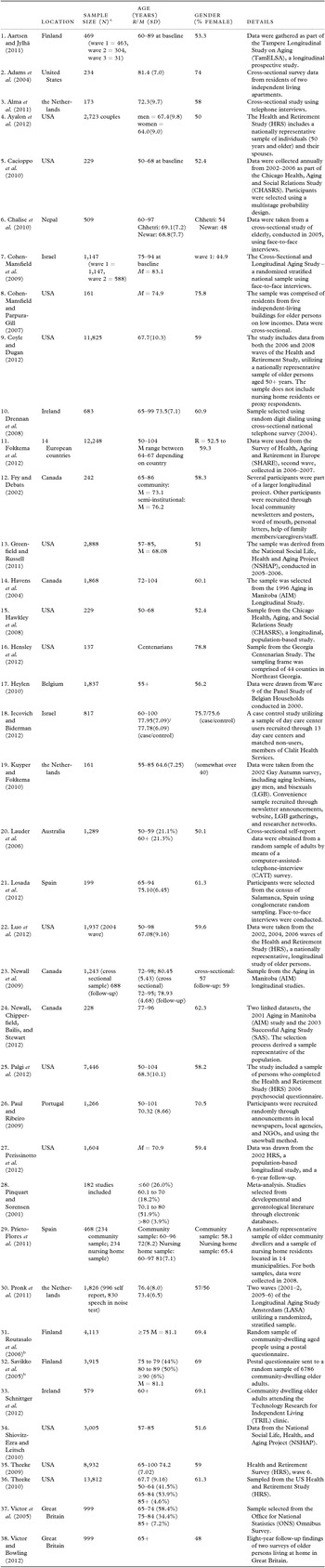
The characteristics of the 38 studies that are included in this review are presented in Table 1. The studies represent a wide range of countries, including the USA (n = 14), Canada (n = 4), Finland, the Netherlands, Israel (n = 3 each), Great Britain, Spain (n = 2 each), Ireland, Nepal, Belgium, Austria, and Portugal (n = 1 each). One study examined loneliness in 14 European countries (Fokkema et al., Reference Fokkema, De Jong Gierveld and Dykstra2012), and one study is a meta-analysis of 182 loneliness studies (Pinquart and Sorensen, Reference Pinquart and Sorensen2001). Sample sizes ranged from 137 to 13,812.
Study characteristics

aSample size in statistical analyses predicting loneliness.
bStudies no. 31 and 32 in this table studied the same sample with somewhat different inclusion criteria.
Socio-demographic attributes
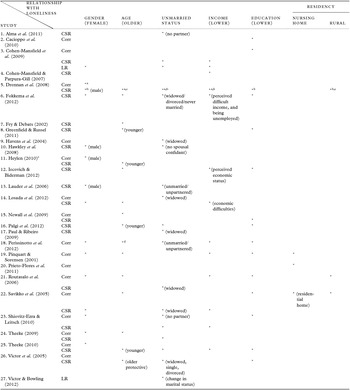
Twenty-seven studies examined the relationship between loneliness and socio-demographic attributes. (Table 2a) Non-married status was consistently found (n = 18 studies) to be a risk factor for loneliness in older adults, often (n = 7) among the widowed. Lower levels of education (n = 15) and lower income (n = 13) were consistently associated with higher levels of loneliness.
Correlates and predictors of loneliness among older adults in peer-reviewed journal articles (2000–2012). Socio-demographic attributes

Note. Statistically significant outcomes are marked (*). Only studies which reported correlations and predictor of socio-demographic attributes are included in the table. The table refers to significant outcomes of the final, adjusted models.
*p < 0.05, a Romantic loneliness, b Family loneliness, c Social loneliness, d < 60 years: younger, 60.1–80 years: non-significant, > 80 years: older.
Corr = Correlation, CSR = Cross Sectional Regressions, LR = Longitudinal Regression.
Older age was a risk factor for loneliness in 11 papers (Pinquart and Sorensen, Reference Pinquart and Sorensen2001; Fry and Debats, Reference Fry and Debats2002; Savikko et al., Reference Savikko, Routasalo, Tilvis, Strandberg and Pitkälä2005; Routasalo et al., Reference Routasalo, Savikko, Tilvis, Strandberg and Pitkälä2006; Drennan et al., Reference Drennan2008; Newall et al., Reference Newall, Chipperfield, Clifton, Perry, Swift and Ruthig2009; Theeke, Reference Theeke2009; Fokkema et al., Reference Fokkema, De Jong Gierveld and Dykstra2012; Iecovich and Biderman, Reference Iecovich and Biderman2012; Losada et al., Reference Losada, Márquez-González, García-Ortiz, Gómez-Marcos, Fernández-Fernández and Rodríguez-Sánchez2012; Perissinotto et al., Reference Perissinotto, Cenzer and Covinsky2012) representing nine samples (Routasalo et al., Reference Routasalo, Savikko, Tilvis, Strandberg and Pitkälä2006 and Savikko et al., Reference Savikko, Routasalo, Tilvis, Strandberg and Pitkälä2005 studied the same sample with somewhat different inclusion criteria) and one meta-analysis. In contrast, five studies reported an inverse association between age and loneliness (Victor et al., Reference Victor, Scambler, Bowling and Bond2005; Heylen, Reference Heylen2010; Theeke, Reference Theeke2010; Greenfield and Russell, Reference Greenfield and Russell2011; Palgi et al., Reference Palgi, Shrira, Ben-Ezra, Shiovitz-Ezra and Ayalon2012). These latter studies, however, tended to be based on samples with lower mean ages (reported in three of the five studies) of around 68, included participants in their 50s, and had a high percentage of participants under 80 years of age. In contrast, associations between older age and loneliness were seen largely with samples having an older mean age ranging 71–81. Nevertheless, there was an exception to the trends (Fokkema et al., Reference Fokkema, De Jong Gierveld and Dykstra2012). Potentially accounting for the differences, Pinquart and Sorensen (Reference Pinquart and Sorensen2001), in their meta-analysis, concluded that there is a U-shaped association between age and loneliness, with loneliness being high in those ≤60 years old, lower in those between the ages of 60 and 80 years, and rising again in persons over 80 years of age.
Of the 14 studies that examined associations between gender and loneliness, 11 found older women more likely to be lonely than their male counterparts (Pinquart and Sorensen, Reference Pinquart and Sorensen2001; Routasalo et al., Reference Routasalo, Savikko, Tilvis, Strandberg and Pitkälä2006; Drennan et al., Reference Drennan2008; Cohen-Mansfield et al., Reference Cohen-Mansfield, Shmotkin and Goldberg2009; Theeke, Reference Theeke2009; Shiovitz-Ezra and Leitsch, Reference Shiovitz-Ezra and Leitsch2010; Theeke, Reference Theeke2010; Fokkema et al., Reference Fokkema, De Jong Gierveld and Dykstra2012; Losada et al., Reference Losada, Márquez-González, García-Ortiz, Gómez-Marcos, Fernández-Fernández and Rodríguez-Sánchez2012; Perissinotto et al., Reference Perissinotto, Cenzer and Covinsky2012; Savikko et al., Reference Savikko, Routasalo, Tilvis, Strandberg and Pitkälä2005). Given the confounding relationship between age and gender, it is not surprising that some of these studies found the relationships between older age and female gender with loneliness to be significant only in bivariate, but not in multivariate analyses (Savikko et al., Reference Savikko, Routasalo, Tilvis, Strandberg and Pitkälä2005; Routasalo et al., Reference Routasalo, Savikko, Tilvis, Strandberg and Pitkälä2006; Newall et al., Reference Newall, Chipperfield, Clifton, Perry, Swift and Ruthig2009; Theeke, Reference Theeke2009; Shiovitz-Ezra and Leitsch, Reference Shiovitz-Ezra and Leitsch2010; Theeke, Reference Theeke2010).
Relatively few studies investigated the relationship between residency setting and loneliness. Living in a nursing home or a residential home significantly predicted loneliness in three studies (Pinquart and Sorensen, Reference Pinquart and Sorensen2001; Savikko et al., Reference Savikko, Routasalo, Tilvis, Strandberg and Pitkälä2005; Prieto-Flores et al., Reference Prieto-Flores, Forjaz, Fernandez-Mayoralas, Rojo-Perez and Martinez-Martin2011). Three studies found higher levels of loneliness in older persons living in rural areas than in those in urban environments (Savikko et al., Reference Savikko, Routasalo, Tilvis, Strandberg and Pitkälä2005; Routasalo et al., Reference Routasalo, Savikko, Tilvis, Strandberg and Pitkälä2006; Drennan et al., Reference Drennan2008).
Social resources
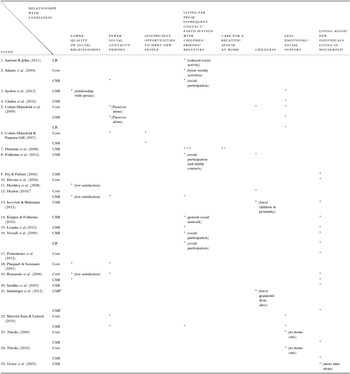
Twenty-five studies examined the relationship between loneliness and social resources (Table 2b). Loneliness was associated with living alone in 15 studies (e.g. Theeke, Reference Theeke2009), and with living far from or having infrequent contact or participation with others in nine studies (Adams et al., Reference Adams, Sanders and Auth2004; Drennan et al., Reference Drennan2008; Newall et al., Reference Newall, Chipperfield, Clifton, Perry, Swift and Ruthig2009; Heylen, Reference Heylen2010; Kuyper and Fokkema, Reference Kuyper and Fokkema2010; Shiovitz-Ezra and Leitsch, Reference Shiovitz-Ezra and Leitsch2010; Aartsen and Jylhä, Reference Aartsen and Jylhä2011; Ayalon et al., Reference Ayalon, Shiovitz-Ezra and Palgi2012; Fokkema et al., Reference Fokkema, De Jong Gierveld and Dykstra2012). A single study investigated the relationship between perceived insufficient opportunities to meet new people and loneliness and reported a positive association (Cohen-Mansfield and Parpura-Gill, Reference Cohen-Mansfield and Parpura-Gill2007).
Correlates and predictors of loneliness among older adults in peer-reviewed journal articles (2000–2012). Social resources

Note. Statistically significant outcomes are marked (*).Only studies which reported correlations and predictors of social resources are included in the table. The table refers to significant outcomes of the final, adjusted models.
* p<0.05, a Family loneliness, b Social loneliness, c Emotional loneliness.
Corr = Correlation, CSR = Cross Sectional Regressions, LR = Longitudinal Regression.
Indicators of lower quality and quantity of social relationships were associated with loneliness in five (Pinquart and Sorensen, Reference Pinquart and Sorensen2001; Routasalo et al., Reference Routasalo, Savikko, Tilvis, Strandberg and Pitkälä2006; Hawkley et al., Reference Hawkley, Hughes, Waite, Masi, Thisted and Cacioppo2008; Heylen, Reference Heylen2010; Ayalon et al., Reference Ayalon, Shiovitz-Ezra and Palgi2012) and seven (Pinquart and Sorensen, Reference Pinquart and Sorensen2001; Adams et al., Reference Adams, Sanders and Auth2004; Routasalo et al., Reference Routasalo, Savikko, Tilvis, Strandberg and Pitkälä2006; Cohen-Mansfield and Parpura-Gill, Reference Cohen-Mansfield and Parpura-Gill2007; Cohen-Mansfield et al., Reference Cohen-Mansfield, Shmotkin and Goldberg2009; Heylen, Reference Heylen2010; Shiovitz-Ezra and Leitsch, Reference Shiovitz-Ezra and Leitsch2010) studies, respectively. In a meta-analysis, quality of contacts was a more potent predictor of loneliness than quantity of contacts (Pinquart and Sorensen, Reference Pinquart and Sorensen2001). Many of these studies, though, conflate quality and quantity of social contacts, despite these being separate constructs (Van Baarsen et al., Reference Van Baarsen, Snijders, Smit and Van Duijn2001). Less emotional or social support was associated with loneliness in six studies (Cohen-Mansfield et al., Reference Cohen-Mansfield, Shmotkin and Goldberg2009; Theeke, Reference Theeke2009; Chalise et al., Reference Chalise, Kai and Saito2010; Shiovitz-Ezra and Leitsch, Reference Shiovitz-Ezra and Leitsch2010; Theeke, Reference Theeke2010; Ayalon et al., Reference Ayalon, Shiovitz-Ezra and Palgi2012), and having no or fewer children was associated with loneliness in five studies (Cohen-Mansfield et al., Reference Cohen-Mansfield, Shmotkin and Goldberg2009; Heylen, Reference Heylen2010; Fokkema et al., Reference Fokkema, De Jong Gierveld and Dykstra2012; Iecovich and Biderman, Reference Iecovich and Biderman2012; Schnittger et al., Reference Schnittger, Wherton, Prendergast and Lawlor2012). Having to care for a relative or spouse at home was a predictor of (family) loneliness in a single study (Drennan et al., Reference Drennan2008).
Health and psychological attributes
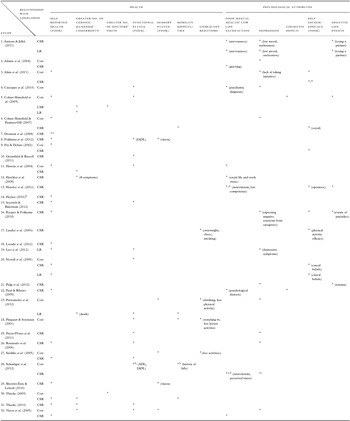
Thirty-two studies examined the relationship between loneliness and health and psychological attributes (Table 2c). With regard to health-related variables, significant relationships were found between loneliness and poor self-reported health (n = 20 studies), poor functional status (n = 16), and greater comorbidity (n = 7). Five studies found relationships between loneliness and poor sensory function (i.e. vision and hearing limitations) (Savikko et al., Reference Savikko, Routasalo, Tilvis, Strandberg and Pitkälä2005; Victor et al., Reference Victor, Scambler, Bowling and Bond2005; Shiovitz-Ezra and Leitsch, Reference Shiovitz-Ezra and Leitsch2010; Fokkema et al., Reference Fokkema, De Jong Gierveld and Dykstra2012; Perissinotto et al., Reference Perissinotto, Cenzer and Covinsky2012), and five studies reported significant relationships with mobility difficulties (Pinquart and Sorensen, Reference Pinquart and Sorensen2001; Cohen-Mansfield and Parpura-Gill, Reference Cohen-Mansfield and Parpura-Gill2007; Theeke, Reference Theeke2009; Perissinotto et al., Reference Perissinotto, Cenzer and Covinsky2012; Schnittger et al., Reference Schnittger, Wherton, Prendergast and Lawlor2012). Significant associations were found between loneliness and a greater number of doctors’ visits in two studies (Cohen-Mansfield & Parpura-Gill, Reference Cohen-Mansfield and Parpura-Gill2007; Theeke, Reference Theeke2010).
Correlates and predictors of loneliness among older adults in peer-reviewed journal articles (2000–2012). Health and psychological attributes

Note. Statistically significant outcomes are marked (*). Only studies which reported correlations and predictors of health and psychological attributes are included in the table. The table refers to significant outcomes of the final, adjusted models.
*p < 0.05, a Social loneliness, b Emotional loneliness.
Corr = Correlation, CSR = Cross Sectional Regressions, LR = Longitudinal Regression, ADL = Activities of Daily Living, IADL = Instrumental ADL.
With regard to psychological attributes, loneliness was associated with depression in 12 studies (Victor et al., Reference Victor, Scambler, Bowling and Bond2005; Routasalo et al., Reference Routasalo, Savikko, Tilvis, Strandberg and Pitkälä2006; Cohen-Mansfield and Parpura-Gill, Reference Cohen-Mansfield and Parpura-Gill2007; Cacioppo et al., Reference Cacioppo, Hawkley and Thisted2010; Kuyper and Fokkema, Reference Kuyper and Fokkema2010; Aartsen and Jylhä, Reference Aartsen and Jylhä2011; Alma et al., Reference Alma, Van der Mei, Feitsma, Groothoff, Van Tilburg and Suurmeijer2011; Prieto-Flores et al., Reference Prieto-Flores, Forjaz, Fernandez-Mayoralas, Rojo-Perez and Martinez-Martin2011; Luo et al., Reference Luo, Hawkley, Waite and Cacioppo2012; Palgi et al., Reference Palgi, Shrira, Ben-Ezra, Shiovitz-Ezra and Ayalon2012; Perissinotto et al., Reference Perissinotto, Cenzer and Covinsky2012; Schnittger et al., Reference Schnittger, Wherton, Prendergast and Lawlor2012), and with other indicators of poor mental health (e.g. psychological distress), and low life satisfaction in nine studies (Adams et al., Reference Adams, Sanders and Auth2004; Havens et al., Reference Havens, Hall, Sylvestre and Jivan2004; Victor et al., Reference Victor, Scambler, Bowling and Bond2005; Hawkley et al., Reference Hawkley, Hughes, Waite, Masi, Thisted and Cacioppo2008; Paul and Ribeiro, Reference Paul and Ribeiro2009; Cacioppo et al., Reference Cacioppo, Hawkley and Thisted2010; Aartsen and Jylhä, Reference Aartsen and Jylhä2011; Hensley et al., Reference Hensley2012; Schnittger et al., Reference Schnittger, Wherton, Prendergast and Lawlor2012). Significant associations were also reported with poor self-esteem or self-efficacy in eight studies (Fry and Debats, Reference Fry and Debats2002; Lauder et al., Reference Lauder, Mummery, Jones and Caperchione2006; Cohen-Mansfield and Parpura-Gill, Reference Cohen-Mansfield and Parpura-Gill2007; Newall et al., Reference Newall, Chipperfield, Clifton, Perry, Swift and Ruthig2009; Cacioppo et al., Reference Cacioppo, Hawkley and Thisted2010; Kuyper and Fokkema, Reference Kuyper and Fokkema2010; Alma et al., Reference Alma, Van der Mei, Feitsma, Groothoff, Van Tilburg and Suurmeijer2011; Hensley et al., Reference Hensley2012), past negative life events in five studies (Cohen-Mansfield et al., Reference Cohen-Mansfield, Shmotkin and Goldberg2009; Newall et al., Reference Newall, Chipperfield, Clifton, Perry, Swift and Ruthig2009; Kuyper and Fokkema, Reference Kuyper and Fokkema2010; Aartsen and Jylhä, Reference Aartsen and Jylhä2011; Hensley et al., Reference Hensley2012), and engagement in unhealthy behaviors in four studies (Pinquart and Sorensen, Reference Pinquart and Sorensen2001; Lauder et al., Reference Lauder, Mummery, Jones and Caperchione2006; Routasalo et al., Reference Routasalo, Savikko, Tilvis, Strandberg and Pitkälä2006; Perissinotto et al., Reference Perissinotto, Cenzer and Covinsky2012). Finally, cognitive deficit was significantly associated with loneliness in two studies (Cohen-Mansfield et al., Reference Cohen-Mansfield, Shmotkin and Goldberg2009; Paul and Ribeiro, Reference Paul and Ribeiro2009).
Focus groups
An analysis of the discussions of the two focus groups yielded several themes that may help elucidate the factors contributing to loneliness in old age.
Boredom and lack of purpose as explaining loneliness
Several participants mentioned inactivity and boredom as sources of loneliness. Conversely, they mentioned that any activity, whether social (e.g. volunteering, attending a senior center, contacting friends, or neighbors) or non-social (e.g. washing the floor, going for a walk, reading a book, watching TV, using a computer) can help alleviate the loneliness, at least temporarily. One of the participants stated: “I paid a house call at this man's place and he told me that he's bored and he doesn't know what to do and it's difficult for him. His wife passed away and his children don't pay any attention to him. So I asked him, ‘why don't you go to the senior center?’ and he replied ‘I don't feel like it, I just want to stay in bed’.”
Illiteracy and language barriers can prevent people from using the media as a means of occupying themselves and warding off loneliness; “Some people are illiterate. . . it is more common with older women that immigrated to Israel in the fifties and didn't learn to read and write. . . they can't even watch television really.” The relationship between inactivity and loneliness is also highlighted by group members commenting on the sensation of loneliness peaking on Saturdays and holidays. Given that a meaningful activity can alleviate loneliness, social norms that devalue volunteering pose a barrier; “First thing they ask when I call looking for volunteers is ‘how much do you pay?’”; “people don't understand that volunteering is actually for them. . . they think they’re being suckered into it”; “only after you try it, you understand how much it helps.”
Financial hardship
Participants complained that even the very low fee required in the senior center (60 shekels a month, equivalent to about US$16) was beyond the means of those living on social security. Another manifestation of the impact of poverty was demonstrated in the stories of disabled people who are homebound since their apartments are in a building with no elevators, and they do not have the means to avail themselves of other technological solutions (such as a stair lift). Finally, a participant told of someone who had to leave his home because of financial difficulties, thereby encountering a new and isolated existence in an unfamiliar neighborhood.
Perceived neighborhood deterioration and crime
Some participants described their neighborhoods as shifting from normative to low class neighborhoods in which African migrant laborers live; these persons are seen as different and unapproachable: “Once, the concept of ‘neighbor’ existed; today, people don't even know who their neighbors are.”; “In the past you had neighbors, an open door; he would come in, you would come in. Today, people don't even say hello anymore.”; “When I came to live in this apartment, all the doors in the building were open. We would meet in the morning, drink coffee, I’d bring a cake. We were always together. I did not want to leave the place, lose my neighbors. But eventually all my neighbors left.”; “No, we have neighbors – Sudanese neighbors. Everyone is from Sudan. I’m the only one there, the only one there. Everyone is from Sudan.” (“Sudanese” is a term often used by Israelis to refer to asylum seekers or migrant laborers from any African country.); “It's a catastrophe. . .it's not what it used to be. It's not what it used to be.” This process drove away their neighbors and friends, and it makes them perceive the neighborhood as unsafe after dark: “At night, even if I want to go out, I’m scared to go out of the house. If I do, then I look in every direction 20,000 times and every person that passes by I’ll be suspicious of him.”; “I have bars on everything – the windows, doors. . .what can you do?” Due to their fear of crime, people are afraid to open their doors to anyone, as they are not sure who it would be, further isolating them even from friendly persons.
Available social outlets are inadequate. Participants complained that the only activity in the local senior center is playing cards, or that activities such as bingo or cards are not appropriate for everyone.
Social isolation
Lack of social contacts was described as originating from language barriers, insufficient contacts with those available for such contact, or loss of social network. While a large proportion of older persons have immigrated to Israel from other countries, most have attained a mastery of Hebrew sufficient for daily discourse. Yet others who have not mastered the language find themselves isolated. Participants complained about children who do not visit, or who come for just a few minutes: “The children come to visit, say ‘hi mom, hi dad’, and then leave after a few minutes, to their business”; “some people, their children hardly come to visit – once a week, once a month. . .that way the older person is alone most of the time, day and night. If they have a caregiver, she comes for two hours a day, and that's it”. Others described people who had no children, whose children have died, or children who are of a different social and intellectual class and with whom they do not have much in common.
One aspect of this schism between descendants and older persons pertains to use of the internet. Children and grandchildren are in the cyberspace era, but the older persons are not: “They are more educated, with the computer. But I’m not.”; “I understand my friends better than my family”. Another explanation given for minimal contact with family members is financial pressures, where family members have to devote all their time to making a living and have no time left for older persons. Finally, a third reason underlying the relative disconnect with children was changing social norms: “Everyone is focused on themselves. Back then, parents used to be the number one priority.”; “The change in values, and the treatment from the government towards elders – no respect, no appreciation, no real treatment to the distresses they experience. . .and it's hard to change big organizations and values.”; “Society's different approach to older individuals paves the way to loneliness.”
Isolation can also be experienced by a person who is taking care of a spouse with a physical or mental illness. Participants described this situation as one in which they never talk with anyone or, at best, have a few words with a formal caregiver who comes twice a week. Another source of isolation is loss of a social support network, such as that culminating from multiple personal losses: “I lost everyone all at once.”; “I know someone who lost everyone all at once and she's in a difficult financial situation, but it's also about a person's character.”; “Being a widow, it's a different kind of loneliness; all of a sudden you’re alone and you don't know what to do . . .all of a sudden a person is alone and he doesn't know how to deal with life.” The isolation can be complete: “A lot of older people here, they’re in a different world. I mean some people are in complete loneliness, and they’re just waiting to go to a better place, that's it.”
Physical and mental health difficulties
Participants described mobility difficulties that prevent them from going out, as well as the lack of energy or will to do so: “At old age there is sickness. A person is sick, he doesn't want to go out of the house because he can't function properly. It's hard for me to walk far, I fall. I have a walking stick.”; “Some people don't have anything to do when they are alone, due to certain disabilities, such as being blind and not being able to watch TV”; “I have a good friend who's bedridden, although he is cognitively well. So he calls me every day for about two hours because he has nothing else to do. He has hobbies, things to do, but he can't move.”
A group member talked about a woman who is both childless and a third-time widow who does not go out of the house because she does not have the energy for it. While the cause of the lack of energy could be construed as physical, mental, or both, participants spoke of various mental health issues as contributing to loneliness. They described fears and anxieties that can lead to isolation: “In old age, people become suspicious –‘What do you want from me? Where are you taking me?’ You need to build their trust.” They also described shame of their current state, not wanting others to know they are lonely or in a difficult situation, or not wanting others to see their disability: “I had a friend who passed away two months ago. Most of her life she was disabled, in a wheelchair. She didn't want to leave the house, she didn't want people to see her in that state. She only went to the hospital or to the HMO. . . . She would do things, paint, use the computer – but only inside the house.”
Personal choice and resources
Only participants from group 2 mentioned character and willingness to find solutions as contributing to loneliness: “Some people want to stay lonely. They want to seem miserable”; “they want society to feel sorry for them.”; “loneliness is sometimes part of the character: if you don't want to be alone, you won't be. Some people want to be victims.”; “my son's piano teacher and her husband, they don't have children, they got old, and now they’re completely introverted, alone, the two of them. I tried to bring them a volunteer, Bella, who speaks many languages and likes classical music. She knocked on their door three times, and they didn't open.” Participants spoke about the tendency to rely on others and not to take responsibility for social initiative. “‘I don't get calls.’ ‘When did you call me?’ ‘Me? I don't make calls.’”; “I have friends who like to complain – ‘nobody calls me. . .you called me twice? Me? I doubt it. I don't get calls.’ People who like to complain always complain.” A participant commented that sometimes the fear of loneliness is worse than the loneliness itself.
Discussion
The experience of loneliness among older adults is multifaceted and is influenced by many factors including those pertaining to socio-demographic attributes, available social resources, and status of physical and mental health. Loneliness is prevalent among older adults and should be viewed as a public health priority (Luanaigh and Lawlor, Reference Luanaigh and Lawlor2008). Since loneliness is associated with poor outcomes, it is of extreme importance to identify those older adults who are at risk and to create appropriate interventions to treat and prevent loneliness. Screening older adults, especially those at greater risk for loneliness, is imperative in order to provide prevention through early recognition. The predictors identified in this review can offer some direction in identifying those older adults who are most at-risk. Once identified, these populations should be examined in greater depth in order to understand the mechanisms that trigger the development of loneliness. This will aid in developing suitable interventions or programs for treatment and prevention.
Socio-demographic attributes that predicted greater loneliness in older persons included female gender, non-married status, older age, poor income, and low education levels. Women may be at greater risk for loneliness since they have a longer life expectancy than men and therefore may be more likely to experience losses in their social network. Additionally, women may more readily admit their feelings of loneliness in comparison with men, which can help account for the higher levels of loneliness observed (Tijhuis et al., Reference Tijhuis, De Jong-Gierveld, Feskens and Kromhout1999). Non-married status and/or widowhood may result in loneliness due to the lack of or loss of support provided by a partner as a confidant with whom to share intimate thoughts and feelings (Paul and Ribeiro, Reference Paul and Ribeiro2009). Those not married are also less likely to have children and the consequent social support they can provide.
The effect of increasing age on loneliness may be mediated through the associated increase in physical limitations, which can interfere with opportunities for social contacts, and through loss of friends and family members (Pinquart and Sorensen, Reference Pinquart and Sorensen2001). Low income limits one's ability to attend social functions, as noted in the comments of participants in the focus groups. Financial resources may also affect loneliness through the impact on self-esteem and self-efficacy, which may, in turn, lead to reductions in social contacts (see Fry and Debats, Reference Fry and Debats2002). Educational level can affect income and accessibility. Participants in the focus groups also commented that illiteracy limited the social and activity opportunities for older persons. However, on the basis of the studies reviewed, it appears that the relationship between low income and loneliness was stronger than that between low education and loneliness.
Social resources that were associated with loneliness in older persons included living alone, residence in non-urban areas, and a low quality of social relationships. Living in a household with others provides inherent opportunities for socialization not available to the person living alone, who may feel isolated and lonely. Although we have originally placed living in rural communities as a socio-demographic variable, it can also be viewed as one representing social resources. In small rural communities, one often sees a migration of young people to cities due to better employment prospects. The older adults, who are often left behind, can suffer from decreases in social contacts, leading to more loneliness (Savikko et al., Reference Savikko, Routasalo, Tilvis, Strandberg and Pitkälä2005).
Overall, the quality of one's social relationships is a stronger predictor of loneliness than the quantity of social contacts. For instance, it has been found that the perceived quality of family relationships is more important than the size of the family network itself in predicting loneliness (Shiovitz-Ezra and Leitsch, Reference Shiovitz-Ezra and Leitsch2010). The same study found that when a couple is married or cohabiting, a supportive relationship has a strong inverse relationship with self-reported loneliness, whereas a strained relationship is associated with greater loneliness. Quality of contact with friends also plays a more important role than contact with neighbors or number of children (Drennan et al., Reference Drennan2008).
Poor health and poor functional status were commonly studied in the literature and were found to be significant predictors of loneliness in older adults. As demonstrated in the qualitative section of this paper, poor health and functional impairment limit an older adult's ability to leave the house to attend social functions or to be involved in activities, which could help alleviate the boredom that contributes to loneliness.
Psychological attributes that were associated with loneliness in older persons included depression and other indicators of poor mental health, low self-efficacy beliefs, negative life events, and cognitive deficits. Of the 21 studies that examined the associations between loneliness and psychological attributes, only three studies involved longitudinal investigations of these associations. The cross-sectional nature of most of the data limits the ability to determine what is cause or effect. The three longitudinal studies included in this review found associations between loneliness and losing a partner (Aartsen and Jylhä, Reference Aartsen and Jylhä2011), causal beliefs regarding affiliation (Newall et al., Reference Newall, Chipperfield, Clifton, Perry, Swift and Ruthig2009), and depressive symptoms (Luo et al., Reference Luo, Hawkley, Waite and Cacioppo2012). The limited availability of longitudinal evidence on the associations between loneliness and psychological attributes suggests an important direction for future research.
The studies included in the review have several limitations. Many employed secondary analysis of very large samples, which may have produced significant results despite small effect sizes. The cross-sectional design of most of the studies limits the ability to determine a cause-effect relationship. Further, the self-report nature of the variables and single-item measures of loneliness that are often used (Theeke, Reference Theeke2009) are problematic, since older adults might be hesitant to directly report feelings of loneliness due to perceived stigma associated with it (Cattan et al., Reference Cattan, White, Bond and Learmouth2005).
Some of the findings of the qualitative study were in line with findings of the quantitative results. These pertain mainly to social isolation, financial hardship (relating to low income), and physical and mental health difficulties. However, the addition of qualitative data to the review provides additional types of insight. First, as demonstrated above, it helps explain the process by which background variables exert an impact on loneliness. Second, it highlights the processes affecting loneliness from the older persons’ perspective. Finally, it suggests variables and potential causes of loneliness which have not been examined in prior research. Future quantitative studies are needed to describe the impact of physical and social environments on loneliness in the older population. Examples of such factors are: neighborhood changes, migration, crime levels, level of leisure or occupational activities, level and type of programs offering social, leisure, and occupational activities for older persons in the vicinity of the person's residence. Additional items to be examined include recent losses of family and friends, as well as mental health issues, such as shame, fear, and helplessness. The experience of loneliness among older adults is complex and is influenced by many factors. It is important to better map these factors and the ways by which they impact loneliness in order to develop better solutions on the levels of public policy, city and environmental planning, and individually-based interventions. Since loneliness is associated with negative outcomes and is prevalent among older adults, this effort should be viewed as a public health priority.
While most of the same topics were raised in both focus groups, the issue of taking responsibility for oneself in initiating, maintaining, or joining in social contacts was mentioned only by the second group. The two groups differed primarily in SES, with the first group being of a lower SES than the second. While the first group attributed loneliness to external factors and low level of resources, the second group highlighted the importance of one's own attitudes and actions. The importance of this latter attribution has been described previously by Newall et al. (Reference Newall, Chipperfield, Clifton, Perry, Swift and Ruthig2009), who reported that endorsement of the belief that making friends was dependent on one's own effort resulted in greater social participation, which, in turn, led to less loneliness. Alternately, the belief that making friends depended on external factors predicted greater loneliness. The quantitative data presented here suggest that self-efficacy may be more characteristic of those with a higher level of resources. The interaction between self-efficacy beliefs and SES, as well as with other cultural factors and social expectations, needs to be explored in future quantitative research.
One of the differences between the quantitative studies and the qualitative one reported here pertains to the countries where they were conducted. Whereas the qualitative study took place in Israel, only two of the quantitative studies were conducted there. However, it is our contention that many of the issues raised in the focus groups are universal. An examination of some of the literature emanating from the Aging Friendly environments movement raises similar issues (e.g. Glicksman et al., Reference Glicksman, Clark, Kleban, Ring and Hoffman2014), including neighborhood crime or the need for civic and social engagement. However, to truly estimate the impact of those factors, new quantitative studies need to examine the relative contribution of these variables to loneliness within different communities.
This paper summarized the results of analyses of large datasets that explored the correlates and predictors of loneliness. Such quantitative studies provide a basis for understanding loneliness, yet this basis alone is insufficient without the links provided by the qualitative data. Some of the issues raised by the qualitative data are not typically addressed in large national surveys, and therefore require dedicated research. The qualitative data particularly highlighted the nature of loneliness within different contexts (e.g. neighborhood), suggesting that localized investigation may be needed in order to develop interventions based on the understanding of correlates and causes of loneliness in specific locales.
Acknowledgments
This study was funded in part by the Ministry for Senior Citizens of Israel.
Conflict of interest
None.
Description of authors’ roles
-
1. JC-M: Conceptualized and designed the study, was involved in the analysis and interpretation of results, wrote and edited the manuscript.
-
2. HH: Assisted with project conceptualization, data interpretation, and editing the manuscript.
-
3. YL Assisted with project conceptualization, data interpretation, and editing the manuscript.
-
4. VS: Assisted with project conceptualization, acquisition of data, data interpretation, and editing the manuscript.