I. INTRODUCTION
Silicon nanoparticles attract growing interest because of their use in optoelectronic devices,Reference Pillai, Catchpole, Trupke, Zhang, Zhao and Green1–Reference Boyraz and Jalili3 solar cells,Reference Beard, Knutsen, Yu, Luther, Song, Metzger, Ellingson and Nozik4 and nanoparticle lasersReference Fojtik, Valenta, Peant, Kalal and Fiala5, Reference Belomoin, Therrien, Smith, Rao, Twesten, Chiab, Nayfeh, Wagner, Mitas, Komarneni, Parker, Vaia, Lu and Matsushita6 and as fluorescent biomarkersReference Wang, Reipa and Blasic7–Reference Rosso-Vasic, Spruijt, Popovi, Overgaag, van Lagen, Grandidier, Vanmaekelbergh, Dominguez-Gutiérrez, De Cola and Zuilhof9 with low cytotoxicity. Quantum confinement of electrons in silicon nanoparticles with a crystallite radius less than the Bohr exciton radius (5 nm for silicon) results in size-dependent bandgapsReference English, Pell, Yu, Barbara and Korgel10–Reference Shirahata, Hasegawa, Sakka and Tsuruoka12 and thus a Stokes shift with high quantum yield photoluminescence.Reference Nayfeh, Rogozhina and Mitas13–Reference Cohen, Zenou, Cahen and Yitzchaik15 A wide range of methods to produce silicon nanoclusters have been published and can be separated into bottom-up processes such as inverse micelles,Reference Warner, Hoshino, Shiohara, Yamamoto and Tilley16 plasma,Reference Mangolini, Thimsen and Kortshagen17 metallorganic precursor decomposition,Reference Ding, Quinn, Haram, Pell, Korgel and Bard18–Reference Hessel, Henderson and Veinot20 solution precursor reduction,Reference Sacarlescu and Simionescu21–Reference Zou, Baldwin, Pettigrew and Kauzlarich24 or electro-chemical reductionReference Zou and Kauzlarich25 and top–down procedures like wafer etchingReference Zhang, Neiner, Wang, Louie and Kauzlarich26–Reference Belomoin, Therrien, Smith, Rao, Twesten, Chaieb, Nayfeh and Wagner30 and laser ablation.Reference Carlisle, Dongol, Germanenko, Phitawalla and El-Shall31, Reference Carlisle, Germanenko, Phitawalla and El-Shall32 These methods utilize either multistep reactions or hazardous chemicals like hydrofluoric acid to functionalize the surface with reactive alkyl-linked groups. The functionalization of nanoparticles with highly reactive chloroalkyl groups using these methods remains a challenging task. Linford et al. previously reported the successful functionalization of porous silicon surfaces with chloroalkyl groups using a secondary hydrosilylation reactionReference Linford, Fenter, Eisenberger and Chidsey33 However, this nondirect approach utilizes high temperatures and strong acids. Previously, we reported that high-energy ball milling (HEBM) is an alternative route to produce functionalized silicon nanoparticles.Reference Heintz, Fink and Mitchell34 In this study, we report the utilization of this process to form chloroalkyl-functionalized silicon nanoparticles in a high yield, facile, and efficient one-step procedure. To our knowledge, this is the first time that a one-step process to produce chloroalkyl group–functionalized silicon nanoparticles has been reported.
HEBM has been shown to form alkyl-passivated silicon nanoparticles through fragmentation events followed by chemical reaction of the exposed surface.Reference Heintz, Fink and Mitchell34, Reference Maurice and Courtney35 The alkyl passivation of the silicon surface is obtained through milling in a reactive liquid medium like alkynes and alkenes under an inert atmosphere in a stainless steel milling vial. The reaction of the terminal triple or double bond with the reactive Si=Si and silicon surface radicals results in the formation of a covalent Si–C bond, which prevents further oxidation of the silicon surface.Reference Maurice and Courtney35–Reference Liu and Hamers38 This cycloaddition of unsaturated hydrocarbons results in organic passivated silicon nanoparticles. The milling in monofunctionalized organic liquids forms silicon nanoparticles that are soluble exclusively in organic solvents.
A high-yield mechanochemical production of chloroalkyl-functionalized silicon nanoparticles accessible for secondary chemical reactions is presented here. For this approach, we used 6-chloro-1-hexyne, which has a reactive triple bond and a terminal chloro group. The triple bond has been shown to react strongly with the reactive silicon sites during the milling process,Reference Heintz, Fink and Mitchell34 whereas the chloro group has been shown to be nonreactive, confirmed by milling experiments with ω-chloro-hexane. Thus, the reaction introduces a terminal chloro group linked via an alkyl chain to the surface of the silicon nanoparticles. The chloroalkyne can be milled with either hexyne or hexene as a coreactant. These two α-unsaturated carbon chains differ in their reactivity because of different heats of reactionReference McMurry39 and thus have different capabilities to compete with the triple bond of the terminal chloro-alkyne for the silicon-binding sites. Here, the statistically favorable formation of the Si–C bond with an alkyne results in silicon nanoparticles with different chloroalkyl coverage when milled with either alkene or alkyne as coreactant. The advantages of mechanochemical synthesis of silicon nanoparticles using HEBM include the rapid production of large quantities in a one-step process and the possibility to scale up. Furthermore, by varying the relative amounts of 6-chloro-1-hexyne to hexene or hexyne the final concentration of the alkyl linked, terminal chloro group can be tuned. This is significant for replacement reactions with biocompatible compounds and functional groups like amines, which have been shown to induce cytotoxicity at a high charge density.Reference Bhattcharjee, de Haan, Evers, Jiang, Marcelis, Zuilhof, Rietjens and Alink40 Additionally, by comparing the relative surface coverage of chloro alkyl groups to methyl groups from milling experiments using a constant concentration of 6-chloro-1-hexyne in a coreactant mixture with hexyne or hexane, a preliminary statement about the reactivity of the alkyne and alkene groups toward the reactive silicon surface can be made.
II. EXPERIMENTAL
All chemicals used were purchased from Sigma-Aldrich (St. Louis, MO) and TCI America (Portland, OR) and used without further purifications unless specified. Hexyne (97% assay) was purified by atmospheric distillation. To produce the chloroalkyl group–functionalized silicon nanoparticles, 0.75 g of crystalline silicon wafer (as obtained from Silrac, Lexington, KY; undoped, mirror finish, orientation [111], one to two pieces of 1–4 cm2 surface area) was milled in various concentrations of 6-chloro-1-hexyne in hexyne or hexene with a total liquid volume of 25 mL. The stainless steel milling vial was loaded with the appropriate chemical components and three stainless steel milling balls (d = 12 mm) under inert nitrogen atmosphere to prevent oxidative side reaction during the milling process. The milling was performed for 12 h in a SPEX 8000D high-energy ball mill in a cold room at 2 °C with an oscillation frequency of 18 Hz (SPEX CertiPrep Ltd., Metuchen, NJ). After the milling was completed, the vial contents were transferred to a plastic centrifugation tube and centrifuged for 30 min at 511 G. The clear supernatant was transferred to a glass vial, and the solvent was removed under reduced pressure in a vacuum oven at 25 °C. The oily residue containing the nanoparticles was then dissolved in organic solvents such as dichloromethane. The nanoparticle yield of this process varies between 60 and 120 mg for a 0.75 g batch, depending on the chemical composition of the organic liquids and thus reactivity. This equals a nanoparticle yield of 8–16% to the silicon precursor mass.
Fourier transform infrared (FTIR) spectroscopy was performed using a Thermo Nicolet NEXUS 670 FTIR(Thermo Fisher Scientific Inc., Waltham, MA). FTIR was performed on films of functionalized silicon nanoparticles deposited on a KBr plate. Nuclear magnetic resonance (NMR) spectroscopy was conducted in chloroform-d1 using a Bruker Avance 300 MHz high resolution NMR spectrometer (Bruker Corporation, Billerica, MA). The chemical shifts are referenced to residual peaks from chloroform present in the used chloroform-d1 solvent at 7.24 ppm. Transmission electron microscopy (TEM) images were taken with a JOEL 2011 TEM using an accelerating voltage of 200 kV (JOEL Ltd., Tokyo, Japan). Energy dispersive spectroscopic (EDS) data were obtained in the TEM using an Oxford Inca attachment (Oxford Instrument, Tubney Woods, UK) with a 3 nm beam spot on a copper grid. The photoluminescence data from the nanoparticles in dichloromethane were obtained using a Varian Cary Eclipse spectrofluorimeter (Agilent Technologies Inc., Santa Clara, CA). UV–vis absorbance characteristics in dichloromethane were acquired with a Cary 50 spectrophotometer. Quantum yields were measured using a multiple concentration method with 9,10-diphenylanthracene as standard.
III. RESULTS AND DISCUSSION
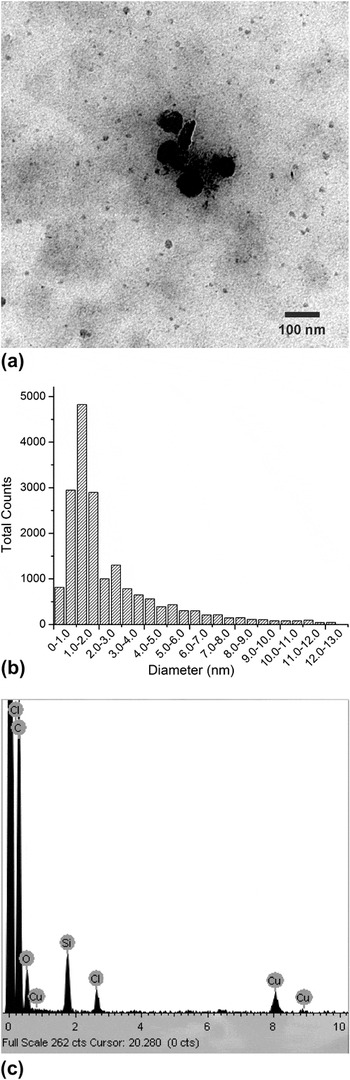
The milling in reactive liquids results in a slurry of silicon particles dispersed in the applied organic milling medium, with a size distribution in the nanometer and micrometer range. Purification of this suspension, using centrifugation, yields a clear, light yellow solution that contains functionalized silicon nanoparticles in the size range between 0.5 –and 100 nm with the overwhelming majority centered at a size of 2.0 nm (Fig. 1).
(a) Transmission electron microscopy images, (b) size distribution, and (c) energy dispersive spectroscopy analysis of silicon nanoparticles produced by milling silicon wafer in 20% 6-chloro-1-hexyne in hexyne after centrifugation and vacuum drying.

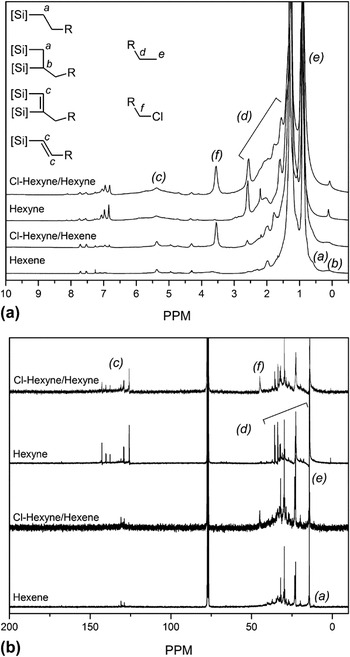
The EDS of nanoparticles show that these particles have a high content of silicon [Fig. 1(b)]. The oxygen is attributed primarily to Si–O species from the precursor material and the serendipitous reaction of silicon with trace concentrations of water in the milling medium. The EDS also indicates that chlorine atoms are associated with these nanoparticles. NMR spectroscopy from the oily residue obtained after solvent removal of silicon milled in the indicated organic media was used to further characterize the organic monolayer of the nanoparticles (Fig. 2). The measurements reveal that these chlorine atoms are linked to the surface of the silicon nanoparticles via the alkyl chain. This can be seen in the NMR peaks at 3.55 ppm (1H NMR) and 45 ppm (13C{1H} NMR) for a –CH2– of a primary chloro group when hexyne or hexene is milled in the presence of 6-chloro-1-hexyne. This peak is not detectable in milling experiments without the chloroalkyne.
(a) 1H nuclear magnetic resonance (NMR) and (b) 13C{1H} NMR spectra of silicon milled in 25 mL hexyne, in 10% 6-chloro-1-hexyne in hexyne, in 25 mL hexene, and in 3.5% 6-chloro-1-hexyne in hexene. The 1H NMR spectra are normalized to the alkyl –CH2– at around 1.3 ppm.

The NMR spectra indicate a successful reaction of the triple and double bond of the coreactants to the nanoparticle surface. In the case of alkenes, the lack of characteristic peaks in the olefinic region in the 1H NMR and 13C{1H} NMR are observed for the resultant nanoparticles. Similarly, there is a lack of alkyne peaks in the 1H NMR and 13C {1H} NMR spectra of the alkyne-reacted nanoparticles. The spectra also show the anticipated peaks for the alkyl chain at 1–2 ppm (1H NMR) and 20–30 ppm (13C{1H} NMR) and for the methyl group at 0.9 and 26 ppm, respectively. From these and previous results,Reference Heintz, Fink and Mitchell34, Reference Heintz, Fink and Mitchell41 we conclude two different Si–C linkage modes as illustrated in Fig. 3.
Idealized schematic illustration of silicon carbon linkage modes formed by cyclo and aliphatic addition processes during high-energy ball milling by milling in a mixture of 6-chloro-1-hexyne in hexyne and 6-chloro-1-hexyne in hexene.

Peaks at around 7–8 ppm in all 1H NMR spectra and around 135 ppm in the 13C{1H} NMR spectra of Fig. 2 can be attributed to 1,3,5-butyl- and 1,2,4-butyl- and/or chlorobutyl-substituted benzene isomers, which are formed from the alkyne components in the organic medium (cyclotrimerization of alkynes results in aromatic impurities, possibly through catalytic processes because of metallic erosion in the milling vial. Results will be published in a separate paper). These specific impurities can be minimized by using an alkene instead of an alkyne coreactant, which results in a decreasing peak area in the 1H NMR at ~7–8 ppm in the normalized 1H NMR spectra of Fig. 3.
Integration of 1H NMR peaks attributable to α-hydrogen atoms of the terminal chloro groups and the methyl hydrogens from the alkyne or alkene linked to the silicon nanoparticles were used to further prove that the triple bond of the organic solvents and not the chloro groups react with the silicon surface during the fracturing of the particles. If the chloro groups were favored in the reaction with the silicon, then the integration area of the primary chloro group peaks should be smaller than the initial molar concentration of 6-chloro-1-hexyne. In the investigated experiments, silicon was milled in 6-chloro-1-hexyne in hexyne, which resulted indeed in nanoparticles with a ratio of the primary chloro group to the methyl group equivalent to the initial molar concentration. However, milling in 6-chloro-1-hexyne, this time in 1-hexene, showed to yield a three times higher ratio of primary chloro groups to methyl. These results not only indicate a favorable reaction of the unsaturated carbon chain over the halogen group but also show the higher reactivity of the triple bond compared with the double bond.
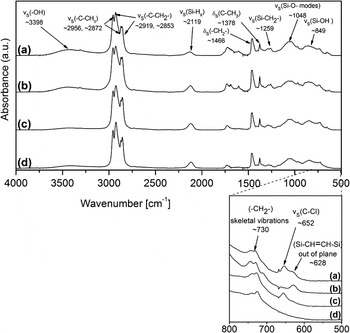
The FTIR spectra taken from thin films of the same silicon nanoparticles (Fig. 4) are in agreement with the results from the obtained NMR spectra (Fig. 2).
Fourier transform infrared (FTIR) spectra of silicon milled (a) in 10% 6-chloro-1-hexyne in hexyne, (b) in 25 mL hexyne, (c) in 3.5% 6-chloro-1-hexyne in hexane, and (d) in 25 mL hexene. The FTIR spectra are normalized to the –CH2– stretching vibration at 2919 cm−1.

All the FTIR spectra indicate the formation of an organic surface layer on the silicon nanoparticle by strong υs(C–H) stretching vibrations in the 2800–3000 cm−1 range and weaker scissoring vibrations (δ, C–H) around 1460 cm−1. The lack of alkyne C–H and C≡C stretching vibrations and the appearance of both weak C=C stretching vibrations (~1600 cm−1) and a weak vibration for υs(C–H) vinylic hydrogens (~3500 cm−1) in samples milled under the presence of alkynes provide further proof of a reaction of the alkyne group with the silicon surface and their reduction to a vinylic group. The reaction of the silicon results in the formation of υs(Si–CH2–) stretching vibrations 1259 cm−1.Reference Yang, Bley, Kauzlarich, Lee and Delgado42 The presence of a vinylic group is further supported by the appearance of the out-of-plane deformation vibration for Si–C=C–Si at 628 cm−1 [Figs. 4(a) and 4(b)] and the out-of-plane CH deformation vibration at 958 cm−1, which are more intense in samples milled in higher concentrations of alkynes.Reference Smith43 The existence of a primary chloro group is corroborated by the characteristic stretching vibration υs(C–Cl) in the samples milled with a chloroalkyne at around 650 cm−1. Furthermore, the FTIR spectra show bands for Si–H stretching at 2119 cm−1 and Si–O stretching modes including Si–O–Si at 1048 cm−1 and Si–OH at 849 cm−1 with a moderate intensity.Reference Mawhinney, Glass and Yates44–Reference Wolkin, Jorne and Fauchet47 The Si–O and Si–H species are primarily attributed to silicon oxide from the precursor material and reaction of the reactive silicon surface with trace amounts of water in the milling medium.Reference Thiel48 However, the strong hydrophobic character, in particular, the excellent solubility in nonpolar solvents, of the obtained sample suggests a rather negligible influence of these groups on the overall surface characteristics of the silicon nanoparticles.
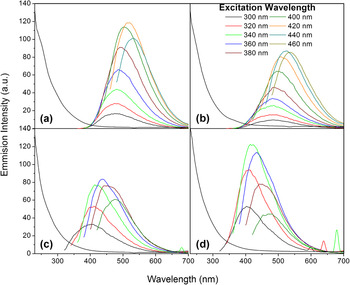
The nanoparticles show a blue luminescence under UV radiation with a quantum yield of 1.25% as an average value for a polydisperse sample. The samples also exhibit the characteristic bathochromic shift of the emission wave length with increasing excitation wavelength (Fig. 5), typical of a polydisperse samples of nanoparticles.Reference Trznadel, Pron, Zagorska, Chrzaszcz and Pielichowski49 The polydisperse nature of the nanoparticle distribution is also indicated by the TEM image (Fig. 1).
Photoluminescence and UV–vis absorption spectra of functionalized silicon nanoparticles obtained from milling (a) silicon in hexyne, (b) 6-chloro-1-hexyne in hexyne, (c) silicon in hexane, and (d) 6-chloro-1-hexyne in hexene.

The origin of the photoluminescence typically arises from particle size–dependent core states, but can be also influenced by surface states, oxidation, and crystal defects of the silicon nanoparticles.Reference Wang, Zhang and Lee50–Reference Wang, Wang, Cao and Cao52 The photoluminescence spectra are in good agreement with previously published photoluminescence spectra for alkyl-functionalized silicon nanoparticles produced by methods including inverse micelle procedures,Reference Rosso-Vasic, Spruijt, van Lagen, De Cola and Zuilhof53 solution precursor reduction,Reference Zhang, Neiner, Wang, Louie and Kauzlarich54 and laser and etching derived synthesis, which show a strong blue luminescence for small silicon nanoparticles of sizes up to 5 nm.Reference He, Kang, Li, Tsang, Fan and Lee55–Reference Shirahata, Linford, Furumi, Pei, Sakka, Gates and Aplund58 Milling in the coreactant hexyne [Figs. 5(a) and 5(b)] instead of hexene [Figs. 5(c) and 5(d)] results in a red shift of more than 90 nm, whereas the terminal chloroalkyl group does not seem to have a strong influence on the luminescence properties. The origin of this shift might be caused by electronic interactions because of the close proximity of the (C=C) double bond and a particle size distribution variation owing to the different reactivity of the coreactant. Oxygen states on the surface of the silicon nanoparticles seem to be an unlikely cause since the FTIR shows no correlating trend for the Si–O absorbance band at ~1048 cm−1 (Fig. 5); however, they cannot be excluded at this point.
A. Effect of the process time
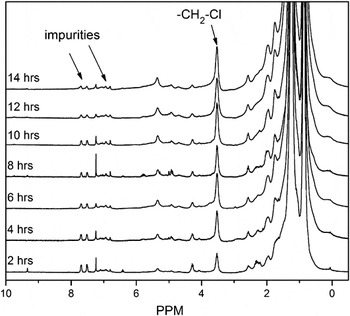
The synthesis of ω-chloroalkyl-functionalized silicon nanoparticles using HEBM is performed as a batch process and thus is highly influenced by the milling time. A mixture of 3.5% 6-chloro-1-hexyne was milled in hexene for various times, and the resulting composition of nanoparticles and impurities was analyzed. The integration values for the peaks attributed to the terminal chloroalkyl group at 3.55 ppm and the alkyl silicon group at 0.2 ppm in the 1H NMR spectra performed of resuspended nanoparticles show a steady increase of the peak area with milling time, whereas the peak areas of the molecular impurities at ~7–8 ppm decrease, indicating different formation kinetics (Fig. 6).
Normalized 1H NMR spectra of the silicon nanoparticles obtained from milling silicon in 3.5% 6-chloro-1-hexyne in hexene for the indicated times. The 1H NMR spectra are normalized to the alkyl –CH2– at around 1.3 ppm.

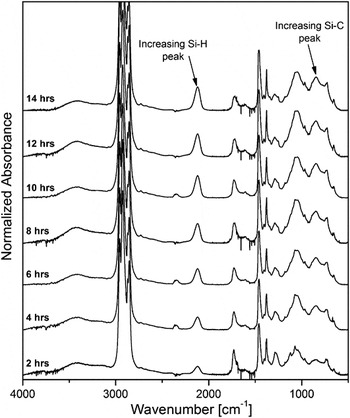
The peak areas of the molecular impurities at ~7–8 ppm, however, decrease with milling time. In particular, it can be observed that, with longer milling times, the relative concentrations of the impurities decrease further to an almost undetectable level. We, therefore, conclude that the formation of the molecular impurities is relatively rapid and occurs at the beginning of the milling process, whereas the nanoparticle formation and functionalization are slower and continue with time. This conclusion is supported by FTIR measurements, where the elevated concentration of silicon nanoparticles manifests itself in an increased Si–C absorbance at around 850 cm−1 compared to impurity associated absorbance bands at around 1700 cm−1 at longer milling times (Fig. 7).
Normalized FTIR spectra of the silicon nanoparticles obtained from milling silicon in 3.5% 6-chloro-1-hexyne in hexene for the indicated times. The FTIR spectra are normalized to the –CH2– stretching vibration at 2919 cm−1.

It can also be seen that the extended silicon surface area, due to fracturing into the nanometer size regime, expresses itself in an increased Si–C (~850 cm−1) and Si–H (~2100 cm−1) absorbance compared with the Si–O band at around 1050 cm−1 because of the prevention of further oxygen passivation. The Si–H can also be found in all 1H NMR spectra at 4.3 ppm and originates as a by-product on the surface of the silicon nanoparticles. However, the concentration of the detected H atoms participating at the Si–H bond is extremely low and account for only 0.1% of the overall hydrogens detected. The Si–H species are persistent because of the protection by the surrounding alkyl chains, which prevents access to this highly reactive moiety and impedes reaction with oxygen and water.
The NMR and FTIR spectra indicate an increase of the nanoparticle concentration with milling time. This observation is in agreement with the measurements of the overall mass of the dried nanoparticles accumulated in the organic milling medium (Fig. 8).
Total yield of silicon nanoparticles obtained from milling silicon in 3.5% 6-chloro-1-hexyne in hexene for various times. The standard deviation of the yields is approximately ±3%.

The data show a linear increase in the mass of the silicon nanoparticles up to a milling time of 12 h. The slope of the nanoparticle formation after this time starts to decrease and an asymptotic approach to the maximal mass of silicon nanoparticle soluble in the given volume of organic medium can be observed. These results indicate that the optimal milling time for the introduced process is 12 h because at this time a high yield in a reasonable time can be obtained with a minimal amount of impurities.
B. Tuning the chloroalkyl surface coverage
The mechanochemical synthesis of chloroalkyl-functionalized silicon nanoparticles also has the advantage of fine tuning the percent coverage of the terminal alkyl-linked chloro groups of the silicon nanoparticles. This can be achieved by the variation of the concentration of ω-chloroalkyne as the coreactant.
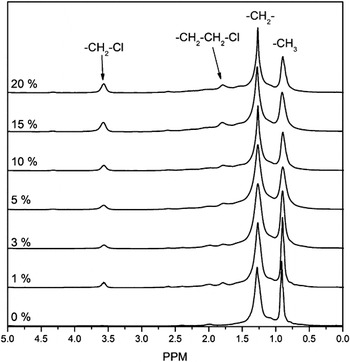
There is an intrinsic difference in the reactivity of an alkyne and an alkene to the surface of a silicon nanoparticle. This difference manifests itself in the surface coverage of terminal chloroalkyl groups milled in different concentrations of 6-chloro-1-hexyne in hexene or hexyne. The lower reactivity of the double bond from the hexene compared with the triple bond of the chloroalkyne results in a higher coverage of chloroalkyl groups on the nanoparticle compared to the starting molar ratio of the two reactants. Conversely, the coverage of chloroalkyl groups should be nearly equal to the initial molar ratio of the chloroalkyne when milled in a hexyne-based system, assuming a statistical reactivity. This is indeed observed for a variety of different reaction conditions, in particular, various silicon precursor masses, milling times, and concentration of 6-chloro-1-hexyne. The milling of silicon in a mixture of various 6-chloro-1-hexyne concentrations in hexene for 4 h resulted in silicon nanoparticles with different degrees of chloroalkyl group coverage as determined by 1H NMR (Fig. 9). This increasing coverage is indicated by the increasing chloroalkyl peak at around 3.55 ppm and a decreasing methyl peak at around 0.90 ppm, which is due to the suppression of the hexene moiety by the higher 6-chloro-1-hexyne concentration.
Normalized 1H NMR spectra of the silicon nanoparticles obtained from milling silicon in the indicated molar concentration of 6-chloro-1-hexyne in hexene for 4 h. The 1H NMR spectra are normalized to the alkyl –CH2– at around 1.3 ppm.

To evaluate the surface coverage, the integration values of the chloroalkyl group at 3.55 ppm to the methyl group at 0.89 ppm of silicon nanoparticles formed in different concentrations of chloroalkyne were compared (Fig. 10). For this approach, the values obtained from silicon milled in various mixtures of 6-chloro-1-hexyne in hexene for 4 h and additionally the values from silicon milled in the same mixtures for 12 h and in mixtures of 6-chloro-1-hexyne in hexyne for 12 h were compared.
1H NMR study of the chloroalkyl group coverage at the nanoparticle surface produced by (a) milling 0.75 g of silicon in various concentration of 6-chloro-1-hexyne in hexyne (■) and in hexene (▼) and (b) milling 2.5 g of silicon in various concentrations of 6-chloro-1-hexyne in hexene (▲). The straight line indicates the coverage equal to the starting molar ratio.

Figure 10 shows that milling silicon in a mixture of 6-chloro-1-hexyne in hexene (▼) yields nanoparticles with a chloroalkyl group coverage, which exceeds the initial molar ratio indicated by the straight line by 7.5–10%. This increased coverage of chloroalkyl groups is due to the higher reactivity of the triple bond compared with the double bond of the coreactant. Milling silicon in mixtures of 6-chloro-1-hexyne in hexyne (■), however, results in a chloroalkyl group coverage equivalent to the starting concentration, as both coreactants are alkynes. These results further prove that milling in an alkene-based system not only reduces the formation of tributyl benzene impurities but also increases the surface coverage of the compound with the higher reactivity. Figure 10(b) also shows that the initial mass of the silicon wafer starting material has no influence on the resulting surface coverage of primary chloroalkyl groups. This observation suggests that the rate of silicon surface exposure is the rate-limiting step.
IV. CONCLUSION
We have demonstrated that mechanochemical synthesis via HEBM is a facile and fast method to simultaneously produce and functionalize silicon nanoparticles with reactive chloroalkyl groups. Furthermore, we have shown that not only the amount of molecular impurities can be supressed, but also an increased surface coverage of the silicon-bound chloroalkyl groups of the nanoparticles can be obtained by variation of the coreactants. This is particularly important for the synthesis of chloroalkyl-functionalized silicon nanoparticles because bifunctional organic molecules are often costly. The terminal chloro groups at the termini of alkyl chains on the silicon nanoparticles are highly reactive and thus suitable for a wide range of organic reactions.
ACKNOWLEDGMENTS
This work is supported by the National Science Foundation (NSF Grant CMMI-0726943) and by the Tulane Institute for Macro-Molecular Engineering and Sciences (TIMES, NASA Grant NNX08AP04A).