INTRODUCTION
Variability in target L2 morphological production is understood by some as a valid indicator of (deviancy in) related syntactic representations (e.g., Hawkins & Liszka, Reference Hawkins, Liszka, van Hout, Hulk, Kuiken and Towell2003, but see, e.g., Lardiere, Reference Lardiere2009 for discussion). Most recently, this issue has taken the form of examining the status of uninterpretable, parameterized syntactic features in L2 grammars. The past tense feature ([upast]) has received particular attention in this discussion, especially for Mandarin Chinese (which lacks [upast]) learners of L2 English. Various proposals have been offered to account for the observed fact that suppliance/production of English past tense morphology proves difficult for this group. These proposals cite sources of difficulty that include morphosyntactic deficits (Hawkins & Liszka, Reference Hawkins, Liszka, van Hout, Hulk, Kuiken and Towell2003), syntax-morphology mapping (Lardiere Reference Lardiere1998a, Reference Lardiere1998b), L1 phonotactic constraints (Davidson, Reference Davidson2005), L1 prosodic constraints (Goad & White, Reference Goad and White2006), perception (Solt et al., Reference Solt, Pugach, Klein, Adams, Stoyneshka, Rose, Brugos, Micciulla and Smith2004), and input factors and processing pressures (Hopp, Reference Hopp2009). It is puzzling that past tense morphology production—spoken and even written—should be so challenging for L2 speakers given that past tense marking is (a) obligatory and therefore highly frequent, (b) almost always overt morphologically, and (c) explicitly taught in English as a Second Language classrooms from the elementary levels and throughout. Indeed, research showing that comprehension is less problematic (see, e.g., Lardiere, Reference Lardiere2007) might lead one to ponder what productive measures (alone) in any modality reveal.
Considering L1 transfer more fully, the evaluation of alternatives to a possible representational problem for L2 syntax seems warranted. Mandarin not only lacks a syntactic feature for past tense, but it also lacks the prosodic structure found in English past tense forms and has phonological restrictions on consonant cluster formation that are incompatible with many English past tense allomorphs. We explore the possibility that the trend of variable L2 English past morpheme production by Mandarin speakers at high levels of L2 proficiency might be better explained by L1 phonological influence as opposed to a syntactic deficit, a possibility examined explicitly in Goad and White (Reference Goad and White2006). We compare three L2 English groups and fully consider how phonological factors might offer an alternative account to production problems that these groups all might share in this domain. If the challenges are mainly phonological rather than syntactic, any group acquiring L2 English whose L1 has similar phonological constraints against consonant clusters and/or prosodic adjunction should show divergences from the L2 target, irrespective of whether their L1 instantiates a syntactic feature for past. To the extent that this is shown empirically by bringing data together from various L1s, using past tense as a grammatical property to argue for a deficit in L2 syntax becomes less reliable precisely because the general difficulty in disentangling the relative contribution of syntax from that of phonology becomes even more problematic. In other words, if it is shown that (a) an L2 learner whose L1 has the past tense feature experiences similar problems in past tense morphological suppliance to an L2 learner whose L1 lacks this feature and (b) both L2 learners have the same relevant phonological obstacles to overcome from their L1s, then it is increasingly less clear that syntax alone is to blame. Of course, it does not immediately follow that similarity between these two aforementioned learners indicates that L2 syntactic deficits do not pertain. Rather, it simply means that there is a confound that precludes reliable determination of such a deficit.
The present study investigates the interlanguage (IL) of Mandarin native speakers and compares their performance against two other L2 English groups (L1 Japanese and L1 Spanish). Comparison with these L2 groups is important to support any claim that a syntactic deficit approach is privileged over an L1 phonological influence account. This is because, despite the fact that Japanese and Spanish have the uninterpretable past [upast] feature available for transfer, all three languages share similar phonological restrictions against consonant clusters and only one (Japanese) patterns prosodically with the English target in the domain of past tense morphology. If syllable structure restrictions are deterministic in L2 morphological suppliance, then the three groups should show evidence of similar difficulties in English past tense suppliance, specifically when the cluster that results from attachment of past tense would be illegal in all three L1s. If prosodic structure is deterministic, it is possible that the Japanese learners could outperform the Mandarin and Spanish L1ers. If, however, it is clearly a syntactic issue alone then only the Mandarin learners should have highly variable suppliance of past tense morphology. To our knowledge, Spanish has not been investigated in conjunction with these two languages to tease apart L1 phonological influence from potential L2 syntactic deficits.
This study presents data for performance tasks that require written and oral past morphology suppliance. As we will see, all three learner groups differ significantly from native controls in oral suppliance of past tense morphology, suggesting that L1 phonological transfer at various levels might be an explanatory factor for L2 variation in obligatory overt morphological suppliance. To be clear from the outset, the data do not present unassailable evidence against representational deficit approachesFootnote 1 (RDAs) per se. Conversely, the data strongly question the basis for using L2 variation in obligatory morphological suppliance as valid evidence in support of RDAs, at least as far as the L2 acquisition of past tense when the syntactic feature is lacking in the L1. The logic is as follows: The fact that Spanish and Japanese learners have similar problems to L1 Mandarin speakers (i.e., that none of these groups supply past tense morphology in a nativelike way) opens the possibility that an inability to acquire new L2 syntactic features, which is only part of the learning task for Mandarin natives, is not the only potential explanation for why Mandarin speakers have so much trouble with English past tense suppliance, especially because such an explanation could not be true for the case of Spanish learners. If phonological considerations are a better explanation for the case of Spanish, then how can one preclude the same explanation as being equally explanatory for the Mandarin speakers? The null hypothesis is that L1 and L2 learners avail themselves of the same mechanisms for acquisition and based on the available data, the null hypothesis simply cannot be rejected.
To be clear and fair, our argument will not overextend the parameters of what our data can support. We will simply maintain that, unless we disentangle the syntactic from the phonological learning task, the domain of English past tense morphological suppliance cannot be used to adjudicate between theories that claim that new L2 morphosyntactic features are unacquirable and those that claim that new L2 syntactic features can be acquired across the life span, contrary to what has been claimed for more than two decades in the literature (see Previous Research).
PREVIOUS RESEARCH
In this study, two broadly labeled formal linguistic (generative) approaches to adult L2 acquisition are considered against one another: RDAs and full access approaches (FAAs).
REPRESENTATIONAL DEFICIT APPROACHES
RDAs maintain that adult L2ers lose the ability to acquire new L2 syntactic (uninterpretable) features from the universal inventory, whereas semantically interpretable features remain accessible (Hawkins & Casillas, Reference Hawkins and Casillas2008; Hawkins & Hattori, Reference Hawkins and Hattori2006; Tsimpli & Dimitrakopoulou, Reference Tsimpli and Dimitrakopoulou2007). Such approaches, however, acknowledge the possibility of L2 learning that can correspond to surface reflexes of new syntactic feature acquisition—for example, rote learning of morphological paradigms and their application through instruction, redeploying grammatical competence in the L1 to process and parse L2 input for meaning.Footnote 2
To the extent that L2 learning in the truest sense obtains, RDAs do not necessarily predict wildly different L2 performances for domains of grammar where surface learning could mask distinctions in underlying representation. Rather, RDAs might expect L2 variability/optionality in performance because other nonsyntactic factors can help adult L2ers perform in targetlike ways. For example, effects of explicit instruction (i.e., rote learning) might help a learner produce past morphology consistently well, even if their L2 grammar does not instantiate [upast]. This prediction is particularly true of several irregular past tense forms, which tend to be frequent in the input. Additionally, compared to regular forms, past tense marking on irregular forms can create a more salient distinction between present and past forms (e.g., “be” – “was” vs. “walk” – “walked”). Therefore, RDAs would not propose a complete lack of knowledge for past if the L2er’s L1 lacks [upast], but rather an observable degree of variability in their suppliance that is higher than what would be expected for native speakers.
FULL ACCESS APPROACHES
FAAs maintain that adults have access to the full set of Universal Grammar (UG) features as in L1 acquisition (e.g., Schwartz & Sprouse, Reference Schwartz and Sprouse1996). FAAs propose that difficulty in L2 functional morphology at advanced L2 proficiency does not result from a maturationally conditioned inability to acquire particular features. That is, nativelike L2 syntactic representations are in principle attainable and any difficulty is the surface outcome of other contributing variables, such as learnability restrictions due to L1 transfer (e.g., L1/L2 subset-superset relationships) (Schwartz & Sprouse, Reference Schwartz and Sprouse1996), complexity inherent to feature reassembly (Lardiere, Reference Lardiere2009), difficulty imposed by morphological learning and/or decomposition for adults (Slabakova, Reference Slabakova2008), mapping problems between underlying representations and production (Prévost & White, Reference Prévost and White2000), and possible competition between taught knowledge and underlying competence (Rothman, Reference Rothman2008), among others. Each of these approaches acknowledges that L2 adult acquisition is different from child L1 acquisition on many planes, yet takes the position that differences are not due to an inaccessibility of syntactic features in adulthood. FAAs attempt to account for the same observable optionality/variability of L2 functional morphology production in ways that offer a tenable and testable alternative to RDAs’ claims.
KEY RELEVANT STUDIES
Hawkins and Liszka (Reference Hawkins, Liszka, van Hout, Hulk, Kuiken and Towell2003) tested advanced L1 speakers of German, Japanese, and Mandarin for marking of L2 English thematic verbs for simple past tense. In an experiment probing written responses (a cloze test) no between-groups differences were found. However, data from elicited production tasks showed a significant between-groups difference for regular and irregular verbs. This difference was due to the Mandarin informants’ markedly lower scores. The authors concluded that the difference could be explained by the fact that Mandarin was the only language without a past feature. The researchers also explored the possibility that L1 transfer of syllable structure was responsible for low suppliance (as argued, e.g., in Lardiere Reference Lardiere1998a, Reference Lardiere1998b, Reference Lardiere and Archibald2000). They compared the performance of Mandarin and Japanese participants on consonant clusters because both languages impose restrictions on them in ways relevant to English past allomorphs. However, Mandarin speakers showed a higher retention of consonant clusters on monomorphemes (82%) than simple past forms (63%), suggesting that the presence of a consonant cluster might not be the determining factor in lower morphological suppliance.
Lardiere (Reference Lardiere1998a, Reference Lardiere1998b, Reference Lardiere and Archibald2000, Reference Lardiere2007) has analyzed longitudinal data from a native speaker of Chinese (Hokkien and Mandarin) known as Patty, who supplies past tense morphology in obligatory contexts in a fairly stable yet nonnativelike manner (34.78%, 34.85%, and 33.82% at three time points over nine years). Lardiere contends that Patty’s production of verb morphology underrepresents her syntactic knowledge, and that syntactic knowledge and its morphophonological reflexes should be understood separately (Lardiere, Reference Lardiere and Archibald2000, p. 120). L1 phonological transfer may account for this discrepancy because consonant clusters are disallowed in Mandarin and Hokkien. Patty’s written data show at least twice as many instances of suppliance of past tense marking in obligatory contexts than in oral spontaneous production (Lardiere, Reference Lardiere2007), again suggesting that nonsyntactic factors can be influential in morphology suppliance.
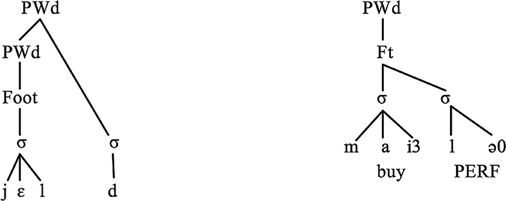
Goad, White, and Steele (Reference Goad, White and Steele2003) tested 12 L1 Mandarin L2ers of English who had resided in Canada between six months and five years. They propose that IL performance is constrained by L1 phonological transfer effects, which can result in either across-the-board deletion of morphophonological material or variable suppliance. They assume that functional morphology is prosodified differently in both Mandarin and English, which they claim is in part responsible for variable suppliance of the past –ed morpheme. The past morpheme in English adjoins to the verb stem (1a), which means that an external prosodic word (PWd) directly dominates the internal PWd while also directly dominating the external syllable. In Mandarin, however, an external PWd cannot simultaneously dominate an internal PWd and an external syllable, and thus functional morphemes (such as the aspectual perfective marker –lə), must be in a position internal to the PWd (1b, examples from Goad et al., Reference Goad, White and Steele2003, p. 248).Footnote 3 Therefore, the learning task for Mandarin speakers consists of retrieving the syntactic [upast] feature from the universal inventory as well as prosodifying functional morphology in a new way.
(1) a. English simple past morpheme b. Mandarin aspect morpheme
 $$
Goad et al. (Reference Goad, White and Steele2003) proposed the prosodic transfer hypothesis (PTH), which originally claimed that an L1 prosodic structure that is not part of the L2 grammar could not be acquired through access to UG. Goad and White (Reference Goad and White2006) revised this strong claim, hypothesizing partial access to UG for prosodic phonology. Although they claim that L2 learners lack access to new licensing relations not instantiated in the L1, they can rely on L1 structures to construct the prosodic representation required for L2 English past tense. Goad and White (Reference Goad and White2006) outline this notion in their discussion of minimal adaptation, which states that construction of L2 prosodic structure is possible if (a) it can be built through combining L1 licensing relations or (b) if it involves L1 structures being licensed in new positions (p. 247). As the authors state, most languages evidence compounding and permit direct domination of a syllable by a PWd. Therefore, “[L]earners from many L1s lacking adjunction should be in a position to build the structure required for English-type inflection” (p. 264).
Both structures necessary for PWd adjunction occur in Mandarin. First, a PWd can link directly to a syllable in a three-syllable construction in which the right-most syllable is not dominated by a foot, which can only dominate two syllables to comply with foot binarity (e.g., [[[man4]σ [man0]σ ]Ft ] [de0]σ ]PWd, adapted from Goad & White, Reference Goad and White2006, p. 251). Second, a PWd can dominate a PWd in the case of compounding. However, these licensing relations do not occur in a single structure, which is a requirement of adjunction. Adjunction is therefore not possible in Mandarin and thus condition b of minimal adaptation is not met. L1 Mandarin speakers, however, can potentially build English prosodic structure because their L1 grammar includes the two structures necessary for the adjunction required for inflection (Goad & White, Reference Goad and White2006).
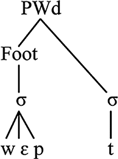
Goad et al.’s (Reference Goad, White and Steele2003) results showed a lower rate of suppliance for regular verbs (57%) than for irregular verbs (78%), a finding consistent with data from Hawkins and Liszka (Reference Hawkins, Liszka, van Hout, Hulk, Kuiken and Towell2003) as well as Lardiere (Reference Lardiere1998a, Reference Lardiere1998b, Reference Lardiere and Archibald2000, Reference Lardiere2007). These findings are in line with the predictions of the PTH as well because (a) pseudo-inflected forms (e.g., “keep” – “kept”) involve organization of the past tense morpheme inside the PWd of its host (see example 2), and (b) the Mandarin aspect morpheme is PWd-internal, so L1 transfer is facilitative. Learners are better at producing a form whose prosodic structure mirrors their L1 structure for inflection than the adjoined form that is not part of their L1.
(2) English pseudo-inflection [wɛpt] ‘wept’ (Goad et al., Reference Goad, White and Steele2003, p. 250)
$$
Goad and White (Reference Goad and White2006) analyzed data from 10 L1 Mandarin speakers and nine native English controls. Participants were required to choose one of two written sentences as a possible continuation to a prompt, as in the following example (from Goad & White, Reference Goad and White2006, p. 252):
(3) Last night after dinner…
–you show me photos of your daughter
–you showed me photos of your daughter
The L1 Mandarin speakers selected the correct tense 83% of the time, in comparison with English natives’ 98% accuracy. However, despite differences between the two groups, the authors argue that Mandarin speakers represent [upast] in their IL because they correctly chose past tense at a rate well above chance.
In addition to examining the production of regular versus irregular forms, the authors compared regular long-stemmed forms ending in a vowel-vowel/consonant-vowel (VXC) sequence (e.g., “helped”) with short-stemmed forms ending in a vowel-vowel/consonant (VX) sequence (e.g., “picked”). Stem length is of interest when investigating prosodic transfer for two reasons. First, learners could treat short- and long-stemmed regulars differently. L1 Mandarin speakers might supply inflection on a short-stemmed form because their PWd-internal representation of inflection allows them to do so. In this case, learners might evidence higher rates of suppliance for short-stemmed forms. This would happen if learners were to treat short-stemmed forms like pseudo-inflected forms, essentially working around PWd-adjunction by constructing a PWd-internal representation of inflection (as in pseudo-inflected forms). Recall that pseudo-inflected forms such as “kept” [kεp-t]PWd are prosodified without adjunction. Similarly, in a short-stemmed form such as “picked” [[pik]PWd t]PWd, in comparison with a long-stemmed VXC-final form such as “helped” [[hεlp] PWd t] PWd, the addition of the past-tense allomorph does not exceed the maximum three-position rhyme and inflection could occur within the PWd: [pik-t]PWd. The second motivation for investigating stem length is the articulatory difficulty that comes with a three-consonant cluster.
Goad and White’s (Reference Goad and White2006) data did not yield significant differences between regular and irregular forms, nor between short- and long-stemmed forms, with rates of suppliance ranging from 87% (short-stemmed regulars) to 94% (ablaut). The authors present evidence of stem reduction in the long-stemmed forms, which could suggest prosodification within a single PWd. However, a phonetic analysis of learner productions indicated otherwise; stem-final consonants in regular and pseudo-inflected forms were treated differently. Thus, similarly to Goad et al. (Reference Goad, White and Steele2003), the authors argue against RDAs. However, differently than Goad et al. (Reference Goad, White and Steele2003), Goad and White (Reference Goad and White2006) claim that learners can build adjunction structures even if they are not available in the L1, provided they can combine existing prosodic structures from their L1 to build the target structure.
PAST TENSE IN ENGLISH, MANDARIN, SPANISH, AND JAPANESE
English.
English encodes the past feature in the morpheme –ed adjoined to a lexical verb (e.g., “walk” – “walked”), although some verbs will undergo suppletion (e.g., “go” – “went”), vowel change (e.g., “run” – “ran”), or both vowel change and affixation (e.g., “keep” – “kept”) (Lobeck, Reference Lobeck2000). Affixation of –ed can manifest in three ways depending on the last segment of the verbal stem: [t] if the last segment is a voiceless consonant (e.g., “missed”), [d] if the segment is a voiced consonant other than [t] or [d] (e.g., “sinned”), or syllabic [id] if the segment is [t] or [d] (e.g., “faded”).
We assume that simple past morphology marking results from a series of procedures that go from a syntactic representation to a phonological manifestation, following Adger (2003, pp. 166–171). Adger proposes that v enters the syntactic derivation with an unspecified uninterpretable tense feature, [uInfl : ]. T hosts an interpretable [past] feature, which values the uninterpretable unvalued feature on v, v[uInfl : ] → v[uInfl : past]. The tense features on T and v match, and the uninterpretable feature on v is checked through c-command and is therefore deleted: v[uInfl : past]. Until this point, all operations are strictly syntactic. The checked v[uInfl : past] feature is spelled out as it interfaces with morphology, rendering it subject to the pronunciation rule that specifies that the affix –ed (for regular verbs) be added to the stem, resulting in the morphological representation: stem+ed. Adger describes this interface rule as in (4):
(4) Pronounce v[uInfl : past] as ed (Adger, Reference Adger2003, p. 170).Footnote 4
Oral production of regular past tense English forms minimally involves the instantiation of the [upast] feature. Considering Adger’s (Reference Adger2003) analysis, Mandarin native speakers need to access and instantiate the [upast] feature from the universal inventory, while native speakers of Spanish and Japanese can transfer it directly from their L1. Regular past affixation can produce two-consonant clusters, for example, “sinned” [sind], “fooled” [fu:ld], “missed” [mist], as well as three-consonant clusters, for example, “helped” [hɛlpt]. Following Goad et al.’s (Reference Goad, White and Steele2003) and Goad and White (Reference Goad and White2006) analysis, regular past tense forms are formed through prosodic adjunction of the –ed morpheme to the verb stem to not violate the three-position rhyme. For example, “worked,” which contains four elements in its rhyme and a three-consonant word-final cluster, does not violate the limit of a three-position rhyme because the final consonant (i.e., the past tense allomorph) is not part of the internal PWd and therefore the rhyme of the internal PWd is a legal vowel-consonant-consonant (VCC) form (see Goad et al., Reference Goad, White and Steele2003, p. 248). We see a different situation with pseudo-inflected forms such as “kept” (VCC rhyme), where adjunction of the past morpheme does not occur and the past morpheme remains internal to the PWd of its host. This violation is fixed by the grammar by shortening the vowel from [i:] to [ɛ], which results in the final licit form “kept” [kʰɛpt], rather than “keept” [kʰi:pt] (see Goad & White, Reference Goad and White2006, pp. 247–248 for further evidence).
Mandarin
Mandarin does not have overt morphology for expressing simple past tense (Li, 1990), and pastness is mainly indicated through using temporal adverbs and/or is calculated by the discourse context. Therefore, the interpretation of a sentence without sufficient context or a time adverbial is ambiguous (example from Hawkins & Liszka, Reference Hawkins, Liszka, van Hout, Hulk, Kuiken and Towell2003, p. 26):
(5) Zhangsan kan dianying
Zhangsan see-INF movie
“Zhangsan is seeing/saw a movie”
Therefore, Mandarin natives’ acquisition task involves retrieving the [upast] feature as well as the prosodification mechanism to adjoin the –ed morpheme to the verb host. In the case of pseudoinflected verbs, we find that, similar to Spanish and Japanese, Mandarin disallows consonant clusters in the rhyme and even single consonants in the rhyme are very limited. As described in Duanmu (Reference Duanmu2007), Mandarin has two possible consonants in the rhyme, /ŋ/ (as in /tuŋ/ “winter”), and /n/ (as in /tan/ “egg”). Therefore, L1 syllable structure transfer is of little help for native speakers of Mandarin because the alternative of treating regular past forms as pseudo-inflected forms is contingent on overcoming another set of L1 syllable structure constraints.
Spanish
Spanish expresses past tense through obligatory functional morphology on the verb and is assumed to instantiate the [upast] feature like English. However, the Spanish affixation paradigm is much richer than in English, especially because grammatical (perfective) aspect is differentiated through separate past morphemes. Another relevant point of comparison with English is the position that the past morpheme occupies with respect to the PWd that contains the lexical verb. To propose a position for the past morpheme in Spanish either inside or outside of the PWd, we examine its relationship with stress assignment. The logic is that if the morpheme is visible to stress assignment, we can take this to mean that it is inside the (lower) PWd. If, alternatively, the morpheme’s presence does not affect stress assignment, we take this to mean that it is outside of the lower PWd. This is in line with Goad, White, and Bruhn de Garavito (Reference Goad, White, Bruhn de Garavito, Danis, Mesh and Sung2011), who argue that the Spanish plural morpheme –s is PWd-adjoined because it is invisible to stress assignment. Here, we start with the common assumption that Spanish verb morphological structure includes the following morphemes: prefix (if any), stem, theme vowel, tense/aspect/mood (TAM), and person/number (PN) (e.g., Harris, Reference Harris1987). Because the tense morpheme is conflated with aspect and mood into a single complex morphological unit (TAM), we explore the position that TAM occupies in the prosodic structure of the verb. For example, in the first-person plural past form of manejar “drive,” primary stress falls on the syllable já in the sequence manejábamos “we drove/used to drive/were driving” (6). This is the case for other regular verbs, in which primary stress is invariably assigned before the TAM morpheme. Following Harris (Reference Harris1987), we assume that the syllable following the TAM morpheme (which hosts PN) is extrametrical and thus organized into a higher PWd. Primary stress is assigned to the initial syllable of the rightmost foot in the lower PWd, which suggests that the TAM morpheme is PWd-internal to ensure that the stress-bearing foot is binary.
(6)
$$
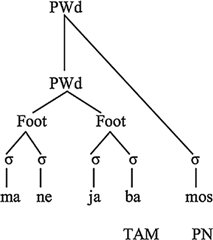
As established, knowledge of English past involves instantiation of the syntactic feature [upast] and a morphological structure that renders stem+ed. Up to this point, the acquisition task for a Spanish speaker is straightforward, as the difference between English and Spanish relies only on the specified past allomorph. However, the acquisition task is more complex when considering the interface of the morphological representation with phonology. As previously stated, English simple past forms involve PWd adjunction of the –ed morpheme. Because the tense marker in Spanish is inside the PWd, native speakers of Spanish will need to rearrange the L1-transferred prosodic structure to match that of the English simple past forms.
Recall that learners are predicted to prosodify inflection adjoined to the PWd in the L2 if (a) their L1 can build the target structure through combining L1 licensing relations or (b) the target structure involves L1 structures being licensed in new positions. While Japanese, as we will see, can resort to L1 transfer in this domain, Spanish and Mandarin must combine existing structures to accommodate the target structure. This should be possible in Spanish because PWd adjunction is an available structure in the verb system that can be adapted for use; the conflated PN morpheme is adjoined to the PWd.Footnote 5 That is, Spanish meets the minimal adaptation condition of an L1 structure being licensed in a new position. However, just because the structure is available does not guarantee it will be used. Therefore, we examine the restrictions that Spanish imposes on consonants in the rhyme in word-final position, which are limited to the following coronal consonants:
(7) a. liquids [l] [ɾ]: e.g. sal [sal] ‘salt’, mar [maɾ] ‘sea’
b. obstruents [ð̪] [s] [θ]Footnote 6: e.g. red [reð̪] ‘net’, más [mas] ‘more’
c. nasal [n]: e.g. pan [pan] ‘bread’
Consonant clusters are mostly produced in careful speech and borrowings (Piñeros, Reference Piñeros2008, p. 109), and only /s/ can be the second element. Furthermore, in casual speech, such clusters are usually reduced by deleting the second consonant, for example, biceps as [′bi.sep], all of which suggests that consonant clusters (such as that in “packed”) will be reduced at least in the L2 English initial stages. While it is possible that the formality of the task we implement in this study might influence the degree of consonant deletion (see the Task section for details), it will be seen in the Results section that such formality is not enough to produce past tense forms at a nativelike rate.
Given the syntactic and phonological configuration of Spanish, the following predictions can be made. RDAs predict targetlike syntactic representation and use because Spanish natives are initially and subsequently aided by L1 transfer. The PTH also predicts targetlike syntactic representation through transfer, but problems in performance might arise in oral production throughout development because past morphology in Spanish is prosodified within the PWd. However, the PTH does not rule out the possibility that some (if not all) advanced speakers might perform in a nativelike manner if they are able to adapt L1 prosodic structures.
Japanese
Japanese expresses past tense through the allomorph –ta or –da added to the verb (Tsujimura, Reference Tsujimura2007). For example, [neru] “sleep” and [ʃin] “die” are nonpast forms and their past forms are [neta] “slept” and [ʃinda] “died,” respectively. Marking the verb with the simple past allomorph is obligatory, and so we follow the assumption in Hawkins and Liszka (Reference Hawkins, Liszka, van Hout, Hulk, Kuiken and Towell2003) that Japanese has instantiated the syntactic feature [upast]. Similar to English, the instantiation of [upast] results in the formation of a morphological rule that creates stem+ta and the –ta/-da allomorph is located outside of the PWd.
Evidence for the position of the past morpheme as outside of the PWd comes from compound verbs, which are frequent in Japanese. In Japanese, two verbs can form the basis of a compound, such as [kiritoru] “cut off,” which comes from [kiru] “cut” and [toru] “off” (example from Vance, Reference Vance2008, p. 191). Because the compound is a verb, it can take the past tense morpheme -ta, in which case two PWds are organized into a higher PWd ([[…]PWd […]PWd]PWd). Therefore, tense must be outside the PWd, resulting in the structure [[[…]PWd […]PWd]PWd -ta]PWd. The implication of this analysis for the present study is that Japanese natives should be in the best position to produce past tense forms because Spanish tense falls within the PWd and Chinese lacks both the syntactic feature and imposes similar phonological constraints. For the Japanese native speaker, then, English regular simple past acquisition involves L1 transfer of [upast], acquisition of the morphological rule stem+ed, and transfer of PWd adjunction of the past tense allomorph. As is the case with Spanish and Mandarin, there will also need to be accommodation of consonant clusters. Japanese has heavy restrictions on the presence of consonants in rhyme position such that only a nasal (e.g., pan [pan] “bread”) or geminate stop consonant (e.g., kitte [kit̚te] “cut!”) is permitted (e.g., Labrune, Reference Labrune2012).
INTERIM SUMMARY
PREDICTIONS AND HYPOTHESES
The elements of the L2 learning task for each group are summarized in Table 1.
Elements of the L2 English learning task for L1 Mandarin, Japanese, and Spanish speakers

Based on potential transfer from the L1, the learning task for each group involves changing an “X” to a “✓” to converge on the target English representation. As can be seen, the relative extent of the learning task depends on the L1; the largest task rests with the Mandarin natives who are also the only group who needs to acquire a new syntactic feature. Thus, RDAs predict that Mandarin native speakers will consistently perform below native speaker level, and worse than Spanish and Japanese native speakers. Conversely, FAAs would predict the possibility of convergence on L2 English for all learners, although timing and difficulty of acquisition might differ across groups. The more L2 learning that is required and the less facilitative that L1 transfer is, the longer it should take and the greater the occurrence of bottlenecks might be during development. Moreover, if it turns out to be the case that the L1 phonology imposes a particularly challenging or insurmountable obstacle, then having the ability to acquire new L2 syntactic features would not spare any learners from showing deficits in morphological suppliance in this domain. Conversely, it would follow that the Spanish and Mandarin learners should pattern together because their learning task based on L1 phonological transfer alone is the same (i.e., overcoming consonant cluster constraints and acquiring PWd adjunction). Alternatively, the Japanese learners would be predicted to display some difficulty, although potentially less than the other two groups because they only need to overcome the phonotactic constraints on coda clusters.
THE STUDY
SAMPLE POPULATION
The experimental tasks were administered to four groups: a native English control group (n = 15) and L1 Mandarin (n = 15), L1 Spanish (n = 13), and L1 Japanese (n = 11) L2 English groups. All participants were recruited in academic settings in different areas of the United States and were first exposed to daily interaction with English native speakers around or after age 18. Prior, they had been exposed to English primarily in a classroom setting with nonnative instructors. Exposure to naturalistic input was deemed important to establish that the participants had enough evidence that past tense morphology is overtly manifested in lexical verbs. Each participant had been living in the United States between one year four months and 25 years, and none was proficient in a third language. A protocol similar to the one in Hawkins and Liszka (Reference Hawkins, Liszka, van Hout, Hulk, Kuiken and Towell2003) was used to determine English proficiency. Subjects were selected based on the combined score obtained in the multiple-choice grammar and vocabulary tests of the Michigan Placement test, and only participants whose scores on both measures fell around or above 75% accuracy were selectedFootnote 7 (see online Appendix 3 for L2 profiles). The Spanish group had the highest proficiency score (M = 86.76, SD = 6.45), followed by the Japanese group (M = 83, SD = 7.5) and the Mandarin group (M = 79.4, SD = 4.2). A univariate ANOVA indicated a significant difference in mean proficiency score among groups (F(2,39) = 5.193; p = .01). Bonferroni post-hoc tests revealed that the Mandarin group had significantly lower scores than the Spanish group (p = .008), but no other group differences were significant. An anonymous reviewer suggests that the difference in proficiency could be problematic; however, the Spanish group does not outperform the Mandarin group in the oral or written tasks (see the Results section). If the Spanish speakers were more advanced, we would expect them to have a significantly higher rate of suppliance than the Mandarin speakers.
The native speakers (n = 15) were studying in U.S. universities and they provided a proficiency score range between 80% and 100% (M = 95.07, SD = 5.75) with an age range between 18 and 31 (M = 21.06, SD = 3.17).
TASKS
Two tasks were administered: a written sentence completion and an oral sentence completion task (see online Appendix 1). Oral responses were recorded and broadly transcribed by two trained native speakers of English.
Each task consisted of 82 short contexts (each controlled to be 20 to 25 syllables long) with one missing word, and participants were asked to complete the sentence with the missing word. The task was designed such that one word in each set could fit in each blank to ensure that participants would choose the same answer. Therefore, the data would be comparable across participants and tasks. Targets were placed at the right edge of the sentence, either in final position or preceding a word with a vocalic onset.Footnote 8 In the written task, participants were asked to write the missing word in the provided blank; in the oral task, they were asked to read a similar set of 82 contexts aloud and utter the missing word within the sentence. These two sentence completion tasks had the same design and therefore provide highly comparable data: the same targets, same number of sentences, and 16 distracters. The tasks were also completed under the same conditions: Participants were told that there was no time limit and that they could change their answers if they wanted. The decision to not speed the task was made considering the potential increase in processing burden (see Sorace, Reference Sorace2011), which could have prevented participants from having the best possible chance to supply past morphology accurately. The only difference in the design was the context in which the targets were embedded to avoid priming effects. The contexts consisted of one or two sentences taken from corpora to resemble the kind of input that L2ers are typically exposed to, and were minimally adapted to control the environment. For example, for the target “filled,” two contexts were generated (one for each version):
(8) a. Johnny had a terrible headache, so he _______ a glass with water and took two aspirins.
[fill write type]
b. In 1950, all computers in existence were huge. Each one _______ a whole room!
[send fill smell]
To control for task effects, half of the participants in each group provided oral responses to one version of the task, and written responses to the second version, while the other half provided written responses to the first version, and oral responses to the second version.
TARGETS
SIMPLE PAST FORMS AND MONOMORPHEMES
Fourteen regular simple past forms with a consonant cluster were included in the test.Footnote 9 Fifteen monomorphemes similar in phonological shape to the regular simple past forms were also included to obtain an indication of whether phonological constraints affect consonant clusters across the board in the L2 IL. This is particularly relevant given that Mandarin, Spanish, and Japanese disallow consonant clusters often seen in English simple past forms and lexical monomorphemic words. Because the goal was to have comparable sets of past forms and monomorphemes, only past forms whose consonant cluster had a similar monomorphemic counterpart were included. This resulted in a selection of 14 past forms and 15 monomorphemes that ended in the coronal consonant clusters [id], [nd], and [st] (see online Appendix 2); all forms were monosyllabic and therefore items with the allomorph [id] were not included. As Goad and White (Reference Goad and White2006) note, learners whose L1s have strict syllable structure constraints and do not have PWd adjunction could still produce past tense stimuli with a VXC-final stem (e.g., “sealed”) in a native-sounding way. This is because the addition of the past tense morpheme to a monosyllabic stem with a VVC rhyme (with C being a coronal consonant) results in a four-position vowel-vowel/consonant-consonant-consonant (VXCC) rhyme, which is a legal shape in English in word-final position when both consonants are coronal. It thus would have been ideal to test an additional set of past stimuli with a four-position rhyme that does not contain a coronal cluster (e.g., “worked”) because this would give us additional evidence as to whether the learner is circumventing PWd adjunction.
To control for frequency, targets were selected from the 5,000 most common words in the Corpus of Contemporary American English (COCA; Davies, 2008–) and we followed a protocol similar to that in Marshall and van der Lely (Reference Marshall and van der Lely2006). For every token, we obtained the total number of hits from the COCA, and then calculated the natural logarithm for each value (see online Appendix 2 for logarithm values). A t-test between the natural log values of the regular past forms in consonant clusters and the monomorphemes (α = .05) showed no significant differences between sets.
Data Coding
For both tasks, past morphology suppliance was coded with a “1” if the morphology was supplied and a “0” if it was not. For example, in a target such as “called,” the item was coded as supplied only if the consonant that carries past tense morphology (here, [d]) was pronounced. Past tense morphology was also considered supplied if a stem-final consonant was deleted but the tense morpheme was supplied (e.g., [kli:d] for “cleaned”). In comparing simple past forms against monomorphemes, when either consonant of the cluster in the monomorphemes was not pronounced, it was coded as not supplied, for example, “cold” pronounced as [kowl] or [kowd], because the two consonants in a monomorphemic form do not have different morphological status.
RESULTS
In this section, we first report the overall results of the sentence completion tests, and then focus on the written data followed by the oral data. Given the results of our statistical analysis, we limit our discussion to inflected versus monomorphemic words and the relationships between L1 and mode. Space limitations do not permit a full analysis of individual variation; however, we report these analyses in the online appendices.
OVERALL SUPPLIANCE
Given the high level of performance of the advanced speakers tested in this study, the data were skewed with 2,934 supplied forms and 254 unsupplied; 33 observations were removed from the analysis due to missing response values. To address skewness, test items with two or fewer total incorrect responses across all groups were removed from the analysis. The use of this method is driven by our goal to reveal any differences between groups, which will come from those items that have a larger number of incorrect responses. Such differences could potentially be masked by the inclusion of the “easier” items. Four items were removed, all of which were monomorphemes with an /st/ cluster: “dust,” “list,” “nest,” and “test.” After cleaning the data, there were a total of 2,547 items (2,293 supplied, 254 unsupplied) submitted to statistical analysis.
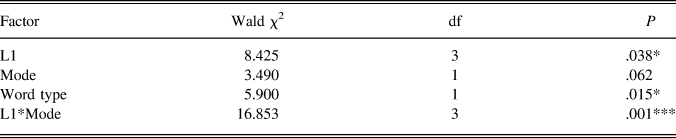
To determine the variables that influenced past morphology suppliance on the written and oral sentence completion tasks, we started by computing a maximal binary logistic regression model. The model included the between subjects effect of L1 (English, Spanish, Mandarin, Japanese) and within-subjects effects of mode (oral, written) and word type (inflected, monomorphemic), as well as the predictors’ two-way and three-way interactions. Past morphology suppliance (yes = 1, no = 0) was the binary dependent variable. The model predicts the presence or absence of the dependent variable based on the values of the predictors. The maximal model was significant and a good fit, but no interactions were significant. Successive reductions of the model through elimination of nonsignificant interactions led us to the final minimal model. As a result, the three-way interaction and all but one two-way interactions were excluded. The results of the final model are presented in Table 2.
Results of the final binary logistic regression model

Note: *p < .050, ***p = .001.
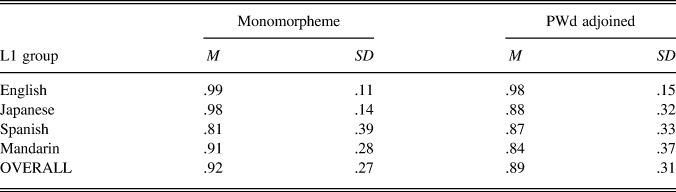
A significant main effect was found for L1, pointing to a difference among groups when not considering mode and word type. However, considering the significant L1*mode interaction, it is of more interest to see how the groups vary across modes, which we discuss in the following sections. A main effect approaching significance was found for mode, indicating that suppliance was more likely overall in the written task (98%) than in the oral task (83%) across groups. A main effect was also found for word type, whereby suppliance was more likely in monomorphemic forms (92%) than in forms that require PWd adjunction (89%). However, there were no significant L1*word type or L1*word type*mode interactions when the maximal model was run. This finding indicates that the likelihood of suppliance did not vary significantly across L1 groups according to a word’s status as monomorphemic or PWd-adjoined, regardless of mode (see Table 3).
Consonant cluster suppliance rates according to L1 and word type (oral/written tasks)

Considering the lack of significant interactions with word type in conjunction with the significant L1*mode interaction, we posit that the differences across groups are due to oral production. To hone in on the L1*Mode interaction, we reduced the statistical model again, removing Word Type as a factor, and excluding the monomorpheme items from our analysis. This left us with L1 and Mode as main effects, and an L1*Mode interaction.
Similar to the larger model reported previously, the analysis of only PWd-adjoined simple past tense forms returned a significant main effect for L1 and L1*Mode, but not for Mode (Table 4).
Results of the reduced binary logistic regression model

Note: *p < .050.
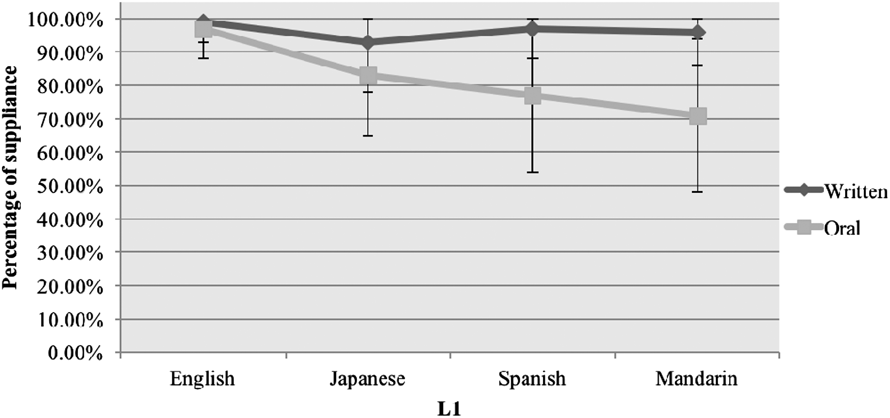
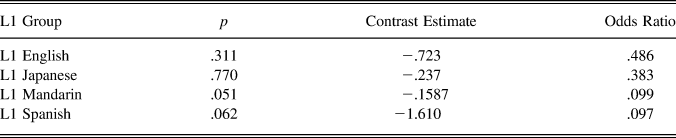
Figure 1 illustrates the rates of past morphology suppliance in written and oral modes by each group. Visually speaking, suppliance in written mode is nearly at ceiling for all the groups and the confidence intervals indicate low rates of variation. By contrast, the L2 groups do not do as well in oral mode, and there is more variation within each group. This observation is statistically supported (Table 5): While the English and Japanese groups’ suppliance does not differ between modes, the difference between modes for the Spanish and Mandarin groups approaches significance.Footnote 10 Moreover, the odds ratios are nearly identical and indicate that the learners in these groups are approximately 10 times (Spanish = 10.10, Mandarin = 10.30) less likely to supply past tense morphology in oral mode than in written mode. In contrast, the Japanese and English groups are fewer than three times less likely to supply past tense morphology in oral mode than in written mode (Japanese = 2.61, English = 2.06). A comparison of the oral data across L1 groups will determine whether the lack of a difference between the Japanese/English and Spanish/Mandarin groups shown here is indicative of a more general pattern in the data.
Percentage of past tense morphology suppliance in oral and written tasks across groups (error bars represent 95% confidence intervals).

Within-groups comparisons, oral vs. written mode

Note: *p < .050.
WRITTEN MODE
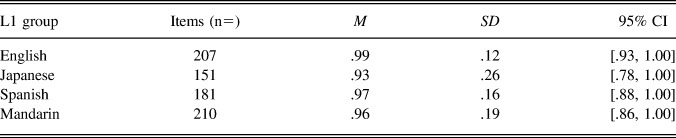
The mean rate of suppliance in written mode for each group (as well as standard deviation and 95% confidence interval) is presented in Table 6.
Past morphology suppliance in written mode

Looking further into the L1*mode interaction, the Mandarin and Spanish groups are not significantly less likely to supply past tense morphology than the English group in the written task, although the Japanese group is less likely to do so than the English group (Table 7). The pairwise contrasts are supported by the odds ratios; the Japanese group is 5.34 times less likely to supply past tense morphology than the English group, while the Spanish group is 1.96 times less likely and the Mandarin group is 2.73 times less likely. However, the Japanese rate of suppliance is 93% (well above chance), and a mere 11 of 151 items were not supplied. Of these 11 items, 10 came from the three of 11 learners that did not score within the L1 English range. Their suppliance rates were 71%, 79%, and 79% (see online Appendix 3 for additional information about these participants).
Between-groups p values, written mode

Note: *p < .050; contrast estimates, odds ratio estimates are in parentheses.
Beyond the group level, we further examined L2er individual performance to quantify how many performed in a nativelike fashion. The control group data show that the native speaker range was 86% to 100%. In the Spanish and Mandarin groups, all participants performed within this range, and in the Japanese group, eight out of 11 did. These data suggest that when morphology is supplied in written modalities and not dependent on phonological production, learners can perform in a nativelike way regardless of the presence or absence of [upast] feature in their L1. Indeed, given that the Mandarin group patterns with the Spanish and English groups despite lacking the [upast] feature in their L1, suggests that an examination of suppliance not mediated by phonology is at the very least warranted. However, as stated earlier, it is plausible that metalinguistic knowledge and/or other compensatory strategies had a role to play in morphology suppliance, as has been posited by RDAs. While the use of such strategies is a possibility, the design of our written and oral tasks was identical, as were the testing conditions. Notwithstanding, it is likely that the written task, which affords more time and space for careful consideration by virtue of its modality, is more subject to such strategies than real-time speech production. As will be shown, however, evidence from both modalities generally points in the same direction for aggregate results and certainly for individuals. We thus feel confident that domain-general strategies are unlikely to explain what was found.
ORAL MODE
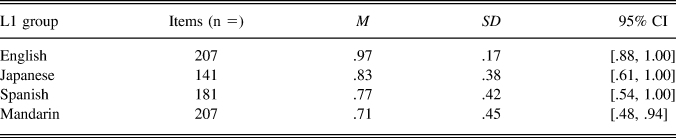
The mean rate of suppliance in oral mode for each group is presented in Table 8.
Simple past morphology suppliance across groups, oral mode

As mentioned, when comparing the L1 groups’ oral suppliance data with the written suppliance data, there is more variation in the oral task. A statistical between-groups comparison of the oral data (Table 9) shows that the English group was more likely to supply past tense morphology than all other groups, and the Japanese group was more likely to supply it than the Mandarin group. That is, the English group outperforms all three L1 groups, and is 6.85 times more likely than the Japanese group, 9.08 times more likely than the Spanish group, and 13.33 times more likely than the Mandarin group to supply past tense morphology. Comparing the learner groups, the Japanese group outperforms the Mandarin group and is 1.94 times more likely to supply past tense morphology in oral mode.
Between-groups p values, oral mode

Note: *p < .050; contrast estimates, odds ratios are in parentheses.
Recall that previous research has pointed to L1 constraints on consonant clusters as an L2 stumbling block (e.g., Lardiere, Reference Lardiere1998a, Reference Lardiere1998b, Reference Lardiere and Archibald2000), and it was predicted that a lack of difference in performance across the three L2 groups would be suggestive of effects of syllable structure constraints. The range of suppliance rates in oral mode and lack of statistical significance (as well as very small effect sizes) between the Spanish and Japanese groups and Spanish and Mandarin groups, all of which have constraints that militate against right-edge consonant clusters, could reflect these constraints.Footnote 11 In fact, (indirect) evidence of this comes from the trend observed in the L2er groups of reducing consonant clusters in monomorphemes and arguably in past forms. What remains to be explained, however, is why the Japanese group (although significantly different than the English group) was more likely to supply the morphology than the Mandarin group but not the Spanish group. Japanese has two things that Mandarin does not: the [upast] feature and PWd adjunction. Thus, it is possible that these differences give the Japanese speakers an advantage over the Mandarin speakers, even though said advantage is not enough to equal the suppliance rate of the L1 English group. Of course, this is an empirical question, the testing of which would require the addition of a group whose L1 has no [upast] feature but has PWd adjunction, and a group whose L1 has no [upast] feature and does not meet a condition of minimal adaptation.
The L1 Japanese suppliance rate in English is 83%, the L1 Mandarin suppliance rate is 71%, and the L1 Spanish suppliance rate is 77%, which are all well above chance but still do not approximate the English group’s suppliance rate. This finding is contrary to what RDAs would predict because the three L1 groups are different from the English group even though Mandarin is the only L1 to lack the relevant syntactic feature. It is thus logical to assume that phonology plays a role here and the relevant phonological constraints are an important source of variability across the groups. The PTH assumes no difference in performance due to the presence or absence of the [upast] feature in the L1. However, based on the PTH, we predicted that the availability of PWd adjunction in Japanese could lead the Japanese group to outperform the other L2 groups. As seen, the probability that the Japanese group would supply the past tense morphology was not higher than that of the Spanish group. However, the PTH posits that the necessary prosodic structure can be constructed in the L2 through minimal adaptation. It is therefore possible that the Spanish group had constructed PWd adjunction. The fact that the Japanese group outperforms the Mandarin group but not the Spanish group might reflect the increased difficulty of the Mandarin group’s learning task in both syntactic and phonological terms.
Remember, however, that the PTH states that while L2 convergence is possible, it is not guaranteed. This led us to examine whether lower mean suppliance rates might reflect individual variation rather than group behavior. The native English group range was 86% to 100% oral past morphology suppliance. In the Spanish group, 7 out of 13 (54%) performed within the native range; in the Mandarin group, 5 out of 15 (33%) were within the native range; in the Japanese group, 8 out of 11 (73%) were within the native range (see online Appendix 3 for more details). The fact that some, but not all, L2ers in each group have acquired English past tense morphology indicates that the necessary morphosyntactic feature and prosodic structure can be acquired in the L2 even when they are not available in the L1.
DISCUSSION
Considering our results, some arguments can be made about the acquisition of morphosyntax and its connection to L1 phonological influence as it relates to morphological production. The data suggest that there are differences between morphology supplied in written and oral modalities, and L1 phonological factors can (negatively) influence (functional) morphology suppliance. We take this to mean that an examination of L1 phonological factors in L2 morphosyntactic oral performance is warranted in general. The Spanish group data and their commonalities with the Mandarin group data underscore that the possibility of L1 transfer of target syntactic features does not nullify L1 phonological effects. By extension, if L1 phonological effects are likely responsible for the behavior of the Spanish and Japanese groups, and given the conformity of the Spanish and Mandarin group performances, it seems reasonable to suggest that one cannot preclude the possibility that target-deviant performances stem from the same source in all groups. That is, these performances could be rooted in L1 transfer at the morphosyntax-phonology interface. At this point, we can offer some generalizations about the data in connection to the predictions of RDAs and a particular version of FAAs, namely the PTH.
Our position that phonology is a factor in L2 morphology suppliance is based on the finding that the difference in written and oral performance for the L1 Spanish and L1 Mandarin groups approaches significance. While the L1 Japanese group does not significantly differ between modes, this result could be attributed to the three outliers in written mode (see Written Mode section). The asymmetry between modes, the difference between the English control and the three L2 groups, and the fact that the learners do not supply past tense morphology in oral mode upward of 30% of the time, suggest that phonological factors (whether constraints on consonant clusters and/or prosodic structure) strongly influence morphology suppliance and that these factors may be more complex than they appear.
Considering the preceding text, we also posit that at advanced stages of development, L2ers’ morphology suppliance for past tense is not necessarily delimited by the L1 syntactic feature configuration ([upast]), but rather deviance in the Mandarin group might equally be explained by phonological factors (as must be the case of the Spanish and Japanese participants). In the case of Mandarin speakers, we wanted to test whether a lack of (or at least a lower rate of) suppliance could be unequivocally attributed to syntactic reasons (i.e., retrieval of [upast]). However, we have presented evidence that even the Spanish and Japanese speakers show less-than-target performance in the oral mode and there is no difference between the Mandarin and Spanish groups, which cannot be attributed to lack of the [upast] feature from these L1s. It is true that RDAs might not face any challenge from the written data alone, given that a written modality affords a greater likelihood that metalinguistic knowledge is employed. That said, we have presented a set of findings that question RDA explanations more directly: The Mandarin speakers demonstrate that phonological issues play a role in past tense morphology suppliance, but a subset of the learners supply –ed in oral production within a nativelike range. Moreover, it is difficult for RDAs to account for the lack of difference between the Mandarin and Spanish groups and Spanish and Japanese groups, given what the different L1s provides at the level of syntactic features. RDAs state that problems in functional morphology suppliance stem from a syntactic deficit that is maturationally conditioned and no specific claims are made about the role of phonological factors. It is therefore unclear how the hypothesis can account for the overall tendency that functional morphology suppliance is lower in oral production.
It is crucial to point out, however, that showing a general L1 phonological contribution across all learner groups does not entail a lack of a co-occurring syntactic deficit. In other words, the data offer no smoking gun against RDA proposals. Our conclusion, then, is relatively modest. The data we have provided merely underscore that data of this type inherently confound morphosyntactic with morphophonological factors and therefore should not be used to support RDA claims any more than it would be fair to use them as unassailable counterevidence to them. This is a valuable contribution to L2 theoretical epistemology precisely because many studies in the past have used such data (and data of a similar type) to make arguments in both directions. Our claim is reminiscent of a significant contribution by Schwartz (Reference Schwartz1992). Prior to this, comparative differences in developmental sequencing between child L1 and adult L2 learners had been used to argue that child and adult L2 acquisition were fundamentally different, that is, adult L2 acquisition was no longer guided by UG (e.g., Clahsen & Muysken, Reference Clahsen and Muysken1986, Reference Clahsen and Muysken1989). Schwartz (Reference Schwartz1992) brought data from child L2ers to bear on the use of such evidence. She highlighted how the developmental sequences of child and adult L2ers were identical, both differing from child L1. The missing variable not being considered previously was the role of L1 influence that would be predicted in both child and adult L2ers. Schwartz argued that developmental sequencing is not a valid argument against adult accessibility to UG, based on the finding that child and adult L2 developmental sequences do not differ, yet both differ similarly from those of L1 children. Keep in mind that Schwartz’s argument does not prove by any means that adults do have access to UG, it simply nullifies any evidence used to adjudicate between different sides of the debate. The same is true for what we can argue here. Having shown that Spanish learners have problems with L2 English past tense suppliance even though they have the relevant syntactic feature in their L1 does not entail that Mandarin learners have acquired [upast]. It is possible that a similar surface pattern of performance in both groups does not reflect the same underlying issues (purely L1 phonological issues vs. a combination of L1 phonological and syntactic issues). Conversely, it is also possible that the same underlying issues are at play in both groups. The problem is that one cannot tease these variables apart and there is no way to be certain either way.
Having acknowledged the difficulty with using these data to make a definitive claim against the tenability of RDAs in general, we still propose that phonological factors seem to be the best candidate for explaining why the L1 Spanish and L1 Japanese groups did not perform as well as the English control despite having the relevant feature in their L1s. The PTH better accounts for such differences in performance; while facilitative L1 transfer is predicted to yield higher rates of suppliance, learners without the necessary L1 prosodic structure can still construct novel structures if they can combine L1 licensing relations. Thus, we conclude that the PTH is on the right track in placing importance on phonological factors in oral production of functional morphology. If phonological considerations are needed or are best poised to explain the Spanish and Japanese speakers’ data, there is no reason to preclude the same as being explanatory for the Mandarin speakers as well. The difference between the L2 groups is expected when one considers the entirety of the unique learning tasks of each L1 group acquiring L2 English. We believe that L1 phonological factors can strongly influence functional morphology production, in that performance is lowered when morphology suppliance is mediated by phonological production for all L2 groups. With that said, it is important to note that we cannot make any strong claims here with respect to the PTH. This is because the L1s we have tested all have the necessary prosodic structures that can be combined to create PWd adjunction. To explicitly test the predictions of the PTH, it will minimally be necessary to investigate an L1 that does not meet either condition of minimal adaptation.
Given the evidence that points to oral suppliance affected by phonological factors, we raise the question of whether L2 prosodic structure can be acquired, or if a learner’s phonological grammar will fossilize rather than construct the target PWd adjunction. The majority of the L1 Japanese participants appear to have acquired the target structure, which is not surprising because they had the prosodic structure available for transfer in their L1. Even the strong version of the PTH (Goad et al., Reference Goad, White and Steele2003) predicts convergence on the L2 target in this case. However, the Spanish and Mandarin groups had to build novel L2 prosodic structure through the combination of preexisting (L1) prosodic structures. The fact that learners in both groups were successful suggests that reassembly of L1 prosodic structures is possible, and the finding that the percentages of learners in the Spanish and Mandarin groups with targetlike oral suppliance were lower than that of the Japanese group suggests that convergence is more likely if reassembly is not part of the L2 learning task. However, we have yet to see evidence of nativelike oral suppliance of past tense morphology at the group level, and this study is no different. Why is it that several individuals in each group (3 of the 11 L1 Japanese participants, 10 of the 15 Mandarin participants, and 6 of the 13 Spanish participants) do not demonstrate acquisition of target prosodic structure if all groups (a) meet one of the conditions of minimal adaptation, and (b) demonstrate that they have the past feature in L2 English? We have already considered the role of constraints on consonant clusters, which could prove to be more difficult to overcome for some learners than others. In addition, input factors (see e.g., Adams, 2004, and Bonner & Martohardjono, Reference Bonner, Martohardjono, Biller, Chung and Kimball2012 for discussion of salience, i.e., prominence in the input) and performance factors (Hopp, Reference Hopp2009) have been hypothesized in the literature to affect L2 inflection production and could provide a complementary and/or alternative explanation to the prosodic account developed in the preceding text.
SUPPLEMENTARY MATERIAL
To view supplementary material for this article, please visit https://doi.org/10.1017/S0272263117000122