Introduction
Over the last few decades, there is increasing recognition that the United States healthcare system is not able to adequately meet the needs of patients near the end of their lives (Institute of Medicine, 2015; Robert Wood Johnson Foundation, 2002). Studies show that most people prefer to die at home, with limited pain and suffering, and surrounded by their loved ones. However, approximately 60% still die in the hospital (Weitzen, Teno, Fennell, & Mor, Reference Weitzen, Teno, Fennell and Mor2003). The SUPPORT (Study to Understand Prognoses and Preferences for Outcomes and Risks of Treatments) Trial highlighted the shortcomings of effective physician-patient communication at the end-of-life leading to uncontrolled symptoms of pain and depression, overutilization of aggressive medical care, and unnecessarily increased costs of healthcare spending (The SUPPORT Principal Investigators, 1995; Lynn et al., Reference Lynn, Teno, Phillips, Wu, Desbiens and Harrold1997). Palliative care and hospice services offer solutions to delivering compassionate and cost-effective care to terminally ill patients. Yet, despite the increasing availability, these supportive services remain underutilized, especially among ethnic and cultural minorities (Crawley, Reference Crawley2005). According to the National Hospice and Palliative Care survey in 2015, only 25% of hospice patients were non-Caucasian and only 7.1% of the Caucasian patients identified as Hispanic or Latino (Organization, 2015). Gaining a better understanding of the barriers these minority populations experience during serious illness or at the end-of-life will aid in a reduction of these differences.
Culture influences the way people understand illness, suffering, and dying. Thus, culture influences the use of healthcare at the end-of-life. Issues influenced by culture that create barriers to palliative care include language and communication barriers, religion and spirituality, responses to inequities in care, and family involvement with decision making (Kagawa-Singer & Blackhall, Reference Kagawa-Singer and Blackhall2001; Laguna, Enguídanos, Siciliano, & Coulourides-Kogan, Reference Laguna, Enguídanos, Siciliano and Coulourides-Kogan2012; Siriwardena & Clark, Reference Siriwardena and Clark2004). Several factors contributing to limitations in language differences include limited use of medical interpreters and paucity of patient-centered and culturally aligned literature regarding hospice or palliative care in other languages. Additionally, cultural differences may limit how information is received even if given in the same language (Searight & Gafford, Reference Searight and Gafford2005). Religious and spiritual beliefs, particularly in those revolving around what happens after death, play a larger role in influencing patients of ethnic minorities to prefer more aggressive care at the end-of-life (Balboni et al., Reference Balboni, Balboni, Enzinger, Gallivan, Paulk and Wright2013; Balboni et al., Reference Balbon, Vanderwerker, Block, Paulk, Lathan, Peteet and Prigerson2007). Lack of health insurance and difficulty with access to healthcare among ethnic minorities is an obvious barrier to palliative care. Federally qualified health centers provide primary and preventative care to many under or uninsured ethnic minorities and yet, few offer palliative care services, creating a gap in care for these patients (O'Malley, Forrest, Politzer, Wulu, & Shi, Reference O'Malley, Forrest, Politzer, Wulu and Shi2005). Discrepancies in the healthcare system can also lead to a general mistrust of providers, which can further hinder efforts to explore less aggressive interventions for minority patients at the end-of-life. Notorious studies such as the Tuskegee Experiment, in which African-American men were unethically denied treatment for syphilis, and fear of undocumented citizenship status have also contributed to suspicion that healthcare providers may not be acting in the best interest of the patient (Born, Greiner, Sylvia, Butler, & Ahluwalia, Reference Born, Greiner, Sylvia, Butler and Ahluwalia2004; Shavers, Lynch, & Burmeister, Reference Shavers, Lynch and Burmeister2000). Lastly, limited health literacy has been cited as a barrier to palliative care in that it can negatively influence information exchange and communication (Schillinger, Bindman, Wang, Stewart, & Piette, Reference Schillinger, Bindman, Wang, Stewart and Piette2004).
Limited research exists that identifies the barriers faced by minority population to receive adequate end-of-life care through palliative and hospice services and even fewer studies investigating methods to overcome the identified barriers. The goal of this paper is to systematically review and appraise the current knowledge based on interventions that target any of the barriers to palliative care in ethnic/racial minorities. This review is designed to evaluate evidence-based ways that barriers can be reduced so that palliative care services are available to ethnic/racial minorities. To the best of our knowledge, this provides the first systematic review of the field to evaluate barriers to palliative care in ethnic minorities.
Methods
Data Sources
A systematic review was conducted to review the barriers to end-of-life services for racial/ethnic minorities and the efforts to overcome those barriers. We conducted a literature search of four databases: PubMed, MEDLINE, CINAHL, and PsycInfo. Key terms used included minority, ethnic, racial, African-American, Asian, Hispanic, Latino, palliative care, hospice, end-of-life, and advanced directive. For PubMed, the controlled vocabulary Medical Subject Headings and “Similar articles” features was used to expand the search. Searches were then limited to peer-reviewed journal articles using the built-in filters for each respective search engine. Articles were limited to English language, published before 2016.
Inclusion and Exclusion Criteria
The following inclusion criteria were applied to each article: 1) the study population included racial/ethnic or underserved minorities in the healthcare field, 2) the article focused on healthcare disparities specifically surrounding end-of-life outcomes, including advanced directives, goals of care, or DNR discussions or hospice enrollment, 3) the design of the study investigated an intervention targeted at overcoming a barrier faced by ethnic/racial minorities. Observational studies were not included. Articles discussing palliative care focused on reducing pain or symptoms were excluded without further review. Articles conducted outside of the United States were included if the study specifically addressed a barrier faced by a racial group identified as a minority within that country. Articles that were not available in the English language were excluded. Studies focused on caregiver or pediatric populations were included if they were identified as being from a racial or ethnic minority group.
Study Selection
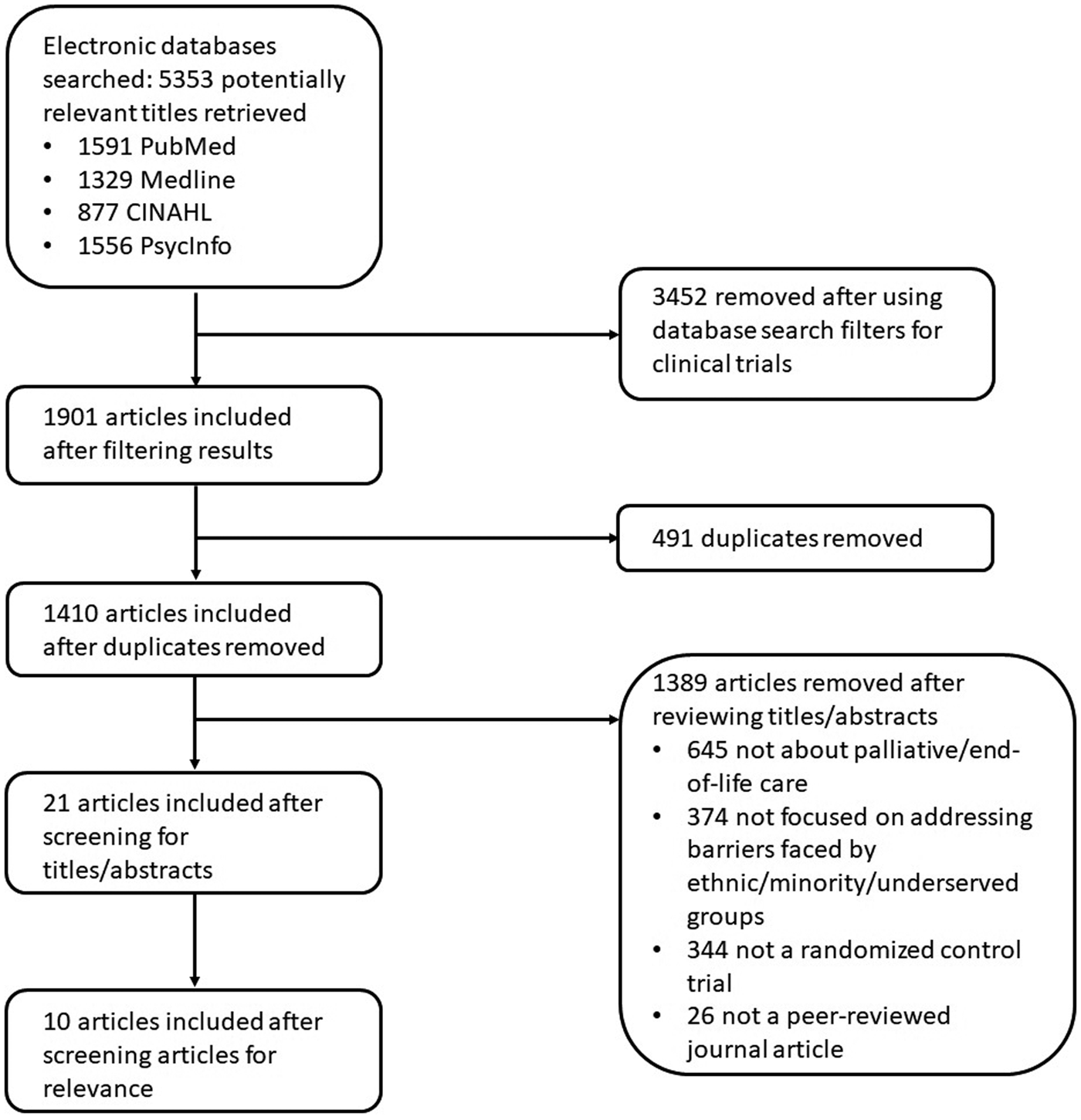
The primary author reviewed the titles and abstracts of all retrieved articles to assess relevance and potential inclusion prior to reviewing the entire article. Articles were included for review if it was unclear from the title or abstract that a specific intervention was investigated using an interventional design or if it was unclear whether the study evaluated a relevant end-of-life outcome. Articles that were reviews, editorials, commentaries, or case studies were excluded. This resulted in 20 articles for full review by two authors. During full review, articles were eliminated if it did not investigate the effect of a targeted intervention, did not address a barrier specifically faced by ethnic/racial minorities, or did not evaluate a specific end-of-life outcome. A total of nine articles were included in the final review (Figure 1). The wide range of interventions and outcomes examined made pooling of results for a quantitative meta-analysis unfeasible.
Results of search strategy.

Data Abstraction
The primary author abstracted data from the remaining articles. Each article had these items extracted: study location, sample size, population studied, identified barrier, intervention studied, results, and major findings.
Quality Appraisal
All studies were systematically appraised using the modified Downs and Black checklist, which is a scoring system that evaluates the quality of a study based on external validity, bias, confounding variables, and power (Downs & Black, Reference Downs and Black1998). Maximum score was 28 and scale from a previously published categorization involving end-of-life studies was used to appraise each study: ≥ 20 very good; 15–19 good; 11–14 fair; ≤ 10 poor (Silva et al., Reference Silva, Genoff, Zaballa, Jewell, Stabler, Gany and Diamond2016).
Results
Article Selection
Of the 5353 articles identified by the searching strategy and removal of duplicates, 1410 articles were selected to review titles/abstracts. A majority of articles were excluded for one of the following three reasons: it did not focus on outcomes specific to palliative or hospice care; it did not emphasize the unique barriers pertaining to ethnic or racial minorities; or it did not identify a possible intervention to overcome those barriers. A few were excluded because they were not from a peer-reviewed journal. A total of 20 articles were selected for full review by two authors. Six of these studies were excluded because the design of the study was observational and did not include an intervention. Two were excluded for not specifically targeting a minority group in healthcare. Three studies did target underrepresented patient populations such as homeless patients and those with poor health literacy. While ethnic minorities are overrepresented in both patient populations, these studies were not included in the final review as it did not specifically address cultural differences that may hinder end-of-life care efforts. As a result, nine articles were found to meet all inclusion criteria (Figure 1).
Type of Studies
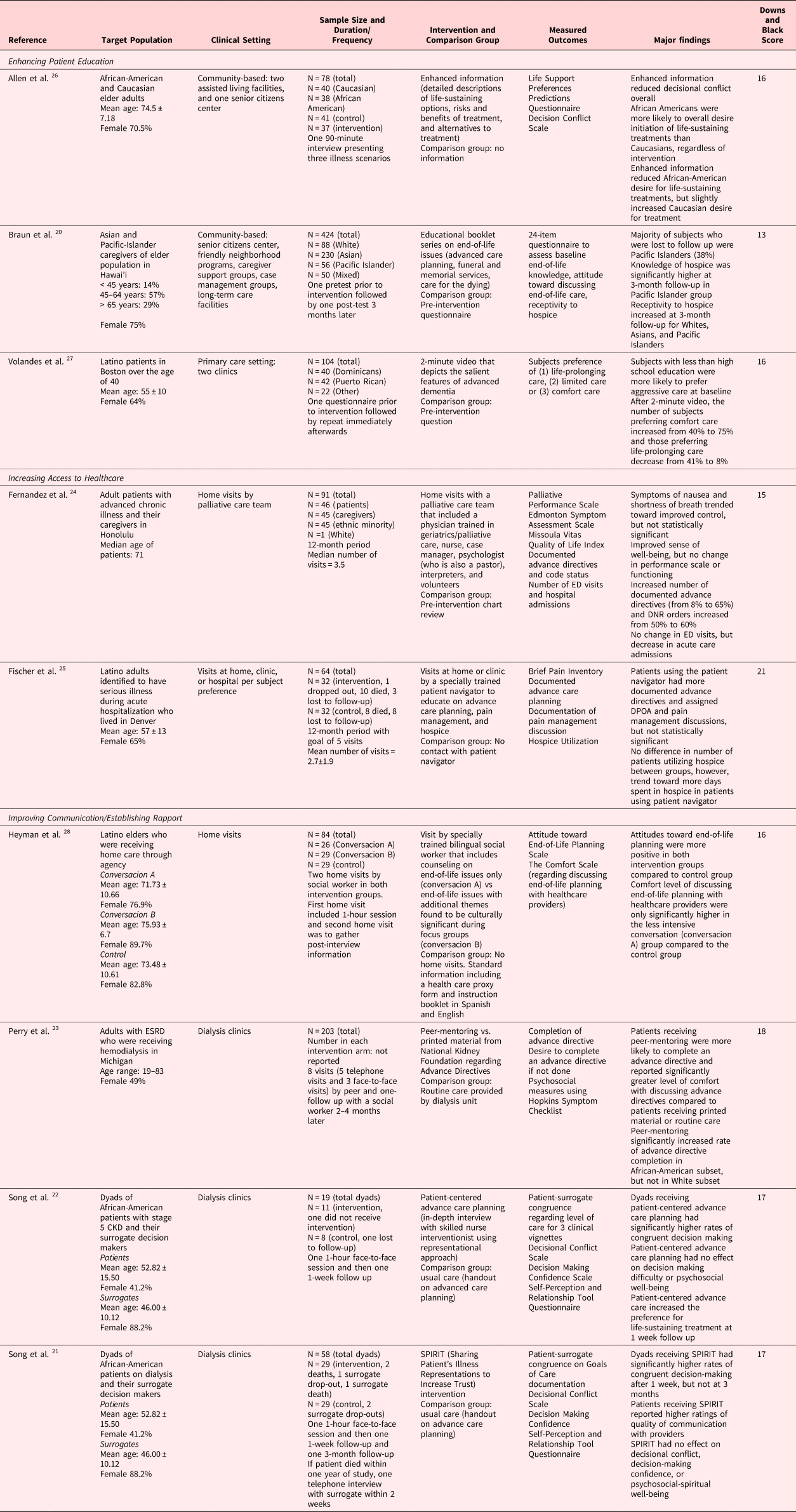
All studies included in final review were published between 2005 to 2015. Settings of conducted interventions included outpatient ambulatory clinics, assisted living facilities, home visits, and telephone follow-ups (Table 1). Three studies included caregivers and surrogate decision makers to receive the intervention (Braun, Karel, & Zir, Reference Braun, Karel and Zir2006; Song et al., Reference Song, Donovan, Piraino, Choi, Bernardini, Verosky and Ward2010; Song et al., Reference Song, Ward, Happ, Piraino, Donovan, Shields and Connolly2009).
Characteristics of Included Studies

All studies involved face-to-face interviews at least once and some form of survey or questionnaire that measured primary outcomes. Two studies included chart reviews to measure the number of completed and documented advanced directives (Fernandes et al., Reference Fernandes, Braun, Ozawa, Compton, Guzman and Somogyi-Zalud2010; Fischer, Cervantes, Fink, & Kutner, Reference Fischer, Cervantes, Fink and Kutner2015; Perry et al., Reference Perry, Swartz, Brown, Smith, Kelly and Swartz2005) with one of those studies also measuring the frequency of return emergency department visits and acute hospitalizations (Fernandes et al., Reference Fernandes, Braun, Ozawa, Compton, Guzman and Somogyi-Zalud2010). Duration of intervention varied between one 1-hr encounte to eight follow-up visits over the course of one year. None of the studies measured outcomes beyond one year.
The target minority groups studied included African Americans (n = 4) (Allen, Allen, Hilgeman, & DeCoster, Reference Allen, Allen, Hilgeman and DeCoster2008; Perry et al., Reference Perry, Swartz, Brown, Smith, Kelly and Swartz2005; Song et al., Reference Song, Donovan, Piraino, Choi, Bernardini, Verosky and Ward2010; Song et al., Reference Song, Ward, Happ, Piraino, Donovan, Shields and Connolly2009), Hispanics or Latinos (n = 3) (Fischer et al., Reference Fischer, Cervantes, Fink and Kutner2015; Heyman & Gutheil, Reference Heyman and Gutheil2010; Volandes, Ariza, Abbo, & Paasche-Orlow, Reference Volandes, Ariza, Abbo and Paasche-Orlow2008), and Asian or Pacific Islander (n = 2) (Braun et al., Reference Braun, Karel and Zir2006; Fernandes et al., Reference Fernandes, Braun, Ozawa, Compton, Guzman and Somogyi-Zalud2010). Notably, most participants in studies were female (Table 1). Six studies included a randomization of patients into intervention versus control arms (Allen et al., Reference Allen, Allen, Hilgeman and DeCoster2008; Fischer et al., Reference Fischer, Cervantes, Fink and Kutner2015; Heyman & Gutheil, Reference Heyman and Gutheil2010; Perry et al., Reference Perry, Swartz, Brown, Smith, Kelly and Swartz2005; Song et al., Reference Song, Donovan, Piraino, Choi, Bernardini, Verosky and Ward2010; Song et al., Reference Song, Ward, Happ, Piraino, Donovan, Shields and Connolly2009). In the other three studies, all participants received the same intervention but outcomes were compared to baseline characteristics of the same group prior to the intervention (Braun et al., Reference Braun, Karel and Zir2006; Fernandes et al., Reference Fernandes, Braun, Ozawa, Compton, Guzman and Somogyi-Zalud2010; Volandes et al., Reference Volandes, Ariza, Abbo and Paasche-Orlow2008). Only one study used a non-minority group as a comparison (Allen et al., Reference Allen, Allen, Hilgeman and DeCoster2008).
Measured outcomes include attitudes and comfort level regarding discussion of end-of-life decisions with healthcare providers (Braun et al., Reference Braun, Karel and Zir2006; Heyman & Gutheil, Reference Heyman and Gutheil2010; Perry et al., Reference Perry, Swartz, Brown, Smith, Kelly and Swartz2005; Song et al., Reference Song, Donovan, Piraino, Choi, Bernardini, Verosky and Ward2010; Song et al., Reference Song, Ward, Happ, Piraino, Donovan, Shields and Connolly2009), preferences for initiating aggressive medical care versus comfort-focused care (Allen et al., Reference Allen, Allen, Hilgeman and DeCoster2008; Volandes et al., Reference Volandes, Ariza, Abbo and Paasche-Orlow2008), completion of advance directives (Fernandes et al., Reference Fernandes, Braun, Ozawa, Compton, Guzman and Somogyi-Zalud2010; Fischer et al., Reference Fischer, Cervantes, Fink and Kutner2015; Perry et al., Reference Perry, Swartz, Brown, Smith, Kelly and Swartz2005), and enrollment into hospice (Fischer et al., Reference Fischer, Cervantes, Fink and Kutner2015).
Identification of Key Themes
All studies included in final review identified a significant barrier faced by ethnic minorities with either accessing or accepting palliative care or hospice services. Three studies used interventions that were aimed at enhancing patient education through written or audiovisual educational material (Allen et al., Reference Allen, Allen, Hilgeman and DeCoster2008; Braun et al., Reference Braun, Karel and Zir2006; Volandes et al., Reference Volandes, Ariza, Abbo and Paasche-Orlow2008). In these studies, participants reported greater receptivity to accepting less aggressive care at the end-of-life after intervention for African-American and Latino patients. However, in the Allen et al. study, enhanced information decreased desire for aggressive care in African-American patients, but desire scores were still significantly higher than those in the white cohort (Allen et al., Reference Allen, Allen, Hilgeman and DeCoster2008). Decision-making conflict was also reduced with enhanced information (Allen et al., Reference Allen, Allen, Hilgeman and DeCoster2008), and knowledge about hospice and increased receptivity to discussing hospice enrollment in Asian and Pacific-Islander cohorts also improved (Braun et al., Reference Braun, Karel and Zir2006).
Two studies focused on efforts to increase the accessibility of healthcare resources mainly through scheduling home visits (Fernandes et al., Reference Fernandes, Braun, Ozawa, Compton, Guzman and Somogyi-Zalud2010; Fischer et al., Reference Fischer, Cervantes, Fink and Kutner2015). Enrollment into a palliative care program that included scheduled home visits did show improvement of symptoms and sense of well-being as measured by self-reported surveys over time for minority groups in Hawai'i. However, these findings were not statistically significant (Fernandes et al., Reference Fernandes, Braun, Ozawa, Compton, Guzman and Somogyi-Zalud2010). Enrollment in both interventional programs did result in increasing the number of documented advance directives and DNR code statuses compared to control groups (Fernandes et al., Reference Fernandes, Braun, Ozawa, Compton, Guzman and Somogyi-Zalud2010; Fischer et al., Reference Fischer, Cervantes, Fink and Kutner2015). Furthermore, Fernandes et al. found that enrollment in their palliative care program decreased the number of acute care hospitalizations but not the number of emergency department visits for Asians and Pacific Islanders living in Hawai'i (Fernandes et al., Reference Fernandes, Braun, Ozawa, Compton, Guzman and Somogyi-Zalud2010). Use of a patient navigator had no effect on the number of Latino participants enrolling into hospice (Fischer et al., Reference Fischer, Cervantes, Fink and Kutner2015).
Four studies investigated the effectiveness of improving communication by using culture-sensitive language as a way of establishing rapport with targeted patient groups (Heyman & Gutheil, Reference Heyman and Gutheil2010; Perry et al., Reference Perry, Swartz, Brown, Smith, Kelly and Swartz2005; Song et al., Reference Song, Donovan, Piraino, Choi, Bernardini, Verosky and Ward2010; Song et al., Reference Song, Ward, Happ, Piraino, Donovan, Shields and Connolly2009). Heyman et al. showed improvement in attitudes and comfort level regarding end-of-life discussions among Latino patients when using bilingual healthcare personnel (Heyman & Gutheil, Reference Heyman and Gutheil2010). Interestingly, participants did not feel more comfortable when culture-specific topics were included in the discussion (Heyman & Gutheil, Reference Heyman and Gutheil2010). Peer mentoring was effective in increasing the completion of advance directives in African Americans with end-stage renal disease (Heyman & Gutheil, Reference Heyman and Gutheil2010). One group designed a counseling intervention with a goal of addressing the unique needs and concerns of African-American patients and showed that it improved congruence of end-of-life decisions between the patient and his or her designated surrogate decision maker (Song et al., Reference Song, Donovan, Piraino, Choi, Bernardini, Verosky and Ward2010; Song et al., Reference Song, Ward, Happ, Piraino, Donovan, Shields and Connolly2009). However, this counseling intervention had no effect on decision-making conflict or self-reported psychosocial well-being in either the patient or their surrogate decision maker (Song et al., Reference Song, Donovan, Piraino, Choi, Bernardini, Verosky and Ward2010; Song et al., Reference Song, Ward, Happ, Piraino, Donovan, Shields and Connolly2009). Additionally, the counseling intervention appeared to increase African-American patients’ desire for more aggressive resuscitation efforts at the end-of-life (Song et al., Reference Song, Donovan, Piraino, Choi, Bernardini, Verosky and Ward2010).
Of the nine included studies, only four addressed the feasibility of their targeted intervention (Braun et al., Reference Braun, Karel and Zir2006; Fischer et al., Reference Fischer, Cervantes, Fink and Kutner2015; Song et al., Reference Song, Donovan, Piraino, Choi, Bernardini, Verosky and Ward2010; Song et al., Reference Song, Ward, Happ, Piraino, Donovan, Shields and Connolly2009). In general, studies that required multiple visits or long durations of follow-up had worse feasibility outcomes, with many participants lost to follow-up or only completing part of the intervention.
Quality of Studies
The median Black and Downs score was 16, with a range from 13 to 21. None of the included studies had the power to detect statistical significance between groups, which eliminated most studies for the “very good” quality score. Only one study was found to be “high quality” even though it did not have power to detect differences (Fischer et al., Reference Fischer, Cervantes, Fink and Kutner2015). Among the six studies that were randomized controlled trials, none of them were blinded, which affected the scores for internal validity. None of the studies discussed potential confounding variables or adverse effects. The study designs that required follow-up either did not describe the characteristics of the participants lost to follow-up or did not account for these participants in the statistical analysis (Braun et al., Reference Braun, Karel and Zir2006; Fernandes et al., Reference Fernandes, Braun, Ozawa, Compton, Guzman and Somogyi-Zalud2010; Fischer et al., Reference Fischer, Cervantes, Fink and Kutner2015; Heyman & Gutheil, Reference Heyman and Gutheil2010; Perry et al., Reference Perry, Swartz, Brown, Smith, Kelly and Swartz2005; Song et al., Reference Song, Donovan, Piraino, Choi, Bernardini, Verosky and Ward2010; Song et al., Reference Song, Ward, Happ, Piraino, Donovan, Shields and Connolly2009). Of note, the two studies that did not require any follow-up tended to have higher appraisal scores because they did not lose any patients to follow-up (Allen et al., Reference Allen, Allen, Hilgeman and DeCoster2008; Volandes et al., Reference Volandes, Ariza, Abbo and Paasche-Orlow2008).
Discussion
Although none of the studies included in this systematic review had power to detect statistical differences between groups, the trends in the data suggest that specifically-targeted interventions may improve receptivity and utilization of palliative care and hospice services among racial/ethnic minorities. This review identified three main types of barriers faced by minorities in the healthcare system: lower health literacy, poorer access to healthcare resources, and lack of effective communication caused by differences in language or culture. Palliative care and hospice are underused in general in the United States, with a majority of Americans opting for more aggressive care at the end of their life (Robert Wood Johnson Foundation, 2002; Weitzen et al., Reference Weitzen, Teno, Fennell and Mor2003). Studies have shown that even fewer non-white ethnic minorities are accessing these end-of-life care services partially due to lack of knowledge of these resources (Barrett, Reference Barrett2005; Carr, Reference Carr2011; Colón & Lyke, Reference Colón and Lyke2003; Eunjeong & Jaehoon, Reference Eunjeong and Jaehoon2014; Fosler, Staffileno, Fogg, & O'Mahony, Reference Fosler, Staffileno, Fogg and O'Mahony2015; Frank et al., Reference Frank, Blackhall, Michel, Murphy, Azen and Park1998; Jang, Chiriboga, Allen, Kwak, & Haley, Reference Jang, Chiriboga, Allen, Kwak and Haley2010; Kapo, MacMoran, & Casarett, Reference Kapo, MacMoran and Casarett2005; Kemp, Reference Kemp2001; Kreling et al., Reference Kreling, Selsky, Perret-Gentil, Huerta and Mandelblatt2010; Elizabeth Trice Loggers et al., Reference Loggers, Maciejewski, Paulk, DeSanto-Madeya, Nilsson and Viswanath2009; Phipps et al., Reference Phipps, True, Harris, Chong, Tester, Chavin and Braitman2003; True et al., Reference True, Phipps, Braitman, Harralson, Harris and Tester2005). Additionally, research has shown that Latinos and African Americans prefer more aggressive, life-prolonging resuscitation efforts (Kemp, Reference Kemp2001; Loggers et al., Reference Loggers, Maciejewski, Jimenez, Nilsson, Paulk, Stieglitz and Prigerson2013; Loggers et al., Reference Loggers, Maciejewski, Paulk, DeSanto-Madeya, Nilsson and Viswanath2009; Welch, Teno, & Mor, Reference Welch, Teno and Mor2005). Therefore, the standard counseling tools, such as written handouts, may not be sufficient in educating patients from ethnic or racial minorities about palliative care services. Decision making at the end-of-life is complex and emotional, which becomes an even bigger challenge when education levels and health literacy is low. Furthermore, mistrust in the healthcare system due to historical factors as previously described further exacerbates the situation. Three studies reviewed here suggest that unique efforts aimed at augmenting patient's education about end-of-life care may lead to greater receptivity of these services (Allen et al., Reference Allen, Allen, Hilgeman and DeCoster2008; Braun et al., Reference Braun, Karel and Zir2006; Volandes et al., Reference Volandes, Ariza, Abbo and Paasche-Orlow2008). The interventions designed in these three studies included visual stimuli, such as video information or pictures, when educating patients about their options. Unfortunately, neither study that utilized a non-traditional educational tool had a control group or investigated the outcomes on non-minority cohorts (Braun et al., Reference Braun, Karel and Zir2006; Volandes et al., Reference Volandes, Ariza, Abbo and Paasche-Orlow2008). The third study provided more detailed descriptions and spent more time counseling African Americans on their options, and found a small improvement in acceptance of comfort care over aggressive measures, suggesting that simply increasing the amount of one-on-one interaction with a healthcare provider may be beneficial (Allen et al., Reference Allen, Allen, Hilgeman and DeCoster2008). One of these studies found that lower education was an independent predictor of desiring more aggressive end-of-life measures (Volandes et al., Reference Volandes, Ariza, Abbo and Paasche-Orlow2008), suggesting that future work should aim to delineate the effect of education status on end-of-life preferences among ethnic minorities.
Another significant barrier is limited access to the healthcare system overall, with even larger discrepancies in end-of-life care. Racial and ethnic minorities are often of lower socioeconomic status in the United States, which in turn affect their ability to pay, find transportation for their appointments, and navigate the healthcare system (Baicker, Chandra, Skinner, & Wennberg, Reference Baicker, Chandra, Skinner and Wennberg2004; Borum, Lynn, & Zhong, Reference Borum, Lynn and Zhong2000; Thomas et al., Reference Thomas, Rodriguez, Boyko, Robinson-Cohen, Fitzpatrick and O'Hare2013). Two studies in this systematic review studied the outcomes of improving access to healthcare by delivering in-home services for ethnic minorities meeting eligibility requirements for hospice care (Fernandes et al., Reference Fernandes, Braun, Ozawa, Compton, Guzman and Somogyi-Zalud2010; Fischer et al., Reference Fischer, Cervantes, Fink and Kutner2015). In both studies, multiple home visits by healthcare provider resulted in greater numbers of documented advance directives, healthcare powers of attorney, and do-not-resuscitate orders, although none reached statistically significant values (Fernandes et al., Reference Fernandes, Braun, Ozawa, Compton, Guzman and Somogyi-Zalud2010; Fischer et al., Reference Fischer, Cervantes, Fink and Kutner2015). However, neither study followed patients through to end-of-life to assess whether patient's actions remained congruent with their documented wishes. Therefore, while home visits may have some effect on number of completed end-of-life paperwork, it is unclear whether they have any effect on actual practices at the end-of-life. Fischer et al. found a trend toward greater number of days spent in hospice when using a patient navigator to guide Latino patients through end-of-life care (Fischer et al., Reference Fischer, Cervantes, Fink and Kutner2015). While findings were not statistically significant, this group is planning on performing a larger randomized controlled trial using the same intervention, which may provide more insight. It is important to note that there were still many participants who dropped out of the study or did not receive proposed intervention in both studies, which suggests that home visits do not completely overcome the challenge of limited healthcare access. Further work should elucidate reasons for participant drop-outs of clinical trials to identify new interventions that address those barriers.
Culture plays a key role in the understanding and response to end-of-life care services. As such, it is often difficult for healthcare providers to establish rapport within the designated timeframe with patients from different ethnic or racial backgrounds (Borum et al., Reference Borum, Lynn and Zhong2000). A “one-size-fits-all” approach to patients may not be effective in communicating the complexities of healthcare management, especially end-of-life care. Peer mentors or tailored dialogue may have some benefit in recruiting patients from ethnic minorities into utilizing end-of-life services. Two studies demonstrated improved attitudes and comfort levels toward end-of-life discussions of Latinos when counseled by a specially-trained staff member using the patients’ preferred language (Heyman & Gutheil, Reference Heyman and Gutheil2010; Perry et al., Reference Perry, Swartz, Brown, Smith, Kelly and Swartz2005). Song et al. conducted two studies that focused on use of oral language to improve decision-making conflict and receptivity to less aggressive care (Song et al., Reference Song, Donovan, Piraino, Choi, Bernardini, Verosky and Ward2010; Song et al., Reference Song, Ward, Happ, Piraino, Donovan, Shields and Connolly2009). Unfortunately, results were inconclusive as they were not powered to detect statistically significant differences within African-American populations, with one study resulting in an increased preference for more aggressive care after counseling (Song et al., Reference Song, Donovan, Piraino, Choi, Bernardini, Verosky and Ward2010). Both studies did, however, show improved congruence in decision making among African-American patients and their surrogate decision maker regarding end-of-life preferences. One major aspect of interest in both studies conducted by Song et al. is the inclusion of surrogate decision makers in the intervention. Decisions regarding end-of-life care is rarely made by the patient in isolation. Oftentimes, family members and loved ones are asked to participate in the discussion with healthcare providers. The involvement of family plays an even larger role among certain ethnic minority groups (Long et al., Reference Long, Engelberg, Downey, Kross, Reinke and Cecere Feemster2014), which further emphasizes the need for research in this area. Other challenges that were not addressed in this systematic review was the effect of religion. One observational study showed that patients receiving more spiritual support from a religious community was less likely to utilize hospice and more likely to desire aggressive intervention than those who received spiritual support provided by a medical team in the hospital (Balboni et al., Reference Balbon, Vanderwerker, Block, Paulk, Lathan, Peteet and Prigerson2007). This is a particularly important barrier among certain ethnic groups whose values and decision making stem strongly from their religion (Koffman, Morgan, Edmonds, Speck, & Higginson, Reference Koffman, Morgan, Edmonds, Speck and Higginson2008; True et al., Reference True, Phipps, Braitman, Harralson, Harris and Tester2005; Winter, Dennis, & Parker, Reference Winter, Dennis and Parker2008). Unfortunately, the investigators in this review were unable to find any interventional studies addressing religion as a barrier to palliative care or hospice.
All nine studies included in this review were of lower quality as appraised using the Black and Downs criteria, except for one (Fischer et al., Reference Fischer, Cervantes, Fink and Kutner2015), and none of them had power to detect statistical differences, which suggests that research into this area is lacking. However, a common theme that emerged from many of the studies was difficulty in recruiting subjects, which may suggest that the same factors contributing to the underrepresentation of ethnic/racial minorities in healthcare is at play when designing larger randomized controlled trials with this patient population. Most study designs that required any length of follow-up experienced participant drop-outs, oftentimes due to lack of interest, making it difficult to study long-term effects of interventions. Studies that do not rely on patient participation to measure outcomes may be more feasible until current challenges are overcome within this patient population.
Acknowledgments
Not applicable.