

Introduction
The discourse on ‘informal care’ and the construction of ‘carers’ as a social category have had a pronounced influence on the United Kingdom (UK) health and social-care agenda (Bytheway and Johnson Reference Bytheway, Johnson, Symonds and Kelly1998; Heaton Reference Heaton1999). Fine (Reference Fine2007) showed that the development of policies and practical interventions towards those who give and receive care, and the accompanying applied research, have themselves shaped theoretical ideas about the concept of ‘care’. After 40 years of lobbying and campaigning (Cook Reference Cook2007), a growing knowledge base (Twigg Reference Twigg1992), and major initiatives on social security and community care (Department of Health 1989), the role and contribution of unpaid carers are now recognised across a wide range of policy arenas (Her Majesty's Government 2008). Carers' rights to support in their caring role are enshrined in legislation (Clements Reference Clements2009), and spelt out in service standards (e.g. Department of Health 1999) and in guidance on implementation and practice (e.g. Department of Health 2009).
Despite widespread recognition of the concept of caring, nomination as a carer depends largely on self-definition. When a person requests an assessment of needs for support, or seeks respite from their caring activities, or applies for the Carer's Allowance, direct payments or a state pension credit, she or he must position their self as a ‘carer’ to receive the services and benefits for those with caring responsibilities. Assuming a carer identity may foster personal growth, self-esteem and social approval, as well as connections with other carers (O'Connor Reference O'Connor2007). Such responses may, in turn, lead some people to participate in shaping the outcomes of services for users and carers (Roulstone et al. Reference Roulstone, Hudson, Kearney, Martin and Warren2006). The benefits of identifying as a carer may extend beyond a person's caring role to improve their access to educational, employment and leisure opportunities; in some jurisdictions, identification of carers and caring roles is linked to property rights and financial security when care-giving ends (Wong Reference Wong2004).
Choosing to identify as a carer is not straightforward, however, and the concepts of caring articulated in research, policy and practice may contradict or undermine customary roles and expectations (Twigg and Atkin Reference Twigg and Atkin1994). Where giving care is seen as an inherent part of family life – something people ordinarily do within the family – taking on a carer identity may sit uneasily alongside other relational roles of parent, spouse, son or daughter. Such ambivalence may explain the widespread occurrence of ‘hidden carers’ – relatives and friends who provide care beyond the gaze of statutory service providers (Cavaye Reference Cavaye2006).
Parents of disabled children find particular difficulty in seeing themselves as ‘carers’ (Beresford Reference Beresford1994), as do children and young people with a disabled parent (Becker, Aldridge and Dearden Reference Becker, Aldridge and Dearden1998). Living together as a couple, however, may be the relationship that is most resistant to the carer identity (Henderson Reference Henderson2001; Parker Reference Parker1993). Marriage or living as married is perhaps the most private of relationships, and caring for a spouse or partner is widely regarded as an extension of the love and support that define many such partnerships. When serious or long-term health-care needs arise, the partners may strive to maintain their ‘normal’ expectations of each other and their relationship. Some people may consciously reject the separate or additional identities as care-giver or care receiver. For others, such identities may not occur to them, for example when providing emotional support and managing distress and anxiety seem more important than providing physical and personal care, which fit more easily with popular perceptions of care-giving. As couples age, both partners are more likely to need and to give support, and the boundaries between providing and receiving care can be blurred.
Caring for a partner is predominantly the experience of older people, increasingly so following increases in life expectancy, and most spouse carers are women (Pickard et al. Reference Pickard, Wittenberg, Comas-Herrera, Davies and Darton2000). For some older women, providing care for a sick or disabled partner revives a caring role that characterised earlier stages of the lifecourse when looking after children, elderly parents and sometimes neighbours (Howarth Reference Howarth1998). However, caring for someone towards the end-of-life makes particular demands on women and men alike. While an impending sense of loss is likely to grow gradually as people age, some people face additional challenges in dealing with complex physical symptoms in their partner, intensive medical procedures and psychological distress. Caring for and caring about the person, preparing for death while maintaining quality of life, dealing with conflicting desires and wishes, and renegotiating social roles and relationships, greatly complicate carers' perceptions of themselves and their interactions with service providers (Payne Reference Payne, Oliviere and Monroe2004).
Advancing age may influence whether and how a person seeks or avoids help (Finucane et al. Reference Finucane, Slovic, Hibbard, Peters, Mertz and MacGregor2002; Howse, Ebrahim and Gooberman-Hill Reference Howse, Ebrahim and Gooberman-Hill2005). In particular, ambivalence or reluctance about identifying as a carer, or delay in doing so, may limit awareness or prevent take-up of services and benefits for carers (National Audit Office 2009; O'Connor Reference O'Connor2007). Wide variations in how service providers and managers perceive relatives and friends of those who are ill or disabled can further hinder the adoption of a carer identity and access to appropriate support (Twigg and Atkin Reference Twigg and Atkin1994). Unpaid care-giving seems to occupy a no man's land between health and social care, where the carer's role and contribution are easily marginalised or ignored by service providers (Association of Directors of Adult Social Services 2010; Donnellan Reference Donnellan2009). Attempts to bridge that divide, for example through systems for identifying carers in general practice settings and referral for social services assessments, have had mixed success as regards sustained impact (Arksey and Hirst Reference Arksey and Hirst2005). The Westminster government's end-of-life care strategy on service delivery and good practice aims to improve support for family members and carers by bringing together issues around dying, death and bereavement (Department of Health 2008).Footnote 1 Need for such support is likely to increase. As the post-war baby boomers enter advanced old age, the number of people experiencing the death of a partner will grow (Office for National Statistics 2009a, 2009b). The ageing of the boomer cohort may influence attitudes to and constructions of carer identities. New technologies are transforming some care situations and may influence perceptions of care-giving in future cohorts that provide and receive care (Jarrold and Yeandle Reference Jarrold and Yeandle2009).
In this paper, we contribute to knowledge and understanding about carer identities by presenting data from research on couples where one partner died. The study was not designed primarily to investigate carer identities, and the main focus was on the financial implications for people whose partner died, but the findings provide useful perspectives on the circumstances in which people identified themselves as carers and used the language of care-giving. These raise issues about policy and practice in allocating resources and services by relying on use of ‘carers’ and ‘care-giving’ as social constructs. The next section describes the design of the study, and explains the approach taken here in using findings which emerged about carers' identities and circumstances.
Methods
The authors' initial study focused on financial transitions and adjustments following the death of a life partner, and their impact on the grieving process. We adopted a mixed-methods design with both secondary analysis of quantitative surveys and a series of qualitative interviews. Full details of the study design and research instruments, including ethical approval, potential limitations, and assessments of representativeness and participation are reported elsewhere (Corden, Hirst and Nice Reference Corden, Hirst and Nice2008). During the qualitative fieldwork, we became interested in the different ways in which people described their relationship with the one who died, and we subsequently decided to investigate further. After the main study was completed, we revisited the qualitative material on carer identities and reviewed the opportunities for secondary analysis of the quantitative data. We draw on both sources of evidence here.
The quantitative component was based on a study group of couples separated by death drawn from the British Household Panel Survey (BHPS), a general-purpose survey of a nationally representative sample of over 5,000 private households in the UK (Taylor et al. Reference Taylor, Brice, Buck and Prentice-Lane2006). By pooling data across 14 annual interview waves, covering 1991–2004, we identified a baseline study sample of 756 couples where the partners had shared an address continuously for at least six months during the year before one of them died. Data were drawn from up to three interviews that were conducted before the death (T1, T2 and T3). The partners' deaths occurred around six months (median) after the T3 interviews (range 2–10 months). The interviews conducted at T1 and T2 took place around 30 months (range 26–34) and 18 months (range 14–22), respectively, before the death. The BHPS respondents could identify themselves in a care-giving role by answering ‘yes/no’ to a question about providing care for someone who was ill, frail or disabled. Care-giving was defined as looking after, giving special help or some regular service that was not provided in the course of paid employment. Those who said ‘yes’ were asked who received such care – child, spouse, relative or friend. We distinguished the carers who said they were caring for a partner, and identified situations in which the partners who subsequently died had said they were providing care for their partner, the survivor.
At the interview immediately before the death (T3), 701 people answered questions about care-giving and they constituted the cross-sectional analysis sample. The longitudinal sample comprised 470 people who responded to the question on care-giving at all three interview waves prior to their partner's death (T1–T3). Losses from the baseline study sample arose from late entry to the panel and missing or proxy responses. To account for design effects, non-response and losses, we used the appropriate sample weights developed by BHPS research staff (Taylor et al. Reference Taylor, Brice, Buck and Prentice-Lane2006). Differences in the characteristics of people in the baseline study sample who said they were caring for a partner or not were assessed using chi-squared two-tailed tests of significance. Multiple factors were assessed using the SPSS logistic regression procedure: factors selected and retained in the model were judged according to the 5 per cent level of statistical significance (p<0.05).
The qualitative component in the initial study comprised interviews with 44 recently bereaved women and men from all age groups and a range of personal and financial circumstances, recruited with help from ten national and local organisations in touch with people whose partners had died. The researchers conducted semi-structured, audio-recorded interviews during 2007 and 2008. Full details are reported elsewhere (Corden, Hirst and Nice Reference Corden, Hirst and Nice2008). In 19 of these interviews, ten women and nine men discussed their views and experiences of providing intensive levels of support and nursing at home for partners with deteriorating respiratory or circulatory conditions, or conditions including dementia and stroke. All except four of those interviewed were over 50 years old; the oldest were aged in their late seventies and eighties. Their partners had all died during the previous two years. We draw here on these 19 interviews. Some of those who took part used the language of ‘care-giving’ and ‘carer’ spontaneously without prompting. Some identified themselves as members of carers' groups and some as recipients of Carer's Allowance. In a few interviews, where appropriate, the researchers asked people directly whether they had thought of themselves as their partner's ‘carer’ and what this meant for them. The qualitative exploration of people's perceptions and experiences of care-giving was thus secondary to the study's principal focus on financial issues, but we believe that the material provides useful insights into people's perceptions of the caring role, and use it here for purposes of illustration and to enhance our understanding of the issues arising from the quantitative analysis.
Findings
In reviewing the quantitative data we aimed for a broad, representative picture of how many people described themselves as caring for their partner in the period leading up to their partner's death, what were their main characteristics, and how they differed from people who said they were not providing care for their partner during the time before they died (‘people’ refers to the BHPS participants whose partner died). Such findings might be useful to policy makers in showing which people themselves adopt a ‘carer’ identity who might be more likely to be counted as carers in censuses and surveys, and more ready to take up services and benefits targeted on ‘carers’, and which people do not describe themselves as caring for their partner. Among the latter might be some of the ‘hidden carers’, unaware of or not receiving support to which they are entitled, often invisible to service providers, and not counted in estimates of the ‘carer’ population.
Adopting an identity of ‘care-giving’
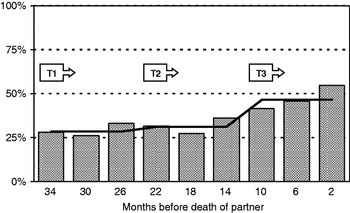
In the last BHPS interview before their partner died (T3), 47 per cent of the participants said they were providing care for their partner. That percentage almost doubled during the last two or three years of the partners' lives (Figure 1). Nearly a third said they provided care at the two interviews before their partner died (T2 and T3), and almost a quarter described themselves doing so at all three interviews (T1–T3). These findings might fit a pattern of onset or increases in a partner's health-care needs as end-of-life approached, or might reflect the influence of duration of care and support on the likelihood of people describing themselves as carers. Almost half (49%) the participants did not identify themselves as providing care for their partner in any of the included BHPS interviews, and a few (8%) had moved out of a caring role at some point before the death, including 4 per cent who said they were not providing care at the last interview before their partner died having previously done so (at T1 or T2, or both). This was a matter of interest because most of those who died were very old and ill (discussed further below).
Percentage of people providing care for a partner at three interviews (T1–T3) before their partner died by months before the death.

The BHPS provides no direct evidence on caring trajectories or why people did or did not identify as giving care. Some deaths do not involve a period of family care. National studies based on random samples of adult deaths indicate that one-in-ten deaths, mainly those arising from ischaemic heart disease or accidents, were sudden and unexpected with no prior illness or warning (Cartwright Reference Cartwright1991). Some people involved in caring activities may have identified themselves as carers after the last BHPS interview (T3) before their partner died. Some partners may have died away from home or received care primarily from another family member. Our qualitative material provided examples of people who said their own poor health during hospital treatment or recovery from operations meant there had been periods when they themselves had been unable to support their partner.
Another reason why some people did not report themselves as providing care might be that they had never thought of themselves in that way or had rejected the idea. Material from the qualitative interviews showed how hard it was for some people to think of themselves as ‘carers’. One woman said her husband's determination to manage as long as possible without help meant she had never thought of herself as a carer. An older woman said her experience in a long marriage was that partners loved and cared for each other in many different ways; when both were becoming frail it was hard to pinpoint a time when ‘care-giving’ began. She had found it hard to think of her husband as needing ‘care’ and herself as his ‘carer’ when the community nurses helped them claim benefits using such terms. The qualitative interviews asked some respondents directly whether they had thought of themselves as carers. Among those who said ‘yes’ were women and men of various ages whose partners had been diagnosed with a terminal illness. The reasons for thinking of themselves as a carer included having to stop work to look after a partner, and doing ‘specialist things’ otherwise done by professional nurses. The BHPS data provide instances of reciprocal care, which challenges formal distinctions between care-giver and care receiver. Where both members of a couple were interviewed, more than one-in-ten reported receiving care from the partner who died – the prevalence did not diminish as the partners approached the death. Four per cent of couples could be described as mutual care-givers at the interview before the death, and in 7 per cent, only the partner who died was described as providing care.
People's characteristics and circumstances
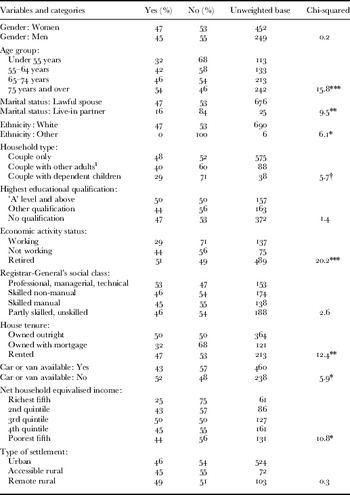
Carers are diverse but population studies have identified several demographic and socio-economic factors that predispose people to the role and to the designation (Maher and Green Reference Maher and Green2002; Parker and Lawton Reference Parker and Lawton1994). Our analysis showed, however, that among couples where one partner died, taking on a carer identity was largely unrelated to socio-economic status, gender or living arrangements. Table 1 shows that differences between people in the BHPS who said they did and did not provide care for their partner were relatively small, and those that were statistically significant were associated with people's ages. Older people, especially those in retirement, were more likely to say they were caring for their partner, as were those who owned their house outright, did not have access to a car for personal use, and were on average or just below average incomes. These factors are inter-correlated and broadly characterised the same group of people. Providing care for a partner was significantly associated with marital status and ethnicity but small cell sizes make these associations unreliable.
Whether providing care for partner according to socio-demographic characteristics at interview before the partner's death

Note: 1. Includes non-dependent children.
Source: BHPS cross-sectional study sample at T3. For details see text.
Significance levels: † p<0.1, * p<0.05, ** p<0.01, *** p<0.001.
When all the factors listed in Table 1 were considered together, only economic activity status had a statistically independent effect, indicating that it was those over pension age and not working that were most likely to describe themselves as providing care for their partner. In general, these findings point to age as a key factor underpinning the likelihood of adopting the carer identity. The influence of age was not unexpected. People's ages were closely correlated with those of their partner (Pearson r=0.87), and partners' ages are likely to be good predictors of the duration and severity of their health-care needs.
Health-care needs
It seemed possible that long-term health problems or deterioration in a partner's health might encourage people to identify as carers, for example through increased awareness of their caring activities and behaviours, especially where such involvement redefines roles and responsibilities within the couple. If so, partner's health status would help predict those who described themselves as providing care, including people with unmet support needs. To investigate this further, we represented partners' health-care needs by three measures: whether health limited daily activities; number of physical health problems (from a list of medical complaints); and psychological distress (four or more symptoms from the 12-item version of the General Health Questionnaire (GHQ): seeGoldberg and Williams Reference Goldberg and Williams1991). We also included partners' ages in the analysis because age is associated with onset of health-care needs and mortality.
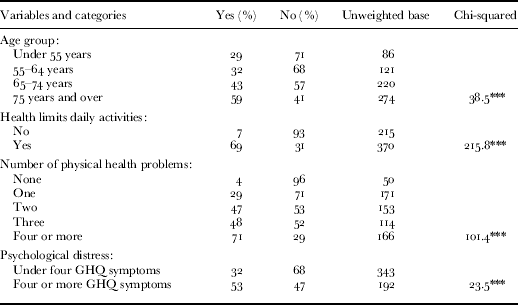
There was a strong association between people identifying themselves as providing care and their partners' age and health at the interview before their death (Table 2). People with partners in the older age groups and in poor health, including high levels of psychological distress, were more likely to say they provided care than those whose partners were younger and presented fewer or no health problems. When we included partners' reported health status at earlier interviews (T1 and T2), to represent the influence of long-standing or recurrent health problems on people describing themselves as care providers, the association with psychological distress strengthened. Partners' health limitations, number of physical health complaints and ages were each independently associated with the likelihood of providing care for a partner. Together, these variables correctly predicted whether people identified themselves as care providers in three-in-four (76%) cases. Psychological distress is generally associated with poor physical health (Goldberg and Williams Reference Goldberg and Williams1991), which might explain why partners' emotional health did not have a statistically independent effect on the likelihood of people adopting a carer identity.
Whether providing care for partner according to partners' age and health at the interview before the partner's death
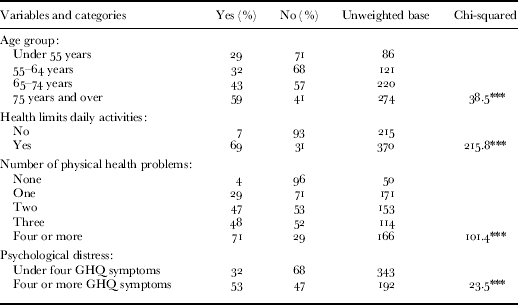
Note: GHQ: General Health Questionnaire.
Source: BHPS cross-sectional study sample at T3. For details, see text.
Significance level: *** p<0.001.
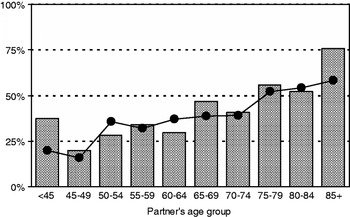
These findings underline that the experience of caring for a partner with poor health in old age is an important influence on self-identification as a carer. The proportion of people who said they provided care for a partner aged 75 or more years was more than double that of those whose partners were aged less than 50 years (Figure 2). One possible explanation is that death of a partner in younger age groups was more often sudden and unexpected, involving no period of family care. Older people, by comparison, were more likely to be caring for a partner with a long-term or deteriorating condition. BHPS data do not classify medical complaints in that way, nor do they identify specific conditions such as dementia which predominate in older age and result in longer dying trajectories that might require partner care. However, despite the association between identifying as a carer and partners' ages, scarcely more than half those with partners aged 75–84 years described themselves as providing care.
Percentage of people providing care for a partner by partners' ages.

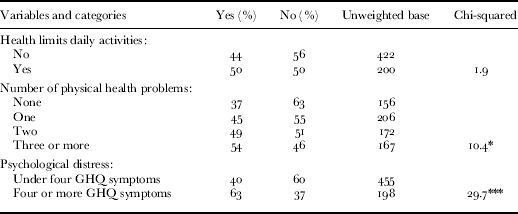
A further avenue for investigation was whether self-perception as someone providing care was associated with a person's own health status. Poor health may prevent some people caring for their partner. It also seems possible that poor health, or factors associated with poor health, might influence people's awareness of their role in providing care, or their need and readiness to seek support for that role. On the other hand, people used to the constraints of their own ill health, and managing this with their partner, might be less aware of any particular ‘caring role’ in the way they lived with a sick partner, especially if health problems developed gradually for them both as they grew older. The statistical analysis showed that people's own reported limitations in daily living activities had no significant influence on whether they identified themselves as providing care (Table 3). Psychological distress rather than poor physical health was the more important predictor of whether people said they provided care, which draws attention to the strain of caring about a partner towards the end-of-life. Difficulties coping with emotional strain, in particular, might lead some people to seek support for their partner and their own caring activities from family members and formal service providers who, in turn, might foster awareness of a carer identity. It is clear, however, that some people were in poor health irrespective of whether they described themselves as providing care.
Whether providing care for partner according to people's health at interview before the partner's death
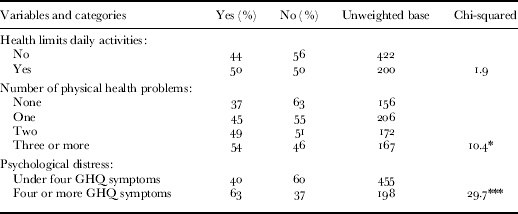
Note: GHQ: General Health Questionnaire.
Source: BHPS cross-sectional study sample at T3. For details, see text.
Significance levels: * p<0.05, *** p<0.001.
Service contacts
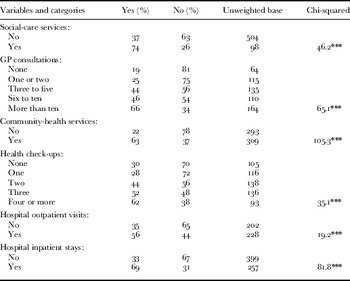
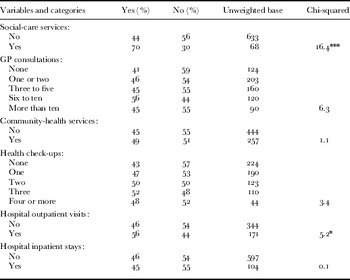
The adoption of a carer identity might be associated with the process of learning about available services, seeking support for their partner or themselves, or experience as a service user. Partner's health-care needs are likely to bring people into contact with various service providers and front-line professionals, especially towards the end-of-life. We examined this further in the analysis. Tables 4 and 5 show service contacts during the past year, reported at the BHPS interview before a partner's death, for partners and the other person in the couple, respectively. Details of how these services were classified can be found at the end of this paper.Footnote 2
Whether providing care for partner according to partners' contact with health and social-care services in past year at interview before the partner's death

Note: GP: general practitioner.
Source: BHPS cross-sectional study sample at T3. For details, see text.
Significance level: *** p<0.001.
Whether providing care for partner according to people's contact with health and social-care services in past year at interview before the partner's death

Note: GP: general practitioner.
Source: BHPS cross-sectional study sample at T3. For details, see text.
Significance levels: * p<0.05, *** p<0.001.
The findings show that whether a person identified themselves as providing care for their partner strongly associated with the partner's contacts with health and social-care services. The greater the number of the partner's general practitioner (GP) visits and health checks, the greater the likelihood of a person saying they provided care. When we included service contacts at earlier interviews (T1 and T2), to take account of a delay between such contacts and realisation of a carer identity, the association with social care and hospital services strengthened markedly. By comparison, people's own service contacts had less influence on whether they described themselves as care providers: only their contacts with social-care services and hospital outpatient visits were associated with providing care (Table 5), and including service contacts reported in earlier interviews had no additional impact.
These findings indicate that social-care service contacts of people and their partners were both important in influencing the adoption of a carer identity. In practice, needs assessments of people using or seeking social or community care services should take into account, where appropriate, the needs of other family members and, since the Carers Act 1995, those providing care have been able to ask for an assessment in their own right. In our analysis, when both members of a couple reported contact with social-care services, 74 per cent of people identified themselves as care providers. Almost the same percentage (75) was found among couples where partners alone reported such contacts. In 14 couples (3% overall), the person alone reported contact with social-care services and 53 per cent of them described themselves as providing care, compared with 37 per cent in couples where neither member mentioned such contacts. These findings suggest that social-care service providers might have played a role in fostering carer identities, especially where care recipients were using or seeking such services. However, the reach of social-care providers was limited in this sample: eight-in-ten couples (81%), including two-in-three self-identifying carers (69%), had no such contacts in the period before the death of a partner (that is, since the interview at T2).
When all the partners' service contacts were considered, social-care service contacts, GP visits, community-health service contacts, and outpatient visits were each independently associated with an increased likelihood of people saying they provided care for their partner. Partners' contact with these services predicted whether 73 per cent of people described themselves as providing care. It seems that partners' contacts with services across the health and social-care system had a cumulative influence on whether the other person thought of themselves as providing care. The absence of independent effects from health checks and inpatient stays, because of their association with variables in the model, may reflect their position in a patient's journey. GP and outpatient visits often lead to health checks and hospital stays which, in turn, lead to further contact with GPs and outpatient clinics.
Our qualitative material provided additional perspectives on the partners' service contacts. Those we spoke to who talked spontaneously about themselves as providing ‘care’, or agreed when asked directly that they thought of themselves as a ‘carer’, all had partners who had numerous contacts with GPs and hospitals and, for some, social services, mental health services, hospices, home nursing services and private medical care. It was apparent that for some people, the term ‘carer’ had two meanings: they talked about themselves in this way and also used the word to describe professionals who supported their partner at home, such as ‘the local carers' firm’ or ‘the carers who come in’. Others used the language of ‘carer’ and ‘care’ only when talking about local authority or agency staff that came into the home to help their partner. When they talked about what they were doing themselves they used the terms ‘looking after’, ‘nursing’ or ‘doing everything’ for their partner. All these were women aged 50 or more years. These findings echo those of Gooberman-Hill and Ebrahim (Reference Gooberman-Hill and Ebrahim2006), who noted that the older people they interviewed reserved terms such as ‘carer’ or ‘care’ for discussion of professional services.
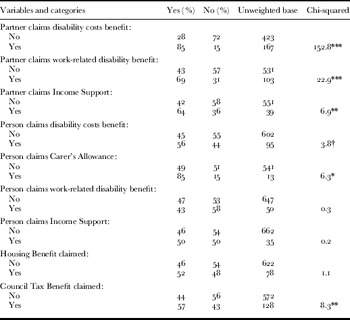
As well as contact with health and social services, we used the BHPS data to examine contact with social security administrators as shown by the receipt of disability and other welfare benefits.Footnote 3 Identifying oneself as providing care for a partner was most strongly associated with the partner receiving benefits, especially those for claimants with disabilities (Table 6). The association between adopting a carer identity and partners' Income Support and Council Tax Benefit may also reflect the influence of partners' medical condition, because ill health and impairment are covered in the eligibility criteria for these benefits and may increase the payment. Receipt of Carer's Allowance formally identifies the carer role but the expected association with describing oneself as providing care was weakened by the preponderance of people over pension age in the BHPS study sample. Most claimants of Carer's Allowance are under the state pension age (at the time of the survey 60 years for women, 65 for men) because it is not paid to those receiving a state retirement pension. Evidence for a potentially stronger link comes from taking a longer view: including former recipients of the allowance (at T1 and T2), some of whom may have lost payments on reaching pension age, or restricting the analysis to those under pension age, increased the likelihood of recipients describing themselves as providing care for their partner.
Whether providing care for partner according to benefit claims at interview before the partner's death

Source: BHPS cross-sectional study sample at T3. For details, see text.
Significance levels: † p<0.1, * p<0.05, ** p<0.01, *** p<0.001.
The influence of partners' health problems and impairments, as reflected in benefit receipts, was further demonstrated when all the benefits listed here were considered together. Two benefit categories, partners' disability costs benefits (such as the Disability Living Allowance) and partners' work-related disability benefits (such as Incapacity Benefit) independently influenced whether people described themselves as providing care for a partner. These two groups of partners' benefits correctly predicted whether three-in-four (75%) people said they were providing care.
Trends over time
As noted in the introduction, recognition and support for carers in the UK has increased over the last 40 years, particularly since the late 1980s. As the discourse of informal care has moved beyond policy and research into everyday practice, it might be expected that ‘carer’ identities would have been more widely adopted by those who provide unpaid care and assistance (Heaton Reference Heaton1999). Examination of trends in carer self-identification across successive cohorts might reflect these developments and the coverage of legislative changes on carer assessments. There is evidence of a general increase in awareness of the concept of caring in the BHPS study sample, which includes couples separated by death between 1991 and 2004. Around 35 per cent of those responding at interviews between 1991 and 1993 reported that they were providing care for their partner at the interview before the death (T3). That percentage increased steadily over the study period to around 55 among those interviewed from 2001 to 2003 (linear trend, p<0.001).
When other factors are taken into account, however, no systematic trend in the proportion of people reporting that they provided care for a partner was found, suggesting that the composition of the BHPS study sample changed over time. The number of partners in contact with social-care and community health services, that reported health checks and hospital outpatient appointments, and that received disability costs benefits at the interview before they died, generally increased across the study period. In contrast, there were no significant changes in self-reported health of people or their partners, or their ages on separation by death. It seemed that successive cohorts of couples had wider contacts with the service system, including services that recognise the role and contribution of carers, and it was this that may have led to an increased likelihood of people identifying themselves as care providers.
Overall model
So far we have examined the contribution of different influences on the adoption of a carer identity. Clearly, some factors are linked, such as individuals' health-care needs and health service use, and might point to more general patterns of influence. Identifying the most important factors might indicate effective entry points for policy action to boost carer recognition and support. Predicting who in the population is providing ‘care’ and identifying those in comparable circumstances who do not describe themselves as ‘carers’ could be useful for targeting and service planning. To bring the statistical findings together, we examined the combined effect of factors considered here on whether people identified themselves as providing care for their partner (including year of T3 interviews, 1991–2003, as a covariate). In doing so, the sample sizes diminished under the cumulative impact of missing values, so an iterative approach was adopted to evaluate the sensitivity of the results to individual factors. The more robust models highlighted the variety of factors that had statistically independent effects and their success in predicting whether people described themselves as providing care.
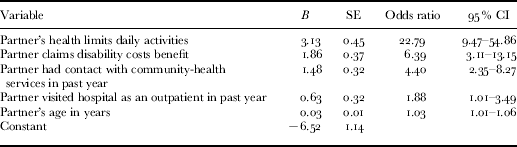
Table 7 illustrates one such model. It shows, firstly, that variables representing partners' age, health limitations, and contact with health services and social security providers, independently associated with whether people identified themselves as providing care. Although drawn from different domains, these variables have a shared theme – the influence of partners' health and support needs on people identifying themselves as providing care for a partner, especially in older couples. Secondly, the model predicted correctly, for more than eight-in-ten (84%) people whose partner subsequently died, whether they identified themselves as providing care. A good fit between the model's predictions and people's responses indicates that the factors considered here, or factors associated with them, influenced the likelihood of people describing themselves as providing care for a partner. According to this model, 17 per cent of those who did not regard themselves as carers reported apparently similar circumstances to those who identified themselves as care providers: some of them might be regarded as ‘hidden carers’.
Logistic regression of whether or not providing care for partner by partners' age, health, service contacts and benefit claims
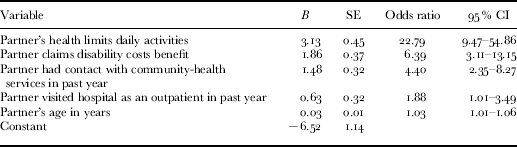
Notes: B: regression coefficient. SE: standard error. CI: confidence interval. Model statistics: Nagelkerke R 2=0.67. Area under ROC curve, c=0.91 (p<0.001). Unweighted sample size 365.
Source: BHPS cross-sectional study sample at T3. For details, see text.
Discussion
The reported findings should be viewed with caution. The analysis has used data from a general purpose survey and a study designed to investigate the financial implications of death of a partner. What influences carer self-identification emerged as an issue as the research progressed. We did not gather information to test specific hypotheses either about who did and did not describe themselves as carers, or about the implications of carer identities for the provision of home-care and palliative-care services. Quantitative information on alternative ways of identifying oneself as a carer, such as participation in caring activities and behaviours, was not available. Carers' identities and intentions were not discussed systematically in the qualitative interviews, but rather we took the opportunities that arose with some of the informants. Our analysis was thus largely opportunistic and descriptive. Nevertheless, we believe the findings contribute to the debate about the construction of carer identities and raise implications for practice.
Self-perception and construction of oneself as a carer depends on processes of cognitive appraisal influenced by interactions with others, including family and friends, front-line professionals, care recipients and other carers (O'Connor Reference O'Connor2007). The dynamics of that process may vary considerably from one individual to another, shaped by the structural context and circumstances of people's lives. The quantitative evidence offers some support for the idea that self-identification as a carer is an individualistic response. None of the socio-demographic factors considered here was linked to whether people described themselves as providing care, unless there was an underlying association with partners' health-care needs. Inter-personal and intra-personal characteristics not recorded in the BHPS may have influenced the process of carer self-identification, such as attachment style (Carnelley, Pietromonaco and Jaffe Reference Carnelley, Pietromonaco and Jaffe1996), marital relationship (Lewis Reference Lewis1998), and culturally-held beliefs and practices (Ahmad Reference Ahmad, Ahmad and Atkin1996; Katbamna et al. Reference Katbamna, Parker, Ahmad and Baker1998). Gendered differences in perceptions of care-giving may also influence adoption of a carer label (Arber and Ginn Reference Arber and Ginn1990; Davidson, Arber and Ginn Reference Davidson, Arber and Ginn2000). We therefore anticipated systematic variation in who positions themselves as a carer and how that category is understood.
The statistical findings indicated that partners' health-care needs and contacts with services increased the likelihood of people describing themselves as care providers. The relevance of such factors is not surprising, although quantitative evidence of their impact is hard to come by. However, the findings underline the cumulative influence of front-line professionals in recognising and affirming the carer identity, and the continuing challenge of reaching and involving carers whose partners fall outside the service system. Evidence of a link over time between carer self-identification and partners' service contacts suggests that sustained investment in service providers' training, professional development and practice guidance around the roles and contribution of unpaid carers would help boost carer recognition and the uptake of carers' services and benefits. Service providers, employers and others who come into contact with those providing care may become more influential in the construction of carer identities following implementation of the Equality Act 2010. Amongst other things, the legislation aims to protect people from discrimination when they are ‘associated with’ someone who is elderly, ill or disabled, including the role of supporters and carers (Government Equalities Office 2009).
As noted in the introduction, the benefits of self-identification for carers are often linked to boosting access to and uptake of social and financial support for carers. We found no firm statistical evidence that people's own contact with service providers listed in the BHPS questionnaire was associated with the adoption of a carer identity. Although people's contacts with social-care services were linked to describing themselves as providing care, these services had limited reach in the study sample and such contacts were mostly associated with those of the care recipient. People's own service contacts apparently played a limited role in the process of carer self-identification or were mediated by other factors; or perhaps service providers and front-line professionals had missed opportunities to ask people about their caring responsibilities and support needs.
It is also possible that people did not recognise some services among the BHPS categories or were in touch with other providers, including those in the private and voluntary sector. In the qualitative interviews, most people who talked about themselves as carers had been in touch with Macmillan Nurses (cancer support), Admiral Nurses (dementia support), or a local support centre for families affected by life-limiting illness. The qualitative interviews showed further that people's late identification of their role and circumstances in the formal language and categories of ‘carer’ and ‘care-giving’ was sometimes linked with delays in claiming financial support through Disability Living Allowance and Carer's Allowance. The effectiveness of formal systems of financial and social support for frail, disabled and ill people living in the community depends on widespread acceptance and recognition of a carer identity. It would be helpful if policy makers could ‘find’ people who might be formally categorised as carers by the regulatory systems to boost take-up and target services. There seems to be no easy way of doing this using a top-down approach. Boosting carer self-awareness will continue to depend largely on service providers, support groups and others who come into contact with those providing care – although there may be changes in self-perception in successive cohorts. Meanwhile, our findings draw attention to the problems in using self-reported identities in both surveys and estimates of take-up of services and benefits when projecting the characteristics and support needs of those in future populations who undertake caring roles.
Further research is required to investigate the circumstances under which providing care equates with adopting or assigning a carer identity. Whether or how positioning oneself as a carer helps make sense of a care situation, informs the construction of meanings around that experience, and shapes coping strategies, would be potentially useful lines of enquiry. Understanding how such appraisals interact with help-seeking and carers' perceptions of services, and influence individual differences in non-use and take-up, has considerable relevance for policy and practice, not least for partnerships between unpaid and professional carers in the provision of care (Pickard, Jacobs and Kirk Reference Pickard, Jacobs and Kirk2003). Positioning oneself as a carer may also have implications for a carer's physical, psychological and social wellbeing (Howse, Ebrahim and Gooberman-Hill Reference Howse, Ebrahim and Gooberman-Hill2005; Rogers, Chapple and Halliwell Reference Rogers, Chapple and Halliwell1998).
There are limits to recognising family relationships as ‘care’. One perhaps unintended consequence of constructing ‘carers’ as a social category is to overlook the significance of extant relationships by focusing exclusively on the needs and wishes of one person in a relationship, or by drawing a sharp distinction between ‘carers’ and ‘users’ (Henderson and Forbat Reference Henderson and Forbat2002; Lloyd Reference Lloyd2006; Twigg and Atkin Reference Twigg and Atkin1994). Relationships between partners may not fit policy constructions that emphasise the role of one member of a couple as the carer. Our findings show that where a partner with reported health-care needs was approaching the end-of-life, the other couple member did not always identify as a carer, and some had changing perceptions of themselves as a care provider. Caring about a partner was, by comparison, a more consistent thread running through the qualitative interviews. Some people, including those who described themselves as providing care for their partner, had health-care needs and received care and support from services in their own right. Our study has also shown wide-ranging implications for families, friends and service providers of death of the partner who had been caring for the other member of the couple.
Lloyd (Reference Lloyd2004) argued that an ethic of care that emphasises the inter-relatedness of people and the importance of social context should be at the heart of policy and professional understanding. It would, she claimed, generate new approaches to policy and practice that encompass the needs and rights of people who depend on care as well as the needs and rights of people providing care. Merging the carers' assessment duty and the community care assessment duty would be consistent with a ‘whole-family’ approach, but a unified assessment process would need to deal with the dilemmas and potential conflicts within caring relationships and situations. Such considerations lend weight to the view that the recognition of people who provide care should go beyond the formal categories of ‘carer’ or ‘care-giving’ and incorporate the language of relationships, inter-dependence and emotional commitment (Gooberman-Hill and Ebrahim Reference Gooberman-Hill and Ebrahim2006; Henderson and Forbat Reference Henderson and Forbat2002). Although relationships may change with the onset of serious, long-term illness or impairment, especially in couples where a partner lacks mental capacity, they still continue. Shared interests, values and beliefs, key decisions, events and roles across the lifecourse, and relationships in the wider family, continue to influence the behaviour and activities of a couple even as physical, mental and cognitive functioning deteriorates (Nolan, Grant and Keady Reference Nolan, Grant and Keady1996). The insights and expertise of people supporting a life partner approaching the end-of-life can be vital to the provision of formal care and support and may or may not include their adoption of a carer identity or use of the language of care.
Acknowledgements
The research on which this paper is based was funded by the UK Economic and Social Research Council (ESRC), Swindon, UK. The authors wish to thank Katharine Nice who, as a member of the research team, helped conduct the qualitative interviews; and Hilary Arksey and two anonymous reviewers for reading an earlier version of this paper and offering valuable comments. Data from the British Household Panel Survey were originally compiled by the Institute for Social and Economic Research at the University of Essex, Colchester, UK, with funding from the ESRC, and supplied by the National Data Archive, Colchester, UK. The authors accept sole responsibility for the analyses and interpretation reported here.