Non-technical Summary
A fossil representing a new species of extinct bird from the late Miocene Epoch has been discovered in the Linxia Basin of China and is named Eopavo hezhengensis. This fossil represents the most complete specimen yet found of a bird related to modern peafowls, offering crucial insights into their evolutionary history. Detailed morphological and phylogenetic analyses confirm that Eopavo hezhengensis shares a close relationship with living peafowl species, including the Indian and Congo peafowl. One particularly notable feature of this ancient bird is an unusually long spur on its foot. This spur, despite its relatively small body size, strongly suggests the individual was a male. The presence of that spur leads to the hypothesis that these ancient birds likely utilized their spurs in aggressive encounters with other males, possibly for mating dominance, similar to some living peafowl. Weighing approximately 1.1 kg, the smaller stature of Eopavo hezhengensis may indicate an adaptation to its arid savanna environment during the late Miocene. Furthermore, the discovery of this species in the high-elevation Linxia Basin at the edge of the Tibetan Plateau strengthens the hypothesis that peafowl originated in the Miocene of Asia before subsequently dispersing to Africa and Europe.
Introduction
Galliformes comprises 302 extant species (http://www.worldbirdnames.org/), including the megapodes (Megapodiidae), chachalacas (Cracidae), guineafowl (Numididae), New World quail (Odontophoridae), and pheasants, or phasianids (Phasianidae: turkey, grouse, partridge, Old World quail, peafowl, and pheasant, including the domestic chicken), that are distributed on all continents except Antarctica. The origin of the largest major galliform clade, Phasianidae, can be traced back to the Oligocene in France (Mayr, Reference Mayr2009). However, compelling evidence from both the current diversity and molecular phylogenetic relationships among living Phasianidae strongly suggests that Asia served as the primary center of diversification for much of this clade (Zhao et al., Reference Zhao, Ma, Wang, Li, Liu, Yu, Yue and Zou2012; Zeng et al., Reference Zeng, Tu, Ma, Yan, Yang, Zhang, Yue and Ran2013; Yan et al., Reference Yan, Zhou, Lu, Tu, Huang, Zhang and Yue2014). Consequently, the fossil record in Asia should hold the key to understanding early evolutionary history and diversification patterns of the Phasianidae.
Several crucial early phasianid fossil records have been unearthed across China. Among these are Shandongornis shanwanensis (Ye, Reference Ye1977), and Linquornis gigantis (Ye, Reference Ye1980), discovered in the middle Miocene diatomaceous lacustrine deposits of Shanwang, Shandong Province (see Fig. 1) (Ye, Reference Ye1977, Reference Ye1980). Notably, Linquornis gigantis is comparable in size to the extant green peafowl (Pavo muticus (Linnaeus, Reference Linnaeus1766)), making it one of the largest galliform fossils found in China (Ye, Reference Ye1980). Fragmentary Miocene material, attributed to relatives of Alectoris and Gallus, has also been reported from Sihong, Jiangsu Province, and Lufeng, Yunnan Province, respectively (Hou, Reference Hou1985, Reference Hou1987). More recently, Panraogallus hezhengensis (Li et al., Reference Li, Clarke, Eliason, Stidham, Deng and Zhou2018), with its nearly complete skeleton and exquisitely preserved elongated coiled trachea, was discovered in the late Miocene Linxia Basin, Gansu Province, on the edge of the Tibetan Plateau.
Holotypes: (1) Shandongornis shanwanensis (H11.158) (Ye, Reference Ye1977); (2) Linquornis gigantis (H11.159) (Ye, Reference Ye1980).
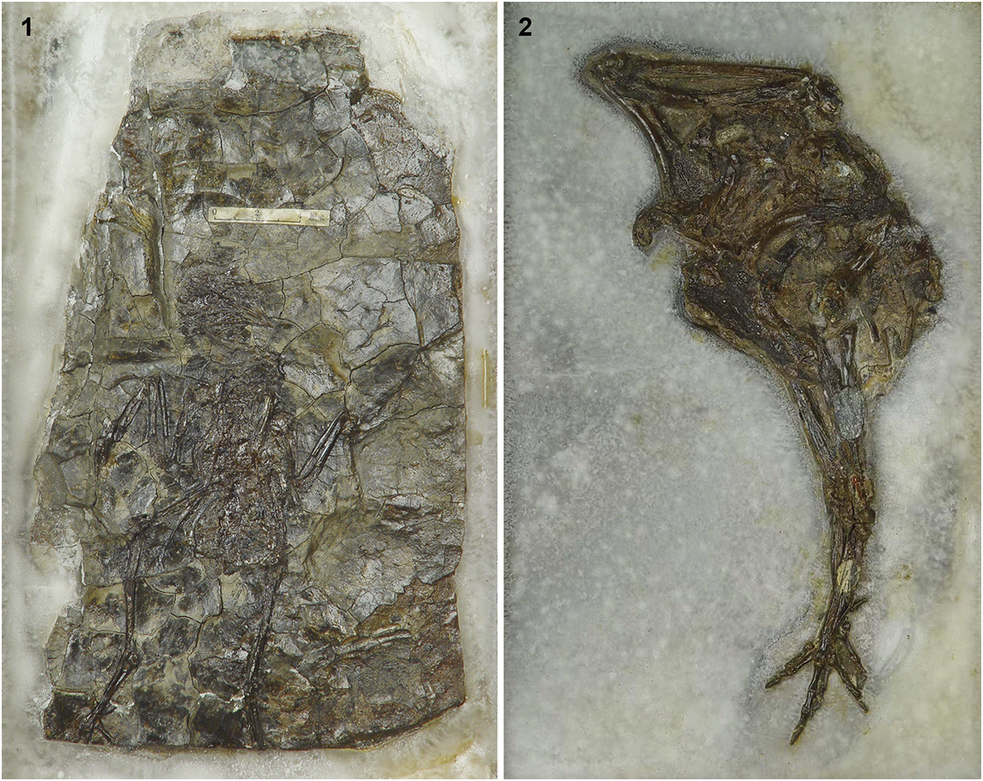
Figure 1. Long description
A two-panel photo displaying fossilized avian holotypes embedded in stone slabs.
Panel 1, on the left, is labeled with a number 1 in the top-left corner. It features the holotype of Shandongornis shanwanensis. The fossil is preserved on a rectangular, vertically oriented dark grey stone slab with a cracked, mosaic-like texture. A small white scale bar with black markings is positioned in the upper-middle section. The avian remains are centered, showing a partial skeleton with visible wing bones extending outward and long leg bones extending toward the bottom of the slab. The fossilized material is a darker brown than the surrounding rock.
Panel 2, on the right, is labeled with a number 2 in the top-left corner. It features the holotype of Linquornis gigantis. This fossil is set against a lighter, mottled grey and white background. The specimen is oriented vertically, showing a more articulated leg and foot structure. At the top, there is a dense cluster of dark brown fossilized bones representing the pelvic or torso region. Extending downward is a long, slender leg bone that terminates at the bottom with a well-preserved three-toed foot, showing distinct phalanges and claws.
The highly recognizable phasianid group called peafowl (a distinct clade within Pavonini) occurs naturally only in Africa and Asia, but individuals have been introduced around the world, where they are seen frequently in gardens and zoos. The extant peafowl species are placed in the genera Afropavo (found in central Africa) and Pavo (found in southern Asia) (see Fig. 2). Traditionally, the closest relatives of peafowl have been hypothesized to be Polyplectron, Argusianus, and Rheinardia, which together with peafowl form the clade Pavonini (or Pavoninae) (Ksepka, Reference Ksepka2009; Kan et al., Reference Kan, Yang, Li, Chen, Lei, Wang, Qian, Gao and Yang2010; Zhao et al., Reference Zhao, Ma, Wang, Li, Liu, Yu, Yue and Zou2012). However, recent research on Galliformes indicates a closer relationship of Polyplectron to Galloperdix, Haematortyx, and Tropicoperdix than to Argusianus, Rheinardia, and peafowl (Chen et al., Reference Chen, Hosner, Dittmann, O’Neill, Birks, Braun and Kimball2021; Kimball et al., Reference Kimball, Hosner and Braun2021). Chen et al. (Reference Chen, Hosner, Dittmann, O’Neill, Birks, Braun and Kimball2021) recognized a restricted Pavoninae (excluding Polyplectron) but did not formally name the “peacock pheasant clade” (Polyplectron and allies) or the clade uniting all these taxa ("ocellated clade"); here we use Pavoninae to refer to all members of the “ocellated clade.” The Asian distribution of the living species of peafowl and their phylogenetically closest living relatives further supports the strong hypothesis of an Asian origin for peafowl (Wang et al., Reference Wang, Kimball, Braun, Liang and Zhang2017).
The distribution of extant peafowl and the location of fossil species. This map is at a scale of 1:100,000,000.
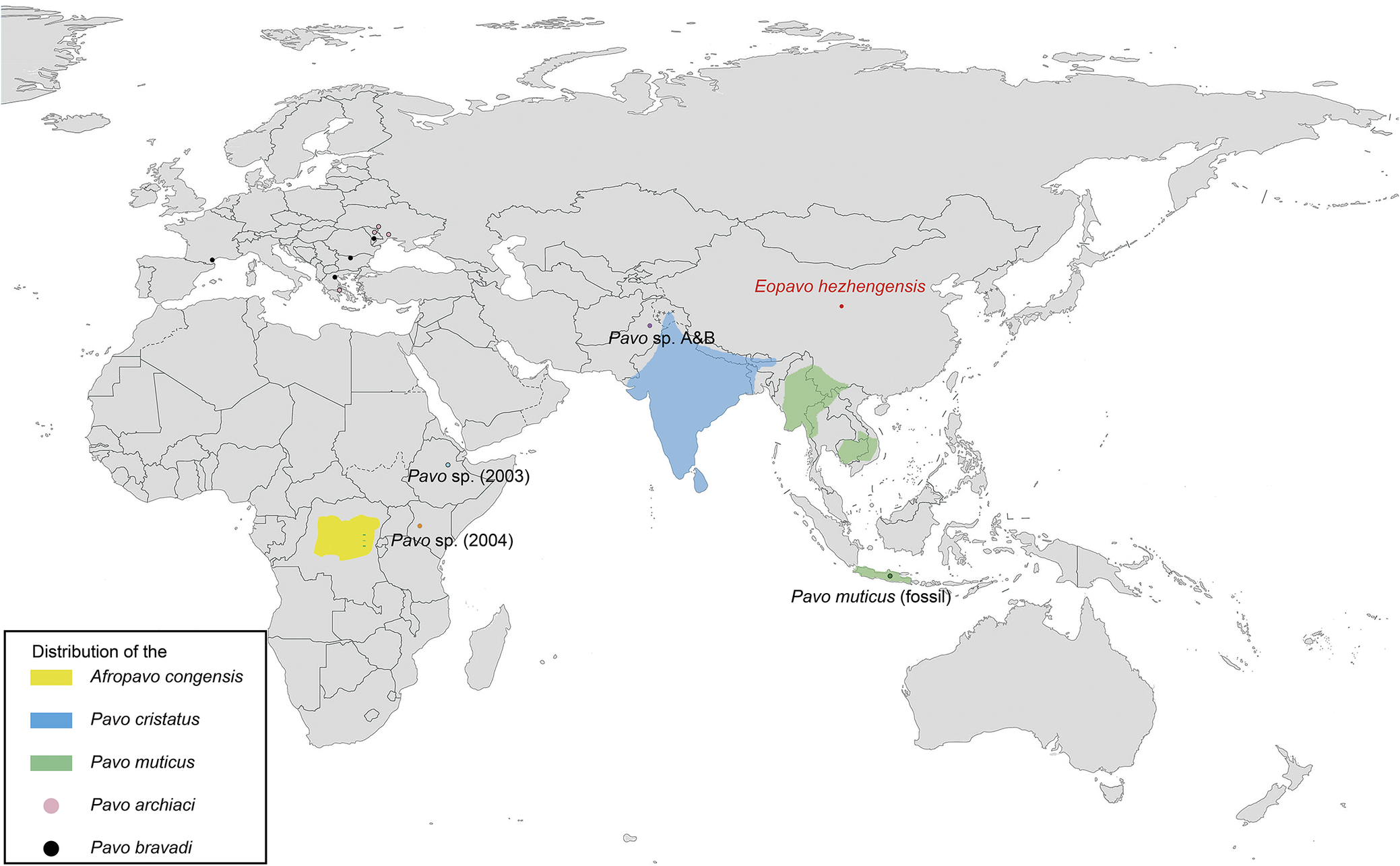
Figure 2. Long description
A world map with a legend in the bottom-left corner. The legend identifies five categories. Afropavo congensis is yellow. Pavo cristatus is blue. Pavo muticus is green. Pavo archiaci is a pink dot. Pavo bravadi is a black dot.
Distribution and fossil locations are as follows.
In Europe, several black dots representing Pavo bravadi fossils are scattered across the South and East, including locations in present-day Spain, France, Italy, and the Balkans.
In Africa, a large yellow shaded area in the central Congo Basin represents the range of Afropavo congensis. To the East of this range are two orange dots labeled Pavo sp. 2003 and Pavo sp. 2004.
In South Asia, a large blue shaded area covering most of the Indian subcontinent represents the range of Pavo cristatus. Just North of this range in the Himalayas are pink dots labeled Pavo sp. A and B.
In East and Southeast Asia, green shaded areas represent the range of Pavo muticus, covering parts of Myanmar, Thailand, Laos, Vietnam, and Cambodia, with a separate green patch on the island of Java. A green dot on Java is labeled Pavo muticus fossil.
In Central China, a single red dot is labeled Eopavo hezhengensis in red text.
The fossil record of peafowl is sparse and consists primarily of incomplete bone fragments from the Pliocene and early Pleistocene across Europe, Africa, and Asia (see Fig. 2). The oldest reported peafowl records, identified as Pavo sp. A and B, were discovered in the Siwaliks sequence in the Tibetan Plateau foothills, dating back to 12.9 Ma and 13.6 Ma, respectively (see Fig. 2) (Louchart, Reference Louchart, Badgley, Morgan and Pilbeam2025). Unfortunately, these middle Miocene records are fragmentary, offering limited phylogenetic information. While a possible interpretation suggests these two specimens represent a large male and a small female, the size difference exceeds the dimorphism observed in extant species (Louchart, Reference Louchart, Badgley, Morgan and Pilbeam2025). Another notable Asian peafowl fossil, attributed to the extant species Pavo muticus (see Fig. 2), was found in Middle Pleistocene deposits on Java Island, Indonesia (Meijer, Reference Meijer2014).
Fossil peafowl remains have also been found in two different African locations (see Fig. 2). Specimens from the Mabget Formation (Pliocene, Kenya), comprising a left and a right distal tibiotarsus likely from a single individual, were identified as Pavo sp. given their typical “Pavo” morphology, although a precise species determination was not possible (Pickford et al., Reference Pickford, Senut and Mourer-Chauviré2004). The other African record, from the early Pliocene of Aramis, Ethiopia, includes bone fragments of a humerus, tarsometatarsus, spur, and pedal digit (Louchart, Reference Louchart2003). Despite the larger number of skeletal elements, a lack of critical diagnostic osteological characters prevents a more precise identification within the genus Pavo (Louchart, Reference Louchart2003).
In Europe, Pavo bravardi (Gervais, Reference Gervais1849) is a well-known fossil peafowl with remains from Pliocene and early Pleistocene localities in France, Greece, and Moldova (see Fig. 2) (Mourer-Chauviré, Reference Mourer-Chauviré1989, Reference Mourer-Chauviré1990, Reference Mourer-Chauviré, Delson, Faure and Guérin2024; Boev and Koufos, Reference Boev and Koufos2000). Pavo bravardi materials include a nearly complete left tarsometatarsus with a long bony spur, a nearly complete right tarsometatarsus, fragments of a left tarsometatarsus with a spur, a nearly complete left humerus, two right tibiotarsi, the proximal end of a right coracoid, the distal part of a right femur, and a left femur (Mourer-Chauviré, Reference Mourer-Chauviré1989, Reference Mourer-Chauviré1990, Reference Mourer-Chauviré, Delson, Faure and Guérin2024). A key distinction between P. bravardi and extant Pavo species is the more distal position of its spur (Mourer-Chauviré, Reference Mourer-Chauviré1989).
Another extinct European species, Pavo archiaci (Gaudry, Reference Gaudry1862) (formerly Pavo aesculapi (Gaudry, Reference Gaudry1862)) has been reported from multiple late Miocene localities in Greece, Hungary, Ukraine, and Moldova (see Fig. 2) (Janossy, Reference Jánossy1991; Boev and Koufos, Reference Boev and Koufos2000; Kovalchuk and Gorobets, Reference Kovalchuk and Gorobets2016). However, the purported oldest record, from the late Miocene in Hungary (Jánossy, Reference Jánossy1991), has been re-classified as Syrmaticus phasianoides (Jánossy, Reference Jánossy1991) (Zelenkov, Reference Zelenkov2016). Excluding that record, P. archiaci is known from localities that fall within the Neogene mammal zones (MN) 9–13 in Europe, and its age range is younger than 11.6 Ma (Mlíkovský, Reference Mlíkovský2002). Pavo archiaci is distinctly smaller than both extant Pavo cristatus (Linnaeus, Reference Linnaeus1758) and Pavo bravardi (Kurochkin et al., Reference Kurochkin, Lopatin and Zelenkov2015).
The geographic distribution of fossil peafowl appears to span a continuous and broad area across Asia, Europe, and Africa, in stark contrast to the more limited and clearly disjunct distribution of extant peafowl in southern Asia and central Africa. The oldest fossil peafowl records from the Siwaliks also align with the hypothesis of an Asian origin for the group. This temporal and geographic pattern suggests that the presence of Pavo fossils in Europe and Africa, along with extant Afropavo, likely resulted from late Neogene dispersal events out of Asia. However, further documentation of the Neogene fossil record of Pavonini, particularly from southern Asia, is crucial to constrain the temporal and spatial origin of the clade and to better understand the changes in their biogeographic distribution over time.
A new key late Miocene fossil from the Linxia Basin, on the edge of the Tibetan Plateau in Gansu Province, China, provides compelling evidence of the early presence of peafowl in East Asia. The high elevation of the Linxia Basin (currently over 2,000 m) and the fossil’s proximity to the Tibetan Plateau are particularly interesting when considering the evolutionary origins of this clade. In addition, this fossil represents the first articulated skeletal material (including limb bones, pectoral and pelvic girdle elements, and cervical vertebrae from a single individual) definitively referred to peafowl. This fossil also provides valuable morphological data on an early member of the clade, with its taxonomic identification reinforced by osteological character comparisons and a phylogenetic analysis.
Materials
Repositories and institutional abbreviations
Institute of Vertebrate Paleontology and Paleoanthropology (IVPP), Chinese Academy of Sciences, Beijing, China; Natural History Museum (NHMUK), Tring, United Kingdom.
Systematic paleontology
Class Aves Linnaeus, Reference Linnaeus1758
Order Galliformes Temminck, Reference Temminck1820
Family Phasianidae Horsfield, Reference Horsfield1821
Genus Eopavo new genus
Type species
Eopavo hezhengensis new species.
Diagnosis
As for the species by monotype.
Etymology
The genus name combines the Latin words eo (dawn) and pavo (peafowl), referring to the dawn of peafowl.
Remarks
See remarks part of the species.
Eopavo hezhengensis new species
Figures 3, 4.1, 5.1, 5.7, 6.1–6.3, 6.8–6.10, 7.1
Holotype of Eopavo hezhengensis n. gen. n. sp. and associated fossils. (1) Photograph of IVPP V15901. (2) Line drawing of the holotype specimen (IVPP V15901). Anatomical abbreviations: co = coracoid; cv = cervical vertebrae; fe = femur; fu = furcula; hh = humeral head; ho = horn; hu = humerus; m3 = third lower molar; ph = phalanges; pl = pelvis; ra = radius; st = sternum; tmt = tarsometatarsus; ul = ulna.
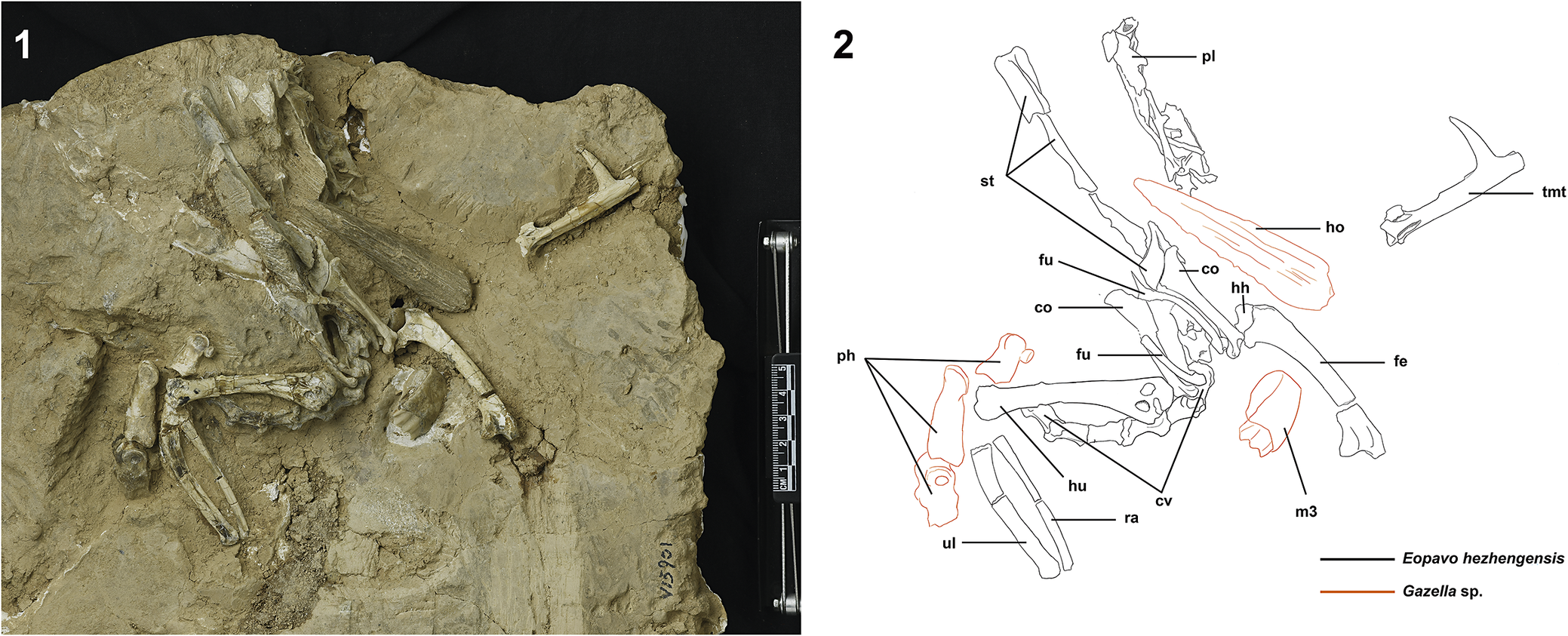
Figure 3. Long description
The display consists of two panels. Panel 1 is a photograph of specimen I V P P V 1 5 9 0 1, showing light-colored fossilized bones embedded in a tan sedimentary matrix with a centimeter scale bar on the right. Panel 2 is a corresponding line drawing that identifies the bones. Black outlines represent Eopavo hezhengensis and red outlines represent Gazella species.
At the top center of the skeletal cluster is the pelvis (p l). Moving downward and toward the center are the coracoid (c o), furcula (f u), and cervical vertebrae (c v). To the left of this central group are the sternum (s t), humerus (h u), radius (r a), and ulna (u l). At the far left are the phalanges (p h) outlined in red.
To the right of the central cluster, the humeral head (h h) connects to the femur (f e). Isolated from the main cluster on the far right is the tarsometatarsus (t m t). Two additional red-outlined elements belonging to Gazella species are positioned near the center: a large horn (h o) above the femur and a third lower molar (m 3) below the femur.
(1–4) Comparative images of the coracoid in ventral view: (1) Eopavo hezhengensis n. gen. n. sp. (IVPP V15901), both sides; (2) Pavo cristatus (IVPP OV1699), left; (3) Pavo muticus (IVPP OV1131), left; (4) Afropavo congensis (NHMUK S/1989.19.16), right. (5–7) Line drawings of the caudal margin of the sternum: (5) Eopavo hezhengensis; (6) Pavo and Afropavo; (7) Lyrurus tetrix. (4) Scale bar =1cm.
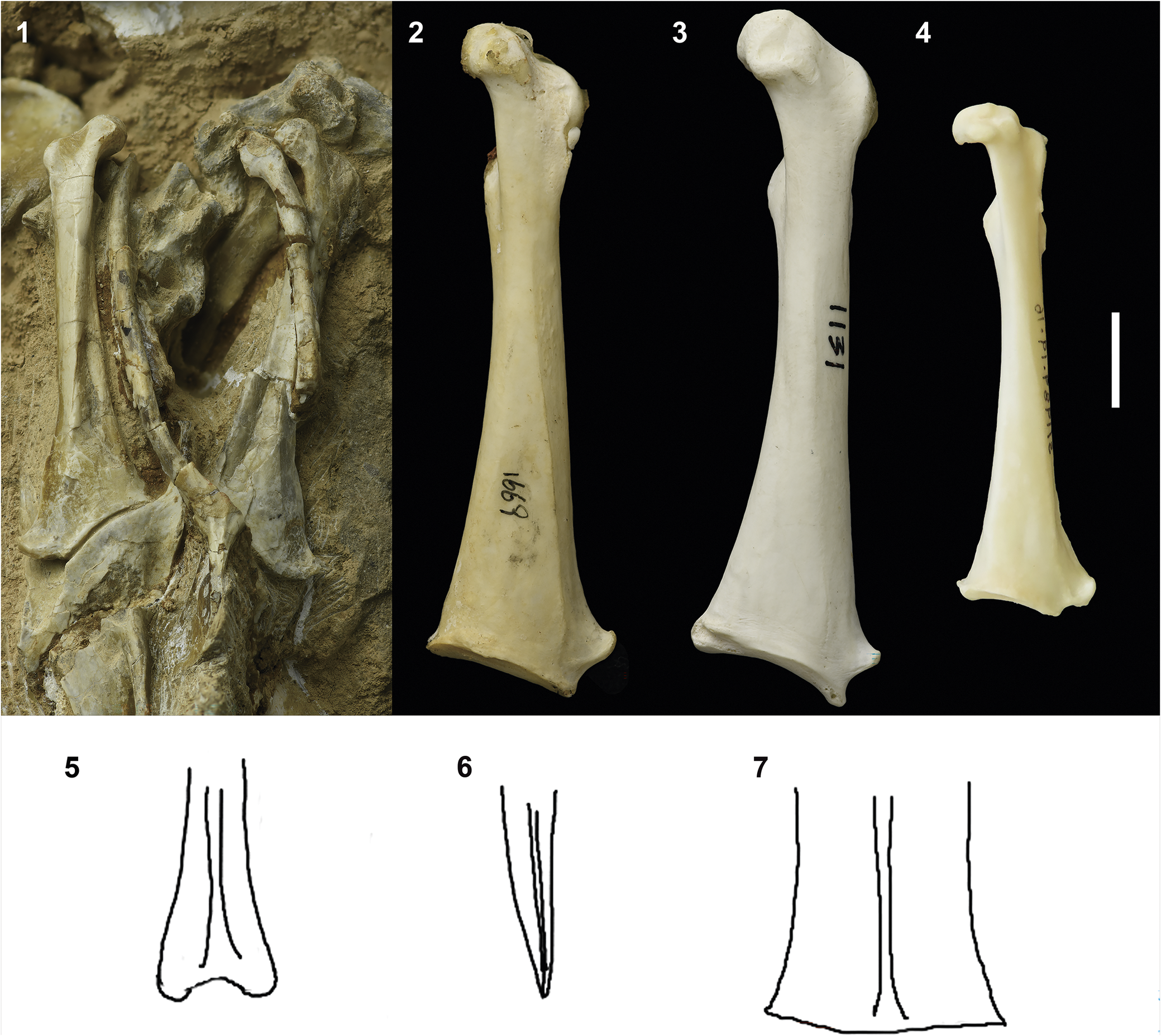
Figure 4. Long description
The top row contains four photos of coracoid bones in ventral view.
Panel 1 shows the fossilized coracoids of Eopavo hezhengensis (I V P P V 15901) embedded in a tan sediment matrix, displaying both the left and right sides.
Panel 2 shows the left coracoid of Pavo cristatus (I V P P O V 1699), a long, slender bone with a rounded head and a flared base, labeled with the number 1699.
Panel 3 shows the left coracoid of Pavo muticus (I V P P O V 1131), similar in structure to panel 2, labeled with 1131.
Panel 4 shows the right coracoid of Afropavo congensis (N H M U K S / 1989.19.16), which is noticeably smaller than the others. A vertical white scale bar representing 1 cm is positioned to the right of this bone.
The bottom row contains three line drawings of the caudal margin of the sternum.
Panel 5 depicts Eopavo hezhengensis with a wide, slightly notched base and two internal vertical lines.
Panel 6 depicts Pavo and Afropavo, showing a much narrower, V-shaped tapering margin.
Panel 7 depicts Lyrurus tetrix, showing a broad, flared base with a central vertical divider.
(1, 7) Eopavo hezhengensis n. gen. n. sp. (IVPP V15901) left humerus: (1) caudal view, with CT scan slice; (7) cranial view. (2, 8) Afropavo congensis (NHMUK S/1989.19.16) right humerus (mirrored): (2) caudal view; (8) cranial view. (3, 9) Pavo muticus (IVPP OV1131) left humerus: (3) caudal view; (9) cranial view. (4, 10) Pavo cristatus (IVPP OV1669) left humerus: (4) caudal view; (10) cranial view. (5, 11) Polyplectron bicalcaratum (Linnaeus, Reference Linnaeus1758) (IVPP OV1527) left humerus: (5) caudal view; (11) cranial view. (6, 12) Gallus gallus (Linnaeus, Reference Linnaeus1758) (IVPP OV1523) left humerus: (6) caudal view; (12) cranial view. The white triangle points to the small concavity created by the sulcus transversus on the crista bicipitalis margin. Scale bars =1cm. Afropavo congensis photography courtesy of Judith White, copyright The Trustees of the Natural History Museum, London.
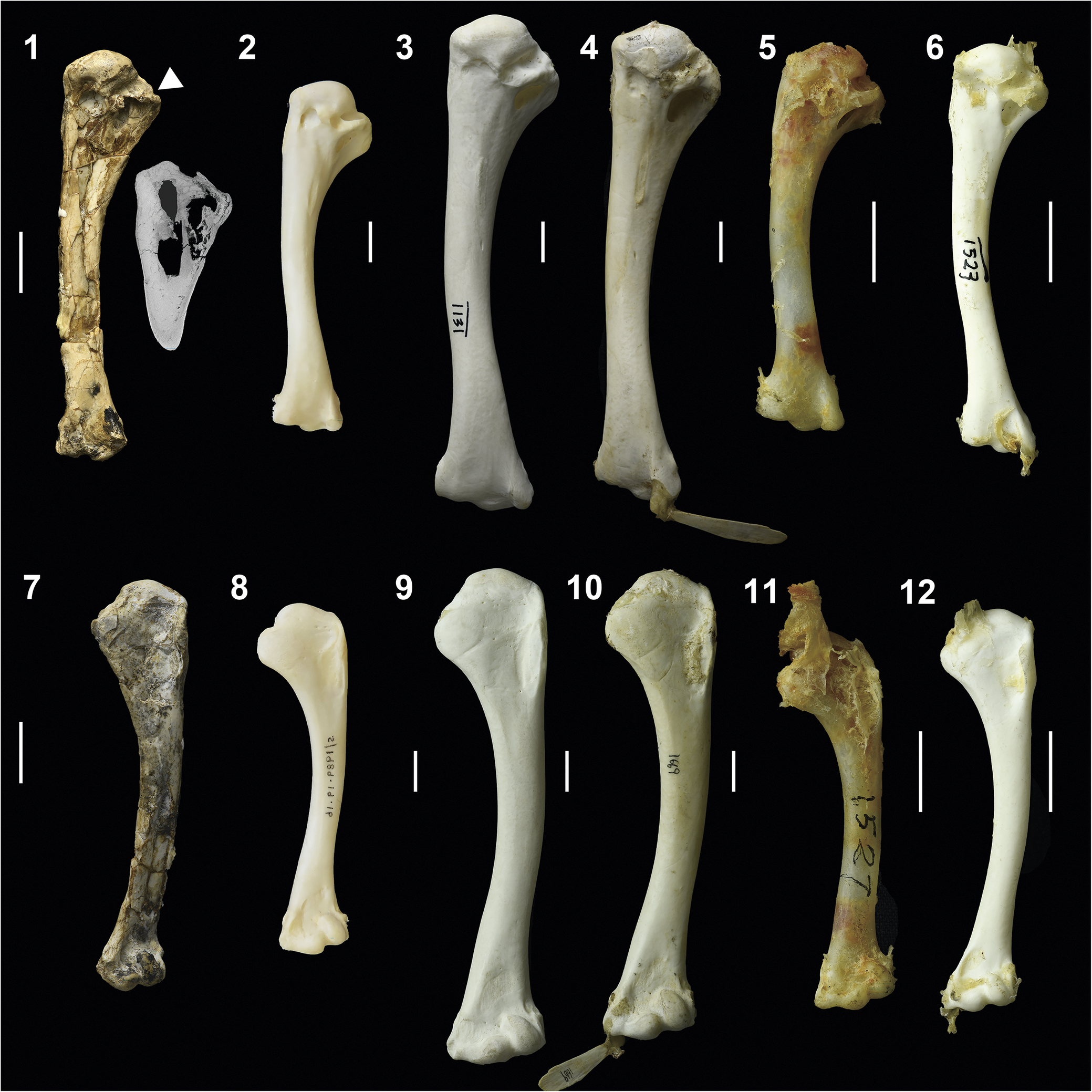
Figure 5. Long description
The photo displays twelve humerus specimens arranged in two rows. The top row (1 to 6) shows the caudal view, and the bottom row (7 to 12) shows the cranial view of the same species.
* Panels 1 and 7: Eopavo hezhengensis (I V P P V 15901). Panel 1 includes a C T scan slice next to the fossilized bone. A white triangle at the proximal end points to a small concavity on the crista bicipitalis margin.
* Panels 2 and 8: Afropavo congensis (N H M U K S / 1989.19.16), right humerus mirrored for comparison.
* Panels 3 and 9: Pavo muticus (I V P P O V 1131).
* Panels 4 and 10: Pavo cristatus (I V P P O V 1669).
* Panels 5 and 11: Polyplectron bicalcaratum (I V P P O V 1527).
* Panels 6 and 12: Gallus gallus (I V P P O V 1523).
Each panel includes a vertical white scale bar representing 1 cm. The bones vary in color from the dark, mineralized brown of the Eopavo fossil to the off-white and yellowish tones of the modern avian specimens. The shafts are generally slender, curving slightly, with expanded proximal heads and distal condyles.
(1–3, 8–10) Eopavo hezhengensis n. gen. n. sp. (IVPP V15901): (1–3) left femur: (1) cranial view; (2) caudal view; (3) lateral view (mirrored); (8–10) right tarsometatarsus: (8) mediodorsal view; (9) dorsal view; (10) proximal view. (4, 13) Pavo cristatus (IVPP OV1669): (4) right femur, lateral view; (13) right tarsometatarsus, proximal view. (5, 14) Pavo muticus (IVPP OV1131): (5) right femur, lateral view; (14) right tarsometatarsus, proximal view. (6, 15) Gallus gallus (IVPP OV1523): (6) right femur, lateral view; (15) right tarsometatarsus, proximal view. (7, 12) Polyplectron bicalcaratum (IVPP OV1527): (7) right femur, lateral view; (12) right tarsometatarsus, proximal view. (11) Afropavo congensis (NHMUK S/1989.19.16) right tarsometatarsus, proximal view. Scale bars = 1 cm. Anatomical abbreviation: fhl = sulcus of musculus flexor hallucis longus. Afropavo congensis photography courtesy of Judith White, copyright The Trustees of the Natural History Museum, London.
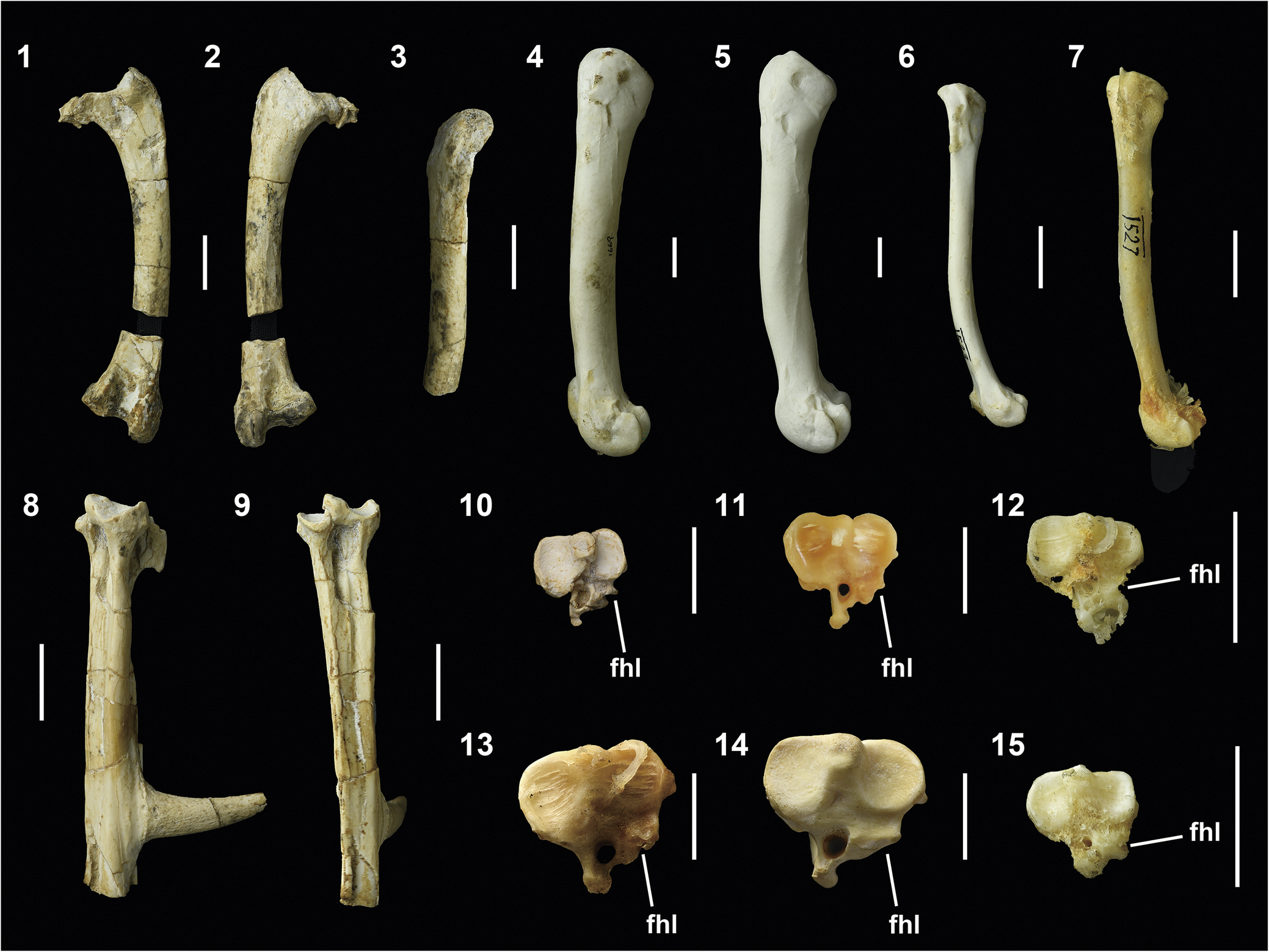
Figure 6. Long description
The photo contains 15 numbered panels against a black background, each with a 1 cm vertical scale bar.
Top Row (Femora):
- Panel 1: Eopavo hezhengensis left femur in cranial view, showing a slender shaft and distinct proximal and distal ends.
- Panel 2: Eopavo hezhengensis left femur in caudal view.
- Panel 3: Eopavo hezhengensis left femur in lateral view (mirrored).
- Panel 4: Pavo cristatus right femur in lateral view.
- Panel 5: Pavo muticus right femur in lateral view.
- Panel 6: Gallus gallus right femur in lateral view.
- Panel 7: Polyplectron bicalcaratum right femur in lateral view.
Bottom Row (Tarsometatarsi):
- Panel 8: Eopavo hezhengensis right tarsometatarsus in mediodorsal view, featuring a prominent spur.
- Panel 9: Eopavo hezhengensis right tarsometatarsus in dorsal view.
- Panel 10: Eopavo hezhengensis right tarsometatarsus in proximal view, with a label f h l pointing to the sulcus of musculus flexor hallucis longus.
- Panel 11: Afropavo congensis right tarsometatarsus in proximal view, with label f h l.
- Panel 12: Polyplectron bicalcaratum right tarsometatarsus in proximal view, with label f h l.
- Panel 13: Pavo cristatus right tarsometatarsus in proximal view, with label f h l.
- Panel 14: Pavo muticus right tarsometatarsus in proximal view, with label f h l.
- Panel 15: Gallus gallus right tarsometatarsus in proximal view, with label f h l.
The proximal views (10-15) highlight the comparative morphology of the hypotarsus and the f h l sulcus across the different species.
Sternum photographs to show details in cranial lateral process. (1) Eopavo hezhengensis n. gen. n. sp. (IVPP V15901). (2) Polyplectron bicalcaratum (IVPP OV1527), mirrored. (3) Pavo muticus (IVPP OV1131). (4) Pavo cristatus (IVPP OV1669). Scale bars = 1 cm.
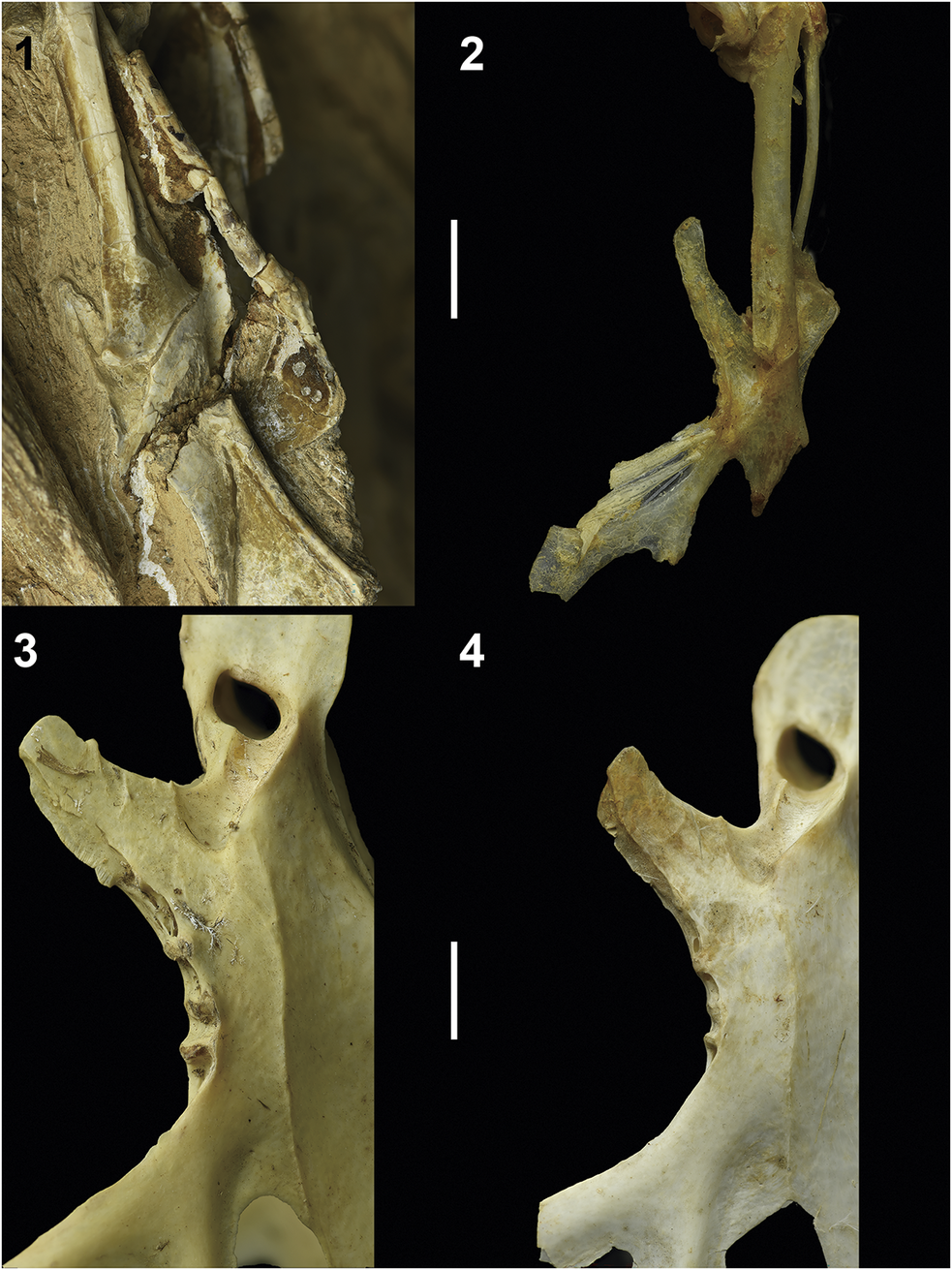
Figure 7. Long description
A four-panel comparative anatomical study of the sternum.
* Panel 1 (Top-Left): A fossil specimen of Eopavo hezhengensis (I V P P V 15901) embedded in a tan sedimentary matrix. The cranial lateral process is visible as a flattened, slightly curved bone fragment with a rough surface texture.
* Panel 2 (Top-Right): A modern specimen of Polyplectron bicalcaratum (I V P P O V 1527), mirrored for comparison. The bone is translucent and yellowish, showing a slender, elongated process extending upward from the main body of the sternum. A white vertical scale bar representing 1 cm is positioned to the left.
* Panel 3 (Bottom-Left): A modern specimen of Pavo muticus (I V P P O V 1131). The bone is opaque white. The cranial lateral process is robust and broad, featuring a prominent oval foramen (opening) at its base and a jagged, irregular distal edge.
* Panel 4 (Bottom-Right): A modern specimen of Pavo cristatus (I V P P O V 1669). Similar in structure to panel 3, it shows a thick cranial lateral process with a large, smooth-edged oval foramen. The distal tip is slightly more rounded than in Pavo muticus. A white vertical scale bar representing 1 cm is positioned between panels 3 and 4.
Holotype
IVPP V15901, a partially articulated skeleton including seven articulated cervical vertebrae, a furcula missing part of left ramus, the ventral part of the sternum with part of the sternal keel, complete left and right coracoids, a complete left humerus, an incomplete left ulna and radius, the proximal right humerus, the left femur, the proximal right tarsometatarsus, and part of the pelvis and synsacrum (see Fig. 3.1, 3.2).
Diagnosis
Characters supporting Eopavo hezhengensis as a member of crown Galliformes include: a slender scapus claviculae of the furcula; a wide crista deltopectoralis of the humerus protruding considerably dorsally; an incisura capitis of the humerus separated from the fossa pneumotricipitalis dorsalis by a ridge; and an enclosed canal for the tendon of the musculus flexor digitorum longus in the hypotarsus of the tarsometatarsus.
Placement of Eopavo hezhengensis within Phasianidae is supported by two discrete characters: (1) the processus lateralis of the coracoid extends to the ventral side and exhibits a well-developed knob; and (2) in cranial view, the crista trochanteris of the femur is distinct and extends more proximally than the head.
Characters supporting the placement of the new species within Pavonini include: (1) a nearly straight crista articularis sternalis of the coracoid; (2) a relatively stout coracoid shaft; (3) an angulus medialis of the coracoid that does not extend far medially, forming a nearly straight angle; (4) a small concavity located at the proximal margin of the crista bicipitalis of the humerus in caudal view (see Fig. 5.1), a feature also seen in Argusianus; (5) a flat, underdeveloped caput humeri in Eopavo hezhengensis, as in peafowl, and Polyplectron (see Fig. 5.1–5.5) and contrasting with other medium to large Phasianidae species in which the caput humeri expands dorsoventrally, forming a large head (see Fig. 5.6); (6) a condylus ventralis of the humerus extending slightly more distally than the condylus dorsalis, with the proximal margin of the condylus ventralis nearly level with the middle of the condylus dorsalis; and (7) a processus flexorius that does not extend ventrally (see Fig. 5.7–5.12). This combination of characters is unique to the group Pavonini and is shared by extant Pavo, Afropavo, and Polyplectron. A well-developed processus supracondylaris dorsalis is present in Eopavo hezhengensis, along with Afropavo, Polyplectron, Argusianus, and Rheinardia, but it is absent in Pavo (see Fig. 5.7–5.10). The width of the distal end of the femur is smaller than the femoral head in Eopavo hezhengensis, similar to Polyplectron, but differs from extant peafowl where the distal end of the femur is equal to or wider than the width of the femoral head. The femur of Eopavo hezhengensis is straight, similar to Pavo, Afropavo, and Polyplectron, while in Gallus, the femur is distinctly curved in lateral view (see Fig. 6.3–6.7).
Characters supporting a closer relationship with peafowl (Pavo and Afropavo) include: (1) a moderately long and wide processus craniolateralis of the sternum, similar to peafowl (in Polyplectron, this process is longer and more slender; see Fig. 7); (2) a crista bicipitalis of the humerus that meets the shaft as a gentle curve, present only in Afropavo and Pavo among extant Phasianidae (see Fig. 5.1–5.6); (3) a small crista bicipitalis, exclusive to Eopavo hezhengensis, Pavo, and Afropavo (see Fig. 5.1–5.4); (4) a femur slightly shorter than or nearly equal to the humerus in length, as in Pavo and Afropavo (in Polyplectron, the femur is distinctly longer); and (5) a large foramen for the tendon of musculus flexor digitorum longus at the proximal end, seen in peafowl species (see Fig. 6.10–6.15). On the plantar side of the proximal tarsometatarsus, the fossa infracotylaris dorsalis and fossa parahypotarsalis medialis are elongate proximodistally and deep, as in Pavo cristatus.
Among peafowl, Eopavo hezhengensis is distinctly smaller than Afropavo and extant and fossil Pavo (see Fig. 8). The hypocleideum of the furcula in Eopavo hezhengensis forms an acute right triangle in lateral view, differing from the obtuse isosceles triangle shape in Pavo muticus and Afropavo congensis (Chapin, Reference Chapin1936) and the teardrop shape in Pavo cristatus. The coracoid shaft in Eopavo hezhengensis is slightly more slender than in extant peafowl (see Fig. 4.1–4.4). The sternal margin of the processus lateralis of the coracoid is less curved than in extant peafowl, and the crista articularis sternalis and the processus lateralis form a distinct obtuse angle, similar to Afropavo but differing from extant Pavo (see Fig. 4.1–4.4). The concavity of the humeral head and the crista bicipitalis is shallower than in Afropavo but similar to extant Pavo (see Fig. 5.1–5.4). The crista bicipitalis margin is deflected distally in Pavo but not in Eopavo hezhengensis or Afropavo (see Fig. 5.7–5.10). Unlike extant Pavo, the dorsal (second) pneumotricipitalis fossa of the humerus is moderately deep, and shallower than the ventral one, resembling Afropavo (see Fig. 5.1–5.4). However, Afropavo has a third pneumatic fossa dorsal to the incisura capitis, absent in Eopavo hezhengensis. The fossa poplitea of the femur is deeper and larger than in extant peafowl. The femur is slender in Eopavo hezhengensis. The passages for the tendon of musculus flexor perforatus digiti II and musculus flexor perforans et perforatus digiti II share an open sulcus in the hypotarsus of Eopavo hezhengensis and Pavo (see Fig. 6.10, 6.13, 6.14) but are separated in Afropavo (see Fig. 6.11). The sulcus for the tendon of m. flexor hallucis longus opens laterally in Eopavo hezhengensis (Fig. 6.10), unlike the plantar opening in Pavo and Afropavo (see Fig. 6.11, 6.13, 6.14).
Reconstruction of the entire skeleton of Eopavo hezhengensis n. gen. n. sp. compared with body outline of the extant Pavo muticus.
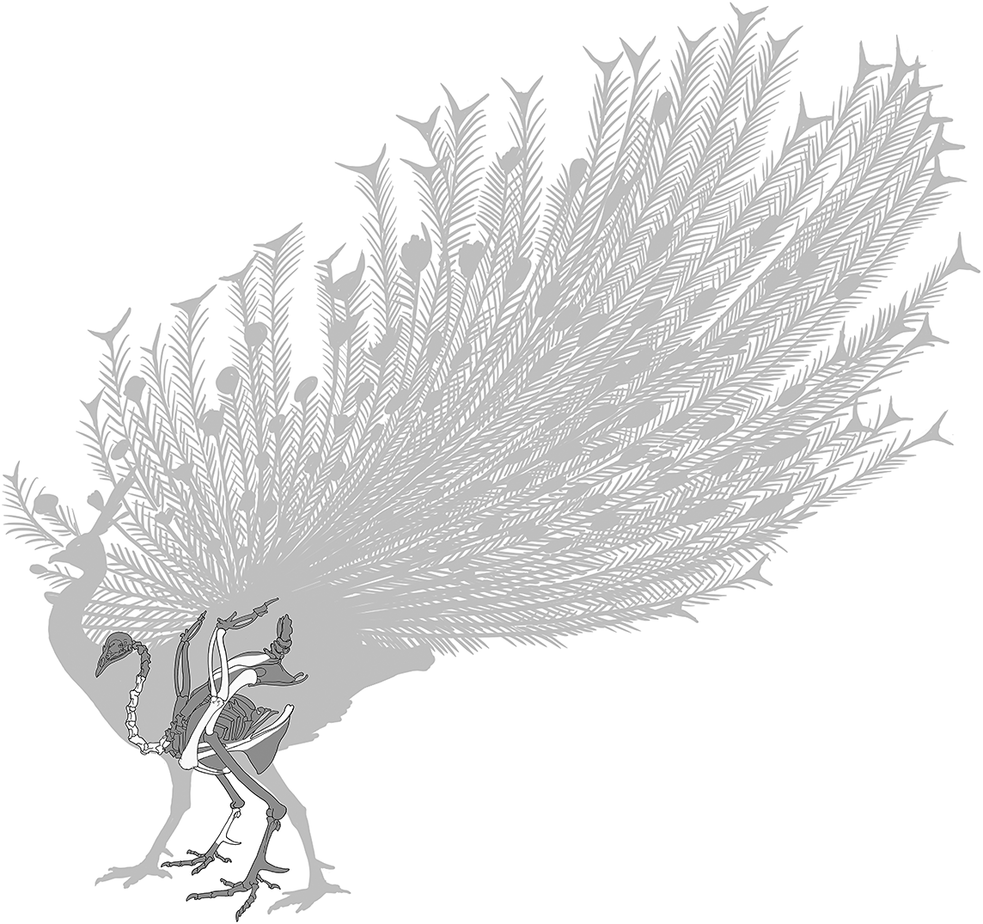
Figure 8. Long description
The illustration features a detailed skeletal reconstruction of the extinct Eopavo hezhengensis rendered in dark and light gray tones. The skeleton is positioned in a standing profile facing left. Starting from the head, the skull shows a curved beak and large orbital cavity. The cervical vertebrae form an S-shaped neck leading to a robust rib cage and thoracic region. The pelvic girdle is prominent, with long, sturdy hind limbs ending in four-toed feet. The forelimbs are folded in a bird-like wing posture. Superimposed behind and around this skeleton is a light gray silhouette representing the body outline of the extant Pavo muticus. This outline includes a large, fanned-out tail display consisting of numerous elongated feathers with distinct eye-like patterns and branched barbs, extending upward and backward to fill the upper right quadrant of the frame. The skeletal structure of the extinct species is scaled to fit within the anatomical proportions of the modern green peafowl silhouette.
Characters supporting the distinction of Eopavo hezhengensis from Syrmaticus kozlovae (Kurochkin, Reference Kurochkin1985), which was discovered in late Miocene deposits of Mongolia, include: (1) the condylus dorsalis of the humerus is narrow and elongate, whereas it is round and distinctly bent in Syrmaticus kozlovae; (2) the sulcus humerotricipitalis is relatively wide, but shallow in Syrmaticus kozlovae; (3) the epicondylus ventralis is weakly developed and difficult to distinguish, whereas it projects slightly ventrally in Syrmaticus kozlovae.
Characters supporting the distinction of Eopavo hezhengensis from Panraogallus hezhengensis, which was also discovered in late Miocene deposits of the Linxia Basin, include: (1) Eopavo hezhengensis is distinctly smaller than Panraogallus hezhengensis; (2) Eopavo hezhengensis possesses a distinct spur on the tarsometatarsus, whereas Panraogallus hezhengensis has only a spur attachment projection.
Occurrence
Liushu Formation, Hezheng County, Linxia Basin, Gansu Province, China.
The known stratigraphic distribution of Gazella sp. and Hipparion plocodus (Sefve, Reference Sefve1927) (preserved within the same block of matrix as the Eopavo holotype) support an age corresponding to the Baodean Asian Land Mammal Age, indicating that IVPP V15901 is part of the Yangjiashan Fauna from the late Miocene, 7.0–9.8 Ma (Deng et al., Reference Deng, Qiu, Wang, Wang and Hou2013).
Description
Seven cervical vertebrae are preserved in articulation. In each, the zygapophysis cranialis is distinctly pronounced and much larger than the zygapophysis caudalis. The length of each cervical vertebra is ~14 mm.
The right furcular ramus, including the hypocleideum, is preserved. The scapus claviculae is long and slender (length 44.0 mm, diameter 2.2 mm), with a relatively narrow angle, forming a V shape similar to extant Phasianidae. The hypocleideum forms a triangular plate-like projection in lateral view, extending distoventrally.
The sternum is visible in ventral view, with the carina sterni protruding ventrally. The process craniolateralis is moderately long and wide, as in extant peafowl (see Fig. 7). The caudal margin widens mediolaterally, forming a swallowtail-shaped expansion (see Fig. 4.5). A widened caudal margin also occurs in black grouse (Lyrurus tetrix (Linnaeus, Reference Linnaeus1758)) among Phasianidae but resembles the upper half part of an opened fan, differing from Eopavo hezhengensis (see Fig. 4.7).
Both coracoids are visible in ventral view and remain in articulation with the sternum. A small, blunt ventral projection of the acrocoracoid process is present adjacent to the facies articularis clavicularis. The processus lateralis extends ventrally and exhibits a well-developed knob. The coracoid articulation and processus lateralis form an obtuse angle.
The left humerus is well preserved, and the proximal end of the right humerus is exposed in ventral view. An extension of finished bone proximal to the fossa pneumotricipital ventralis encloses the incisura capitis and joins the ventral tuberculum. The fossa pneumotricipital ventralis is deep and distinct, enclosing a network of bony lamella and several small pneumatic foramina. The fossa pneumotricipital dorsalis is smaller and shallow. X-ray computed tomography (CT) imaging of the left humerus shows that the fossa pneumotricipital ventralis extends into the shaft (see Fig. 5.1). The crista bicipitalis has a rounded edge and meets the shaft distally as a gentle curve. The sulcus humerotricipitis is relatively wide while the sulcus scapulotricipitis is narrow. In cranial view, the crista deltopectoralis is wide and protrudes considerably dorsally (see Fig. 5.7). The sulcus transversus is deep but short, resulting in a concavity at the edge of the crista bicipitalis in caudal view. The fossa brachialis is moderately deep, with its ventral margin deeper. The condylus ventralis extends more distally than the condylus dorsalis. The processus supracondylaris dorsalis and tuberculum supracondylare ventrale are nearly level proximodistally. The shaft of the left humerus is partly broken on both cranial and caudal sides.
The proximal and distal ends of the left ulna and radius are missing. The ulnar shaft (middle shaft diameter 6.3 mm) is much wider than the radius shaft (middle shaft diameter 3.1 mm). As articulated, the bones enclose a wide interosseous space.
The pelvis is visible in ventral view. The synsacrum is well preserved and bears a shallow sulcus ventralis synsacri. The ilium is preserved as broken fragments surrounding the synsacrum, making its original structure difficult to determine. Four thin processus transversi of the synsacrum are preserved. The distance between the first and the second is the shortest, while the distance between the second and the third is the same as the distance between the third and the fourth.
The femur is slender and nearly equal in length to the humerus (see Table 1). The femur is straight in lateral view. The crista trochanteris extends farther proximally than the femoral head, forming a thin ridge on the lateral side, extending to the caudal side and surrounding the fossa trochanteris. The preserved shaft is smooth, with indistinct attachments for muscles or intermuscular lines. The sulcus patellaris deepens distally, connecting to the deeper sulcus intercondylaris. The epicondylus medialis is underdeveloped. A shallow, oval concave fossa is distal to the epicondylus medialis. The epicondylus lateralis forms a small cone protruding from the lateral surface (the base width is ~2.5 mm). In caudal view, the fossa trochanteris is moderately deep, with a greater concavity distally. The fossa poplitea is deep and contains several small pneumatic foramina. The trochlea fibularis is thin but deep. The condylus lateralis extends more distally than the condylus medialis. The impression ligamenti cruciati cranialis is notably shallow.
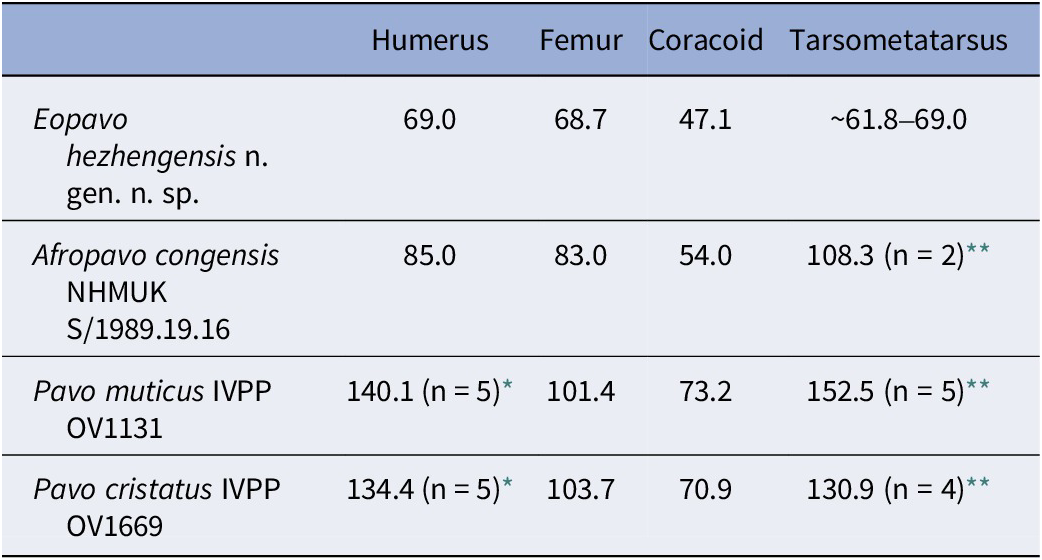
The measurements of total length in four peafowl species (mm):
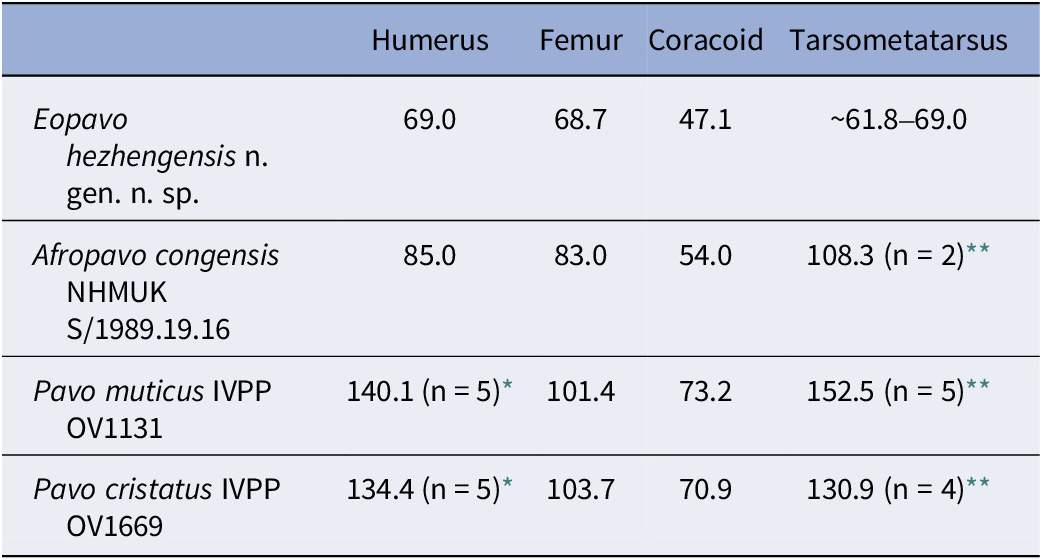
Table 1. Long description
The table consists of five columns and five rows. The columns are labeled Species, Humerus, Femur, Coracoid, and Tarsometatarsus.
Row 1: Eopavo hezhengensis n. gen. n. sp. measures 69.0 for Humerus, 68.7 for Femur, 47.1 for Coracoid, and approximately 61.8 to 69.0 for Tarsometatarsus.
Row 2: Afropavo congensis N H M U K S forward slash 1989 dot 19 dot 16 measures 85.0 for Humerus, 83.0 for Femur, 54.0 for Coracoid, and 108.3 for Tarsometatarsus with a sample size of n equals 2.
Row 3: Pavo muticus I V P P O V 1131 measures 140.1 for Humerus with a sample size of n equals 5, 101.4 for Femur, 73.2 for Coracoid, and 152.5 for Tarsometatarsus with a sample size of n equals 5.
Row 4: Pavo cristatus I V P P O V 1669 measures 134.4 for Humerus with a sample size of n equals 5, 103.7 for Femur, 70.9 for Coracoid, and 130.9 for Tarsometatarsus with a sample size of n equals 4.
* Data from Mourer-Chauviré (Reference Mourer-Chauviré1989).
** Data from Mourer-Chauviré (Reference Mourer-Chauviré1990).
On the plantomedial side, a large spur (17.4 mm long, preserved with the tip missing) indicates that the skeleton likely derives from an adult male individual (Davison, Reference Davison1985). The cotyla medialis is larger and has a deeper concavity than the cotyla lateralis. The fossa infracotylaris dorsalis on the dorsal side is slender, deeply concave, and is located slightly laterally (see Fig. 6.9). The fossa parahypotarsalis medialis is a deep, oval depression (see Fig. 6.8). The passage for the tendon of musculus flexor digitorum longus on the plantar side forms a closed bony canal on the hypotarsus, and the crista medialis of the hypotarsus extends most plantarly (see Fig. 6.8). This tendinal passage forms a large foramen at the proximal end of the tarsometatarsus (see Fig. 6.10). The passages for the tendons of musculus flexor perforatus digiti II and musculus flexor perforans et perforatus digiti II share an open sulcus on the plantar side of the hypotarsus (see Fig. 6.10). The sulcus of musculus flexor hallucis longus opens laterally (see Fig. 6.10). The crista lateralis is the smallest among the three cristae present.
Etymology
The specific epithet hezhengensis refers to Hezheng County in the Linxia Basin, Gansu Province, where abundant avian and mammal fossils, including this holotype, have been collected.
Remarks
Eopavo hezhengensis is distinctly smaller than that of any other extant or fossil peafowl, making Eopavo hezhengensis the smallest peafowl ever found. The notably long spur on the tarsometatarsus suggests that the holotype likely belongs to a male individual.
In addition to the skeletal elements of Eopavo hezhengensis, remains of at least one individual of Gazella sp. are preserved in the same block, including one horn core, three phalanges, and a third lower molar. On the counter side of the block, a complete juvenile skull referred to Hipparion plocodus is well preserved.
Miogallus altus (Milne-Edwards, Reference Milne-Edwards1869), a large phasianid from the middle Miocene of Germany and France (Ballmann, Reference Ballmann1969; Zelenkov, Reference Zelenkov2016), has a carpometacarpus (~5.1 cm long) similar in size to extant Pavo (Ballmann, Reference Ballmann1969). Its tarsometatarsus shares a sulcus for the tendon of m. flexor hallucis longus with Pavonini, but this single similarity is insufficient to place Miogallus altus within Pavonini (Ballmann, Reference Ballmann1969). Recent research also has found no close phylogenetic relationship between Miogallus and peafowl (Zelenkov, Reference Zelenkov2024). The coracoid of Miogallus altus differs from Eopavo hezhengensis, Pavo, and Afropavo by having a curved crista articularis sternalis and an obtuse triangle-shaped processus lateralis (Zelenkov, Reference Zelenkov2016). The absence of a concavity between the humeral head and crista bicipitalis further distinguishes Miogallus altus from Eopavo hezhengensis.
Previously figured materials referred to Pavo archiaci include humerus, femur, and tibiotarsus fragments from the late Miocene of Greece (Michailidis et al., Reference Michailidis, Roussiakis and Theodorou2010). This fossil species also has been found at multiple localities in Europe (Mourer-Chauviré, Reference Mourer-Chauviré1989; Boev and Koufos, Reference Boev and Koufos2000). The humerus of Eopavo hezhengensis differs from Pavo archiaci by having a concavity at the ventral margin of the crista bicipitalis of humerus and a deeper fossa pneumotricipitalis dorsalis. The condylus ventralis extends more distally in Pavo archiaci, and the processus supracondylaris dorsalis is absent. In Pavo archiaci, the crista trochanteris extends laterally, forming a distinct “neck” structure under the femoral head, which is absent in Eopavo hezhengensis.
Previously figured material referred to Pavo bravardi includes a nearly complete left humerus, right tibiotarsus, left tarsometatarsus, proximal end of right coracoid, a left femur, and a fragment of the left tarsometatarsus with a spur (Mourer-Chauviré, Reference Mourer-Chauviré1989, Reference Mourer-Chauviré1990). The proximal femur and coracoid are similar to Eopavo hezhengensis. The humerus differs by the presence of a concavity at the ventral margin of the crista bicipitalis and a processus supracondylaris dorsalis, both absent in Pavo bravardi. The sulcus for musculus flexor hallucis longus is shallower in Pavo bravardi, resembling Pavo muticus, but is well developed and laterally open in Eopavo hezhengensis. The fossa parahypotarsalis medialis is shallower in Pavo bravardi. Both species have long spurs (Mourer-Chauviré, Reference Mourer-Chauviré1989, Reference Mourer-Chauviré1990).
Linquornis gigantis, a large phasianid from the middle Miocene of China, is poorly documented, making detailed comparison difficult (Ye, Reference Ye1980). It is distinctly larger than Eopavo hezhengensis. A long spur is present on the tarsometatarsus of Eopavo hezhengensis, but this structure is absent in Linquornis gigantis.
Panraogallus hezhengensis, from the late Miocene of the Linxia Basin, is a large phasianid (humerus length 74.0 mm; femur length 81.5 mm) (Li et al., Reference Li, Clarke, Eliason, Stidham, Deng and Zhou2018). It is much larger than Eopavo hezhengensis. Its tarsometatarsus has only a spur attachment projection, and the fossa parahypotarsalis medialis is shallow, distinguishing it from Eopavo hezhengensis.
Syrmaticus kozlovae is the only fossil species of the genus Syrmaticus and was discovered in the late Miocene of Mongolia (Zelenkov and Kurochkin, Reference Zelenkov and Kurochkin2010). It is similar to Eopavo hezhengensis in the width of the humerus and femur. The condylus lateralis of the femur extends slightly more distally than the condylus medialis in Syrmaticus kozlovae. However, the condylus lateralis extends far more distally than the medial condyle in Eopavo hezhengensis. The condylus dorsalis of the humerus is narrow and elongate in Eopavo hezhengensis, whereas it is round and distinctly bent in Syrmaticus kozlovae. The sulcus humerotricipitalis is narrow in Syrmaticus kozlovae, but it is relatively wide in Eopavo hezhengensis. The epicondylus ventralis of Syrmaticus kozlovae projects slightly ventrally, whereas it is weakly developed and difficult to distinguish in Eopavo hezhengensis. Both species share the character that the processus flexorius is displaced slightly distally, terminating short of the distal margin of the condylus dorsalis.
Phylogenetic analysis
We added scorings for Eopavo to a morphological character matrix from a previous study by Ksepka et al. (Reference Ksepka, Early, Dzikiewicz and Balanoff2023), including 105 osteological characters, one arthrological character, 16 plumage characters, 10 miscellaneous soft tissue characters, and four egg and reproductive behavior characters. The matrix comprises 66 taxa, including Eopavo, and was analyzed in PAUP version 4.0a169 to determine the phylogenetic relationships of Eopavo within Galliformes, and particularly among the members of Phasianidae. A molecular backbone constraint from Hosner et al. (Reference Hosner, Tobias, Braun and Kimball2017) was applied in the heuristic search, using 3,000 random taxon addition sequences and tree bisection and reconnection branch swapping (TBR). Palaeognathae and Anseriformes were used as the outgroups. The analysis yielded 15,118 most parsimonious trees with a total length of 459 steps. The strict consensus tree places Eopavo hezhengensis within a monophyletic Pavonini in a polytomy with Afropavo congensis and Pavo cristatus (see Fig. 9).
Strict consensus of 15,118 most parsimonious trees of 459 steps from parsimony analysis of 136 morphological characters, applying a backbone constraint based on the molecular study of Hosner et al. (Reference Hosner, Tobias, Braun and Kimball2017). The new extinct species is highlighted. Ancestral state reconstruction of character 117 is also shown in the strict consensus tree. Green points represent state 0 (number of tail feathers is fewer than 16); yellow points represent state 1 (number of tail feathers is equal to or greater than 16).
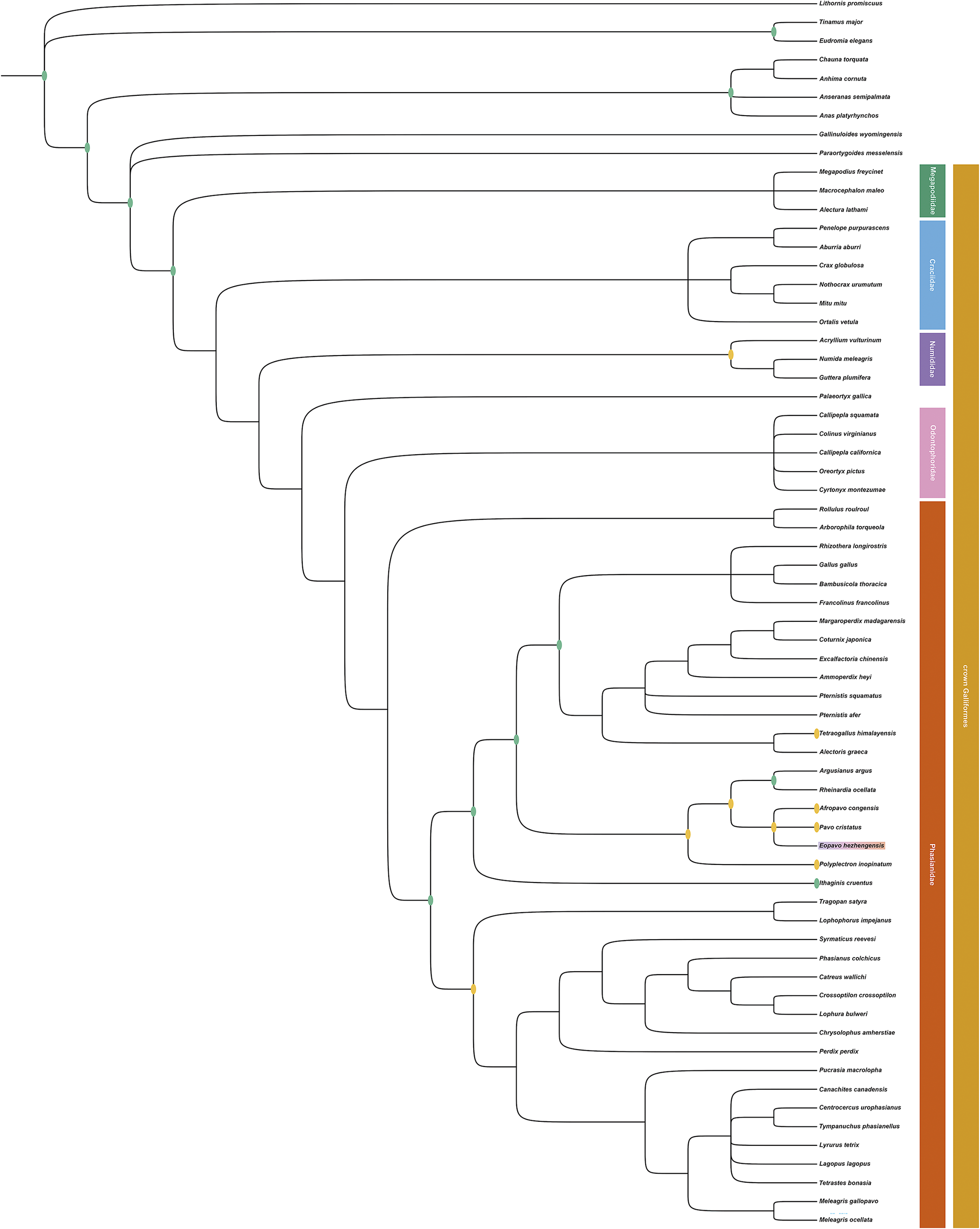
Figure 9. Long description
A cladogram branching from left to right. Nodes are marked with colored points indicating ancestral states for character 117. Green points represent fewer than 16 tail feathers, while yellow points represent 16 or more tail feathers.
On the far right, vertical colored bars group the taxa. From top to bottom, these include:
* Megapodiidae (green bar)
* Cracidae (blue bar)
* Numididae (purple bar)
* Odontophoridae (pink bar)
* Phasianidae (orange bar)
All these groups are enclosed within a larger gold bar labeled crown Galliformes.
In the lower section of the Phasianidae group, the extinct species Eopavo hezhengensis is highlighted with a red background. This species is nested within a clade where nodes are predominantly yellow, indicating 16 or more tail feathers. Specifically, it is positioned as a sister taxon to a clade containing Afropavo congensis and Pavo cristatus. Most basal nodes of the entire tree are marked with green points.
The consistency index (CI) of the strict consensus tree is 0.3220, the retention index (RI) is 0.7467, and the rescaled consistency index (RC) is 0.2408. Despite some convergent evolution, the relatively high retention index indicates that most characters still retain a strong phylogenetic signal, although the overall fit is moderate to low. We also completed a bootstrap analysis without a backbone constraint, and Eopavo was recovered within Phasianidae in 53% of bootstrap replicates.
In the strict consensus tree, the clade uniting Afropavo congensis, Pavo cristatus, and Eopavo hezhengensis is supported by three characters: (48:1) a moderately wide and (49:1) long processus craniolateralis of the sternum (see Fig. 7) and (91:0) a femur shorter or equal to the length of the humerus.
Body size and environmental influence
Among the three extant peafowl species, Afropavo congensis is the smallest, and Pavo muticus is the largest (Madge et al., Reference Madge, McGowan and Kirwan2002). The fossil peafowl species P. bravardi is similar to or larger than the extant green peafowl, and Pavo archiaci is slightly smaller than the Indian Peafowl (Mourer-Chauviré, Reference Mourer-Chauviré1989, Reference Mourer-Chauviré1990; Boev and Koufos, Reference Boev and Koufos2000; Mlíkovský, Reference Mlíkovský2002; Kurochkin et al., Reference Kurochkin, Lopatin and Zelenkov2015). Eopavo hezhengensis is the smallest peafowl discovered to date, with humerus, femur, and coracoid lengths approximately 80–85% of those in Afropavo congensis (see Table 1). However, the distal width of the coracoid in Eopavo hezhengensis is nearly identical to that of Afropavo congensis. Compared with Pavo muticus, the humerus of Eopavo hezhengensis is 43% shorter, the femur 30.8% shorter, the coracoid 36.1% shorter (see Table 1). In both the new species and extant peafowl, the femoral shaft diameter is ~10% of the femur’s total length. The femoral shaft’s transverse section is oval in E. hezhengensis, whereas it is nearly round in Pavo and Afropavo. This difference makes the femur of Eopavo hezhengensis appear slender, despite having the same relative femoral shaft width as extant species.
The preserved spur of Eopavo hezhengensis measures at least 17.4 mm long (tip unpreserved) with a spur-to-femur ratio of 25.3%. By comparison, spur length in Pavo muticus ranges from 14.6 to 31.0 mm (spur-to-femur ratio 14.4–30.6%), and in P. cristatus, it ranges from 5.1 to 18.5 mm (4.9–17.8%) (Mourer-Chauviré, Reference Mourer-Chauviré1989; Louchart, Reference Louchart2003). These data suggest that Eopavo hezhengensis has a relatively longer spur even for its smaller body size, and that relative enlargement may be related to sexual selection and aggressive intrasexual interactions in this extinct species.
We used the least femoral shaft circumference to calculate the body mass of Eopavo hezhengensis. Estimation of body mass derived from equations based on heavy-bodied terrestrial birds and ordinary least squares (OLS) equations on all birds was similar (Campbell and Marcus, Reference Campbell and Marcus1992), suggesting that Eopavo weighed approximately 1.1 kg. Among extant peafowl, Afropavo is the smallest, with a mean male body mass of ~1.4 kg (larger than Eopavo), and Pavo ranges between 3.0 and 5.0 kg (Dunning, Reference Dunning2007). The small body size of Eopavo hezhengensis seems to be an exception as other Miocene fossils of peafowl are similar in size to extant Pavo. This smaller size in Eopavo may reflect an adaptation to the high-elevation late Miocene savanna environment through a reduced body mass. Extant Afropavo typically inhabit forests, with Pavo in southern Asia adapting to semi-open forest edge near water sources, such as streams (Madge et al., Reference Madge, McGowan and Kirwan2002). Some Pavo cristatus populations have adapted a wider range of environment, including savannas; however, their presence in such ecosystems is supported by indirect or direct feeding by humans. Fossil records of Pavo often are considered evidence of the presence of water and forest habitats (Pickford et al., Reference Pickford, Senut and Mourer-Chauviré2004; Louchart, Reference Louchart, Badgley, Morgan and Pilbeam2025). By contrast, the late Miocene Linxia Basin was a semiarid grassland/savanna habitat (Deng et al., Reference Deng, Qiu, Wang, Wang and Hou2013), more arid than typical peafowl habitats. This difference suggests that Eopavo had different ecological preferences or tolerances compared with its closely related living relatives. Forest fragmentation is associated with a reduced body mass in frugivorous birds, particularly in tropical areas (Bregman et al., Reference Bregman, Sekercioglu and Tobias2014). However, as extant peafowl are omnivorous and the diet of Eopavo hezhengensis is unknown (but likely omnivorous), a direct link between habitat changes and body size reduction cannot be confirmed at present, although a connection to its unique ecology and environment is likely.
Paleobiology
The occurrence of a tarsal spur in Galliformes often correlates with male–male reproductive competition (i.e., fighting ability) and may serve a role in sexual selection (Davison, Reference Davison1985). However, smaller spurs also occur in females of several species of Pavonini, including Afropavo congensis and Pavo cristatus (Madge et al., Reference Madge, McGowan and Kirwan2002). The absence of spurs in both sexes of Rheinardia and Argusianus contrasts with their occurrence in peafowl (both sexes) and males of Polyplectron (typically 2–3 sharp spurs, sometimes more) (Madge et al., Reference Madge, McGowan and Kirwan2002). Spur morphology in Pavonini is highly variable, likely resulting from complex evolutionary and sexually selective processes. In extant peafowl, males must acquire and defend display sites to attract females, and the ability to chase away “floating” males (those without a stable territory) is crucial for males with territory (Petrie et al., Reference Petrie, Tim and Carolyn1991). However, in Pavo cristatus, males avoid physical combat, instead using their large trains to threaten intruders without contact. There is no evidence that spur length influences the successful acquisition of display sites or defense in Pavo cristatus (Loyau et al., Reference Loyau, Jalme and Sorci2005). Thus, the spurs of Pavo cristatus may not be directly tied to current sexual selection but may be retained from an ancestral combative condition. The long spur in Eopavo may reflect sexual selection, differing from its extant relative, supporting the hypothesis that Eopavo aggressively acquired and defended display sites using its spur.
Peafowl are best known for their long, elaborate tail feathers or “train.” Ancestral state reconstruction for feather character 117 in the strict consensus tree suggests that the ancestral Pavonini had more than 16 tail feathers (see Fig. 9). Thus, Eopavo likely had a large number of tail feathers. However, the matrix does not include tail feather length. Given Eopavo’s phylogenetic placement within Pavonini and the long train in Pavo, Rheinardia, and Argusianus (with a moderately long tail in Afropavo), Eopavo likely carried and displayed a long train composed of 16 or more feathers.
Biogeographic origin of peafowl
Fossil peafowl records from Miocene, Pliocene, and Pleistocene deposits in Asia, Europe, and Africa indicate a broad geographic distribution (see Introduction). Kimball et al. (Reference Kimball, Braun and Ligon1997) proposed Miocene dispersal events between Asia and Africa via land bridges, consistent with similarities between Indian (southern Asian) and Ethiopian avifauna. The Neogene, particularly the late Miocene and Pliocene, is known for vertebrate interchange between Asia and Africa exemplified by hipparion horses (Sun et al., Reference Sun, Liu, Song, Liu, Wang, Shi, Zhang and Wang2021) and small carnivores (Jiangzuo et al., Reference Jiangzuo, Wang, Law, Su and Jia2024). Similarly, the extinct sandgrouse Linxiavis from the Linxia Basin and Tibetan sandgrouse taxa likely result from ancient dispersal from Africa to the Tibetan region (Li et al., Reference Li, Stidham, Deng and Zhou2020). The presence of late Miocene ostriches in the Linxia Basin reinforces this Africa–Asia linkage (Hou et al., Reference Hou, Zhou, Zhang and Wang2005; Li et al., Reference Li, Alida, Thomas and Deng2021). Although sandgrouse and ostriches appear to have dispersed from Africa to Asia, differing from peafowl (see below), this distribution suggests frequent avian interchanges between these continents during the Miocene. These dispersal events likely explain the broad, continuous Neogene distribution of peafowl across Asia, Europe, and Africa. However, the disjunct distribution, with ~6,000 km separating African (Afropavo) and South Asian (Pavo) clades, likely is the result of extirpation of intermediate populations and species from significant climate and environmental changes in the late Neogene and Pleistocene (Kimball et al., Reference Kimball, Braun and Ligon1997; Louchart, Reference Louchart2003).
Ancestral range reconstruction of extant Galliformes suggests that the peafowl originated in the Oriental Region (Wang et al., Reference Wang, Kimball, Braun, Liang and Zhang2017). The oldest peafowl fossil from Asia is in the Siwaliks (Louchart, Reference Louchart, Badgley, Morgan and Pilbeam2025) and supports Asia, particularly the Tibetan Plateau, as a likely center of origin. The discovery of Eopavo in the Miocene of Asia, in a similar peri-Tibetan location, increases the taxonomic diversity of Asian peafowl and further supports this biogeographic origin hypothesis. Additional fossils across their temporal and geographic range are needed to clarify their biogeographic history.
Extant Pavo species inhabit areas with elevations of up to 3,000 m in the Himalayan region but typically occur below 1,500 m (Madge et al., Reference Madge, McGowan and Kirwan2002; Khanal et al., Reference Khanal, Sapkota, Bhattrai and Bist2020). Afropavo is restricted to lowland rainforests below 1,200 m (Madge et al., Reference Madge, McGowan and Kirwan2002). The Linxia Basin, at the edge of the Tibetan Plateau, has an average elevation exceeding 2,000 m, higher and drier than typical extant peafowl habitats. The oldest peafowl fossil, from the Siwaliks (Louchart, Reference Louchart, Badgley, Morgan and Pilbeam2025), was also discovered in an area with an average altitude of approximately ~1500–2,000 m, suggesting peafowl adapted to high-altitude environments around the Tibetan Plateau in the late Miocene. Other Pavonini, such as Argusianus (up to 2,170 m) and Polyplectron (up to 2,000 m), also occur at high altitudes (Madge et al., Reference Madge, McGowan and Kirwan2002), indicating that high-altitude adaptation may be common in Pavonini lineages. Additional fossil records are needed to confirm this hypothesis.
Conclusion
Eopavo hezhengensis n. gen. n. sp. is the first articulated fossil peafowl known, and it has a currently unresolved relationship with the extant species of peafowl, forming a polytomy (Afropavo congensis + Pavo cristatus + Eopavo hezhengensis). Its presence in the late Miocene of Gansu Province, China, along with the other oldest peafowl fossils from the peri-Tibetan region, suggests that peafowl dispersed from Asia to Europe and Africa during the late Miocene and Pliocene, with the Tibetan Plateau as a possible center of origin. The small body size of Eopavo may be linked to its unique high-elevation savanna environment, which is distinctly different from that of other extinct and extant peafowl. Living in a drier grassland-dominated habitat unlike its closest relatives, Eopavo likely had a different lifestyle also tied to its overall smaller size. Its long tarsal spur and probable enlarged train suggest the occurrence of complex sexual and reproductive strategies common among peafowl and their relatives.
Acknowledgments
We thank J. White (NHMUK) for providing photographs of the skeleton of Afropavo congensis (NHMUK S/1989.19.16, from the collection of the Natural History Museum, Tring). We thank W. Gao (IVPP) for taking great photos of the holotype specimen IVPP V15901, Z. Zhang (IVPP) for preparing and repairing the holotype, Y. Xu (IVPP) for making the wonderful reconstruction, Q. Shi (IVPP) for identifying the mammalian bones and providing related references, and D. Li (IVPP) for providing access to modern osteological specimens. We thank C. Sun (Shandong Museum) for providing Linqu fossil bird photos. We also thank Z. Ju (Institute of High Energy Physics) for painting the sketch of the holotype. We thank the reviewers and editors for comments on earlier drafts of the manuscript that improved our work. We also acknowledge funding support by National Key Research and Development Project of China (2024YFF0807603) and Natural Science Foundation of China (42172029, 42430207, 42288201).
Competing interests
The authors declare no competing interests.
Data availability statement
Data available from the Dryad Digital Repository: https://doi.org/10.5061/dryad.x69p8czzw.